With Superman, writer-director James Gunn tries restarting the DC cinematic universe with the third attempt at this original hero in the last twenty years. To do so, he reimagines a colorful world with several superhero plot lines already in progress. He figures audiences can get up to speed without belaboring origin stories all over again. So here we are, three years into Superman’s career as a hero. David Corenswet brings the right golly-gee jawline to the upright iconography of the hero and aw-shucks humility of his bespectacled Clark Kent disguise. He’s already entangled in a romance with newspaper colleague Lois Lane (Rachel Brosnahan) and embroiled in a one-sided rivalry with billionaire Lex Luthor (Nicholas Hoult). He has a friendly-but-frosty relationship with some other heroes knocking about his corner of the universe: Green Lantern (Nathan Fillion), Hawkgirl (Isabela Merced), and Mr. Terrific (Edi Gathegi). There are robots and giant monsters and portals to parallel universes and cameos form upcoming spinoffs an lots of glowing gadgets and opportunities for vivid, cartoony, splash-panel spectacle. There’s even lots for Krypto the super-dog to fetch. It’s all done in a coherent Gunn style, tonally more Suicide Squad than Guardians of the Galaxy, but recognizably in wide angles and blocky frames, overflowing with his smirking sincerity and hurly-burly earnest pop culture spirit. The result is a zippy, zany comic book eruption of excess. The movie’s chaotic and overstuffed, but with its heart in the right place.
It really does care about the totally authentic goodness of its Superman, and lets the conflicts rise up organically out of a world that’s not built to take goodness seriously or even believe in it. There are puffed-up corporate interests and snarling foreign dictators and slimy pundits and rival do-gooders and they’re all jostling for the kind of authority and attention that Superman gets just by being himself. There’s something pure and lovely about that. Even as Gunn is less interested in the character as a symbol or an idea, he’s more interested him as a person who's a vision of how to do your best to be a force for good in a world falling apart at the seams. In doing so, he succeeds in making a big, bright movie full of likable characters, but as the scenes hustle by and supporting characters flit in and out and the movie hurtles through scenes of digital destruction, I found myself thinking it’s all a bit much. A little deadening digital destruction goes a long way. I’ll take a slow-mo shot where Superman swoops down and stops a little girl from being hit by debris over dozens of minutes of punching robots and super-beings every time.
Coincidentally Marvel is also going back to one of its earliest comics for their latest superhero movie. It, too, is the third attempt in twenty years at getting these characters right, and eschews an origin story to just get down to business. Fantastic Four: First Steps starts four years into their heroism. They live in a retro-futurist alternate universe that looks like its just upstream from a Jetsons aesthetic. There the stretchy scientist Mr. Fantastic (Pedro Pascal), his sometimes-invisible wife (Vanessa Kirby), flammable brother-in-law (Joseph Quinn), and rock-monster best friend (Ebon Moss-Bachrach) are celebrities for defending the planet from all manner of comic book threats. There’s a charming rapid-fire montage that opens the movie blitzing us with glimpses of enough villains and action sequences to fill a few movies. Instead, it settles into a weirdly low-key family drama intercut with apocalyptic stakes, but keeps up the rapid-fire CliffsNotes style, racing through exposition and slaloming through plot lines and complications other movies might spend a whole run time developing. The whole movie has a feeling that it’s trying to make up for lost time.
The period-piece sci-fi aesthetic gives the movie a fine visual look, and gives the midcentury comic book its best outing on the big screen. (Though arriving so late puts it deep in the shadow of the far superior Incredibles movies, which got to the look, and a Michael Giacchino score, better and first. ) The actors are all likable enough, and inhabit the familiar dilemmas of their characters without given the chance to really stretch out and play to those dramas. We do get to some extremely comic book sequences, though, including an invisible woman giving birth in zero-gravity while her brother shoots lasers at a space woman surfing behind their spaceship as it slingshots around a black hole. It caused me to reflect on the days when comic book movies were afraid to even use the costumes from the illustrations on screen. Now they’re doing spectacular sci-fi looniness without batting an eye. This one paradoxically goes all in on these enormous fantastical ideas while keeping the movie incredibly small.
The ginormous intergalactic villain Galactus (Ralph Ineson’s voice rumbling the subwoofers) wants to gobble up Earth, sending the Silver Surfer (Julia Garner, cool with an eerie shimmery stillness and metallic intonation) to herald his impending arrival. We get a tossed-off reference to a Galactus cult forming, and crowds debating making a sacrifice to him, and the whole movie operates under this cloud of world-ending stakes. But the movie is content to leave that as the backdrop to the shot-reverse-shot predictability of its leads talking strategy and family dynamics. Solutions seem to arrive easily for our characters, side-characters are cut to glorified cameos, and, though the weight of the word hangs heavily on their shoulders, complications become backup plans in a blink. The movie’s in too big a hurry to get to the next thing, even by the end of the movie when it’s still just setting up promises that it’ll hopefully pay off next time. If there’s anything in the movie that most feels like typical Marvel Cinematic Universe routine, there it is. What’s here is just enough to count as a movie, and just charming enough to make these likable characters again, and just busy enough to feel like we’ve had the kind of blinking lights and flashy colors that make popcorn go down easy. But it is also relentlessly manipulative with an imperiled infant (and a shockingly shoddily composited one, at that) used as shorthand for us to care instead of investing in building depth for the plot’s complications and implications. Maybe the next movie can find a story instead of a collection of things that happen.
Showing posts with label Michael Giacchino. Show all posts
Friday, July 25, 2025
Friday, March 11, 2022
Dark City: THE BATMAN
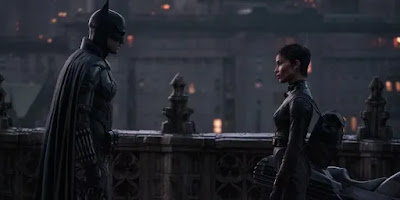
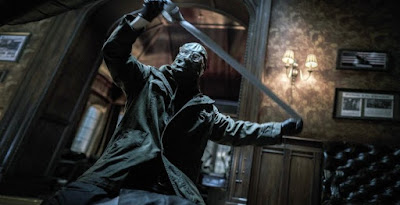
Even after all these years of superhero movies, Batman remains perhaps the most uniquely cinematic. Take Bruce Wayne, the Caped Crusader, striking fear in the hearts of Gotham City’s villainy, all the way back to his early comic book origins. He’s always been at the intersection—thematically, visually, tonally—of gangster pictures, German expressionism, and film noir. He’s accrued Art Deco shadows and grungy urban doom. It’s sometimes dialed up to goofy midcentury camp (hello, Adam West), sometimes dialed down to mumbling Michael Mann skyscraper canyons (howdy, Christian Bale), sometimes drawn out in luxuriously complicated Saturday morning cartoons (the Animated Series and Beyond) or stretched out in gargantuan backlot artifice (holy Tim Burton, Batman!). But it’s always recognizably this stew of influences, plus his costume a simple silhouette with silent film recognizability. His gadgets and gumshoe approach to avoiding the pain of the orphaned billionaire boy grown up collide with the sick and sicker in his crumbling home metropolis. Even the bad Batman movies are still often fun visions of this world, engaging as pulpy interiority blown out to blockbuster dimensions. The latest, directed and co-written by Matt Reeves, and starring Robert Pattinson as the angular chin and brooding eyes hidden within the cape and cowl, is maybe the most downbeat and dreary version yet, once again stumbling down dark alleys in pursuit of something like justice that’s forever out of reach.
There’s something pessimistic at the core of this hero. When talking DC’s icons, Superman is what we hope America can be. Batman is who we fear America is. No high-flying truth and justice here. Bruce Wayne and his alter ego can suit up and punch villains every night, but the sad truth of capitalist corruption and crime—a city where the cops and robbers are often one and the same, and everyone from the Mayor to the District Attorney to the mob bosses are all part of the same pool of dark money and influence—just won’t budge. So Reeves, an intelligent big budget filmmaker coming off of two interestingly textured and thoughtful Planet of the Apes pictures, visualizes these ideas by making his Gotham constantly overcast, usually raining, generally nocturnal. (It has to be a close cousin to the unnamed city in Fincher’s compellingly gross serial killer thriller Se7en.) There’s always a cloud hanging over the scenes, and the slow, patient drip of detective information about the central mystery takes precedence over slam-bang action. That makes the one fun car chase all the more thrilling, a welcome sparking rattling roar of an engine revving to life as the Batmobile makes its long-awaited appearance tearing off after a slimy bad guy. And it leaves the proceedings to move at a steady trudge, resisting the usual fanfare. To its credit, this downbeat affair that creaks by at a long three-hour run time, is trying for something genuinely wiggly and unsettling in the middle of so much iconography and cliche.
The whole thing kicks off with the murder of the mayor by a mysterious killer known only as The Riddler (Paul Dano). More victims follow. At each, he’s recording viral videos and leaving taunting clues in greeting cards at the scene for lead detective Gordon (Jeffrey Wright) to give to The Batman. Together, the two men hunt for clues and chase down leads. Sometimes they cross paths with a slinky nightclub waitress Selina Kyle (Zoe Kravitz), whose cat burglar outfit is the best since Pfeiffer’s. She has her own reasons to investigate the goings-on at a club run by the town’s top gangster (John Turturro) and his waddling underling (Colin Farrell buried in a fat suit). Reeves leans into the tight-lipped pathos of these pathetic, wounded characters creeping around the shadows of society, looking for leverage over each other in an attempt to make things a little brighter by any means necessary. Unlike the usual comic book dichotomy—or pat mirroring that leads villains to the inevitable “we’re two sides of the same coin” monologuing—this movie makes clear that everyone’s inevitably shaped by societal forces beyond their control. Batman, Catwoman, The Riddler, Detective Gordon—all are willing to bend rules and skulk around to reshape Gotham toward their ends, some for slightly better, some for way worse. There’s never a sense anyone will actually unambiguously triumph. Michael Giacchino’s pounding score takes that cue, edging along Elfman horns while plucking some “Tubular Bells.”
Here’s a city possessed with an urban rot that no one can escape. This makes for a brooding, brutal, cynical, ice-cold, paranoid and conspiratorial picture. It’s not fun, exactly, but from its opening montage of vandals and muggers spooked by the sight of the Bat-signal in the sky, to an ending where Gotham is significantly worse off than before the movie started, there’s a grimly compelling fatalism that gets its hooks in, even as the plot dwindles to a hesitant close. It’s all of a piece—a mumbled noir narration, a dimly fuzzy filmic-by-way-of-digital-and-back-again look, a sumptuously gaunt color palate, a murmuring collection of careful performances, a superhero movie that resists the overfamiliar spectacular climaxes we’ve come to expect. Like Pattinson’s sunken performance—a rare Wayne that’s not even a little sparkling—The Batman is obsessive, haunting, and unresolved. Sure, that’s partly the usual superhero move of making one feel like a first entry is so much prologue for promised future story. (And, sure, I’ll take another one with this cast and vibe.) But here that lack of resolution has tonal and thematic sense, too. Gotham, as we’ve long known, has deeply rooted systematic problems. No wonder its citizens, good and bad alike, are going mad. Who can relate?
There’s something pessimistic at the core of this hero. When talking DC’s icons, Superman is what we hope America can be. Batman is who we fear America is. No high-flying truth and justice here. Bruce Wayne and his alter ego can suit up and punch villains every night, but the sad truth of capitalist corruption and crime—a city where the cops and robbers are often one and the same, and everyone from the Mayor to the District Attorney to the mob bosses are all part of the same pool of dark money and influence—just won’t budge. So Reeves, an intelligent big budget filmmaker coming off of two interestingly textured and thoughtful Planet of the Apes pictures, visualizes these ideas by making his Gotham constantly overcast, usually raining, generally nocturnal. (It has to be a close cousin to the unnamed city in Fincher’s compellingly gross serial killer thriller Se7en.) There’s always a cloud hanging over the scenes, and the slow, patient drip of detective information about the central mystery takes precedence over slam-bang action. That makes the one fun car chase all the more thrilling, a welcome sparking rattling roar of an engine revving to life as the Batmobile makes its long-awaited appearance tearing off after a slimy bad guy. And it leaves the proceedings to move at a steady trudge, resisting the usual fanfare. To its credit, this downbeat affair that creaks by at a long three-hour run time, is trying for something genuinely wiggly and unsettling in the middle of so much iconography and cliche.
The whole thing kicks off with the murder of the mayor by a mysterious killer known only as The Riddler (Paul Dano). More victims follow. At each, he’s recording viral videos and leaving taunting clues in greeting cards at the scene for lead detective Gordon (Jeffrey Wright) to give to The Batman. Together, the two men hunt for clues and chase down leads. Sometimes they cross paths with a slinky nightclub waitress Selina Kyle (Zoe Kravitz), whose cat burglar outfit is the best since Pfeiffer’s. She has her own reasons to investigate the goings-on at a club run by the town’s top gangster (John Turturro) and his waddling underling (Colin Farrell buried in a fat suit). Reeves leans into the tight-lipped pathos of these pathetic, wounded characters creeping around the shadows of society, looking for leverage over each other in an attempt to make things a little brighter by any means necessary. Unlike the usual comic book dichotomy—or pat mirroring that leads villains to the inevitable “we’re two sides of the same coin” monologuing—this movie makes clear that everyone’s inevitably shaped by societal forces beyond their control. Batman, Catwoman, The Riddler, Detective Gordon—all are willing to bend rules and skulk around to reshape Gotham toward their ends, some for slightly better, some for way worse. There’s never a sense anyone will actually unambiguously triumph. Michael Giacchino’s pounding score takes that cue, edging along Elfman horns while plucking some “Tubular Bells.”
Here’s a city possessed with an urban rot that no one can escape. This makes for a brooding, brutal, cynical, ice-cold, paranoid and conspiratorial picture. It’s not fun, exactly, but from its opening montage of vandals and muggers spooked by the sight of the Bat-signal in the sky, to an ending where Gotham is significantly worse off than before the movie started, there’s a grimly compelling fatalism that gets its hooks in, even as the plot dwindles to a hesitant close. It’s all of a piece—a mumbled noir narration, a dimly fuzzy filmic-by-way-of-digital-and-back-again look, a sumptuously gaunt color palate, a murmuring collection of careful performances, a superhero movie that resists the overfamiliar spectacular climaxes we’ve come to expect. Like Pattinson’s sunken performance—a rare Wayne that’s not even a little sparkling—The Batman is obsessive, haunting, and unresolved. Sure, that’s partly the usual superhero move of making one feel like a first entry is so much prologue for promised future story. (And, sure, I’ll take another one with this cast and vibe.) But here that lack of resolution has tonal and thematic sense, too. Gotham, as we’ve long known, has deeply rooted systematic problems. No wonder its citizens, good and bad alike, are going mad. Who can relate?
Friday, June 16, 2017
Write and Wrong: THE BOOK OF HENRY
Now three films into his career, it’s safe to say the
defining feature of a Colin Trevorrow picture is an unfamiliarity with actual
human behavior. With irritating high-concept indie dramedy Safety Not Guaranteed and thunderously tone-deaf Jurassic World, he exhibited both basic
competency behind the camera and a total lack of understanding as to how any
consistent or recognizable human characteristics might develop in front of it. This
led to some painful movies, potentially fun scenarios completely undermined and
undone by a feeling like they’re movies made by someone only aware of other
movies, endless regurgitations of tropes and ideas (and problematic
perspectives) from better inspirations with no concept of why they were evocative
in the first place. But his latest, The
Book of Henry, takes such painful artificiality to new heights that I
couldn’t help but admire its oddball overflowing grab bag of sentimentality,
manipulation, and unpredictability. It got me. This might not be a good movie,
dripping as it is in knockoff Amblin 80’s polish and driven by characters and
decisions that strain credulity at many turns. But I found it to be an
entertaining and involving one. It’s all of a piece. Here Trevorrow is making a
strange B-movie, but hardly seems to know it, so smothers it in A-level, high-gloss
mushiness, feel-good soppiness, and mechanical tear-jerking. This very tension,
combined with the plot’s unpredictability, had me invested in discovering what
could possibly happen next.
As it begins, introducing a precocious 11-year-old (Jaeden
Lieberher), the movie looks to be setting up a Very Special Kid narrative. He
delivers a wordy extemporaneous paragraph in class, to which his teacher says
in a transparently expository way, “Remind me again why we can’t put you in a
gifted school?” Never mind that he doesn’t appear to be too terribly advanced
for his grade level, he’s coded as brilliant. He helps his single mom (Naomi
Watts) keep track of her finances. (They have no money problems despite her part-time
waitressing job, with only tossed off references to stocks to explain it away.)
He makes Rube Goldberg inventions. He reads incessantly. He indulges in some
child’s play with his adorable little brother (Jacob Tremblay). He has a crush
on the withdrawn, mostly silent dancer next door (Maddie Ziegler), and banters
with his mom’s sarcastic alcoholic co-worker (Sarah Silverman). It treats him
as unbelievably intelligent and persuasive, but at least the movie knows enough
to make its ultimate plot resolution hinge on a key character reminding herself
that no matter how brilliant an 11-year-old may be, that child should not be
making life-and-death decisions for adults.
All seems quirky family film well, but then the movie shifts
into darker territory as the boy Rear Window-style spies a neighbor (Dean Norris) do
something truly terrible. He secretly starts planning a way to take the man
down. See what I mean by a B-movie in disguise lurking under the twinkling
Michael Giacchino score and John Schwartzman’s crisp autumnal cinematography?
Watch it with the sound off and you’d think you were watching a high-budget
Hallmark card, not a pint-sized revenge-by-proxy movie. That’d be enough for
some features, but the screenplay by Gregg Hurwitz (a thriller novelist in his
feature debut) piles on more: a sudden disease diagnosis, a mild Psycho protagonist shift, a mysterious
notebook, an elaborate posthumous plan, and a procession of sequences that, if
you squint a little, make Movie Logic sense, but leave little room for how
actual humans would process them. Characters instead cohere as collections of
plot needs and design details. There’s heightened cloying button-pushing
happening, with teary-eyed close-ups and dramatic flourishes built out of raw
emotions used as phony grist for turning the gears of a treacly family drama
with disturbing content kept slyly aloft from their full impacts.
Why, then, did it work for me? I chalk it up to the
consummate professionalism on display by the craftspeople – this is one
handsome movie – and the actors – Watts’ maternal warmth, Tremblay’s
sympathetic cuteness, Norris’ subtle menacing gravity. They manage to hold it
together, finding emotional continuity despite the plot’s best efforts. Its
story lurches, but the tone doesn’t falter, like everyone involved had no idea
how odd it is. I didn’t stop to ask questions, because I was pulled along by
the movie’s heartfelt artificiality and was engaged by the likable performers
who must be good, because I only noted the frayed edges and logical leaps to
pull apart after the fact. I was in the moment. The movie stumbles and strains,
but strides so confidently through its twists and turns and straight-faced improbabilities
that I couldn’t help but be charmed by its very existence. As unlikely as it
grows – each development more so than the last, right up to a climax
intercutting a school talent show with, on the other side of town, a stalking
sniper – I was entertained. It’s so blatantly artificial and earnestly manipulative,
I didn’t mind going along.
Friday, June 19, 2015
The Life of the Mind: INSIDE OUT
Inside Out is a
film so in touch with its protagonist’s emotions it makes them characters unto
themselves. The result is one of Pixar’s loveliest conceptual gambits, daring
in its simplicity, moving in its surprising dexterity. Certainly the idea of
personifying the human brain’s many emotions is not a new one. But what’s new
is this film’s sustained commitment to psychological zaniness, finding
inventive and satisfying analogues for mental processes without losing a sense
of compassion or an elastic sense of humor. A moving evocation of complicated
emotions through brilliantly colorful cartoon adventure, it’s a perfect fit for
Pixar’s favorite subjects: elaborate contraptions, colorful characters,
memorable complications, affectionate teamwork parables, and emotional
complexity. This is one of the animation studio’s warmest, most vital films in
years.
Here is a film knowledgeable about what it’s like to be
eleven, going on twelve, full of conflicting impulses on the bridge between
childhood wonder and adult resignation. Our main character is Riley (Kaitlyn
Dias), a girl whose loving parents (Diane Lane and Kyle MacLachlan) have
decided to move from Minnesota to San Francisco, a prospect as intimidating as
it is exciting. Our setting is her brain, amongst the little voices inside her
head. Writer-director Pete Docter (responsible for modern classics Monsters, Inc. and Up) imagines a quintet of primary-color cartoon beings sitting
behind a control panel in a big pastel room, processing incoming sensory detail
and converting them into memories. Most importantly, they’re her emotions,
helping her react to the world. Taking charge is Joy (Amy Poehler), but Sadness
(Phyllis Smith), Fear (Bill Hader), Disgust (Mindy Kaling), and Anger (Lewis
Black) are jostling to make themselves known as well.
The emotions are brought to vivid life in voice performances
brimming with a child’s excitable naïveté. Joy isn’t the lead for no good
reason. There’s energy and happiness, and character coherence as the five
beings make themselves known through one voice. It’s easy to believe these
different outlooks on life expressed by their color-coded geometric designs –
sunny yellow flower Joy, blobby blue Sadness, wiry purple Fear, broccoli-green
Disgust, squat fire-red Anger – add up to one character. They’re treated as
figures of fun, predictable in their responses to any given development, and
seriously as key components of any healthy mind. You might think a movie built
around characters defined by precisely one emotion would grow monotonous, but
the performers find remarkable shadings within their set ranges, piling on
adjectives, growing complex as they work together to run one mind. Docter and
crew find value in every emotion, acknowledging they each have their place.
As they punch buttons and manipulate glowing memory orbs on
their way to storage, we see only a blending of their attributes can accomplish
the goal. Trouble starts when, struggling to keep Riley joyful after the
jarring cross-country move, Joy and Sadness are caught in an accident. They’re left
stranded far from the controls, lost in Long Term Memory. The others try their
best to keep Riley safe and sane, resulting in mood swings – sarcasm, panic,
and outbursts. Meanwhile, Joy and Sadness move through cartoon symbolism – a
train of thought, warehouse workers causing forgetfulness, dream production
studios, and a dark scary subconscious. This vision of the mind is a world of
vibrant colors, candy textures in gleaming mental faculties factories and vast
corridors of memories. Joy and Sadness work their way through lands of
imagination, abstract thought, core personality traits, and crates of facts and
opinions, on the way back to where they belong.
Imagination fills the frame. We meet a forgotten imaginary
friend (Richard Kind), glimpse childhood memories, and meet some of Riley’s
fears and dreams (scary clowns and towheaded boy bands). Rubbery cartoon
mechanics in the mind – splats and bonks, stretchy expressionism and sight gags
– tie to a real-world portrayed more drably and realistically, as the wacky
emotions’ antics play out subtly across the girl’s face. It’s one of the most
simply astonishing feats of animated acting I’ve ever seen. Inside her
emotions contort and careen, while on the outside she appears thrillingly
natural, a real little girl. It’s a terrific crosscut cause-and-effect, good
for gags and heartfelt tenderness. This is as good a metaphor for depression as
I’ve ever seen – inner conflict leading to outer discomfort and vice versa –
wrapped in a buoyantly entertaining cartoon adventure. Riley is unhappy with
her new circumstances and is unsure how to react. Starting over in a new place
is difficult.
So is growing older. Memories fade. What once was important to your personality evolves, or disappears. Old happy memories gain bittersweet tints. This all packs quite the wallop. Like Up and Toy Story 3, it gains great power from its recognition of aging’s melancholy inevitability, and the importance of embracing new aspects of life’s journey, stepping forward with those you love. Here there are passages of childhood memory I would compare to The Tree of Life for their precise observation and overwhelming compassion. Moments inside the brain, cartoony though they may be, come freighted with symbolic imagery in vast stretches of psychology transmuted into only-in-animation splendor. There is no villain. Joy’s main goal to keep Riley happy all the time is recognized as unsustainable. In its simplicity, it’s complicated.
And yet it’s also light and lovely, teasing in its
complexity. It contains great truths and great feelings without dragging itself
down. Great fun is kept aloft by the lovable voices, Pixar-formula cotton-candy plotting (co-written by Meg LeFauvre and Josh Cooley),
Michael Giacchino’s chirpy New Age fairy tale score, and a team of animators
imbuing each frame with buoyant personality. It could make you laugh and cry and feel happy
for doing so, indulging every single emotion at the controls of your responses
as we speak. Another great Pixar confection, Inside Out is sweet entertainment for the whole family. And like
the best family films, it imagines a lively multicolored scenario a little
exciting, a little scary, as bright and funny as it is wise. In a world that
can be full of forced good feelings and manic positivity, how wonderful to find
such a fast, clever, entertaining argument for embracing every feeling in your emotional palate.
Friday, February 6, 2015
Spaced Out: JUPITER ASCENDING
Jupiter Ascending is
an all-you-can-eat sci-fi smorgasbord. Writer-directors Andy and Lana Wachowski
provide a generous spread filled with way more than one person, or, as it turns
out, one film could possible devour in one sitting. It’s a big goofy space
opera serving non-stop silly names, strange creatures, intergalactic scheming,
gobbledygook jargon, majestic CGI vistas, swooshing spaceships, and laser guns that
go pew-pew-kaZAAp, all wrapped up in an impenetrably convoluted mythos. Unlike
the Wachowski’s Matrix trilogy, which
invited a casual view deeper and deeper down a nutso rabbit hole, this offering
is crazy from the jump. They’ve gotten so far into their worldbuilding they’ve
forgotten to leave an entry point for the rest of us. I don’t mean to give off
the impression that I hated it. On the contrary, I admired its idiosyncrasies,
but only to a point. I felt perpetually on the outside looking in.
At least the view’s nice. It has spectacular production
design, from spaceships that look like sea-creatures with throne-room
interiors, to massive steam-punk factories nestled in gas giants, whirring
robots, ornate gowns, glowing gewgaws and weird alien thingamabobs from gravity
boots to memory wipes and high-tech paperwork. It has a sweeping Michael
Giacchino score in full pa-rum-pa-pum-pum epic swelling mode, immersive
bleeping and rumbling soundscapes, and a bevy of hilarious camp voices. So it
looks and sounds like a great pulp space adventure. But for all its whiz-bang
flash and sizzle, as clean and shiny as anything the Wachowski’s have made,
it’s chintzy on a human scale, with ridiculous characters, hazy motivations,
and an overcomplicated story that’s at once too much and too little. It’s both
overstuffed and thinly repetitive.
What, exactly, is supposed to be happening amidst the
shimmery sci-fi frippery on display? Well, you see, there’s this cleaning lady
(Mila Kunis) who, after the movie's weirdly scattered and confused false starts, agrees to sell her eggs to help her illegal immigrant family.
Strange place to start, but the movie doesn't seem to care. It’s just a place where she can be attacked by evil alien bounty
hunters and saved at the last minute by a dashing space guy, Channing Tatum with
elvish ears and a wolfish grin. He eventually takes her to space, where three
wealthy warring alien siblings (Eddie Redmayne, Tuppence Middleton, and Douglas
Booth) each want her captured for their individual purposes. Turns out she’s a
reincarnation of their mother, a matriarch in a race of practically ageless
aliens who seeded the Earth with human DNA millennia ago and are ready to
collect their harvest.
They want to trick Kunis into giving up the rights to Earth,
since their mother left her eventual reincarnation that very planet in her
will. Make sense? It takes more than an hour to introduce all these stakes, as
we head to each evil sibling one at a time in episodic encounters, each more
dangerous than the last. Allegiances shift, strange creatures and rituals
appear, and elaborate background is filled in, like learning Tatum is an
animal-human hybrid – part dog, part man – with a complicated sketchy past.
Elsewhere we see a part-bee man named Stinger (Sean Bean), armies of winged
dinosaur things in trench coats, and a man-sized pilot with the face of an
elephant. (When given an order, he trumpets with determination.) It’s fun, but exhausting
keeping up with the free-floating oddities that never seem to connect with any
real purpose. They’re laid out in earnestly campy detail, so at least some of
the giggles these concepts provoke are intentional delight.
It should be a simple story of empowerment, with Kunis as a
special person who discovers her alien gifts and ascends to a place of power in
the galaxy while interacting with weird beasties and strange beings. Instead,
she flails and falls through busy CGI spectacle, bounced helplessly from one
elaborate plot point to the next. Those who erroneously claim the Star Wars prequels are only about trade
routes won’t be happy to find that Jupiter
Ascending is literally only a fight over the deed to Earth. Now, granted,
it has energetic action, vials of youth serum, warring factions of
creature-people, and nods towards usual Wachowski themes of destiny,
reincarnation, conspiracies, redemption, consumption, and rampaging capitalism. And the
actors are up for the mood of the thing, with Kunis and Tatum going totally
sincere, and others like Redmayne going batty with affected whispery high-pitch
mumbling and stiff movements.
But with only the barest rooting interest in any character’s
plight, it’s hard to care about the serious craziness on screen. It’s a film of
incredible sights put to use muddling through the political machinations of a
galactic oligarchy, half-hearted self-actualization, and a totally unbelievable
romantic subplot. Throughout, obvious apocalyptic stakes are weirdly
downplayed, the main narrative and emotional thrusts drifting away. I appreciated the Wachowskis’ commitment to loony concepts. Keep in
mind I think Speed Racer is their
best work. But they didn’t crack this narrative open in any compelling way. There’s
a fun movie hidden somewhere in Jupiter
Ascending's confusion of dropped plot lines and ridiculous implications, but they didn’t quite find it. Perhaps it’s no surprise to find
buried with this mess a cameo from Terry Gilliam, the patron saint auteur of
fantasy follies. This movie may not work, but it’s the kind of distinctive,
eccentric, personal failure I find hard to dismiss entirely.
Friday, July 8, 2011
Royal Mixup: MONTE CARLO
What makes Monte Carlo
such a surprisingly enjoyable squeaky-clean family comedy is its low-key,
laid-back approach to its mild farce. It’s a fantasy European vacation
involving beautiful scenery, pretty young ladies, fashionable young men, glamorous
clothes and accessories, and a central case of improbable mistaken identity,
but the movie never makes too much of an effort to point out the fantasy of it
all. It’s a sweet, disarming production that moves along pleasantly, genially,
and allows the audience to simply enjoy the warm, relaxed comedy of it all.
Up-and-coming young actress Selena Gomez, notable in last
year’s Ramona and Beezus, has a sense
of ease on camera that places her firmly ahead of her fellow Disney Channel
alums of the Miley Cyrus ilk. There’s never a sense that Gomez is straining to
play at the comedy or the charm of the film. No, she just settles into the
right groove and works the moods perfectly well. She plays a girl who just
graduated high school and who, after saving her money and receiving a
graduation gift from her mom and stepdad, is off to spend some days in Paris
with her best friend (Kate Cassidy), a twenty-something high school dropout who
works with her at a local diner. At the last minute, they’re told that Gomez’s
recently added college-aged stepsister (Leighton Meester) will be tagging along
as both a bonding experience and as a covert chaperone.
The girls zip off to France and find that they’ve selected
the worst tour possible, one seemingly designed to not allow visitors the
chance to actually look at Paris. They race through the Louvre so fast that
they have to be coming close to breaking the record set in Godard’s Band of Outsiders, leaving the trio no
choice but to dash down the corridors to catch up. When they finally take a
moment to breathe and look out over the city, getting their first chance to just
simply marvel at the beauty of it all while at the Eiffel tower, the bus leaves
without them.
Lost in the city and caught in the rain, the girls stumble
into a fancy hotel to dry off when they discover a spoiled British heiress
(also Gomez) who is getting ready to ditch her scheduled charity trip to Monte
Carlo. Upon emerging from the lobby bathroom after attempting to towel off
their hair, the trio are spotted by hotel staff and whisked into a luxury suite
and eventually given their airplane tickets for the next day. The heiress is
nowhere to be found and the resemblance is so close (it’s a dual role for
Gomez, after all) that these Americans abroad are about to get an all-expenses-paid
weekend of Gallic glitz and glamour so long as the mistake isn’t caught.
Though sitting atop a shaky premise, director Thomas
Bezucha, who also co-wrote with three other credited writers, keeps the
proceedings light and frothy, never trying too hard to convince us of its
veracity and never once patronizing its target audience. The relationships
between the three main girls feel real and are teased out in ways that are
quieter and subtler than you might expect. Gomez handles the double role convincingly
with plenty of charm while Cassidy and Meester have little arcs of their own
that unfold with a convincing patience. All the while, Michael Giacchino’s
jazzy score and Jonathan Brown’s sunny cinematography help keep the film in a
nice balance between fizzy and frivolous with just enough weight to keep the
admittedly far-fetched events at least somewhat grounded.
It’s exactly what you’d want from a summery family comedy.
Well, maybe not you specifically, but it’s certainly more than I expected from this
one. There’s enough low-key farce to keep things hopping and enough chaste
romance to keep the tweens in the audience swooning. The actors are fun to
spend time with, the scenery is lovely, and the plot bumps along with a likably
unhurried quality refreshingly devoid of heavy-handed moralizing. This is not a
great movie, but it’s sweet and amiable and in this case that’s enough. It
tells its story with a dose of relaxed charm that was unexpected enough to win
me over.
Wednesday, June 3, 2009
Go Wachowskis, Go!
A year ago, the film community had almost forgotten about Speed Racer, caring only about its box office failure and the horrible critical consensus. I, on the other hand, loved it and took comfort in finding that Dennis Cozzalio, Richard Corliss, and Rob Humanick shared my enthusiasm. The film ended up on all four of our lists of favorite movies for 2008 (Cozzalio: #1, Corliss: #9, Humanick: #2) but it will take some time for the cult of Speed Racer to grow. Allow me to add another voice to the choir singing the praises of this film that was so unfairly beaten up and left for dead. This is a future cult classic.
Like most little boys, I loved Saturday morning cartoons, the louder, the flashier, the more action-packed the better. Sure, the quieter, funnier ones were great but they failed to occupy the same fever-dream intensity in the imagination that boiled them out onto the playground. The genius of the Wachowski Brothers’ film adaptation of the early pre-anime series Speed Racer is in its effortless capturing of those feelings. The film is a big, over-the-top, live-action cartoon, and unapologetically so. The film is a wide-eyed digital creation, a film of non-stop action and intense gumball colors that pop and blur and burn their ways across the screen.
It’s every boy’s cartoon-fueled fantasy filmed and thrown onto the screen. It’s fitting that the film opens with a young Speed Racer sitting in class daydreaming about being a racecar driver. The classroom melts away into a childish doodle of a race that soon slides into the most remarkably dense and layered opening sequence of any film this year with three flashbacks simultaneously unfolding. It’s smart of the Wachowskis to throw us right into a race-sequence (two of the flashbacks are races). As fun as the film is, when the cars take off down the track the movie becomes a flashing, spinning, kaleidoscopic, neon pinball machine. These exciting races are not only inspired by the original show’s early-anime aesthetic but seem equally inspired by Hot Wheels, “Mario Kart,” and “Wacky Races” while still seeming radically original in execution and style. The look is, in influences, part futuristic, part retro, but all cartoon.
The races take up a good portion of the film but the plot itself is a topsy-turvy speed through all kinds of cartoon clichés which are invigorated by the pitch-perfect cartoonish performances by all involved. All of the performers know exactly the kind of movie they are in and acts accordingly. Emile Hirsch hits just the right notes of earnest naiveté as Speed Racer who races in the shadow of his older brother who was killed racing years before. His father (a perfectly paternal John Goodman) and mother (Susan Sarandon bringing just enough maternal warmth) support him, as does his younger brother (Paulie Litt, the right amount of annoying). They’re a family right out of the 1950’s but the villains are right out of a mid-80’s cartoon: a nefarious head of a corporation (Roger Allam) with a troupe of slimy henchmen out to fix the race. While on the subject of performances and casting, why don’t we pause to marvel at Christina Ricci (playing Trixi, Speed’s girlfriend), who, through a combination of costuming, hairstyling, makeup and genetics has the perfect look of a cartoon heroine with her big, wide eyes.
This is an overstuffed and over-the-top film with moneys, ninjas, piranhas, cars, trucks, booby traps, throwing stars, and machine guns but the Wachowskis never seem to be operating with a checklist of cartoon staples and stereotypes. Even moments as bizarre as a monkey, drunk on candy, driving a vehicle and rocking out to Lynyrd Skynyrd almost, no, definitely, make sense in context. All sorts of puns and slapstick that, in any other setting, would have no reason to be funny work surprisingly well. I had to laugh with glee when, in the middle of the race, while still in their cars, one racer punches another in the face. As with anything radically original, there will be those resistant to its charms. Don’t listen to them. This is truly a film that has to be seen to be believed.
A decade ago, Andy and Larry Wachowski made the genre-busting, envelope pushing special-effects picture The Matrix, a film the ramifications of which are still being felt in the genre. Blockbusters still ape the color palate and every action film slightly out of the ordinary can count on finding someone to call it “the next Matrix.” Now, with Speed Racer, the Wachowskis, dare I say it, have bested themselves. They have created a heart-pounding action-adventure family film that’s such a radical and successful fusion of style and content that it’s nearly impossible to copy. This is uniquely exhilarating, startlingly vivid filmmaking that creates a delirious candy-coated kaleidoscope of colors that swirl and mix to make up this live-action cartoon that is a persistent and immersive world that exists only in the realm of the imagination.
The fluid, dynamic and expressive score from Michael Giacchino, in concert with the sensational sound editing, work overtime to keep the ears as dazzled as the eyes; the technicians are more than successful. Yes, the film can at times be overwhelming, threatening sensory overload, but it’s the same effect cartoons can have on kids. This is terrific entertainment, not just for its technical achievement but because it had me stumble exhilarated from the theater pulse-pounding, blinking the colors from my eyes, and with a smile so wide it hurt my face.
Like most little boys, I loved Saturday morning cartoons, the louder, the flashier, the more action-packed the better. Sure, the quieter, funnier ones were great but they failed to occupy the same fever-dream intensity in the imagination that boiled them out onto the playground. The genius of the Wachowski Brothers’ film adaptation of the early pre-anime series Speed Racer is in its effortless capturing of those feelings. The film is a big, over-the-top, live-action cartoon, and unapologetically so. The film is a wide-eyed digital creation, a film of non-stop action and intense gumball colors that pop and blur and burn their ways across the screen.It’s every boy’s cartoon-fueled fantasy filmed and thrown onto the screen. It’s fitting that the film opens with a young Speed Racer sitting in class daydreaming about being a racecar driver. The classroom melts away into a childish doodle of a race that soon slides into the most remarkably dense and layered opening sequence of any film this year with three flashbacks simultaneously unfolding. It’s smart of the Wachowskis to throw us right into a race-sequence (two of the flashbacks are races). As fun as the film is, when the cars take off down the track the movie becomes a flashing, spinning, kaleidoscopic, neon pinball machine. These exciting races are not only inspired by the original show’s early-anime aesthetic but seem equally inspired by Hot Wheels, “Mario Kart,” and “Wacky Races” while still seeming radically original in execution and style. The look is, in influences, part futuristic, part retro, but all cartoon.
The races take up a good portion of the film but the plot itself is a topsy-turvy speed through all kinds of cartoon clichés which are invigorated by the pitch-perfect cartoonish performances by all involved. All of the performers know exactly the kind of movie they are in and acts accordingly. Emile Hirsch hits just the right notes of earnest naiveté as Speed Racer who races in the shadow of his older brother who was killed racing years before. His father (a perfectly paternal John Goodman) and mother (Susan Sarandon bringing just enough maternal warmth) support him, as does his younger brother (Paulie Litt, the right amount of annoying). They’re a family right out of the 1950’s but the villains are right out of a mid-80’s cartoon: a nefarious head of a corporation (Roger Allam) with a troupe of slimy henchmen out to fix the race. While on the subject of performances and casting, why don’t we pause to marvel at Christina Ricci (playing Trixi, Speed’s girlfriend), who, through a combination of costuming, hairstyling, makeup and genetics has the perfect look of a cartoon heroine with her big, wide eyes.
This is an overstuffed and over-the-top film with moneys, ninjas, piranhas, cars, trucks, booby traps, throwing stars, and machine guns but the Wachowskis never seem to be operating with a checklist of cartoon staples and stereotypes. Even moments as bizarre as a monkey, drunk on candy, driving a vehicle and rocking out to Lynyrd Skynyrd almost, no, definitely, make sense in context. All sorts of puns and slapstick that, in any other setting, would have no reason to be funny work surprisingly well. I had to laugh with glee when, in the middle of the race, while still in their cars, one racer punches another in the face. As with anything radically original, there will be those resistant to its charms. Don’t listen to them. This is truly a film that has to be seen to be believed.
A decade ago, Andy and Larry Wachowski made the genre-busting, envelope pushing special-effects picture The Matrix, a film the ramifications of which are still being felt in the genre. Blockbusters still ape the color palate and every action film slightly out of the ordinary can count on finding someone to call it “the next Matrix.” Now, with Speed Racer, the Wachowskis, dare I say it, have bested themselves. They have created a heart-pounding action-adventure family film that’s such a radical and successful fusion of style and content that it’s nearly impossible to copy. This is uniquely exhilarating, startlingly vivid filmmaking that creates a delirious candy-coated kaleidoscope of colors that swirl and mix to make up this live-action cartoon that is a persistent and immersive world that exists only in the realm of the imagination.
The fluid, dynamic and expressive score from Michael Giacchino, in concert with the sensational sound editing, work overtime to keep the ears as dazzled as the eyes; the technicians are more than successful. Yes, the film can at times be overwhelming, threatening sensory overload, but it’s the same effect cartoons can have on kids. This is terrific entertainment, not just for its technical achievement but because it had me stumble exhilarated from the theater pulse-pounding, blinking the colors from my eyes, and with a smile so wide it hurt my face.
Friday, May 29, 2009
Up (2009)
Much has been made about the lack of merchandising appeal in Pixar’s recent movies. I fail to see why that should be so. From where I’m sitting, I can spot on my desk a WALL-E figurine and a stuffed Anton Ego (the food critic from Ratatouille). These aren’t conventionally appealing characters – they aren’t cute with pretty colors and soft edges – but they work on a better, deeper level. They’re characters to care about, to identify with, and they come from really good movies. With Up the kind folks at Pixar Animation have continued their uninterrupted run of greatness by once again giving us a beautiful, funny, heartbreaking work of visual splendor (I can’t wait to see the toys). I don’t like it quite as much as WALL-E (my favorite movie from last year), but that’s a tough act to follow for anyone, and doesn’t make Up any less of a masterpiece. There are moments so evocative, so moving, that I found myself with tears in my eyes; there are also moments so fresh with visual inventiveness and whimsy that I nearly whooped in joy. This is an exhilarating, uplifting film.I purposely tried to stay away from plot details before my viewing, so I won’t discuss any here. After all, everyone now knows the basic premise: an elderly man lifts his house with hundreds of balloons and takes off for South America, along with a little scout stowing away. The surprise comes from how the plot kicks in and the direction it goes from there, a direction that is both more and less predictable than you might suspect. The film unspools in surprising and delightful ways. Pixar is still working at a different level than their computer-animation competition. Watch the ways colors bounce and shift through the mass of balloons, sending dapples of primary colors across the sides of buildings. Note the realistic gut-flipping depth to the heights. See how director Pete Docter and his team have created characters that are immensely appealing and have real emotional heft.
Ed Asner plays the old man, who is harboring a long dormant spirit of adventure, and mourning a deeply affecting loss. Asner brings the right amount of hidden charm to the man who’s not merely a grumpy-old-man caricature; he’s an understandable man with doubts, fears, regrets and vast reservoirs genuine human emotion. This character has more weight than many live action characters. His sighs pierce the soul as he shuffles about, the weight of his loneliness causing him to drag his feet as he clutches his cane, drooping ever closer to the ground. But watch how his adventure puts a new spring in his step as Asner gives his voice a bit more of a bounce and the animators slowly straighten his posture.
And what an adventure this is. There are thrilling chase scenes that soar through the frame with graet energy and color mixed with a confident sense of weight and place. Pete Docter also directed Monsters Inc, with its great climactic roller-coaster sequence that takes the characters through a vast warehouse of closet doors that zoom by at incredible speeds while the characters go through disorienting loops and drops. Here, every chase is like that virtuoso sequence. The characters are literally tethered to this floating house (some subtle in-your-face symbolism) during these chases, and there is great inventiveness in the way they flip, dip, fly, and fall but (hopefully) catch themselves at the last second. The action is perfectly paced and elegant in its cartoony construction. There are great moments of generous whimsy as the movie plays out like a vast expanse of the imagination, but the whimsy is focused and controlled, playing perfectly within the rules the movie sets forth. This is a movie giddy with the act of creation. The filmmakers know they have a great story to tell and trust the audience will go along with them on the incredible ride they’ve designed. It’s not as tight a plot as Pixar has had in the past. In fact, the movie feels unpredictably adrift in the specifics, but always, oddly, comfortably predictable in the arc of the ride.
This is certainly no mindless ride. Unlike Monsters vs. Aliens, which used its high-concept plot to merely plug in a couple sequences of high-speed – but bland – visual frenzy, Up unfolds with patience and care, hitting character moments both big and small with ease and subtlety that allows the action pieces additional stakes. We care about these people; we care about their dreams and goals, their hopes and fears. Above all, we want them to succeed. I could indentify equally with the old man and the little boy. They reminded me of people I knew, people I know; they are who I was, am, and could be. The opening scenes of the film introduce us to the old man as a little boy (looking a bit like a young Roger Ebert) then reveal his entire life to date (until he looks vaguely like Spencer Tracy), and are heartbreaking and beautiful, simultaneously, in their immediacy and potency. In fact, Pixar expertly shows in minutes the impermanence, the fleetingness, of life that some films can barely show in hours. It’s not often that family films tackle these feelings, along with feelings of regret, loneliness, and the awful and sweet unpredictability of life. Even rarer, the family film that tackles them well.
Up is beautifully rendered in picture and perfectly controlled in tone. There are shots that rival Miyazaki for pure artful beauty, but this is also, like Miyazaki’s films, a blast, as signaled by (the always great) Michael Giacchino’s excellent score that bleats with childlike glee at the humor with a deep, soaring, undercurrent of respect. It’s a fun and exciting movie. There have been other movies so far this summer that have made my inner child happy, but only Up pleases the inner child and the outer adult in equal, even overlapping, ways. (Only Star Trek's come close). This is a nimble, mature, complex film of deep emotion and huge creativity. In other words, Pixar’s done it again, with a film that lands on the heart with a feeling of permanence.
Note: Pixar’s tradition of including a pre-feature short is intact with the inclusion of the delightful Partly Cloudy, a work of quick visual humor that expertly manipulates emotions. Also, the use of 3D in Up is fairly unnecessary. Feel free to save yourself a few bucks by seeing it in 2D.
Labels:
3D,
Ed Asner,
Michael Giacchino,
Pete Docter,
Pixar,
Review,
Up
No comments:
Sunday, May 10, 2009
Star Trek (2009)
It’s refreshing, after all these years of diminishing returns and dormancy, to see Star Trek back and as good as it has ever been (which, for me, is the second film Wrath of Kahn and TV series The Next Generation, although that's certainly not all I've enjoyed). The new movie is both an excellent starting point for people whose relationship with the franchise is little to none and a great chance for rediscovery for those, like me, whose interest has waned some in the years since the franchise last churned out interesting product. It is a fast-paced (I’ve seen it two times in two days now and, boy, does this thing move) crowd-pleaser of the summer-popcorn variety and a great revival of these classic characters. The movie is a reintroduction to the general public, focusing mostly on young Kirk and young Spock, at least at the beginning of the film. Chris Pine (as Kirk) and Zachary Quinto (as Spock) create distinct performances, respectful without ever copying the original performances. Quinto, especially, seems to get into the core of Spock, his Vulcan calm hiding tumultuous humanity. It’s a testament to his performance that when, through a time-warp, Leonard Nimoy shows up playing Spock, Quinto’s portrayal does not seem any less true.
I know it’s traditional for reviews to set up the plot of the film but the movie is so startlingly solid that I hesitate to reveal much at all. The movie’s actual plot (by which I mean the villain’s evil plot) is the weakest link, but it’s not terrible and we needed some way to explain away inconsistencies, round up the characters into one place and show us why we liked these characters to begin with, even all the way back to 1966 when they were first revealed. Director J.J. Abrams and writers Roberto Orci and Alex Kurtzman have allowed the movie to create charges of recognition as the plot gathers steam. I never thought it could be so exciting just to hear the word “phasers” shouted again. Uhura (now Zoe Saldana) is just as striking, but with more emotional complications. That has to be McCoy; Karl Urban’s doing a great job matching DeForest Kelly’s intense yet jovial mannerisms. There’s the Enterprise! It looks great! Now we’re on the bridge. There’s Sulu (John Cho) and Chekov (Anton Yelchin). Where’s Scotty? Don’t worry; he’ll show up, and Simon Pegg will play him perfectly.
The movie gives great moments to all the cast members and I was so grateful for it and the great rush of nostalgia the movie gave me. This is the kind of big-budget science-fiction space opera movie I’ve been loving since I was a kid, the kind of movie that is fast, loud, colorful fun, by turns funny and suspenseful, filled with the latest, greatest bells and whistles and stuffed full of surprising and delightful turns of events. My first viewing I was distracted by catching all the in-jokes, the winks (look at the member of the away team in the red jumpsuit, ha ha), and the recognitions that I ended up nitpicking the movie as I watched it, wondering if the chances taken with the established back-story were paying off, questioning if the surprising wholesale destruction of a major element of the universe was worth it. And is it just me or is the middle of the film a bit soggy?
My second viewing dissolved all such doubts. This movie works as fast and as successfully as it moves, propelled along by great visuals and a great score (by Michael Giacchino, who has fast become one of my favorite composers). Abrams finds room in the pacing for beautiful shots amid some unfortunately blurry action. Early there’s a wide-angle shot of a line of shuttles moving away from a wounded ship which will be echoed later with a similar shot of a line of missiles moving towards a ship.
So it looks great, sounds great, and moves along quickly. I guess that means the movie is very satisfying, and a total blast to boot. It’s one of the most welcome and enjoyable franchise reboots and, unlike Bond and Batman, doesn’t exist completely outside the established canon. By the end of the movie, I’m energized (no pun intended) and ready for more Trek. I can’t wait to see where the franchise will go after this most promising start. It's okay that they left out Klingons and the reflections of contemporary social issues. They had to leave room to grow.
Subscribe to:
Posts (Atom)