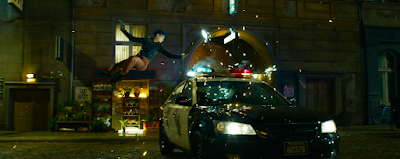
There’s something romantic amid The Matrix Resurrections’ bafflements—a grasping, yearning, swooning desire for connection—that might surprise those who remember the original trilogy mostly for its trench coats, machine guns, mind-bending reveals, and nu-metal soundtrack. But wasn’t this always a series about learning to reconcile the parts of oneself, and one’s world, and to hold close those whose love holds the key to The Truth? Like so many franchise pictures these days, Resurrections is a reboot about reboots, a movie about itself. But unlike other properties doomed to grow ever-more airless and walled off from real emotion, here’s one that explodes out the emotional world of its predecessors in big, bold, busy ways, growing more overtly expressionistic and sentimental. Writer-director Lana Wachowski lovingly, yet not uncritically, returns solo to the world she and her sister Lilly created over twenty years ago and finds that it’s changed in passionate, provocative, and confusing ways.
She, co-writing with screenwriter Aleksandar Hemon and novelist David Mitchell, decided that Neo (Keanu Reeves), the self-sacrificing hero of the super cool, genre-busting, paradigm-shifting originals has found himself, post-death, recreated and plugged back into The Matrix. He doesn’t remember the events of those movies, or rather remembers them incorrectly, or rather thinks of them in the wrong category entirely. Almost. That’s when it’s clear Wachowski is making no mere remake or legacy sequel only drifting off nostalgia, although it is. Even more it’s a recreation and refutation, a continuation and complication. Once again characters are separated from their true selves, and true loves, and true worlds. Machines strain against their coding and people struggle to reconcile the paradoxes of a buggy program called life. Thus the movie’s thrillingly dense and bafflingly never quite what you think it’ll be, steering hard into philosophical and psychological dilemmas that always formed the structure of this series’ sensational action spectacle. It makes for a heady trip.
You see, instead of Neo once again learning that what we think is reality is, in fact, a digital construct fed to us by a ruling class of advanced robots to keep humans captive in pods of goo that are their energy source, he’s a coder for a tech company who thinks that story is the plot of their most famous games. A trilogy of them. What better way to make a people forget that they’re in that simulation than make them think The Truth is mere fiction? When Neo’s boss (Jonathan Groff) calls him in to say the moneymen want to exploit the I.P. again he’s told “Warner Brothers is making Matrix 4 with or without” them. Here’s a sequel spinning games within games, in which a focus group is called in to stand in for Matrix fans discussing theories about what it was all about, man. It’s about trans self-actualization; or it’s about simulation theory; maybe it’s all about the bullet time. All of the above, Wachowski says. And wait’ll you see where it goes from there. Neo’s therapist (Neil Patrick Harris) is concerned that his patient’s reality is blurring—we see flashes of the earlier movies, echoes of sequences past that rattle around in moments of tingling deja vu. There’s something real and unreal at the same time, ripples from conflicts and debates in the so-called real world shaking the foundations of the green lines of code.
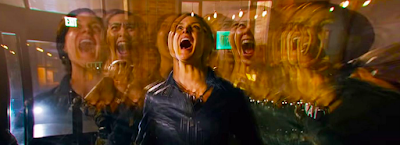
Neo is more lost than ever, imbued with the knowledge he needs yet all the more resistant to the truth for having buried it in plain sight. Trinity (Carrie-Anne Moss), his soul mate in kung-fu, and love, is also resurrected in the Matrix. But she’s been pushed even deeper into the computer’s fiction. As they find themselves drawn by destiny, by programming, by happenstance, by fate to reconnect with each other and themselves, a host of returning characters and new faces (coolest has to be the blue-haired Jessica Henwick as rogue freedom-fighter Bugs—“like Bunny,” she quips) and some returning characters in new faces (Yahya Abdul-Mateen II, making a habit of that sort of thing) line up along scrambled battle-lines leftover from the old revolution. The proceedings get ever more complicated. But even in the long stretches where I wasn’t quite sure what was happening or what outcome to root for, there’s that central yearning. That’s what makes it romantic—that strong surge of emotion, that plaintive push toward greater understanding of oneself and one’s loved ones. Reeves and Moss haven’t missed a step from their earlier performances, slipping easily into the human avatars of the fake world and the broken real humanity beneath—synthesized in the eventual uneasy steps back toward digital superheroes. It’s still a world of point-and-click prophecy and computerized spirituality, of shifting perspectives and cyclical conflicts. And Wachowski clearly loves her characters—and wants to see them reawaken to their full potential as much as we do.
The result is just as much a knotty puzzle of a head-fake, mind-bender as the originals—but woolier and more static, with a meandering central drive that’s sometimes as lost as its characters. In its long scenes of exposition spoken intently by the large cast, it pays off the intense, long-lived conversations from those who undertook the amateur field of Matrix studies seriously those decades ago. (Remember the philosophers’ commentaries from the DVDs? I hope that roundtable is reconvened for this one.) The movie can be playfully meta-textual, and even knowingly self-parodic, as it relentlessly plays with expectations. I didn’t always find it as immediately gripping or legible as the originals. It’s less self-consciously cool and stingier in action, but it’s still rich in ideas and has swelling heartfelt expressions of human (and inter-human) connection, and shot with a warm energy in sumptuous light and slick effects. And some stuff blows up. When in motion, the movie’s a shock of recognition but, successfully and unsuccessfully, chopped up, remixed, edited to ribbons, and smoothed out in new and bewildering ways. It may not always be legible, and lacks the immediacy and palpable visual pleasures of its progenitors, but its heart is in the right place.
This is the distinctive work of a filmmaker who has stylishly, entertainingly drawn out these ideas—of humans caught in a system built to grind them down, and who assert their passions and humanity against all odds—with her usual co-writer/director sister through Speed Racer’s masterpiece of hyperactive anime homage, Cloud Atlas’s six-fold cross-cut reincarnated melodramas, and Sense8’s dazzlingly sensual sci-fi poly-psychic mind-blender series. So it should be no surprise to find her returning to The Matrix with a totally earnest extension of the originals’ cyberpunk Plato’s cave. It meets our moment of accelerated techno-dystopian alienation and confusion with its own, and lets some love shine through the cracks. How romantic.
Showing posts with label Carrie-Anne Moss. Show all posts
Thursday, December 23, 2021
Friday, February 21, 2014
Do You Like Movies About Gladiators? POMPEII
Hardly the first bit of fiction to spin a yarn about the
final days of Pompeii, the ancient Roman city infamously swallowed up by its
nearby volcano’s eruption, Paul W.S. Anderson’s Pompeii is a sturdy evocation of old B-movie energy and pleasures. Its
ties to cinema past – a little prestige Roman epic here, a little trashy sword-and-sandals
actioner there – are earnest and sometimes exciting. This is a film with actors
walking around lavishly fake sets in flowing togas and militaristic leather,
speaking in vaguely English accents to denote their existence in the past. It
features a love-at-first-sight slave boy/rich girl romance, Ancient Roman
Empire intrigue, plots for revenge, threats of slave revolt, gladiatorial
combat, and a subplot involving the funding for a new construction project.
There’s something for everyone. Because Anderson never condescends to the
material, throwing himself into making fine use of widescreen spaces and
crackling effects work, it’s an empty diversion that comes by its schlock
honestly and unpretentiously.
In the past fifteen years or so, Anderson has become one of
our most reliably vivid visual storytellers, whether it be in a horror film (Event Horizon), an actioner (Death Race), a swashbuckler (The Three
Musketeers), a sci-fi splatterfest (Alien
vs. Predator), or all of the above (the Resident
Evils). Now, those aren’t all great films or even good films, though I have
a soft spot for some of them. But what they have is commitment to style and
design that turns out terrific genre imagery and occasional fluid sequences of
impressive action. They’re hardly what you’d call prestige pictures. They're the kind
of mid-range studio fare that’s easily ignored or written off indiscriminately
as nothing but garbage. But there’s a difference between lazy trash and artful
trash and Anderson almost unfailingly brings the spirit of artful visual play
to any project. In Pompeii, he
designs a gloriously fake ancient city, a mix of shiny CGI equivalents of matte
paintings and studio sets not too far removed from the kind Ernest B.
Schoedsack and Merian C. Cooper used for their Last Days of Pompeii in 1935. Within this overtly movie-ish
setting, he lets his framing and staging pop with enjoyable momentum, pleasing
symmetries, and striking shots.
One striking shot occurs right at the beginning, when a
young Celtic boy wakes up after being knocked out cold while Romans slaughtered
his entire village. He finds the corpses of his father and other rebels
dangling by their feet from a lone tree in the center of a vast field. The boy
grows up to be an enslaved gladiator (played by Game of Thrones’ Kit Harington) who is taken to Pompeii to compete
in their tournament. He’s the slave who’ll catch the eye of the rich girl
(Emily Browning). She’s the daughter of Pompeii’s leaders (Jared Harris and
Carrie-Anne Moss), and spends her time fleeing the unwanted advances of a Roman
senator (Kiefer Sutherland). That senator happens to be the man who led the
massacre of the slave boy’s village (small world) and happens to now be in
Pompeii to pay an imperially threatening visit to the town which is simmering
with potentially rebellious undercurrents.
These plots are all stock elements put together by
screenwriters Janet Scott Batchler, Lee Batchler, and Michael Robert Johnson
with dutiful coincidences. After all, how better to make us care about the town
that’s about to get buried in lava than populate it with characters engaged in
colorful cardboard historical melodramas? I haven’t even mentioned the champion
slave (Adewale Akinnuoye-Agbaje) who will get his freedom if he kills the boy
in combat. There’s a lot of conflict in this little town. Something bloody was
going to go down here even without the volcano blowing its top.
The characters and plots are engaging in a rote way, but
what really makes them click is the casting. Harington walks into the picture
abs-first, swaggering down a dungeon corridor and into the arena in a fine
entrance. He’s a chiseled hero and good match for his foe, who Akinnuoye-Agbaje
plays as a tough guy you just know will come to team up with the man he’s
forced to fight and attempt to get back at their enslavers. It’s a long time
coming, but fairly satisfying when it does. Then there’s the romantic co-lead, Browning,
who doesn’t speak so much as breathes every line from between perpetually
parted lips. Harris, all gravitas, and Moss, all tough caring, lend a fine
sense of parental authority to the proceedings, while Sutherland is all
patrician slime. They do good work with thin material, much like their
director, who makes them look great and, working with cinematographer Glen
MacPherson in their fourth collaboration, brings his considerable visual
interest.
It’s the rare movie that’s never fully convincing, sometimes almost laughable, and yet
grows more urgent and involving every step of the way. It ends on a high downer
note as the gladiator movie turns into a rumbling disaster movie. Rolling walls
of acrid smoke, oozing lava, collapsing pillars, crumbling ground, and crashing
waves fly off the screen (the 3D is flinchingly good in this department) as
extras stumble around, smacked by debris, spilling down cracking staircases,
and flailing about in flames. Pompeii is falling apart like there’s no
tomorrow, but there’s still plenty of time for the stock subplots to finish off
in predictable but largely satisfying ways in sword fights, chariot chases, thundering
comeuppances, sacrificial acts, and a kiss. There’s not much to Pompeii in the end – or much to Pompeii
in the end, come to think of it – overall nothing more than shiny schlock. But because Anderson stages the material
earnestly, confidently, with a nice cast and visual appeal, it’s endearing schlock
all the same.
Subscribe to:
Posts (Atom)


