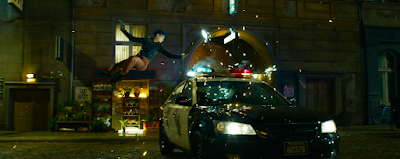
There’s something romantic amid The Matrix Resurrections’ bafflements—a grasping, yearning, swooning desire for connection—that might surprise those who remember the original trilogy mostly for its trench coats, machine guns, mind-bending reveals, and nu-metal soundtrack. But wasn’t this always a series about learning to reconcile the parts of oneself, and one’s world, and to hold close those whose love holds the key to The Truth? Like so many franchise pictures these days, Resurrections is a reboot about reboots, a movie about itself. But unlike other properties doomed to grow ever-more airless and walled off from real emotion, here’s one that explodes out the emotional world of its predecessors in big, bold, busy ways, growing more overtly expressionistic and sentimental. Writer-director Lana Wachowski lovingly, yet not uncritically, returns solo to the world she and her sister Lilly created over twenty years ago and finds that it’s changed in passionate, provocative, and confusing ways.
She, co-writing with screenwriter Aleksandar Hemon and novelist David Mitchell, decided that Neo (Keanu Reeves), the self-sacrificing hero of the super cool, genre-busting, paradigm-shifting originals has found himself, post-death, recreated and plugged back into The Matrix. He doesn’t remember the events of those movies, or rather remembers them incorrectly, or rather thinks of them in the wrong category entirely. Almost. That’s when it’s clear Wachowski is making no mere remake or legacy sequel only drifting off nostalgia, although it is. Even more it’s a recreation and refutation, a continuation and complication. Once again characters are separated from their true selves, and true loves, and true worlds. Machines strain against their coding and people struggle to reconcile the paradoxes of a buggy program called life. Thus the movie’s thrillingly dense and bafflingly never quite what you think it’ll be, steering hard into philosophical and psychological dilemmas that always formed the structure of this series’ sensational action spectacle. It makes for a heady trip.
You see, instead of Neo once again learning that what we think is reality is, in fact, a digital construct fed to us by a ruling class of advanced robots to keep humans captive in pods of goo that are their energy source, he’s a coder for a tech company who thinks that story is the plot of their most famous games. A trilogy of them. What better way to make a people forget that they’re in that simulation than make them think The Truth is mere fiction? When Neo’s boss (Jonathan Groff) calls him in to say the moneymen want to exploit the I.P. again he’s told “Warner Brothers is making Matrix 4 with or without” them. Here’s a sequel spinning games within games, in which a focus group is called in to stand in for Matrix fans discussing theories about what it was all about, man. It’s about trans self-actualization; or it’s about simulation theory; maybe it’s all about the bullet time. All of the above, Wachowski says. And wait’ll you see where it goes from there. Neo’s therapist (Neil Patrick Harris) is concerned that his patient’s reality is blurring—we see flashes of the earlier movies, echoes of sequences past that rattle around in moments of tingling deja vu. There’s something real and unreal at the same time, ripples from conflicts and debates in the so-called real world shaking the foundations of the green lines of code.
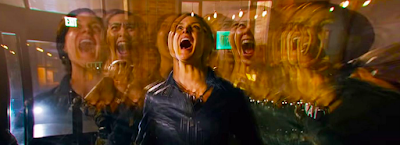
Neo is more lost than ever, imbued with the knowledge he needs yet all the more resistant to the truth for having buried it in plain sight. Trinity (Carrie-Anne Moss), his soul mate in kung-fu, and love, is also resurrected in the Matrix. But she’s been pushed even deeper into the computer’s fiction. As they find themselves drawn by destiny, by programming, by happenstance, by fate to reconnect with each other and themselves, a host of returning characters and new faces (coolest has to be the blue-haired Jessica Henwick as rogue freedom-fighter Bugs—“like Bunny,” she quips) and some returning characters in new faces (Yahya Abdul-Mateen II, making a habit of that sort of thing) line up along scrambled battle-lines leftover from the old revolution. The proceedings get ever more complicated. But even in the long stretches where I wasn’t quite sure what was happening or what outcome to root for, there’s that central yearning. That’s what makes it romantic—that strong surge of emotion, that plaintive push toward greater understanding of oneself and one’s loved ones. Reeves and Moss haven’t missed a step from their earlier performances, slipping easily into the human avatars of the fake world and the broken real humanity beneath—synthesized in the eventual uneasy steps back toward digital superheroes. It’s still a world of point-and-click prophecy and computerized spirituality, of shifting perspectives and cyclical conflicts. And Wachowski clearly loves her characters—and wants to see them reawaken to their full potential as much as we do.
The result is just as much a knotty puzzle of a head-fake, mind-bender as the originals—but woolier and more static, with a meandering central drive that’s sometimes as lost as its characters. In its long scenes of exposition spoken intently by the large cast, it pays off the intense, long-lived conversations from those who undertook the amateur field of Matrix studies seriously those decades ago. (Remember the philosophers’ commentaries from the DVDs? I hope that roundtable is reconvened for this one.) The movie can be playfully meta-textual, and even knowingly self-parodic, as it relentlessly plays with expectations. I didn’t always find it as immediately gripping or legible as the originals. It’s less self-consciously cool and stingier in action, but it’s still rich in ideas and has swelling heartfelt expressions of human (and inter-human) connection, and shot with a warm energy in sumptuous light and slick effects. And some stuff blows up. When in motion, the movie’s a shock of recognition but, successfully and unsuccessfully, chopped up, remixed, edited to ribbons, and smoothed out in new and bewildering ways. It may not always be legible, and lacks the immediacy and palpable visual pleasures of its progenitors, but its heart is in the right place.
This is the distinctive work of a filmmaker who has stylishly, entertainingly drawn out these ideas—of humans caught in a system built to grind them down, and who assert their passions and humanity against all odds—with her usual co-writer/director sister through Speed Racer’s masterpiece of hyperactive anime homage, Cloud Atlas’s six-fold cross-cut reincarnated melodramas, and Sense8’s dazzlingly sensual sci-fi poly-psychic mind-blender series. So it should be no surprise to find her returning to The Matrix with a totally earnest extension of the originals’ cyberpunk Plato’s cave. It meets our moment of accelerated techno-dystopian alienation and confusion with its own, and lets some love shine through the cracks. How romantic.
Showing posts with label Neil Patrick Harris. Show all posts
Thursday, December 23, 2021
Thursday, November 25, 2021
Returns and Exchanges:
8-BIT CHRISTMAS and HOME SWEET HOME ALONE
Nothing like the holidays for joyless repackaging of better times past. Why see something new when you can queue up pale echoes of the glories of Christmases long, long ago? Guess that’s what streaming programmers were thinking when they flipped the green light on what passes for new non-Hallmark Christmas movies this year. There’s an 80s-centric reworking of A Christmas Story called 8-Bit Christmas over on HBO Max and a deeply unpleasant new Home Alone over on Disney+. The former is a little better, just because it’s not actively awful. It’s far too schmaltzy and passively derivative for that. Neil Patrick Harris narrates the story of a boy who desperately wants a particular gift for Christmas. Along the way he deals with his eccentric family, neighborhood bullies, and schemes to bring the object of his affection to the top of the shopping list. It’s 1988. Instead of a Red Ryder BB gun, it’s a Nintendo. (The parents are still concerned about health effects, but at least he won’t shoot his eye out.) Instead of heart-warming carols on the soundtrack, we get a nonstop barrage of 80s pop. Instead of wry observation, we get clumsy sitcom wisecracks. Instead of the weird kid getting his tongue frozen to a pole, he repeatedly projectile vomits. (Seeing that, I nearly did, too.) It all feels a little past its sell-by date; Story isn’t as omnipresent as it once was, and these days 80s nostalgia is almost entirely supplanted by the 90s. And since a surface-level feature-length riff on those two elements are all on offer in this mild mediocrity, the thing’s a pretty empty experience. (Besides, if you want to see a Christmas comedy about scrambling for a hot ticket toy, there’s always the superior Jingle All the Way.) Even reliably funny Steve Zahn and June Diane Raphael as the parents—the source of most of the movie’s smiles and eventual sentimentality—can’t elevate such a charmless, formulaic thing.
But at least that one feels like a real movie. Home Sweet Home Alone is a cringingly ugly nothing all the way down. It’s inspired (and I use “inspiration” loosely) by the 1990 original, in which Macaulay Culkin was left home alone over the holidays and fought off some nasty burglars who tried to rob him. What plays like juvenile silliness with exaggerated violent slapstick and cloying sentiment now seems, also, like a paragon of a kind of broad Hollywood craft. Chris Columbus shot his version on a cozily dressed suburban set with filmic textures, and the warm blanket of John Williams’ score is holiday spirit aurally embodied. This new version, scripted by vets of the latest, most disappointing, SNL seasons, is shot with all the charm of an industrial warehouse. The titular home is lit and staged like a half-empty IKEA showroom. Who’d want to be there, alone or not? The family is icy, miserable, and obscenely wealthy. The kid (Jojo Rabbit's charming sidekick Archie Yates done a disservice) destined to be left alone is an insufferable brat. (They should all be lucky to be rid of each other.) Worst, though, is that the thieving villains of the picture (Ellie Kemper and Rob Delaney), the ones trying to break into the home, are set up for comeuppance, but are in the right. They’re a married couple on the brink of losing their home who cross paths with the brat at an open house after which they notice a priceless doll has been stolen. Suspecting the kid, they need to break in and steal it back. He fights back with the mean-spirited contraptions you'd expect from this series. I wish it knew he was the real villain. (Better Watch Out, a holiday horror film from a few years ago, did a better spin on the evil Christmas kid, though its R-rating means it won't get family replay value.) Alas, whatever narrative convolutions are necessary to bring this to a resolution that absolves all parties of wrongdoing and contrives a real-meaning-of-the-season snow-globe final shot feels all the cheaper. Every scene from beginning to end is a total blank, dead air despite stacking the cast with one-scene comedy ringers. You almost have to want to make a bad movie to end up with something this awful. That deciding to make this was one of Disney’s first acts upon purchasing it with the 20th Century Fox sale had me wondering how deep the business objectives went. This remake is so bad, so ugly, so witless, so empty, that I started wondering if they were deliberately trying to make the original look even better by comparison.
Friday, October 3, 2014
Going...Going...GONE GIRL
Gone Girl is a
sick dispatch from the dark center of a poisoned culture. It’s a missing person
thriller imbued with the tick-tock urgency of a well-wrought procedural. But
for all his precise surface sheen, David Fincher is a director interested in
implications far more troubling and upsetting than any given episode of any
given crime drama. Just look at how he turned the true crime Zodiac into a masterful investigation of
obsession and unknowablity. With Gone
Girl, the screenplay by Gillian Flynn, from her novel, obliges his impulses,
creating a world that snaps into revealing action when a woman in a small
Missouri town vanishes from the home she shares with her husband of five years.
In doing so, it exposes a culture that’s selfish, prejudiced, misogynistic,
easily misled, and eagerly superficial. And in the middle are characters who
exploit these flaws.
At first, we know the drill. And because Fincher is a
director who loves process and information, we appear to be on solid genre
ground. The front door is open. The glass coffee table is smashed. There’s a
bit of blood on the kitchen cabinet. And Amy Dunne (Rosamund Pike) is nowhere
to be found. Her husband Nick (Ben Affleck) calls the cops. Officers (Kim
Dickens and Patrick Fugit) show up to collect samples and rope off the
suspected crime scene. He’s interviewed, then released to stay with his twin
sister (Carrie Coon) while his wife’s parents (Lisa Banes and David Clennon)
race to town. Search parties are gathered. A tip line is established. The media
flocks, from local station vans getting all Ace
in the Hole on lawns and sidewalks, to the tabloid media sharks (Missi Pyle
and Sela Ward) ripping their teeth into the story’s details from the desks of
their cable news channels.
This is how these things always go, whether in Law & Order or in real life. The
husband is a source of suspicion. The wife is valorized. Fear and excitement creep through the community, media whips the nation into a frenzy of judgment, and
the police chase down clues with professionalism. It's dryly funny, a mixture of unease, bewilderment and practicality. This is the least showily
directed of Fincher's work, but he still ably deploys Jeff Cronenweth’s
cinematography – clean, simple images, clear shadows and soft colors – to keep
the vice grip of tension screwing tighter. Sinister steady shots glide together
with propulsive, clever editing – like a cute, creepy cut from a flashback to
the couple’s first kiss to his mouth being swabbed by forensics – to bring
considerable menace and dread to the procedural beats as the story grows more
complex.
As the investigation moves forward, Amy narrates past scenes
from their marriage, happy days and growing ominous inklings alike. In the
present, clues begin to add up to an unpleasant picture for Nick. The police
grow more skeptical of his story. They and we see uglier sides of his
personality. What begins as a wrong-man thriller starts to gather a nauseous
nagging weight. But that’s not the end of the story, and it doesn’t end up
where you’d think from that set up. The film takes loop-de-loops with audience
identification, recontextualizing characters, shifting sympathies
with each new piece of information.
The cast expands. We meet a high-powered defense attorney (Tyler
Perry), a mistress (Emily Ratajkowski), a chatty neighbor (Casey Wilson), a
wronged ex (Scoot McNairy), a stalker (Neil Patrick Harris). But, with
confident and nuanced performances across the board, none are as they seem.
Dangerous people end up victims. The sleazy end up noble. The helpful are
dupes. The clueless are shrewd. It’s important to consider not only what we
know, but from what perspective we learned it, what we’ve seen and what we’ve
only heard. Fincher deftly navigates the script’s developing mysteries and
twists with a dread as steady as his eye for accumulating detail, even if some
of the plot devices come across as only that.
In the center remain the couple, the husband left behind and
the wife who is missing. They’re each playing a role in this case, exposing
their lives to the world and leaving it up to the media’s interpretation. They
weren’t perfect. They weren’t happy. They left New York crushed by the
recession to take root in the Midwest, and found their seemingly perfect lives
crack under the pressure. Selfish motives filled the cracks and pulled them
apart. And now this. Now what?
Affleck and Pike play complicated roles that develop from
stock types into richly complicated contradictions. They are both convincing as
normal people trapped in a marriage that’s nearing a turning point, and
heightened genre constructs heading towards a startling conclusion. Fincher
gets them playing the easily digestible surfaces and the roiling ugliness
underneath, hanging everything out for us to see them fully. The better to
twist the plot in directions that are as surprising as they are sickening. The
resulting gender politics are queasy, either sloppy or too clever and more than
a little troubling in the ways it plays into a sexist’s worst nightmare
assumptions. But the performances carry the film over anyway. It’s worth
puzzling over because of how ice cold complicated the actors manage to be, by
steering into the ugliest aspects of their characters.
Our culture values easy surface details and convenient
narratives. They let us avoid the need to look further, think more deeply. In Gone Girl, there are those exploiting
this for their own benefit. And I’m not just talking about the villain(s). (I’m
being purposely vague there.) The cops make assumptions. The media finds easy
targets. It’s easy to frame people, mislead the public, and obscure the
obvious. Public relations becomes a way to win a case, or at least wriggle out
of suspicion. Even Amy’s parents turned her childhood into a series of
idealized kids’ books, then enjoyed conflating the character and their daughter
for financial gain.
So it’s not merely a story of lurid violence and voyeuristic
chills with fear mongering, although that’s certainly exploited here. (The
film’s closer to De Palma than Hitchcock, if you catch my drift.) It’s also a
movie about psychological damage of many kinds, drawing upsetting conclusions
about the lengths people will go to appear good, to appear innocent, to get
what they want and look right in others’ eyes. Why else would a do-gooder snap
a selfie at a vigil, then get offended when asked to delete? She wants proof of
appearances for her own use, no matter how unsettled or difficult it leaves
those in her wake. It’s a film full of such troubling details.
Being so detail-oriented, Fincher makes films with
impeccable craftsmanship of the highest order. Handsomely photographed and
hermetically sealed, Gone Girl looks
and moves like hard-edged blockbuster pulp, confident, prurient, and expensive.
And yet it’s a wholly pessimistic and scathingly misanthropic Hollywood
thriller, an eerily beautiful and darkly funny poison pill swallowed straight
into the heart of our chaotic frivolousness. It resolves thematically with a
chilling snap, leaving its implications dangling, lingering, and staining. What’s
going on inside the minds of others? You can think you know someone, but once
you learn the truth, there’s no unknowing.
Sunday, June 1, 2014
Easy Dying; Hard Comedy: A MILLION WAYS TO DIE IN THE WEST
Seth MacFarlane must think you’re stupid. For A Million Ways to Die in the West, his
second feature film, the creator of the nauseating cartoon Family Guy and the so-so R-rated teddy-bear comedy Ted has written and directed a Western
comedy that assumes you have only a passing familiarity at best with the genre
and with the history of the American frontier. The screenplay, a loose
collection of often ugly comedy conceits strung along a fairly standard Western
plot, is written from a detached angle to the material, filled with characters
who stand back and explain the context of the jokes. This is how a town in
Arizona got ice shipped from Boston. Here’s the level of medical care a
frontier town could expect. Did you know people don’t smile in old pictures? Did
you know there were a lot of deadly dangers in the Wild West? There’s a
condescension here that assumes you won’t get the jokes, such as they are. It’s
a movie made for people who snicker at old movies for no other reason than
because they’re from another time.
Stuck in approach somewhere between Lawrence Kasdan’s
grinning revival Silverado and Mel
Brooks’ anything-goes satire Blazing
Saddles, MacFarlane’s film is at once a smirking know-it-all comedy and a
somewhat earnest attempt to do a Western. The plot is simple. It’s 1882 in Old
Stump, Arizona. A poor sheep farmer (MacFarlane, giving himself the lead) is
left by his girlfriend (Amanda Seyfried) and soon starts courting the beautiful
stranger (Charlize Theron) who happens to ride into town. Unbeknownst to him,
she’s the wife of the region’s most terrifying gunfighter (Liam Neeson). That’s
the skeleton of a fine Western plot, and it’s carried along by expansive
widescreen photography from Michael Barrett and a classically trumpeting score
by Joel McNeely sounding a lot like what Max Steiner or Dimitri Tiomkin
would’ve done in the genre’s heyday. But every time a character speaks, it’s
with a clattering, colloquial modern speaking tone that’s ironic, smarmy, and
simply not funny.
Patient zero for this flat, desperately unfunny performative
patter is MacFarlane, who delivers his own writing with the enervating energy
of an overeager standup. He’s impressed with himself, convinced his subpar
quips and lazy observations are hilarious. He’s not charming. He’s smug. His
character is disconnected, standing aside from even his castmates. He’s given
long scenes in which he stands apart, mugging for the camera as he makes fun of
1800’s fashion, medicine, politics, transportation, and technology from a
vaguely know-something modern perspective, nothing a high school freshman who
half paid attention to history class couldn’t snark. It’s impossible to take
him seriously as a person in this story, which is too bad considering the
nearly two-hour movie has him in every scene. I simply couldn’t get invested in
a whiny, inconsistent character who is barely invested in the plot himself. He
keeps giving the whole production the side-eye, as if he knows more than he
does and feels so very self-satisfied about it.
Meanwhile, there are real actors around him who at times make
his (and Family Guy co-conspirators
Alec Sulkin and Wellesley Wild’s) repetitive and insulting writing seem almost
palatable. Theron’s a welcome presence, transforming a decorative plot device
into something like a character. Neeson for the most part retains his dignity,
assuming that’s a stunt butt that gets a daisy stuck in it, as he seemingly
gallops in from a serious Western. Elsewhere, Sarah Silverman and Giovanni
Ribisi are trapped in a gross-out subplot that plays like bad
knockoff Farrelly brothers, with a prostitute and her fiancé “waiting for
marriage,” but they almost make it work. The only person who gets the peculiar
tone of the picture exactly right is Neil Patrick Harris, playing a mustachioed
jerk wringing every bit of possible enjoyment out of his every appearance. He
has to play a scene where he suffers a fit of diarrhea in the middle of the
street, catching his runny excrement in his floppy cowboy hat. And he almost makes it work.
MacFarlane is a stunted, juvenile gag writer who expects to
get laughs out of edgy material, but fails to shape jokes with thought or
artistry. It’s a flat, stiff production that can barely set up a decent sight
gag. Characters are placed in front of the camera, barely move, and talk at each other in bad sitcom asides. Periodically they blurt out references to horrible subject matter – racism, misogyny, domestic
violence, murder, rape, child abuse – and MacFarlane assumes the shock will get a laugh.
The movie is casually dismissive and/or actively hateful to women, Native
Americans, African Americans, Chinese, Jews, and Muslims. Sometimes the racism
is cut with the smug white guy in the center of it all pulling
ain’t-I-a-stinker? faces. A “Runaway Slave” carnival shooting game has targets
that are big-lipped, wide-eyed blackface images chowing down on a slice of
watermelon. Two Chinese men wear rice-paddy hats and sport Fu Manchus. A
character jokes he’s going to recite his “Islamic death chant” and proceeds to
ululate gibberish.
You can’t have your aggressive stereotyping and hate speech
and wave it off, too. So what if (only sometimes) MacFarlane turns to another
character and says, “Um, isn’t that racist?” It is. But then what, exactly, are
we supposed to be laughing at? The movie comes across as stubbornly created
from the perspective of a narrow-minded, privileged, rich white male tittering
at anything beyond his immediate frame of reference. Words have meaning. Images
have power. MacFarlane knows what buttons to push, but fails to truly grapple
with, subvert, or defuse their impact. As director, he can barely stage a High
Noon shootout, saloon brawl, surreal drug trip, or musical number with any
clarity or consistency. No wonder he can’t even begin to figure out how to frame
or otherwise handle hot-button issues.
He wants laughs, and I truly believe you can craft a good
joke out of any topic, but he goes about it in exactly the wrong way. This is
comedy filmmaking at its most cheap, lazy, and unthinking. Are we supposed to
laugh because he went there, or does
he actually think he’s being clever? The writing is either offensive or
groan-worthy. The gross-out anatomical gags are just gross. Cameos (Christopher
Lloyd? Ewan McGregor? Ryan Reynolds?) are merely random nothings. The violence
is flatly presented and full of miscalculated gore. A face bloodily squished by
a brick of ice isn’t exactly a fun pratfall. At best, the movie is either
unfunny or incompetent, a pleasant and vacant experience. But when it’s bad, it’s
odious.
Friday, September 27, 2013
Leftovers: CLOUDY WITH A CHANCE OF MEATBALLS 2
A major asset of 2009’s zippy pleasure Cloudy with a Chance of Meatballs was its sense of surprise. It was
an unexpected treat in the form of a zany hilarious contraption of imagination
and heart. The bouncily, colorfully animated story of Flint Lockwood (Bill
Hader) and his food-generating invention (the FLDSMDFR) that goes very right,
then very wrong, is a mile-a-minute joke machine running on slapstick, puns,
and running gags of every kind imaginable. The premise was wacky – weather that
rains food onto a goofy small town – and the breakneck pacing and deep down
heartfelt characterization only helped elevate it into a glorious cartoony
experience. Now, Cloudy with a Chance of
Meatballs 2 is not and maybe never could’ve been the total surprise delight
of the original. But there’s almost enough diverting silliness here all the
same. It is in many ways more conventional and subdued. To say it has half the
laughs sounds like an insult until you remember the overwhelming number and
variety of jokes that were packed into its predecessor.
Starting exactly eight minutes after the end of Cloudy, the sequel finds Flint and all
the citizens of Swallow Falls awestruck by a famous inventor and C.E.O of
multinational tech corporation Live Corp. helicoptering into their wrecked
food-covered town. Chester V (Will Forte), as limber as he is rich, pays to
relocate the townspeople while his crews of researchers clean up the island.
Eagerly accepting the offer, the characters move on with their new lives. Six
months later, though, clean up hasn’t made much progress because the FLDSMDFR
somehow survived the first film and has generated an entire island ecosystem of
mutant food. Meanwhile, Flint is having trouble getting promoted out of his
entry level position at Chester’s company, so he jumps at his boss’s offer to
travel back to island and find the rogue invention and shut down the jungle of
“Foodimals” before they can reach the mainland and wreak chewy havoc.
Off Flint goes, with his dad (James Caan), meteorologist
girlfriend (Anna Faris), and pet monkey (Neil Patrick Harris), as well as a cameraman
(Benjamin Bratt), a chicken-loving bully-turned-friend (Andy Samberg), and the
town’s policeman (Terry Crews). A sort of pun-heavy riff on Jurassic Park, the plot of Cloudy 2 finds our intrepid protagonists
trudging through a jungle of fruits and veggies, running into all manner of
monstrous (and cute) food creatures: smiling berries, grumpy pickles,
elephantine melons, a gargantuan “taco-dile,” and hamburger spiders with French
fry legs and poppy seed eyes. I especially liked a brief glimpse of a snake
with a slice of pie for a head and a Twizzlers tail. Unlike its predecessor's
joyfully overcooked disaster movie spoof, this is more of a light kiddie
adventure with a dusting of smile-worthy winks to keep things lightly comedic. The
characters are appealing and the visual design is delicious. It’s the screenplay
cooked up by John Francis Daley, Jonathan M. Goldstein, and Erica Rivinoja
(with story credits for Chris Miller and Phil Lord) that could’ve used more
time in the oven.
Though even at its most obvious, there are elements that
tickled me. The creatures are imaginatively designed and good for fun puns. I enjoyed the not-so-subtle dichotomy of organic goodness versus
processed factory food evil that simmers underneath the proceedings. Live Corp
is in the tradition of deceptively benign movie corporations that hide evil
intentions in cavernous rooms populated by anonymous white lab coats busying
themselves with unknown scientific tinkerings. I mean, Chester V’s assistant
(Kristen Schaal) is an orangutan with a human brain implanted inside her own.
He’s clearly up to no good, even without the most heavy-handed
mustache-twirling foreshadowing in the opening scene. (Given the way the rest of
the movie plays out, I wonder if that moment was put in specifically to defuse
what would’ve otherwise been a little plot twist.)
But compared to the densely hilarious framing and sturdy
script of its predecessor, Cloudy 2
feels thinner than it should. (Compared to, say, Turbo or Planes, however,
it doesn’t look so bad.) The plotting plays out more or less exactly as you’d
expect, with largely easy lessons that don’t really threaten to become anything
too emotionally impactful. Pair that with the sparser joke population and the
whole thing bakes into a flavorful concoction that could use a bigger does of
sugar to get truly tasty. Still, there’s enough imagination in the creatures
and silliness in the execution to make the time pass amiably enough. It is, after
all, not every day you see a movie with a subplot in which a man teaches a
bunch of pickles how to fish.
Saturday, November 5, 2011
On High: A VERY HAROLD & KUMAR 3D CHRISTMAS
Writers Jon Hurwitz and Hayden Schlossberg have found the
sweet spot for Harold & Kumar silliness
and it only took a hit of Christmas to do so. (But, not even a week past
Halloween, don’t you think it’s a little early for Yuletide in the multiplex?) The
first film to feature the stoner pals was 2004’s Harold & Kumar Go to White Castle, an ambling, crude film in
which they were too high to find their way to hamburgers at White Castle
without running into all kinds of problems. Was it funny? Some thought so. I
found it had its charms, but, even at 88 minutes, it was a tad on the tiring
side. Then came 2008’s Harold & Kumar
Escape from Guantanamo Bay, which took away most of its predecessors
defiantly ambitionless smallness and replaced it with self-important Bush-era
satire that, while agreeable, sucked out much of what made the first film so low-key.
Now here we are with A
Very Harold & Kumar 3D Christmas, a title that seems to scream out that
the screenwriters have gone further astray when in fact they’ve dialed back. As
this picture begins, Harold and Kumar haven’t spoken for years. They’re living
very different lives. Kumar (Kal Penn) lives in his old small apartment,
constantly smoking weed with his new nerdy roommate (Amir Blumenfeld) and
stewing, lamenting the loss of his relationship with his old girlfriend. Harold
(John Cho), on the other hand, is a married banker trying desperately to make
sure Christmas will be perfect for his wife (Paula Garcés) and her family. Not
only will his very scary father-in-law (Danny Trejo!) be spending the holidays
with them, but he’s also bringing the whole extended family along as well as
the Christmas tree that he has personally grown for 12 years to be the perfect
holiday adornment. Needless to say, Harold is finding full-fledged adulthood
stressful.
As luck would have it, a giant joint addressed to Harold is
delivered to the old apartment on Christmas Eve, so Kumar does the right thing
and brings it over. Harold’s father-in-law has loaded up the whole family and driven
them into town for midnight mass, leaving the tree in his son-in-law’s care, so
he’s there alone to greet his old friend. As they haltingly reacquaint
themselves, Kumar lights up the joint. Harold, who has long given up the habit,
scolds him and tosses it out the window. A gust of wind flips it back into the
house and burns down the tree. Now, the two guys have to head out and find a
tree of the same size and perfection in order to save Harold’s reputation with
his father-in-law.
It’s a plot that turns out to be perfectly pitched for these
guys, with higher stakes than merely getting to White Castle, but not so
overheated to include Guantanamo Bay. It also proves that these characters have
a charming knack for finding trouble, even when they’re sober, at least some of
the time. Their race to find a tree gathers reluctant support from Kumar’s
roommate and one of Harold’s co-workers (Thomas Lennon) and his baby. Their
difficult, but not impossible, task is interrupted by strange obstacles
punctuated by bouts of bad taste. The search soon involves a car crash, the
Russian Mafia, drugs, guns, random violence, a giant Claymation snowman,
surprise encounters with old friends, beer pong, intimidating tree salesmen,
Neil Patrick Harris, an elaborate song-and-dance number, a waffle-making robot,
a painful recreation of A Christmas Story’s
tongue-on-a-cold-pole scene recreated with an even more sensitive body part, and
Santa Claus himself, complete with his flying reindeer. It’s gleefully goofy, with
first-time director Todd Strauss-Schulson further enlivening the sometimes
disgusting and, truth be told, often funny script by chucking things at the
camera in 3D just to make sure we’ve gotten the full extent of the jokey
concept.
This is a film that will go anywhere for a joke. But, unlike
the first two, which felt blunter and coarser, this installment balances its
crudeness with sweetness. This is a thoroughly, irreverently secular, spectacularly hard-R,
Christmas movie that nonetheless, in its shocking, subversive way, reaffirms
the basic meaning of the holiday. Beneath the non-stop crude references and
raunchy dialogue, this is essentially a story about friendship and family and
uses its holiday setting to help the characters learn to appreciate each other,
reconcile their differences, and become better people in the process. In that
way, it’s also a casually sweet riff on evolving male friendship. That may be
the biggest surprise of all, that this loose, aimless, goofy movie with enough
vulgarity to ensure it’s self-selecting audience will be a small one, is at its
core just a particularly filthy spin on pure sentimentality. Harold and Kumar
have (sort of) grown up! Like its predecessors, this third H&K adventure feels less than the
sum of its riffs, but it hangs together better as a movie, complete with actual
narrative momentum and the series’ highest rate of inspired scenes to insulting
ones. Besides, can any movie that puts Danny Trejo in a Christmas sweater be
all bad?
Wednesday, January 6, 2010
Short-order Weather: CLOUDY WITH A CHANCE OF MEATBALLS (2009)
I held off on seeing Cloudy with a Chance of Meatballs when it was first released. It looked loud and frantic and 3D to boot, not at all what I wanted to see happen to a sweetly whimsical, albeit mostly plotless, picture book about a small town that finds itself the center of a most unusual weather pattern that precipitates food. The mostly lukewarm critical reaction confirmed my suspicions and I stayed away despite the intriguing positive statements from a handful of trusted sources. I recently caught a screening (in 2D, just fine for me) of the movie at my local dollar theater and have been in disbelief ever since that the movie isn’t at all what I thought it was. Instead of an aggressively banal example of non-Pixar computer animation, it’s one of the best times I’ve had at the movies in 2009, a sheer delight from beginning to end. It’s a sprightly and energetic film with nonstop (often running) gags and jokes that are actually funny, never just quickly stale pop culture references. It’s unashamedly a cartoon, think more Looney Tunes than Snow White, with appealingly rubbery visuals. It’s a bouncy, energized, stylized slapstick motion machine that refused to slow down too often, not even to let me catch my breath between laughs.
The opening credits announce, in the location usually reserved for the director’s name, that the movie is “A Film By A Lot of People” and so, fittingly, I have much praise to lavish upon the talented people who created such a great time. The directors, Chris Miller and Phil Lord, do a fine job helming such a meticulous endeavor as a computer animated film and making it seem effortless and spontaneous. As the movie rockets forward it becomes a good-natured parody of disaster movie clichés, all the funnier for appearing in multiplexes so close to 2012. The unobtrusive celebrity voice work, rather than distracting, actually compliments the story with such funny people as Bill Hader, Anna Faris, Neil Patrick Harris, Bruce Campbell, Mr. T and Andy Samberg proving they are wonderfully expressive comedians even when restricted to voice only. The cast carries the rapid-fire vocal comedy as a team of capable animators provide the adorable squishy textures and rounded shapes of the characters and setting, creating a convincing cartoon universe with beautiful food-covered vistas popping with gorgeous colors and sparkling light.
Only stepping back from the experience do I start to realize that the plot itself, including the Big Lesson to be gleaned, is hardly new (though the “it’s good to be smart” message is certainly welcome) and the emotions evoked don’t go quite as deep as Pixar has conditioned us to expect. But that’s not what the filmmakers wanted to do here, was it? This is a movie that doesn’t tread entirely unfamiliar ground in its arc and yet spins wildly inventive imagery and versatile humor around it. None of the small doubts I have ultimately take away from the experience of seeing the movie in action which creates a state of bliss so complete that’s it’s hard to shake. And why would you want to shake off a feeling so good?
Subscribe to:
Posts (Atom)


