In Good Fortune, Keanu Reeves plays a guardian angel looking for a promotion who tries to save his first lost soul by showing a guy how the grass isn’t always greener on the other side. The joke is that he swaps a poor man’s life with a rich man’s life and the poor man decides it actually is better that way. For a cute comedy, the movie’s pretty sharp about the wages of poverty, enumerating the indignities of part-time and gig work. The result is a sitcom concoction with an unusual combination of influences. It’s one part Frank Capra fable—think It’s a Wonderful Life without the deeper emotional force—and one part Barbara Ehrenreich’s Nickel and Dimed. That 2001 book-length work of reportage subtitled On (Not) Getting By in America is a now-classic look at the American working poor. To read its accounts of unpredictable schedules, runaway housing costs, labyrinthine fines and fees, arbitrary rules, and inconsistent low pay is to be reminded of the crushing obstacles toward success for those trying to cobble together a living with multiple minimum (or near minimum) wage jobs. The problems she describes have not been ameliorated, but instead exacerbated by the growth of fleeting transactional tasks mediated by tech companies’ apps. There’s no sense of community or connection between employer and employee in such insecurity and inequity, and certainly no sense of duty or responsibility to take care, either. It’s this tension that gets a working over in the writer-director-co-star’s Aziz Ansari’s comic concept.
It’s an amusing and earnest effort for Ansari. He plays the poor man who’s sleeping in his car and working multiple jobs when he crosses paths with a shallow tech bro played by Seth Rogen. When they are swapped by Reeves’ angel, it appears that, although money may not buy happiness, it can certainly alleviate a whole lot of unhappiness. It also turns Ansari into quite an unpleasantly selfish guy willing to trick his way into more time in this setup. It sneakily makes Rogen into the main character, too, as he’s humbled by just how difficult it is to get and keep work, let alone make ends meet. He’s paired with Reeves, who’s increasingly zen frazzled as he’s made mortal as punishment by his peeved boss (Sandra Oh), and the two guys make a fun odd couple bumming around the lower classes while Ansari just might realize how his hollow riches still won’t win him a second date with Keke Palmer’s pretty union organizer. The movie has a light touch even as it hits its socioeconomic points hard, with a pleasant, likable cast as characters and with bantering dialogues that bounce breezily through the plot’s modest complications. If you think it’ll end without everyone learning a valuable lesson and returning to a slightly better status quo, you don’t know what kind of movie you’re watching. It’s all so bright and brightly lit that it’s hard to dislike even as you sense it won’t get any deeper.
Showing posts with label Keanu Reeves. Show all posts
Thursday, October 23, 2025
Saturday, July 19, 2025
Spun Off: KARATE KID: LEGENDS and BALLERINA
If you’re looking for the second remake of an 80s movie, or a legacy sequel to an 80s series, or a sequel to a streaming show spun off from that series, or a sequel to a 2010 remake of an 80s movie that reveals that the original and the remake were in the same canon all along, well, here’s Karate Kid: Legends. It’s all of the above at once. It follows a new martial arts youngster (Ben Wang), a Chinese teen studying under Jackie Chan’s Mr. Han. (His prior student, Jaden Smith, goes unmentioned.) The boy moves with his mother (Ming-Na Wen) to New York City. There he promises his mom he won’t get into fighting. But would you believe there’s a pretty girl (Sadie Stanley) at his school whose ex-boyfriend (Aramis Knight) works out at a dojo and challenges him? Well, this is a Karate Kid movie after all. A fun wrinkle is that the girl’s father (Joshua Jackson) is an ex-boxer and the kid trains him, too, in hopes of winning a match and saving a struggling pizzeria. That’s an unexpected move. Still, the movie’s a five car pile-up at cliche station. Every plot thread proceeds exactly as you’d expect, right down to Chan, given only one brief, darkly lit action moment, calling in Ralph Macchio, fresh from the series finale of Cobra Kai, to assist in making this Karate Kid ready to fight in the Big Tournament against the bully. And the movie moves so quickly that it really can’t service all of the tropes it whips up. A tighter focus on the boy might’ve worked better, in that it could put more depth to the cardboard types it throws up around him. He’s likable enough, and the movie’s efforts to be a simple little teen drama are its best moments. There could be something there. Instead, we have a light, slight movie filmed with a minimum of fuss in bright, quick scenes that maneuver a handful of pleasant predictable elements into place for their foregone conclusions while managing the nods and winks toward the larger franchise.
If you’re looking for a spinoff that’s also a quasi-sequel set between two other sequels in an ongoing contemporary action series, well, here’s Ballerina. All of the marketing makes sure to append From the World of John Wick to the title in order to make sure we know what to expect. Set between Chapters 3 and 4 of that Keanu Reeves’ vengeful hitman franchise, this picture introduces Ana de Armas as an orphan trained by Anjelica Huston to become a ballerina assassin. Or is it assassin ballerina? Regardless, the movie is about how she wants revenge on the organization that murdered her father, and thus sends herself into elaborate action of the John Wick kind. What follows are the typical elaborate sequences in which bones are broken and heads are splattered in rhythmic and gymnastic ways. There’s some cleverness here. I especially liked a shootout in an icy neon club in which people go slipping and sliding. There’s also, later, a fun action sequence we discover in retrospect as she walks through the aftermath only to end up in the start of another as she exits the building. The whole thing is a bit deadening, though, in the way the lesser Wicks can be. All the endless shooting gallery stuff is repetitive past a certain point, and the gleeful gore becomes so routine as to be vaguely alienating and off-putting. The plotting here also stretches credulity with dopey twists and a setting in increasingly insular assassin circles until literally every character on screen is a force for violence. When everyone on screen is a killer, then the dangers of action spilling out over a small European mountain village lose their edge. Director Len Wiseman gives it all a phony sheen that does nothing to pump the stakes, and, though De Armas is a compelling presence, the movie never quite makes her stand out from any other anonymous killer. Worst is when she’s put up against Wick himself in scenes that remind us of better movies and which I frankly did not understand in the context of the others in the series. He paused between when to do what? Maybe you need to love the other entries more, or less, to get it.
Tuesday, December 24, 2024
Rings of Power: SONIC THE HEDGEHOG 3
I have no defense of Sonic the Hedgehog 3 except that I was once an 11-year-old boy. My adult self sat watching this sequel slightly bored by the shiny, proficient formula on screen. If you’ve seen director Jeff Fowler’s first two Sonic the Hedgehog movies, this will be totally familiar—a simply plotted, gently silly scurry across brightly-lit colorful settings while the super-speedy animated blue hedgehog of Sega video game fame tries to protect his adopted human family, and the world, from the villainous machinations of evil scientist Jim Carrey. These are narratively flimsy, emotionally shallow, predictably told cartoon-logic movies. And yet, sometimes movies like this invite the Ghost of Moviegoer Past to step in and watch instead of the Present for a while. In that spirit, I had a good time. This isn’t even the best Sonic movie—that’s 2 by a nose, a perfectly pleasant pileup of kids’ adventure cliches and a good balance of human funny business. But 3 and the others are movies I would’ve enjoyed as a boy. It has likable leads with a funny ensemble, and a brisk pace with varied and imaginative-enough adventure sequences. This one has an early hedgehog versus motorcycle chase down a busy Tokyo street, and later a fight in a vault with tiles that are randomly anti- or extra-gravity. There’s just enough cleverness there. And then there’s Carrey hamming it up, this time in a double role as the villain and his own grandfather. His antics along with the Sega aesthetics are key 90s throwbacks. Is it any wonder the movie has two of the humans high-five and declare it “best decade ever?”
If the common complaint of the first picture was that it put Sonic in the passenger seat to pleasant live-action family comedy from James Marsden, Tika Sumpter, and Natasha Rothwell, this third Sonic goes the other way. It reduces the humans to glorified cameos and spends most of its time with Sonic (Ben Schwartz) and pals Tails (Colleen O'Shaugnessey) and Knuckles (Idris Elba) on the hunt for an evil hedgehog named Shadow (Keanu Reeves) who escaped containment in a secret base and is rampaging across the world looking for revenge against those who captured him. We get lots of flashbacks explaining why he’s upset, and seeding the ground for his eventual change of heart. (Though weirdly it is unacknowledged how one key character in those flashbacks has to be closely related to a key character in the present.) This series, like Fast and Furious before it, is very good about setting up villains to become sidekicks in future entries. And, better than Marvel lately, knows how to tease a new character in the credits of one entry and pay it off immediately in the next. (And easily incorporates events of a streaming series quickly, too.) This might be the ideal form of the modern franchise: cheap, efficient, reliable quality and return on investment, self-referential and fan-flattering without bogging down in self-seriousness, and exactly as ambitious as its target audience wants. It’ll never be great, but it’s always consistent. Bring on Sonic 4!
Thursday, December 23, 2021
Version Control: THE MATRIX RESURRECTIONS
There’s something romantic amid The Matrix Resurrections’ bafflements—a grasping, yearning, swooning desire for connection—that might surprise those who remember the original trilogy mostly for its trench coats, machine guns, mind-bending reveals, and nu-metal soundtrack. But wasn’t this always a series about learning to reconcile the parts of oneself, and one’s world, and to hold close those whose love holds the key to The Truth? Like so many franchise pictures these days, Resurrections is a reboot about reboots, a movie about itself. But unlike other properties doomed to grow ever-more airless and walled off from real emotion, here’s one that explodes out the emotional world of its predecessors in big, bold, busy ways, growing more overtly expressionistic and sentimental. Writer-director Lana Wachowski lovingly, yet not uncritically, returns solo to the world she and her sister Lilly created over twenty years ago and finds that it’s changed in passionate, provocative, and confusing ways.
She, co-writing with screenwriter Aleksandar Hemon and novelist David Mitchell, decided that Neo (Keanu Reeves), the self-sacrificing hero of the super cool, genre-busting, paradigm-shifting originals has found himself, post-death, recreated and plugged back into The Matrix. He doesn’t remember the events of those movies, or rather remembers them incorrectly, or rather thinks of them in the wrong category entirely. Almost. That’s when it’s clear Wachowski is making no mere remake or legacy sequel only drifting off nostalgia, although it is. Even more it’s a recreation and refutation, a continuation and complication. Once again characters are separated from their true selves, and true loves, and true worlds. Machines strain against their coding and people struggle to reconcile the paradoxes of a buggy program called life. Thus the movie’s thrillingly dense and bafflingly never quite what you think it’ll be, steering hard into philosophical and psychological dilemmas that always formed the structure of this series’ sensational action spectacle. It makes for a heady trip.
You see, instead of Neo once again learning that what we think is reality is, in fact, a digital construct fed to us by a ruling class of advanced robots to keep humans captive in pods of goo that are their energy source, he’s a coder for a tech company who thinks that story is the plot of their most famous games. A trilogy of them. What better way to make a people forget that they’re in that simulation than make them think The Truth is mere fiction? When Neo’s boss (Jonathan Groff) calls him in to say the moneymen want to exploit the I.P. again he’s told “Warner Brothers is making Matrix 4 with or without” them. Here’s a sequel spinning games within games, in which a focus group is called in to stand in for Matrix fans discussing theories about what it was all about, man. It’s about trans self-actualization; or it’s about simulation theory; maybe it’s all about the bullet time. All of the above, Wachowski says. And wait’ll you see where it goes from there. Neo’s therapist (Neil Patrick Harris) is concerned that his patient’s reality is blurring—we see flashes of the earlier movies, echoes of sequences past that rattle around in moments of tingling deja vu. There’s something real and unreal at the same time, ripples from conflicts and debates in the so-called real world shaking the foundations of the green lines of code.
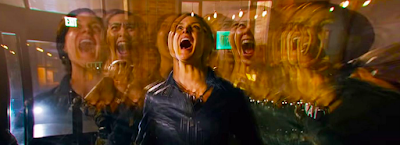
Neo is more lost than ever, imbued with the knowledge he needs yet all the more resistant to the truth for having buried it in plain sight. Trinity (Carrie-Anne Moss), his soul mate in kung-fu, and love, is also resurrected in the Matrix. But she’s been pushed even deeper into the computer’s fiction. As they find themselves drawn by destiny, by programming, by happenstance, by fate to reconnect with each other and themselves, a host of returning characters and new faces (coolest has to be the blue-haired Jessica Henwick as rogue freedom-fighter Bugs—“like Bunny,” she quips) and some returning characters in new faces (Yahya Abdul-Mateen II, making a habit of that sort of thing) line up along scrambled battle-lines leftover from the old revolution. The proceedings get ever more complicated. But even in the long stretches where I wasn’t quite sure what was happening or what outcome to root for, there’s that central yearning. That’s what makes it romantic—that strong surge of emotion, that plaintive push toward greater understanding of oneself and one’s loved ones. Reeves and Moss haven’t missed a step from their earlier performances, slipping easily into the human avatars of the fake world and the broken real humanity beneath—synthesized in the eventual uneasy steps back toward digital superheroes. It’s still a world of point-and-click prophecy and computerized spirituality, of shifting perspectives and cyclical conflicts. And Wachowski clearly loves her characters—and wants to see them reawaken to their full potential as much as we do.
The result is just as much a knotty puzzle of a head-fake, mind-bender as the originals—but woolier and more static, with a meandering central drive that’s sometimes as lost as its characters. In its long scenes of exposition spoken intently by the large cast, it pays off the intense, long-lived conversations from those who undertook the amateur field of Matrix studies seriously those decades ago. (Remember the philosophers’ commentaries from the DVDs? I hope that roundtable is reconvened for this one.) The movie can be playfully meta-textual, and even knowingly self-parodic, as it relentlessly plays with expectations. I didn’t always find it as immediately gripping or legible as the originals. It’s less self-consciously cool and stingier in action, but it’s still rich in ideas and has swelling heartfelt expressions of human (and inter-human) connection, and shot with a warm energy in sumptuous light and slick effects. And some stuff blows up. When in motion, the movie’s a shock of recognition but, successfully and unsuccessfully, chopped up, remixed, edited to ribbons, and smoothed out in new and bewildering ways. It may not always be legible, and lacks the immediacy and palpable visual pleasures of its progenitors, but its heart is in the right place.
This is the distinctive work of a filmmaker who has stylishly, entertainingly drawn out these ideas—of humans caught in a system built to grind them down, and who assert their passions and humanity against all odds—with her usual co-writer/director sister through Speed Racer’s masterpiece of hyperactive anime homage, Cloud Atlas’s six-fold cross-cut reincarnated melodramas, and Sense8’s dazzlingly sensual sci-fi poly-psychic mind-blender series. So it should be no surprise to find her returning to The Matrix with a totally earnest extension of the originals’ cyberpunk Plato’s cave. It meets our moment of accelerated techno-dystopian alienation and confusion with its own, and lets some love shine through the cracks. How romantic.
She, co-writing with screenwriter Aleksandar Hemon and novelist David Mitchell, decided that Neo (Keanu Reeves), the self-sacrificing hero of the super cool, genre-busting, paradigm-shifting originals has found himself, post-death, recreated and plugged back into The Matrix. He doesn’t remember the events of those movies, or rather remembers them incorrectly, or rather thinks of them in the wrong category entirely. Almost. That’s when it’s clear Wachowski is making no mere remake or legacy sequel only drifting off nostalgia, although it is. Even more it’s a recreation and refutation, a continuation and complication. Once again characters are separated from their true selves, and true loves, and true worlds. Machines strain against their coding and people struggle to reconcile the paradoxes of a buggy program called life. Thus the movie’s thrillingly dense and bafflingly never quite what you think it’ll be, steering hard into philosophical and psychological dilemmas that always formed the structure of this series’ sensational action spectacle. It makes for a heady trip.
You see, instead of Neo once again learning that what we think is reality is, in fact, a digital construct fed to us by a ruling class of advanced robots to keep humans captive in pods of goo that are their energy source, he’s a coder for a tech company who thinks that story is the plot of their most famous games. A trilogy of them. What better way to make a people forget that they’re in that simulation than make them think The Truth is mere fiction? When Neo’s boss (Jonathan Groff) calls him in to say the moneymen want to exploit the I.P. again he’s told “Warner Brothers is making Matrix 4 with or without” them. Here’s a sequel spinning games within games, in which a focus group is called in to stand in for Matrix fans discussing theories about what it was all about, man. It’s about trans self-actualization; or it’s about simulation theory; maybe it’s all about the bullet time. All of the above, Wachowski says. And wait’ll you see where it goes from there. Neo’s therapist (Neil Patrick Harris) is concerned that his patient’s reality is blurring—we see flashes of the earlier movies, echoes of sequences past that rattle around in moments of tingling deja vu. There’s something real and unreal at the same time, ripples from conflicts and debates in the so-called real world shaking the foundations of the green lines of code.
Neo is more lost than ever, imbued with the knowledge he needs yet all the more resistant to the truth for having buried it in plain sight. Trinity (Carrie-Anne Moss), his soul mate in kung-fu, and love, is also resurrected in the Matrix. But she’s been pushed even deeper into the computer’s fiction. As they find themselves drawn by destiny, by programming, by happenstance, by fate to reconnect with each other and themselves, a host of returning characters and new faces (coolest has to be the blue-haired Jessica Henwick as rogue freedom-fighter Bugs—“like Bunny,” she quips) and some returning characters in new faces (Yahya Abdul-Mateen II, making a habit of that sort of thing) line up along scrambled battle-lines leftover from the old revolution. The proceedings get ever more complicated. But even in the long stretches where I wasn’t quite sure what was happening or what outcome to root for, there’s that central yearning. That’s what makes it romantic—that strong surge of emotion, that plaintive push toward greater understanding of oneself and one’s loved ones. Reeves and Moss haven’t missed a step from their earlier performances, slipping easily into the human avatars of the fake world and the broken real humanity beneath—synthesized in the eventual uneasy steps back toward digital superheroes. It’s still a world of point-and-click prophecy and computerized spirituality, of shifting perspectives and cyclical conflicts. And Wachowski clearly loves her characters—and wants to see them reawaken to their full potential as much as we do.
The result is just as much a knotty puzzle of a head-fake, mind-bender as the originals—but woolier and more static, with a meandering central drive that’s sometimes as lost as its characters. In its long scenes of exposition spoken intently by the large cast, it pays off the intense, long-lived conversations from those who undertook the amateur field of Matrix studies seriously those decades ago. (Remember the philosophers’ commentaries from the DVDs? I hope that roundtable is reconvened for this one.) The movie can be playfully meta-textual, and even knowingly self-parodic, as it relentlessly plays with expectations. I didn’t always find it as immediately gripping or legible as the originals. It’s less self-consciously cool and stingier in action, but it’s still rich in ideas and has swelling heartfelt expressions of human (and inter-human) connection, and shot with a warm energy in sumptuous light and slick effects. And some stuff blows up. When in motion, the movie’s a shock of recognition but, successfully and unsuccessfully, chopped up, remixed, edited to ribbons, and smoothed out in new and bewildering ways. It may not always be legible, and lacks the immediacy and palpable visual pleasures of its progenitors, but its heart is in the right place.
This is the distinctive work of a filmmaker who has stylishly, entertainingly drawn out these ideas—of humans caught in a system built to grind them down, and who assert their passions and humanity against all odds—with her usual co-writer/director sister through Speed Racer’s masterpiece of hyperactive anime homage, Cloud Atlas’s six-fold cross-cut reincarnated melodramas, and Sense8’s dazzlingly sensual sci-fi poly-psychic mind-blender series. So it should be no surprise to find her returning to The Matrix with a totally earnest extension of the originals’ cyberpunk Plato’s cave. It meets our moment of accelerated techno-dystopian alienation and confusion with its own, and lets some love shine through the cracks. How romantic.
Saturday, August 29, 2020
Time Keeps on Slippin': BILL & TED FACE THE MUSIC
For all the ways Bill and Ted, they of the Excellent Adventure and Bogus Journey, are like so many comedy film duos, there’s something singular about them, too. These SoCal teenage friends act like stoners but never toke, surfers but live inland, bros but never get nasty. For all their dim-bulb energy, they’re surprisingly shrewd when they need to be. For all their slacker energy, they nonetheless can commit themselves to a big goal and see it through to the end. (Maybe that’s what being told you’re destined to save the world will get you.) Sure, they’re dopey, but they’re lovably dopey. After all, it’s not just any pair of best buddies who could’ve traveled through time for a history project or visited heaven and hell while joshing with death and take it in such stride. Their two blissfully silly movies from the late-80s and early-90s were carried along entirely on their goofball sci-fi charms, shaggy low-stakes treatment of space-time fatalism, and, above all else, that unrepeatable fortuitous chemistry from writing two amiably idiosyncratic characters and finding the exact right pair of actors to bring them to life. So even though Bill & Ted Face the Music is easily the least of the now trilogy of comedies starring those guys, it’s still capable of capturing some of their low-key cleverness and aw-shucks capitulation to whatever fate has in store for them. Destiny, after all, is always easier with a best pal along for support. Everyone involved is having a good time.
And so it is that when Keanu Reeves and Alex Winter step back into the roles for the third time, after three decades away, it feels like a pleasant reunion. Sure, they’re older, but you understand they’re basically the same people. Turns out they had some minor success with their rock band Wyld Stallyns, but have stalled out, now playing family weddings and open mic nights. It’s not clear how they have enough to support themselves, let alone their wives and kids. But they still love each other’s company and have each other’s back. Good thing, too, since yet another futuristic visitor (this time Kristen Schaal, playing the daughter of George Carlin’s character from the original) shows up and asks for their help saving the universe by playing one killer song. Only problem: they haven’t written it yet. This leads them hither and yon through some wispily sketched time travel ideas where they encounter various versions of their future selves while attempting to hop to a time in which they’ve already written the song. Director Dean Parisot and returning screenwriters Chris Matheson and Ed Solomon have a good enough time goofing around with the idea. And the actors are still so winning as the leads that it’s hard to dislike the movie. Yet its best idea is giving the guys grown daughters (Samara Weaving and Brigette Lundy-Paine), who are pitch-perfect young-woman versions of the eponymous duo. They have the same charming chemistry and earnestly dewey dopiness. I almost wish the balance of the film was flipped, giving them more screen time and making their subplot — a jaunt through time to collect the Greatest Musicians, like Louis Armstrong, Jimi Hendrix, and Mozart, for their dads’ band — the main attraction. How rare to do a Next Generation of a beloved cult comedy team and have it work so well, even if the film around it is a bit thin.
Saturday, June 24, 2017
Bad to the Bone: THE BAD BATCH
Ana Lily Amirpour’s second feature, The Bad Batch, is an extension of her cool sense of iconography and
obvious love of genre playfulness, as displayed in her 2014 debut, the slick,
black-and-white, Iranian vampire movie A
Girl Walks Home Alone at Night. This new film is a dirty, sweaty, grimy
post-apocalyptic western, with grifters and drifters eking out survival in a
sun-blasted stretch of desolate Texan desert. It creates a vision of America in
tune with these pessimistic and absurd times. In this near-future world, the
poor, the sick, the disabled, the undocumented immigrants, and the convicts are
tossed without a safety net to live discarded in this wild patch of land known
as The Bad Batch. (I wondered if this was just one of many such locales, but
the film has too narrow a focus to get into that.) On one side of the desert is
a trailer park full of cannibals (among them glowering muscle Jason Momoa). On
the other is a town called Comfort, run as a cult of personality by a man
(Keanu Reeves, in another of his unusual and mesmerizing roles of late) who
preaches from the giant neon boombox in the center of town which houses a DJ.
Stuck between them is a pretty blonde (Suki Waterhouse) who quickly pays an arm
and a leg for the privilege of sticking around, then stumbles around looking
for...something. (There’s also Jim Carrey as a mute homeless man, so
weather-beaten as to be nearly unrecognizable.)
As you can see, this is the sort of movie that sounds like a
lot of fun when you hear its eccentricities explained flat out like that, but
for all the imagination that went into creating this world – like an appealing
low-budget Mad Max prequel vibe run
through a Robert Rodriguez emulator – there’s far too little narrative
interest. It’s a compelling, visually striking environment. Lyle Vincent’s
woozy sun-baked cinematography perfectly cooks the grubby, dirty, displays of dried
blood, heat-blasted landfills, and craggy survivor’s peeling complexions. The
imagery is so matter-of-factly bizarre that a cult attachment to its dutifully flat-faced
oddity is inevitable. But all this creates a movie which never arrives at a
reason for being. It’s not fun enough for sick kicks, or smart enough for a
trenchant allegory. It simply rides its grubby cool, coasting to a dead end.
Friday, February 10, 2017
Outgunned: JOHN WICK: CHAPTER 2
John Wick, the
2014 directorial debut of stuntmen Chad Stahelski and David Leitch, had cool, impeccably choreographed
action sequences. The film’s considerable appeal is in the smooth Keanu Reeves
spinning and shooting in blissed-out sequences of zen gun-fu. But it wasn’t
just the sweet, sleek look of the thing that made it a cult classic. It was the
brutal, elemental motivations involved. Malcontents killed this ex-hitman’s
dog. What else could he do but exact revenge? He systematically dismantled a
whole shady kingpin’s operation over the sight of a bloody puppy corpse. It
makes pure action movie sense. Now, though, John
Wick: Chapter 2 must labor to bring the ex-hitman out of retirement again,
layering more mythology on top of what was already a neatly cracked video game
world in which a whole secret society of assassins carries its own currency and
code of conduct, rules and regulations controlled by the dispassionate
hoteliers and coroners who cater to this select clientele. There’s an agreeable
B-movie vibe to the enterprise, but the convolutions of this sequel lead to a
muddier set of motivations, and eventually even the well-staged gunplay started
to wear me down.
There’s simply too much of a good thing. Reeves is still
perfectly poised, and director Stahelski (alone this time, since Leitch was off
making his own solo outing) can stage effective fight scenes. But the story –
ballooning to slightly over two lumpy hours – is stretched thin, and the
emptiness is filled with nauseating gun love. Wick is back in action, pulled,
after a roaring car-centric demolition derby of a curtain raiser, into the
hitman game once more when a debt from his past comes due sending him off to
Italy to off an heiress. Already we’re removed from the clear emotional lines
of the original, but Derek Kolstad’s script finds reasons to keep upping the
stakes. As the film moves along, more and more factions in the hitman world
turn against Wick, until a whole host of rivals are out to claim a bounty on
his head. That should be fun, but it gets tiresome, leading to endless rounds
of gun fire, punctuated with kicking and stabbing and punching, each blow
considered and crunchy. But even more time is given over to loving shots of
Wick’s endless array of weapons, with lengthy sequences involving his procuring
of these weapons, examining them, hyping up their qualities for maximum deadly
impacts. It’s queasy to watch the film making drooling admiration over the
tools of death.
It’s one thing for a bloody actioner to get off on violence.
That’s par for the course. But here it goes too far for my taste, slobbering in
glee over the arsenal, talking up the benefits of machine guns and automatic
weapons as essential for anyone planning on mowing down a crowd. There’s no
moral counterbalance provided, or consideration given to collateral damage. One
scene finds Wick going up against an assassin (Common, who, after the far
superior Run All Night, seems to be
making a habit of these roles), both men armed with silencers. They’re walking
parallel on two separate platforms in a subway station, taking potshots at each
other through the crowds. We’re meant to realize they’re such good shots no
innocent is wounded or worse. This is a throwaway detail, intended humor in how
cavalier and dispassionate their demeanors. (They share a drink during their
down time, professionals off the clock.) But I couldn’t shake the nastiness of
the staging. Many scenes play out like this – one in an art museum had me
cringing as blood splattered paintings on the walls – and though it might be
fun watching a gory shootout in a Lady from
Shanghai hall of mirrors conclusion, I was by then thoroughly displaced
from caring, or even enjoying the surface visual pleasure. There’s a case to be
made for the amoral action movie. Plenty of downbeat, messy, grim, or exploitative
genre pictures provide low pleasures. But here I just couldn’t get on board.
Labels:
Chad Stahelski,
Common,
Derek Kolstad,
Keanu Reeves,
Review
No comments:
Subscribe to:
Posts (Atom)