Tuesday, August 29, 2023

Man Rehearses Machine: GRAN TURISMO

We’re so used to stories of man versus machine that there’s something peculiar about landing in a story that’s man merging with machine. That’s the uncanny element that made Neill Blomkamp’s sci-fi debut District 9 such a sensation, and his followups Elysium and Chappie so divisive and confounding. To see a human swallowed up by something alien or robotic, and to emerge the other side something altogether transformed, treated as ambivalent, and maybe even net positive, is a head-scratcher. Thus I find Blomkamp’s filmmaking alternately compelling and off-putting, especially as he takes such potentially cold ideas—all the more so when they’re juiced with viscera-splattering action sequences—and slathers on sentiment and quasi-pointed uplift within their mechanical hearts. There’s really nothing else quite like it, for better or worse.

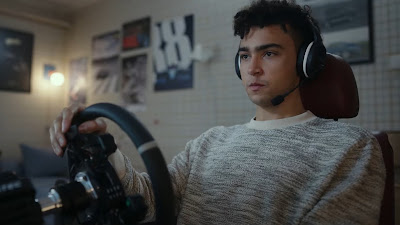
Somehow, though, in stepping away from sci-fi, one can find his personality still fits in a based-on-a-true-sports-story like Gran Turismo. Car racing is already a story of man melding with machine to do something greater than either could alone. This one adds the wrinkle of the eponymous video game. The narrative is loosely formed around real events in which the makers of the game convince Nissan and Playstation to bankroll an experiment by which the world’s best Gran Turismo players would get the chance to compete as real race car drivers. The movie casts its lead as a cute fresh-faced gamer and aspiring racer (Archie Madekwe) with a blue-collar dad (Oscar Nominee Djimon Hounsou) and mom (Spice Girl Geri Halliwell) who have their doubts as he leaps at this chance to live his dream. As we follow a pretty standard rise-fall-rise underdog story—would you believe the rich career drivers aren’t keen to share the track with an untested joystick jockey?—the young man is trained by an expert (David Harbour), boosted by a corporate climber (Orlando Bloom), and dogged by self-doubt.

The racing scenes are well-shaped and photographed for quick-paced car stunts. But the real charge in its heart comes from the way it allows the lead’s video game knowledge of tracks and tires to come in handy in real life. That’s the Blomkamp touch, letting the simulated dynamics of the game—down to the digital flourishes that visualize his memory of routes and alerts—turn into a thrill and an asset, as a real winner emerges from a melding with the machines. Even the real doubts, typified by a moving scene in which Hounsou and Halliwell watch a wreck on live TV and register the shock and uncertainty with only their eyes, fade in the midst of the momentum of the formulaically effective plotting. It’s selling a fantasy of man melding with machine that any number of gamers will find flattering, and makes for a sturdy car picture, a la such diverse pictures as Grand Prix and Ford v Ferrari and Talladega Nights, redone in a fresh coat of paint.

Friday, August 11, 2023

From Beneath: TEENAGE MUTANT NINJA TURTLES: MUTANT MAYHEM and MEG 2: THE TRENCH

The art of film appreciation is, to paraphrase Fritz Lang’s classic sci-fi silent Metropolis, a handshake agreement between the heart and the mind. We can find much to intellectually assess about any given picture, but inevitably the heart takes over, too. Thus it is that I think Teenage Mutant Ninja Turtles: Mutant Mayhem is a good movie, but one for which my enthusiasm is muted. Whereas Meg 2: The Trench is a bad movie, and yet it’s one with which, I must admit, I had a certain amount of fun. It comes down to this. Mutant Mayhem, the umpteenth Ninja Turtles project, is a good version of a thing I’ve never much cared about, and for which my ceiling of potential enjoyment is apparently much lower than the average audience. Meg 2, on the other hand, is a giddily stupid sequel that never once thinks it’s doing anything else but serving creature feature silliness larded up with all sorts of cheap paperback thriller plotting. Neither movie asks to be taken seriously, which is all for the better. They’re flip sides of the same goofy coin: putting silly characters and sloppy monsters on the big screen for us to gawk at and laugh with and walk out reasonably pleased. I imagine anyone willingly buying a ticket and walking into a movie called Teenage Mutant Ninja Turtles: Mutant Mayhem or Meg 2: The Trench will find exactly what they hope to see there.

Ninja Turtles is an animated feature that redoes an origin story for the ubiquitous amphibious karate teens. It’s a formulaic superhero tale that twins a toxic ooze catalyst for both heroes and villains. The latter is Superfly, a clear nod to blaxploitation down to the rumbling, street-tough Ice Cube voice performance. He’s a mutant bug who rallies his slimy siblings to steal lab equipment with the goal of assembling a machine to wipe out mankind. Luckily, the pack of plucky adolescent kung-fu tortoises in the sewers below have decided to surface and think they should stop him. They’re a gangly, likable bunch—largely indistinguishable but bubbling over with authentic teenage awkwardness, slang, and bravado. Anyone even vaguely aware of kids programming over the past four decades will recognize the shape of their style—the headbands, the ninja weapons, the love of pizza, the rat father. (He’s Jackie Chan now, and gets some appropriate fight choreography to match.) There’s something comforting enough to the fresh coat of paint slapped on a sturdy, predictable plot engine. Never once is the outcome in doubt. Of course the turtles will discover their powers and live up to their potential, while the bad guys will be defeated in a slam-bang fight downtown, and bigger baddies will lurk in the shadows to be teased in a mid-credits scene. But at least it looks neat and the squeaky cracking turtle performances have a real teen energy going. It’s nice to see them animated with a Spider-Verse-style scragginess, down to the wiggly penmanship, expressive line work, and layered visual jokes. It has a rat-a-tat rambling to the dialogue, and sequences stuffed with quick-witted gags and gooey sentimental heart you’d expect from a collaboration between Seth Rogen and a co-director on Mitchells vs the Machines. This might be as good as these turtle movies get.

Meg 2
is objectively worse, but I sure didn’t mind it in the moment. Imagine a simpler, dumber Deep Blue Sea and you’re onto something. Jason Statham returns to outwit enormous prehistoric sharks that’ve eluded capture at a scientific outpost meant to contain them. There’s a slog of exposition up top, a lot of soggy business about an ensemble trapped in dive suits on the ocean floor in the middle, and then a chomping spectacle at a beach resort that ends things on a toothy grin. Along the way we get gun-toting villains with a duplicitous boss out of a bad Michael Crichton rip-off, as well as a tentacled deep-sea beastie and eel-like lizard things slithering around making extra variables for the sustained climactic action. I could describe all the flimsy characters and simple interpersonal dynamics and cheap attempts at emotional investment. But really all the movie has going for it is a brisk pace and a willingness to just go for it. The director is Ben Wheatley, who usually does unsatisfying indie horror movies—though his best was winking feature-length shoot-out Free Fire, and his worst was a dismal, instantly-forgotten remake of Hitchcock’s Rebecca for Netflix. Here he gets a chance to make a studio budget (boosted by an international co-production with Chinese backers and actors) colorful and bright and dripping in off-screen PG-13 gore. It’s so stupidly diverting I only wished it was even stupider. A little extra excess—and yes, I’m really saying a movie culminating in Statham stabbing a prehistoric jumbo-shark through the mouth with a broken-off helicopter propeller should be more excessive—could’ve made Meg 2 a classic of its kind. It’ll have to settle for agreeably crummy B-minus movie status instead.

Tuesday, August 8, 2023

Center Stage: THEATER CAMP

If Theater Camp doesn’t become a Drama Club classic, it’ll be another bad sign for the future of movies. It may not be an exemplar of the form, but its shaggy, underdog affection for its characters and milieu makes it all the more charming. I can’t image anyone who is now or has ever been a theater teen who’d be anything but charmed. As satire, it’s knowing, but very gentle. It comes on like a grainy mockumentary, setting up the eponymous locale as a financially strapped institution perched on the precipice of foreclosure. Its owner (Amy Sedaris in a whirlwind cameo) is in a coma, leaving the task of running the summer to her wannabe influencer son. (When told about the budget for “straight” plays, he earnestly asks what a “gay” play is. “Musicals,” the stage manager answers.) The staff is well-meaning, but silly at best and pretentious at worst. Honestly, their curriculum leaves a lot to be desired, too. But for all the above seems set up for mockery, the movie finds only sweetness. Everyone means well. Conflict is easily patched over. And even the unlikeliest participants will have their moment to shine.

The plot itself is developed sketchily, in scenes that play out as loose skits—goofy classes, camp complications, personality quirks. The adults get the bulk of the work, with the kids largely confined to reliable reaction shots. And despite starting their summer off with a long list of productions, the movie quickly focuses on just one. It narrows into a reliable old format—the let’s-put-on-a-show-and-save-our-beloved-space musical. Within that format, the movie finds an amiable, amusing approach that suits the affection it finds around every corner. It simply loves these ragtag theater kids and their teachers. There’s no interpersonal drama amid the campers, and the main problems the adults face are 1.) insufficient and/or misplaced confidence in their own talents, and 2.) outside financial problems from money minders who just don’t get artists’ goals. That doesn’t seem so difficult to overcome with some sparkles, jazz hands, original music, and a theatrical flair.

The loose, improvised feeling and communal spirit shine through the movie’s insistence that the show must go on. The fact that the main cast—Ben Platt, Molly Gordon, Noah Galvin—are also the co-writers (and also, in Gordon’s case, co-director) is surely what gives the project its pleasant sense of hanging around. And in the end, when it leans entirely on the audience buying the transformative power of theater, well, the magic of the stage got to me, too. When one character lets his inner drag queen into the spotlight, and another bravely comes out as straight, as everyone takes the stage for a rousing group number celebrating their favorite summer spot, why, it’s almost like Theater Camp has room for everyone.

Thursday, July 27, 2023

Fire and Ice: OPPENHEIMER

Oppenheimer is a historical epic that largely keeps the epic off screen.The war is raging, but we don’t see it. High level conversations are happening, and we only sometimes hear pieces of them. Bold-faced names walk through, but as just a string of colleagues, allies, and foils. Its enormity comes from our, and their, understanding of its title figure’s accomplishments, and how the ramifications continue to reverberate. This is all about character—how one man moves through his life and, one step after another, brings about the possibility to destroy the world in an instant. That’s heavy. The film is written and directed by Christopher Nolan, who is good at affecting a popcorn seriousness. His films—Inception, Interstellar, The Dark Knight, a list of some of the more imposing blockbuster efforts in recent memory—move with portent, images that land with sturdy thuds and soundscapes that simmer and tremble and rumble. He makes enveloping moods of iced surface sensation, vice-twisting tension, and looming doom. For this new movie, he’s found a subject beyond space, beyond comic books, beyond sci-fi conceits that lets his skills expand into tough terrain that matches his moods. Like Dunkirk, his other film set during World War II, Oppenheimer is seriously serious. But unlike that movie’s relentless action focus on combat and survival, this is a brooding character piece through which the fate of mankind runs, and as such carries within it a heaviness that accumulates until the entire weight of the three hour runtime lands so hard in its finality that its effect is hard to shake. The movie, like the man at its center, looks upon his mighty works and despairs.

Nolan’s approach—a cold-to-the-touch sentimentalism, or sweeping high-concept pessimism shot through with messy stuff of human feeling—is here comparable to David Lean’s epics. Like Lawrence of Arabia, we can find in this new picture a vivid historical recreation writ large and small—major, world-shaping events that flow through the intimate experiences of specific people. Here, with Oppenheimer, we see a man whose scientific brilliance got him the job of overseeing the creation of the atomic bomb. Nolan sometimes fills the screen with cutaways to swirling electrons, arcing sparks, water drops and ripples. We get the sense the film, like its subject, can see to the whirling atomic heart of things, past the illusion of so many molecules tricking us into thinking we are on solid ground. Cillian Murphy plays Oppenheimer with a casual confidence in his intellect. He struts around deep into his theories, but struggles with putting them into practice. He’s willing to let others check the math and do the lab work. Though a womanizer—both his wife (Emily Blunt) and mistress (Florence Pugh) are drawn into his off-kilter charisma—and able to talk his way into contact with all the top scientific minds of his time from Heisenberg to Bohrs to Einstein, he can also be grindingly aloof, and unaware of interpersonal graces. He wants to sink into the deeper philosophical heart of science. That explains how haunted his gaze grows, as the implications of his ideas’ practical import grow all the more tangible as they escape his mind and enter the world.

In short scenes and snappy exchanges lensed with vivd filmic tones and chilly glow by Hoyte van Hoytema, and set against a Ludwig Göransson score in constant motion, we see a career on the rise. Oppenheimer’s academic work is on a collision course with a war, and a need to press his research into militaristic utility. There’s momentum hurtling things along, even as we see his personal entanglements—affairs, insults, Communist meetings—are vulnerabilities that may come back to haunt him professionally and emotionally. As his talents are requisitioned by the United States government, represented primarily by a no-nonsense general played by Matt Damon, a secret desert laboratory is assembled along with a team of the nation’s top scientific minds (a cornucopia of character actors at their best, recognizable faces that serve as quick-flash characterization and memory aid to hold onto in the lengthy swirl of activity). The movie picks up even more urgency from its propulsive process there. It’s behind-the-scenes of a bomb, with trial and error and jangling nerves from competing egos and ideas. The enormity of their project’s consequences is ever-present. There’s incredible tension on all sides. They feel they must succeed at all costs. And yet, what is that cost?

Adding to the sense of hindsight, and sorrowful retrospection, is the structure. We see the story flashing back from two post-war times: in color, Oppenheimer’s attempt to renew his security clearance, and, in black and white, a Senate hearing considering for a prospective cabinet position a bureaucrat (Robert Downey Jr) who clashed with Oppenheimer. Their responses to official questions guide us into the story of the bomb’s creation, a long, clear-eyed swirl of small roles and vivid impressions culminating in a fearsome test sequence. Nolan stages several heart-stopping moments, with bomb tests and other concussive effects masterfully manipulated sound and fury. But the fire and brimstone filter into other moments as well, as the film’s period piece pleasures of documents and interrogations and tense debates are filtered through the subjective perspectives—nightmarish sequences of fearful visions, quick flashes of paranoid suspicions or haunted memories mixed in with the forward momentum of historical reenactments’ inevitabilities and the scientific method’s rigid mix of theory and practice. It’s a movie about chain reactions, both the atomic forces unleashed by Oppenheimer’s work, and also the politics and people who collide and combine to form our world, or destroy it.

Dolled Up: BARBIE

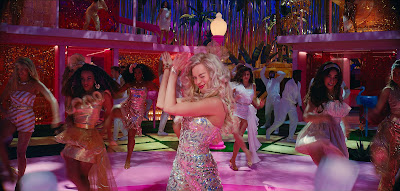
Greta Gerwig’s Barbie is a live-action cartoon philosophizing specifically about Barbie’s place in our culture, and gender performativity more broadly. In gleaming pink dollhouse sets against a painted sky, it is artifice in search of a truth. (Squint and you could call it Wes Anderson’s LEGO Movie.) It works, blending bright, sparkling silliness with clever ideas and even some moving earnest heart. That it manages to pull it off well is a post-modern two-step, setting up a dialectic—Barbie is a force for girlish fun and breezy empowerment versus Barbie as pernicious faux-feminist message in a materialistic patriarchal image—that’s somehow simultaneously criticism and advertisement. I’d like to hear how Barbie’s corporate owners let that happen. It’s both an obvious celebration of Barbie-land, and an overt problematization, a rich text that won’t stop explaining itself. The movie has characters flat out speak its ideas and debate their meaning, but it’s so nonstop funny and visually appealing that it rarely feels forced. We’re in a fizzy existential crisis for a movie that’s poppy and peppy and almost profound.

Gerwig opens the movie with gleaming fakery. After a 2001-style origin montage, which winkingly asserts the arrival of Barbie solved every girls’ real-world problems, we meet Stereotypical Barbie (Margot Robbie) living her Dream Life in her own little world. It’s a land full of Barbies—President Barbie, Doctor Barbie, and so on—who rule every profession, and their doting Kens who stand around and smile. (The well-cast world is populated with charmers putting on their best plastic grins.) Every day is a beach paradise, and every night is a dance party. But one night, during a bopping choreographed number to an original Dua Lipa song, she’s suddenly aware of her mortality. As her worry only escalates the next day, she’s informed by Weird Barbie (Kate McKinnon) that she should go to the Real World and find her owner to fix this. The resulting story makes the boundary between her world and ours porous, as her new understandings earned through fish-out-of-water interactions also get into the heads of her fellow Barbies and Kens. Ryan Gosling’s Ken is a particularly amusing vector of this confusion, as he gets hyped up on harmful real-world masculine stereotypes and turns from a purposeless accessory to an amped up parody of maleness. Other Barbie associates always seemed aware of their vestigial status, like real discontinued Ken friend Alan (Michael Cera), and the world-building is so loose and light that the very emptiness of these figures is the point.

While our world’s gender politics intrude on the oblivious Barbie’s consciousness, the movie introduces a real woman (America Ferrera) and her teenage daughter (Ariana Greenblatt) who alternately reject and entertain the fantasy Barbie offers. Here’s that dialectic, as Gerwig’s broad screenplay pushes and pulls at the delights and the dangers of the Barbie society, and our own. The CEO of Mattel (Will Ferrell) wants her back in the box, so to speak, but she’s starting to think she doesn’t like it there. The movie gives Robbie a deceptively complicated part to play—the perfect doll, then the plucky doubter, all while teasing out the slow crumbling of her facade. It’s strangely moving to see. We project so much, for good and ill, on this toy. To see Robbie bring a sense of interiority to the plastic ad-spread design is to see fifty years of feminism collapsing in on her. But there’s a bubblegum snap to the writing, co-scripted by Noah Baumbach, that never lets us forget the silliness of its construction. And there’s inventive filmmaking that continually reveals surprises in cartoony tableau and theatrical flourishes (even a climactic dream ballet), a sparkling, knowing campiness that melts into something genuine about purpose and connection and mothers and daughters and growing older. Gerwig, with Lady Bird and Little Women, made movies that glow with inner life, and here she finds that spark in plastic hearts. Or, to put it even more accurately, the spark is how those plastic people reflect and refract our own self-images. After all, who wants to be boxed in by other’s expectations?

Friday, July 21, 2023

Accept It:
MISSION: IMPOSSIBLE — DEAD RECKONING PART ONE

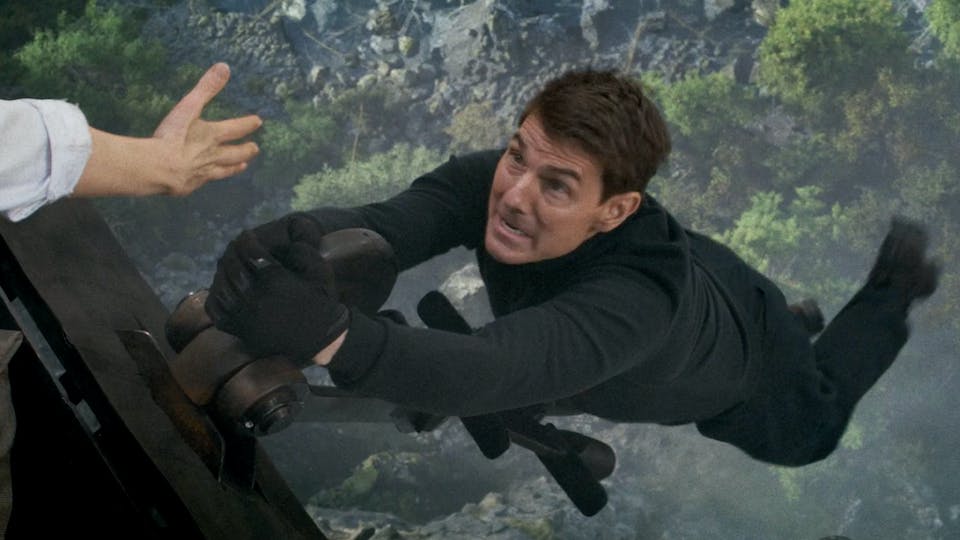
I tend to love when a long-running franchise finds its melancholy, and Mission: Impossible — Dead Reckoning Part One is no exception. The Tom Cruise action series has been reliably exciting, allowing his star persona to hone and sharpen along with his super-spy Ethan Hunt. They’ve fused as a man of singular focus and determination, willing to throw himself—literally his whole body—into pulling off incredible stunts. Hunt does it to save the world. Cruise does it to save the big screen blockbuster. Well done, both. The last few Missions Impossible, under the guidance of writer-director Christopher McQuarrie, have been sharply cobbled together with an excellent sense of escalating stakes, clever crescendos of momentum, and suitably coherent spectacular action—always with a sense of peril from a convincing over-the-top realism. These are top tier entertainments. The great success of Dead Reckoning Part One is that it doesn’t lose those attributes, and, in fact, by stretching out over three hours of rising action (this is only the first of a promised two-parter, after all) allows it to grow more complicated, and more emotionally engaged. The story is another MacGuffin hunt—two halves of a key that’ll unlock a missing server that holds the brains of a rogue military-grade artificial intelligence—but by pacing itself, it allows for that sadness to creep in. McQuarrie and Cruise have made Hunt a man driven by a desire to avoid loss—not just global, but personal—and here’s a movie that doubles and triples and quadruples down on that prospect.

It considers the effects of being a man for whom the impossible is pulled off in wild stunts of teamwork and the effects such constant danger and close calls have on himself and his only friends—those who work with him. Cruise has always played characters who think they can outrun the gravity of a situation’s reality. (Look no further than Top Gun: Maverick, in which that urge is proven correct.) Impossible has always been a series playing with the potential to flail in the face of danger—remember him dangling over the alarmed floor in the first one. This latest Mission runs toward and with that gravity. Its melancholy is a fine new flavoring that finally taps a rich vein at which the previous pictures have merely glinted. But this is still, as one might expect from these pictures, a rip-roaring adventure with some of the best action thrills anywhere, photographed cleanly and clearly, edited with energy and style, and keeping every aspect in vivid focus without losing the thread. Each sequence—from a sandstorm firefight to airport sleuthing, a car chase through Rome, and combat on a runway train that builds to Buster Keaton levels of astonishing chain reactions—are cleverly stacked with multiple variables, complications, and suspense elements—pursuers, ticking bombs, causes and effects—that make for delightfully complicated thrills.

For however heavy the undertow, the movie stays light on its feet, playful, and propulsive. The action is staged for impact of objects in dizzying motion that balance on a mix of danger and delight. Picture a tiny car tumbling down a massive stone staircase, causing its handcuffed passenger and driver to switch places, all while a massive Hummer smashes down after them. And yet it’s that underlying sadness that lets such giddiness play against a somber backbeat that finds these characters in an almost existential crisis when confronting their latest foe. (No wonder there’s no conclusion.) When a charming new character (Hayley Atwell) is given the choice to join the team for this mission, it’s presented with a somber touch. She needs to know the consequences. This earned level of sadness gives the hugely entertaining movie a genuine whiff of finality. In these endless franchise plays crowding our multiplexes, a few are starting to find satisfying stakes can be found by intimating an actual end is looming. All the pleasures of the momentum machine herein feel all the more weighted toward danger, and make the complications all the more delightfully compounded.

Friday, June 30, 2023

Time After Time: PAST LIVES

Thirty-six is young enough to feel like a massive life change is still possible, but also old enough to have a lot of vivid “what ifs” that have closed off some possibilities entirely. I’m sure I’m not the first to draw a metaphor comparing living your life to catching a flight. If your childhood is the runway, and your twenties are takeoff, then your thirties have to be the point where you feel you’re at cruising altitude. You’re far enough along to relax into a routine, see the shape of the horizon, while still knowing you have a long way until you reach your final destination. What if? There’s still time. Here’s Past Lives, a wistful and fragile little movie borne aloft by those doubts and those “what ifs” as its 36-year-old characters turn inwards, and backwards, for just a few days. They’re in a blend of nostalgic reverie and deep contemplation that, together and apart, cause them to reflect on their lives’ routes so far, and the other paths that had to be foreclosed to get there.

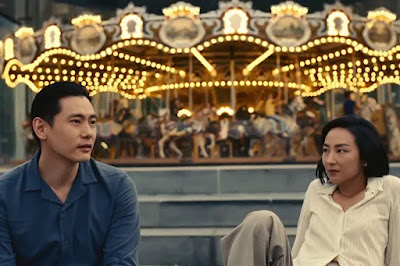
It starts at the turn of the 21st century, where two 12-year-old South Korean classmates’ friendship is teetering on the edge of romantic feelings. They sit close in class. They talk on their slow walks home. Their moms arrange a date in the park. She cries after getting a lower grade on a test than she’d expected, and he calmly stands there, awkwardly, silently, supportive. It’s all very sweet and cute, a first blush of real, deep connection in a pre-adolescent way that arises out of affection and proximity. When her family immigrates to Canada before the next school year, they don’t see each other, they don’t speak, they don’t stay in touch. More than a decade passes. The movie’s main drama—softly spoken, precisely observed—happens in two following parts: a fleeting long-distance friendship, and a long-awaited reunion on the streets of New York City a decade after that. In their mid-thirties for the film’s present tense culmination, she (Greta Lee) is a married American, and he (Teo Yoo) has just broken up with his girlfriend back in Seoul. The emotional tension swells through the two time jumps ellipsis, empty narrative space we fill in with the context clues, and the nuanced performances in which whole decades well up through body language and eye movements, as every silence swells with the unspoken.

Though it has the raw material of overheated melodrama, the confident grace and simplicity of writer-director Celine Song’s debut feature carries off a poised empathy. It’s not building to the stuff of high drama, but of small realizations, shifts in thoughtful connection, self-knowledge, and lost potentials. It embodies the melancholy wonderings of a wandering mind, traveling back to those moments in life where another choice would’ve taken you an entirely different direction. This isn’t even a movie about regrets, per se. Her husband (John Magaro) is as well-adjusted and empathetic as you could ask. This allows for a movie about the headspace a reunion can generate—and Song’s sensitive writing and cozy filmic lensing allows for the characters to explore their complicated emotions kicked up by the grown person before them being simultaneously the tween they once knew, and a stranger they’ve never known. They see some lost part of themselves reflected back in a stranger’s eyes. The movie’s generous enough to play that out with compassionate contemplation, and the final emotional release is all the more potent for it.