Thursday, July 27, 2023

Fire and Ice: OPPENHEIMER

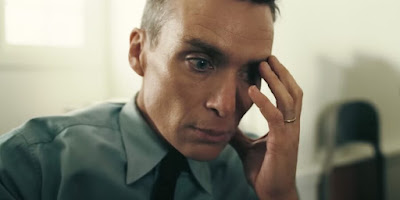
Oppenheimer is a historical epic that largely keeps the epic off screen.The war is raging, but we don’t see it. High level conversations are happening, and we only sometimes hear pieces of them. Bold-faced names walk through, but as just a string of colleagues, allies, and foils. Its enormity comes from our, and their, understanding of its title figure’s accomplishments, and how the ramifications continue to reverberate. This is all about character—how one man moves through his life and, one step after another, brings about the possibility to destroy the world in an instant. That’s heavy. The film is written and directed by Christopher Nolan, who is good at affecting a popcorn seriousness. His films—Inception, Interstellar, The Dark Knight, a list of some of the more imposing blockbuster efforts in recent memory—move with portent, images that land with sturdy thuds and soundscapes that simmer and tremble and rumble. He makes enveloping moods of iced surface sensation, vice-twisting tension, and looming doom. For this new movie, he’s found a subject beyond space, beyond comic books, beyond sci-fi conceits that lets his skills expand into tough terrain that matches his moods. Like Dunkirk, his other film set during World War II, Oppenheimer is seriously serious. But unlike that movie’s relentless action focus on combat and survival, this is a brooding character piece through which the fate of mankind runs, and as such carries within it a heaviness that accumulates until the entire weight of the three hour runtime lands so hard in its finality that its effect is hard to shake. The movie, like the man at its center, looks upon his mighty works and despairs.

Nolan’s approach—a cold-to-the-touch sentimentalism, or sweeping high-concept pessimism shot through with messy stuff of human feeling—is here comparable to David Lean’s epics. Like Lawrence of Arabia, we can find in this new picture a vivid historical recreation writ large and small—major, world-shaping events that flow through the intimate experiences of specific people. Here, with Oppenheimer, we see a man whose scientific brilliance got him the job of overseeing the creation of the atomic bomb. Nolan sometimes fills the screen with cutaways to swirling electrons, arcing sparks, water drops and ripples. We get the sense the film, like its subject, can see to the whirling atomic heart of things, past the illusion of so many molecules tricking us into thinking we are on solid ground. Cillian Murphy plays Oppenheimer with a casual confidence in his intellect. He struts around deep into his theories, but struggles with putting them into practice. He’s willing to let others check the math and do the lab work. Though a womanizer—both his wife (Emily Blunt) and mistress (Florence Pugh) are drawn into his off-kilter charisma—and able to talk his way into contact with all the top scientific minds of his time from Heisenberg to Bohrs to Einstein, he can also be grindingly aloof, and unaware of interpersonal graces. He wants to sink into the deeper philosophical heart of science. That explains how haunted his gaze grows, as the implications of his ideas’ practical import grow all the more tangible as they escape his mind and enter the world.

In short scenes and snappy exchanges lensed with vivd filmic tones and chilly glow by Hoyte van Hoytema, and set against a Ludwig Göransson score in constant motion, we see a career on the rise. Oppenheimer’s academic work is on a collision course with a war, and a need to press his research into militaristic utility. There’s momentum hurtling things along, even as we see his personal entanglements—affairs, insults, Communist meetings—are vulnerabilities that may come back to haunt him professionally and emotionally. As his talents are requisitioned by the United States government, represented primarily by a no-nonsense general played by Matt Damon, a secret desert laboratory is assembled along with a team of the nation’s top scientific minds (a cornucopia of character actors at their best, recognizable faces that serve as quick-flash characterization and memory aid to hold onto in the lengthy swirl of activity). The movie picks up even more urgency from its propulsive process there. It’s behind-the-scenes of a bomb, with trial and error and jangling nerves from competing egos and ideas. The enormity of their project’s consequences is ever-present. There’s incredible tension on all sides. They feel they must succeed at all costs. And yet, what is that cost?

Adding to the sense of hindsight, and sorrowful retrospection, is the structure. We see the story flashing back from two post-war times: in color, Oppenheimer’s attempt to renew his security clearance, and, in black and white, a Senate hearing considering for a prospective cabinet position a bureaucrat (Robert Downey Jr) who clashed with Oppenheimer. Their responses to official questions guide us into the story of the bomb’s creation, a long, clear-eyed swirl of small roles and vivid impressions culminating in a fearsome test sequence. Nolan stages several heart-stopping moments, with bomb tests and other concussive effects masterfully manipulated sound and fury. But the fire and brimstone filter into other moments as well, as the film’s period piece pleasures of documents and interrogations and tense debates are filtered through the subjective perspectives—nightmarish sequences of fearful visions, quick flashes of paranoid suspicions or haunted memories mixed in with the forward momentum of historical reenactments’ inevitabilities and the scientific method’s rigid mix of theory and practice. It’s a movie about chain reactions, both the atomic forces unleashed by Oppenheimer’s work, and also the politics and people who collide and combine to form our world, or destroy it.

Dolled Up: BARBIE

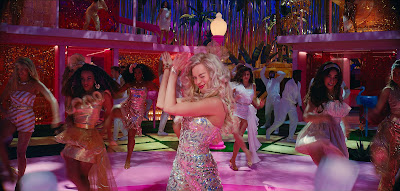
Greta Gerwig’s Barbie is a live-action cartoon philosophizing specifically about Barbie’s place in our culture, and gender performativity more broadly. In gleaming pink dollhouse sets against a painted sky, it is artifice in search of a truth. (Squint and you could call it Wes Anderson’s LEGO Movie.) It works, blending bright, sparkling silliness with clever ideas and even some moving earnest heart. That it manages to pull it off well is a post-modern two-step, setting up a dialectic—Barbie is a force for girlish fun and breezy empowerment versus Barbie as pernicious faux-feminist message in a materialistic patriarchal image—that’s somehow simultaneously criticism and advertisement. I’d like to hear how Barbie’s corporate owners let that happen. It’s both an obvious celebration of Barbie-land, and an overt problematization, a rich text that won’t stop explaining itself. The movie has characters flat out speak its ideas and debate their meaning, but it’s so nonstop funny and visually appealing that it rarely feels forced. We’re in a fizzy existential crisis for a movie that’s poppy and peppy and almost profound.

Gerwig opens the movie with gleaming fakery. After a 2001-style origin montage, which winkingly asserts the arrival of Barbie solved every girls’ real-world problems, we meet Stereotypical Barbie (Margot Robbie) living her Dream Life in her own little world. It’s a land full of Barbies—President Barbie, Doctor Barbie, and so on—who rule every profession, and their doting Kens who stand around and smile. (The well-cast world is populated with charmers putting on their best plastic grins.) Every day is a beach paradise, and every night is a dance party. But one night, during a bopping choreographed number to an original Dua Lipa song, she’s suddenly aware of her mortality. As her worry only escalates the next day, she’s informed by Weird Barbie (Kate McKinnon) that she should go to the Real World and find her owner to fix this. The resulting story makes the boundary between her world and ours porous, as her new understandings earned through fish-out-of-water interactions also get into the heads of her fellow Barbies and Kens. Ryan Gosling’s Ken is a particularly amusing vector of this confusion, as he gets hyped up on harmful real-world masculine stereotypes and turns from a purposeless accessory to an amped up parody of maleness. Other Barbie associates always seemed aware of their vestigial status, like real discontinued Ken friend Alan (Michael Cera), and the world-building is so loose and light that the very emptiness of these figures is the point.

While our world’s gender politics intrude on the oblivious Barbie’s consciousness, the movie introduces a real woman (America Ferrera) and her teenage daughter (Ariana Greenblatt) who alternately reject and entertain the fantasy Barbie offers. Here’s that dialectic, as Gerwig’s broad screenplay pushes and pulls at the delights and the dangers of the Barbie society, and our own. The CEO of Mattel (Will Ferrell) wants her back in the box, so to speak, but she’s starting to think she doesn’t like it there. The movie gives Robbie a deceptively complicated part to play—the perfect doll, then the plucky doubter, all while teasing out the slow crumbling of her facade. It’s strangely moving to see. We project so much, for good and ill, on this toy. To see Robbie bring a sense of interiority to the plastic ad-spread design is to see fifty years of feminism collapsing in on her. But there’s a bubblegum snap to the writing, co-scripted by Noah Baumbach, that never lets us forget the silliness of its construction. And there’s inventive filmmaking that continually reveals surprises in cartoony tableau and theatrical flourishes (even a climactic dream ballet), a sparkling, knowing campiness that melts into something genuine about purpose and connection and mothers and daughters and growing older. Gerwig, with Lady Bird and Little Women, made movies that glow with inner life, and here she finds that spark in plastic hearts. Or, to put it even more accurately, the spark is how those plastic people reflect and refract our own self-images. After all, who wants to be boxed in by other’s expectations?

Friday, July 21, 2023

Accept It:
MISSION: IMPOSSIBLE — DEAD RECKONING PART ONE

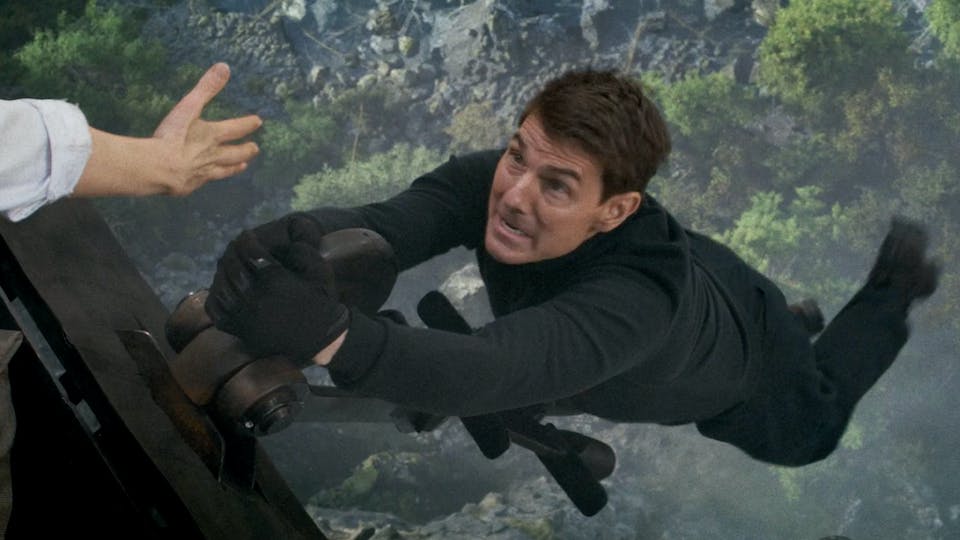
I tend to love when a long-running franchise finds its melancholy, and Mission: Impossible — Dead Reckoning Part One is no exception. The Tom Cruise action series has been reliably exciting, allowing his star persona to hone and sharpen along with his super-spy Ethan Hunt. They’ve fused as a man of singular focus and determination, willing to throw himself—literally his whole body—into pulling off incredible stunts. Hunt does it to save the world. Cruise does it to save the big screen blockbuster. Well done, both. The last few Missions Impossible, under the guidance of writer-director Christopher McQuarrie, have been sharply cobbled together with an excellent sense of escalating stakes, clever crescendos of momentum, and suitably coherent spectacular action—always with a sense of peril from a convincing over-the-top realism. These are top tier entertainments. The great success of Dead Reckoning Part One is that it doesn’t lose those attributes, and, in fact, by stretching out over three hours of rising action (this is only the first of a promised two-parter, after all) allows it to grow more complicated, and more emotionally engaged. The story is another MacGuffin hunt—two halves of a key that’ll unlock a missing server that holds the brains of a rogue military-grade artificial intelligence—but by pacing itself, it allows for that sadness to creep in. McQuarrie and Cruise have made Hunt a man driven by a desire to avoid loss—not just global, but personal—and here’s a movie that doubles and triples and quadruples down on that prospect.

It considers the effects of being a man for whom the impossible is pulled off in wild stunts of teamwork and the effects such constant danger and close calls have on himself and his only friends—those who work with him. Cruise has always played characters who think they can outrun the gravity of a situation’s reality. (Look no further than Top Gun: Maverick, in which that urge is proven correct.) Impossible has always been a series playing with the potential to flail in the face of danger—remember him dangling over the alarmed floor in the first one. This latest Mission runs toward and with that gravity. Its melancholy is a fine new flavoring that finally taps a rich vein at which the previous pictures have merely glinted. But this is still, as one might expect from these pictures, a rip-roaring adventure with some of the best action thrills anywhere, photographed cleanly and clearly, edited with energy and style, and keeping every aspect in vivid focus without losing the thread. Each sequence—from a sandstorm firefight to airport sleuthing, a car chase through Rome, and combat on a runway train that builds to Buster Keaton levels of astonishing chain reactions—are cleverly stacked with multiple variables, complications, and suspense elements—pursuers, ticking bombs, causes and effects—that make for delightfully complicated thrills.

For however heavy the undertow, the movie stays light on its feet, playful, and propulsive. The action is staged for impact of objects in dizzying motion that balance on a mix of danger and delight. Picture a tiny car tumbling down a massive stone staircase, causing its handcuffed passenger and driver to switch places, all while a massive Hummer smashes down after them. And yet it’s that underlying sadness that lets such giddiness play against a somber backbeat that finds these characters in an almost existential crisis when confronting their latest foe. (No wonder there’s no conclusion.) When a charming new character (Hayley Atwell) is given the choice to join the team for this mission, it’s presented with a somber touch. She needs to know the consequences. This earned level of sadness gives the hugely entertaining movie a genuine whiff of finality. In these endless franchise plays crowding our multiplexes, a few are starting to find satisfying stakes can be found by intimating an actual end is looming. All the pleasures of the momentum machine herein feel all the more weighted toward danger, and make the complications all the more delightfully compounded.

Friday, June 30, 2023

Time After Time: PAST LIVES

Thirty-six is young enough to feel like a massive life change is still possible, but also old enough to have a lot of vivid “what ifs” that have closed off some possibilities entirely. I’m sure I’m not the first to draw a metaphor comparing living your life to catching a flight. If your childhood is the runway, and your twenties are takeoff, then your thirties have to be the point where you feel you’re at cruising altitude. You’re far enough along to relax into a routine, see the shape of the horizon, while still knowing you have a long way until you reach your final destination. What if? There’s still time. Here’s Past Lives, a wistful and fragile little movie borne aloft by those doubts and those “what ifs” as its 36-year-old characters turn inwards, and backwards, for just a few days. They’re in a blend of nostalgic reverie and deep contemplation that, together and apart, cause them to reflect on their lives’ routes so far, and the other paths that had to be foreclosed to get there.

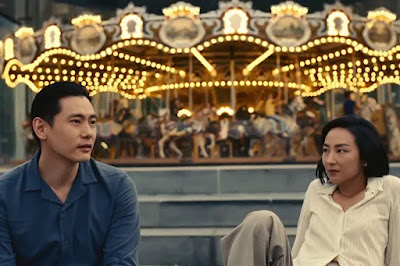
It starts at the turn of the 21st century, where two 12-year-old South Korean classmates’ friendship is teetering on the edge of romantic feelings. They sit close in class. They talk on their slow walks home. Their moms arrange a date in the park. She cries after getting a lower grade on a test than she’d expected, and he calmly stands there, awkwardly, silently, supportive. It’s all very sweet and cute, a first blush of real, deep connection in a pre-adolescent way that arises out of affection and proximity. When her family immigrates to Canada before the next school year, they don’t see each other, they don’t speak, they don’t stay in touch. More than a decade passes. The movie’s main drama—softly spoken, precisely observed—happens in two following parts: a fleeting long-distance friendship, and a long-awaited reunion on the streets of New York City a decade after that. In their mid-thirties for the film’s present tense culmination, she (Greta Lee) is a married American, and he (Teo Yoo) has just broken up with his girlfriend back in Seoul. The emotional tension swells through the two time jumps ellipsis, empty narrative space we fill in with the context clues, and the nuanced performances in which whole decades well up through body language and eye movements, as every silence swells with the unspoken.

Though it has the raw material of overheated melodrama, the confident grace and simplicity of writer-director Celine Song’s debut feature carries off a poised empathy. It’s not building to the stuff of high drama, but of small realizations, shifts in thoughtful connection, self-knowledge, and lost potentials. It embodies the melancholy wonderings of a wandering mind, traveling back to those moments in life where another choice would’ve taken you an entirely different direction. This isn’t even a movie about regrets, per se. Her husband (John Magaro) is as well-adjusted and empathetic as you could ask. This allows for a movie about the headspace a reunion can generate—and Song’s sensitive writing and cozy filmic lensing allows for the characters to explore their complicated emotions kicked up by the grown person before them being simultaneously the tween they once knew, and a stranger they’ve never known. They see some lost part of themselves reflected back in a stranger’s eyes. The movie’s generous enough to play that out with compassionate contemplation, and the final emotional release is all the more potent for it.

Retired: INDIANA JONES AND THE DIAL OF DESTINY

The most incredible part of Indiana Jones and the Dial of Destiny is how quickly it promises little, and how thoroughly it proceeds to under-deliver even on that. The deficit of imagination starts from the first shot. Remember how Spielberg’s great adventure serials would always immediately signal their exuberant visual playfulness with clever transitions out of the Paramount logo and into the action in ways that cue us to the fun to follow? Raiders of the Lost Ark fades from the studio’s painted mountain to an actual one—a flourish announcing an exciting adventure filled with cleverness. Temple of Doom goes to an engraving on a gong—the better to tell us the following will be loud, splashy, over-the-top clamor. Last Crusade fades into Monument Valley—a Western throwback telling us it is back in the zone of a comfortable lark with real imposing danger—while Kingdom of the Crystal Skull reveals a gopher hill—the better to signify the following picture will confound expectations with a mix of the self-referential and self-critical. Dial of Destiny, a much belated sequel helmed by James Mangold, and for which the raison d’ĂȘtre seems to be simply to cash in on one last chance for 80-year-old Harrison Ford to wear the fedora and wield the whip of everyone’s favorite action-archeologist, does something else entirely. New corporate owners mean we first see the Disney castle. Then we see the Paramount logo, followed by the Lucasfilm crest on a black background. We then cut to: a suitcase. There’s no attempt at making it a clever fade in or even a cute match cut. It just starts. I know it seems a small detail on which to focus, but the longer the movie went on, the more it seemed to typify the whole approach. Here’s a movie that cues us right from frame one to expect less.

The only one giving his all in this fifth and presumably final Indiana Jones movie is Harrison Ford. Every unadorned close-up of his aged face is full of pathos and experience that sells years of adventuring nearing its end. He’s now mostly done with field work, on the eve of retirement from his professorship, and feeling out of place in 1969. But of course a MacGuffin from his past—an ancient Grecian dial that just might have something to do with time itself—is suddenly the source of eager hunting from an ex-Nazi (Mads Mikkelsen, perfectly slimy) who’s hoping to beat a younger rogue archeologist (Phoebe Waller-Bridge, gratingly insincere) to its enormous powers. Good old Doctor Jones is the only one who can help. Or get in their way. Or both. It takes a long time for Indiana to get back in the whip-cracking spirit, and he often is without his trademark hat. He’s really, truly tired of all this. (There's nothing on that idea wasn't said more elegantly and effectively in Crystal Skull. We're in repeat territory here.)  But save the world he must, though Ford’s better at sympathetically selling the weariness and reluctance now than the hard-charging action, which is left to a de-aged CG version of himself in an interminable flashback prologue or computer-assisted stunts in the present tense stuff.

Mangold, whose Logan and 3:10 to Yuma show he can make sturdy adventure elsewhere, does this no favors by shooting everything too close, and in a phony digital sheen slathered over, while cutting quickly with modern zippy animated stunt people. Early limp chases on a train and through a parade look so false and play so low-energy it’s hard to get the pulse up to care. The Foley work might be the familiar thwacks and thunks with each booming punch and echoing gunshot, and what a treat to hear John Williams once again scoring a movie with his lush orchestrations. But the pacing is all off throughout—too smooth and routine and so blandly choreographed that it all slides right off the eyeballs in an instant. Ford is the only element that feels real, even and especially when everything’s growing flimsier around him. There are a few fine gambits here—the fantastical final act, especially, is bound to be divisive, though I liked it, if more for the attempt than the weak execution. But this whole movie is weak like that, simply tired and underdeveloped thorough and through. It’s loaded with clunky plot points, scarce characterization for most side characters, and with barely an interesting image, let alone a compellingly staged action beat. Previous Indiana Jones pictures were rollercoasters. This one just coasts.

Monday, June 26, 2023

Starred Up: NO HARD FEELINGS

Jennifer Lawrence is a Movie Star. If a dozen years of good performances in all sorts of genres, including anchoring the Hunger Games franchise and her multiple trips to the Oscars weren’t enough to prove that, here’s a new strong piece of evidence. In No Hard Feelings, she takes a character that’s slightly ridiculous, in a plot that’s a bit of a stretch, in a screenplay that’s a little undercooked, and filmed in a generic style, and edited to just-the-plot functionality, and easily commands the screen every step of the way. She makes the movie worth seeing. Now that’s a star. She lifts the familiar and the awkward into something entertaining, and even finds some honest sentiment in it all.

Her character is a struggling Uber driver who gets her car repossessed, so she answers an ad placed by a wealthy couple (Matthew Broderick and Laura Benanti) who want a young woman to date their shy 19-year-old son (Andrew Barth Feldman) and “bring him out of his shell” before he heads off to college. If she can successfully seduce him, she’ll get a car. He can’t find out about the arrangement, of course. (Guess what’ll happen about an hour later?) The concept clunks and clanks as it falls into place, but Lawrence dances effortlessly across the lumpy writing and polishes every scene until it’s entertaining. Consider this exchange, in her job interview:

“I just turned 29. Last year.”
“So you’re 29?”
“Last year."
“And how old are you right now?”
“32.”

Lawrence makes lines like that sparkle with a blend of obvious half-joking deception and self-effacing sarcasm. At first, her character—though teetering on the edge of desperation—comes on way too strong, a broad burlesque of feminine wiles that purposely falls totally flat, wriggling in tight dresses and leaning into obvious innuendo. It’s only when she stops trying that something softens up inside her and she can’t quite bring herself to break the boy’s heart. Lawerence sells both aspects, a quick witted desperation turning into flailing false seductiveness becoming something low-key real and charming. She elevates the material with a quicksilver timing—when told the boy’s going to Princeton, she nods and deadpans “heard of it”—that surfaces class consciousness and real connection alike.

That the movie never quite becomes a hard-edged romantic comedy is for the better. Her boyish co-star is an endearing dork we might actually care about. His awkward charms and slow-thawing shyness are played real, and not judged. But what is judged is his cocoon of privilege. The movie’s dancing a tricky line there, and it’s Lawrence’s generous, and generally real, interplay with his insecurities and ignorance alike that makes a fine counterweight to all the ways these scenes could be played wrong. She makes it almost believable this over-the-top comic premise might leave these characters slightly better people by the end. Even when the movie takes an idea to excess—neither ostensibly comedic scene of clinging to the roof of a speeding car works, though the nude fight scene is a so-bold-it’s-funny total commitment to a bit—the filmmakers are lucky they have their star just barely holding the whole picture together.

I couldn’t quite believe that I was nostalgic for this sort of movie. Here’s an R-rated relationship comedy shaggily assembled and thinly plotted, perched entirely on the charisma of its famous lead and the general likability of its supporting cast. Ten or fifteen years ago this would’ve been par for the course—every few months you could expect one or two just like it. Now, though, when the big screen is often missing Movie Star personality pictures, not to mention comedies without guns or fantasy conceits, a movie like this is a breath of fresh air. How nice to see a movie in which the only real failing is its occasional preposterousness of behavior and some formulaic plotting. At least it’s the kind of preposterousness that’s trying to entertain at a human scale, and the formulas are old enough to feel like long-lost friends. Oh, here’s where she develops real feelings for the mark. Ah, here’s the moment when the secret’s revealed. Oh, here’s the reconciliation. How nice. That such sweetness can emerge from a filthy concept is not news, but here director and co-writer Gene Stupnitsky (in a vast improvement on his painfully awkward Good Boys) makes it feel fresh enough just by letting it happen again. It helps that he trusts entirely in Lawrence’s star power to elevate everything around her. She sure does.

Friday, June 23, 2023

Story Telling: ASTEROID CITY

Asteroid City is something of a skeleton key for Wes Anderson’s approach to filmmaking. It consistently tells you the whole picture is artifice all the way down—and surfaces genuine emotion on the regular anyway. That’s the Wes Anderson way. He’s always doing that—using his dollhouse designs, symmetrical blocking, picture-book precision, handcrafted effects, nesting-doll framing devices, play with aspect ratio, and deadpan witty dialogue to dig deeply into ideas and emotions that hit all the harder for having been approached slyly and indirectly. An audience can be dazzled by the parade of delights he seemingly unfolds with great whimsy, only to realize the subtleties and nuances of the earnest, deliberate intentionality behind his grand designs. Detractors who misinterpret his methods as shallow affectation or meme-worthy ticks or airless style betray only their own lack of depth.

For in a Wes Anderson movie, the apparent limits are what instead allow limitless capacity for deep contemplation. He presents us perfectly designed jewel box settings and finds his characters’ melancholies radiating, uncontainable, as they, and we, are forced to confront the messiness of art, science, family, religion, sex, violence, and everything that makes life. After his Grand Budapest Hotel found bittersweet endings in its screwball capers and romantic nostalgias cut short memorialized by a writer’s work and The French Dispatch an anthology of aesthetic reveries in a funereal tribute for a magazine editor—both pictures as political and elegiac as they are surface fizz—this new film foregrounds its form and telling even further. In so doing, it also furthers Anderson’s commitment to exploring the power of storytelling—not as a pat inspirational cliche, but as the vital stuff of human existence.

Of course a playful movie so deeply and delightfully engaged in ideas about how we explain ourselves to ourselves, and how our senses of identity and purpose are constructed, would be self-conscious as it searches for deep meaning. The movie opens on a host (Bryan Cranston) telling us we are about to watch a rehearsal for a play. In boxy black-and-white framing with theatrical lighting, we see an author (Edward Norton) at a typewriter, and the large cast assembled, and the rigging and stagehands and fakery in the wings. And then, as the story-within-that-story begins, it transforms into widescreen color full of its own artificial tricks—matte paintings, miniatures, stop-motion, and a small town where every window and door is its own proscenium arch. Here, at Asteroid City in 1955, a quaint nothing town in what’s cheerfully described as “the middle of the California, Nevada, Arizona desert,” we find a troop of Space Cadets with parents and a teacher along for a Star Gazing meetup around an ancient asteroid. The tiny motor lodge with individual cabins, next to a gas station and across from an observatory, is just another stage on which life can play out its little eccentricities.

At the center is grief, with a sad photographer father (Jason Schwartzman) telling his nerdy teen son and three cute little daughters that their mother has died. Their grandfather (Tom Hanks) is going to meet them there and drive them home, a necessity because the car just died, too. C’est la vie. It’s building a picture of a world where, no matter how much we seek to quantify and contain, people die, machines break, and the universe never loses its capacity for surprise. A mechanic (Matt Dillon) confidently tells the family that there are only two possibilities for what’s wrong with the car, only to quickly run into trouble and declare that the problem is “a third thing.” (Late in the picture, a character will matter-of-factly comment on a makeshift invention: “Everything’s connected, but nothing’s working.) More than once, a character asked “why” will respond with “It’s unclear.” And as we track back into the black-and-white world for expressionistic reenactments of the dramaturgical process, one actor will admit to not understanding his character or even the play itself. His director tells him, simply, “keep telling the story,” a phrase of advice that radiates back down into the fictions-within-fictions, and back up to us, too.
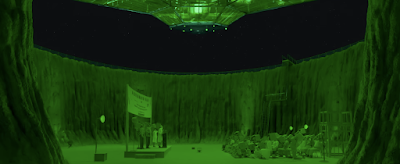
The look and tone is a fine blend of mid-century influences—Western-themed architecture and vintage technologies and designs and non-stop cowboy folk songs wafting over the town’s radios—and reflexively playful about the kinds of melodramas, both abstract and overheated, that a mid-50s writer might conjure. Knowledgeable audiences might clock the relation to the sandy sunlit widescreen staging of John Sturges’ Bad Day at Black Rock or the Technicolor small-town anxieties in Vincente Minnelli’s Some Came Running, not to mention Thornton Wilder and Samuel Beckett and Tennessee Williams and Arthur Miller and so on. (The town also has a roadrunner who chirps “meep meep,” a fine cartoon wink to foreshadow and top off the drama’s impending dusting of sci-fi elements.) And yet, for all this meta-text, we’re seeing a television special inside reenactments inside a rehearsal inside a production about a fictional town populated by dreamers and actors and schemers and scientists, every layer lost in losses and daydreams, grief and preoccupations. Perhaps an ecstatic peak of all this is when a kid performs a song, and as his classmates and teacher join in the dance, we see they’re being watched on a closed-circuit television. It’s all performances within performances.

Anderson keeps these meta-fictions spinning as an expertly choreographed and brilliantly staged nesting doll of fakery. It layers the colorful whimsy of its central story—the Star Gazers and the locals are soon trapped in town by a bizarre series of events, Close Encounters by way of Buñuel—in fictions and their tellings. It allows the movie to access both the charms of its simply plotted southwestern magical realism and its characters’ aching emotional issues, and the dizzying effort the telling. It gets at fiction itself—stories we’re told and stories we tell—and how we can get lost in it by giving ourselves over to what’s real truth within them—even kitsch, even obscure artful gestures, even when we’re unsure but “keep telling the story.” The film finds all kinds of rituals—religious sentiments, scientific methods, philosophical musings, method acting exercises, military orders, keynote addresses, backstage gossip—and notices with great melancholic empathy we’re all looking for, or clinging to, something that’ll explain our place in the vast mysteries of the universe. We need to find ourselves in the right story.

Although many of Anderson’s prior pictures allow the audience to get totally carried along in a compelling narrative and invested in characters in his controlled style, here he utilizes the grinning delights of his aesthetics of geometrical camera movements and perpendicular staging to make us always aware we’re sitting on the fourth wall. (There are even fleeting eye-contacts with the camera.) And here’s the magic: I still cared, deeply, about the characters at even the deepest levels of the fictions. There are beautiful moments of performance and writing that suddenly bring tears to the eyes with their emotional honesty. Anderson’s ability to suggest with the subtlest shifts and swiftest shimmers of interiority, whole lives behind the eyes, deep wells of regrets and confusion, longing and yearning flowers beautifully. I know I’m watching an actor playing an actor playing a character—the movie reminds us constantly—and yet, suddenly, I’m drawn in by his grief, or her confusion, or his confusion. An actress (Scarlett Johansson) in the story-within-the-story asks to run lines with a new friend and suddenly those lines (a mere half-glimpsed excerpt of another story) are somehow moving, too. It’s marvelous, the entire movie constantly making hairpin shifts between cold cerebral conceit and warm sentiment—committing fully to both and serving the thoughtfulness of each equally. The whole movie is this magic trick only a master filmmaker could pull off. It’s deeply poignant and intelligently articulated, a heady blend of heart and mind. It’s a director delivering a disquisition on his style and its intended effects, that also lands those effects with the very best of them. We’re so lucky to have Wes Anderson telling us these stories as only he can.