In Paul Thomas Anderson’s One Battle After Another multiracial leftist militants and conspiratorial white supremacists share a love of codewords, rituals, purity tests, and in-fighting. In fact, they’re so concerned with their own inner workings, that we see the actual plot of the movie is an almost inconsequential side-story to these groups’ larger aims. Without drawing a false equivalency, or even clean lines of ideological dispute other than clearly preferring the doomed progressive impulses to the drooling cartoon evil of racist authoritarians, the movie becomes a picture of a well-intentioned father-daughter pair just trying to survive. “I don’t get angry about anything anymore,” says the man, a former explosives expert for that leftist terrorist organization who now spends his days in hiding smoking weed and worrying that the government, or his ex-wife, will come knocking at the small house he shares with his teenage daughter. One gets the sense that so much fear and anger has passed in the decade-and-a-half of hiding that he’s just tired of caring. He just wants his daughter safe.
It makes for an electrifying contemporaneous American film. Anderson uses imagery of immigration raids, paramilitary invasions, and police harassing protestors as so much vivid, dangerous backdrop to a quite simple chase story embellished with literally sensational filmmaking focused on a roving camera, booming sound, and sequences chockablock with eccentric characters down to the smallest bit parts. It’s a lot of movie: a big, filmic beauty with exacting set-pieces and satisfying spectacle. Even so, Anderson swerves from the expected. It opens with what appears to be a doomed romance between Rocket Man (Leonardo DiCaprio), a slightly off-tempo activist, and the imperious militant Perfidia Beverly Hills (Teyana Taylor). She casts a strong impression as she almost instantly becomes a more complicated, hard-edged character who first secretly betrays him, then allows her hair-trigger propensity for violence to put her in a position from which she rats out the group. For appearing only in the prologue, her complications—and struts and stares—linger over the picture. She, and the dizzying political backdrop, is refracted in the relatively small story that follows as it’s blown up to epic proportions. The paranoid ex-radical DiCaprio is separated from his daughter (Chase Infiniti) when a paramilitary strike force (led by a wacky intense Sean Penn) takes over their small town in an immigration raid intended as a distraction for a personal revenge extraction.
What follows is an overflow of action and activity, dense sequences with constant detail and movements, by turns sharply satirical and propulsively suspenseful, sometimes in the same moment. Somehow it manages to be a biting political cartoon, a hard-charging suspense picture, a bustling tossed-off portrait of marginalized communities, and an earnestly sentimental father-daughter picture. The result is a deeply on-edge hurly-burly whirligig of a picture, at once sweeping and small, chaotic and contained, wickedly raucous and righteously angry. DiCaprio floats through the chaos, pushing through the haze to find the right passwords and coordinates to rendezvous with his daughter, and to avoid the personal vendetta of the evil Colonel Jockjaw (the names are pure Pynchon, whose novel Vineland loosely inspired the movie). How dreadful to see the villain is emboldened to use the cover of law enforcement to selfishly chase the ghosts of his past and find favor in the secretive suits who literally lurk in underground layers. It’s in the dichotomies that the movie holds its bold, slippery power. Here a country is slipping into authoritarianism and tearing itself apart, between the boot heels hoping to stomp and the wide variety of resistance that pushes back. One group of radicals exits as others are born. One villain is taken down, but the system remains. There’s no winning the war, just the next battle, and the next.
It becomes a movie about the legacy of struggle and division that each generation leaves for the next, this American life as a constant messy push-and-pull for progress in the face of old-fashioned backlash and repression, and those who’d use the struggle as excuse to wreak havoc. It’s also a movie about how caring for individuals is always better than centering violence. The latter is ideology as power; the former is real power. Consider the squabbling pedantic radicals on a circular hotline juxtaposed with the chill warmth of Benicio del Toro’s calm karate master who casually floats through his city’s underground communities, a steady center around which much activity orbits as he’s offering aid around every corner. (A long wandering take through his underground railroad’s maze of doors and corridors and tunnels as he confidently takes care of business while DiCaprio unravels behind him is a highlight.)
I wish the movie had more time for its choice supporting players. Anderson’s usually so good at elucidating complicated relationships, like in The Master’s cult-leader-and-convert or Phantom Thread and Licorice Pizza’s romantic infatuations as power plays. But here they just breeze by. Only Del Toro really pops, and there’s entirely too much Penn, and the rest of the ensemble (from Regina Hall to Alana Haim) is just evocative fleeting impressions. I especially wanted to know more about what drove the father, and the daughter’s political perspective, and how they filled regular days. But the strong shorthand of Chase Infiniti’s rooting charisma, a blend of vulnerable and inviolable, and the stumbling melancholic comic urgency of DiCaprio, high out of his mind, flailing around like a Millennial Lebowski, make for a sturdy through line as the camera’s elegant tracking shots and jangled score find laughter and twists in the live-wire energy of now. Through its wild comedy and dark action, it sees all manner of leftists are targets of civic violence from those wielding the force of quasi-military power, who are themselves split between matter-of-fact law enforcement and a collection of loose-cannon militias and bounty hunters. By the end, the only hope is that the next generation will be even slightly better than those who’ve left them this mess.
Showing posts with label Alana Haim. Show all posts
Monday, September 29, 2025
Saturday, January 29, 2022
Road to Somewhere: LICORICE PIZZA
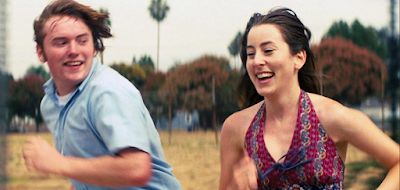
The main characters in Paul Thomas Anderson’s Licorice Pizza are a couple of young people constantly on the move. They seem to operate with the unspoken assumption: why walk when you can run? They’re running heedlessly into their futures on an abundance of youthful energy and naive restlessness. One, Gary Valentine (Cooper Hoffman), is a sweaty teenage boy with a crush. The other, Alana Kane (Alana Haim), is a twenty-something woman on whom he’s crushing. The fact that they are played by relatively fresh newcomers—he’s Philip Seymour’s son; she’s in the band Haim with her sisters, who play her sisters here, too—gives the movie a genuine sense of fumblingly appealing youthful discovery and charisma. The two of them fall into a funny friendship, finding themselves simpatico in the ways his precociousness (he’s a child actor using his money to start dubious entrepreneurial ventures) and her failure to launch (she still lives at home with her parents) meet. There’s a charge of attraction on his part, but she holds him at a distance from that. They simply enjoy their time together as friends, roaming around California’s San Fernando Valley in the early 1970s. He’s a wheeler-dealer, 15 going on 50, falling into one attempted money-making scheme after the next. She’s not sure what she wants to do with her life, so happily falls into his orbit.
Anderson unfolds their converging and diverging stories through a loose collection of shaggy anecdotal episodes. It’s a movie about that awkward time between when high school seems hopelessly juvenile, but the adult world is still held at a remove of skepticism. As is so often the case with young people, they test their sense of self in every moment, adjusting based on circumstances, comparing to people around them, blustering and bluffing to get by, or receding in the face of a more dominant adult presence. Here is a string of events—by turns funny, yearning, oddball, and suspenseful—that brings these young people’s sense of self more and more into focus for themselves. It’s a process still in motion as they run to the final credits. Through them we meet agents, actors, casting directors, teachers, teenagers, producers, politicians, chaperones, hosts, assistants, parents, siblings, salesmen, restaurateurs, photographers and more.
This assemblage of interesting faces and eccentric personality types is warmly carried out by a wide-ranging ensemble of character actors and marquee names (including Bradley Cooper, Tom Waits, Sean Penn, Christine Ebersole, John Michael Higgins, and Mary Elizabeth Ellis). We see each new situation with these various complicated and problematic adult figures through the eyes of our leads. Anderson situates them in a world of flawed or otherwise half-formed aspirations as they scramble toward maturity in the shadows of showbiz. Despite centering the couple, there’s an egalitarianism to the various sequences, a sense that every character on screen is a full, rich, interesting figure in and of themselves. Even people appearing for one or two scenes carry the sense that we could follow them off into an equally enjoyable film all their own. This gives the movie a full sense of lives in motion—pushing forward through emotions and encounters that our leads are working through to get to…somewhere. They’re figuring it out as they go along.
This loose, shaggy one-thing-after-another Anderson gives the proceedings matches his project—from Boogie Nights and There Will Be Blood through The Master and Inherent Vice—of treating intimate character pieces with the sweep and detail of a historical epic. The twinned comings-of-age here also fits in with Anderson’s other awkward, inscrutable relationship semi-comedies, like Punch-Drunk Love and Phantom Thread, although that’s also a common thread through his films. I suppose that might make Licorice Pizza a quintessential Anderson effort. It has a long-lens close-up approach, a dazzling specificity of character foregrounded amid casually perfect period recreations that fill the frames around the central focus. Here the 70s swagger of vintage tech and indoor smoking, of burgeoning pop culture happenings and gasoline shortages, is just a fact of life for the characters who try to find their way into who they’ll become. There’s an aimless free-spiritedness to the hustle—and a squinting toward possibility that never quite arrives.
Anderson gives the movie that touch of Altman—long noted as one of his favorite inspirations—with whipping up an ensemble of controlled chaos. Sequences in schools and restaurants, parties, shops, and offices spill rough natural jumbled life out of relaxed wide frames that are casually composed. And yet their filmic beauty effortlessly guides an audiences’ eye with a steady hand and a generosity of spirit. There’s a sun-dappled grainy romanticism of the past, carried aloft on a steady stream of vintage records, and a cool-eyed present-tense perspective knowing these characters are as-yet unformed. The characters may not know where life will take them, but there’s fun to be had in watching them drift through it. In one of the film’s most exhilarating sequences, a delivery truck runs out of gas mid-trip, so the leads white-knuckle their way downhill, gritting teeth as they plunge through intersections and take tight turns. It is a movie, after all, about the exhilaration of coasting.
Subscribe to:
Posts (Atom)