Showing posts with label Dominique Fishback. Show all posts

Saturday, June 10, 2023

Less That Meets the Eye:
TRANSFORMERS: RISE OF THE BEASTS

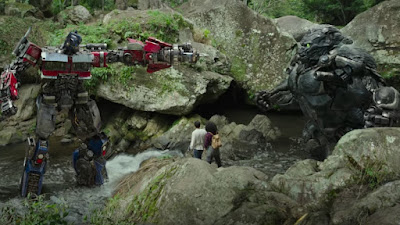
Let’s start by acknowledging that there’s a lot that’s just fine about Transformers: Rise of the Beasts. It has a capable director in Creed II’s Steven Caple Jr., who knows how to work with actors, deploy a needle-drop, and make the computer-generated effects for the eponymous extraterrestrial shape-shifting vehicles look passably personable and, more importantly for the Hasbro overlords, pleasingly toyetic. It has engaging leads in Anthony Ramos (In the Heights) and Dominique Fishback (Judas and the Black Messiah), who show a lot of star charisma as they occasionally overpower the flimsy material and breathe a little bit of life into cliched figures made up mainly of characteristics needed for plot utility. He’s an electronics-expert ex-military underdog with a heart of gold; she’s an ambitious museum employee dreaming of making an archeological discovery. They each get little moments up front to look something like real people before they're thrust into the explosions. That’s all fine. There’s also a decent use of a 1994 setting to allow for the plot to bump into some old tech in the set and car designs, and play era-appropriate hip-hop on the soundtrack—Digable Planets and LL Cool J get satisfying showcases. It’s also the right time period to introduce the Beast Wars characters, 90s-era Transformers that turn into animals. I can’t complain about any of that. These are good ideas deployed in largely non-irritating ways. But, as barely a sequel to the Bumblebee prequel and only vaguely a prequel to the original Michael Bay Transformers, the whole movie is pinned in by that larger overall sense of indecision.

Say what you will about Bay’s work, it makes huge decisive choices about what to show—staging the central alien robots towering over their human castmates, hurtling through action sequences shot for heft and scale. Those movies, for all their chaos and confusion, grounded outsized spectacle with a real sense of gravity and space, always filling the frame with a flurry of activity across multiple planes of perspective, placing its giants in motion against backdrops of forests and skyscrapers and small streets and recognizable architectural features to consistently place us amid the careening clashes and explosions in a state of concussed awe. Rise of the Beasts doesn’t bother. It largely takes place in wide open places or in frames that barely explore the spacial possibilities of its enormous aliens. It hops around the usual MacGuffin chase—to get Optimus Prime and his Autobots home they need to beat Unicron’s minions to the trans-warp key! Yes, the trans-warp key! I practically shouted it with them at a certain point of peak repetition—every stop on the journey loaded up with rumbling quips and bland formula. Then it ends in the usual all-CG conflict in a bland, grey field of nothing in the middle of nowhere as a portal in the sky threatens to explode the world. It’s all curiously small, holding back from the excesses of Bay’s efforts—shorn of most of his high-impact militarism, the leering objectification, and the casual prejudices, but the process has also leeched the enormity of the fireballs and visual weight. The memorable fun, in other words. It’s just a play-it-safe, by-the-numbers franchise entry where all the good ideas are buried in the vague nothing of its aesthetic choices and narrative familiarity.

Sunday, February 14, 2021

Talkin' Bout Revolution: JUDAS AND THE BLACK MESSIAH

A key sequence in Judas and the Black Messiah is a rally in which a charismatic leader of the Black Panther party, Fred Hampton (Daniel Kaluuya), has the audience totally in his control. It’s the moment to which all emotional and dramatic through-lines in the tough, serious, and sensitive historical picture have built, and it’s the moment from which all of the major players are soon in position for the inevitable tragic end. His speech is a work of impassioned rhetoric, powerfully incantatory, delivered in commanding staccato and deep rumbling righteousness, sweat beading on his brow, building to climactic call-and-response. “I am! A revolutionary! I am! A revolutionary!” The crowd erupts, awoken with fiery political fervor renewed and refreshed. Among their number: Hampton’s pregnant fiancee (Dominique Fishback), his head of security (Lakeith Stanfield), and the FBI agent (Jesse Plemons) who has already put in motion the events that will, with information from a mole in the Panthers, bring this whole chapter to a bloody end. Told with the high-gloss appeal of any Hollywood true-story epic animated by politics, social upheaval, and startling tragedy — swooping camera, copious period detail, polished historicity, patient accumulation of cause and effect — director and co-writer Shaka King illuminates this pivotal moment in gripping characterization and mournful engagement.

It’s a Civil Rights story shorn of the usual white lenses that come with telling these stories at a level of studio prestige. (Not since Spike Lee's Malcolm X, really.) This film is alive with the particulars of injustice from the clear and angry perspective of the oppressed. Drawing the story in vivid recreation, King builds a portrait of a time through small spaces — intimate meetings, quiet dialogues, tense strategizing — as the Chicago headquarters of the Illinois Panthers slowly builds power. We see persuasive speeches, attempts to grow their base by teaming up with other mistreated groups in the city, time spent building programs for free breakfast for kids and free healthcare for seniors. We also see the growing suspicion of law enforcement, who somehow see the group as a challenge to their power — a reflection of violent racial and political prejudice. The film then positions itself at a point of view in the crucible between these poles. Caught impersonating an FBI agent in order to steal a car, a troubled young man (Stanfield) is hauled into the bureau’s local office and given an ultimatum: become a paid informant or go to prison for years. He takes the job. Thus he’s the bomb under the table, in the Hitchcockian sense, as he’s at first reluctantly, but then quite legitimately becoming a member of the Panthers. He was told they’re dangerous, but he sees the good they do and grows increasingly conflicted, torn between his growing political convictions and his sense of self-preservation.

As the film builds to its wrenching finale, King keeps the performances central to the powerful effect. We see the yearning for justice in the young men and women who are drawn into Hampton’s project. We see the older-than-his-years confidence of Hampton’s powerful presence; it’s easy to see why so many would place their confidence, their hope in him. We see, too, how he was made a scapegoat, how dogged the feds were in making him another figure to be brought down. Even if you don’t know your history, you know this story is moving nowhere good. With great clarity, the film consistently brushes past a legacy of easy historical assumptions and cliched Black Panther portrayals. King lingers generously in soft moments—a romantic interlude, an impromptu community restoration project, a poem gently read—before smashing into cruelty—a shootout with vindictive cops, or a vise-tightening moment of casual prejudice between high-ranking agents. The film is convincing in every moment, the ensemble so uniformly tuned into the tone of the endeavor. Its prestige pleasures of crackling design and grainy cinematography — Sean Bobbit catching beauty and grit with equally dexterous use of shadow and light — extend to a parade of great character turns in even small parts, like Lil Rel Howery in a fur coat like out of a blaxploitation classic as a shady dealer, or Alysia Joy Powell as a grieving mother. By centering the humanity of all the major players, and extending that grace to even one-scene figures, this becomes a film of impeccable craft that’s more than a reenactment; it’s an embodiment of these interpersonal stakes that exploded into something momentous for a movement.

Saturday, August 15, 2020

Weak Stream: MAGIC CAMP and PROJECT POWER

The latest Disney+ original is Magic Camp, a long-on-the-shelf theatrical castoff that was filmed three years ago, but plays more like ten. The thing would’ve been stale and behind-the-times even if it came out when it first was made. It stars Adam DeVine, from back when some thought he might turn a moderately appealing supporting turn in a couple Pitch Perfects, and starring role in an irritating Comedy Central show, into something like a leading man career. This was right before most big screen comedy stopped existing in any significant way, and also before his Jexi bombed hard. You can tell it’s a musty project is what I’m saying. Here he’s doing a milquetoast impression of the kind of role Jack Black would've turned down as a down-on-his-luck magician who agrees to be a counselor at a magic camp. (Think School of Rock if that was a bad movie.) He takes the job in order to compete with his much-more-successful rival, played with disinterest by Gillian Jacobs. There’s a lot of material about the campers that plays like mild sub-Disney Channel shenanigans and believe-in-yourself sentiment, and the stuff between the adults is the kind of half-amusing-at-best sitcom antics you might tolerate in syndication if you turned in a few minutes too early for the rerun you really wanted to see. (Remember that?) There’s a vague sense of low-key dissatisfaction radiating off screen, including Jeffrey Tambor, seen here pre-#MeToo allegations, who appears to be contemplating anything but the scene he’s in. No one really cares. It’s all flatly lit and sluggishly paced, with nothing engaging even threatening to happen at any point. The director is Mark Waters, whose good work on the Lohan classics Mean Girls and Freaky Friday shows he’s capable of more, but he’s clearly at the mercy of an undercooked, formulaic screenplay. (Anyone who’s seen Vampire Academy, a more recent effort, will understand how he’s not an elevator of subpar material.) The result is a big whiff. No wonder Disney held it back to quietly slip out into the streaming library of originals instead of making a big deal about it.

A little better, but not by much, is Henry Joost and Ariel Schulman’s Project Power over on Netflix. It has a good premise. There’s a new designer drug flooding the black market in New Orleans. The little glowing pills give the user five minutes of a random superpower. We get early action scenes like one in which a glowering Jamie Foxx alternately flees and fights a desperate dealer who turns himself into a Human Torch. A little later, cop-on-the-edge Joseph Gordon-Levitt (in his second straight-to-streaming high-concept thriller of the summer, after several years away from movies—it’s good to see him) chases a naked bank robber who has turned himself invisible. Luckily the puff of paint from the cash bag keeps him somewhat noticeable. These are fun ideas. The movie bounces between its lead characters for the longest time—and quickly includes a third, an imperiled teenager (Dominique Fishback)—who are all on the hunt for something. It has a fine where’s-this-all-going? interest for a while. And the filmmakers tackle the project with a stylish approach much like their superior Nerve, the entertaining social-media truth-or-dare thriller from a few years back. There are canted angles and vibrant colors and hip-hop interludes—a pounding back beat and a saturated neon look freely mixing with a graffiti and wet-concrete local color. It’s a delight to see for a bit. But the movie gets slower and slower as it goes, each subsequent ten minutes feeling like twenty, then thirty. I checked the time counter thinking surely I’d been watching for hours and saw it’d been barely 50 minutes. Not even half done. The characters grow less interesting as it goes, and the intriguing concept is drained of interest by formulaic moves. It’s never as clever or appealing as it should be. By the end, Mattson Tomlin's screenplay has drawn together its various plot strands for increasingly boring action sequences with lots of hectic cutting and loud noises failing to gin up additional interest. What begins with a colorful blast ends with the typical blurry genre nothing.