Showing posts with label Lin-Manuel Miranda. Show all posts

Wednesday, January 15, 2025

Pride Rock and Prejudice: MUFASA: THE LION KING

Mufasa is actually pretty interesting as a Barry Jenkins movie. It’s about community and family forged in opposition to societal pressures to segregate and denigrate. It’s about parents and children pulled apart and finding their ways back to a sense of normality. It’s about the power of legacy, and the cyclical echoes of generational struggle. It’s about a young person trying to find his way in the world, defining himself both with and against what the world tells him he should be. So it’s definitely of a piece with the thematic preoccupations of the director of tender dramas Moonlight and If Beale Street Could Talk and his broader, metaphorical Underground Railroad. It also has some of his visual interest in a camera that’s motivated by its subjects' movements, joined to their physicality and their interiority. It has some of those Demme-style head-on close-ups and supple, floating motion through its sun-dappled production design. It’s a Jenkins work through and through. You might have to squint a little to see it in this movie, and might miss it if you weren’t prompted to be on the lookout, but there it is nonetheless.

Consider that something of a miracle considering glimpses of heartfelt, recognizably personal material and approach are fighting their way out of the packaging of a prequel to Disney’s 2019 photorealistic computer animated remake of The Lion King. That nadir of the company’s current cycle of remaking its animated classics was a bizarre heartless photocopy—an often shot-for-shot re-rendering of the colorful and expressive big cat Hamlet that studiously sucked every ounce of life from the original hand-drawn lines. The inexpressive realism of the animals’ faces and understated voice performances continually clashed with the script’s high drama and low wisecracks, and the clunky weight and textures aping nature documentary style drained all oomph and pizazz from the musical numbers. Most everything that’s bad about Mufasa carries over from those original sins. That Jenkins—and usual collaborators like production designer Mark Friedberg, editor Joi McMillon, and cinematographer James Laxton, who are also bending the technology to their will as much as animatedly possible given the corporate constraints—gets so much thematic personality and stylistic touches through the sheer tonnage of mandated CG falseness proves he’s one of the strongest directors working today.

He does what he can to bring more personality into the animals’ expressions—and there’s some real progress there. The cubs are pretty cute. They actually emote this time, and the musical numbers have a better bounce and color—though songwriter Lin-Manuel Miranda is operating at about half his usual wit and catchiness. (That’s still considerably more than one could say for songs he didn’t write in Moana 2.) At least the movie’s telling a new story. Monkey Rafiki tells it like a legend to Simba’s daughter Kiara, the name a nice nod to the original hand-drawn Lion King 2. Here’s how Mufasa became the Lion King, and how his brother Scar became a scheming outcast, and how he met Sarabi, the lioness with whom he’d have Simba. It’s sometimes moving, sometimes boring, how it reflects the original with a story of a lost cub wandering in the wilderness and a villainous lion hoping to take control of the pride lands. If it weren’t for the Jenkins touches enlivening the lion drama and generational echoes, it’d be pretty flat. It still is sometimes, as it trudges through the dutiful, schematic plotting of Jeff Nathanson’s screenplay. But then there’s that extra tincture of soulfulness in the performances, a little more life in the staging of the animation. It’s not good, exactly, but it’s compelling to see it wrestle between its disparate elements, from relatively serious, engaged emotions to dull cliche. It’s a collision of intent between the earnest and the frivolous. (Consequently, Timon and Pumba’s more self-aware comic relief has never been more discordant, with references to Disney lawyers and the Broadway show.) As is, it’s an intriguing movie fighting valiantly to rise above the mandated mediocrities.

Thursday, December 30, 2021

Broken Homes: ENCANTO and FLEE

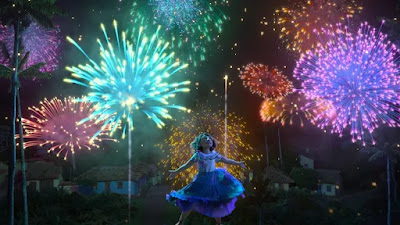
Encanto is an atypical Disney animated musical. Sure, it has the twirling and singing and magic and cute kids and animal sidekicks. But it’s also curiously interior—literally and psychologically—concerning itself mostly with feelings of anxiety and insecurity among the enchanted family nestled safe, but not so sound, in a fantastical house in a small Colombian village. The usual Disney lively likable misfit protagonist is middle daughter Mirabel (Stephanie Beatriz), a plucky, curly-haired, bespectacled do-gooder who feels left out of the family specialness, since she’s the only one who wasn’t bestowed a magical power. The grandmother matriarch presides over their home with a glowing miracle candle gifted her out of the ether upon the death of her husband at the hands of marauders fifty years prior. Since then it’s filled their home with sentient floors and banisters, cupboards, counters, and stairs. And every other member has a gift to share—super-hearing, power-lifting, shape-shifting, plant-sprouting, medicinal cooking, weather-controlling, animal-talking, prophesying. 

The plot of the movie concerns Mirabel’s attempts to make herself valuable to the family by saving their flickering flame, suddenly vulnerable for the first time in decades. To do so, she’ll need to grapple with discovering various family member’s own insecurities, and learns along the way that she’s not the only one who feels pressure to live up to the family name and expectations that come with it. Each song, provided by Lin-Manuel Miranda with his usual rat-a-tat wordplay and love of rhyming rounds and recurring motifs, returns to this theme, with several characters given numbers that express their internal struggles, and a few group numbers full of family gossip about others’. This is strangely rocky territory for a bustling, busy animated musical—at once cramped and complicated—and it never really takes off like a Moana or Frozen. But what it has in spades is personality, bursting to the seams with side characters and flowing with seemingly authentic Columbian style—food and language and clothes and flowers exploding in colorful flourishes. It’s a thoroughly well-intentioned picture.

Flee is a far different animated experience in form and content—although, oddly enough, it treads some similar thematic grounds. It’s a story of a family threading to be splintered, and yet bound together by love. It’s about generational trauma, how good fortune in the face of long odds can become the root of insecurity. This one happens to be true. It’s a documentary animated out of necessity as it’s the testimony of an Afghan refugee who wished to remain anonymous. Because he’s an old friend of director Jonas Poher Rasmussen, he’s willing to give his testimony to the project. Provided the name Amin for the purposes of this film, he narrates the story of his happy early years in Afghanistan, and the sorrowful reasons his family decided to leave their homeland for Europe. Amin details a harrowing journey of a displaced child sent off from the only place he knew, tossed into the unknown. It gets all the more isolating when the family is splintered out of the necessities of various border crossings and asylum claims. Eventually he ends up a young person alone in Denmark, carrying so many painful memories and secrets that must be kept to ensure he stays and survives in this new country. 

Rasmussen sketches out the details by guiding in lovely, spare hand-drawn animation—fluid and simple, with soft colors, precise personal details, and evocative gestures—that conjures the gentle spirit and sensitive memories of his subject. The conversation on the audio stays at a relative even-keel, with Amin’s soft-spoken precision, and some subtle stumbling over the most difficult moments, carrying the narrative along. As he grows into himself, the journey of self-discovery is not only a refugee’s double-consciousness, but as a budding intellectual, and a gay man, he’s filled with reasons to feel apart from the others. Rasumussen helps to bring these complications to a full flowering, and the film becomes less a catalogue of struggles, and more a tribute to his friend’s resilience. Here’s a loving portrait of man’s ability to bloom where you’re planted, and to find strength in the very roots that might also be the source of one’s regrets and anxieties.

Sunday, November 21, 2021

In the Spotlight: MAINSTREAM, THE EYES OF TAMMY FAYE, and TICK, TICK...BOOM!

A fluke of pandemic scheduling found Andrew Garfield starring this year in a loose accidental trilogy of movies about ambitious people for whom others’ perceptions of them becomes their reality. In Gia Coppola’s Mainstream, he’s a social media influencer on the rise. In Michael Showalter’s The Eyes of Tammy Faye, he’s a televangelist in over his head. And in Lin-Manuel Miranda’s filmmaking debut adapting Jonathan Larson’s tick, tick…BOOM!, he’s a struggling young musical playwright hoping to finally get a break on the eve of his thirtieth birthday. Garfield appears to be working out ideas of stardom and success, artistry, ambition and attention, and these films give him different notes to play and conclusions to draw. It’s fitting for a supremely talented actor looking to find the best avenues for his atypical charisma.

His career so far has been one of the attractive young man who gets stuck between character actor and matinee idol. Either way, he’s always one to watch, from artful ease in the likes of The Social Network, Silence, and Never Let Me Go, where his stubborn wet-eyed self-seriousness forms a moral backbone, to shouldering Mark Webb’s underrated Spider-Mans with a loose-limbed moodiness that sets him apart from Maguire’s sturdy earnestness and Holland’s jumpy excitement. Stuff like the flat-footed war movie Hacksaw Ridge strand him between those modes, while the loopy pop conspiracy Under the Silver Lake tapped into a wilder streak that springs from a fount of wiry, wound-up interior intensity. The through line is clear: Garfield loves to perform. No wonder he’s been drawn lately to this material that interrogates that impulse, asks what people get out of that transaction, and sees all too clearly how it’ll hollow someone out if they aren’t prepared, just as surely as it’ll be a lingering frustration to never make it there to begin with.

Mainstream is an underwritten modern Network that noodles around Big Ideas about How We Stream Now without ever quite getting to a point. Somehow Gia Coppola, in her follow-up to her level intimate teen drama Palo Alto, is content to swirl up a storm of ideas and moods and leave it at that. Garfield plays a free range prankster whose antics catch on through the help of a bartender with a crush on him (Maya Hawke), and eventually the two get hooked up with a promoter (Jason Schwartzman) who’ll fake their way to the top of the viral charts and all the promoted content that implies. Of course it spirals out of control, fame going to the head, power corrupting, and underlying mental problems compounded, as the feedback loop between audience and star grows precariously thin. But even if the general spirit of the thing has a bleeding-edge bite, the scenarios it concocts are never convincing enough to underpin any serious social satire, from an interview show that literally puts its clownish lead between Johnny Knoxville and Logan Paul to some kind of YouTube gameshow—called “Your Phone or Your Dignity,” natch—that looks like something Paddy Chayefsky might’ve put in a first draft. It’s all so much glitter and flailing, but Garfield’s wild-eyed gesticulation sells that dead-eyed striving you see creep into these wannabe pseudo-celebs from time to time. It ends with everyone involved worse off in some way, and a towering close-up of Garfield grinning like a maniac while he’s applauded, as if to say, that’s showbiz, folks.

The Eyes of Tammy Faye
is a more believable look at this kind of boom and bust celebrity. The film is based on the true story of televangelists Tammy Faye and Jim Bakker, played here with sunny surface cheerfulness and an undertow of sadness by Jessica Chastain and Garfield. They inhabit them with a cheery artifice and cheek fillers. The result is a serious character study with a slight satiric streak as it watches their scrappy rise and eventual entanglement with evangelical corruption that brings them down as scapegoats while letting the worse above them off free. Showalter, a long-time comedy pro, views his central figures with sympathy and skepticism, which sometimes softens the edges and holds them at a slight remove. The style, too, is a soft and pillowy look, a critique cushioned in unlikely blurred affection. 

 His film cares about them to a point, but doesn’t quite know how seriously to take their early intentions to spread the word of God. The couple starts young and passionate, speak softly and earnestly about their missionary fervor as they meet in Bible college and, quickly married, set out on a touring puppet show that catches the attention of Jerry Falwell (Vincent D’Onofrio) and his burgeoning Christian television network. It’s clear they like the spotlight and the trappings of fame as their show grows into a media empire. But the movie also sees the poignancy between the distance between who they want to be and who they actually are, the blindness in their conflation of their desires and the Lord’s. Garfield, especially, leans into the sleaze that can ooze in around the edges of such an ego. Ultimately the movie enjoys the silliness of Christian kitsch surrounding them—the outlandish 80’s hair and makeup mixed with reverential semi-country ballads that are sticky as hell—while allowing for the weight of semi-secret struggles within the community—especially the plight of women and gays. I found an improbable amount of empathy for these two despite their obvious shortcomings, since eventually they’re as much victims of this system—typified by a slimy Falwell—as they are victimizers within it. Chastain and Garfield are capable of showing the pained souls underneath the layers of fakery.

Garfield’s at his best, though, in tick, tick…BOOM! Here he inhabits the bohemian energy animating a frustrated artist who believes entirely in his talent, but has run aground on worries he’ll never break through with it. You can see that tension in his posture, the moment where the carefree drains away, leaving that do-or-give-up sense of now or never. In Larson’s semi-autobiographical show, the future writer of Rent is on his eighth year working in a diner while struggling to complete a sci-fi musical opus. (That we know the real Larson would die before Rent opens gives a melancholy layer to this youthful work.) Under the direction of Miranda, it becomes a kind of doubled vision of aspiring theater-making. He knows of musical workshops and the difficulty in honing a massive vision to a kind of pop theatrical purity. (One sees his capable direction in this feature and might think, gee, does the creator of In the Heights and Hamilton need to be a solid filmmaker, too?). 

Told through the kind of conversationally anthemic songs that would make Rent itself such Gen X lightning-in-a-bottle, the musical plays out in greasy booths and corner offices, cramped apartments overflowing with struggling artists and practice spaces warmly lit. Garfield sits at a piano and invites us into his mindset—a frame story that snaps into place with a softly moving reveal near the end—while a backing band croons support. He takes us into anecdotes as he drafts songs and scrapes together money, tries to get his agent to call back, juggles friendships and romance, and, yes, takes shifts serving coffee and toast to dismissive diners. Miranda balances the tone between realist and theatrical and Garfield straddles both admirably, able to dive into an artificial flourish of magical realism as his character’s Broadway mind imagines his surroundings out into stage lighting and prosceniums, or hunker down on the arm of a tattered couch to extemporaneously sing his feelings. The rest of the cast (Alexandra Shipp, Robin de Jesus, Vanessa Hudgens) capably follows along as a swirling ensemble of influences, supportive yet clear-eyed. The songs are strong; the dynamics are believable; the small flights of fancy are a window into a writer’s mind where everything can be material. The constant across scenes is the simmering suspense of doubt that’ll be painfully familiar to anyone who has ever felt stuck in a life of artistic interests, in that awful double-bind of needing experience to get recognition and recognition to get experience. He just needs a break. The clock’s ticking.

Friday, August 13, 2021

Call of the Mild: JUNGLE CRUISE and VIVO

Jungle Cruise is a throwback to a throwback to a throwback. It’s Jaume Collet-Serra’s Stephen Sommer’s Steven Spielberg’s homage to adventure serials. And then there’s a whole lot of other recent(ish) live-action Disney adventure movies — Pirates of the Caribbean, National Treasure — thrown in on top of the fact it’s loosely based on an attraction from Disneyland et al. The wonder is that it works at all. The jaunty opening has much promise. It’s 1916, a time when a story like this would’ve made fine pulp magazine reading. We find a scrappy woman explorer (Emily Blunt) infiltrating a stuffy old boy’s club scientific association in jolly old London in order to heist an artifact that will lead her to a magic flower deep in the Amazon. There’s some clever sneaking and light fisticuffs, ending with a near-pratfall involving a window, a ladder, and a double decker bus. Neat. From there, the whole set up is archetypal adventure fun as it goes through some stunt-show paces. To the plucky woman we add her persnickety posh brother (Jack Whitehall) off to the jungle where they hire a punning, slumming skipper (Dwayne Johnson) willing to hire his ramshackle boat for their purposes. Hot on their tail: the Kaiser’s U-boat-captaining son (Jesse Plemons) who speaks in a loopy accent and talks intently with wild animals; and some gloopy undead conquistadors who look like rejected designs from Verbinski’s Pirates.

So the variables are there for a fine adventure, every cog in place. Even the thin, vaguely African Queen dynamic plays off some light crackling dialogue at first. Johnson does sturdy, unsurprising work as a steady rock, while Blunt wears the pants in the transaction, and the character actors spin around the margins to keep the plot and the comedic relief puttering along. There’s a baseline competency here, surely courtesy director Collet-Serra, who, with smaller genre efforts from the disturbing adoption horror story Orphan and economical shark attack picture The Shallows to a string of Liam Neeson’s best thrillers, often does more with less. Here, though, in the grinding machine of the biggest studio around, he ends up doing less with more. As the movie goes on, the stunts get less focused on charming old school pleasures like dangling from ropes and swinging off boats, and more on endless CG haziness and weightless peril that drags on and on. By that point the characters have never really sparked with personality beyond the surface appeal. Even the increasingly boring puzzle that is the central quest — it’s both too simple to care about, and too complicated to figure out without arbitrary exposition — never generates more than a token amount of suspense. The fizz goes out of the confection way too early and then you’re just stuck watching the animatronic figures passing for people as the screenplay’s stiff hydraulics makes them herk and jerk. The whole thing is dopey and baggy and corny and chipper and artificial. In other words: it’s a theme park ride. Guess that’s the point.

Somehow Sony Animation has been more consistent about letting the distinct personalities of its filmmakers shine through their projects. Earlier this year was the charming, hectic, sharply funny The Mitchells vs. The Machines, which definitely fits the Gravity Falls sweet-and-silly creepy-and-clever mold from which its makers hail. Other high points include Spider-Verse making comic panel sense out of CG swoops. Even the Hotel Transylvanias have been an interesting push-pull between the cartoony look of animator Genndy Tartakovsky and the hangout vibe of star Adam Sandler. The studio’s latest is Vivo, the story of an adorable kinkajou, a small critter that looks like a cross between a monkey and a raccoon. He performs with an old busker on the streets of Havana. If you didn’t go in aware this was a Lin-Manuel Miranda musical, you’d know the instant the animal opened its cute little mouth to sing-rap his way through an introductory song. It gives the movie that distinct wordy patter and lilting melodies that made Hamilton and In the Heights such good song scores. Sure, Miranda’s seemingly been everywhere the last six or seven years, and sometimes crosses over into the omnipresence that invites backlash — or at least people growing tired of his formula — but I still get a little musical theater lift out of his syncopated enjambment and complicated rhymes. Vivo feels like his work through and through, from its loners longing for belonging, to families struck with loss, and communities coalescing around what makes them special. That the screenplay is credited partially to Quiara Alegría Hughes, Miranda’s Heights co-writer, makes that continuity all the more apparent.  

The plot here is pretty standard kids’ movie stuff, but it’s done up in pleasant style and set to a fine beat. Vivo’s elderly owner gets an invitation to attend the final concert of his old unrequited love, a famous singer who moved to Miami when they were younger. He can’t make it, for sad reasons, but Vivo gets his hands on a love song the man wrote for her explaining his true feelings. So it’s up to the kinkajou to get it to Miami himself, reluctantly tagging along with a rambunctious tween Floridian to get there in time. The simple story jets through the Everglades, meeting other animals along the way, while the girl’s mother gives chase, and the big concert draws nearer. The whole thing has the hurry-scurry energy of some Pixar-style moves, without working up to that level. And there’s never much sense that the ending’s in doubt. But, however thinly drawn, the designs of the characters are cute, and the look of the animation is painted in popping primary colors. And there’s a zip to its plotting that seems to understand the story is simple and the motivations are broad. Even when it leans down hard on sentimentality, there’s plenty of time spent in a sweet spot of cartoon silliness and unexpected little gags. (I liked a despondent love-sick bird, and, elsewhere, some overzealous Girl Scouts in pursuit of our leads.) There’s also the bouncing energy from consistently apportioned musical numbers keeping the project afloat. They may not be top-tier Miranda compositions (maybe the Moana vet is saving his really great stuff for his forthcoming return engagement with Disney Animation), but there’s a certain charm and cleverness to the Latin rhythms in music and lyrics. I couldn’t help but grin when an imaginative girl spins a swirling hallucination out of a dance track about following the beat of her own drum, or at a climactic number in which a speedboat zooms toward a neon Miami as different characters sing about running out of time. And in the end it’s a sweet-hearted all-ages movie about appreciating family you have and what talents you can share. It’s nice.

Friday, June 11, 2021

Block Party: IN THE HEIGHTS

At a moment when so many feel isolated, disconnected, left behind by the vagaries of a difficult year and a stratified society increasingly emphasizing everyone-for-themselves lonely responsibility, here’s a story of a neighborhood. It’s disappearing, in the process of getting priced out by gentrification, and in danger of losing its distinctive personality. That’s New York City for you. Lin-Manuel Miranda’s pre-Hamilton musical In the Heights tells this story, inhabiting the world of Washington Heights, where the Latin music flows  in melodious Spanish lyrics and salsa rhythms, and the food simmers as the people dream—some yearning for escape up the ladder of success, while others find comfort in the world they and their neighbors have built for themselves, a little bit of their home countries carried over into their American dream. The movie adaptation, scripted by the stage production’s co-author Quiara Alegría Hudes, is as broad and generous and alive as it is specific and well-observed. It’s a constant delight in its unfolding, a musical that leaves you feeling for the characters as much as humming the tunes on the way out.

All told, it builds to a moving expression of communal spirit and togetherness in a fountain of color and movement and dance, bringing each member of the cast to center stage for winning spotlight. The story — textured and swirling — takes place during a heat wave, and circles the concerns of a wide ensemble of characters. We meet Usnavi (Anthony Ramos), a young bodega owner who hopes to return to the Dominican Republic someday. He’s crushing on the pretty young stylist (Melissa Barrera) who enjoys her gossipy co-workers at the salon (Daphne Rubin-Vega, Stephanie Beatriz, and Dascha Polanco), but would prefer to be a fashion designer. Usnavi’s business-minded best friend (Corey Hawkins) is interested in the cute college girl (Leslie Grace) back for the summer visiting her entrepreneur father (Jimmy Smits). Elsewhere is the undocumented teenager (Gregory Diaz IV) and his alcoholic father (Marc Anthony), a sweet elderly woman (Olga Merediz) who plays abuela to the entire block, and a snow-cone vendor (Miranda) who harbors a resentment of the ice cream truck. They’re all interconnected, even when they don’t want to be.

As the intersecting dreams and dramas play out against the sizzling sidewalks and easy flow of the hip-hop merengue, the musical numbers strut out in broad, bold studio style, a modern Arthur Freed slick spectacle with a little break-dancing here, a little Gene Kelly there, a little Busby Berkeley everywhere. Director Jon M. Chu brings the sense of movement and space that made his Step Up 3D so beautifully expressive, and commits, with that series’ choreographer Christopher Scott, to showing the full glory of dancers in perfect synchronicity and deeply felt emotive power. Here a community pool becomes a glorious watery number Esther Williams would recognize, the side of a fire escape becomes the site of a couple so in love they could float up the wall, a subway becomes a tunnel of ghostly memories, and an apartment courtyard becomes a “carnaval del barrio.” The best numbers go on and on and I felt I could revel in their joyous eruption of togetherness for hours. The movie succeeds by tapping into the show’s empathetic imagination, proudly sensitive and sentimental befitting its pounding backbeat, but wise to cast a somewhat hard-edged eye on the limits of the American dream. After all, this neighborhood is slipping away, but the traditions will live on for those who dare to keep them alive. This movie loves this place and these people too much to let it go away unnoticed, and throws a massive block party of a musical to celebrate. What a well-timed ecstatic burst of a lively tribute to the restorative power of community connections.

Friday, July 3, 2020

HAMILTON Tells His Story

Hamilton is a pop culture phenomenon that lives up to the hype. All but the most insanely hyperbolic are exactly right: it’s a major work. Lin-Manuel Miranda’s hip-hop history musical inspired by the life of Alexander Hamilton takes Revolutionary War history and projects it forward and backward in style, giving it Shakespearean dimension and modern musicality. Like the Bard’s History Plays, it’s a moment of our national story fitted to our times as a mirror and a comment. This is where we were, as told by where we are. The sung-through musical, written in verse dense with intricate clever rhymes and swirling motifs, is staged on a well-oiled machine of a production. The ensemble of characters has a depth of relationships, politics, and personalities as they circle each other, jabbing, hoping to build up their own lives with and against the politics of their moment, setting a scramble for status and satisfaction within the birth of a nation. You’ve likely heard the story by now. Hamilton (Miranda) has a lively, hard-charging ambition that sends him straight into pivotal roles in our nation’s founding, building his legacy and his family. The first act takes off with head-spinning rapid-fire biographical sketches and events in the overthrow of colonial control. The second act settles into the knotty political entanglements of forming a new government, and the increasingly complicated personal life of Hamilton. And all along it’s narrated by Aaron Burr (Leslie Odom Jr.), who’s one part Judas, one part Iago, and two parts Salieri, whose jealousies and frustrations power his perplexed admiration for the title man.

Filmed over three days in the summer of 2016, the original cast’s performances in their original Broadway staging have been preserved in an excellent document of a movie. What prevents it from being a mere concert-film cash-in or a Fathom event live-stream is the way director Thomas Kail (also the show’s stage director) uses the camera to direct our attention and stay out of the play’s way. He uses his deep understanding of the staging to hang back in medium shot, capturing every bit of the theatricality in perfect proscenium awareness. It gives us the documentary sense of being there in the front row. But he also knows just when to get a tad closer, pushing in for a close up on a particularly emotional line, or slowly pulling back to capture the spirit of a moment. Kail allows this film’s audience to appreciate the craftsmanship and choreography, the theatricality on display, while following the fast-paced, densely plotted, endlessly quotable musical numbers and electrifying, deeply moving storytelling. The show is alive with possibility, with a haunting melancholy of historical inevitability hanging over it. Here are the founders’ great ideals, and here’s how far short they fell. In their greatness is also their fatal flaw. They were only human, after all.

We meet all sorts of characters from history books, brought down to life with human motivations and understandable urges — Washington (Christopher Jackson), Jefferson and Lafayette (Daveed Diggs), Madison and Mulligan (Okieriete Onaodowan). King George (Jonathan Groff) brings scene-stealing petulance, while Hamilton’s loves (Phillipa Soo and Renée Elise Goldsberry) get big beautiful ballads and a swaggering intro. Their lives play out on a stage that can slowly rotate subtly enhancing the blocking or emphasizing a moment. The set is simple, and props are kept to a minimum, the better to glide through time and space as quick as a couplet, and stretching, suspending, or reversing in key moments with nothing more than a flourish of melody and the glide of a dancer. This documentary recording finds the joy of live performance in every second — watch the performers belt out notes and spit out rhymes as they dance and emote while sweating (or, in the case of Groff, literally spitting); they’re astonishing — just as the show itself finds hope and solace in the potential and promise of an art form, a country, a legacy. How lucky we are to have this film keeping this production for posterity.

Wednesday, November 23, 2016

Heart of the Ocean: MOANA


Disney’s latest animated spectacular is Moana, a princess musical and a rollicking fantasy adventure. This is a refreshing change of pace, for it finds the legendary animation studio back in its comfort zone, willing to reappropriate the modes which made it famous for new purposes. It’s a familiar comfort and exciting transformation in the same way The Little Mermaid gave their princesses Broadway brio, Mulan brought action-movie heroism attacking gender norms, and Frozen challenged the primacy of fairy tale romantic love with an ode to sisterly connection. (Their Zootopia from earlier this year brought similarly absorbing excitement to their other staple – the talking animal picture.) Moana delivers everything you’d want from a Disney movie – a host of terrific songs, memorable characters, sympathetic motivations, beautiful images – with the willingness to tweak the formula. It has a stirring “I want” number, and not a hint of romance. It has cute comic relief animal sidekicks, and energetic high-stakes allegorical action sequences without a standard villain. Most moving in this concoction is its tight fit with its undertow theme about respecting tradition by bravely making your own path.

Set on a lushly imagined Pacific island, the film finds a tight-knit tribe where everyone has his or her place. It’s an idyllic society, close and loving, self-sufficient, tranquil, tropical. The chief (Temuera Morrison) proudly looks back over the generations, keeping his people safe by insisting they never travel past the reef. That’s why he’s so troubled by his precocious daughter (Auli’i Cravalho) as she’s drawn to the ocean. Her wise grandmother (Rachel House) – the village crazy lady, the old woman happily admits – mischievously encourages the young girl’s curiosity and connection, especially since a magical moment found the toddler mysteriously able to commune with the waves’ spirit, bending it to her will, cooperating with the current. Alas, such magic has no place in her father’s plans, which see her more as a practical, down-to-earth successor ready to deal with the daily business of running the tribe. But even all these years later, there’s the open ocean calling to her, some essential part of her inner being that must be explored.

She’s driven to do so by encroaching ecological disaster. Centuries earlier the demigod Maui misguidedly stole the heart of the sea’s living essence, letting loose a slowly seeping poison killing off islands’ natural resources. This environmental disaster is approaching Moana’s village, and the elders would prefer to ignore the warning signs – fish vanishing, crops rotting on the vine. Motivated by her grandmother’s urging, and the discovery of her people’s forgotten tradition of exploration on sturdy long-distance sailing ships, it’s up to this teenager to act. She needs to keep her world safe by taking a risk, shaking off recent tradition to tap into an even older way of life. She finds her way to the exiled Maui on a distant island, but he’s not exactly interested in helping her. Voiced by Dwayne Johnson, he’s dripping in charming gruffness and ironic tough guy ego hiding core softness. As he joins the quest as a companion and foil for our hero, his jocular energy spun on a modern sensibility aligns him with The Genie and Mushu in the Disney Renaissance tradition of star-power-driven postmodern magic aide.

With a musical setup, Moana is off on an adventure, encountering a Harryhausen mix of creatures: a giant shiny crab who sings like Bowie, tiny wordless coconut-clad pirates on massive ships, and a towering lava monster. The action swoops around like a Kung Fu Panda, deftly weaving through clockwork clever choreography. But it’s not just manic visual noise. It’s always grounded in the emotional journey of its deeply sympathetic – and traditional wide-eyed, fresh-faced, Disney-looking – lead. There’s a good mix. She’s strong, confident, determined, stubborn, and charming, driven to help but prone to doubts. Her rascally trickster demigod helper is a fine snarky counterbalance, always wavering as to whether or not he’ll be more help than hindrance. (The dumb chicken clucking along at their feet is a nice silly grace note who never outstays her welcome.) There’s sparkling personality in the voice performances, a fine quipping banter cut with real sentiment. The earnest underpinnings are underlined with a Miyazaki-like respect for the majesty of the natural world, the movie’s supernatural sights and warm, unexpectedly quiet conclusions imbued with a genuine feeling of magic and nature, ecology and spells fluidly mingling the humane and divine.

This movie is what Disney does best: beautifully rendered crowd-pleasing all-ages entertainment. It moves quickly, dancing easily between light comedy, grand adventure, soaring music, and deeply-felt poignant turns. Songs by Hamilton’s Lin-Manuel Miranda flow with his witty rhymes and emotional clarity, their melodies forming the backbone of Mark Mancina’s score. The CG animation is as striking as the medium allows (a rare feat, when so many competitors churn out plastic-looking garbage). Sunlight dapples through waves, sand has grit, water has heft, hair drips and flows, abundant green jungles move with leafy ripples. Best of all, the characters come to life with a lively glow in their skin, lit from within by real presence, so smooth and tactile you could almost reach out and caress it. (That it’s all that, but somehow still vibrantly cartoony is the best feature. It’s unreal in a most pleasing way.) Directed by Ron Clements and John Musker (Mermaid, Hercules) with Don Hall and Chris Williams (Big Hero 6), it plays every expected beat in big-hearted Disney musical tradition, and breathes with welcome, respectful cultural specificity and fresh voices. A moving story of respecting the past while finding your own future, Moana practices what it preaches, introducing a lovable young hero in the process.