Showing posts with label Molly Gordon. Show all posts

Tuesday, September 9, 2025

Love Hurts: OH, HI! and TWINLESS and SPLITSVILLE

Too often small movies these days have a concept or a premise and then leave it there, flatlining for the rest of the run time. I yearn for these movies to discover a second, let alone a third, gear. Take the acidic relationship comedy Oh, Hi!, for instance. Here writer-director Sophie Brooks delivers a fine hook. A young couple is on a weekend vacation at a sleepy rural cabin far from the city. She (Molly Gordon) is head-over-heels for him (Logan Lerman). After a nice day of boyfriend-girlfriend fun, they’re cuddled up in bed when he admits that he’s way less serious about this relationship than she is. Bad move. She leaves him handcuffed to the headboard and insists she’ll win him over. Visions of Stephen King (Misery meets Gerald’s Game, perhaps) dance in this darkly funny inciting incident. She’s desperate to keep him, and the literal vision of that neediness twists with a biting mania. Unfortunately, the movie’s exactly as stuck as the guy is. The initial provocation is startling and silly, and the early dialogue just past this development has a tense ping-ponging triangulation as each party tries to say the right things to unlock the next right step. But as it goes on, Brooks doesn’t quite know how to bring it to a resolution. Some late additions to the cast fall flat despite their appealing presences because the comedy grows sitcom loopy and the last lingering strands of emotional intelligence dissipate. The performances are committed, and the movie’s blessedly short. But it still runs out of ideas by the halfway mark and then just repeats itself until finding a pretty limp final beat to play. 

For a movie with more than a couple good moves past its premise to offer, there’s Twinless. Writer-director James Sweeney’s dark relationship dramedy has an even better hook. Sweeney plays a gay loner who meets a depressed straight guy (Dylan O’Brien) in a support group for people who are mourning the death of their twins. They become unlikely friends. At first I was worried the movie tips its hand with an obvious twist. I was dreading waiting the next hour or more for the reveal. Instead, it almost immediately lets us know that it knows we know that (mild spoiler) Sweeney doesn’t have a twin. The betrayal has layers of deception, and as he gets closer and closer to the other man so desperately and earnestly reaching out for companionship in his loneliness and grief, the movie’s tone is all the more filled with sickly sweet tension and a sensitive queasiness. Here’s a movie so tightly attuned to both characters in this situation that it doesn’t short-change the compounded psychological damage that brought them together and is brewing a sad reveal. We’re waiting for the characters to notice the twist we’ve already been shown. Sweeney gives it all a soft wit and sharp eye, developing the characters’ awkwardness and neediness and slowly developing connection. The writing has clever construction, and there’s intentionality in the visual flourishes, too, like a casually masterful split-screen journey through a party in which the halves of the frame separate, wander, and then rejoin. And the performances feel just real enough, from Sweeney’s cringing vulnerability and awkwardly hidden secrets, to O’Brien’s convincingly inhabited fumbling through pain in a hunched posture and tight jaw. (When flashbacks to his cocky twin make it a double role, it’s all the more impressive.) The picture’s all of a piece in a melancholic and unusual situation in which two people are too entangled to make a clean break. There’s no real satisfying resolution on the offer, but it’s decent enough to sit in the ambiguities of a situation that maybe can’t resolve without something tenuous and sad. 

It’s Michael Angelo Covino’s Splitsville, however, that offers the most robust indie relationship dramedy in quite some time. What a relief to see a movie that starts with a provocative idea and then keeps building through the implications and consequences until we arrive at a dizzy screwball finale as natural as it is surprising. It’s about time one of these actually gave us characters with places to go and people to see and changes to make. It not only has a meaty first act, it has a second, and a third, each more propulsive and entertaining than the last. It stars co-writer Kyle Marvin as a well-meaning dope blindsided when his stunning wife (Adria Arjona) asks him for a divorce. He runs, literally, to his friends’ vacation home, where, as he whines over glasses of wine, his best friend (Covino) tries to cheer him up by admitting that he and his wife (Dakota Johnson) have decided to be non-monogamous. Marvin laughs it off until, late at night, he wonders if it was an invitation. Later, upon returning to his soon-to-be-ex-wife, he wonders if they should try that arrangement, too, instead of divorce. What follows is a riot of modern befuddlement over gender roles, sexual mores, and relationship norms as what people find exciting or even just plausible in theory, is pretty complicated once real feelings and bodies get involved.

It follows a couple marriages that threaten to turn into the Marx Brothers routine in which too many people pile into too small a room. It keeps up a brisk pace of hilarious line-readings, brisk banter, clever reversals, and surprising, only slightly heightened, sight gags, and then gives it all an undertow of serious emotional stakes. It follows the twists and turns of its characters’ whims as they can’t get out of their own ways, double back to try to provoke jealousy, then scramble more as their plans end up manipulating themselves more than others. It’s a movie of anxious tap-dancing over inevitable confusion, constantly second-guessing if they’re with the right person or making the right plans for the future. How apt for a society that feels perpetually on the brink of pulling apart these days. The movie’s blend of nervy humanism, too-easy sex, and Millennial neuroticism matches well with its vulgarity and its anything-goes permissiveness that has a sharp spine of regret and bewilderment. The performances are as energetic and committed as its script, and, though it occasionally threatens to play like a vanity project to pair its writer and director as actors with gorgeous scene-partners, it’s ultimately too self-critical and breezily open to fleshing out even the bit players with meaty, complicated humanity to succumb. It’s a feat of writing and directing to kick up all this mess and keep messing until it lands with a relaxed inevitability that actually cares about the fates of these flawed and fumbling people. 

Tuesday, August 8, 2023

Center Stage: THEATER CAMP

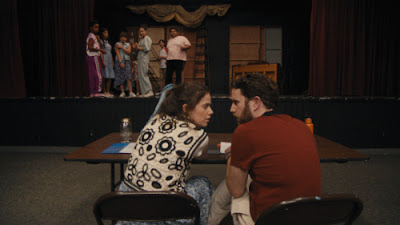
If Theater Camp doesn’t become a Drama Club classic, it’ll be another bad sign for the future of movies. It may not be an exemplar of the form, but its shaggy, underdog affection for its characters and milieu makes it all the more charming. I can’t image anyone who is now or has ever been a theater teen who’d be anything but charmed. As satire, it’s knowing, but very gentle. It comes on like a grainy mockumentary, setting up the eponymous locale as a financially strapped institution perched on the precipice of foreclosure. Its owner (Amy Sedaris in a whirlwind cameo) is in a coma, leaving the task of running the summer to her wannabe influencer son. (When told about the budget for “straight” plays, he earnestly asks what a “gay” play is. “Musicals,” the stage manager answers.) The staff is well-meaning, but silly at best and pretentious at worst. Honestly, their curriculum leaves a lot to be desired, too. But for all the above seems set up for mockery, the movie finds only sweetness. Everyone means well. Conflict is easily patched over. And even the unlikeliest participants will have their moment to shine.

The plot itself is developed sketchily, in scenes that play out as loose skits—goofy classes, camp complications, personality quirks. The adults get the bulk of the work, with the kids largely confined to reliable reaction shots. And despite starting their summer off with a long list of productions, the movie quickly focuses on just one. It narrows into a reliable old format—the let’s-put-on-a-show-and-save-our-beloved-space musical. Within that format, the movie finds an amiable, amusing approach that suits the affection it finds around every corner. It simply loves these ragtag theater kids and their teachers. There’s no interpersonal drama amid the campers, and the main problems the adults face are 1.) insufficient and/or misplaced confidence in their own talents, and 2.) outside financial problems from money minders who just don’t get artists’ goals. That doesn’t seem so difficult to overcome with some sparkles, jazz hands, original music, and a theatrical flair.

The loose, improvised feeling and communal spirit shine through the movie’s insistence that the show must go on. The fact that the main cast—Ben Platt, Molly Gordon, Noah Galvin—are also the co-writers (and also, in Gordon’s case, co-director) is surely what gives the project its pleasant sense of hanging around. And in the end, when it leans entirely on the audience buying the transformative power of theater, well, the magic of the stage got to me, too. When one character lets his inner drag queen into the spotlight, and another bravely comes out as straight, as everyone takes the stage for a rousing group number celebrating their favorite summer spot, why, it’s almost like Theater Camp has room for everyone.

Sunday, April 4, 2021

Promising Young Women: SHIVA BABY
and THE CRAFT: LEGACY

Shiva Baby is so drenched in social anxiety — not to mention family obligations, professional frustrations, and sexual tension — that one could practically wring it out. The whole endeavor has a palpable feeling of discomfort, the camerawork close and ever-so-slightly trembling, the score spare stabbing strings, the dialogue surface pleasant, subtextually jabbing small talk of needling relatives gossiping and hesitant strangers networking. It takes place almost entirely at a shiva for a distant relative (someone’s second wife’s sister—that sort of thing) of our protagonist, a college senior (Rachel Sennott) whose various worlds are about to uncomfortably collide. Her future looks uncertain, graduating without good prospects, to the dismay of her mother (Polly Draper) who tells her to let the other mourners think she has interviews lined up. Her father (Fred Melamed) still pays her bills since her babysitting job is so erratically scheduled. And neither know that her alleged babysitting job is a cover story for her real meager source of income: meeting men on a sugar daddy app and getting some easy money for a good time. We start the movie at the end of her latest hookup with an older man (Danny Deferrari), the better to recognize him when he enters the house. Small world. His wife (Dianna Agron) and baby are meeting him there, too. The walls are closing in.

There’s a constant sense of teetering on the edge of potential embarrassment, and Sennott capably plays the squirm, blundering forward though her insecurities and realizing only too late each escalating cringe. The tension rises as she’s bolstered by craft that keeps her tightly framed and blocking that presses her into corners or into uncomfortable exposure. In this small gathering the rooms were already full of elderly family friends (like Jackie Hoffman) prying nicely or passive aggressively into her personal life, and her childhood best friend and first romantic partner (Molly Gordon) makes eyes at her, too. Now it's only more complicated. Writer-director Emma Seligman, in a striking debut feature, has the confidence to sustain this small, well-tuned picture — a mere 70-some minutes and just a wisp of plotting to carry it — by signaling the largely interior stakes through small gestures and flushes of discomfort. The movie’s all about eye lines and furtive glances, the cold sweat of conversational awkwardness and the tension between polite fictions and outright deceptions. All the while, the whole thing plays out like a prelude to a panic attack, emotionally edging right up to the brink of a psychological catastrophe that never quite erupts. It feels like an achingly real emotional state.

You never know where you’ll find that. For instance, I just caught up with writer-director Zoe Lister-Jones' The Craft: Legacy. Who’d have thought the couple decades belated sequel/remake of the cult teen coven classic would have some emotional truth in it? I didn’t. But there it is anyway. There’s a scene in the middle, a sort of Breakfast Club misfit confession circle, in which the star teen girls who dabble in witchcraft as a form of self-empowerment — but dangers lurk, because of course they do — talk with a former bullying boy from their school. He tearfully admits his closeted bisexuality and earnestly confesses to feeling stifled by gender norms. It’s a real bolt of interesting emotional valences that changes the temperature of the scene and resonates throughout the rest of the picture. The whole thing is an amiable teen flick, with lockers and house parties and cute montages and, befitting its horror roots, a bit of dark sinister intentions lingering underneath. There are a few good creepy moments, and fine parallel plots about our new-in-town lead girl (Cailee Spaeny) getting to know her new friends and her latent powers, and her single mother (Michelle Monaghan) finding a new beau, a masculinist self-help guru and maybe-cult-leader (David Duchovny). (Some shades of The Lost Boys, there, perhaps.)

So there’s decent contrast drawn between the girl-power witches and dark forces of misogyny, and there’s the usual stuff about crushes and classes and learning to grow into oneself inherent in the teen movie of any genre. It’s a consistent through line of inquiry connecting the boy’s troubles and the girls’, a frank admission that societal expectations can hurt everyone, even those who are theoretically built up by them. Even if the movie never quite leans all the way into horror — though there’s a bit with a figure in a mirror in a darkened bedroom that’s quite spooky — and there are fleeting moments where it feels like one of those featherlight Netflix Original buzzword Mad Libs pictures, the whole project has a consistent and pleasant earnestness about its characters that makes for a modestly enjoyable effort as it coasts to its routine conclusion.