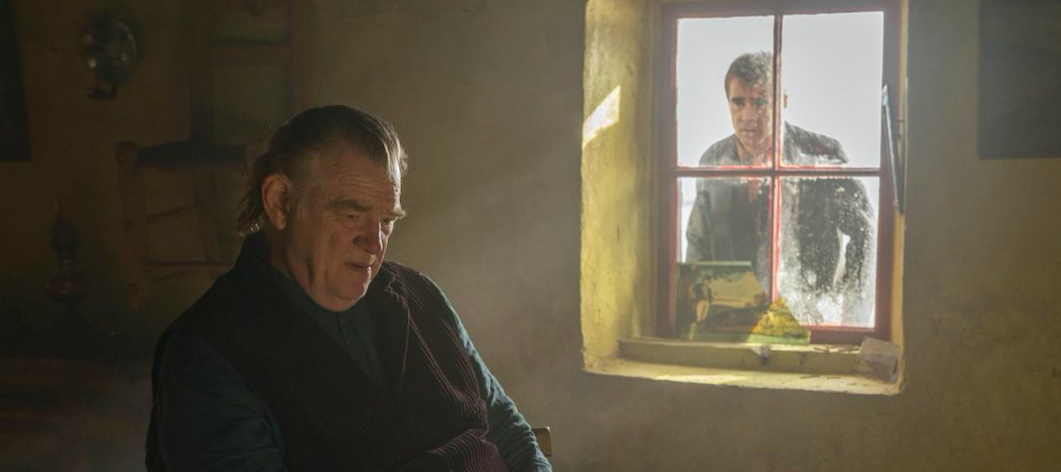
It can be difficult to make friends in adulthood, and even more difficult losing one. Sometimes that prospect can result in a friendship coasting on routine, someone you hang around just because, well, you have for too long to stop it now. And what would happen if you did? That’s the emotional crux of Martin McDonagh’s The Banshees of Inisherin. It’s set in 1923 on a small island off the coast of Ireland. Not a lot of options for socializing there, so the locals take what they can get. Sometimes they can hear cannon fire on the mainland—the Irish Civil War. That distant rumbling is a fine underlining of the story’s main civil strife: one man (Brendan Gleeson) suddenly deciding he doesn’t want to be friends with another (Colin Farrell). He doesn’t really have a reason. He just doesn’t want to talk with him anymore. For years, they’ve met every afternoon at the pub for a drink and a chat. But now, it’s abruptly over, and the man doesn’t even feel he owes a reason. From this simple—almost adolescent playground—declaration, this falling out is gossiped about and talked over by the whole tiny town. Word travels fast. But the facts of the case rest most heavily on Farrell’s befuddled loss. He’s desperate for his friend back, or at least an explanation.
McDonagh, the playwright-turned-filmmaker whose In Bruges was also a good blackly comic showcase for these two actors, gives this sure-footed narrative the purity of a folksy tale. It’s gnarled with colloquialisms and a straight-faced dark humor. And it’s carried along by a slow-rolling matter-of-fact shock—a then-he-did-what?—as the men’s interactions escalate. At one point Gleeson calmly says that if Farrell talks to him again, he’ll go home and cut off one of his own fingers, just to prove how serious he is. Unmoored from their only meaningful friendship, they both drift off into middle-aged melancholy. And McDonagh balances the story’s sympathies as it becomes a portrait of this kind of loneliness of adulthood, where connections can strain and fall flat or grow mercenary. Where time starts to weigh heavily through sheer inertia of habits, a dawning awareness of time slipping away every day creeps in with a sense of waste. The windswept fields and dirt paths and icy ocean views make a stark backdrop for this romantic—in the classic intensity of emotion sense—ennui, and the chattering daily grind of whispered rumors and stormy escalations. The characters are often separated by windows and walls, or going for long walks across chilly landscapes, and always fumbling to ruminate over the mysteries of their lives.
We get a sense that the smallness of life in the vastness of the terrain is brewing an insular despair. In this town, there’s an abusive constable and mean old ladies and well-meaning bartenders and docile animals and the town idiot and a firm-but-fair sister. Barry Keoghan and Kerry Condon, as those last two, are especially sharp counterpoints to Farrell’s befuddled pity. Gleeson, for his part, plays one long exasperated sigh, as a man whose depressive clanging against the bars of his own mortality drags out his potential harm to himself and others. With this steady orchestra of personalities, McDonagh creates a grimly generous work, then, with a bleakly Irish ending. It reaches a logical conclusion like a short story that snaps shut with the most pleasingly logical ambiguity. The potent sadnesses and frustrations at the core aren’t exactly exorcised, but, like a local legend retold and embellished, they have revealed something real and true about the darkness lurking for the unfulfilled and the unsatisfied. That’s why it’s nice to have a friend. And nicer still to keep one.
Sunday, December 11, 2022
Friday, December 9, 2022
Tender is the Night: AFTERSUN
They say poetry is about the words that aren’t written, music is the notes that aren’t played, and sculpting is a matter of carving away everything that isn’t the intended shape. Aftersun is a movie like that. It is precisely told. It builds up the unspoken and the unsaid so fully and so evocatively that its pinpoint emotional turns hit all the more overwhelmingly for having been suggested instead of stated outright. Writer-director Charlotte Wells, in her debut feature, here tells the story of an 11-year-old girl on a vacation with her thirty-something father sometime around the most recent turn of the century. (My, how quickly our present became past.) We gather she spends most of her time with her mother in Scotland, so this summery week at a mid-range resort in Turkey is clearly meant for a rare sustained moment of father-daughter bonding. The movie is exactly that simple: an anecdotal story that observes these two characters in a tender moment. It’s also delicately perched on a precipice—a last fleeting moment before tipping over into something new. She’s naturally on the edge of massive change—curious in tentative ways about the opposite sex, about her place in the world, about how others perceive her, and how she sees others. She’s trying to figure out how people relate to each other, and how she can, too. Her young dad is similarly in flux, with plans for the future, a desire to maintain a healthy relationship with his daughter, and sublimated emotional currents, symbolized by the cast on his arm, that are held back for her sake.
I’ve been trained by decades experiencing stories of melodrama and misery to fear an explicit tragic turn with this setup. Indeed, there is a certain suspense hanging over some of the proceedings—an ear for the potentially ironic. A line about birthdays, or scuba diving, or the passage of time, or a stray reference to sexuality or substance abuse, can press with the weight of expectation. But the movie’s too sensitive and circumspect and real to push toward such explicit drama. Instead, it finds a genuine love between father and daughter, and a casually-worn insight into the spaces between the world of an adult and a world of a child. To the eyes of a grown-up audience, a certain fragility and danger can sit in scenes where the father allows his child to wander the resort, or adolescent figures crowd near as specters of looming diminution of innocence, or a momentary lapse in judgement leaves the pre-teen to fend for herself for a brief span of time. But the girl’s remaining childhood innocence is both a protection and vulnerability—neither quite needed, but the scrim of retrospection hangs heavily. Threaded throughout are scenes shot from a camcorder. The first, in fact, is also the last—a heavily pixelated goodbye that’s then rewound. Here’s a movie dreamily, melancholically, past-tense. It’s nostalgic in the purest sense of the term in its original Greek: the pain of returning.
This rewind—punctuated with the pop and whir of old tech punctuating intuitive remembrance—leads into a memory poem of a film that delicately folds back in on itself by the end. Its diaristic, impressionistic structure isn’t a mystery to solve, but clarity that slowly comes into focus in soft lighting and gentle observation. Scenes in their room, at meals, games, pools and sightseeing, unfold with the precision imagery and sounds of the most frangible memories. There’s such lovely, low-key attentiveness in performance and staging and sound here—a glance, a gesture, a murmur of affectionate advice, a slow slipping mistake, an earnest apology, a song, a smile, a dance, a helping motion. It’s a child’s hair softly teased with a kind hand. It’s a shared satisfaction in a game, or a view. It’s a sudden frosting-over of interactions and a slow, inevitable thaw.
In the performances of Paul Mescal (Normal People) and Frankie Corio (a winningly natural debut), we see how much unspoken import passes between parent and child—the longing for connection, the imbalance of power, the loving, the imperfections, and the loving despite and because of those imperfections. It’s about the slow shift in dynamics, and the circular nature of their mutual sympathies. What makes the movie especially special, moving, haunting, is its attention to detail—a keen eye for physicality, a sharp understanding of the weight a word—or its absence—can have in the memory. The movie’s approach is built around the loneliness they feel together, a slowly widening self-consciousness, and looming sense of aging and loss. There’s a feeling that this is a Final Moment, though it never tips its hand for why, exactly, it feels these two might never meet again. We return at the end to the beginning—a goodbye, except, as the camcorder closes, this one feels like forever, and like a memory to which she, and we, will need to return.
I’ve been trained by decades experiencing stories of melodrama and misery to fear an explicit tragic turn with this setup. Indeed, there is a certain suspense hanging over some of the proceedings—an ear for the potentially ironic. A line about birthdays, or scuba diving, or the passage of time, or a stray reference to sexuality or substance abuse, can press with the weight of expectation. But the movie’s too sensitive and circumspect and real to push toward such explicit drama. Instead, it finds a genuine love between father and daughter, and a casually-worn insight into the spaces between the world of an adult and a world of a child. To the eyes of a grown-up audience, a certain fragility and danger can sit in scenes where the father allows his child to wander the resort, or adolescent figures crowd near as specters of looming diminution of innocence, or a momentary lapse in judgement leaves the pre-teen to fend for herself for a brief span of time. But the girl’s remaining childhood innocence is both a protection and vulnerability—neither quite needed, but the scrim of retrospection hangs heavily. Threaded throughout are scenes shot from a camcorder. The first, in fact, is also the last—a heavily pixelated goodbye that’s then rewound. Here’s a movie dreamily, melancholically, past-tense. It’s nostalgic in the purest sense of the term in its original Greek: the pain of returning.
This rewind—punctuated with the pop and whir of old tech punctuating intuitive remembrance—leads into a memory poem of a film that delicately folds back in on itself by the end. Its diaristic, impressionistic structure isn’t a mystery to solve, but clarity that slowly comes into focus in soft lighting and gentle observation. Scenes in their room, at meals, games, pools and sightseeing, unfold with the precision imagery and sounds of the most frangible memories. There’s such lovely, low-key attentiveness in performance and staging and sound here—a glance, a gesture, a murmur of affectionate advice, a slow slipping mistake, an earnest apology, a song, a smile, a dance, a helping motion. It’s a child’s hair softly teased with a kind hand. It’s a shared satisfaction in a game, or a view. It’s a sudden frosting-over of interactions and a slow, inevitable thaw.
In the performances of Paul Mescal (Normal People) and Frankie Corio (a winningly natural debut), we see how much unspoken import passes between parent and child—the longing for connection, the imbalance of power, the loving, the imperfections, and the loving despite and because of those imperfections. It’s about the slow shift in dynamics, and the circular nature of their mutual sympathies. What makes the movie especially special, moving, haunting, is its attention to detail—a keen eye for physicality, a sharp understanding of the weight a word—or its absence—can have in the memory. The movie’s approach is built around the loneliness they feel together, a slowly widening self-consciousness, and looming sense of aging and loss. There’s a feeling that this is a Final Moment, though it never tips its hand for why, exactly, it feels these two might never meet again. We return at the end to the beginning—a goodbye, except, as the camcorder closes, this one feels like forever, and like a memory to which she, and we, will need to return.
Labels:
Charlotte Wells,
Frankie Corio,
Paul Mescal
No comments:
Monday, December 5, 2022
Listen Up: SHE SAID and WOMEN TALKING
“Everything is sex, except sex, which is power.” — Janelle MonĂ¡e
Never underestimate Hollywood’s ability to turn any true story into a movie, even, or maybe especially, its own scandals. How quickly the shock of the new turns into the grist for the content mill. Here it’s She Said, a dramatization of the reporting of the 2017 New York Times story that exposed the decades-long abuses of producer Harvey Weinstein. That he was a bully and a bad boss had been widely known the whole time. Whispers of his sex crimes floated, too, usually on the margins of gossip reports and blind items. But it took this reporting, and others, to break a culture of silence around such shameful practices. This then became one of the first sparks that lit the #MeToo fire, a rolling bonfire of stories outing predatory men in a variety of industries. I wish we could, five years later, point to something more systematic that’s changed other than the ousting of various bad men from prominent positions they held. Still, that’s better than nothing. What we have with this new movie, from director Maria Schrader (Unorthodox) and screenwriter Rebecca Lenkiewicz (Ida) could’ve easily been a major Hollywood studio simplifying the case and building to a false triumph. Instead, it achieves a kind of unsettled cumulative force. Gathering sources, fact checking, finding corroborating evidence, and eventually clicking publish has a certain tension, and knowing it is only one step toward justice and not justice entire.
There’s definite inspiration from Spotlight in She Said. There’s the just-the-facts approach to interviews and collecting information. There’s the flatly honest glimpses into the home life of reporters. There’s the tone and style—serious, direct, plain, with accumulative force—much like the reporting it portrays. But where the former movie took a story an audience knew the general outline of, and used the specifics of the procedural undertaking to draw deeper understanding as the layers of secrets were peeled back, this one seems to proceed from a point of assumed knowledge on the part of the audience. Some of the names that are dropped and stories that are referenced are mentioned as if we already have that understanding. But there’s still that sense of unfolding discovery, as two reporters (Carey Mulligan and Zoe Kazan) are tasked by their editor (Patricia Clarkson) of getting the story in publishable shape. The sleuthing elements make for a sturdy, simple studio drama, with lots of talky sequences, some flatly expositional and others with a bit more personality, bringing to life something like a convincing portrait of the import job it reenacts.
Because a good journalism movie is also a detective story, it’s notable that the movie starts with the assumption that the guy who is suspected of committing the crime is absolutely the one who did it. The tension becomes not so much learning new information about the story—although impactful one-or-few-scene performances from Jennifer Ehle and Samantha Morton, along with Ashley Judd as herself, go a long way to dramatizing the pain of their persecutions—but the moral weight of asking the women confiding in them to go on the record. Mulligan and Kazan, inhabiting casually credible portrayals of working mothers, feel acutely the potential pain they’re leading these victims toward, and the sensitivity needed to get them to all agree to take uncertain steps toward outing their powerful victimizer. Its best scenes are ones that drive relentlessly into the process of doing so, in tandem with running through the necessary steps to draft, approve, and fine-tune a major article. The newsroom scenes of shop talk and phone calls and long meetings is a fine conclusion to all this hard work—and the final shot, of a cursor hovering over a button, makes an interesting counterpoint to the whirring presses of newspaper movies past. It’s a culmination of hard work that’s deceptively simple. What happens next is more difficult.
An even talkier exploration of this sort of abuse, and the consequences of speaking out, is writer-director Sarah Polley’s Women Talking. It’s set in a repressive Mennonite community—a few families on a secluded stretch of farmland—where the men keep the women uneducated and under their control. The story starts with the men off to town, leaving the women alone and able to discuss the sexual abuses to which they’ve been subjected. We see haunting flashbacks—quick cut images, really—of bruises on thighs, blood on mattresses. It is upsetting material handled with a soberness and lack of exploitation. Thus Polley keeps most of the film’s action to one meeting where the women gather to talk out their options. Should they stay and fight? Should they stay and forgive? Should they leave? There are few easy answers, and little agreement, at the start. Polley’s filmmaking is typically engaged with such questions, like her best work, autobiographical documentary Stories We Tell which most explicitly sees the ways in which people can thrive on false assumptions about themselves and those around them. That, too, sees the benefits of exposing the truth and talking it out. So here the women are in pain, expressed in different ways, and stand up the arguments that flow from these perspectives.
Throughout, there’s a collection of great actresses—Rooney Mara, Claire Foy, Jessie Buckley, Judith Ivey, Frances McDormand, Sheila McCarthy—ventriloquizing differing points of view, talking points brought to life. They’re partly real, convincing people, partly imagined inhabitations of their thorny debate. Adding to this incomplete sense of reality, the movie is shot in a sickly digital pallor—a super-wide frame with a stretch of wan color correction that seems to bleach out all sense of specificity. It feels like a well-cast experiment, in unforgiving digital that washes out the light and leaves the figures in the frame stranded in a smudge of pale fuzziness. It convincingly makes what could’ve been pastoral, and maybe even a rural ideal on the surface, into something that looks as uninhabitable as an alien planet. This emphasizes both the discomfort of their position, and the difficulties of seeing a way out. But it also emphasizes the conceit of it all—a sense of otherness and remove that heightens the dramaturgy and flattens the debate. I found myself wishing the movie was as powerful as its subject matter and, though it is respectful and an engaged intellectual exercise, the form and function never quite click into place for the transcendence of purpose for which it’s searching. Still, as reality continues to prove, there’s value in the talking, and we’re better off not letting such abuses fall under the powerful protection of silence, even if the results are imperfect.
Never underestimate Hollywood’s ability to turn any true story into a movie, even, or maybe especially, its own scandals. How quickly the shock of the new turns into the grist for the content mill. Here it’s She Said, a dramatization of the reporting of the 2017 New York Times story that exposed the decades-long abuses of producer Harvey Weinstein. That he was a bully and a bad boss had been widely known the whole time. Whispers of his sex crimes floated, too, usually on the margins of gossip reports and blind items. But it took this reporting, and others, to break a culture of silence around such shameful practices. This then became one of the first sparks that lit the #MeToo fire, a rolling bonfire of stories outing predatory men in a variety of industries. I wish we could, five years later, point to something more systematic that’s changed other than the ousting of various bad men from prominent positions they held. Still, that’s better than nothing. What we have with this new movie, from director Maria Schrader (Unorthodox) and screenwriter Rebecca Lenkiewicz (Ida) could’ve easily been a major Hollywood studio simplifying the case and building to a false triumph. Instead, it achieves a kind of unsettled cumulative force. Gathering sources, fact checking, finding corroborating evidence, and eventually clicking publish has a certain tension, and knowing it is only one step toward justice and not justice entire.
There’s definite inspiration from Spotlight in She Said. There’s the just-the-facts approach to interviews and collecting information. There’s the flatly honest glimpses into the home life of reporters. There’s the tone and style—serious, direct, plain, with accumulative force—much like the reporting it portrays. But where the former movie took a story an audience knew the general outline of, and used the specifics of the procedural undertaking to draw deeper understanding as the layers of secrets were peeled back, this one seems to proceed from a point of assumed knowledge on the part of the audience. Some of the names that are dropped and stories that are referenced are mentioned as if we already have that understanding. But there’s still that sense of unfolding discovery, as two reporters (Carey Mulligan and Zoe Kazan) are tasked by their editor (Patricia Clarkson) of getting the story in publishable shape. The sleuthing elements make for a sturdy, simple studio drama, with lots of talky sequences, some flatly expositional and others with a bit more personality, bringing to life something like a convincing portrait of the import job it reenacts.
Because a good journalism movie is also a detective story, it’s notable that the movie starts with the assumption that the guy who is suspected of committing the crime is absolutely the one who did it. The tension becomes not so much learning new information about the story—although impactful one-or-few-scene performances from Jennifer Ehle and Samantha Morton, along with Ashley Judd as herself, go a long way to dramatizing the pain of their persecutions—but the moral weight of asking the women confiding in them to go on the record. Mulligan and Kazan, inhabiting casually credible portrayals of working mothers, feel acutely the potential pain they’re leading these victims toward, and the sensitivity needed to get them to all agree to take uncertain steps toward outing their powerful victimizer. Its best scenes are ones that drive relentlessly into the process of doing so, in tandem with running through the necessary steps to draft, approve, and fine-tune a major article. The newsroom scenes of shop talk and phone calls and long meetings is a fine conclusion to all this hard work—and the final shot, of a cursor hovering over a button, makes an interesting counterpoint to the whirring presses of newspaper movies past. It’s a culmination of hard work that’s deceptively simple. What happens next is more difficult.
An even talkier exploration of this sort of abuse, and the consequences of speaking out, is writer-director Sarah Polley’s Women Talking. It’s set in a repressive Mennonite community—a few families on a secluded stretch of farmland—where the men keep the women uneducated and under their control. The story starts with the men off to town, leaving the women alone and able to discuss the sexual abuses to which they’ve been subjected. We see haunting flashbacks—quick cut images, really—of bruises on thighs, blood on mattresses. It is upsetting material handled with a soberness and lack of exploitation. Thus Polley keeps most of the film’s action to one meeting where the women gather to talk out their options. Should they stay and fight? Should they stay and forgive? Should they leave? There are few easy answers, and little agreement, at the start. Polley’s filmmaking is typically engaged with such questions, like her best work, autobiographical documentary Stories We Tell which most explicitly sees the ways in which people can thrive on false assumptions about themselves and those around them. That, too, sees the benefits of exposing the truth and talking it out. So here the women are in pain, expressed in different ways, and stand up the arguments that flow from these perspectives.
Throughout, there’s a collection of great actresses—Rooney Mara, Claire Foy, Jessie Buckley, Judith Ivey, Frances McDormand, Sheila McCarthy—ventriloquizing differing points of view, talking points brought to life. They’re partly real, convincing people, partly imagined inhabitations of their thorny debate. Adding to this incomplete sense of reality, the movie is shot in a sickly digital pallor—a super-wide frame with a stretch of wan color correction that seems to bleach out all sense of specificity. It feels like a well-cast experiment, in unforgiving digital that washes out the light and leaves the figures in the frame stranded in a smudge of pale fuzziness. It convincingly makes what could’ve been pastoral, and maybe even a rural ideal on the surface, into something that looks as uninhabitable as an alien planet. This emphasizes both the discomfort of their position, and the difficulties of seeing a way out. But it also emphasizes the conceit of it all—a sense of otherness and remove that heightens the dramaturgy and flattens the debate. I found myself wishing the movie was as powerful as its subject matter and, though it is respectful and an engaged intellectual exercise, the form and function never quite click into place for the transcendence of purpose for which it’s searching. Still, as reality continues to prove, there’s value in the talking, and we’re better off not letting such abuses fall under the powerful protection of silence, even if the results are imperfect.
Saturday, December 3, 2022
Oh Ho No: VIOLENT NIGHT
Violent Night is for people who still think it makes them sound interesting to pretend they just noticed Die Hard is a Christmas movie. This hard-R actioner’s one innovation is to have the real Santa Claus (David Harbour) interrupt a home invasion. Alas, this is a noxiously pedestrian effort, lousy with gore and four-letter-words and filled with the unappealing, poorly sketched characters in the most routine plotting. It wants to be winking and transgressive. It tries really, really hard. How boring. It takes a real misanthrope or outsider to understand the undercurrents possible in a dark Christmas story. Put a Christmas Evil or Black Christmas or Dial Code Santa on and you’ll find a cozy Yuletide scumminess in harsher-edged stories of queasy intimate despair and real bloody danger. There’s always something bittersweet and sad about the holidays, a time to reflect on a fall from childhood innocence and domestic happiness. Even a more monstrous take—Rare Exports or Gremlins—plays up the Charlie Brown Christmas melancholy as it excavates clever ways to set scares against the setting. This one, with all its blandly blocked studio gloss, is just dull. It takes its idea’s surface and resolutely refuses to dig even one centimeter into its implications, senselessly colliding stupid fantasy with gooey gunplay over and over. And the thing stretches that thinness over two whole hours. Talk about a lump of coal.
The resulting forced frivolity leaves only mirthless misery where the action and comedy should be. It finds a horrible wealthy family trapped in their mansion on Christmas Eve when a paramilitary heist squad (led by John Leguizamo) shows up to take millions out of their vault. Turns out the family runs a black-ops contractor company and stole their stash from the US government by claiming it disappeared in the Middle East. Since we met the sweater-clad family (which includes Edi Patterson and Cam Gigandet and Beverly D’Angelo) vulgarly sniping at each other around a crackling fire, we aren’t exactly predisposed to like these crooked people. But the villains are never sympathetic either. And the movie lacks the moral or political clarity to actually make something of all that. So it’s just nasty for nasty’s sake. That’s an ain’t-I-a-stinker? move that runs straight into the movie’s actual attempts to make this all about The Spirit of Christmas. The horrible family has one bright spot: an innocent little girl (Leah Brady) brought by her reluctant mother (Alexis Louder). The tot still believes in Santa, and that belief in him will help save them all once Saint Nick himself ends up coming down the chimney and reluctantly reconnects with his Viking roots. Its approach to Claus lore is typically charmless. To see the jolly old elf himself sledgehammer and electrocute and behead the intruders, is, well, something, I suppose. This is all tiresomely tedious, and director Tommy Wirkola (Dead Snow), working from a screenplay by the Sonic the Hedgehog guys, lacks the chops to really make this mess of intentions cohere. The result is an ugly mixture of cringing empty holiday sentimentality and nasty artless violence.
Same As It Ever Was: WHITE NOISE
You can always tell when a filmmaker enjoys reading great literature. There’s the extra understanding of the importance of the shape of a story, an added attention to weaving incident and images with thematic motifs, a patience for constructing dialogue with an ear for layers of meaning and revealing detail. There’s the confidence for letting a story feel like it’s sprawling, even as the pile-up of moments and impressions builds to somewhere intentional. Watching a movie from such a filmmaker—even a partially-successful one—can sometimes activate the English class seminar in me, filling the brain with the pleasing close-reading feeling of getting absorbed in a fascinating narrative and pinging off each noteworthy detail as you build a grand theory of the text.
Noah Baumbach’s always been a clever, verbose screenwriter, with his early efforts like Kicking and Screaming and Mr. Jealousy of a piece with that 90’s wave of East Coast indie wordsmiths, like Whit Stillman and Hal Hartley, who made their bones on dialogue patter with a fine-tuned ear for idiosyncratic character. Lately, though, he’s risen to greater heights, and ever more literate efforts. His Marriage Story is a precise dance of perspective as both partners in a divorce have their foibles and complaints balanced on the fulcrum of what’s best for their child. In its focused generosity of character and anecdote, it has the vibes of a densely imagined ensemble adult drama of the Terms of Endearment or Ordinary People adaptations kind, albeit with more quotidian conflicts instead of tear-jerking tragedy. Fizzy comedies like Mistress America and Frances Ha are shaggy, observational, and quippy like a slim, charming, surprisingly soulful character study. Greenberg has its cranky epistolary hook. Best is his The Meyerowitz Stories (New and Selected), which, from the title on down, plays like the best collections of linked short stories. This one has insight into three generations, interest in art and legacies, empathy for revealing eccentricities and tender connections, and smart repetitions of key lines. That gives it the intimate interior scope of the finest-tuned concision.
His latest is a further expression of his literary tastes: White Noise, an ambitious adaptation of Don DeLillo’s 1985 novel. That classic was a timely satire of middle-class ennui, academia’s tunnel vision, and consumer culture’s mass homogenizing media noise. It’s the story of a small-town college professor (Adam Driver) and his family. He’s an expert in Hitler Studies. His wife (Greta Gerwig) is a frizzy-haired wellness coach and secret addict of experimental pills. They have a Brady Bunch of children from their previous marriages. The first part of the story is a swirling, arch take on campus politics—especially as the professor talks with colleagues, including a new friend (Don Cheadle) who teaches a class on cinematic car crashes and dreams of being the expert in Elvis Studies—and a cozy, overlapping ensemble family dramedy. The second, best, part takes a swerve for the apocalyptic, as a train derailment sparks what’s known euphemistically as an Airborne Toxic Event. The town has to evacuate, cutting short the brewing plot lines and tossing the characters dynamics into a tumbler. These sequences are shot with wide lens complexity and dazzling real-world spectacle—like Altman’s Nashville traffic jam meets the UFO gawkers from Spielberg’s Close Encounters. The final stretch, an extended denouement, returns to resolve some of the threads from before, but the traumas of the middle stretch contaminate. The new dark cloud of mortality that hangs over all.
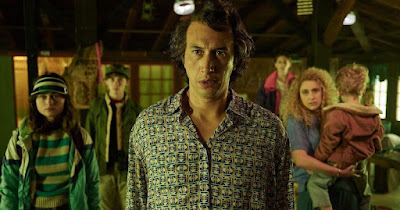
Appearing on our screens now in 2022, the adaptation is somehow even more timely in the midst of a pandemic, and an opioid crisis, and an ongoing erosion of confidence in systems big and small. But to reduce it to the oblique commentary on its 80s times, or ours, is shortchanging it as a work of ideas. It buys into the humanity of its characters and their predicaments, even as the movie operates at a heightened pitch. It swings from quiet, tightly-framed, naturalistic dialogues to loud, highly choreographed, widescreen sequences saturated with colors and lights. In grocery stores and campus cafeterias, the fluorescents practically radiate with an intensity. In the home, crowded with kids and books and nooks and crannies, there’s a cozy hustle and bustle to the more naturalistic textures. In the wilderness, an endless highway and crowded campground, there’s wide open possibility that’s somehow closing in. Here’s a story at least in part about life as a jumble of sensations guided by circumstance and environment that don’t care for you or your systems. And it’s about the meanings we make with, and for, each other to make sense of it in spite of the bombardments of stimulus. “Family,” goes a repeated professorial axiom herein, “is the cradle of misinformation. We’re fragile creatures, and the society we’ve built to obscure that fact is easily strained. A key image has to be an evacuated man angry that their fear hasn’t made the news, and thus isn’t validated, or that that feels the same as not existing at all.
Baumbach stretches his style here with impressive dexterity and scope. He shoots his adaption like a 90s ironic version of a 70s suburban drama—all overlapping dialogue and roaming camera and self-consciously elaborate tableau. Lol Crawley’s cinematography is slick and insistent, not unlike what Conrad Hall brought to American Beauty or how Alan Rudolph half-successfully adapted Vonnegut’s Breakfast of Champions. It’s at once flatly naturalistic and cocked at a half-joking expressionism. Turns out, you tip an 80s consumerist playground or small-town aesthetic just slightly to the left or right and you get a rumbling, believable self-satirizing setting. There’s a high-toned seriousness played for woozy, breezy, frazzled choking smirks. Danny Elfman’s score has pounding carnival horns and soaring theremins and dark, noodling madness—a perfect amalgamation of his collaborations with Tim Burton and Sam Raimi. Together the sound and image create a tension, a lightness, and an inner motor for a movie that bursts with inner life—the suggestion of intellects spiraling. And in the middle is a rather believable family relationship, as Driver and Gerwig and the younger performers make a unit that’s lovably eccentric and unbelievably tossed about by the upsetting events that threaten to tear them apart. There’s something emotive there to hang onto as the movie takes its spins through incidents amusing, frightening, chaotic or cringing. It looks at a world with fears, and denials, and ominous signs of contamination and infection and distraction and despair and says, well, fair enough. But you gotta have hope, too.
The movie, like the book, albeit without slavishly chasing its every rabbit hole, feels caught, and overwhelmed, in a time of transition. DeLillo’s work was in the mode of fascinating 80’s boomer novels—far enough from the incomplete progress of 60’s radicals to feel the failures, and taking the temperature of the very waters that’ll brew the Gen X disaffected distancing. Inspired by this source, Baumbach has copied over its frazzled stream of ideas, a sure-footed confusion, a world bombarded with messages and television and radio dispatches and camcorders and corded telephones. He captures a sense of disruption, and places at its center earnest performances invested in the characters emotions. It’s a neat trick making the people real and their world hyperreal, piling on details verging on surreal—The Event, vivid nightmares, a drop into potential climactic violence—while the characters maintain their sense of self. The film strains to capture these extremes at times, tipping fleetingly into too-clever artifice while trying to play it flat. And without the inner monologue there’s some vagueness around some less convincing plot turns. (What works on the page is sometimes harder to transition on screen, especially the swerves in the final third.) And yet, Baumbach directs like a smart reader, drawing our attention like a tour guide to the ideas and images and people on display. He takes us through a book’s notable ideas, dramatized and stood up on a stage for us to see. Not unlike when Gerwig herself adapted Little Women (easily my favorite classic-book-to-film in many years), the form itself is an argument to return to the text. It may not be a great movie, but, at its best, it can light up one’s brain like one.
Noah Baumbach’s always been a clever, verbose screenwriter, with his early efforts like Kicking and Screaming and Mr. Jealousy of a piece with that 90’s wave of East Coast indie wordsmiths, like Whit Stillman and Hal Hartley, who made their bones on dialogue patter with a fine-tuned ear for idiosyncratic character. Lately, though, he’s risen to greater heights, and ever more literate efforts. His Marriage Story is a precise dance of perspective as both partners in a divorce have their foibles and complaints balanced on the fulcrum of what’s best for their child. In its focused generosity of character and anecdote, it has the vibes of a densely imagined ensemble adult drama of the Terms of Endearment or Ordinary People adaptations kind, albeit with more quotidian conflicts instead of tear-jerking tragedy. Fizzy comedies like Mistress America and Frances Ha are shaggy, observational, and quippy like a slim, charming, surprisingly soulful character study. Greenberg has its cranky epistolary hook. Best is his The Meyerowitz Stories (New and Selected), which, from the title on down, plays like the best collections of linked short stories. This one has insight into three generations, interest in art and legacies, empathy for revealing eccentricities and tender connections, and smart repetitions of key lines. That gives it the intimate interior scope of the finest-tuned concision.
His latest is a further expression of his literary tastes: White Noise, an ambitious adaptation of Don DeLillo’s 1985 novel. That classic was a timely satire of middle-class ennui, academia’s tunnel vision, and consumer culture’s mass homogenizing media noise. It’s the story of a small-town college professor (Adam Driver) and his family. He’s an expert in Hitler Studies. His wife (Greta Gerwig) is a frizzy-haired wellness coach and secret addict of experimental pills. They have a Brady Bunch of children from their previous marriages. The first part of the story is a swirling, arch take on campus politics—especially as the professor talks with colleagues, including a new friend (Don Cheadle) who teaches a class on cinematic car crashes and dreams of being the expert in Elvis Studies—and a cozy, overlapping ensemble family dramedy. The second, best, part takes a swerve for the apocalyptic, as a train derailment sparks what’s known euphemistically as an Airborne Toxic Event. The town has to evacuate, cutting short the brewing plot lines and tossing the characters dynamics into a tumbler. These sequences are shot with wide lens complexity and dazzling real-world spectacle—like Altman’s Nashville traffic jam meets the UFO gawkers from Spielberg’s Close Encounters. The final stretch, an extended denouement, returns to resolve some of the threads from before, but the traumas of the middle stretch contaminate. The new dark cloud of mortality that hangs over all.
Appearing on our screens now in 2022, the adaptation is somehow even more timely in the midst of a pandemic, and an opioid crisis, and an ongoing erosion of confidence in systems big and small. But to reduce it to the oblique commentary on its 80s times, or ours, is shortchanging it as a work of ideas. It buys into the humanity of its characters and their predicaments, even as the movie operates at a heightened pitch. It swings from quiet, tightly-framed, naturalistic dialogues to loud, highly choreographed, widescreen sequences saturated with colors and lights. In grocery stores and campus cafeterias, the fluorescents practically radiate with an intensity. In the home, crowded with kids and books and nooks and crannies, there’s a cozy hustle and bustle to the more naturalistic textures. In the wilderness, an endless highway and crowded campground, there’s wide open possibility that’s somehow closing in. Here’s a story at least in part about life as a jumble of sensations guided by circumstance and environment that don’t care for you or your systems. And it’s about the meanings we make with, and for, each other to make sense of it in spite of the bombardments of stimulus. “Family,” goes a repeated professorial axiom herein, “is the cradle of misinformation. We’re fragile creatures, and the society we’ve built to obscure that fact is easily strained. A key image has to be an evacuated man angry that their fear hasn’t made the news, and thus isn’t validated, or that that feels the same as not existing at all.
Baumbach stretches his style here with impressive dexterity and scope. He shoots his adaption like a 90s ironic version of a 70s suburban drama—all overlapping dialogue and roaming camera and self-consciously elaborate tableau. Lol Crawley’s cinematography is slick and insistent, not unlike what Conrad Hall brought to American Beauty or how Alan Rudolph half-successfully adapted Vonnegut’s Breakfast of Champions. It’s at once flatly naturalistic and cocked at a half-joking expressionism. Turns out, you tip an 80s consumerist playground or small-town aesthetic just slightly to the left or right and you get a rumbling, believable self-satirizing setting. There’s a high-toned seriousness played for woozy, breezy, frazzled choking smirks. Danny Elfman’s score has pounding carnival horns and soaring theremins and dark, noodling madness—a perfect amalgamation of his collaborations with Tim Burton and Sam Raimi. Together the sound and image create a tension, a lightness, and an inner motor for a movie that bursts with inner life—the suggestion of intellects spiraling. And in the middle is a rather believable family relationship, as Driver and Gerwig and the younger performers make a unit that’s lovably eccentric and unbelievably tossed about by the upsetting events that threaten to tear them apart. There’s something emotive there to hang onto as the movie takes its spins through incidents amusing, frightening, chaotic or cringing. It looks at a world with fears, and denials, and ominous signs of contamination and infection and distraction and despair and says, well, fair enough. But you gotta have hope, too.
The movie, like the book, albeit without slavishly chasing its every rabbit hole, feels caught, and overwhelmed, in a time of transition. DeLillo’s work was in the mode of fascinating 80’s boomer novels—far enough from the incomplete progress of 60’s radicals to feel the failures, and taking the temperature of the very waters that’ll brew the Gen X disaffected distancing. Inspired by this source, Baumbach has copied over its frazzled stream of ideas, a sure-footed confusion, a world bombarded with messages and television and radio dispatches and camcorders and corded telephones. He captures a sense of disruption, and places at its center earnest performances invested in the characters emotions. It’s a neat trick making the people real and their world hyperreal, piling on details verging on surreal—The Event, vivid nightmares, a drop into potential climactic violence—while the characters maintain their sense of self. The film strains to capture these extremes at times, tipping fleetingly into too-clever artifice while trying to play it flat. And without the inner monologue there’s some vagueness around some less convincing plot turns. (What works on the page is sometimes harder to transition on screen, especially the swerves in the final third.) And yet, Baumbach directs like a smart reader, drawing our attention like a tour guide to the ideas and images and people on display. He takes us through a book’s notable ideas, dramatized and stood up on a stage for us to see. Not unlike when Gerwig herself adapted Little Women (easily my favorite classic-book-to-film in many years), the form itself is an argument to return to the text. It may not be a great movie, but, at its best, it can light up one’s brain like one.
Labels:
Adam Driver,
Greta Gerwig,
Noah Baumbach
No comments:
Friday, November 25, 2022
Guess Who: GLASS ONION
Glass Onion isn’t exactly a sequel to Knives Out. It’s simply another complicated case for its sole returning character to puzzle through. Good thing detective Benoit Blanc (Daniel Craig) is such great company, oozing Southern charm and confidence, while behaving an enlightened, affable gentleman who can slip right into any social context. He somehow stands out and blends in, the better to be underestimated as he gathers clues. And good thing, too, that writer-director Rian Johnson knows a thing or two about constructing a sequel that zigs when you’d expect it to zag, and ends up satisfying even more for giving you what you didn’t know you’d like to see. This one is a larger film, trading the first’s bickering family clad in cute sweaters, holed up in a cozy New England house while all their grievances tumble out, for a palatial mansion, with enormous sunny sets on a private Greek island filled with rich friends hanging around in sunglasses and beachwear. If Knives Out had an autumnal Thanksgiving vibe, Glass Onion is pure summer vacation.
It finds Blanc invited to a murder mystery party. He’s the ringer, and stranger, in a group of obscenely wealthy friends—a satirical send-up of every contemporary societal ill. There’s the host: an out-of-touch, and out-of-his-mind, tech bazillionaire (Edward Norton). And there are the guests: a hypocritical politician (Kathryn Hahn), a private-sector scientist-for-hire (Leslie Odom, Jr.), an alt-right YouTuber (Dave Bautista) and his girlfriend (Madelyn Cline), a ditzy model-turned-mogul (Kate Hudson) and her assistant (Jessica Henwick), and a former business partner who may be out for revenge (Janelle MonĂ¡e). It’s pretty easy to believe one of them will actually be murdered, and that they’ll all be so greedy and stupid that it might give Blanc quite a challenge. Johnson gives us a long, glittery, rambling opening hour that provides introductions to all of the characters and their dynamics. Invitations are delivered. The group assembles in Greece for the boat ride to the island. (Set during the first COVID summer, the way they wear their masks upon arrival is a big clue about their personalities.) They settle in for their first night in the mansion—a massive high-tech structure with dozens of rooms and topped with a gargantuan glass onion. The camera often pulls back to sweep around in bright establishing shots and drink it in, the sets and the setting providing a gleaming backdrop for the scheming. And throughout, Johnson, by taking his time, makes these political cartoons into bantering people we can size up and keep in mind as believable variables at play as the plot unfolds.
By the time the screenplay springs its surprises, doubling back on itself and deliberately filling in gaps I hadn’t paused to realize were left open, the film reveals it is awfully clever in a way that never stops paying out. There’s plenty of enjoyment on the surface of the movie, but when the setup reveals its full intentionality, there’s an added layer of rewards for the attentive viewer. This is a charmer of a mystery that you could practically chart on graph paper as its various setups converge with supremely satisfying reveals and conclusions. There’s an airtight clockwork construction at play, with each gear of plotting and character and humor turning at just the right time to click into place for crowd-pleasing punchlines and payoffs. Johnson’s a filmmaker with a great sense of genre play. See his straight-faced high-school noir Brick, or pretzel-logic time-travel thriller Looper, or his vivid, moving Star Wars episode. Here he’s totally at home, and clearly having fun, constructing these crafty mystery plots. They twist and turn, dangle detours and dole out tricks of perspective, but they always play fair with the audience. You can keep up with the logic, and by the end see the details close in with a pleasing snap. (It’s the dialogue and editing that does all the crackling and popping.) There’s evident delight in the construction, and that extends to the ensemble’s winning commitment to throwing themselves into the proceedings with wit and verve, too.
This has been a busy year for the whodunit movie. We got Greg Mottola’s shaggy, appealing Confess, Fletch. There was Kenneth Branagh’s opulent, excessive, and over-acted adaptation of Agatha Christie’s Death on the Nile; that has its velvety 70mm melodrama pleasures. We got a quaint and cozy little jewel box of a Christie homage, See How They Run; that’s a cute, winking meta-movie about a fictionalized murder mystery around the stage production of Christie’s The Mousetrap. (That movie actually brings Christie onstage, as if to say it was Agatha All Along.) But Glass Onion is head-and-shoulders above the rest. Rather than falling into homage or dutiful resuscitation of old tales, it’s the real deal itself. It’s built for maximum audience pleasure, and is quite pleased with itself, too. It’s formula without being formulaic. We return to these stories, not to be shocked and appalled or grossed out, but to take the mental exercise. Maybe it’s the cozy comfort of knowing, though the film may start with a dead body, it’ll end with a murderer revealed, and something like justice doled out.
Thursday, November 24, 2022
Visions of Light: THE FABELMANS
In the opening scene of Steven Spielberg’s The Fabelmans, it’s a snowy night in 1952 and a little boy is a little nervous about going to see his first movie. The prospect of giant people filling a wall in the downtown movie palace makes him leery. So his parents cheerfully try to calm his nerves. His father (Paul Dano), a meek, bespectacled engineer, launches into a technical explanation. Movies are just an illusion, he says: still photographs passed quickly before a light projecting the impression of moving pictures. His mother (Michelle Williams), who we’ll learn is a frustrated musician who battles depression, takes a more metaphorical approach. Movies are dreams, she says: dreams you never forget. Right there, in the opening dialectic between mother and father, science and art, reality and dreams, is the whole picture. It’s also a whole life, and a whole career. Anyone with an understanding of Spielberg the man and Spielberg the filmmaker will recognize that that boy, though he’s Sammy Fabelman here, is little Spielberg himself. Those are his parents’ occupations and personalities. And there he is, at his first movie, ready to discover The Greatest Show on Earth.
The movie that follows finds the boy’s growing interest in moviemaking, and dawning awareness that his parents’ marriage isn’t happy. These two aspects of his personal education are seen through a broader dawning of awareness of the world around him, and we see how a variety of influences inform who this young person starts to become—as an artist, and a man. Co-writing with Tony Kushner (in their fourth productive collaboration), scenes spanning his youth and teenage years are rich with character details that build out the world of this family, and their small circle of friends and relatives, as well as the reactions and habits that suggest their inner lives. We get amusing dinner-table chatter and passive-aggressive sniping and warm expressions of sympathy and acceptance. We also get those cross-currents of competition and concern that can push and pull on the decorum of a family. And further still, we get lots of happy moments, where the boy and his sisters and buddies make elaborate home movies and eccentric relatives float through and long car trips give a child new landscapes to feed his sharpening eye for noticing. (Great classic movies are doing that for him, too.) The scenes are framed in such a way that an adult eye can pick up on the unspoken details a child might not, but the perspective does so with such subtlety that there’s a fine-tuned generosity, and a lack of judgement. This isn’t a movie about a boy sometimes angry with his parents that is actually angry with the parents. There’s a lot of love here, foregrounded in the story, and some regret in the telling.
Spielberg approaches this semi-autobiographical sketch with the sensitivity to portray the dynamics honestly, the empathy to extend understanding to all involved, and the distance to deepen and resonate its ideas. This isn’t a retelling for self-aggrandizement or self-pity. Instead, it draws on a rich understanding of the relationships involved, and a lack of judgement on their actions. The boy finds much to be angry or sad about, and solace in honing his craft, but the movie itself is too compassionate to give in. This is a mature, even-handed look at specific moments in one particular family’s life. He keeps up the motif of the mechanical and the metaphorical, the technical and the emotional, light’s illusion and reality, throughout. The contrast between father’s machines—something to be taken apart, retooled, repaired—and mother’s music—piano practice filling the house with melancholy classical works—stand in for their ability to be complementary influences in a relationship. But it also stands in for their incompatibility. They’re trying, and there’s genuine affection there, but it just can’t connect consistently for the long term. It’s the figure of the boy, whose love for the movies becomes a love for the process—in long, loving montages behind-the-scenes of ingenious amateur filmmaking tricks and the procedural montages of previewing and cutting and adjusting 8mm reels—becomes the join between the head and the heart, the machine that makes ideas.
For that’s what the movies are: a technical feat that hits the heart. That’s what makes it a craft and an art. (So, too, says the movie, a calling.) By looking with such thrill of discovery at the makings of beginners’ films—and a beginning filmmaker—The Fabelmans reminds us that the movies are illusions that show us the world. They are collective dreams that hold us captive and can reveal something beyond the real and tangible—the deeper truths any great art form can access. Families are like that too, sometimes, built on shared dreams and memories, fueled by careful editing and elisions, motifs of light and shadow, rules and intuition. It’s about the framing, in what you see and know, and when, and how. It’s about whose perspective we share, what conclusions can be drawn, or faked, or ignored. Spielberg makes this movie with a clear-eyed love for family and film. It’s perhaps his most restrained work, with great blocking and image-making, but little of the obvious virtuosic camera moves or soaring scores for which he’s known. But it’s still, as so many of his movies are, about people seeing, or realizing, something amazing, and puzzling over its implications.
Moviemaking may be artifice, but the resulting art is, at its best, beautiful, and true, and real. And personal. Scenes of Sammy showing his movies to crowds are electric with pleasures and tensions. Seeing the audience react to one of his filmic tricks, you can see satisfaction sharing space with the wheels turning about how to grow and evolve as a technician and artist. Late in the film, Sammy, having shown one of his movies, is startled to discover he’s accidentally reframed reality for a character—and the gap between the screen and their daily existence opens up a crisis about how they’ll never live up to that image. This is a mirror of a scene in the middle where a few characters see an uncomfortable truth in some raw footage, a family secret hidden in plain sight. The movies can hide as easily as they reveal. And in the alchemy that takes them from an idea, to a camera, to a process, to art—there it is, real and unreal and all its consequences.
This is a movie about the thrilling act of creation, and the feedback loop between artist and audience. And it’s about how transporting and fulfilling it can be to see that screen light up with images you never knew you needed. Few movies about movies get this as right, perhaps because it’s not simply an ode to the form, but about the feelings and talents that come out of life lived full of complicated situations and shifting relationships. In the end, the movie’s final shot reminds us that all of this is framed with intentionality, considered for its implications, and shifted to clearly communicate its ideas. Here’s a movie from a master filmmaker, making the argument that everything one experiences goes into one’s art, and the results, with enough hard work, talent, and luck, can be transcendent. He’s right.
The movie that follows finds the boy’s growing interest in moviemaking, and dawning awareness that his parents’ marriage isn’t happy. These two aspects of his personal education are seen through a broader dawning of awareness of the world around him, and we see how a variety of influences inform who this young person starts to become—as an artist, and a man. Co-writing with Tony Kushner (in their fourth productive collaboration), scenes spanning his youth and teenage years are rich with character details that build out the world of this family, and their small circle of friends and relatives, as well as the reactions and habits that suggest their inner lives. We get amusing dinner-table chatter and passive-aggressive sniping and warm expressions of sympathy and acceptance. We also get those cross-currents of competition and concern that can push and pull on the decorum of a family. And further still, we get lots of happy moments, where the boy and his sisters and buddies make elaborate home movies and eccentric relatives float through and long car trips give a child new landscapes to feed his sharpening eye for noticing. (Great classic movies are doing that for him, too.) The scenes are framed in such a way that an adult eye can pick up on the unspoken details a child might not, but the perspective does so with such subtlety that there’s a fine-tuned generosity, and a lack of judgement. This isn’t a movie about a boy sometimes angry with his parents that is actually angry with the parents. There’s a lot of love here, foregrounded in the story, and some regret in the telling.
Spielberg approaches this semi-autobiographical sketch with the sensitivity to portray the dynamics honestly, the empathy to extend understanding to all involved, and the distance to deepen and resonate its ideas. This isn’t a retelling for self-aggrandizement or self-pity. Instead, it draws on a rich understanding of the relationships involved, and a lack of judgement on their actions. The boy finds much to be angry or sad about, and solace in honing his craft, but the movie itself is too compassionate to give in. This is a mature, even-handed look at specific moments in one particular family’s life. He keeps up the motif of the mechanical and the metaphorical, the technical and the emotional, light’s illusion and reality, throughout. The contrast between father’s machines—something to be taken apart, retooled, repaired—and mother’s music—piano practice filling the house with melancholy classical works—stand in for their ability to be complementary influences in a relationship. But it also stands in for their incompatibility. They’re trying, and there’s genuine affection there, but it just can’t connect consistently for the long term. It’s the figure of the boy, whose love for the movies becomes a love for the process—in long, loving montages behind-the-scenes of ingenious amateur filmmaking tricks and the procedural montages of previewing and cutting and adjusting 8mm reels—becomes the join between the head and the heart, the machine that makes ideas.
For that’s what the movies are: a technical feat that hits the heart. That’s what makes it a craft and an art. (So, too, says the movie, a calling.) By looking with such thrill of discovery at the makings of beginners’ films—and a beginning filmmaker—The Fabelmans reminds us that the movies are illusions that show us the world. They are collective dreams that hold us captive and can reveal something beyond the real and tangible—the deeper truths any great art form can access. Families are like that too, sometimes, built on shared dreams and memories, fueled by careful editing and elisions, motifs of light and shadow, rules and intuition. It’s about the framing, in what you see and know, and when, and how. It’s about whose perspective we share, what conclusions can be drawn, or faked, or ignored. Spielberg makes this movie with a clear-eyed love for family and film. It’s perhaps his most restrained work, with great blocking and image-making, but little of the obvious virtuosic camera moves or soaring scores for which he’s known. But it’s still, as so many of his movies are, about people seeing, or realizing, something amazing, and puzzling over its implications.
Moviemaking may be artifice, but the resulting art is, at its best, beautiful, and true, and real. And personal. Scenes of Sammy showing his movies to crowds are electric with pleasures and tensions. Seeing the audience react to one of his filmic tricks, you can see satisfaction sharing space with the wheels turning about how to grow and evolve as a technician and artist. Late in the film, Sammy, having shown one of his movies, is startled to discover he’s accidentally reframed reality for a character—and the gap between the screen and their daily existence opens up a crisis about how they’ll never live up to that image. This is a mirror of a scene in the middle where a few characters see an uncomfortable truth in some raw footage, a family secret hidden in plain sight. The movies can hide as easily as they reveal. And in the alchemy that takes them from an idea, to a camera, to a process, to art—there it is, real and unreal and all its consequences.
This is a movie about the thrilling act of creation, and the feedback loop between artist and audience. And it’s about how transporting and fulfilling it can be to see that screen light up with images you never knew you needed. Few movies about movies get this as right, perhaps because it’s not simply an ode to the form, but about the feelings and talents that come out of life lived full of complicated situations and shifting relationships. In the end, the movie’s final shot reminds us that all of this is framed with intentionality, considered for its implications, and shifted to clearly communicate its ideas. Here’s a movie from a master filmmaker, making the argument that everything one experiences goes into one’s art, and the results, with enough hard work, talent, and luck, can be transcendent. He’s right.
Subscribe to:
Posts (Atom)


