Showing posts with label Claire Foy. Show all posts

Thursday, December 28, 2023

All Those Lonely, Lonely Times: ALL OF US STRANGERS

Andrew Haigh’s All of Us Strangers is a palpable portrait of loneliness and the long tail of childhood grief. It’s a film that feels haunted with the intense emptiness that comes from a solitary life. It stars Andrew Scott as a writer just south of middle age who lives alone in a small apartment in a mostly uninhabited new building in London. Though the movie will technically leave this cramped home, in all the really important ways it stays trapped there with him, and within his head. He meets another inhabitant of the building, a troubled younger man (Paul Mescal) with whom he strikes a hesitant romantic interest. They’re drawn together as two loners, clearing their throats to speak like they're unaccustomed to doing so. There’s a sense even as they open up emotionally, sharing stories of their pasts, their coming outs, and their romantic interests, that they’re holding something back. They’ve been hurt before.

The writer is currently working through some of his hurt with an autobiographical project about his parents. He imagines them as they were when he was 12 years old. They were dead before he was 13, killed in a car crash at Christmastime. How awful. Now this writer will sometimes return to his childhood home and see them. Hardly ghosts, they are flesh and blood memories he inhabits, having conversations he wishes he could’ve had, and still could have but for that fateful black ice—reminiscences explanations, apologies, a coming out. The parental presences are projections of the son, but Claire Foy and Jamie Bell play them with full personalities. These aren’t dream parents; they’re not always parroting ideas their now-grown child would hope they’d share with him. They’re real, and unreal. (There's a productively weird cognitive dissonance of seeing actors of roughly the same age playing parent and child, too.) He’s happy to see them, but there’s that spectral distance, too. They’re part of him, and yet not. Here’s a man so used to being alone he holds everything at arm’s length, from that potential new boyfriend to the grief he’s never quite addressed.

Haigh is a filmmaker always so closely attuned to the subtleties of human interactions—the way a shift in information or understanding ripples imperceptibly across a face, and then out across an entire relationship or community. It's in the intimate close-ups and spaces for quiet contemplation. He makes movies in which people sit and talk to each other, revealing as much in their silences and implications as with their conversations. There’s the hookup coupling that tentatively teases the idea of something more in Weekend or the anniversary that teeters on the precipice of a breakup in 45 Years. His works are always careful to conceal and reveal his characters interiority in conjunction with softly naturalistic performances that capture their humanity. He also expert at getting deft, delicate drama out of symbols lesser directors would fumble as obvious underlining. Here’s a movie about a man literally haunted by his grief, and has trouble bringing someone new into his lonely life. That core specificity gives its abstractions their power.

It’s about the disconnection he feels from the world around them, and from some essential part of himself and his past. So of course there’s that huge empty building, and a cozy memory place of childhood memory. The two blur. There’s a mid-80s photo from right before the incident. It becomes a vision of the past with a child actor; it’s also a recreation with the adult. Past and present are joined by the Pet Shop Boys’ swirling synths. That’s a peak of hazy sadness in a movie that’s a most tender, melancholic ghost story. Later, a simple move of the camera swaps one ghostly presence for another, although we might not quite know it until we reflect on it later. The movie builds to a climax of emotional revelation, and nods to the power of love to last. Because the performances are so natural, and the filmmaking so attentive, it gathers considerable metaphoric force. It feels heavy with depressed yearning in every gesture.

Monday, December 5, 2022

Listen Up: SHE SAID and WOMEN TALKING

“Everything is sex, except sex, which is power.” — Janelle MonĂ¡e

Never underestimate Hollywood’s ability to turn any true story into a movie, even, or maybe especially, its own scandals. How quickly the shock of the new turns into the grist for the content mill. Here it’s She Said, a dramatization of the reporting of the 2017 New York Times story that exposed the decades-long abuses of producer Harvey Weinstein. That he was a bully and a bad boss had been widely known the whole time. Whispers of his sex crimes floated, too, usually on the margins of gossip reports and blind items. But it took this reporting, and others, to break a culture of silence around such shameful practices. This then became one of the first sparks that lit the #MeToo fire, a rolling bonfire of stories outing predatory men in a variety of industries. I wish we could, five years later, point to something more systematic that’s changed other than the ousting of various bad men from prominent positions they held. Still, that’s better than nothing. What we have with this new movie, from director Maria Schrader (Unorthodox) and screenwriter Rebecca Lenkiewicz (Ida) could’ve easily been a major Hollywood studio simplifying the case and building to a false triumph. Instead, it achieves a kind of unsettled cumulative force. Gathering sources, fact checking, finding corroborating evidence, and eventually clicking publish has a certain tension, and knowing it is only one step toward justice and not justice entire.

There’s definite inspiration from Spotlight in She Said. There’s the just-the-facts approach to interviews and collecting information. There’s the flatly honest glimpses into the home life of reporters. There’s the tone and style—serious, direct, plain, with accumulative force—much like the reporting it portrays. But where the former movie took a story an audience knew the general outline of, and used the specifics of the procedural undertaking to draw deeper understanding as the layers of secrets were peeled back, this one seems to proceed from a point of assumed knowledge on the part of the audience. Some of the names that are dropped and stories that are referenced are mentioned as if we already have that understanding. But there’s still that sense of unfolding discovery, as two reporters (Carey Mulligan and Zoe Kazan) are tasked by their editor (Patricia Clarkson) of getting the story in publishable shape. The sleuthing elements make for a sturdy, simple studio drama, with lots of talky sequences, some flatly expositional and others with a bit more personality, bringing to life something like a convincing portrait of the import job it reenacts.

Because a good journalism movie is also a detective story, it’s notable that the movie starts with the assumption that the guy who is suspected of committing the crime is absolutely the one who did it. The tension becomes not so much learning new information about the story—although impactful one-or-few-scene performances from Jennifer Ehle and Samantha Morton, along with Ashley Judd as herself, go a long way to dramatizing the pain of their persecutions—but the moral weight of asking the women confiding in them to go on the record. Mulligan and Kazan, inhabiting casually credible portrayals of working mothers, feel acutely the potential pain they’re leading these victims toward, and the sensitivity needed to get them to all agree to take uncertain steps toward outing their powerful victimizer. Its best scenes are ones that drive relentlessly into the process of doing so, in tandem with running through the necessary steps to draft, approve, and fine-tune a major article. The newsroom scenes of shop talk and phone calls and long meetings is a fine conclusion to all this hard work—and the final shot, of a cursor hovering over a button, makes an interesting counterpoint to the whirring presses of newspaper movies past. It’s a culmination of hard work that’s deceptively simple. What happens next is more difficult.
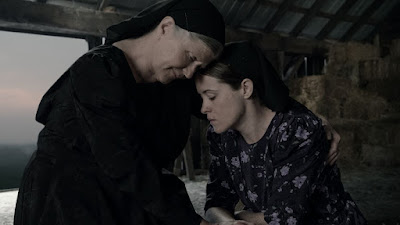
An even talkier exploration of this sort of abuse, and the consequences of speaking out, is writer-director Sarah Polley’s Women Talking. It’s set in a repressive Mennonite community—a few families on a secluded stretch of farmland—where the men keep the women uneducated and under their control. The story starts with the men off to town, leaving the women alone and able to discuss the sexual abuses to which they’ve been subjected. We see haunting flashbacks—quick cut images, really—of bruises on thighs, blood on mattresses. It is upsetting material handled with a soberness and lack of exploitation. Thus Polley keeps most of the film’s action to one meeting where the women gather to talk out their options. Should they stay and fight? Should they stay and forgive? Should they leave? There are few easy answers, and little agreement, at the start. Polley’s filmmaking is typically engaged with such questions, like her best work, autobiographical documentary Stories We Tell which most explicitly sees the ways in which people can thrive on false assumptions about themselves and those around them. That, too, sees the benefits of exposing the truth and talking it out. So here the women are in pain, expressed in different ways, and stand up the arguments that flow from these perspectives.

Throughout, there’s a collection of great actresses—Rooney Mara, Claire Foy, Jessie Buckley, Judith Ivey, Frances McDormand, Sheila McCarthy—ventriloquizing differing points of view, talking points brought to life. They’re partly real, convincing people, partly imagined inhabitations of their thorny debate. Adding to this incomplete sense of reality, the movie is shot in a sickly digital pallor—a super-wide frame with a stretch of wan color correction that seems to bleach out all sense of specificity. It feels like a well-cast experiment, in unforgiving digital that washes out the light and leaves the figures in the frame stranded in a smudge of pale fuzziness. It convincingly makes what could’ve been pastoral, and maybe even a rural ideal on the surface, into something that looks as uninhabitable as an alien planet. This emphasizes both the discomfort of their position, and the difficulties of seeing a way out. But it also emphasizes the conceit of it all—a sense of otherness and remove that heightens the dramaturgy and flattens the debate. I found myself wishing the movie was as powerful as its subject matter and, though it is respectful and an engaged intellectual exercise, the form and function never quite click into place for the transcendence of purpose for which it’s searching. Still, as reality continues to prove, there’s value in the talking, and we’re better off not letting such abuses fall under the powerful protection of silence, even if the results are imperfect.

Monday, March 26, 2018

UNSANE in the Brain


Unsane, Steven Soderbergh’s latest film, is a breathlessly suspenseful psychological thriller built upon a great lead performance, and an experiment in technical limitations. It finds tightly wound tension as a woman (Claire Foy) is involuntarily committed to a mental institution and therefore quickly pushed to her wits end. The more she loudly and wildly proclaims her sanity, the less the staff is likely to believe her, especially when the cops see the paperwork she signed, and the insurance company signs off on underwriting her stay. Shot almost entirely on iPhones, the perspective is unfamiliar, set on tables and desks, at unusually close or low angles a full-sized camera on a conventional set couldn’t possibly find. There’s a sense of tactile energy to the framing, and a crackling sense of unease in how unfamiliar the look becomes. This isn’t manipulated like Sean Baker’s Tangerine (the other major iPhone-shot feature) to have a rough-hewn beauty approaching the digital expressiveness of Michael Mann or latter day Godard. Soderbergh allows for the phone’s camera to manifest natural jaggedness in pans, slight wobbling of focus at the edges, tight aspect ratio that leaves black the edges of a properly sized and matted theater screen. Every interaction seems ripe with danger. The whole frame is closing in on its main character, trapping her as reality seems to warp and distort in the bugs of the visual information’s capture. 

The trick of the movie is the deceptively simple filmmaking and crystal clear screenplay by Jonathan Bernstein and James Greer letting suspicion cloud judgement. Maybe, the thought occurred to me early on, our protagonist really is in need of this treatment. She went to see a therapist about lingering uneasiness related to being the victim of a stalker (Joshua Leonard). She admits to occasional thoughts of self-harm. Then she’s asked back into the inner wards and locked in a seven day stay for her own good, cooped up with others (Jay Pharaoh, Juno Temple) who view her as one of them. Soon, she starts lashing out – striking an employee, berating her fellow patients – eventually appearing to hallucinate her stalker is one of the nurses at the facility. How easy it is to slip out of sanity, when stress is pushed to the limits. She feels trapped, held against her will, loudly protesting when no one believes her pleas. She is unsafe, she cries. No, say the doctors, she is simply unsane. Soderbergh takes her point of view at clinical face value, the great twist brewing in plain sight. He’s simply not trying to trick you, playing everything exactly straight, playing the audience’s doubts against his character. Foy does a Grade-A breakdown, expertly modulating her mood swings from exasperated frustration and wailing despair to violent disbelief or depressed resignation and back again as the week stretches on. As the film picks up in a pulpy fever pitch, it becomes a double-edged harm – from a health care system easily manipulated by corrupt individuals, and from the long-lasting effects of trauma. It’s as gripping an experiment as any Soderbergh has yet pulled off.

Saturday, February 8, 2014

Fanged Up: VAMPIRE ACADEMY


Vampire Academy doesn’t seem finished. It feels like the filmmakers gave up on it, like on some fundamental level the story just wasn’t working and instead of taking the time to fix it, they filmed it anyway. The movie is flavorless, unimaginative, and often uncommunicative as it gets tangled up in its own jargon. The story starts with two runaway vampires who are quickly caught and returned to their Vampire Academy where the headmistress is awful disappointed or something. Then it becomes a teen high school movie that’s neither horror nor comedy. It involves sub-Harry Potter schoolyard conspiracies and pseudo-Twilight divisions and hierarchies of vampiric magic and wars between a variety of clans the names of which I could never keep straight despite the movie never missing an opportunity to talk about it. The movie is all tell, no show, and all the worse for it, especially since all that telling left me mostly hopelessly confused. By the time the movie finishes clearing its throat, it manages to bump up against some modest entertainment value for about five minutes. That hardly seems worth it.

We’re introduced to the movie’s taxonomy of vampires with an expositional voiceover reinforced by key terms turning up on screen in bold lettering. There are Dhampir, half-human vampires, Moroi, royal vampires, and Strigoi, who can only be evil, as represented by their paler-than-usual vampire skin and bloodshot eyes. Don’t quiz me on their differences. I only got that far by checking Wikipedia. Our leads, the runaways the story opens upon, are best friends who snuck away from the school for what seems to be a Very Important Reason that remains vague. One is a Dhampir girl (Zoey Deutch) who has some psychic connection to her friend (Lucy Fry), a Moroi who may be in line to be the next Vampire Queen. She can read her friend’s thoughts; it is cool in theory, but in practice involves her essentially watching scenes she’s not in and commenting on them for us to hear.

The head of the school (Olga Kurylenko) begrudgingly lets the girls back into the school on the condition that the Dhampir trains to protect royal pal. From there, class is in session, taking us straight into plot contortions involving a nerdy third wheel (Sarah Hyland), ex-boyfriends (Edward Holdcroft and Ashley Charles), guys with crushes (Dominic Sherwood and Cameron Monaghan), a vindictive catty girl (Sami Gayle), a missing teacher (Claire Foy), a glowering Russian combat trainer (Danila Kozlovsky), and an ill vampire gentleman (Gabriel Byrne). One or more of them may be behind the ominous messages written in blood that turn up to menace our leads. That’s a lot of characters to juggle, too many I’d say, since almost none of them get satisfying introductions or resolutions. They’re just there.

Maybe fans of the young adult book series upon which this is based could make sense of all these characters, with their variety of backstories and motivations. I couldn’t, despite the movie spending so much of its runtime trying to fill me in on the pertinent details. If there was ever a scene not devoted to explicitly explaining its place in the plot, I must’ve missed it. And yet, there’s not a bit of narrative momentum on which to hang all this talk. What curses, powers, magic, histories, grudges, potions, talismans, spells, creatures, bloodlines, and insults are supposed to matter most when they’re all given the same flatlining importance?

Screenwriter Daniel Waters (of Heathers) and his brother, director Mark Waters (of Mean Girls), know a thing or two about staging high school comedies, but here it’s as if they were working from an outline and forgot to flesh out the characters’ personalities and their film’s tone along the way to a finished product. Some attempts at memorable quips – “they looked at me like I was a porcupine in a hot tub” – fall flat since I couldn’t get my bearings in the setting or understand who any of these characters are. Who runs this school? What is at stake? Why should we care? I certainly couldn’t tell you. It’s a shame the filmmakers couldn’t either. It doesn’t help that it’s all shot in a dull haze and edited together with no feeling for spatial coherence.

It’s all a bland blur, endlessly telling us what is happening, why it’s happening, and what the pertinent fantasy gibberish is, and yet still communicating almost nothing about its world or why we should be invested in it. The movie is an uninvolving mishmash of tones, wobbling from snark to snarling danger to snoozy exposition with little sense of impact or understanding of cause and effect. Worldbuilding isn’t easy, all the more because it should look easy, but if after two hours of painfully obvious hard work I couldn’t begin to tell you even the simplest facts about your fantasy world and the plotlines running through it, something has gone disastrously wrong.

I spent the film scowling, wondering if I was simply zoning out during the most important information or if every scene was really skipping away into the next with little concern for pacing or personality. I’m sure it was the latter. It’s telling that only the climactic action – when the characters finally shut up about their powers and dangers and put them to use – comes close to working on any level. More telling is this line of dialogue one girl says to the other after events have gotten largely incomprehensible: “I can’t remember who loves us and who hates us.” If they don't know, what hope did I have?