It’s a shame the bottom fell out of the theatrical Young Adult books adaptation cycle as it was moving away from supernatural and dystopian metaphors and into more quotidian lived experiences. If it’s valuable for teenagers to see their emotions and concerns blown out into allegorical genre dimensions—and, at their best, the Twilights and Hunger Games and Divergents of the world hook into those with a sugar-high power—then surely it’s also worth exploring those same mindsets in something closer to real life. Somehow it’s been eight years since The Fault in Our Stars found bittersweet love between teen cancer patients, and got big box office in return. The years since have given us just a handful of similar efforts to take something serious teens might face in their actual lives and put them on screen. As good as something like The Hate U Give—about police brutality—or The Miseducation of Cameron Post—set at a gay conversion camp—can be, the majority of mainstream teen screen stories are now cheap Netflix rom-com programmers or distended cable series with preposterous coked up shock value. Sure, kids these days also have their flood of digital noise on TikTok and Snapchat, but those can be as unreal, and mind-numbing. I miss feature films that treat a young adult audience as, well, young adults.
Luckily Josephine Decker brings us The Sky is Everywhere, a picture of a grieving teenager that creates a close emotional association with its lead’s mental state. Here an artistic, musical, creative teenager (Grace Kaufman) misses her recently departed older sister like a phantom limb. She aches for her presence. They’d been living with their grandmother (Cherry Jones) since the death of their mother some years prior. She asks her uncle (Jason Segel), her mother’s brother, if grief ever goes away. He looks at her warmly and answers: I don’t think so. Here’s a movie that’s honest about its situations, even as the screenplay, adapted by Jandy Nelson from her novel, loads itself up with YA turns of dramatic and romantic complications. There’s a cute new boy in school (Jacques Colimon). There’s her sister’s ex-boyfriend (Pico Alexander). There are friends to chat and classes to attend and futures to plan. It leaps between these peaks of teen drama and finds the shadow valleys of mourning between.
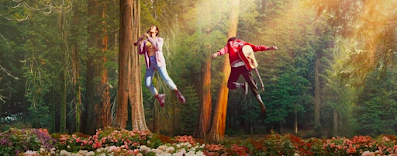
But what keeps the movie above the routine of such things is Decker’s commitment to visualizing her main character’s active mind. Like in her previous pictures—the loose artistic tension of Madeline’s Madeline and the stormy grit of Shirley—style follows from psychological cues. When the lead moves into her flights of fancy, colors are over-cranked, backgrounds can turn into dioramas, montage might become magical realism, flourishes of dance or poetry performance can fill the frame. Befitting her musical abilities, the score might be intrusive, or fade away. This makes for a movie that’s not overstuffed with quirk, but instead fancifully interior, an outpouring of precocious passionate imagination and surging adolescent curiosities and urges. It wisely meets its lead and its prospective audience where they are, and then, through its ability to add shading and texture to its side characters—Jones especially has a moving moment of perspective-bringing near the end—help them grow beyond.
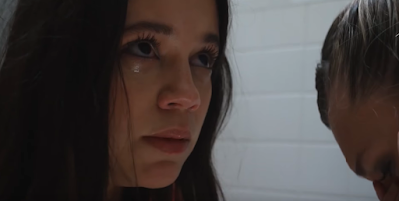
Another new movie that’s a picture of teenage grief is The Fallout. A finely realized debut feature for writer-director Megan Park, heretofore best known for a role on ABC Family’s The Secret Life of the American Teenager, the movie is less dreamy and sad than Decker’s. Instead, it’s teetering on an edge with depression and despair. But it’s so tenderly observed and warmly sympathetic to its characters that it understands all-too-well the difficulties they have readjusting to something like normal in the wake of a tragedy. One gets the sense in the opening scenes that it would be an appealing, low-key high school coming-of-age dramedy if not for the swerve into an unexpected awful event. Isn’t that always the case with these moments? It begins with a teenage girl (Jenna Ortega) talking with her sister (Lumi Pollack) and parents (John Ortiz and Julie Bowen), with friends and acquaintances and teachers (Will Ropp, Christine Horn). It’s the start of a normal day. She ends up in the restroom during class—avoiding class, really—and talks to a more popular classmate (Maddie Ziegler). That’s when they hear gunfire in the hallway. Screams. Slams. They hide. It seems to last forever, but then…that’s it. It’s over. They survived. Their school, their classmates, themselves, are now just another statistic.
The school shooting movie has, sadly, become something of a tradition now. It reflects the way this has been allowed to become a grim fact of life. In our politics, we hear an awful lot of whining about the supposedly deleterious effects of something like wearing a mask to go to school during a global pandemic. These complaints are usually coming from the same people who have never had anything meaningful to say about the far worse effects of getting shot to death in school. So here it is in the movies. Gus Van Sant’s floating camera in 2003’s Elephant and Denis Villeneuve’s grainy black-and-white 2009 Polytechnique make intense in-the-moment works of dread and violence. Last year’s Mass was a talky, probing look at parents grappling with deaths of this nature years later. Recent documentary Bulletproof shows the preparation for the possibility of such events—lockdown drills, kevlar backpacks or hoodies, potential classroom fortifications—as just another back-to-school routine, cut into its flowing montage of teacher trainings, band practices, sports drills, and assemblies. How sad that we’ve had over twenty years of reactions to mass deaths like these and protests against the very gun laws that encourage such destruction, and yet little has changed. What The Fallout brings to the conversation is not the violence, which is largely implied, but a softer touch and intimate detail, keyed into its leads’ numbed aimlessness in the aftermath.
Ortega takes center stage in tight focus for a character who is convincingly drawn. She expertly plays teen angst as a sort of normal acting out refracted through her vulnerable and raw post-trauma days and weeks as she claws back to a sense of self. There’s something convincing when she throws a thrashing little “God, mom!!!” flailing fit, and in the way she and Ziegler become friends bonded by their survival. They clung to each other as the chaos boomed outside; now they cling together to make it through. They’re contrasts—Ortega loose and swimming in baggy clothes, Ziegler clenched and poised in tight outfits as an Insta glamour princess—but connected. An early scene in which they text back and forth late at night is expert at conjuring that sort of intimacy—a flurry of closeups of eyes, fingertips, ellipses. And then they’re back to school, back to friends, trying to find their way in a string of episodic moments. By turning the mechanisms of a gentle Hollywood slice-of-teen-life style on the wake of a mass shooting, it makes a bitter sting of grief and hopelessness all the more affecting.
The film sees how the tragedy works its way through the community of characters, and watches as its impact shifts dynamics, closes off some old habits, and opens up new avenues of potential harm and growth alike. Bowen and Ortiz bring good detail to shaken, frustrated, and loving parents, while the other young actors sell a wide range of responses. Most telling, perhaps, are a few scenes where Ortega visits a sympathetic counselor played by Shailene Woodley. Aside from making viewers of a certain age feel old that this former Fault and Secret Life star has now aged enough to play one of the grown-ups, there’s an interesting disconnected connection Woodley and Ortega forge, with one’s insistence that things might get better personally, and the other’s looking at society around her with justified suspicions. I hope the potential young audience for this movie takes away some of these visions of humanity, and recognize something true in it.
Showing posts with label Cherry Jones. Show all posts
Wednesday, March 16, 2022
Saturday, March 12, 2016
In the Cards: KNIGHT OF CUPS
I always leave a Terrence Malick film with my mind still
cloudy with its cadence, and my eyes seeing the world more closely. He’s always
been a poetic filmmaker, prone to gliding away from obvious plot progression
through visual metaphor and a roaming curiosity for finding the beauty, the
sublime, in any given moment. Lately, though, he’s been drifting further away
from narrative. Where once his artful and spiritual approach was tied to the
likes of a World War II film (The Thin
Red Line) or a tale of colonial America (The New World), he now digs into his character’s minds with
increasingly elliptical and empathetic discursiveness. He builds repeating
patterns of images and rhyming, rhythmic, trance-like editing. Through The Tree of Life and To the Wonder and now his latest, Knight of Cups, he’s been drawn to
similar images: beatific but sad women, stern fathers, people running barefoot
on wet sand, hands gliding along surfaces smooth (stone, sheets, running water,
skin) and textured (hair, grass, leaves). Does he repeat himself? Very well,
then he repeats himself.
In Knight of Cups
story and character are gathered only in flashes, flowing forth not in scenes
but in impressions, moods, juxtapositions. Malick’s recurring images are the
only entry point, and as a result it continues his trend toward gradually more
obscurant and opaque films, increasingly alienating for anyone who can’t quite
get on his wavelength or forgo skepticism about the sincerity of his
intentions. But there’s real meditative, contemplative power for those of us
who can. This new film stars Christian Bale as a disillusioned Hollywood
screenwriter wandering through a womanizing, glamorous life in Los Angeles. But
this is no hectic star-struck satire. Malick takes his style and approach to
urban environs for the first time, but finds the intimate and the natural
growing through. Every woman the man interacts with gets taken to the beach and
cavorts in the puddles and waves. Gardens and boulevards express themselves
through concrete and surround glassy mansions. One cameo-stuffed sequence finds
a party in a palatial mansion, but Malick’s eye is often drawn to the mountains
beyond.
This is an ethereal and spiritual story of a man who feels
hollow, who tries to fill the void with women (a terrific lineup: Cate
Blanchett, Natalie Portman, Freida Pinto, Imogen Poots, Teresa Palmer), with
family (a deadbeat brother, Wes Bentley; an imposing father, Brian Dennehy; a
warm mother, Cherry Jones), with nature, with religion (a priest played by
Armin Mueller-Stahl). But he can’t quite make the pieces fit. He’s a pilgrim
without progress (the first voice we hear is Ben Kingsley reading from John
Bunyan’s 1678 text), going through the motions. Not even an earthquake or a
robbery can shake him from his haze of disaffected yearning. He wants to be
made whole, and yet can’t figure out how to fill the missing parts of his soul.
There’s a solemn sadness to the film’s hovering beauty, Emmanuel Lubezki’s
luminous camera breathing and moving on a plane of enlightenment the character
can’t. It floats, slowly tracking or pushing, distracted by beauty all around.
It follows a stream of consciousness, of memory, poetic associations,
intuitive connections, casual and tactile expressions of faith and philosophy.
Bale walks along empty beaches and vacant backlots, stands
stranded in the desert, sees homeless and hurting people on sidewalks and in
clinics, hobnobs with Hollywood elites, rolls about with lithe naked women,
sinks into pools. He’s drifting through experiences, part of them without being
a part. Tarot cards, agents, parents, lovers, all have advice to impart about
what gives life meaning. Each person - a talented cast posing and maneuvering, each bringing a different flavor and tone into the mix - has an effect on him. And yet there are no direct dialogue exchanges of any
import as scenes slide and collide, linger on silences and flow with
wall-to-wall impassioned murmuring voice over and classical music cut with bits
of score and rock. The film is a fog, rootless, directionless, adding up to
great meaning that the character can’t access. Strangely, this walls off the
audience at times. I felt its yearning for completion, was often moved by it, and still had moments when
I stared at the screen in befuddlement as images collected while only
occasionally connecting.
Perhaps the key to unlocking this entrancing, beguiling,
beautiful mystery of a film comes when Bale imagines (or is it actually
happening?) a rooftop confrontation with his stubborn but frail father. The old
man laments that he thought as he aged everything about life would begin to
make sense, but instead he’s sad to find nothing but a confusing tangle of
messy memories. The film finds moments of intense emotional drama and
thoroughly somnambulant despair, holding them both at the same remove, behind
artful glass and sacred aloofness. Moments of pain and moments of grace are
swallowed up by the character’s depression and the film’s interest in turning
his distress into beautiful suffering. It all adds up to a heavy spell I’ve
found hard to shake, even as my mind struggled in the moment and afterwards to
puzzle through its throughlines. This isn’t one of Malick’s best efforts,
lacking his usual intuitiveness in its progression, but that’s mostly due to
how closed off it feels. I get the sense this is intensely personal, a movie
dragged kicking and screaming out of his innermost being and now sits there
vulnerable and foreboding, full of raw spiritual power.
Subscribe to:
Posts (Atom)

