It’s a shame the bottom fell out of the theatrical Young Adult books adaptation cycle as it was moving away from supernatural and dystopian metaphors and into more quotidian lived experiences. If it’s valuable for teenagers to see their emotions and concerns blown out into allegorical genre dimensions—and, at their best, the Twilights and Hunger Games and Divergents of the world hook into those with a sugar-high power—then surely it’s also worth exploring those same mindsets in something closer to real life. Somehow it’s been eight years since The Fault in Our Stars found bittersweet love between teen cancer patients, and got big box office in return. The years since have given us just a handful of similar efforts to take something serious teens might face in their actual lives and put them on screen. As good as something like The Hate U Give—about police brutality—or The Miseducation of Cameron Post—set at a gay conversion camp—can be, the majority of mainstream teen screen stories are now cheap Netflix rom-com programmers or distended cable series with preposterous coked up shock value. Sure, kids these days also have their flood of digital noise on TikTok and Snapchat, but those can be as unreal, and mind-numbing. I miss feature films that treat a young adult audience as, well, young adults.
Luckily Josephine Decker brings us The Sky is Everywhere, a picture of a grieving teenager that creates a close emotional association with its lead’s mental state. Here an artistic, musical, creative teenager (Grace Kaufman) misses her recently departed older sister like a phantom limb. She aches for her presence. They’d been living with their grandmother (Cherry Jones) since the death of their mother some years prior. She asks her uncle (Jason Segel), her mother’s brother, if grief ever goes away. He looks at her warmly and answers: I don’t think so. Here’s a movie that’s honest about its situations, even as the screenplay, adapted by Jandy Nelson from her novel, loads itself up with YA turns of dramatic and romantic complications. There’s a cute new boy in school (Jacques Colimon). There’s her sister’s ex-boyfriend (Pico Alexander). There are friends to chat and classes to attend and futures to plan. It leaps between these peaks of teen drama and finds the shadow valleys of mourning between.
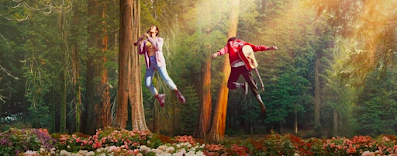
But what keeps the movie above the routine of such things is Decker’s commitment to visualizing her main character’s active mind. Like in her previous pictures—the loose artistic tension of Madeline’s Madeline and the stormy grit of Shirley—style follows from psychological cues. When the lead moves into her flights of fancy, colors are over-cranked, backgrounds can turn into dioramas, montage might become magical realism, flourishes of dance or poetry performance can fill the frame. Befitting her musical abilities, the score might be intrusive, or fade away. This makes for a movie that’s not overstuffed with quirk, but instead fancifully interior, an outpouring of precocious passionate imagination and surging adolescent curiosities and urges. It wisely meets its lead and its prospective audience where they are, and then, through its ability to add shading and texture to its side characters—Jones especially has a moving moment of perspective-bringing near the end—help them grow beyond.
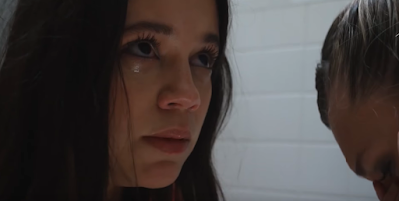
Another new movie that’s a picture of teenage grief is The Fallout. A finely realized debut feature for writer-director Megan Park, heretofore best known for a role on ABC Family’s The Secret Life of the American Teenager, the movie is less dreamy and sad than Decker’s. Instead, it’s teetering on an edge with depression and despair. But it’s so tenderly observed and warmly sympathetic to its characters that it understands all-too-well the difficulties they have readjusting to something like normal in the wake of a tragedy. One gets the sense in the opening scenes that it would be an appealing, low-key high school coming-of-age dramedy if not for the swerve into an unexpected awful event. Isn’t that always the case with these moments? It begins with a teenage girl (Jenna Ortega) talking with her sister (Lumi Pollack) and parents (John Ortiz and Julie Bowen), with friends and acquaintances and teachers (Will Ropp, Christine Horn). It’s the start of a normal day. She ends up in the restroom during class—avoiding class, really—and talks to a more popular classmate (Maddie Ziegler). That’s when they hear gunfire in the hallway. Screams. Slams. They hide. It seems to last forever, but then…that’s it. It’s over. They survived. Their school, their classmates, themselves, are now just another statistic.
The school shooting movie has, sadly, become something of a tradition now. It reflects the way this has been allowed to become a grim fact of life. In our politics, we hear an awful lot of whining about the supposedly deleterious effects of something like wearing a mask to go to school during a global pandemic. These complaints are usually coming from the same people who have never had anything meaningful to say about the far worse effects of getting shot to death in school. So here it is in the movies. Gus Van Sant’s floating camera in 2003’s Elephant and Denis Villeneuve’s grainy black-and-white 2009 Polytechnique make intense in-the-moment works of dread and violence. Last year’s Mass was a talky, probing look at parents grappling with deaths of this nature years later. Recent documentary Bulletproof shows the preparation for the possibility of such events—lockdown drills, kevlar backpacks or hoodies, potential classroom fortifications—as just another back-to-school routine, cut into its flowing montage of teacher trainings, band practices, sports drills, and assemblies. How sad that we’ve had over twenty years of reactions to mass deaths like these and protests against the very gun laws that encourage such destruction, and yet little has changed. What The Fallout brings to the conversation is not the violence, which is largely implied, but a softer touch and intimate detail, keyed into its leads’ numbed aimlessness in the aftermath.
Ortega takes center stage in tight focus for a character who is convincingly drawn. She expertly plays teen angst as a sort of normal acting out refracted through her vulnerable and raw post-trauma days and weeks as she claws back to a sense of self. There’s something convincing when she throws a thrashing little “God, mom!!!” flailing fit, and in the way she and Ziegler become friends bonded by their survival. They clung to each other as the chaos boomed outside; now they cling together to make it through. They’re contrasts—Ortega loose and swimming in baggy clothes, Ziegler clenched and poised in tight outfits as an Insta glamour princess—but connected. An early scene in which they text back and forth late at night is expert at conjuring that sort of intimacy—a flurry of closeups of eyes, fingertips, ellipses. And then they’re back to school, back to friends, trying to find their way in a string of episodic moments. By turning the mechanisms of a gentle Hollywood slice-of-teen-life style on the wake of a mass shooting, it makes a bitter sting of grief and hopelessness all the more affecting.
The film sees how the tragedy works its way through the community of characters, and watches as its impact shifts dynamics, closes off some old habits, and opens up new avenues of potential harm and growth alike. Bowen and Ortiz bring good detail to shaken, frustrated, and loving parents, while the other young actors sell a wide range of responses. Most telling, perhaps, are a few scenes where Ortega visits a sympathetic counselor played by Shailene Woodley. Aside from making viewers of a certain age feel old that this former Fault and Secret Life star has now aged enough to play one of the grown-ups, there’s an interesting disconnected connection Woodley and Ortega forge, with one’s insistence that things might get better personally, and the other’s looking at society around her with justified suspicions. I hope the potential young audience for this movie takes away some of these visions of humanity, and recognize something true in it.
Showing posts with label Jason Segel. Show all posts
Wednesday, March 16, 2022
Thursday, December 20, 2012
Scenes from a Marriage: THIS IS 40
Audiences first met Pete and Debbie (Paul Rudd and Leslie
Mann) in Judd Apatow’s hit 2007 comedy Knocked
Up. They were the harried couple in their mid-30s with two young kids, a
family that was both a source of hope and a cautionary tale to the film’s
leads, expectant parents played by Seth Rogen and Katherine Heigl. Pete and
Debbie were in some ways the best parts of that movie, memorable and with some exaggerated
truth about them. You might remember Pete warning, “Marriage is like a
tense, unfunny version of Everybody Loves
Raymond. Only it doesn't last 22 minutes. It lasts forever.” Now Apatow has
plucked these characters from his earlier hit to create a spin-off with This is 40, a movie that proves Pete’s
line about marriage correct. This is a sort of epic, R-rated sitcom episode,
right down to the sunny bland visual sense, unfunny in large patches and
lasting seemingly forever. It’s a shaggy, uneven film with some small,
incidental pleasures that from time to time nearly make up for the production’s
overarching solipsism.
The film takes place in the days before Pete and Debbie’s
fortieth birthdays, a fine hook on which to hang a plot of personal reflection
perched on the precipice of potential midlife crises exacerbated by pressures
from outside the marriage. In true sitcom fashion, each half of this couple is
hiding or minimizing important information from the other. Pete, when he’s not
secretly scarfing cupcakes, has been giving money to his freeloading dad
(Albert Brooks), which couldn’t be more inconvenient since his indie record
label is on the brink of collapse and he’s missed a few mortgage payments.
Debbie is also having trouble with her dad, an aloof, awkward, distant parent
(John Lithgow), and money problems that need her to find out which one of her
employees (either Megan Fox or Charlene Yi) is stealing from her boutique
clothing store.
These are the main threads of anxiety that run through the
picture, which are certainly fine impetuses for stress. It’s a shame that the
film follows its characters right down a tunnel of self-absorption, with two
characters locked in marital conflict in petty, grating ways. They bicker about
diets, sex, childrearing, habits, money, vacations, and schedules. Over the
course of 134 minutes, the film has plot elements that dead-end or take a cul-de-sac
in a loose, rambling structure that allows foibles and miscommunications to
escalate, pile up, fade away, come roaring back, shift priorities, and resolve,
or not, in sometimes enjoyable fashion. Rudd and Mann are very good performers
and are here, but the film is ultimately so repetitive an irritant, circling
around the same emotional problems, relationship conflicts, and thematic
concerns with increasingly less to say, that in the end I cared about the side
characters far more than the couple at the center of it all.
Take, for example, the great Melissa McCarthy, an Oscar
nominee last year for her work in the very good comedy Bridesmaids, who here plays a mom of one of Pete and Debbie’s
daughter’s classmates. Following a terrible scene in which Debbie, thinking
she’s sticking up for her daughter, cruelly berates the poor kid, the parents
are called into the principal’s office. In a painfully uncomfortable scene,
Debbie simply denies the encounter, which leads to McCarthy getting
increasingly agitated. In the end, she’s the one who gets in trouble with the
principal, coming across as a crazy person simply because Pete and Debbie
present such a united front of deceit. (Well, McCarthy's character's a little crazy too, but still.) Beats me why we’re supposed to like this
sort of thing. All this really did was cut off any lingering affection I had
for the main characters.
Besides, all the stuff even approaching funny is happening
with characters sitting on the sidelines with undernourished subplots, a fact
that’s some sort of astonishing in a film this indulgent. For starters, there
are Apatow’s daughters, Maude and Iris, playing Pete and Debbie’s daughters
through convincing and cute character traits, the older newly adolescent and
moody, the younger awfully precocious in a good way. I liked their relationship
with each other as well, which leads to the film’s best off-handedly sweet
moments. Brooks and Lithgow, as the flailing grandfathers, are fun as well, but
never more than when they get a chance to play a scene opposite each other. Fox
and Yi are amusing as two diametrically opposite employees, each quick to
accuse the other of being the thief. Then there’s the terrific supporting cast
filled with people like Chris O’Dowd, Jason Segel, and Lena Dunham, who have a
handful of mildly funny lines, if that, each.
The determined self-centered absorption at the film’s center
ends up dragging down all of its more admirable qualities, which are scattered
about the film with no real central drive or organization. If we are to care
about the couple at the middle of it all, it’s made all the more difficult by
their selfishness wherein a great deal of their problems would disappear by
simply speaking to one another honestly or thinking about the feelings and
motivations of others. If we are not suppose to care about this couple, than
the least the movie could do is offer up sharper character studies instead of
unconvincing types stuck crosswise in three or four Idiot Plots at once. Perhaps
Apatow really does believe that marriage is a tense, unfunny, formless, endless
sitcom episode, but he didn’t have to go and make one, did he?
Monday, April 30, 2012
Love and Marriage: THE FIVE-YEAR ENGAGEMENT
Lacking the focus and bite that gave Nicholas Stoller’s bad-break-up
island-getaway comedy Forgetting Sarah
Marshall its notable power, his newest film, The Five-Year Engagement, starts strong, but gets softer and
lousier the longer it goes on. It follows Tom (Jason Segel, also the co-writer)
and Violet (Emily Blunt), who keep pushing back their wedding date whenever
they encounter new obstacles. He’s a chef in San Francisco, but she gets a job
offer at the University of Michigan. Why not take the job, move across the
country and delay the wedding? The timing just doesn’t work out, but they love
each other. They’re devoted and supportive. But why rush? They’ll be spending
their whole lives together, after all. What’s another year? Or two? Or three?
As the story slips through events that take place over the
course of what is eventually the five years of the title, it becomes a
relatively lengthy, shapeless movie that meanders from scene to scene. At first
it’s a rush of parties and preparations, but then time stretches out and
seasons turn. Tom’s parents (great character actors Mimi Kennedy and David
Paymer) and Violet’s parents (Jim Piddock and Jacki Weaver, so frightening in
her Oscar-nominated role as the crime family matriarch in Animal Kingdom) would like to see them married sooner rather than
later. The wedding is always on the horizon, but the distance to it never seems
to shrink. Tom sees his goofy friend (Chris Pratt) receive the promotion he
would have gotten had he remained in San Francisco. Violet sees her sister
(Alison Brie) get married and have a baby.
But those happenings are more than half a country away from
Ann Arbor, Michigan, a great city in its own right. It’s a charming college
town that nonetheless provides wintry challenges to these Californians. And the
people they meet are certainly friendly and challenging in ways related to
their individual eccentricities. Violet’s boss (Rhys Ifans) and colleagues
(Mindy Kaling, Kevin Hart, and Randall Park) and Tom’s newfound friends
(including pothead sandwich maker Brian Posehn and stay-at-home dad Chris
Parnell) are supportive, if eccentric. They know their way around local bars
and hunting weekends respectively. The couple tries again and again to get
wedding plans off the ground, but for one reason or another the date is pushed back again and
again.
A wobbly mix of shapelessness and sharpness gives the movie
its lackadaisical approach. The main problem here is the way it
becomes clear that Tom and Violet have a pretty good relationship. I’m glad
that the filmmakers at first steer clear of stupid movie-plot conflicts as ways
to push back the wedding. It seems perfectly reasonable to avoid rushing into
marriage, especially when Tom’s struggling to restart his chef ambitions in
their new environs and Violet is trying to navigate the start of a promising
career in academia. They love each other and, even if professional goals
frustrate them at times, it doesn’t seem to effect their essential
compatibility or their enjoyment of each other’s company, even when they argue.
In the film’s most quietly funny and painfully accurate scene, Tom lashes out,
complaining about his seemingly stagnant path in life, and finally says that
he’d like some alone time. Violet gets up to go into the next room, but he
calls after her. “Where are you going? I want to be alone here with you.”
What’s so unexpectedly sharp and recognizably humane about
this film is the way it soberly approaches romance from a practical standpoint. This isn’t a swoony love-conquers-all Hollywood concoction. This is a movie
that acknowledges in a serious, albeit in a mostly comedic context, the
difficulties of blending two lives into one, especially when the people
involved are struggling to get their lives as individuals started. It’s a movie
about the futile pursuit of future perfection when the present is pretty good
already.
By the movie’s back half, though, the sweetness and
laid-back observation of this couple living their lives becomes just another
romantic comedy. Contrived conflicts arise that divide the two, causing them to
rethink their entire relationship. The plotting devolves into a distended
version of the standard strained crisis before eventual reconciliation that can
be found in so many romantic comedies, even some of the good ones. What’s
particularly disappointing about this change is that the movie starts as a
nicely unconventional look at romance, questioning a pressing need for
matrimony when things seem to be so unsettled. The easy charm of the cast and
the likable rapport of Segel and Blunt remain, but the supporting cast has been underdeveloped and the jokes have been a bit undercooked and so they just can’t carry the
slow switch into formula. The whole thing starts to take on a feeling of an affable but lumbering episodic mess.
Thursday, November 24, 2011
Inspirational Celebrational Muppetational: THE MUPPETS
Now this is the Muppets! Jim Henson’s cast of
lovable, furry misfits, oddballs, and weirdoes from The Muppet Show and
several delightful feature films, haven’t been seen on the big screen for
twelve years, languishing all this time in a couple TV specials and a handful
of YouTube videos. They haven’t been gone, not exactly, but they haven’t been a
cultural presence the way they once were. Since Henson’s untimely death in
1990, the characters have seemed every-so-slightly lost. This new feature,
called simply The Muppets, reintroduces them in the biggest, funniest,
loveliest, way possible. This is a hugely satisfying film that scrambles all
definitions of kids’ films and grown-ups’ films, a giddy nostalgic reunion with
old friends, and an unmitigated success.
The Muppets have found a great new voice, one that sounds as
close to their old voice as possible without Henson, in co-writers Jason Segel
and Nicholas Stoller. You might remember their Apatow production Forgetting
Sarah Marshall in which the main character wants to produce an all-puppet
Dracula musical. That film’s grand finale was that production, complete with
sweet song-and-felt numbers. Of course, that film was most definitely R, but
their love of G-rated Muppetry was obvious in that sequence. The Muppets have
an earnest and earned innocence, a broad delight in vaudevillian antics, puns,
slapstick, heartfelt musical numbers and staying true to yourself while
sticking by your closest friends. Segel and Stoller get that perfectly in a
splashy, witty musical with great numbers written by Bret McKenzie of Flight
of the Conchords, who knows a thing or two about funny songs. Together they
create a film that starts by acknowledging that the world has seemingly left
the Muppets behind, but, even if unexpressed, the world is desperately in need
of their return.
At the film’s start we’re introduced to Gary (Segel), a
human, and his brother Walter, a Muppet in Smalltown, USA. They’re big fans of The
Muppet Show and plan a trip with Gary’s girlfriend, Mary (Amy Adams), to
Los Angeles, the main attracting being the Muppet Studios. They set off to L.A.
on a bus by way of a musical number. When they arrive at their destination,
they’re disappointed to discover the place run down, an unenthused tour guide
informing them that the Muppets haven’t been seen in years. Poking around the
rundown buildings on his own, Walter overhears the property’s owner, Tex
Richman (Chris Cooper), explaining to Statler and Waldorf (the old heckling
duo) his plans for bulldozing the place to drill for oil. The Muppets would
need ten million dollars to buy back the old theater.
Horrified, Walter sets out determined to save the Muppet
Theater. Luckily, he eventually runs into Kermit the Frog and convinces him to
try and raise the money by getting the old gang back together and putting on a
show. Why not? After all, it was Mickey Rooney himself who helped see Gary,
Mary, and Walter off at the Smalltown bus stop. So, Kermit his new pals set off
to gather up all the Muppets they can find, all of whom have long since gone
their separate ways. Some are struggling, singing in a Muppet tribute band at a
shady hotel lounge, for instance. Others are doing reasonably well for
themselves, like working at Vogue’s Paris bureau. Regardless of
circumstance, though, most are more than happy to jump back into their old
variety show ways. It’s an utter delight to see the Muppets reunite one by one:
Fozzie Bear, Gonzo, Animal, Rowlf, and Miss Piggy. And what would a Muppet
movie be without Dr. Bunsen Honeydew and Beaker? Sam Eagle? The Swedish Chef?
Dr. Teeth? They’re all here and more besides, including some ingenious
celebrity cameos I wouldn’t dare spoil.
What makes the movie so very entertaining is the nonstop
hilarity that comes from a sweet, good-natured desire to do nothing more bring
joy and laughter to the world. The script is filled with funny meta flourishes
that comment on the Muppets’ faded cultural status and extended absence as well
as the film’s very nature as a film. In an opening sequence, a terrific
Broadway-style musical number, there is a pause in the music and the dancing
townsfolk are seen lounging around, waiting for their cue to start up again.
Later, plot points are resolved through literal movie magic. How to drive to
Europe? Let’s go by map! How to pick up all the rest of the Muppets in a timely
manner? Use a montage! Director James Bobin, veteran of TV comedy, brings an
effortless cinematic quality to such playful filmmaking, allowing these
gorgeously simple piece of felt to find their footing once again without ever
once letting it feel dated or quaint. He wrangles the production well. The
familiar felt faces (performed and voiced by Steve Whitmire, Eric Jacobson,
Dave Goelz, Bill Barretta, David Rudman, and Matt Vogel) mix well with the game
human cast, who are entirely unselfconscious in the face of such broad and
varied, smiling wit and whimsy. The film’s hip, clever, and witty without
feeling edgy or contemporary. It has the timeless feel you’d want.
What makes the movie somewhat moving is the way it uses new
Muppet Walter to illuminate that which has always made the Muppets so
singularly special. They’re all misfits in some way. They’re too loud, too
corny, and too musical. They try their hardest and seem unfazed when they fail.
They’re not afraid to get mad at each other, but they’re even less afraid of
forgiving each other. They’re friends and colleagues who have come together in
spite of their weirdness, united by their desire to bring happiness into the
world and to celebrate the weirdness, the boundless hope and enthusiasm that
makes them so wonderful. Walter doesn’t fit in. But with the Muppets, he can
find acceptance. The Muppets have always communicated this message. It gets
better. All you have to do is be yourself and there’s a chance that you’ll find
just the right group of misfits who love the same things you do, who support
you every step of the way, and who will pick up a friendship right where it
left off, even if it’s been years. The humor and the wisdom of the Muppets come
from their unwavering consistency of personality. They are who they are.
I hadn’t seen these guys on the big screen since 1996’s Muppet
Treasure Island. So, I was somewhat surprised to find that, as I waited all
day to see an evening show of The Muppets, I felt a rare anticipation of
the kind I associate only with childhood Christmas Eves. The film was a present
worth waiting for. It’s the funniest movie of the year, the best movie musical
in many a year, and a film so purely, warmly enjoyable that I had a smile on my
face from the first scene to the last credit. It’s a joyous return for these
characters, a generous, contagious, blast of effervescent exuberance and fun
that recaptures the old magic. The film’s working title was The Greatest
Muppet Movie Ever Made. I’d imagine a humble deference to the characters’
legacy caused the change, but now having seen it, that original title would
have barely been hyperbole. This is as good as these iconic characters have
ever been and certainly their best feature film since 1979’s The Muppet
Movie. It’s truly a rekindled rainbow connection. Welcome back, Muppets!
Subscribe to:
Posts (Atom)


