Wasn’t it stupid to try to make a big movie during a pandemic? So says Judd Apatow’s
The Bubble, a big Netflix movie made during the pandemic. Aside from that central uneasy irony, the whole thing’s a bust. It’s a long, loosely-structured would-be comedy with really only the animating anxious confusion of life during COVID and free-floating anger at a flailing studio system hanging the shambles together. The picture takes place in a palatial hotel in the English countryside in the pre-vaccine phase of our current crisis. How strange to see that time so far in the rearview already, and yet still we muddle on. Nonetheless, it forces the fictional studio in this movie, in the midst of mounting the $100 million-budgeted production of the too-chintzy-to-believe
Cliff Beasts 6, to lock its cast and crew in an isolation bubble. There’s a lot of wincing goofiness at the top as the cast assembles in masks for temperature tests, nasal swabs, and a two-week quarantine. And then they’re off, with sequences alternating between broad goofs on Hollywood egos and studio politics in front or behind the scenes, and even broader chafing against the COVID protocols on the other.
There’s much silliness made out of clashing actors—pompous leading men (David Duchovny), mumbling self-serious thespians (Pedro Pascal), ditzy leading ladies (Leslie Mann), lifestyle-brand floggers (Keegan-Michael Key), flailing aged ingenues (Karen Gillan), and a social media star (Iris Apatow). That last one has to be the funniest, with Apatow’s younger daughter nailing the spacey cadence and passionless dancing of a zoned-out TikTok influencer. (That her manager mom is played by the equally zonked-out, wide-eyed Maria Bamford makes perfect sense, and made me wish the she was in the movie more than her fleeting appearance. Maybe the whole movie should’ve just been about them? Hey, still could do a spin-off, right?) There’s also Fred Armisen as an indie director failing in a franchise, Peter Serafinowicz as the harried producer, Kate McKinnon as the heartless executive, and a host of other bit roles filled out by interesting or amusing presences like Maria Bakalova, Rob Delaney, and Daisy Ridley. Much is made out of safety zones, face shields, and positive tests, but just as much tepid farce about cooped up celebrities and harried crew members falling into hook ups and drug use and so on. Any sense of life outside this bubble fades fast, leaving the wasn’t-that-a-time material stale and distant and empty.
Apatow is always at his best with character portraits—
Knocked Up, Trainwreck, The King of Staten Island—and less adept at the problems of the rich—
This is 40. Yet strangely he’s done a great look at showbiz loneliness before in his best film—
Funny People. Maybe it helped that it was set in the world of comedy, from stand-ups to writers to movie stars. He understood how to communicate the loneliness of life in this kind of success, and the yearning for a big break from those on the lower rungs. Here, in
The Bubble, there’s no such understanding of how these enormous spectacles are actually made—scenes in the green screen spaces or with special effects handlers are weird guesstimates, scenes of the movies-within-the-movie don’t even rise to the level of convincing satire. and there are few attempts to make the characters people instead of caricatures. That leaves the movie with empty farce that does nothing but remind you that there’s still a novel virus tearing through our world and an unfunny movie about the problems of a bunch of fake people in rarified circumstances isn’t making the comments it thinks it is.
That’s not to say it’d be too early to make fun of Hollywood excesses against the backdrop of a global pandemic that’s still killing thousands a day. But the movie’s too scattershot to land its punches with any verve, and the screenplay is so dramatically inert and tepidly shot that it’s two pretty flat hours that crawl by. Besides, the characters are so excruciatingly thinly drawn that there’s nowhere for it to go, anyway. When the leading lady has her hand shot off by an overzealous security guard, well, I guess that’s just par for the course. There’s no sense of escalation to the silliness, so by the time we get there, it’s just one more thing. I don’t doubt Apatow’s genuine dissatisfaction with the soulless Hollywood machinery churning out stupider product in the midst of a fraught time. However, the movie isn’t built to bolster that claim, instead finding at most mild amusement as his cast of personalities bounce off of each other, and then frittering away any attempt to add it all up. This manages to make Apatow’s movie simultaneously a howl of frustration and a whine of privilege. The extent to which the movie’s aware of that fact is dialed up and down seemingly at random. How frustrating. It asks: how dare a studio give these people a lot of money to make something this stupid at a time like this? Ditto.
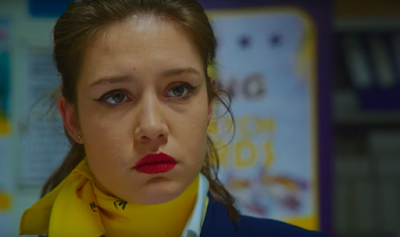
A new streaming movie that’s actually about what it feels like to work for a living these days is Belgium’s small, well-observed flight attendant drama,
Rien à foutre, which can be translated as
Zero Fucks Given. With a title like that, and the copious stories lately about belligerent passengers refusing to, say, wear a mask to prevent the spread of disease, you’d think the movie would be a wild, vulgar affair. Going in I was thinking it’d be something like Pedro Almodovar’s deliriously fizzy airplane comedy
I’m So Excited by way of Radu Jude’s
Bad Luck Banging’s pandemic satire. But the movie is actually a sensitive little character study about a lost young woman, adrift in the air and on the ground alike as she tries to make do. It’s mostly a pre-pandemic story—though everyone’s in masks in the final scene, a bittersweet way of marking time, to be sure. Its consistent mood of now-what? is spot on.
The focus is simply on sketching the contours of one woman’s life, and finds no build to any false conflict or cheap revelations. No Sundance sentiment or workplace sitcom here. There’s something real and lived-in at the center of the picture. The flight attendant works for a budget airline and is lost to a grinding routine—airports, drinks, clubs, and one-night stands, dating apps and Instagram. She’s making enough money to get by, and she dreams of someday getting better routes to more glamorous destinations, even as she smiles and sells drinks and manages passengers and tries to hit her quotas. She’s not unambitious, but she’s uninterested or unable to achieve liftoff. Even when her supervisor essentially forces her to apply for a promotion, she’s a little put off. She’s happy the way she is. Or, maybe not happy, but it’s what she knows. Even the corporate hoops are mere inconvenience, until they’re not. There are moments where her face fills the frame as a smile passes subtly, slowly from genuine to fake, and you feel her world shift underneath her.
Credit star Adèle Exarchopoulos, then, for keeping the movie aloft. Though filmmakers Julie Lecoustre and Emmanuel Marre, working from a screenplay they wrote in collaborations with Mariette Désert, bring a ring of specificity to attendants’ shifts and downtime alike, it’s the lead who lifts it to the level of engaging throughout. Fittingly, they keep the camera in tight close-ups and medium shots on her expressive face and body language, precise and casual, beautiful and troubled. Exarchopoulos, who made such a memorable presence as a hungry teenager in the lesbian coming-of-age drama
Blue is the Warmest Color nearly a decade ago, here again makes a compelling center of attention. She appears to be good at her job—she listens, she’s polite, she endures demands and insults with some grace. But she also drinks—sometimes too close to flights—and has no interest in maintaining relationships. Friendships are restricted to her co-workers and seem to last just the duration of any given stay. Romances are ordered up on apps for a few hours at a time. Eventually, she ends up back home with some family for a while, and we get some added insight into reasons why she feels particularly at a loss to move on. There’s real sadness there. But also love.
And it’s not like she’s only miserable, exactly. Here’s a movie that understands the complicated feelings many young people have today about their work and their seemingly stalled pathways forward. She seems to get pleasures from her lifestyle, and can like her job from time to time, but there’s also that indescribable sense that there’s no clear way to get more out of it, or to escape these cycles. Exarchopoulos, enlivening a quiet charisma sinking under a facade of pleasantries or a layer of sleepy depression, knits these details together into one convincing portrait. By the end, she feels like a real person we’ve gotten to know, and the movie’s lack of resolution or even easy ambiguity feels like we’ve just left her, she and we still wondering what’s next. In a time when employees are looking for work to give them not only meaning and money, but dignity, too, here’s a movie about a woman slowly realizing she’s worth more than they, or she, might think.


