In A House of Dynamite, director Kathryn Bigelow brings the procedural precision of her War on Terror films The Hurt Locker and Zero Dark Thirty to a hypothetical doomsday scenario. In tensely believable scenes of people staring at monitors and tapping on keyboards and frantically setting up phone calls, we see a scarily workaday picture of how the end might arrive. As the movie begins, a nuclear warhead of unknown origin has been launched toward America. The whole security apparatus springs into action, tracking the object, attempting to intercept it, tracing its origin, planning potential retaliation, and, finally, bracing for the worst. It’s a vision of competence in the face of the inexplicable and cataclysmic, contingencies planned for since the Cold War suddenly defrosted and put to use. Bigelow marshals a large cast of talented, dependable actors whose very presence denotes professionalism. We check in at the White House Situation Room with Rebecca Ferguson and Jason Clarke, in the oval office with Idris Elba, with high-ranking officer Tracy Letts and cabinet official Jared Harris, and at FEMA with Moses Ingram. The cast expands as the options narrow. There’s something uniquely suspenseful about watching people who we believe to be thoroughly knowledgable and totally capable growing frightened as the implications settle into their faces.
Bigelow has such a firm grasp of tone to keep things tense and tenable that it is a shame it doesn’t add up to more. She here deploys the typical modern signifiers of Hollywood verisimilitude: handheld camera, spontaneous movement, tumbling jargon. The actors are all crisp and clear. It’s all pleasingly convincing on the surface, although the political context of its release in this turbulent 2025 has with it a kind of disbelief or alternate reality feeling. I watched these rooms of professionals calmly and reasonably and thoughtfully respond to a crisis with the awareness that rooms like these don’t look like this now. Imagine the current president, and cabinet officials, and advisors in this situation and the cold sweat induced by the premise grows even colder. That said, the movie is ultimately a disappointment, not for this disjunction alone, but for the movie’s ultimate lack of a conclusion. The movie is three first acts in search of ending. Noah Oppenheim's screenplay takes us to a cataclysmic climactic point and then doubles back to show us a different perspective and then goes back again a third time. We never get past that moment of peak suspense, and each trip through the same beats is actually diminishing returns, never meaningfully adding to the scenario since many actors and key lines repeat anyway. Then the intention to leave us in doubt certainly plays a part in drawing out a political statement about the dangers of nuclear proliferation, but it’s all The Day Of with nary a hint toward The Day After, which gives the movie a big deflating lack of impact or release. It’s a lot of expert suspense with nothing in the end to say about its ideas.
Showing posts with label Moses Ingram. Show all posts
Saturday, October 25, 2025
Sunday, January 9, 2022
What's Done Cannot Be Undone:
THE TRAGEDY OF MACBETH
Tragedy, in the most classic sense, is about consequences. It’s forged in the moment where characters are confronted, inescapably, with the cold, hard facts of their downfall and realize that they brought it on themselves. It is thus that Shakespeare’s Macbeth is perhaps his most tragic tale. Not the saddest, and not the most dramatic, necessarily, but perhaps the most tragic for it sits almost entirely in that moment of realization. Macbeth is quickly brought to commit treasonous murder—from inscrutable witches on the one hand prophesying his kingship, and from a scheming wife’s goading on the other—and the rest of the play watches as the weight of such a deed sends him to his doom. This deep engagement in what happens and what inevitably results from those happenings is something writer-director Joel Coen, adapting the play for his first film without his brother Ethan, understands. (Quite a brotherly compliment to replace Ethan with the Bard; they do share a love of language.) The Coens have made a career out of films, often some mixture of bleakly suspenseful and darkly funny, about characters confronted with the distance between what they think they can get, and what life’s circumstances have in store for them. I often think of an exchange from their 2009 effort A Serious Man, still perhaps the finest film in a body of work made up almost entirely out of excellent films. In this moment, a harried professor confronts a befuddling student, telling him: “Actions have consequences.” To which the young man replies: “Yes, sir. Often.” The professor’s immediate frustrated response: “No! Always! Actions always have consequences.” There’s no running from that.
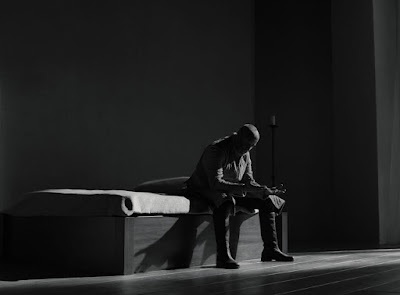
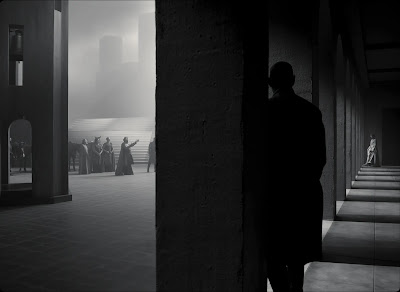
So here’s The Tragedy of Macbeth, a stark and unsparing black and white feature shot in sharp digital closeups, filmed on spare stages cloaked in artifice and darkness, backgrounds that are bleary and sets cavernously empty. A boxy aspect ratio forms a proscenium around the performers, trapping the characters even as their proximity to the camera often causes a startling immediacy. You can see every pore in their face, every wrinkle, each subtle darting of the eye or twitching of the lip. The film is at once intimately engaged in its actors’ decisions and held back at a theatrical remove—a cold and distant picture that’s nonetheless inscrutably, uncomfortably near. Coen’s vision of this story, made vivid by cinematographer Bruno Delbonnel and production designer Stefan Dechant, is one that’s part the high-contrast lighting of a film noir—a look that turns Lady Macbeth into a regal femme fatale—and the woozy constructed angles in crooked stairways and enormous windows of German expressionism—down to its extension of anxieties about dreams and realities. Coen at every turn emphasizes the moral confusion inside the characters by highlighting the foggy displacement around them. The opening shot looks like it is staring up into milky sky, a bird circling, until the fog starts thinning and we see it’s a vast expanse of pale dirt and puddle where crouches our otherworldly portents ready to unfold a grim tale in which its characters are cogs. In this warped world of oppressive contrast and artifice, the potential majesty of the throne is all implication—down to the landscapes terminating in blankness the color of a scrim, through which the castle can be only just barely glimpsed, a flicker in the distance like Kane’s Xanadu. You just know that’ll be unsatisfying for anyone who wants to rule there.
And that’s how Denzel Washington approaches the lead role, as a man who, perhaps unconsciously, already senses that achieving a royal status won’t solve the deep dissatisfactions in his soul. Washington takes his considerable charisma—he easily commands attention like few of his or any generation—and twists it inward in hesitation and guilt. His head hangs heavy even before the crown, like his mind really is plagued with scorpions, leading him to question his choices before, after, and as he makes them. He becomes a reluctant conduit for his own malevolence, and as such is almost going through the motions as a spectator. His soliloquies are hushed, tortured. His later outbursts of madness have none of the live-wire aggrandizement you might expect. Although he holds considerable power in the lives of the other characters, he always carries himself like a pawn. It’s an embodiment of what Emma Smith, professor of Shakespeare studies at Oxford, identifies as a central question of the text: “Is [Macbeth] in control of his own actions…or is he merely working out a part that has been written—by witches’ prophecies, by historical chronicle, by Shakespeare himself?” Washington’s approach wrings pathos from this uncertainty as he frets his hour upon the stage, worried that his life, in the end, will signify nothing. Coen’s film never once roots for his victory; it sees too well how this insecurity leads to his brutality. And Macbeth’s uncomfortable wracked nerves and slippery senses in this telling makes the characters plotting his downfall seem like an act of planning to put him out of his misery.
The movie constantly feels the crushing weight of inevitability. Other characters exist either in direct dialogue with Macbeth, or lurk outside of his notice, each playing their preordained part in the tale. There’s his wife (Francis McDormand), a brittle shiv of ambition whose inability to handle hiding their dark deeds marks the couple’s conjoined unraveling. There are assorted men of more and less power in the kingdom (Corey Hawkins, Brendan Gleeson, Harry Melling, Ralph Ineson, and more) who go under the knife or jostle for power in ways violent, righteous, and self-involved. (Stephen Root’s careless drunken babbling is a fine counterpoint there.) And then there’s the innocent, victimized Lady Macduff (Moses Ingram) sees her home and family burned to the ground by the cruelty of men’s ambitions. All are brought into the nightmare logic of the filming and of the tragedy, positioned as fellow travelers in what fate has in store. Everything is trapped in that aim, as just another facet of the design. Loud on the soundtrack are the steady drips of falling water, or blood—thuds and knocks in a regular rhythm like Poe’s tell-tale heart, or the clock that one should ask not for whom it tolls. We hear fluttering birds and heavy footfalls against cavernous castle walls, every action a reaction. The three witches, all deviously inhabited in the contorted body and raspy voice of the same performer (Kathryn Hunter), remain scarily ambiguous, clearly otherworldly and possessed of dark powers through shifting specters. Are they predicting the future or controlling it? Everything they say comes to pass. Yet dark forces unleashed by greed, guilt, and despair have their own cruel, predictable logic. And tomorrow and tomorrow and tomorrow creeps in from day to day to the last syllable of recorded time. Tragically, one can find too late the consequences of actions are all one’s left in the end. They can signify everything.
So here’s The Tragedy of Macbeth, a stark and unsparing black and white feature shot in sharp digital closeups, filmed on spare stages cloaked in artifice and darkness, backgrounds that are bleary and sets cavernously empty. A boxy aspect ratio forms a proscenium around the performers, trapping the characters even as their proximity to the camera often causes a startling immediacy. You can see every pore in their face, every wrinkle, each subtle darting of the eye or twitching of the lip. The film is at once intimately engaged in its actors’ decisions and held back at a theatrical remove—a cold and distant picture that’s nonetheless inscrutably, uncomfortably near. Coen’s vision of this story, made vivid by cinematographer Bruno Delbonnel and production designer Stefan Dechant, is one that’s part the high-contrast lighting of a film noir—a look that turns Lady Macbeth into a regal femme fatale—and the woozy constructed angles in crooked stairways and enormous windows of German expressionism—down to its extension of anxieties about dreams and realities. Coen at every turn emphasizes the moral confusion inside the characters by highlighting the foggy displacement around them. The opening shot looks like it is staring up into milky sky, a bird circling, until the fog starts thinning and we see it’s a vast expanse of pale dirt and puddle where crouches our otherworldly portents ready to unfold a grim tale in which its characters are cogs. In this warped world of oppressive contrast and artifice, the potential majesty of the throne is all implication—down to the landscapes terminating in blankness the color of a scrim, through which the castle can be only just barely glimpsed, a flicker in the distance like Kane’s Xanadu. You just know that’ll be unsatisfying for anyone who wants to rule there.
And that’s how Denzel Washington approaches the lead role, as a man who, perhaps unconsciously, already senses that achieving a royal status won’t solve the deep dissatisfactions in his soul. Washington takes his considerable charisma—he easily commands attention like few of his or any generation—and twists it inward in hesitation and guilt. His head hangs heavy even before the crown, like his mind really is plagued with scorpions, leading him to question his choices before, after, and as he makes them. He becomes a reluctant conduit for his own malevolence, and as such is almost going through the motions as a spectator. His soliloquies are hushed, tortured. His later outbursts of madness have none of the live-wire aggrandizement you might expect. Although he holds considerable power in the lives of the other characters, he always carries himself like a pawn. It’s an embodiment of what Emma Smith, professor of Shakespeare studies at Oxford, identifies as a central question of the text: “Is [Macbeth] in control of his own actions…or is he merely working out a part that has been written—by witches’ prophecies, by historical chronicle, by Shakespeare himself?” Washington’s approach wrings pathos from this uncertainty as he frets his hour upon the stage, worried that his life, in the end, will signify nothing. Coen’s film never once roots for his victory; it sees too well how this insecurity leads to his brutality. And Macbeth’s uncomfortable wracked nerves and slippery senses in this telling makes the characters plotting his downfall seem like an act of planning to put him out of his misery.
The movie constantly feels the crushing weight of inevitability. Other characters exist either in direct dialogue with Macbeth, or lurk outside of his notice, each playing their preordained part in the tale. There’s his wife (Francis McDormand), a brittle shiv of ambition whose inability to handle hiding their dark deeds marks the couple’s conjoined unraveling. There are assorted men of more and less power in the kingdom (Corey Hawkins, Brendan Gleeson, Harry Melling, Ralph Ineson, and more) who go under the knife or jostle for power in ways violent, righteous, and self-involved. (Stephen Root’s careless drunken babbling is a fine counterpoint there.) And then there’s the innocent, victimized Lady Macduff (Moses Ingram) sees her home and family burned to the ground by the cruelty of men’s ambitions. All are brought into the nightmare logic of the filming and of the tragedy, positioned as fellow travelers in what fate has in store. Everything is trapped in that aim, as just another facet of the design. Loud on the soundtrack are the steady drips of falling water, or blood—thuds and knocks in a regular rhythm like Poe’s tell-tale heart, or the clock that one should ask not for whom it tolls. We hear fluttering birds and heavy footfalls against cavernous castle walls, every action a reaction. The three witches, all deviously inhabited in the contorted body and raspy voice of the same performer (Kathryn Hunter), remain scarily ambiguous, clearly otherworldly and possessed of dark powers through shifting specters. Are they predicting the future or controlling it? Everything they say comes to pass. Yet dark forces unleashed by greed, guilt, and despair have their own cruel, predictable logic. And tomorrow and tomorrow and tomorrow creeps in from day to day to the last syllable of recorded time. Tragically, one can find too late the consequences of actions are all one’s left in the end. They can signify everything.
Subscribe to:
Posts (Atom)