Showing posts with label Francis McDormand. Show all posts

Sunday, January 9, 2022

What's Done Cannot Be Undone:
THE TRAGEDY OF MACBETH

Tragedy, in the most classic sense, is about consequences. It’s forged in the moment where characters are confronted, inescapably, with the cold, hard facts of their downfall and realize that they brought it on themselves. It is thus that Shakespeare’s Macbeth is perhaps his most tragic tale. Not the saddest, and not the most dramatic, necessarily, but perhaps the most tragic for it sits almost entirely in that moment of realization. Macbeth is quickly brought to commit treasonous murder—from inscrutable witches on the one hand prophesying his kingship, and from a scheming wife’s goading on the other—and the rest of the play watches as the weight of such a deed sends him to his doom. This deep engagement in what happens and what inevitably results from those happenings is something writer-director Joel Coen, adapting the play for his first film without his brother Ethan, understands. (Quite a brotherly compliment to replace Ethan with the Bard; they do share a love of language.) The Coens have made a career out of films, often some mixture of bleakly suspenseful and darkly funny, about characters confronted with the distance between what they think they can get, and what life’s circumstances have in store for them. I often think of an exchange from their 2009 effort A Serious Man, still perhaps the finest film in a body of work made up almost entirely out of excellent films. In this moment, a harried professor confronts a befuddling student, telling him: “Actions have consequences.” To which the young man replies: “Yes, sir. Often.” The professor’s immediate frustrated response: “No! Always! Actions always have consequences.” There’s no running from that.

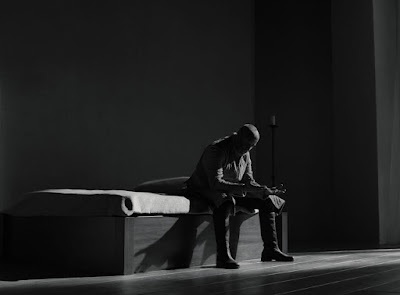
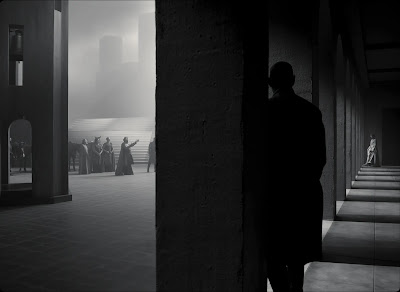
So here’s The Tragedy of Macbeth, a stark and unsparing black and white feature shot in sharp digital closeups, filmed on spare stages cloaked in artifice and darkness, backgrounds that are bleary and sets cavernously empty. A boxy aspect ratio forms a proscenium around the performers, trapping the characters even as their proximity to the camera often causes a startling immediacy. You can see every pore in their face, every wrinkle, each subtle darting of the eye or twitching of the lip. The film is at once intimately engaged in its actors’ decisions and held back at a theatrical remove—a cold and distant picture that’s nonetheless inscrutably, uncomfortably near. Coen’s vision of this story, made vivid by cinematographer Bruno Delbonnel and production designer Stefan Dechant, is one that’s part the high-contrast lighting of a film noir—a look that turns Lady Macbeth into a regal femme fatale—and the woozy constructed angles in crooked stairways and enormous windows of German expressionism—down to its extension of anxieties about dreams and realities. Coen at every turn emphasizes the moral confusion inside the characters by highlighting the foggy displacement around them. The opening shot looks like it is staring up into milky sky, a bird circling, until the fog starts thinning and we see it’s a vast expanse of pale dirt and puddle where crouches our otherworldly portents ready to unfold a grim tale in which its characters are cogs. In this warped world of oppressive contrast and artifice, the potential majesty of the throne is all implication—down to the landscapes terminating in blankness the color of a scrim, through which the castle can be only just barely glimpsed, a flicker in the distance like Kane’s Xanadu. You just know that’ll be unsatisfying for anyone who wants to rule there.
And that’s how Denzel Washington approaches the lead role, as a man who, perhaps unconsciously, already senses that achieving a royal status won’t solve the deep dissatisfactions in his soul. Washington takes his considerable charisma—he easily commands attention like few of his or any generation—and twists it inward in hesitation and guilt. His head hangs heavy even before the crown, like his mind really is plagued with scorpions, leading him to question his choices before, after, and as he makes them. He becomes a reluctant conduit for his own malevolence, and as such is almost going through the motions as a spectator. His soliloquies are hushed, tortured. His later outbursts of madness have none of the live-wire aggrandizement you might expect. Although he holds considerable power in the lives of the other characters, he always carries himself like a pawn. It’s an embodiment of what Emma Smith, professor of Shakespeare studies at Oxford, identifies as a central question of the text: “Is [Macbeth] in control of his own actions…or is he merely working out a part that has been written—by witches’ prophecies, by historical chronicle, by Shakespeare himself?” Washington’s approach wrings pathos from this uncertainty as he frets his hour upon the stage, worried that his life, in the end, will signify nothing. Coen’s film never once roots for his victory; it sees too well how this insecurity leads to his brutality. And Macbeth’s uncomfortable wracked nerves and slippery senses in this telling makes the characters plotting his downfall seem like an act of planning to put him out of his misery.

The movie constantly feels the crushing weight of inevitability. Other characters exist either in direct dialogue with Macbeth, or lurk outside of his notice, each playing their preordained part in the tale. There’s his wife (Francis McDormand), a brittle shiv of ambition whose inability to handle hiding their dark deeds marks the couple’s conjoined unraveling. There are assorted men of more and less power in the kingdom (Corey Hawkins, Brendan Gleeson, Harry Melling, Ralph Ineson, and more) who go under the knife or jostle for power in ways violent, righteous, and self-involved. (Stephen Root’s careless drunken babbling is a fine counterpoint there.) And then there’s the innocent, victimized Lady Macduff (Moses Ingram) sees her home and family burned to the ground by the cruelty of men’s ambitions. All are brought into the nightmare logic of the filming and of the tragedy, positioned as fellow travelers in what fate has in store. Everything is trapped in that aim, as just another facet of the design. Loud on the soundtrack are the steady drips of falling water, or blood—thuds and knocks in a regular rhythm like Poe’s tell-tale heart, or the clock that one should ask not for whom it tolls. We hear fluttering birds and heavy footfalls against cavernous castle walls, every action a reaction. The three witches, all deviously inhabited in the contorted body and raspy voice of the same performer (Kathryn Hunter), remain scarily ambiguous, clearly otherworldly and possessed of dark powers through shifting specters. Are they predicting the future or controlling it? Everything they say comes to pass. Yet dark forces unleashed by greed, guilt, and despair have their own cruel, predictable logic. And tomorrow and tomorrow and tomorrow creeps in from day to day to the last syllable of recorded time. Tragically, one can find too late the consequences of actions are all one’s left in the end. They can signify everything.

Saturday, October 30, 2021

Off the Press: THE FRENCH DISPATCH

The French Dispatch is an impeccable handcrafted artifice somehow turning into the purest sincerity at the same time. It is, in other words, a Wes Anderson film. He’s a filmmaker who can make intricate dollhouse constructions over the darkest of melancholies. He’s one of our great appreciators of style and tone, able to take a gleaming picture of theatrical techniques and literary flourishes, pack it dense with allusions and yet give it surface pleasures all its own. He’s best at building out little pocket worlds—an eccentric wealthy New York family in The Royal Tenenbaums, a brotherly train tour of India in The Darjeeling Limited, a tiny New England island community in Moonrise Kingdom, or, his best, the towering, luxurious European mountain getaway in The Grand Budapest Hotel. Within he can indulge his eye for design—a blend of vintage mid-century aesthetics informed by a well-curated artistic intellect—while building up beautiful sadness and delightful serendipities. There’s no wonder the astonishing emotional power he can build—whether a gentle reconciliation between father and child, or a bittersweet acknowledgement of encroaching fascism bringing a golden age to a close—can catch viewers by surprise, if they can see it at all, beneath his dazzling, droll surface precision.

His latest takes as its conceit the last issue of a fictional magazine, The French Dispatch, upon the death of its founder, editor, and chief benefactor. The old man (Bill Murray) willed it so. One gets the sense it wouldn’t have the money to keep going without him. He expired near the end of editing the latest volume of what we’re told is an outgrowth of a weekend supplement for his late father’s Kansas-based newspaper that became, over the course of fifty years, its own periodical run out of storybook-perfect, snow-globe-pretty Ennui, France (the sly Francophilia is from the heart). It was a haven for the sort of literary journalists and essayists that flourished in the early to mid twentieth century. (The first card of the end credits lists, in tribute, several who serve as inspirations for Anderson’s inventions, from E.B. White and Lillian Ross to A.J. Liebling and James Baldwin.) The film becomes an amusing, eclectic mixture of that era’s art, music, design, and politics run through the typical Andersonian styles. But above all it is driven by evoking long, discursive, artfully poetic journalistic inquiries, some terse typewriter clatter, others honeyed descriptive detail. This kind of magazine writing has been practically driven extinct, save a few New Yorker-style holdouts, over the last few decades of rapacious hedge fund buyouts and relentless internet erosion of readership and attention.

It’s this sense of a bygone era that animates the movie’s wistfulness. As it begins with a death, it feels all the more like an end of that era. The movie is set in 1975, a time when a magazine like this still seemed almost the norm. Anderson begins with the editor’s obituary, and then dramatizes the four articles that make up the farewell publication. Each begins with the title positioned in crisp type, and is greeted with lovely pastiche prose that sounds just right for the period and style. They’re narrated by the journalists—a laid-back observational man-about-town (Owen Wilson), a snooty and secretly wild art expert (Tilda Swinton), a persnickety quasi-radical researcher too close to her subjects (Francis McDormand), and a refined, poetic appreciator of appetites (Jeffrey Wright). Each section is thus framed as a nesting doll—authors recounting stories within their essayistic impressions to interlocutors in faded color stock, bursting into beautiful black-and-white reportage that still further blooms into vivd color at key moments of artistic transcendence.

Thus these dispatches proceed as a collection of lovely little short stories told in a collage of filmmaking techniques. They mix film stocks and aspect ratios, split-screen juxtapositions, vigorous intuitive montage, miniatures, rear projection, slide-away stage walls, freeze frames made by actors standing still, stop-motion and hand-drawn animation. It’s a Whitman’s sampler box of a film: a sturdy, segmented container with a place for each bite-size bit of everything Anderson can do, every little nugget crafted for distinct aesthetic appeals and bittersweet surprises bursting when bit into and chewed over. The resulting stories are all in their own ways about the oddities of human experience and the dilemmas in which eccentrics and artists can find themselves. They’re over-brimmed with petty disappointments, deep wells of sadness, and grand attempts at connection outside oneself. First is a bicycle tour through the town of Ennui. The next takes us to the world of a prisoner (Benicio del Toro) painting his muse, a beautiful guard (Léa Seydoux). An art dealer (Adrian Brody) wants to invest. The next has a college activist (Timothée Chalamet) who wants to change the world, or maybe just find a lover, as he’s groping toward a manifesto. Then we get the tale of a taste test in a police kitchen (run by chef Steve Park and cop Mathieu Amalric) interrupted by an urgent kidnapping investigation. (That one gives new meaning to the term pot-boiler, eh?) The stories never quite go the way you’d think, and take detours into the silly, the tragic, and the profound, sometimes even all at once. Each ends back in the editor’s office as he mulls over some suggestions. His favorite is one all good English teachers should adopt: “Try to make it sound like you wrote it that way on purpose.”

That’s what Anderson does, too. He makes movies with rigorous structure and visual whimsy, together drawing out his whip-smart dry dialogue, textured thematic concerns, and layered images with clear intentionality and a crystal clear unity of form and purpose. This latest is deceptively light, the stories tossed off and slighter than the richness of his character work in other films. But as it draws to a close, it has a cumulative effect. Throughout, we see characters engaged in all kinds of artistic pursuits—painting, cooking, philosophizing, writing—and appreciations—viewing, eating, buying, reading. We see madness in pursuit of new tastes and new visions, and we see the comfort of finding those who understand you through your ideas, your perspective, your words. In these ways, the segments speak to each other, and build to a lovely epilogue that ties the larger portrait together. It’s about art’s capacity to draw us outwards and upwards toward the beautiful, no matter how fleeting. And it’s the story of a man through the work he shepherded—a true editor’s funeral. And it’s a filmmaker at the height of his powers, in total control over his techniques. One can sit and marvel: look at it go. In the list of artistic pursuits it demonstrates and venerates, it makes sure filmmaking is always one of them.