Showing posts with label Seth Rogen. Show all posts

Thursday, October 23, 2025

Angel in the Right Field: GOOD FORTUNE

In Good Fortune, Keanu Reeves plays a guardian angel looking for a promotion who tries to save his first lost soul by showing a guy how the grass isn’t always greener on the other side. The joke is that he swaps a poor man’s life with a rich man’s life and the poor man decides it actually is better that way. For a cute comedy, the movie’s pretty sharp about the wages of poverty, enumerating the indignities of part-time and gig work. The result is a sitcom concoction with an unusual combination of influences. It’s one part Frank Capra fable—think It’s a Wonderful Life without the deeper emotional force—and one part Barbara Ehrenreich’s Nickel and Dimed. That 2001 book-length work of reportage subtitled On (Not) Getting By in America is a now-classic look at the American working poor. To read its accounts of unpredictable schedules, runaway housing costs, labyrinthine fines and fees, arbitrary rules, and inconsistent low pay is to be reminded of the crushing obstacles toward success for those trying to cobble together a living with multiple minimum (or near minimum) wage jobs. The problems she describes have not been ameliorated, but instead exacerbated by the growth of fleeting transactional tasks mediated by tech companies’ apps. There’s no sense of community or connection between employer and employee in such insecurity and inequity, and certainly no sense of duty or responsibility to take care, either. It’s this tension that gets a working over in the writer-director-co-star’s Aziz Ansari’s comic concept. 

It’s an amusing and earnest effort for Ansari. He plays the poor man who’s sleeping in his car and working multiple jobs when he crosses paths with a shallow tech bro played by Seth Rogen. When they are swapped by Reeves’ angel, it appears that, although money may not buy happiness, it can certainly alleviate a whole lot of unhappiness. It also turns Ansari into quite an unpleasantly selfish guy willing to trick his way into more time in this setup. It sneakily makes Rogen into the main character, too, as he’s humbled by just how difficult it is to get and keep work, let alone make ends meet. He’s paired with Reeves, who’s increasingly zen frazzled as he’s made mortal as punishment by his peeved boss (Sandra Oh), and the two guys make a fun odd couple bumming around the lower classes while Ansari just might realize how his hollow riches still won’t win him a second date with Keke Palmer’s pretty union organizer. The movie has a light touch even as it hits its socioeconomic points hard, with a pleasant, likable cast as characters and with bantering dialogues that bounce breezily through the plot’s modest complications. If you think it’ll end without everyone learning a valuable lesson and returning to a slightly better status quo, you don’t know what kind of movie you’re watching. It’s all so bright and brightly lit that it’s hard to dislike even as you sense it won’t get any deeper. 

Friday, August 11, 2023

From Beneath: TEENAGE MUTANT NINJA TURTLES: MUTANT MAYHEM and MEG 2: THE TRENCH

The art of film appreciation is, to paraphrase Fritz Lang’s classic sci-fi silent Metropolis, a handshake agreement between the heart and the mind. We can find much to intellectually assess about any given picture, but inevitably the heart takes over, too. Thus it is that I think Teenage Mutant Ninja Turtles: Mutant Mayhem is a good movie, but one for which my enthusiasm is muted. Whereas Meg 2: The Trench is a bad movie, and yet it’s one with which, I must admit, I had a certain amount of fun. It comes down to this. Mutant Mayhem, the umpteenth Ninja Turtles project, is a good version of a thing I’ve never much cared about, and for which my ceiling of potential enjoyment is apparently much lower than the average audience. Meg 2, on the other hand, is a giddily stupid sequel that never once thinks it’s doing anything else but serving creature feature silliness larded up with all sorts of cheap paperback thriller plotting. Neither movie asks to be taken seriously, which is all for the better. They’re flip sides of the same goofy coin: putting silly characters and sloppy monsters on the big screen for us to gawk at and laugh with and walk out reasonably pleased. I imagine anyone willingly buying a ticket and walking into a movie called Teenage Mutant Ninja Turtles: Mutant Mayhem or Meg 2: The Trench will find exactly what they hope to see there.

Ninja Turtles is an animated feature that redoes an origin story for the ubiquitous amphibious karate teens. It’s a formulaic superhero tale that twins a toxic ooze catalyst for both heroes and villains. The latter is Superfly, a clear nod to blaxploitation down to the rumbling, street-tough Ice Cube voice performance. He’s a mutant bug who rallies his slimy siblings to steal lab equipment with the goal of assembling a machine to wipe out mankind. Luckily, the pack of plucky adolescent kung-fu tortoises in the sewers below have decided to surface and think they should stop him. They’re a gangly, likable bunch—largely indistinguishable but bubbling over with authentic teenage awkwardness, slang, and bravado. Anyone even vaguely aware of kids programming over the past four decades will recognize the shape of their style—the headbands, the ninja weapons, the love of pizza, the rat father. (He’s Jackie Chan now, and gets some appropriate fight choreography to match.) There’s something comforting enough to the fresh coat of paint slapped on a sturdy, predictable plot engine. Never once is the outcome in doubt. Of course the turtles will discover their powers and live up to their potential, while the bad guys will be defeated in a slam-bang fight downtown, and bigger baddies will lurk in the shadows to be teased in a mid-credits scene. But at least it looks neat and the squeaky cracking turtle performances have a real teen energy going. It’s nice to see them animated with a Spider-Verse-style scragginess, down to the wiggly penmanship, expressive line work, and layered visual jokes. It has a rat-a-tat rambling to the dialogue, and sequences stuffed with quick-witted gags and gooey sentimental heart you’d expect from a collaboration between Seth Rogen and a co-director on Mitchells vs the Machines. This might be as good as these turtle movies get.

Meg 2
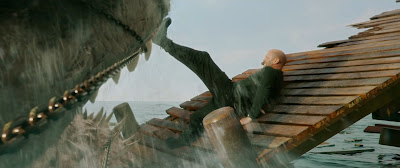
is objectively worse, but I sure didn’t mind it in the moment. Imagine a simpler, dumber Deep Blue Sea and you’re onto something. Jason Statham returns to outwit enormous prehistoric sharks that’ve eluded capture at a scientific outpost meant to contain them. There’s a slog of exposition up top, a lot of soggy business about an ensemble trapped in dive suits on the ocean floor in the middle, and then a chomping spectacle at a beach resort that ends things on a toothy grin. Along the way we get gun-toting villains with a duplicitous boss out of a bad Michael Crichton rip-off, as well as a tentacled deep-sea beastie and eel-like lizard things slithering around making extra variables for the sustained climactic action. I could describe all the flimsy characters and simple interpersonal dynamics and cheap attempts at emotional investment. But really all the movie has going for it is a brisk pace and a willingness to just go for it. The director is Ben Wheatley, who usually does unsatisfying indie horror movies—though his best was winking feature-length shoot-out Free Fire, and his worst was a dismal, instantly-forgotten remake of Hitchcock’s Rebecca for Netflix. Here he gets a chance to make a studio budget (boosted by an international co-production with Chinese backers and actors) colorful and bright and dripping in off-screen PG-13 gore. It’s so stupidly diverting I only wished it was even stupider. A little extra excess—and yes, I’m really saying a movie culminating in Statham stabbing a prehistoric jumbo-shark through the mouth with a broken-off helicopter propeller should be more excessive—could’ve made Meg 2 a classic of its kind. It’ll have to settle for agreeably crummy B-minus movie status instead.

Friday, August 7, 2020

A Sitch in Brine: AN AMERICAN PICKLE

An American Pickle is perched on a premise of such delicate whimsy that it’s a wonder it doesn’t collapse under the slightest weight. And yet it works because star Seth Rogen takes it just seriously enough, lending it a gentle humane grace in the midst of flimsy conceits. The idea is this: in 1919, Herschel Greenbaum, a Jewish immigrant to New York City stuck living a hardscrabble Upton Sinclair life as a rat catcher in a pickle factory, falls, unnoticed, into a vat of brine. The factory is, coincidentally, condemned that day. In 2019, the vat is finally opened, and out pops the perfectly preserved man. The movie doesn’t care about why that happens; it winks at you, so you know the intent is for a fable and goes with that. It sets up what could be mere broad fish-out-of-water comedy, with the hardy, boisterous, bearded fellow, more used to manual labor and with memory of fleeing Cossacks still fresh in his mind, suddenly confronted by modern Brooklyn. (In fact, one similarly beardy hipster does compliment his style and asks if his clothes are vintage.) But what happens is slightly less schtick than you’d expect, as the film zigs into something slower, quieter, and low-key. The man is released into the care of his great grandson — his only living relative, and spitting image. 

Rogen does good work differentiating these performances, and finding warmly humorous rhythms in the disjunction between the two. One man’s bursting gregariously with a chewy eastern European accent and taking up space with ease. The other is seemingly shrinking behind his glasses and folding into himself with unexamined grief. The modern Rogen is a shy freelance app developer, lonely without any living relatives, comfortable in a small life. Good thing the old Rogen is similarly grieved, having lost his beloved wife (Sarah Snook) decades before he awoke, and missed his son’s and grandson’s lives entirely. The last living Greenbaums are now bridging a century together, and maybe, just maybe, can help each other move on. The screenplay by Simon Rich — as befits a humorist of his sort — has this bittersweet center, and then proceeds to be variations on a theme. What if the two Rogens got along? What if they didn’t? And what would social media think? The movie cycles between those three scenarios, each quickly developed and sometimes thinly sketched, but the central dual role enlivens the proceedings each step of the way. Director Brandon Trost—usually working as a cinematographer, many times for films with a Rogen connection—knows not to linger on the absurdities. This is somehow a soft-palate, quietly staged movie with a viral pickle business, a literal Twitter mob, and a circus of a court room scene within its modest framework, but always keeps the focus on the connection the men share. It’s ultimately a story of how comfortable the modern man’s life is, and yet how empty. He just needed to reconnect with his roots (religion, relatives) to bring new fulfillment to his days. And that strong idea, embodied by a fine performer, is just enough to hold the whole odd little movie together.

Saturday, August 13, 2016

Food Poisoning: SAUSAGE PARTY


The sheer number of CG animated movies about anthropomorphized animals and objects, from Pixar on down to their lowliest imitators, leaves an opening ripe for parody. Enter Seth Rogen and Evan Goldberg (co-writers on the likes of Pineapple Express and This is the End) with the idea to go hard-R on the Pixar formula. In Sausage Party they imagine the world of a grocery store from a food’s-eye view. The cartoon products sing an Alan Menken song about how much they wish to get purchased and live forever with their gods (us) in the Great Beyond. Little do they know certain death and digestion await. It’s a funny idea, and mostly follows through to its logical conclusions. But in pitching the humor they go too high and too low, reveling in an allegorical approach that’s a cockeyed consideration of religion and mortality, and in a nonstop barrage of four-letter words and innuendoes. The manic pace hammers away nuance with glee, and the execution grows thin, repetitive, and one-note awfully quickly.

It starts with the idea that the store is split up into its own little countries, each aisle organized around racial and cultural stereotypes of their respective cuisines. The only thing that brings them all together is worship of the shoppers. But when a hot dog (Seth Rogen) gets a hint about the truth of what sits beyond the sliding doors, he’s desperate to get proof and bring a nihilistic, hedonistic brand of atheism back to his brethren. He and his hot dog bun lover (Kristen Wiig) get lost in a tragic shopping cart accident shot like the opening of Saving Private Ryan, with a ripped open ramen cup trying to stuff his noodles back in, a jar of peanut butter weeping over spilled jam, and a banana with its face slowly peeling off. That’s a fun bit of inspiration, but the movie grows repetitively insulting as it winds its way through nonstop ethnic jokes. The hot dog and his bun-to-be, who are waiting until after purchase to get together (there’s no buns- or sausage-related innuendo that goes unspoken), wander through the store looking to get back to their aisle. Each stop on the way brings them into contact with an endlessly condescending parade of stereotypes and racial humor.

The Mexican foods (including a lesbian taco voiced by Salma Hayek) drink all day and follow secret tunnels to better lives. The Chinese foods speak in exaggerated rolling Ls and Rs. The German food wants to eliminate all the juice. The Middle Eastern lavash (David Krumholtz) feuds with a bagel (Edward Norton doing a Woody Allen impression) he thinks is unfairly settling in his aisle. The fruits are lilting lispers. The grits (Craig Robinson) is a blaxploitation gangster. The firewater (Bill Hader) is a Native American whose every appearance is signaled with an eagle’s cry. It’s a pileup of the worst kinds of tiring wink-wink racism and prejudice in pursuit of anti-racism and cross-demographic understanding. It’s so wearing, asked to laugh again and again at this sort of thing as the movie demands to feel like it’s okay because it reaches the right conclusions. Rogen and Goldberg (writing with The Night Before’s Kyle Hunter and Ariel Shaffir) want to make a filthy adult comedy that parodies the style of the CG kids’ movie while still having a clear moral message. In other words, it’s an adults-only kids’ movie, and every bit as juvenile, wrongheaded, and infantilizing as that sounds.

The movie remains on a fairly obvious level, relying on the shock value of hearing cartoon characters swear, get violent, and express sexual urges. (Anyone who thinks that’s a new idea should talk to Ralph Bakshi.) The thing is, the writers have imagined a funny world and have an interesting perspective. They have plenty of smile-worthy puns that go down easy. Why insist on such a barrage of cynical cheap shots? Other distasteful ingredients include swipes at the disabled (consider the plight of a deformed sausage (Michael Cera) whose only soul mate can be a smushed bun) and a scene in which a feminine hygiene product (Nick Kroll) sexually assaults a juice box. (You read that correctly. That happens.) Sausage Party crosses the line, not because it wants to make an R-rated animated movie, but because it allows itself license to push further than it should with such touchy material. That it’s sometimes funny, and tethered to a surreal premise, doesn’t alleviate its uglier impulses.

Directing this perverse sledgehammer to propriety are veterans of CG family films Conrad Vernon (of a variety of DreamWorks features like Madagascar 3) and Greg Tiernan (of Thomas the Tank Engine products). They clearly relish cooking up the movie’s crass and disgusting surprises, but it’s also clearly done on the cheap. The character designs are all slightly off, not just the ugly food, but the stiff and wobbly humans lumbering over them as well. The sets and locations appear Saturday-morning simple and crude. It’s just not quite right every step of the way, in every way. It has a fine setup and some truly jaw-dropping final moments staggeringly inappropriate and in many ways inexplicable, but at least relatively non-toxic – a massive pansexual free-for-all followed by a surprising smashing of the fourth wall – compared to what comes before. But by that point the movie’s been such an obvious, overdetermined, obnoxious slog, it’s hard to cook up much interest.

Sunday, May 22, 2016

Block Party: NEIGHBORS 2: SORORITY RISING


Like so many comedy sequels, Neighbors 2: Sorority Rising is little more than a belabored reason to repeat the first movie’s basic structure and gags, with a lower joke success rate and a sparser humor density. At least in this case the “little more” is interesting. So it’s not nothing, but still quite a bit less enjoyable than the broad, bawdy, and surprisingly thoughtful sight-gag heavy original. It found a frat house (led by Zac Efron) moving in next door to a married couple (Rose Byrne and Seth Rogen) and their baby. This was, of course, an acrimonious situation, generational discomfort agitated into a prank war as the parents sad to see their youth slipping away desperately attempted to get the frat bros evicted. By the end they’d reach some understanding, the bros and the adults going to their separate ways supposedly wiser for the experience. Not so, it turns out, as a sorority moves into the now-empty frat and the cycle starts all over again.

Getting a sorority involved is the movie’s cleverest idea. It allows for an exploration of gendered double standards, explicitly asking if the wild behavior and mean-spirited pranks the girls get up to over the course of the story would be considered quite so extreme if it were done by guys. It’s also a sharp elbow in the side of campus culture, bringing up the totally true rule that sororities aren’t allowed to throw parties. This is why a group of misfit freshmen girls (ChloĆ« Grace Moretz, Kiersey Clemons, and Beanie Feldstein, funny, if somehow underused in their own movie) decide to start up their own off-campus sorority, throwing a bunch of parties with cover charges to pay for rent. It’s empowering after a fashion, a sloppy animal house for the young ladies. Girls can have a dumb raunchy college comedy, too, you know. But, alas, that’s where the movie’s inspiration ends.

That freshness is tied to a retread of its returning characters’ emotional arcs. Why not find something new for Rogen and Byrne to do instead of simply worry about the effect of the out-of-control college kids next door again? Wouldn’t it be funny if they tried a different approach? The stakes are ratcheted up from the last time. Now they’ve bought a new house, are close to closing a deal selling their current one, and are afraid the girls will sink the escrow, leaving them with no choice but to go bankrupt. That’s ominous. But their response is to engage in the exact sort of behavior that got them in over their heads last time. Once more they’re torn about their out-of-touch status and fretting about being good parents while roping in old friends (like Ike Barinholtz) to terrorize the sorority and kicking off another prank war. You’d think they’d know better by now. The new idea they try is a contortion to get Efron back in the mix, this time working with them to help combat the youngsters. This is also the point where you realize age is coming for us all, and recent teen star Efron is closer in age to Rogen than to Moretz. Time marches on and whatnot.

The screenplay cobbled together by director Nicholas Stoller, Rogen and writing partner Evan Goldberg, with co-writers Andrew Jay Cohen and Brendan O’Brien takes narrative shortcuts to get to jokes and setpieces. Then, once there, it’s not really worth the time. There’s a lengthy sequence set at a tailgate that’s just misjudged and tedious. The parties aren’t as fun or chaotic as the first film’s; nor are the relationships between the sorority sisters sketched out as clearly as the frat bros’. That’s not to say there aren’t funny developments – a handful of Minions-inspired cutaway jokes are almost reason enough to have made the movie – but the lengths to which it goes to generate less of an effect than before is a little dispiriting. So much falls flat and so little seems to be telling a focused story or expressing coherent behavior that it’s just sitting there on screen.

Yet as far as disappointing and unnecessary sequels go, this one’s not actively harmful, just a bit of a drag. The performers have a lot of energy – more than the plot, jokes, and filmmaking know what to do with – and the whole thing has a nice low-key progressive bent. It’s not straining to be open-minded. It just is. There’s a sharp, if occasionally muddled, understanding of what it means to be a woman on a college campus and the sexist lenses with which society at large views them. (Blame the few cheaper moments – like weeping en masse to a sad movie – on the total lack of women in the writer’s room, I suppose.) And there’s something to its casual, natural acceptance. An early scene finds a gay couple’s engagement joyously celebrated by their former frat bros who jump up and down chanting “U.S.A.” That’s a patriotic image in my book. Would that all these good intentions turn the lackluster film around them into something worth the watch.

Sunday, January 31, 2016

Village of Pandas: KUNG FU PANDA 3


A fine conclusion to its trilogy, Kung Fu Panda 3 is as energetic and visually dazzling as you’d hope and expect from one of DreamWorks Animation’s very best franchises. What’s so continually satisfying about this series is its tradition of making what are effectively animated kung fu movies. Sure, they feature anthropomorphic cartoon animals living in a cartoony simulacrum of ancient China. But these are films with interfamily conflict, wizards and warlords, masters and students, training montages, action balanced between clever slapstick and dangerous dance, and heaps of mystical spirituality where inner peace and self-knowledge are the most effective skills and power the most awesome moves. I like imagining that somewhere there’s a kid who gets into vintage Jackie Chan or Shaw Brothers films because they’re so over the moon about this fun string of movies about a panda who learns to be a kung fu master.

These movies are plenty fun on their own terms, too. 3 picks up with Po the panda (Jack Black) and his kung fu teammates (tiger Angelina Jolie, mantis Seth Rogen, viper Lucy Liu, crane David Cross, and monkey Jackie Chan) enjoying down time in the peaceful valley they’ve saved twice over. Having become The Dragon Warrior and coming to peace with his tragic past, what’s left for Po to do? Well, Master Shifu (Dustin Hoffman) tells Po he needs to complete his training by finding inner strength. To do so, he must truly know who he is. Luckily enough, his long-lost biological father (Bryan Cranston) shows up in the village, eager to reconnect with the son he had to abandon all those years ago, and teach him the panda way. This gets Po excited, even though his adopted goose father (James Hong) fears his little panda cub will leave him forever. There’s a moving and special adoption story told with care through these silly figures.

But what would a kung fu movie be without external conflict? This one has a growling bull (J.K. Simmons), a villain defeated five centuries ago, escape from the spirit realm with an army of solid jade henchmen in tow. He’s on the rampage, out to capture the souls of all kung fu practitioners who stand in his way, and turn their lifeless bodies into more zombie soldiers to do his bidding. To learn how to defeat them, Po must travel to a secret panda village where maybe, just maybe, he can connect with ancient, long-forgotten panda magic. Screenwriters Jonathan Aibel and Glenn Berger neatly – maybe too neatly – tie together his inner struggles with the needs of the action plot, leaving plenty of time to deliver heaping helpings of cute roly-poly panda antics. They’re adorable, and love to eat, hug, roll, dance, and sleep. What’s not to like? And then, when it’s time to get serious about defeating evil, they spring into action with the best of them.

Returning director Jennifer Yuh, who last time around broke the record for highest-grossing feature directed by a woman, works with co-director Alessandro Carloni (a longtime DreamWorks artist) to stage the film in bright, beautiful colors. It’s an extravagant explosion of fast-paced visual delights, swirling primary hues filling out lush exteriors and intricate architecture, snapping into high-contrast action when the adventure gets going. Where plot and character are concerned, this is a repetition, a riff on previous conflicts with character arcs consisting of reworked aspects of the first two films. But in motion, the movie moves and sings with contagious energy, each image colorful and intricately designed, bursting with zippy and clever choreography. Best are a mĆŖlĆ©e that finds unexpectedly productive kung fu uses for pandas’ inherently cute lazy habits and bookending vibrant zero-g clashes in the spirit realm smashing swirls of glowing magic light through floating boulders.

The story boils down to the same be-yourself platitudes so many family films do, but at least it has the decency to be woo-woo mysto about it, and use it to hold up exciting, amusing, trippy, and striking imagery. The animators bring an elaborate fantasy look of the kind DreamWorks has been trying out these days (with this series, as well as their How to Train Your Dragons, Rise of the Guardians, and The Croods), even throwing split screens, hand-drawn interludes, and extreme color gradients into the mix of lush and buoyant imagery. As a combination reiteration and finale of the trilogy, it may not have the novelty of the first, or the weight of the second, but it is fun. If this is the last we see of Kung Fu Panda, it is a worthy conclusion and a perfect place to stop: with Po learning to love his two dads and be his best self, and with confetti, transcendence, warm and fuzzy reunions, and an angelic choir singing Carl Douglas’s “Kung Fu Fighting” in Chinese translation.

Saturday, November 21, 2015

Three Wise Guys: THE NIGHT BEFORE


An R-rated Christmas comedy, The Night Before is a festive After Hours party through New York City with a trio of buddies on their last carousing Christmas Eve. They started the holiday party tradition as teenagers when Ethan (Joseph Gordon-Levitt) was unexpectedly orphaned and alone. His best friends wanted to give him some Yuletide cheer and help him mourn. But now, years later, they’re moving on without him. Isaac (Seth Rogen) is married with a kid on the way, and Chris (Anthony Mackie) is a big football star. Ethan’s still adrift, without steady employment and freshly broken up from his most recent, and most perfect, girlfriend (Lizzy Caplan). He has commitment issues to everything but his Christmas traditions, and is clinging to this one last great time.

He wants it to be a perfect night of drinking, karaoke, Chinese food, and fellowship. He even scored tickets to a legendary secret party, the best in town. Naturally, his clinging to an ideal night is part of what makes it all go wrong in a cavalcade of hilarious antics involving drugs, slapstick, misunderstandings, and the fumbling loose patter of modern comic dialogue. What follows is a terrific comedy, quick and charming even when it’s just dawdling around with its leads. The throughline is the amiable chummy spirit, a hangout vibe that lets each guy’s personality breathe and bounce off the others in amusing fashion, as the night gets progressively odder. They have great sociable chemistry, convincingly close, like longtime friends who know how to twist the knife of an observation, but care enough to look out for each other’s mistakes.

They’re growing apart and recognize that, but are willing to try to keep their relationships strong. As a result, they’re often great company as they try their best to have a good time. It’s funny enough and fast enough to make me forgive it for being yet another crude comedy about man-children who need to be indulged before finding a family and settling down makes them finally grow up. Director Jonathan Levine (50/50), who co-wrote with Kyle Hunter, Ariel Shaffir, and Evan Goldberg (Superbad), keeps the focus on the three guys and their problems. Because it’s rooted in real and understandable pain, and the movie’s narrative arc and comic engines are built on the unproductiveness of their partying lifestyle, it avoids certain bro-centric traps. The women's roles are underwritten, but there are none of the cheap shots found in other movies of this ilk. This is a basically kind movie, plenty of dirty banter but basically nothing in the way of cruelty.

It helps that they’re real characters, not punchline machines. One is struggling with adulthood, while his slightly more mature friends are worried about fame and babies and what their lives mean. A convincing grounding in real insecurities drives the emotions behind the silliness, a charming tension between the high emotional pressure of the holidays and the desire to cut loose and forget their troubles. Mackie’s jock is desperate to stay cool in the eyes of his fans, teammates, and sponsors. Rogen’s wife (Jillian Bell) gives him a box of drugs – a free pass to get high one last time before their baby arrives, a scary milestone he’s a total mess over. And Gordon-Levitt flashes his boyish charm, but you can see the fear of his economic and emotional instability bubbling underneath.

So they each have their problems to work out as around each corner they encounter drunken Santas, an excited limo driver, an oddball drug dealer, a homeless Grinch, surprise sexts, and other assorted comic scenarios (each involving a recognizable actor, each more unexpected than the last). It’s episodic, and therefore a little hit and miss, but I found the ratio to be fairly high as situations escalate to big laughs on a consistent basis. A highpoint is Rogen, sweaty, panicked, progressively higher, and almost-but-not-quite freaking out throughout in one of his very best performances, whether talking to a nativity scene, admiring another man’s equipment, or vomiting during a midnight mass. Levine balances the picture, though, letting each lead, and most of the supporting cast, have great little moments of surprise, humor, and warmth. Mackie gives chase to a groupie who stole his pot. Gordon-Levitt gets relationship advice from a drunk pop star. At one point, the guys stop to play Nintendo 64, for old time’s sake. They just want to have fun while they can.

A winning movie that had me smiling from beginning (with rhyming storybook narration) to end (with declarations of love), it’s filled with as much holiday spirit as raunch. Unlike a Hangover picture’s smutty cynicism, The Night Before breathes with genuine humane feeling behind its sweet and filthy jokes. It is, after all, a Christmas movie, filled with cozy messages of love, hope, self-improvement, togetherness, and the power of Miley Cyrus’s “Wrecking Ball.” Likable people learn valuable life lessons after an eruption of wackiness, deciding to stop clinging to a tradition’s specifics. Instead, they grow to appreciate embracing evolving relationships while maintaining the spirit of traditions. It’s a simple message that you could fit inside a Hallmark card, but good luck finding one that comes with glitter and tinsel, but also joints, booze, Run-DMC, bad sweaters, a car crash, and a fight or three. It’s a crackling one-crazy-night Christmas comedy more than earning its right to bust guts and warm cockles on a yearly rotation.

Monday, October 26, 2015

Mac Man: STEVE JOBS


Steve Jobs was a brilliant designer and a difficult person. He was a free-thinking creative and a prickly perfectionist. He was partly responsible for some amazing technological innovations and an often unrepentant jerk. This is not only the conventional wisdom about the man who co-founded Apple Computers. This is the sum total of insight Steve Jobs, a handsome but empty Hollywood prestige picture, brings to the table. Here was a man full of contradictions, who oversaw the creation of the Macintosh computer and the iPod, and yet in the process of being an insufferable genius got fired, and then rehired, by the company he helped create. A mystique about him as a cool figure, a Silicon Valley guru with crossover appeal lingers. All that is interesting, but the film breaks down the story into obvious binaries – work and family, art and commerce, intellect and empathy. It’s overwritten, obvious, and thinly developed.

At least it’s not a conventional biopic like 2013’s Ashton Kutcher-starring Jobs, which blandly recounted the broad strokes of his life. Aaron Sorkin has written a predictably wordy script rather thrillingly, at least in theory, structured around three product launches: the 1984 Mac computer, the 1988 NeXT cube, and the 1998 iMac. Each represents a phase of Jobs at Apple. The first shows us the man at his early peak, right before he sets in motion the events that’ll lead to his dismissal. Next, we see Jobs in exile, struggling to make a computer with enough buzz to reclaim his tech genius status in the industry and the media. Lastly, we see his triumphant return, launching the product line that eventually leads to the iPod and iPad. Michael Fassbender, in a deftly chatty but mostly unconvincing performance, plays Jobs as a man always performing, dominating a room with his outsized expectations, willing reality to distort to his desires.

Each segment takes place backstage before a press and shareholders event, Jobs pacing, contemplating his speech, and focusing on last minute details. Each time, the same sets of characters run up to engage him in conversations that are exclusively variations on the same exact themes. Jobs’s assistant Joanna Hoffman (Kate Winslet in a slippery accent) runs behind him fixing problems and treating him with tough maternal concern. Apple CEO John Sculley (Jeff Daniels) shows paternal interest, sagely contemplating his colleague’s flaws before erupting in frustration. An engineer (Michael Stuhlbarg) wants Jobs to go easier on him. Apple co-founder Steve Wozniak (Seth Rogen) wants more public recognition for his department’s contributions. And Job’s estranged ex-girlfriend (Katherine Waterson) and their daughter he refuses to acknowledge (as a teen, Perla Haney-Jardine, pre-teen, Ripley Sobo, and at first little Makenzie Moss) have emotional appeals.

It sure is convenient they all showed up to have similar arguments before these three different big moments, and it’s tedious to watch the repetitions develop. (The best scenes break out of the structure in flashbacks, like a dramatic board meeting backlit by a rainstorm, and an early argument in the company’s garage origins.) I don’t care one bit if the movie’s conceit is true to the real events or real people involved. I only care that it doesn’t work emotionally or dramatically to reduce everyone down to a monotonous need expressed repeatedly and in too-similar ways. Sorkin’s vision of Jobs is a surface level expression of deep contradictions, juxtaposing him through lengthy walk-and-talk dialogue with characters representing differences in business, technology, or family, and watching him clash with them to get his own way. There are small fluctuations in his personality, but by the ending, with a swell of music, slow-mo, twinkling lights, and meaningful glances, I wasn’t entirely convinced he arrived at new understanding about himself any more than we had a better understanding about him than we had in the first five minutes.

This Jobs is very much a Sorkin figure. He’s whip smart and successful in his chosen profession, able to speak fluently and elegantly about his ideas (like The American President, The West Wing, and so on). He’s a distant prodigy who wants to help people in the abstract, but has difficulties in interpersonal relationships, and who thinks he can fill a hole in his heart with impressive invention (like Zuckerberg in the brilliant Social Network). The man’s been shoehorned into Sorkin’s old tricks without the overarching narrative interest or emotional specificity to excuse such tired troubled-man-of-greatness tropes. The movie says a lot, pages upon pages of monologues and diatribes spoken well by a talented cast. But for all the metaphors and cute turns of phrase, they’re really not saying much at all. What more do we know about who these characters are, or what they feel, or what they mean to their industry or to our times? Not much.

Director Danny Boyle (Trainspotting, 28 Days Later, Slumdog Millionaire, 127 Hours), one of our most reliably visually eclectic and propulsive filmmakers, leaves most of the pyrotechnics to the screenplay’s verbal loop-de-loops. But he, with cinematographer Alwin Küchler, makes sure to indulge his interest in color and texture – lingering on a table with brightly colored notes reflected in Jobs’s glasses, setting a confrontation in a cavernous room crowded with overturned chairs, or throwing faded archival footage illustrating a metaphor on a blank wall behind a character. He has sharp blocking and canted angles cut together with pep from editor Elliot Graham. But there’s none of Boyle’s usual constant forward movement, excitement, dread. It’s curiously inert: a somnambulant approach that matches the strained profundity of the overall picture. Steve Jobs is at least trying to be something different, but it’s still the sort of movie that ends its big emotional climax with a man looking at his daughter’s Walkman and promising to invent a way to put 1,000 songs in her pocket. The movie is too clumsy and obvious for its own good.

Wednesday, December 31, 2014

The Bad News Bros: THE INTERVIEW


For all the hullabaloo surrounding its release, from the hackers to the threats to the studio waffling and beyond, the new Seth Rogen/James Franco comedy The Interview has only minor pleasures to offer. With its high concept, dirty jokes, sporadic violence, casual insensitivity, and queasy morality, it’s the kind of movie that, were it made in the 1970s, would be a staple of exploitation pictures recommended by Tarantino. There’s a spirited absurdity to the whole endeavor that finds Franco and Rogen as a talk show host and his producer who land an interview with Kim Jong-un, ruler of North Korea, and are promptly asked by the CIA to help them carry out an assassination. It’s one part fish-out-of-water buddy comedy, one part spy spoof, and one part bloody satire. The whole thing’s deeply silly and omnidirectionally offensive.

Franco’s talk show is positioned as a vapid gossip peddler. He’s a force of personality who gets confessional interviews out of celebrities, a sort of super dumb Dick Cavett. He’s a total idiot, a self-absorbed nonsense man so totally lost in his own media stardom he’s convinced every thought he has is worth sharing. His producer, on the other hand, has aspirations of doing more important work. He’s the one who figures out how to land this monumental interview. Though, to be fair, he’s smarter than his boss, he’s only marginally less bumbling in practice. A CIA agent (Lizzy Caplan, excellent as always) gives them a scant briefing, some secret poison, and lets them on their way to meet with a dictator and take him down. It’s a dubious plan, but, despite utilizing a real country’s actual ruler as a character and target, this isn’t a movie big on sense.

Most of the movie plays out in Kim’s vast grey compound as the two guys stumble their way around, trying not to mess up the mission and utterly failing most of the time. There are real jabs at North Korean ills – famine, executions, propaganda, isolation – mixed into scenes of technical malfunctions, missed connections, and endless coarse banter between the leads. Rogen’s the straight man, while Franco delivers a weirdly artificial performance in which every gesture, every line is letting us know he’s in on the joke. It rarely works. Funniest, even lovable at times, is Kim himself, played with charisma and sly charm by Randall Park as an insecure guy who just wants his guests to like him.

Best is the relationship they develop, as the talk show host finally meets a man as egocentric and needy as he is. There’s something biting in there about an American celebrity, especially one in something like the news business, finding much in common with a dictator. But the film’s largely sloppy as satire, blending sharp commentary and free-range goofiness. There’s also a heaping helping of the typical R-rated bro comedy’s crutches of so-called ironic sexism, racism, and gay panic, masked with a thin veil of knowing wink-wink ain’t-this-awful posturing. It’s part of the film’s broad jumble of potent nihilistic cynicism and gross out gags.

The film was helmed by Rogen and Evan Goldberg, writing partners whose directorial debut was last year’s funny-at-times, and even sloppier, This is the End. Here they wrangle their story, scripted by Dan Sterling, into a mix of bro hangout, male anxieties, and satiric jabs, until culminating in an absurdly violent third-act shootout. It’s a big, hard-edged, live action cartoon, at its best when it steers straight into the absurdity. I especially liked a recurring Katy Perry song used to undercut, and later amplify, tension, the right kind of dopily weird. Otherwise, it’s a mixture of easy geopolitical points, mild media teasing, and sex, drugs, and poop jokes.

The comedy is hit-and-miss, and it’s too goofy to offend as much as it wants. But in the end, the worldview on display through the parade of idiots and violence is more scathing than maybe it thinks. At one point a North Korean propagandist (Diana Bang) discovers their plan to enact a CIA-backed overthrow of a foreign dictator and asks, “How many times will America make the same mistake?” Franco shouts back, “As many times as we have to!” Here’s a movie that says the whole world’s supremely screwed up – with dumb Americans, cruel dictators, and the empty-headed media rhetoric of them both – and the only people who eke out a win are those whose buffoons control the message. 

Sunday, May 11, 2014

The Boys Next Door: NEIGHBORS


An R-rated comedy can sour quickly. There’s a tendency among Hollywood’s purveyors of that subgenre to rush to the R and forget the comedy when planning their edgiest jokes or letting the actors endlessly riff on the lines until scenes grow baggy and dirty. The surprise of Nicholas Stoller’s Neighbors is that it gets the balance mostly right. You’d think a movie about a married couple and their newborn daughter who find their lovely suburban college-town lives disrupted by a rowdy fraternity moving in next door would lend itself to lazy stereotypes and general degeneracy. It does, but even though the movie is exuberantly vulgar, broad, and loud, it never loses track of the human qualities in its characters. There’s an allowance for some small nuance that avoids reducing the characters to their cheapest, ugliest selves.

We start with the married couple (Seth Rogen and Rose Byrne) trying to adjust to life as parents. Unlike Rogen’s many man-child roles, this is a movie about two adults who are mostly happy to have matured to the extent they have. With movies like Forgetting Sarah Marshall and The Five Year Engagement, director Stoller has proven himself interested in exploring the emotional shifts the continual process of growing as an adult entails. In his films, the relationships ring true and are treated with a degree of weight. Here our leads are doting on and toting around their adorable baby, enjoying life while still wondering if having a child has to mean leaving their carefree party days behind. Just as they’re figuring out their new, more responsible, fully adult selves, an explosion of youthful id moves in next door.

At first it doesn’t seem so bad. The frat’s president (Zac Efron) promises they’ll keep the noise down. The other boys (Dave Franco, Christopher Mintz-Plasse, Jerrod Carmichael, Craig Roberts) seem nice enough, cooing over the baby and saying they want to keep the neighborhood pleasant. But then the partying starts. It’s loud, long, and debauched, just as you’d expect. And soon the couple is forced to call in a noise complaint. When the responding cop (Hannibal Buress) tells the frat the source of the call, the frat takes it up a notch. They aren’t just loud and obnoxious partiers by night, litterers and loiterers by day. (That’s familiar to anyone who has lived in a college town.) They’re now actively antagonistic, pranking their neighbors in escalatingly dangerous and improbable ways. After a visit to the flighty dean (Lisa Kudrow) proves unhelpful, the couple decides to sabotage the frat and shut them down for good. The script by Andrew J. Cohen and Brendan O’Brien follows a clear structure, with the frat behaving boorishly and the couple plotting ways to force them out.

With such a setup, it’d be easy for the movie to fall into characterization as simple and button-pushing as its preoccupation with bodily functions, body parts, and bodily harm. A lesser comedy would make the frat boys only villains and the thirtysomethings only virtuous. Here the terrible frat boys are, between raunch and bullying, allowed moments of surprising tenderness, self-doubt, and worry about their fast-approaching post-graduation prospects. One guy goes to a job fair where he’s told flat out he’s “too dumb.” Later, one frat kid earnestly tells another, “You don’t like them [the neighbors] because they remind you of the future.” As for those neighbors, they like smoking a little weed now and then, want to keep their sex life interesting, and have real doubts about the suburban bliss they feel pressure to want. These unexpected shadings go a long way towards balancing the broader, dumber moments.

Some of the situations are unlikely. (Wouldn’t the couple at least close their curtains at night?) Slapstick – like a violent and far-fetched airbags prank – and gross-out gags – like a breastfeeding emergency or, worse, a mix-up involving a discarded, unused prophylactic – might go too far. But the film remains largely likable because it has the right balance. Cinematographer Brandon Trost (who also worked on the better-looking-than-you’d-think This is the End) shoots with a slick, loosely held style that gives weight and a degree of realism to the proceedings. Maybe that’s why the more exaggerated moments feel a bit false, but it also helps sell the truth in the solid performances. Rogen and Byrne have warm chemistry and easy repartee. I particularly liked them arguing about who gets to be the irresponsible Kevin James-type in their marriage. Around them the ensemble – from Efron and Franco on down – is well-cast and well-deployed. And the baby is adorable, ready to give cute cutaway reaction shots while being kept nice and safe, sleeping peacefully when the most dangerous moments erupt.

Too often movies about frats want to wink, nudge, and enjoy the sexism, racism, carousing, and homophobic hazing, wallowing in celebratory immaturity. It’s good, then, that Neighbors finds itself squarely on the side of growing up, saying to do so means finding the proper balance between partying and responsibility. It likes its characters, even when they make mistakes, even at their most caricatured and stereotypical. It’s not a great comedy, a little low on laughs, but it’s pleasant enough to be a decent time at the movies. Without a mean spirit and with a relatively short runtime of 90 minutes and change, it’s the rare R-rated comedy that accommodates dirty jokes, bad behavior, and even a few unfunny scenes, without going sour. 

Wednesday, June 12, 2013

Left Behind: THIS IS THE END


You can almost see the good version of This is the End within it, which makes it all more disappointing this isn’t that. The concept’s solid. Some celebrities are having a party at James Franco’s house when the apocalypse happens. That’s kind of funny, right? What follows is a film that’s entirely too self-satisfied and cripplingly indulgent, resting for far too long on the audience’s assumed delight at watching recognizable faces play themselves. The only truly apocalyptic aspect of the film is the feeling that we’ve well and truly gone past the point of caring about the umpteenth narrative of stoner manchildren haltingly realizing they need to grow up. If This is the End should represent the end of anything, it should be Seth Rogen, Jay Baruchel, Jonah Hill, and the others putting aside this played out character arc once and for all.

Filled with the gentlest of self-critical mockery and hyperbolic play with personas, the film is, for the most part, locked up in Franco’s mansion while fiery Armageddon rages outside. The opening bit of spectacle swallows up a bunch of welcome cameos and scoops up extras in the Rapture, leaving us with Franco, Rogen, Baruchel, Hill, Craig Robinson, and Danny McBride huddled together with dwindling supplies. They fight over survival strategy, have extended comic riffs, and develop spats extrapolated out of their fictional relationships. As is to be expected with this group’s standard R-rated comedy routine, there are endless gross out gags, cultural references both obscure and obvious, and lengthy conversations about every natural bodily function and a few unnatural ones as well. It’s rarely surprising, even at its most unexpected.

This has been written and directed by Rogen and his long-time writing partner Evan Goldberg. It’s pretty clear that every bit of the film is a result of a funny (more likely funny at the time) idea that either they or a member of the cast fumbled their way towards during some session of brainstorming or improvising. The result is an uneven experience, sometimes funny, usually not, as if a sloppy dorm room thought experiment has somehow made it to the big screen largely unchanged. Like, dude, what if the world was ending? And what if we hid in this house? Like, you’d be like this and I’d be like that and, oh man, you know so-and-so would totally die right away. But the difference between engaging in this kind of freewheeling teasing in a hypothetical scenario with your buddies and doing that but for a worldwide audience of moviegoers is that when a major studio bankrolls you, each dumb digression is literalized. You might think suggesting a friend would eventually get possessed and projectile vomit demon juice is a funny idea, but when seen on the screen, there’s a good chance it’ll look like overkill at best, an inside joke at worst. And so it goes here, over and over again.

I’m mostly frustrated with the way the creative energies behind this movie conjure up world-ending stakes and then use them to only poke soft fun at their public personas and circle the same tired types of jokes they’ve been making in film after film for years now.  It could be funny to take a celebrity perspective on disaster. It gets there a couple of times, like when Jonah Hill says he’d expect celebrities to be saved first: “Clooney, Bullock, me, and, then if there’s room, you guys.” But the film dwindles away into disconnected silliness that grows tedious as the claustrophobic minutes tick by, the guys repeating the same basic actions and tics. When the group finally gets out of the house, the energy picks up with the kind of surprises and surprise cameos this thing could’ve used more of. But by then we’re in the last ten or twenty minutes of the picture and it’s all too late. The movie is just a big concept filled up with small ideas, inadvertently saying the only way these guys will grow up is through the intervention of God himself.

Friday, July 27, 2012

Suburban Space Invaders: THE WATCH

Turning out to be nothing more than a belabored, R-rated commercial for Costco (actual dialogue: “They really do have everything we need!), The Watch is a halfhearted action comedy content to do nothing surprising. The story, such as it is, kicks off when the local Costco manager (Ben Stiller) shows up to work one morning to find that the store has overnight turned into a crime scene. The local cop (Will Forte) informs him that the night watchman has been mysteriously murdered. Shaken up, Stiller puts out a call for his sleepy suburb to form a neighborhood watch and is a little disappointed that the only people who respond are a needy middle aged motormouth (Vince Vaughn) who just wants a break from intruding upon his teenager’s social life, an awkward wannabe vigilante (Jonah Hill), and a bumbling British man (Richard Ayoade) who wants to join a group to fit in with the locals.

Eventually it turns out that the murderer is an alien who is simply one of many who are already in the town, poised to phone home and start the invasion proper. So, it’s up to the four flawed guys to stop the space creatures before they can move forward with their plan. Not that the film gathers any momentum from this threat. No, the movie just meanders through typical moments of male gross-out humor bonding, stumbles into a lame Invasion of the Body Snatchers lite and then lazily gets up the effort to squeak out a typical shoot-‘em-up climax.  Altogether it feels like the result of letting a bad Apatow knockoff write and direct a Hollywood remake of Attack the Block. It’s lazily paced, painfully predictable and unimaginative in all aspects, like two faded copies of copies placed one over the other.

It didn’t have to be this way. The talent involved here is promising. The cast is made up of funny, skilled performers and I haven’t even mentioned Rosemarie DeWitt, relegated to a thanklessly underwritten role as Stiller’s wife, or Doug Jones, the incredible performer behind so many great screen creatures (not the least of which is Pan’s Labyrinth’s terrifying Pale Man) who suits up to play the aliens. But the story, written by Seth Rogen and Evan Goldberg (of the great raunchy teen comedy Superbad) and rewritten by Jared Stern (of the not-so-great Mr. Popper’s Penguins), is beat-by-beat dull and rote. It feels slapped together in a way that makes everyone involved appear to be shrugging towards paychecks. Everyone on screen has been vibrant and energetic, funny and sympathetic in other roles. Here, though, they’re all playing characters that are thinly sketched and vaguely off-putting while just going through the paces in a movie that can’t quite get its act together. It is witless and lame every step of the way.

The anemic script is certainly the key problem here, but it doesn’t help matters that its tone is so unformed. When it opens on Stiller narrating us through a typical day in the life of his character, the film appears to be sharpening its satirical claws on the gleaming store shelves and perfect suburban subdivisions, looking with scorn upon the hollow homogenized lifestyles of the characters. But, as more characters come into focus and the gears of the plot slowly get up to speed, it’s clear that this movie’s going nowhere fast. Strange detours into the kinky life of a creepy neighbor (Billy Crudup) and a half-formed subplot about a leering teenager (Nicholas Braun) after Vaughn’s daughter sap away momentum and cloud the tone. Are we supposed to actually validate the overzealous behavior of the central characters in so thoroughly, incompetently, poking around where they don’t belong? They’re hard to root for and when the plot resolves, it does so almost by accident.

The biggest disappointment here is the direction from Akiva Schaffer, not because it’s especially bad – it’s slick and competent – but because it’s so devoid of energy and creativity.  After directing so many terrific, hilarious Digital Shorts for Saturday Night Live and the smart-stupid new cult comedy classic Hot Rod, it’s unfortunate to see him deliver something so uninspired. There’s just about nothing here worth talking about or reacting to. I saw the movie amongst a boisterous crowd of people who, as the movie started, fell silent. As the movie played, we stayed silent. Then, a little over 90 minutes later, we all filed out. I went in hoping for a few laughs and left feeling dispirited. It’s not just bad; it’s nothing but missed opportunities all around.

Sunday, October 2, 2011

Laughter and Medicine: 50/50


There’s no getting around the fact that 50/50 is a cancer movie, but that’s such misleading terminology to saddle the film with. This is no standard, overly weepy disease-of-the-week tearjerker. Instead screenwriter Will Reiser and director Jonathan Levine approach the subject in a sneakier, more palatable way, sidling up to the material in a tender, lightly comic mood that remains palpably perceptive to the main character’s emotions. It’s funny and likable – and, yes, eventually earning tearfulness – precisely because it feels so honest and open. This isn’t a movie of magical thinking or cold, hard reality. This is a movie that creates a character that is an individual, recognizable and distinct, and then has the truthfulness to portray his reaction to the disease convincingly and with nuance.

It takes its approach from Adam, the main character played with wonderfully underplayed charm and quiet restraint by Joseph Gordon-Levitt. He goes in to the doctor with a minor complaint and, an MRI later, is told that he has a tumor on his spine. It’s cancer. As the doctor continues to talk the soundtrack fuzzes out his words while the focus pulls away until all we can clearly see is Adam’s ear in the foreground. Cancer. What a frightening word. There’s never a good time to hear that diagnosis, but he’s only 27. He has his whole life in front of him, or at least he did that morning. Now, everything is scarily uncertain.

He tries to remain calm, and for a while it seems that he is. His best friend (Seth Rogen, playing the Seth Rogen part) tells him that young people beat cancer all the time. His 50/50 odds are actually great. Besides, cancer could help him pick up chicks, an especially important fact since his relationship with his girlfriend (Bryce Dallas Howard) has been a little cold recently.

This all seems to be dubious advice, but at least having such a reliable goofy friend around keeps his spirits high. His mother (the terrific Anjelica Huston), upon hearing the news, worries about him and calls him often, but at least he can talk her out of wanting to move in with him. (Besides, she’s already dealing with her husband’s (Serge Houde), Adam’s father’s, Alzheimer’s.) With all of these people in his life, varying reactions to the cancer surrounds Adam. He’s the calm at the center of the storm.

Enter his therapist, Katherine (Anna Kendrick). She’s only 24 and not technically an experienced doctor. (Actually, she’s still working on her doctorate.) He seems suspicious of her youth and gets her to confide that, yes, she’s new at this. He’s her third patient. He tells her he feels calm, even “good.” He’s not sure that he even needs therapy, but there’s something in the sparkling atmosphere of caring that his visits engender that keeps him coming back. It’s obvious that they like each other, but their relationship has to remain strictly professional.

For a while, 50/50 plays out like a fairly standard R-rated buddy comedy (the raunch is a bit too much at times) with a light dusting of romantic comedy. But every so often, the cancer is inevitably brought to the forefront. Adam goes in for chemotherapy and visits with two chatty older gentlemen (Phillip Baker Hall and Matt Frewer). Their spirits are high – they’re high off some special macaroons too – but sitting there in the hospital brings in a level of cold reality that the rest of the outside world seems to march on without. Throughout the film, Adam’s sense of calm gives way to difficult realizations and increasingly turbulent emotions. He’s struggling.

By the time the film reaches a point where the cancer can no longer be denied, when there is one final push into weepier territory, the tears are earned. I won’t spoil whether or not he survives, but to see a young man close to death is moving and upsetting, all the more so for having spent so much time in his life. Reiser’s script is semi-autobiographical and benefits greatly from the feeling of verisimilitude that brings. Gordon-Levitt brings this script to life with such vitality and likability. He’s one of the very best actors, if not the best actor, in his age range and here is given a slam-dunk Oscar bait role. He doesn’t treat it as such, though. There’s such a lived-in charm and an intimate immediacy to his performance that it helps make the encroaching pressure of the disease feel all the more wounding.

Near the end of the film, as Adam gets wheeled into an operation, we see his mother and father, his best friend, and his therapist sitting in the waiting room, nervously trying to hold it together while waiting for news. It’s the kind of scene that we’ve seen played out in just about every film with disease at the center, but here it feels more immediate than usual. It’s not a cheat for cheap emotion. We know these characters. We know how they’ve dealt with the cancer just as much as we’ve come to know Adam. Laughter instead of tears has been a light distraction from the harsh truth of the situation. But now the laughs have faded away, and we’re all waiting to hear if he’ll be okay.

Tuesday, August 9, 2011

Unidentified Friendly Object: PAUL

Greg Mottola’s Paul may not have the emotional resonance of his two previous efforts (the excellent coming-of-age films Adventureland and Superbad), but it’s still decent entertainment. It’s a warm geeky embrace of a movie, a sci-fi action comedy, jam-packed with winking references. If you’re like me, the kind of person who can appreciate a collage of homage derived from nearly every notable piece of 70’s and 80’s sci-fi (from E.T., Star Wars, and Back to the Future to Aliens, Close Encounters of the Third Kind and Repo Man), you’re in for a treat. But even if every single reference flies over your head, I can’t imagine having the fun entirely pass you buy. Here’s a comedy that really knows how to utilize its talented cast as it builds a satisfying collection of set-ups and pay-offs. It’s an efficient sugary treat.


Simon Pegg and Nick Frost, who also wrote the screenplay, star as two British nerds on an American road trip that starts at Comic-Con and winds its way through famous southwestern UFO hotspots like Area 51. While on a lonely stretch of road, they happen upon a car accident that introduces them to Paul (voiced by Seth Rogen), an escaped alien in desperate need of a ride. It turns out that this little green dude is on the run from the feds (a straight-laced Jason Bateman and two goofball underlings Bill Hader and Joe Lo Truglio) and he wants the nerds to help him flee to a remote patch of wilderness where he will meet his fellow aliens for a ride back to his home planet. Along the way, the trio picks up, under strange duress, a fundamentalist Christian woman (Kristen Wiig) who has a hard time believing in science, specifically that aliens are possible. What do you expect? Her T-shirt reads “Evolve This!” which accompanies a drawing of Jesus shooting Darwin in the face.

This is all so much broad shtick, that’s for sure. The characters are silly caricatures and the plot is just a mash of influences grafted onto a road movie. It’s a little disappointing see so much talent go towards something that, however much fun it provides moment to moment, comes up feeling awfully minor. But Mottola’s coming off of two great films and so are Frost and Pegg who together wrote and starred in director Edgar Wright’s Shaun of the Dead and Hot Fuzz, terrific, sneakily moving, satires of zombie and cop films respectively. There’s a sense that, however minor, a lot of earnest energy went into Paul. Perhaps there’s a feeling that this is simply talented people expending great amounts of effort on goofing off. It embodies a geeky love of the minor details of sci-fi lore. The cast gamely throws itself into the ridiculousness and Mottola, with cinematographer Lawrence Sher, has a nice eye for slick widescreen southwestern spaces in which to arrange his silly, splashy, sometimes explosive, gags.

Its sense of slightness and its sense of humor ultimately balance each other out and Paul evens out at a reasonably enjoyable level of fun. Despite a few too many gay panic jokes, it’s theme of acceptance and open-mindedness is ultimately welcome. The comedy is a self-reflexive and self-aggrandizing look at fandom that posits that neat sci-fi spectacles can draw people together. That may not be exactly true, sci-fi fanboys can be awfully vicious, but if the world at large were as giddily geeky as these characters, people just might have a few more reasons to get along, bonding over the cool little moments found in cult classics.

Saturday, May 28, 2011

Paws of Fury: KUNG FU PANDA 2

Dreamworks Animation’s Kung Fu Panda 2, like Kung Fu Panda before it, delivers lively action sequences (and slapstick) with choreography capable of equaling, even besting, live-action adventure. Animation has the possibility to be the triumph of imagination over practicality, and here that’s completely the case with characters flipping, punching, flying, kicking, and stomping through intricate hand-to-hand combat in ways that would simply be too dangerous and impractical to ask of real creatures. In the summer of 2008, Kung Fu Panda had the best action sequences you could find on the big screen. I’m not so sure 2 will end up in a similar place – the novelty’s gone, for one thing – but it sure is fun.

The first film, set in a medieval China populated solely by anthropomorphized English-speaking animals, featured Po (Jack Black), a roly-poly panda, discovering his true calling to be a kung fu master. He trained with red panda Master Shifu (Dustin Hoffman) to become one of a group of kung fu masters (a Lucy Liu viper, an Angelina Jolie tiger, a Jackie Chan monkey, a David Cross crane, and a Seth Rogen mantis) who protect a humble little valley. That film gained its fun and its momentum from the challenges in the training of the Kung Fu Panda as he prepared to help his new colleagues defeat an outside threat to their safety.

In good sequel form, Kung Fu Panda 2 ups the ante. There’s an evil peacock (Gary Oldman) who has become determined to take over China by harnessing the power of fireworks to blast away any kung fu challenge that comes his way. His first step towards this goal took place a couple dozen years earlier when, after receiving a prophecy that a black and white warrior would defeat him, he slaughtered a village of innocent pandas. One panda, a baby, managed to escape unharmed and was found and adopted by a noodle-cooking goose (James Hong). That panda was Po. So, this time the conflict’s personal, but only for the audience at first. Po doesn’t know where he came from, and his adopted father only knows so much. It’s a mystery to him.

Rather than merely recycle the plot beats of the earlier film, screenwriters Jonathan Aibel and Glenn Berger (with uncredited assistance from Charlie Kaufman) take the opportunity to flesh out the backstory of the central character. Rooting the new plot’s impetus in Po’s past, along with his desire to learn more about it, helps to propel the emotions as well as the action, giving it a bit of pleasing depth. The fighting animals head off across the wilderness once they hear that this peacock has taken over his ancestral town and is planning to use it as a base from which to launch his dastardly deeds. With the mystery of Po’s origins weighing heavily on the plotting, exposition here is given a satisfying kick of emotion.

Under the direction of Jennifer Yuh Nelson, the animation is gorgeously rendered, tactile and fluid, beautifully lit in all the right ways. This could be a film just to look at, worth the price of admission just to stare. But luckily the story the visuals tell is worthy of attention as well, though it feels a bit too formulaic in its structure, which isn’t helped by the opening prologue that tells the audience all about the panda massacre which robs Po’s late discovery of much of it’s power. But he’s searching not just for information. Most importantly, he’s searching for a way to find inner peace. It may be trite, it may be an easy indefinable plot point, but it’s also a quest imbued with such elemental qualities that it’s hard to argue with it.

It’s not a film of zen meditation and grim personal history. There’s boundless irrepressible energy that pushes the whole thing forward. Not just a fast zip to the credits, this is a speedy sprightly delight with a surprising level of emotion. It’s a fun time even though, with an all-too-obvious structure and an inelegantly deployed ensemble (other than Po, characterization remains surface level), I felt the fun was ultimately a little less than what the first film dished out. This is shaping up to be a fine series of kung fu movies for kids, and one that feels respectful of the live-action genre used as inspiration. And if some of those kids, as they get a little older, feel driven to dive deeper into said genre, that could only be an added value to cinephilia.

Added note: It’s a shame that a fun teaser of a final scene, that hints at a direction for a future plot line, is separated from the end credits by the words “The End.” Who do they think they’re fooling?