Showing posts with label Bryan Cranston. Show all posts

Saturday, February 3, 2024

All Artificial, No Intelligence: ARGYLLE

Is this just what movies are going to be now? I sank in my seat as I asked myself that question while the deadening Argylle played out on screen. I dreaded the answer as my pessimism grew. The image was bright. The sound was loud. And I was entirely bored. The thing is just so phony I could hardly believe it as it grew worse by the second. The picture opens with an exaggerated goof on spy movie tropes as Agent Argylle (Henry Cavill) chases a bombshell villainess (Dua Lipa) down twisty Grecian streets while his partners in espionage (John Cena and Ariana DeBose) press buttons and sip coffee. Dua Lipa is on a motorcycle doing tight turns and Cavill is sailing over rooftops in a jeep. There’s not a single shot that doesn’t look sloppily green-screened or like the actor’s face hasn’t been plastered on a stunt person or the digital recreation thereof. The dialogue is all tinny and the scenario entirely prefab. At least when it cuts to Bryce Dallas Howard playing the author of junky spy novels, revealing this prologue was a scene from her latest book, one can briefly entertain the notion that the exaggerated falseness was the point. But then scenes of Howard’s quote-unquote normal life proceed with the same blatantly chintzy computerized backdrops and, as the movie progresses, not a single location appears real in any meaningful sense. Every sequence—dialogue and action alike—is shot with the same bland sloppiness as the opening. It gets less forgivable every time it shows a glitchy face-replacement or cartoon cat effect. When you can’t even get a real cat on set, or at least make a convincing digital double, something’s gone awry.

The movie ramps up into more silliness—dragging through 140-some minutes of plot structured as nesting dolls of stupid twists—as the author is entangled in real espionage as warring spies want her to write the next chapter of a real case. The supporting cast—Sam Rockwell, Samuel L. Jackson, Catherine O’Hara, Bryan Cranston—gamely props up the silliness by snarling and chewing on every scrap of interest the dialogue manages to provide. (Not much; this is a movie that’s constantly, loudly grinning and nodding at its own misplaced sense of cleverness.) But with all this talent and potential, the movie is totally dead on arrival for its aesthetic sins. It’s a part of a mind-numbing trend of visual despair that finds the complete erasure of real things in head-scratching preference for the ugly fakery of pure digital mush. Real and talented performers are stranded with not only a nonsense plot pushed along by scenes of mindless exposition, but in entire worlds of falsehood. I’m sure it doesn’t help that every shot, every line, every concept, every twist is so totally overplayed and thoroughly cliched. It’s cluttered with noisy snark and pounding pseudo-ironic needle-drops and misfiring comedy and redirecting twists that all collide to undermine each other. In the end, Samuel L. Jackson spends half of the climax watching a Lakers game, and the other half watching a slow download’s progress bar, and that’s the fun part. Who cares about a floating CGI fortress blowing up in animated flames while our flimsy heroes speed off in a fake getaway boat into an unreal sunset? It’s witless fakery all the way down.

Used to be you could suspend your disbelief in a high-concept adventure movie because at least the cars and boats and landscapes and animals were real. And real things blew up in beautiful fireballs. And the effects served the story instead of feeling like a rich frosting that’s totally replaced the cake. Now we have this nadir of current trends, with a 200 million dollar movie from deep-pocketed studios, a name director, and a cast that’s cumulatively EGOTed, and it barely looks like a movie at all. It’s over lit, overwrought, computerized nothing. Not even scenes of people in a field or on a roof escape a completely disconnected physical space in front of computer-generated backdrops that make old-fashioned studio rear-projection look believable. Director Matthew Vaughn’s earlier works, like vulgar alt-superhero comedy Kick-Ass and the super-violent double-oh riffing Kingsman movies, are also hyperbolic and over-cranked works of excessive style in action and violence. But at least those have a kind of swirling CG coherence grounded in something pulpy and filmic. With Argylle it’s all frictionless digital blandness. For a big-budget spy movie, it doesn’t look expensive, or glamorous, and the action isn’t clever or exciting. It simply goes on and on, completely and totally alienated from reality and cinema alike. Of course it makes its main characters’ favorite song the new zombie Beatles track—they swirl down the same cultural gutter, amalgamated simulacrum of culture we used to enjoy. We’re in a time where cultural products can be all artificial, no intelligence.

Friday, June 23, 2023

Story Telling: ASTEROID CITY

Asteroid City is something of a skeleton key for Wes Anderson’s approach to filmmaking. It consistently tells you the whole picture is artifice all the way down—and surfaces genuine emotion on the regular anyway. That’s the Wes Anderson way. He’s always doing that—using his dollhouse designs, symmetrical blocking, picture-book precision, handcrafted effects, nesting-doll framing devices, play with aspect ratio, and deadpan witty dialogue to dig deeply into ideas and emotions that hit all the harder for having been approached slyly and indirectly. An audience can be dazzled by the parade of delights he seemingly unfolds with great whimsy, only to realize the subtleties and nuances of the earnest, deliberate intentionality behind his grand designs. Detractors who misinterpret his methods as shallow affectation or meme-worthy ticks or airless style betray only their own lack of depth.

For in a Wes Anderson movie, the apparent limits are what instead allow limitless capacity for deep contemplation. He presents us perfectly designed jewel box settings and finds his characters’ melancholies radiating, uncontainable, as they, and we, are forced to confront the messiness of art, science, family, religion, sex, violence, and everything that makes life. After his Grand Budapest Hotel found bittersweet endings in its screwball capers and romantic nostalgias cut short memorialized by a writer’s work and The French Dispatch an anthology of aesthetic reveries in a funereal tribute for a magazine editor—both pictures as political and elegiac as they are surface fizz—this new film foregrounds its form and telling even further. In so doing, it also furthers Anderson’s commitment to exploring the power of storytelling—not as a pat inspirational cliche, but as the vital stuff of human existence.

Of course a playful movie so deeply and delightfully engaged in ideas about how we explain ourselves to ourselves, and how our senses of identity and purpose are constructed, would be self-conscious as it searches for deep meaning. The movie opens on a host (Bryan Cranston) telling us we are about to watch a rehearsal for a play. In boxy black-and-white framing with theatrical lighting, we see an author (Edward Norton) at a typewriter, and the large cast assembled, and the rigging and stagehands and fakery in the wings. And then, as the story-within-that-story begins, it transforms into widescreen color full of its own artificial tricks—matte paintings, miniatures, stop-motion, and a small town where every window and door is its own proscenium arch. Here, at Asteroid City in 1955, a quaint nothing town in what’s cheerfully described as “the middle of the California, Nevada, Arizona desert,” we find a troop of Space Cadets with parents and a teacher along for a Star Gazing meetup around an ancient asteroid. The tiny motor lodge with individual cabins, next to a gas station and across from an observatory, is just another stage on which life can play out its little eccentricities.

At the center is grief, with a sad photographer father (Jason Schwartzman) telling his nerdy teen son and three cute little daughters that their mother has died. Their grandfather (Tom Hanks) is going to meet them there and drive them home, a necessity because the car just died, too. C’est la vie. It’s building a picture of a world where, no matter how much we seek to quantify and contain, people die, machines break, and the universe never loses its capacity for surprise. A mechanic (Matt Dillon) confidently tells the family that there are only two possibilities for what’s wrong with the car, only to quickly run into trouble and declare that the problem is “a third thing.” (Late in the picture, a character will matter-of-factly comment on a makeshift invention: “Everything’s connected, but nothing’s working.) More than once, a character asked “why” will respond with “It’s unclear.” And as we track back into the black-and-white world for expressionistic reenactments of the dramaturgical process, one actor will admit to not understanding his character or even the play itself. His director tells him, simply, “keep telling the story,” a phrase of advice that radiates back down into the fictions-within-fictions, and back up to us, too.
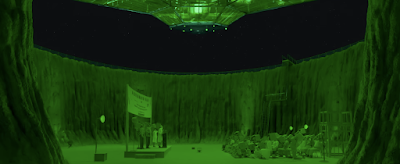
The look and tone is a fine blend of mid-century influences—Western-themed architecture and vintage technologies and designs and non-stop cowboy folk songs wafting over the town’s radios—and reflexively playful about the kinds of melodramas, both abstract and overheated, that a mid-50s writer might conjure. Knowledgeable audiences might clock the relation to the sandy sunlit widescreen staging of John Sturges’ Bad Day at Black Rock or the Technicolor small-town anxieties in Vincente Minnelli’s Some Came Running, not to mention Thornton Wilder and Samuel Beckett and Tennessee Williams and Arthur Miller and so on. (The town also has a roadrunner who chirps “meep meep,” a fine cartoon wink to foreshadow and top off the drama’s impending dusting of sci-fi elements.) And yet, for all this meta-text, we’re seeing a television special inside reenactments inside a rehearsal inside a production about a fictional town populated by dreamers and actors and schemers and scientists, every layer lost in losses and daydreams, grief and preoccupations. Perhaps an ecstatic peak of all this is when a kid performs a song, and as his classmates and teacher join in the dance, we see they’re being watched on a closed-circuit television. It’s all performances within performances.

Anderson keeps these meta-fictions spinning as an expertly choreographed and brilliantly staged nesting doll of fakery. It layers the colorful whimsy of its central story—the Star Gazers and the locals are soon trapped in town by a bizarre series of events, Close Encounters by way of Buñuel—in fictions and their tellings. It allows the movie to access both the charms of its simply plotted southwestern magical realism and its characters’ aching emotional issues, and the dizzying effort the telling. It gets at fiction itself—stories we’re told and stories we tell—and how we can get lost in it by giving ourselves over to what’s real truth within them—even kitsch, even obscure artful gestures, even when we’re unsure but “keep telling the story.” The film finds all kinds of rituals—religious sentiments, scientific methods, philosophical musings, method acting exercises, military orders, keynote addresses, backstage gossip—and notices with great melancholic empathy we’re all looking for, or clinging to, something that’ll explain our place in the vast mysteries of the universe. We need to find ourselves in the right story.

Although many of Anderson’s prior pictures allow the audience to get totally carried along in a compelling narrative and invested in characters in his controlled style, here he utilizes the grinning delights of his aesthetics of geometrical camera movements and perpendicular staging to make us always aware we’re sitting on the fourth wall. (There are even fleeting eye-contacts with the camera.) And here’s the magic: I still cared, deeply, about the characters at even the deepest levels of the fictions. There are beautiful moments of performance and writing that suddenly bring tears to the eyes with their emotional honesty. Anderson’s ability to suggest with the subtlest shifts and swiftest shimmers of interiority, whole lives behind the eyes, deep wells of regrets and confusion, longing and yearning flowers beautifully. I know I’m watching an actor playing an actor playing a character—the movie reminds us constantly—and yet, suddenly, I’m drawn in by his grief, or her confusion, or his confusion. An actress (Scarlett Johansson) in the story-within-the-story asks to run lines with a new friend and suddenly those lines (a mere half-glimpsed excerpt of another story) are somehow moving, too. It’s marvelous, the entire movie constantly making hairpin shifts between cold cerebral conceit and warm sentiment—committing fully to both and serving the thoughtfulness of each equally. The whole movie is this magic trick only a master filmmaker could pull off. It’s deeply poignant and intelligently articulated, a heady blend of heart and mind. It’s a director delivering a disquisition on his style and its intended effects, that also lands those effects with the very best of them. We’re so lucky to have Wes Anderson telling us these stories as only he can.

Sunday, March 26, 2017

Low Wattage: POWER RANGERS


It wasn’t far into Power Rangers, a crude, clangorous and nonsensical attempt to make big budget franchise potential out of a live-action Saturday morning adventure show, that I felt my brain squinting to understand. So crass, ugly, and erratic, I found myself longing for the relative classicism of Michael Bay’s sumptuous visual eye and Brett Ratner’s crisp pacing. (Nothing like a terrible movie to throw under-appreciated pop filmmakers into a better light.) It’s not that I couldn’t follow it. There simply wasn’t anything to follow. Subplots are assembled haphazardly and developed in odd fits and starts. Worldbuilding careens between over-explained jargon and assumed prior knowledge of franchise lore. It’s at once punishingly faux-adult – built from buzzwords and edgy innuendo – and mind-numbingly juvenile – “They found their robo-cars,” I believe I heard the villain howl at one point. Who is it for? Why was it made in this way? Who will it delight, children’s entertainment buried under layers of phony character drama and filters of skuzzy dark grays and blues? Its incompetence is stunning, every canted angle, wooden melodrama, jumbled motivation, and confused exposition adding up to a punishingly dull chaos.

The plot, such as it is, is a generic superhero origin story, director Dean Israelite treating it much the same way he did time travel in his similarly smeary Project Almanac: as a fuzzy mess of familiar beats played off key. We meet a troubled Breakfast Club of diverse teens whose personal lives were seemingly assembled at random from suggestions drawn out of a hat labeled “sad backstory.” The white guy (Dacre Montgomery) is a former football star nearly killed in a car crash. (He happened to be fleeing police at the time and now is under house arrest, except for Saturday detentions.) The funny black guy (RJ Cyler) is on the spectrum, mourns his dead dad, and likes amateur treasure hunting. The white girl (Naomi Scott) has a confused subplot about sexting in which she’s somehow a bully we’re to think of as a victim. The Latina loner (Becky G) is maybe a lesbian. (Her subplot is half allusion, half wishful-think-piecing, if you ask me.) And the Asian guy (Ludi Lin) takes care of his sick mother, and for some reason they live in an abandoned boxcar by the railroad tracks in the middle of nowhere. Fortuitously, they all happen to be at the same quarry late one night when they accidently discover magic rocks that give them superpowers and also a massive underground spaceship that’s waited 65 million years for the Chosen Ones to find it.

The rest of the movie is simply about the teens overcoming their personal problems and interpersonal conflicts by training to become primary-colored armor people driving robo-dino-cars into battle against a green monster lady (Elizabeth Banks camping it up as the ridiculously named Rita Repulsa). She’s assembling a golden warrior giant out of fillings she rips out of the mouths of homeless people. Yes, all that and the teens are trained by a robot (voiced by Bill Hader doing a Patton Oswalt impression) and a wall from which protrudes a big Bryan Cranston face towering over them and speaking through what looks like one of those Pin Art toys. Any one bit of this has potential, but thrown together as a pile of clichés in a random hodgepodge of dim and poorly constructed images, it just grates and grinds. So humorless even the comic relief isn’t funny, it’s at once indebted to the mechanics of its source material and yet, in its muted monotonous teen-issues melodrama, also completely embarrassed of its candy-colored infantile roots. This is a movie for no one, cast expensively into the multiplex in hopes it’ll please someone. Unless you’re that someone, there’s nothing here for you.

Sunday, January 31, 2016

Village of Pandas: KUNG FU PANDA 3


A fine conclusion to its trilogy, Kung Fu Panda 3 is as energetic and visually dazzling as you’d hope and expect from one of DreamWorks Animation’s very best franchises. What’s so continually satisfying about this series is its tradition of making what are effectively animated kung fu movies. Sure, they feature anthropomorphic cartoon animals living in a cartoony simulacrum of ancient China. But these are films with interfamily conflict, wizards and warlords, masters and students, training montages, action balanced between clever slapstick and dangerous dance, and heaps of mystical spirituality where inner peace and self-knowledge are the most effective skills and power the most awesome moves. I like imagining that somewhere there’s a kid who gets into vintage Jackie Chan or Shaw Brothers films because they’re so over the moon about this fun string of movies about a panda who learns to be a kung fu master.

These movies are plenty fun on their own terms, too. 3 picks up with Po the panda (Jack Black) and his kung fu teammates (tiger Angelina Jolie, mantis Seth Rogen, viper Lucy Liu, crane David Cross, and monkey Jackie Chan) enjoying down time in the peaceful valley they’ve saved twice over. Having become The Dragon Warrior and coming to peace with his tragic past, what’s left for Po to do? Well, Master Shifu (Dustin Hoffman) tells Po he needs to complete his training by finding inner strength. To do so, he must truly know who he is. Luckily enough, his long-lost biological father (Bryan Cranston) shows up in the village, eager to reconnect with the son he had to abandon all those years ago, and teach him the panda way. This gets Po excited, even though his adopted goose father (James Hong) fears his little panda cub will leave him forever. There’s a moving and special adoption story told with care through these silly figures.

But what would a kung fu movie be without external conflict? This one has a growling bull (J.K. Simmons), a villain defeated five centuries ago, escape from the spirit realm with an army of solid jade henchmen in tow. He’s on the rampage, out to capture the souls of all kung fu practitioners who stand in his way, and turn their lifeless bodies into more zombie soldiers to do his bidding. To learn how to defeat them, Po must travel to a secret panda village where maybe, just maybe, he can connect with ancient, long-forgotten panda magic. Screenwriters Jonathan Aibel and Glenn Berger neatly – maybe too neatly – tie together his inner struggles with the needs of the action plot, leaving plenty of time to deliver heaping helpings of cute roly-poly panda antics. They’re adorable, and love to eat, hug, roll, dance, and sleep. What’s not to like? And then, when it’s time to get serious about defeating evil, they spring into action with the best of them.

Returning director Jennifer Yuh, who last time around broke the record for highest-grossing feature directed by a woman, works with co-director Alessandro Carloni (a longtime DreamWorks artist) to stage the film in bright, beautiful colors. It’s an extravagant explosion of fast-paced visual delights, swirling primary hues filling out lush exteriors and intricate architecture, snapping into high-contrast action when the adventure gets going. Where plot and character are concerned, this is a repetition, a riff on previous conflicts with character arcs consisting of reworked aspects of the first two films. But in motion, the movie moves and sings with contagious energy, each image colorful and intricately designed, bursting with zippy and clever choreography. Best are a mêlée that finds unexpectedly productive kung fu uses for pandas’ inherently cute lazy habits and bookending vibrant zero-g clashes in the spirit realm smashing swirls of glowing magic light through floating boulders.

The story boils down to the same be-yourself platitudes so many family films do, but at least it has the decency to be woo-woo mysto about it, and use it to hold up exciting, amusing, trippy, and striking imagery. The animators bring an elaborate fantasy look of the kind DreamWorks has been trying out these days (with this series, as well as their How to Train Your Dragons, Rise of the Guardians, and The Croods), even throwing split screens, hand-drawn interludes, and extreme color gradients into the mix of lush and buoyant imagery. As a combination reiteration and finale of the trilogy, it may not have the novelty of the first, or the weight of the second, but it is fun. If this is the last we see of Kung Fu Panda, it is a worthy conclusion and a perfect place to stop: with Po learning to love his two dads and be his best self, and with confetti, transcendence, warm and fuzzy reunions, and an angelic choir singing Carl Douglas’s “Kung Fu Fighting” in Chinese translation.

Tuesday, December 8, 2015

Smart Guy, Dumb Movie: TRUMBO


Jay Roach’s Trumbo strikes me as a movie with a small target audience of people who care about Hollywood history without caring too much about movies themselves. It’s a well-intentioned recounting of the time when blathering idiots in Congress whipped up enough Americans with anti-Communist propaganda that they had to do something about it, that something being mindless persecution costing a great many people their livelihoods. (That we, too, live in a time where blathering politicians make a lot of noise about taking away civil liberties is a parallel not unnoticed.) At the center is screenwriter Dalton Trumbo (here played with gravel and scene-chewing by Bryan Cranston, late of Breaking Bad) who wrote many films (including A Guy Named Joe and Gun Crazy) before running afoul of conservative business folks who were sufficiently spooked by his Communist party affiliation to blacklist him and others like him. The movie lays out the broad strokes of the Blacklist’s rise and fall without caring too much about pesky things like nuance, context, or ambiguity.

With docudrama gloss, Roach (best known for directing Austin Powers, but who has done the reenactment thing before, with election-based HBO films Recount and Game Change) sets about recreating 1950’s Hollywood. He uses the too-bright, too-clean style of every biopic unconcerned with capturing anything but the events. He’s armed with a clear message of right and wrong (Yay, artists! Boo, bullies!), an interesting real-life hook, and a host of recognizable faces playing famous people. (There’s Michael Stuhlbarg as character actor Edward G. Robinson, Helen Mirren as gossip columnist Hedda Hopper, Dean O’Gorman as Kirk Douglas, and so on.) The screenplay by John McNamara (NBC’s Aquarius) serves up the narrative with simple clarity and strictly expositional dramaturgy, which renders every line flat with the dust of a particularly earnest book report. People stand around explaining things to each other, talking like they’re dictating their thought processes, philosophies, and motivations for posterity. At one point, Trumbo is told to “stop talking like your words are being chiseled in granite.” Would that the film had taken its own hint.

The shame of it is that there’s a good story here. Trumbo was a first amendment hero, and the movie does the bare minimum to show it. He speechifies, he testifies, and he’s always a charismatic charmer. The scene where he refuses to name names and runs quippy circles around a Congressional committee is the highlight in this regard. But as he spends years hammering out scripts under pseudonyms for less pay and no credit, even winning Oscars for movies (like Roman Holiday) he can’t acknowledge he’s written, the film merely twinkles with the comfort of hindsight. Sure, poor Trumbo went through some tough times, didn’t he? But, ah, look who got the glory in the end, eh? After all, the Red Scare tried to drive him out of the movies and look who’s still here. Two-plus hours of uncomplicated back-patting from a movie that’s content to view the past from a know-it-all modern standpoint is hard to take. There’s not an ounce of genuine surprise or feeling in the whole thing.

Where’s the real investigation of Trumbo the character? The filmmakers have him on such a high pedestal they forgot to bring him down to our level and really dig into his thoughts and feelings. We see him interacting with his wife (Diane Lane) and kids (including Elle Fanning), but instead of illuminating his personal life, it plays like perfunctory “here’s the family” scenes.  We see him organizing support from writer pals (Alan Tudyk, Louis C.K.) and producers (Roger Bart, John Goodman), but those also play like dutifully arranged footnotes played lightly for strained seriousness. Trumbo the movie is clumsy and overfamiliar, too thin for those who know their Hollywood history, too flavorless for anyone. Trumbo the man was a good deep thinker, now immortalized in a movie of depressingly airy superficiality. The good news is that no one will remember this movie in six months, let alone last as long as his works. That’s the problem with bad movies about good filmmakers: there’s no good reason not to just go to the source.

Friday, May 16, 2014

King of the Monsters: GODZILLA


There’s a difference between filling a movie with effects and setpieces and constructing a movie with effects and setpieces. Gareth Edwards illustrates that difference with great excitement and skill in Godzilla, the latest attempt to recreate the beloved 60-year-old Japanese franchise on American shores. Edwards succeeds where others failed precisely because he takes great care in constructing his imagery – steady, dynamic, clear – and pacing – slow and steady, building to an impressive crescendo – to create a vivid sensation of awe. His Godzilla is awesome in the most literal sense of the word, an overpowering feeling of astonishment and terror. He manipulates his film and his audience with a methodical Spielbergian brio, gazing up at his tense scenarios and massive spectacle with trembling fear and wonder.

Edwards’ shoestring 2010 indie Monsters was a meandering mumbly relationship drama set against the backdrop of enormous beings wreaking havoc off-screen, but with it he proved his facility with effects. It ended with a scene of alien monsters so tenderly photographed as to border on the sublime. Now with a massive budget and a requirement to amp up the action, he finds a similar core of respect for the biology and ecology of Godzilla. He’s presented as an animal like any other where it counts, part of the natural order of things. We should fear him and respect him.

The beast’s 1954 debut created him out of the atomic anxieties of post-World War II Japan. This new iteration places him firmly in modern environmental worries. It begins with two scientists (Ken Watanabe and Sally Hawkins) surveying a dig in the Philippines that has uncovered incomprehensibly large fossils, and evidence a creature has dug its way out into the ocean. Meanwhile, distant tremors collapse a Japanese nuclear power plant where two more scientists (Bryan Cranston and Juliette Binoche) struggle to contain the radiation. In an echo of our modern climate change and superstorm anxieties, there’s a clear sense that humans are about to learn we don’t control nature. In fact, it is quite the opposite.

We jump ahead 15 years. Scientists continue to study the strange readings around the disaster area of the film’s opening. Cranston and his now-grown Navy officer son (Aaron Taylor-Johnson) explore the area and get caught up in the proceedings when an enormous beast breaks free, revealing itself to the world. In a nod to the franchise’s past, we learn that the military’s Cold-War-era nuclear tests in the Pacific were actually an attempt to put down the ancient beast they called Godzilla. They succeeded only in putting him in hibernation. Now he’s awake, hungry, and on the hunt for sustenance. It’s only a matter of time before he makes landfall in a few cities. The army, led by a tough general (David Strathairn), is in desperate pursuit, frantically cobbling together a plan to save the planet.

If you think all that sounds like it could be the generic plot description of many a monster movie, you’d be right. But where this new Godzilla really makes an impact is in its sensitivity in framing the disasters – the slam-bang monster battles, the peek-a-boo creature stalking, the crumbling buildings, rounds of ammunition, and billowing fireballs – against the consuming terror such a calamity would be to the people on the ground. It’s a monster movie stocked with flat characters run through a diversity of sequences of action and destruction as the low camera looks up at the creatures towering above causing their devastation. But because the people remain framed in the foreground, creating a sense of scale while stumbling away from unimaginable horror, gazing upwards in windswept confusion and terror, it matters.

So what if Taylor-Johnson, our lead, has an incredibly simple emotional through-line of needing to fight his way back to his health-care professional wife (Elizabeth Olsen) and adorable moppet (Carson Bolde) who are stranded in harm’s way? There’s no harm in such shameless emotional manipulation if it isn’t careless. This is also a movie that repeatedly puts barking dogs, small children, and the sick and elderly squarely in the path of chaos. But the movie seems to care about their plights, regards the destruction with a measure of real sorrow instead of mere CGI kick, and treats the events with the right mix of gravity and entertainment. It comes off less a series of jolts, more as a grand, relentless amusement park ride.

The movie is filled with complicated effects shots, pa-rum-pum-pum-pum booming brass on the score, and rattling sound design with deep bass footsteps that start as soft quakes until suddenly something is right on top of us. But it doesn’t add up to only a chaotic jumble of sensations. It’s a movie focused on process, troop movements, and monster behavior. Edwards, with screenwriter Max Borenstein, has shaped setpieces within this narrative to have peaks and valleys, tense escalations, teasing suspense, and dips of shaky, tenuous comfort. Take, for example, a great sequence set at an airport. The power goes out. There are explosions and commotion in the distance. The power comes back on, illuminating a monster towering over the runway. It’s a great tease, and Edwards takes amused pleasure in the construction of it while never losing sight of the scare. Like Spielberg’s Jaws or Jurassic Park or Ridley Scott’s Alien, Edwards knows how to get just as much entertainment out of not showing the monsters as revealing them to us in their entire enormity. No need to get the whole thing in the frame right away when one massive scaly flank striding past as people quake in their skyscrapers is even scarier. Even better, we aren't tired of the monster by the time the climax arrives.

This Godzilla is a full movie: big imagery telling a complete story. It’s not up to much beyond the sensations of its awesome creature feature spectacle. The stock characters remain flat. The ecological message doesn’t resonate or build as impactfully as it could. But it’s operating near the genre’s highest level. Edwards is working with impressive craftsmanship, visual intelligence, and moral weight that too few spectacle-wranglers can manage. Like the best popcorn entertainments of Spielberg, James Cameron, Guillermo del Toro, and Peter Jackson, he builds wonder with great patience, excitement, and skill. 

Monday, October 15, 2012

Geopolitical Showbiz: ARGO


In early 1980, an unknown producer quietly, but with a modicum of industry press attention, put a next-to-no-budget science fiction movie named Argo into production. This movie was not destined to be a hit. It wasn’t even to be made at all, cancelled before it even got off the ground. It was, however, a movie of some small historical importance. Argo was a C.I.A. cover story for an attempted extraction of six Americans trapped in Tehran during the Iran Hostage Crisis. This unlikely true story is now a movie named Argo, so the whole thing comes full circle. Now a movie about itself, to a certain extent, its new iteration, directed by star Ben Affleck, is a nicely paced period piece thriller.

Though smartly scripted and narrowly focused by Chris Terrio, this film starts messily, with a flurry of heavy-handed exposition and clumsily staged scene setting. Laying out a Cliffs Notes background of 20th century Iranian history right off the bat led me to believe that the film would be far more interested in providing and exploring the political context rather than leaving the setting and situation as mere set-dressing and plot motivators for its primary concerns. Those concerns are nothing more than crisply presented scenes of period detail and men in suits urgently taking care of business, a terrific collection of character actors doing what they do best: lending weight and likability to small, but impactful roles.

In the film’s opening moments, the American embassy in Iran is taken over and six of its employees (Tate Donovan, Clea DuVall, and others) manage to flee, taken in by the Canadian ambassador (Victor Garber). They can’t stay there for long. Soon someone will grow suspicious. The embassy hostage-takers will realize they don’t have all the Americans in their possession. Domestic pressure is mounting as well. The days go by with little news, good or bad, and the populace grows weary and restless. Affleck fills the opening of the film with copious cutaways to news footage both mock and real, filling in information of the political malaise of the times with overeager intrusiveness. Still, the point gets across. What will become of this dangerous situation? The U.S. government needs a plan.

That’s where the fake movie comes in. It’s, in the words of the C.I.A. operative played by Bryan Cranston, “the best bad idea we’ve got.” The agent played by Ben Affleck will fly into Tehran posing as a producer of a Canadian science fiction film, meet up with these hiding Americans and fly away claiming them as Canadians in his film crew. To do so, the movie needs be adequately believable, which is where two Hollywood veterans – a special effects expert (John Goodman) and a weary producer (Alan Arkin) – come in. They’re there to make the whole thing look legitimate. The Hollywood sequences in the film are dryly funny in the tension between the literal life-and-death stakes of the agents’ plans and the been-there-done-that attitudes of the showbiz types.

Focusing on the process of this unlikely, stranger-than-fiction rescue attempt, Argo mixes scenes of tense walks down hallways, conversations around rotary phones and passing manila folders between men in sharp suits and shaggy facial hair. (This is a film that gets a lot of mileage out of its period costuming, a sort of spy game Mad Men in that way.) In sequences set in America, great that-guy actors like Chris Messina, Kyle Chandler, Zeljko Ivanek, and Titus Welliver fill in quickly sketched government roles, spouting jargon, delivering terse one-liners, and getting the plot moving. In Iran-set sequences, threats are presented as vague foreign rage that rumbles outside the home in which the six Americans are nervously hiding, unable to even look out a window for fear of capture and execution. As the hidden Americans’ and their hopeful rescuers’ plotlines slowly merge, the film builds to an extended period of undeniably effective suspense, skillfully made.

Affleck has proven himself a relatively unshowy auteur, creating functional pieces of serious-minded mid-budget genre filmmaking – thrillers of one sort or another, all – without generating much in the way of distinctive filmmaking. In Gone Baby Gone and The Town, as in Argo, he gets good actors solid material and stays out of the way, doing only what’s necessary to get the story on the screen. That’s not an altogether unworthy approach. Even if here it leads to some visual uncertainty – he’ll go for three shots when one would do – he knows when to capture strong popcorn energy and how to build tension out of nervous editing and tense parallelism. The final stretch of Argo is a nearly white-knuckle tightening of dramatic tension that unfolds so crisply and intensely that I could feel the collective exhale in the theater when the pressure eventually released. This is strong work. 

Wednesday, August 8, 2012

Waiting for Kuato: TOTAL RECALL

Len Wiseman’s new Total Recall, like Paul Verhoeven’s 1990 Total Recall, has a twisty, memory-bending plot. It’s about Douglas Quaid, an everyman – this time around, it’s Colin Farrell, a more convincing everyman than Arnold Schwarzenegger – who grows tired of the drudgery of everyday future life. To shake things up, he heads to Total Recall, a shady company that specializes in implanting fake memories for people who wish for a brief escape from a dull life. Unfortunately, that’s where it all goes wrong. The procedure either awakens secret agent skills and memories within Quaid, sends him stumbling into a full psychotic breakdown, or delivers exactly the thrill ride he paid for. That’s the fun mystery underpinning all of the running and shooting to follow.

Verhoeven, one of the smartest, stylish blockbuster filmmakers of the last few decades, made his Total Recall between his Robocop and Starship Troopers, two consistently underrated sci-fi action-heavy satires. Recall has no such potency for me. It has several instantly iconic moments – the triple-breasted woman, the malfunctioning mechanical disguise, the creepy Kuato – and a propulsive puzzle of a plot, but overall it feels hollow and hokey to me. There’s definite room for improvement here but Wiseman, along with writers Kurt Wimmer and Mark Bomback, have only mixed things up in surface ways. Now, instead of a dichotomy between Earth and Mars, the societal split in the futuristic world is between the only remaining livable land, the topside, an affluent Great Britain, and “the colony,” a rainy, dystopic Australia.

Connected by what is basically a massive elevator that shoots up through the planet core, the northern government, led by a shady, but underutilized Bryan Cranston, wants to quash a revolution led by colonial ringleader Bill Nighy, putting in what’s basically a cameo. Farrell’s Quaid gets his memory scrambled and suddenly his wife (Kate Beckinsale) is trying to kill him. She’s a secret agent too, working for the opposite side. What follows is an identity-crisis chase movie that finds soldiers human and robot alike running one step behind Quaid as he races through both cities trying to piece together who he is and what he has to do to save himself and the world. He gets some help running through high-tech security devices, flying-car chases, topsy-turvy elevator shafts, and massive gun battles (the niftiest is in zero-gravity) when Jessica Biel swoops in out of his fractured former memories and lends him a helping hand.

If that sounds a little like the Total Recall you remember, you’d be correct. I didn’t find the remake significantly better or worse, although it’s certainly a little worse without the strong personality behind the camera. This version is slick and competently put together. The special effects are top-of-the-line and the acting gets the job done. That I was relatively uninvolved in all of the above is not a factor of my memory of the original. If anything, the vague déjà vu memories of the first Recall reverberate thematically within the confines of a memory-puzzle story. No, what surprised me was how the movie draws heavy, obvious inspiration from a variety of sci-fi action films, derivative in unexpected and depressing ways:

1. The two cities in the film are so familiar I was thinking of them as Coruscant from the Star Wars movies and future Los Angeles from Blade Runner.

2. The palate’s all grim green and the screen is cluttered with sleek futurist bric-a-brac. It’s strange to think that after a decade The Matrix and Minority Report, inventive and ambitious science fiction films, are still the go-to inspirations for unambitious sci-fi.

3. The have-nots riding a giant elevator down from a gleaming metropolis had me thinking of, well, Metropolis, yet another inspiration that’s far better than this particular movie.

The point is: thinking about lots of much better films didn’t help involve me in this one. Wiseman has style, but not enough to compensate for a mishmash of borrowed substance. The film sands down the charms of the plot and keeps only the trappings that are supposed to be cool, but are simply derivative concepts. The actors, most of them generally charismatic, are dreadfully non-present here and the expected action, aside from a well-staged chase or two, failed to engage me. I sat around waiting to catch a glimpse of meaning, a reason for the movie to exist, and left with nothing.

Friday, June 15, 2012

Old Time Rock and Roll: ROCK OF AGES

Rock of Ages is nothing but fake all the way deep down to its core. It’s without even the slightest nod towards genuine human emotion or dramatic interest with a plot stitched together from naked cliché and generational pandering, a whirlwind jukebox tour through 80’s rock set in a blender and ground up with that decade’s fashion and fads with a wink and snarl. That’s almost a compliment. It’s been put together by Adam Shankman, a choreographer-turned-director who, five years ago, made the delight of the summer with the film adaptation of Broadway’s Hairspray. But that movie had great music, memorable characters, and an enjoyable story. Rock of Ages, adapted from Chris D’Arienzo’s play by Justin Theroux and Allan Loeb, has attitude and wall-to-wall music, but nothing else. Even the attitude is fake, conflicted about whether or not the production is taking a satiric point of view.

Set in what feels like an exaggerated theme-park approximation of 1987, the plot concerns a rundown Los Angeles rock bar run by an aging rock fan (Alec Baldwin) and his right-hand man (Russell Brand) who are besieged by the seemingly uptight mayor (Bryan Cranston) and his ultra-conservative wife (Catherine Zeta-Jones), who want to shut them down for reasons of back taxes and morality, respectively. But that all takes a back seat to the two-pronged central narrative, half of which is devoted to a dopey love story between aspiring singers (Diego Boneta and Julianne Hough) working at the bar. The other half is dominated by Tom Cruise as Stacee Jaxx, a rock star teetering on the verge of becoming a has-been when he rolls in to give the club a much-needed boost of revenue by performing his final concert before going solo. It’s a dark, admirably weird performance that has Cruise writhing in leather and grinding against groupies. Whenever he enters a room, women faint and the soundtrack swells with guitars in electric palpitations. But the role is barely a caricature, let alone a parody, of an out-of-control rock star. And it’s certainly not a real character for Cruise to play.

Sure, Jaxx is a drunk, spaced-out eccentric with a pet monkey and various addictions, but there’s a point where it all starts to feel like an affectation. This could be a commentary on how show business can, has, and does exploit performers, transforming the talented into out-of-touch egos, churning them out for audiences’ adoration and idolatry, and then casting them aside for the next great thing. You might think that’s where this all is headed with the sweet kids (Boneta and Hough are definitely cute) primed to follow in Jaxx’s cautionary tale footsteps, but the plots take so many swerves from earnest to snarky and back again that it’s hard to know when and if the movie is ever getting around to developing a point of view. That’s the overarching problem with Rock of Ages. It’s both a dull celebration of empty show-biz provocation and commercialism and rejection thereof, all mixed in with these celebrities covering 80’s hits from Poison, Bon Jovi, Journey, REO Speedwagon, Slade, Foreigner, and more.

Lest it threatens to become nothing more than an energetic game of Rock Band with an all-star cast, the film swells to include an ensemble with which to propel the whole thing forward with incident upon incident, contrivance layered upon cliché and pushed along by miscommunications of the most unforgiveable kind, including one of those scenes where two characters talk around the very thing that would solve their problem leaving it unspoken as they go their separate ways. Paul Giamatti plays a slimy producer on the prowl for new talent while he milks every last dollar out of the talent he has. Malin Akerman plays perhaps the worst reporter in rock history (that’s saying something), showing up before the big show to interview Jaxx and then sticking around for some other scenes in the rest of the movie. And Mary J. Blige turns up to sing a number or two (and prove she has the best pipes of the ensemble) as the largely anonymous manager of a strip club. The most satisfying characters are ones we see only briefly in funny little cameos, like horror director Eli Roth as a silver-jumpsuit clad music-video director and Will Forte as a reporter covering Jaxx’s concert and Zeta-Jones’s protest, playing it as essentially his old SNL character Greg Stink.

It all adds up to a mess of simple plot and thin characters barely held together by its chain-reaction of musical numbers edited in a hacked-up fashion that is still somewhat more coherent than what Shankman and his co-conspirators do with the plain old dialogue scenes. It’s often hard to get visual bearings in this production. The group numbers are garbage, but the duets (between Boneta and Hough, Cruise and Akerman, and especially the one entirely unexpected one between Baldwin and Brand) are mostly fun. The cast is certainly energetic and the music is loud and carries with it a certain amount of 80’s charm, but the movie as a whole is an irredeemably junky work of confused kitsch that goes on, and on, and on, and on. By the time the “Don’t Stop Believing” finale gets to that song’s line about how “The movie never ends,” that sure sounded like a threat to me.

Sunday, June 10, 2012

Three-Ring Boredom: MADAGASCAR 3: EUROPE'S MOST WANTED

What is there to say about Madagascar 3: Europe’s Most Wanted? At this point you already know if you like this sort of thing. It’s the latest in Dreamworks Animation’s series about animals that, in the original film, went from a zoo in New York City to the wilds of Madagascar, then into deepest Africa in the sequel. Now, the group of wacky creatures (blandly voiced by Ben Stiller, Chris Rock, David Schwimmer, and Jada Pinkett Smith) is on the move again. Has there been a series of kids’ movies with a more aggressively uncharismatic ensemble of characters? I’ve never once cared about the lion, zebra, giraffe, and hippo that bumble around so dully in the protagonist roles. I couldn’t even tell you the first thing about their personalities. The lion’s vain, I guess? The giraffe’s kind of nervous quite a bit? That sounds about right. The point is, my affection for the series is awfully low. I walk in to the theater, the movie happens, and then I walk out. I don’t love them or hate them. They just are and they’re not for me. I can’t care about such generic cartoon critters.

No, all the fun characters – what few there are, that is – can be found around the margins. I like the reasonably silly penguins (funny enough to get their own spin-off cartoon series that ditches the dead weight of those lame leads) and an agreeably wacky vocal performance from Sacha Baron Cohen as a deluded lemur king. It’s with these characters that the movies threaten to break off into something altogether more enjoyable. In this movie the whole group is trying to get back to America, but have somehow ended up in Europe. They’re forced to join the circus to hide from a competently villainous new character, a seemingly indestructible French animal-control meanie, Captain DuBois (Frances McDormand in a thick, thick accent). It’s a good thing that the story clutters up with partially amusing distractions like DuBois, as well as a train full of circus critters like a gruff tiger (Bryan Cranston), a silly sea lion (Martin Short), and a nice leopard (Jessica Chastain). They’re not all that fleshed out, either, but at least the ensemble swells to take your mind off of the real leads.

The story here (cobbled together by series regular Eric Darnell and Noah Baumbach, of all people) is awfully dull and predictable, adhering to an undisguised and uncomplicated three-act structure that plods along like most low-functioning family films. It’s essentially a creaky tumble of colorful animation and wacky voices mixed in with grating pop culture references and obvious music cues. What helps it not be completely terrible is the way directors Eric Darnell, Tom McGrath, and Conrad Vernon seem to push against the plot and just make things tumble over in free-form silliness from time to time. The actual jokes fall flatter than flat, but some sequences have meager visual whimsy. All of the best scenes, and there are some good ones, could be nice, wacky shorts in a Looney Tunes style. I liked when the lemur falls in love with a bear and together they ride the bear’s tricycle through Vatican City in a romantic montage set to “Con Te Partirò.” And it’s worth a chuckle when DuBois escapes from a grimy Italian prison by hiding inside a mattress. That’s not to mention the big opening sequence in which the animals are chased around Monte Carlo in a brisk and funny slapstick chase. And there are a couple of big circus setpieces that are pleasing neon 3D swirls. But, like usual, all of these highlights are mostly secondary to the unremarkable stories of the main characters.

I suppose people like these movies or else they wouldn’t be so profitable. I’m just not one of those people. This is a series that has always felt tired to me, right from the beginning. I went to this third installment not expecting much and got a little more than I expected anyways. There are fleeting moments of smile-worthy goofiness and plenty of objects thrust out through the fourth wall to take advantage of the 3D. I guess I liked this the best out of the Madagascars, even though that’s not saying much. I still don’t care much for these characters and the movie doesn’t even try to get the unconverted there. I couldn’t care less if they made it back to New York, but as long as the movie crashed through common sense and indulged it’s silliest side-characters’ antics, I could be distracted just enough not to care that I didn’t care. The instant the credits rolled, the movie began to leave my mind. There’s nothing wrong with these Madagascar movies that better jokes, better stories, and more memorable main characters couldn’t fix. 

Tuesday, September 20, 2011

Can't Go On Thinkin' Nothing's Wrong: DRIVE


Like a meticulous Jean-Pierre Melville thriller filtered through the glowing unrequited romance in isolation of Wong Kar-Wai and the dark neon criminality of Michael Mann, Nicolas Winding Refn’s Drive builds its tension slowly by piling simple, stylish scenes upon each other. As you can probably tell by the variety of filmmakers I referenced just to begin to get at a description of the film’s style, Refn is primarily concerned with the look, the feel, and the mood of his film. It’s awash in striking lighting, soaking in a synthy score, marinated in an 80’s genre feel with some 90’s neo-noir baked in. It’s a hollow genre exercise, living on nothing but its trance-like sensation of danger around every corner. But what a sensation! It’s hollow, but exciting and welcome as well.

The film stars Ryan Gosling as a man who drives. He’s a stunt driver for the movies and a getaway driver for hire. Both jobs he procures through his boss (Bryan Cranston, made leaner and more dangerous by the tremendous Breaking Bad), a mechanic who owns a small garage. As the movie begins, we follow Gosling through the process of preparing for a robbery. On a disposable cell phone in a darkened room, he agrees to be parked outside a particular target at a certain time, giving his unseen clients a five-minute window. He arrives. He parks. To the steering wheel, he straps his watch, its ticking ratcheting up the tension and mingling with the sounds of a basketball game on the radio. Finally the clients, armed, wearing black masks, and carrying suspicious duffle bags, rush out and get in the car, fleeing ahead of an alarm. Then, Gosling drives.

After this brilliant, focused introduction to the world of Drive, we settle into a quiet rhythm that establishes with slow-motion lens flares, 80’s aping song choices, and ample silence and solitude the life of the driver. He has few attachments. His boss, though, has connections to a pair of goofily menacing low-level mobsters, a cheapo movie producer (a threatening Albert Brooks) and a pizzeria proprietor (a darkly funny Ron Perlman). The Driver, on the other hand, appears to live simply for the chance to drive. He talks with his boss in shy, boyish tones, and then switches into clipped, matter of fact speaking when he commands his clients, walking them through his rigid rules for helping them escape the law. It’s an empty life, but a simple one. He seems comfortable, never more so than when behind the wheel.

But before too long, there’s a complication. There always is in films of this sort. A comfortable criminal existence can never remain so. The complication in Drive patiently emerges and develops. I had managed to shield myself from the downpour of hype for the film that started in Cannes and continued in a trailer that reportedly gave away the bulk of the plot. I had no idea where this ride would take me and that’s a part of the reason that I found it so successful. (If you want to remain similarly shielded, go ahead and skip the next paragraph).

The Driver grows close to his neighbors, a young mother (a sadly underutilized Carey Mulligan) and her small son (nice, natural Kaden Leos). They spend time together. He helps her out, fixes her car and gives her rides to work. Then her husband (the terrific Oscar Isaac) comes back from prison. Rather than falling into the expected, with a jealous ex-con filled with anger towards this suspiciously helpful neighbor, the husband thanks the Driver for helping out the family during his absence. Later the man asks the Driver to assist him (and a glum beauty played by Mad Men’s Christina Hendricks) with a pawnshop heist, a job that will pay his mob-owed debt and protect his wife and son from certain danger. The Driver agrees to help. But all doesn’t go as planned. Complications pile on complications and, though brief blasts of chaos puncture the best-laid plans, the film’s style never loses its cool.

Characters are observed in action, or more often inaction, vivid embodiments of tightly coiled potential. By the time this exercise in cool and quiet style explodes into gobs of gory violence that are over before you even have time to fully register what you’re nearly retching at, the film has had an undeniable visceral impact. Refn uses his characters as a means to an end, to satisfying his stylistic goals. They’re spare and simple uncommunicative beings, genre types boiled down to their purest embodiments, characterized by the gaps and silences in the storytelling. Gosling’s driver cares for the girl next door and wishes for the safety of her child. He likes to drive – he’s a great driver – and thinks that he can help her by using his talents. But who is this nameless driver? Who is this woman? Who are these criminals? Refn doesn’t seem too terribly interested in answering those questions. (To be fair, the script by Hossein Amini, from a novel by James Sallis, doesn’t provide the answers either). Characters exist only to the extent that they facilitate the action and the mood. This is a film that grooves on its artful tension, its twisting dark plot, and in its focus on style as substance. I was captivated. It’s a sugar rush, a contact high, and an absorbing, disturbing experience.

Wednesday, September 14, 2011

Going Viral: CONTAGION


The screen is dark. The theater is silent save for one ragged cough echoing in the speakers. Suddenly the screen comes alive with a cut to a clearly ill woman – puffy red eyes, pale skin – sitting at an airport bar talking on her cell phone while rummaging in a small bowl of complimentary peanuts. She coughs again. She’s tired. “Jet lag,” she says. “Day Two,” an ominous subtitle announces. It has already begun.

This is the opening of Contagion, the newest film from Steven Soderbergh. It reteams him with screenwriter Scott Z. Burns who wrote his corporate espionage comedy The Informant!, but there’s nothing funny about their new collaboration. Closer in spirit, if not depth, to Soderbergh’s drug-war epic Traffic, Contagion soberly, seriously, and single-mindedly portrays a global pandemic. It starts with a new strain of a disease, deadly variations on common ailments. Once infected, a person is contagious without knowing it, spreading it to those nearby. Then, flu-like symptoms set in. Then come the seizures. Then, all too often, comes death. By then, there are already more people to count among the growing numbers of the infected.

It all starts with the woman (Gwyneth Paltrow) in the opening scene. She’s returning home to Minneapolis from a business trip to Hong Kong.  Her husband (Matt Damon) and her son (Griffin Kane) are concerned about her, as her symptoms grow ever increasingly worse. A film of massive scope starts small, with this little family unit, but grows larger and larger as the virus makes its way across the planet. We meet scientists (Jennifer Ehle, Elliot Gould, Demetri Martin) tasked with analyzing the disease that has suddenly appeared in Minnesota. Could it have a connection to the mysterious ailment that is affecting certain villages in China? And now there are reports of this strain in London, in Hong Kong, in Chicago. Who came into contact with this one sick woman who happened to cross the globe, who infected her and where did they take the infection? Or is she the source?

The disease spreads. The ensemble grows. At the Center for Disease Control, urgent meetings are held. They’re in contact with the scientists, but no one seems to be able to say for sure what is happening. Laurence Fishburne sends Kate Winslet to Minnesota to investigate what they have taken to calling “Ground Zero.” Overseas, the World Health Organization sends Marion Cotillard to Hong Kong, where they’re working with their own leads. All want to understand this ailment, so that they can cure it. Contracting the disease is not quite a death sentence – some of the sick do survive – but it’s close enough. Everywhere the cameras turn, there are new characters to puzzle through the mess with us, a general (Bryan Cranston), bureaucrats (Chin Han and Enrico Colantoni), even a confident conspiracy theorist (Jude Law) who sees it all coming, posting a viral video of a Chinese man collapsing on a bus, all the while ranting about evil pharmaceutical companies and pure natural remedies. But for all his sense of righteous certainty, he’s no more capable of stopping the pandemic than the ones in power that he castigates.

For all the explanations, the crinkling scientific dialogue and the pulsing montages, the essential source of fear remains elusive. It’s essentially a zombie movie without the zombies. Death is slowly, relentlessly coming. You can hole up, you can hide, but it will inevitably arrive. There’s an invisible source of creeping dread that could infect you and kill you, but not before you spread it to your family and friends. It’s a slow motion freak-out. Soderbergh pays attention to the surfaces we come into contact with on a daily basis. Buttons, knobs, handles, and counters become simple sources of anxiety. He holds the camera an extra beat when someone presses against a door, or punches information into a computer. No one has to speak the word “germs” to start the unsettling sense of grim distress. By the time the world is in a full-blown panic over the pandemic, rioting, looting, protesting, worrying, the germs are only part of the problem.

The characters are moved about as pawns in the cold what-if scenario, this pandemic epic. It’s an extraordinary cast, movie stars expertly deglamourized and not at all safe, but the disease is the real star. The film spends its time reveling in the nuts-and-bolts of its elaborately staged outbreak while allowing the human element to stretch thin. It convincingly sends shivers into audiences with its sole meticulous purpose to put out a chilly, convincing bio disaster scenario. Soderbergh uses his considerable skills as a filmmaker to create a fast pace and a believable atmosphere, effortlessly cutting between the dozens of characters and locations, juggling many plotlines. His camera stares with cold hues, a sickly pallor, and unblinking detachment at the dead bodies, the computer screens, the press conferences, the roundtable meetings, and all those potentially deadly shared surfaces. It’s all too real. It doesn’t have a satisfying ending, but how could it? It's a movie about an overwhelming problem, and tentative, maybe even tenuous resolution. The world as we know it may be hurtling to a believable close, and all one can do is hug your family close before it gets to you. The film doesn’t resolve so much as coast to a poignant stop, and the journey there is terrifying. It’s effective and persuasive, unadorned with obvious embellishment. I found myself shifting in my seat, my popcorn untouched, keeping my hands away from my face as my throat grew scratchy and I fought the urge to cough.