Showing posts with label Jason Statham. Show all posts

Thursday, September 28, 2023

The Old Men and the Guns: EXPEND4BLES

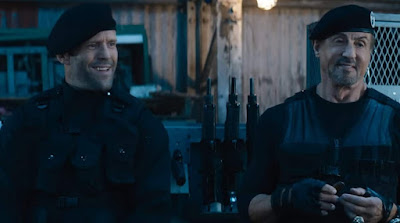
Expend4bles is running into all the usual problems that can dog an aging franchise limping back into theaters—diminished energy, effort, and interest. The title of the latest is its creative peak. This action series started as an aging action star ensemble picture. Not a bad idea to put a black-ops squad of oldsters together, a Grumpy Old Men with guns and gore. Sylvester Stallone lead the charge and, across three movies, supporting roles went to the likes of Dolph Lundgren and Arnold Schwarzenegger and Bruce Willis and Wesley Snipes and Jean-Claude Van Damme and Jet Li and Harrison Ford and Chuck Norris and Mel Gibson and dozens more. The token young guy was Jason Statham, then only a decade removed from his first breakout in the Transporter movies. Now, though, he’s less than a decade removed from Stallone’s age in the first Expendables. When Stallone was Statham’s current age, 56, he was already gearing up to play Rocky and Rambo in their elder years (for the first time). Statham isn’t wearing his age like that. He’s still in fighting form as the youngest regular guy on the squad, able to jump and leap and stab and parry and even sell a perfectly aimed gunshot from a moving motorcycle as it spins midair. He’s still got it. No matter how many junk pictures he pops up in, I’m never tired of him. This movie, however, is tired. This belated fourth Expendables entry has no good young blood to offer to bolster Statham’s spot. And it doesn’t have the deep bench of older actors willing to return with them. So it’s still the same guys, but with fewer older stars willing to return to joke around in a subpar spectacle that relies almost entirely on the throwback appeal of said stars. It’s an aging varsity team with most of the roster unavailable and no one on the JV squad to call up. The result is so low-key and lethargic I spent even the action scenes wondering when it’d pick up the pace.

The director this time is Scott Waugh, an action expert whose films are sometimes solid. His video-game-adaptation Need for Speed is a fun car chase flick, though his Act of Valor is torpid US military propaganda, while his most recent prior film, the long delayed Hidden Strike, is torpid Chinese military propaganda. He’s not the sort of director who can overpower another’s priorities, in other words. Here he’s dutifully serving star demands and franchise image, but with much more of the former and less of the latter. Some of his frames here have a plasticine energy that tries hard to whip up a sense of fun. But that’s undone by characterizations that are one-note stereotypes. Even in a movie as broad and slight as a dumb throwback actioner, there’s just nothing to hold onto. It’s bad enough returning characters are simple and repetitive. Statham is a confident rule-bender always serving Stallone, the unquestioned macho leader adored by his team. It’s what he wants to project as a Movie Star in his twilight. I don’t think that’s changed much since the first. It comes with the territory. But such thinness is worse when the characters are new and quickly reduced to nothing. Newcomer 50 Cent spends the movie vaguely grumpy and gets no cool action. Megan Fox careens between nagging girlfriend and pin-up-poster glamor commando. Then these nobody characters enlivened only by the spark of celebrity in their casting are sent into a tediously simple storyline involving just a handful of locations, some pro forma deck-shuffling conspiracy blather, a layer of macho posturing and military jargon, and some CG blood splatter. It doesn’t even do right by its ensemble, leaving most of the fighting to Statham alone. (I mean, I would, too, but I’m also not going to try out for the Expendables team anytime soon.) I almost wish this movie was enjoyably bad instead of just dull.

Friday, August 11, 2023

From Beneath: TEENAGE MUTANT NINJA TURTLES: MUTANT MAYHEM and MEG 2: THE TRENCH

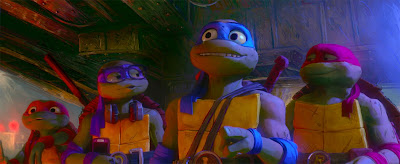
The art of film appreciation is, to paraphrase Fritz Lang’s classic sci-fi silent Metropolis, a handshake agreement between the heart and the mind. We can find much to intellectually assess about any given picture, but inevitably the heart takes over, too. Thus it is that I think Teenage Mutant Ninja Turtles: Mutant Mayhem is a good movie, but one for which my enthusiasm is muted. Whereas Meg 2: The Trench is a bad movie, and yet it’s one with which, I must admit, I had a certain amount of fun. It comes down to this. Mutant Mayhem, the umpteenth Ninja Turtles project, is a good version of a thing I’ve never much cared about, and for which my ceiling of potential enjoyment is apparently much lower than the average audience. Meg 2, on the other hand, is a giddily stupid sequel that never once thinks it’s doing anything else but serving creature feature silliness larded up with all sorts of cheap paperback thriller plotting. Neither movie asks to be taken seriously, which is all for the better. They’re flip sides of the same goofy coin: putting silly characters and sloppy monsters on the big screen for us to gawk at and laugh with and walk out reasonably pleased. I imagine anyone willingly buying a ticket and walking into a movie called Teenage Mutant Ninja Turtles: Mutant Mayhem or Meg 2: The Trench will find exactly what they hope to see there.

Ninja Turtles is an animated feature that redoes an origin story for the ubiquitous amphibious karate teens. It’s a formulaic superhero tale that twins a toxic ooze catalyst for both heroes and villains. The latter is Superfly, a clear nod to blaxploitation down to the rumbling, street-tough Ice Cube voice performance. He’s a mutant bug who rallies his slimy siblings to steal lab equipment with the goal of assembling a machine to wipe out mankind. Luckily, the pack of plucky adolescent kung-fu tortoises in the sewers below have decided to surface and think they should stop him. They’re a gangly, likable bunch—largely indistinguishable but bubbling over with authentic teenage awkwardness, slang, and bravado. Anyone even vaguely aware of kids programming over the past four decades will recognize the shape of their style—the headbands, the ninja weapons, the love of pizza, the rat father. (He’s Jackie Chan now, and gets some appropriate fight choreography to match.) There’s something comforting enough to the fresh coat of paint slapped on a sturdy, predictable plot engine. Never once is the outcome in doubt. Of course the turtles will discover their powers and live up to their potential, while the bad guys will be defeated in a slam-bang fight downtown, and bigger baddies will lurk in the shadows to be teased in a mid-credits scene. But at least it looks neat and the squeaky cracking turtle performances have a real teen energy going. It’s nice to see them animated with a Spider-Verse-style scragginess, down to the wiggly penmanship, expressive line work, and layered visual jokes. It has a rat-a-tat rambling to the dialogue, and sequences stuffed with quick-witted gags and gooey sentimental heart you’d expect from a collaboration between Seth Rogen and a co-director on Mitchells vs the Machines. This might be as good as these turtle movies get.

Meg 2
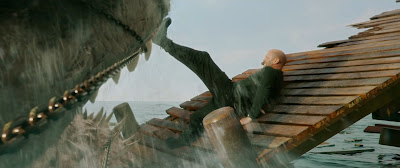
is objectively worse, but I sure didn’t mind it in the moment. Imagine a simpler, dumber Deep Blue Sea and you’re onto something. Jason Statham returns to outwit enormous prehistoric sharks that’ve eluded capture at a scientific outpost meant to contain them. There’s a slog of exposition up top, a lot of soggy business about an ensemble trapped in dive suits on the ocean floor in the middle, and then a chomping spectacle at a beach resort that ends things on a toothy grin. Along the way we get gun-toting villains with a duplicitous boss out of a bad Michael Crichton rip-off, as well as a tentacled deep-sea beastie and eel-like lizard things slithering around making extra variables for the sustained climactic action. I could describe all the flimsy characters and simple interpersonal dynamics and cheap attempts at emotional investment. But really all the movie has going for it is a brisk pace and a willingness to just go for it. The director is Ben Wheatley, who usually does unsatisfying indie horror movies—though his best was winking feature-length shoot-out Free Fire, and his worst was a dismal, instantly-forgotten remake of Hitchcock’s Rebecca for Netflix. Here he gets a chance to make a studio budget (boosted by an international co-production with Chinese backers and actors) colorful and bright and dripping in off-screen PG-13 gore. It’s so stupidly diverting I only wished it was even stupider. A little extra excess—and yes, I’m really saying a movie culminating in Statham stabbing a prehistoric jumbo-shark through the mouth with a broken-off helicopter propeller should be more excessive—could’ve made Meg 2 a classic of its kind. It’ll have to settle for agreeably crummy B-minus movie status instead.

Thursday, June 24, 2021

Back in Action: NOBODY and WRATH OF MAN

The lizard-brained appeal of the shoot-‘em-up Nobody is a little misjudged. It stars Bob Odenkirk, the great sketch comedian of Mr. Show turned wry and soulful character actor star of Better Call Saul, as a suburban family man in a rut. An early montage shows us his daily routine of coffee and commute and office work filling spreadsheets. His wife won’t sleep with him. His son doesn’t respect him. Day after day. This is interrupted by a pair of semi-bumbling thieves who break into his home and steal just a few trinkets. Feeling emasculated for failing to stop the robbery, he roams the city looking for trouble, eventually beating up some shady characters on a city bus with surprisingly adept combat moves. Turns out he’s a former secret agent retired in protected obscurity. Also turns out he just beat up some guys connected to a Russian mobster, who sends dozens of anonymous goons after him, leaving this humble middle-aged dope no choice but to send his wife and kids away while he goes full John Wick. (That the screenplay is from Wick scripter Derek Kolstad should be no surprise.) The result is a movie in which a mid-life crisis of masculinity is solved by violence—waves and waves of shootings and stabbings and all sorts of things to make a faceless, personless baddie’s body go splat. I’ll admit the action, staged by director Ilya Naishuller (whose previous actioner, the woozy POV-shot Hardcore Henry was repellently violent), takes on a passable jolt, and the dumb retribution logic plays out with some dopey spirit. But I couldn’t shake the fact that the whole amoral shape of the thing was like someone traded American Beauty’s portrait of male-pattern ennui’s sex fantasies for violence, then dropped the clumsy satire for overplayed needle drops and self-satisfied slow-mo. Odenkirk is smartly restrained and underplayed throughout, though. And the shoot outs and explosions and car wrecks have a stupid satisfaction to them. But the whole arc of the picture — better living through mass murder — leaves a nasty aftertaste.

Far better to see a movie that knows how deadly serious its pulp plotting is. I’d be loath to say a thriller as unremittingly dark and unsparing as Wrath of Man is a moral work, but it has a code and a perspective that understands there is no such thing as good violence or a righteous kill. It’s too stark and unflinching, lean and mean, to be anything but impressed by the emptiness with which it leaves every character involved. There’s something ominous to its undertow, crisp crime plotting that will be drug under by its poisonous grasp. Here men’s schemes are what opens that Pandora’s box. They’re pitiless; their crimes run cold; blood oozes and splatters like tar. It stars Jason Statham in one of his chilliest performances, his tight musculature crafted into a stone-faced determination. He’s a new hire at an armored truck company that has recently been targeted by a team of robbers who blocked off a road, blew out the side door, and gunned down the drivers. Statham is silently hyper-confident, keeps to himself, and seems to be way more talented than the job requires as the movie’s introductory passages draws him into his co-worker’s world of jargon and joshing. You can tell he’s up to something. As the movie steadily widens its scope, sidestepping to show us other groups of men, we see this armored truck depot is the hub of criss-crossing plots: two teams of thieves looking for a big score, a man-on-the-inside working to help one of them, some cops who may or may not be onto something. And Statham? He’s on his own, out for revenge. You can tell when he calmly, precisely guns down some potential robbers without breaking a sweat, and then follows it up with the faintest flicker of disappointment. These weren’t the thieves he was looking for. The movie’s unflinching grimness and deliberate forward motion matches Statham’s, as his vengeance works itself into mythical, or perhaps Old Testament, dimensions through the dark rumblings of fatalism, the taciturn brutality of its sparingly deployed concussive violence, the score full of low, slow strings and thunderously rolling drums.

The film untangles its deceptively knotty plot with razor-sharp simplicity and focused tension. Revelations drop into  a sturdy structure that thuds each new variable into place with equal parts inevitability and surprise. Moving backwards and forwards in time, and moving in different groups of dangerous men on a direct collision course with each other, the heat steadily builds to a boiling point, spilling over in a clever and tragic escalating climax. The way there finds in its long set-up and clockwork payoffs a merciless logic and calculated futility. We get the sense all of these guys need to take action in response to their circumstances (they were wronged, or greedy, or bored), but know deep down all this danger won’t get them much of anything in return. It’s a fallen neo-noir world past saving, but something must be done anyway. The big ensemble of enjoyable character actors (Holt McCallany, Josh Hartnett, Jeffrey Donovan, Scott Eastwood, and on and on) keep the personality on a low simmer, the kind of hard-bitten pulp dialogue that curlicues with just enough flair, a mixture of hollow macho posturing and gruff molasses-drip dialogues of heavy seriousness. The film matches this tone with its own self-seriousness: chapter headings, drawings of snakes and devils in the open credits, a well-deployed use of a gravely Johnny Cash lament in a violent montage, restraint in patient wide-shots and smartly withheld reveals. But that seriousness finds a good match in the mood and craft of the picture, which imbues what could be affectations with a level of tightly controlled artfulness that elevates what could in lesser hands devolve to mere shoot-‘em-ups. Here every shot counts, and hurts.

That it comes from writer-director Guy Ritchie marks potentially a new era in his filmmaking. After all, he began in the 90s as part of the post-Tarantino fast-talking genre movie crowd, with jumpy and jumbled crime pictures like Snatch and Lock, Stock, and Two Smoking Barrels that rattled chronologically and pictorially. Those early films of his are energetic and youthful, but also empty, callow contraptions. His exercises in style were then well-served as directorial eccentricities in massive Hollywood branded blockbusters — two Sherlock Holmes, a Man from UNCLE, a King Arthur, an Aladdin. He often enlivened what duller hands would’ve turned out perfunctorily, taking his quick-cut flashiness and scrappy chatter to glossy spectacles. With Wrath of Man, he’s come full circle with a sense of an aged master, older and wiser, confident in his narrative chops and control of tone. He entrusts a thick layer of menace to a talented cast and crew of ace craftspeople. Every shot is well-judged and clear. Every sequence is economical and thrilling. He rarely goes out of his way to accomplish in two shots what could be done in one. Thus it becomes an exercise in control, taking his interest in underdogs and rivalries, ambition and deception, fatalism and determination, and drawing them out in a mechanically impressive scrambled chronology told with an atypically heavy pace. It’s a two-hour crescendo of sustained suspense and dread, promising and delivering clever realizations and anyone-goes violence. It builds. It escalates and modulates. It finds new depths to dig as it wrestles with the darkness at the heart of these men’s plans, the way wrath animates yet hollows out everyone around it. Here’s a film that look on the evil men do — in so many forms — and feels sick from the weight it carries, before exploding outward in intense genre thrills.

Friday, September 4, 2015

New Model: THE TRANSPORTER REFUELED


The Transporter movies, a B-level series of action pictures produced and co-written by busy French genre impresario Luc Besson, have simple goals. They just want to provide exuberantly ridiculous car chases and clever hand-to-hand combat, a man in a fine tailored suit handsomely in the middle of it all. They’re mostly enjoyable on that level, but are otherwise best known for coronating Jason Statham an action star, casting him in the role of a black-market driver, a tightly controlled, expressively competent, vaguely bemused, adeptly violent man with a code. He spent three movies saving kids, stopping polluters, freeing captives, and rescuing refugees, more often than not by engaging in high-speed precision driving and by punching people in creative ways. My favorite involves his use of a hose to take out half a dozen baddies in Transporter 2, the franchise’s high-water mark, so to speak.

So when The Transporter Refueled decided to recast (a TV spin-off already had, but nevermind) the filmmakers had a difficult task. On the one hand, the character has little backstory, few attachments, a stock personality, and almost no continuity. But on the other hand, The Transporter has been affixed almost irretrievably with Statham’s screen persona, to the point where the actor turned up this summer in Furious 7 and Spy playing what were two very different variations on his most famous role, with an audience expected to be instantly in on the joke. Here we have a relatively new face, Ed Skrein, most famous for a handful of Game of Thrones episodes, stepping into the shiny black Audi gleaming in fawning product placement sheen, ready to make the part his own. He doesn’t, really, but the movie zooms ahead anyway.

Refueled is a strange sideways reboot, expecting us to already know who The Transporter is: an excellent driver following a strict set of rules for his behavior and protection. But we’re not expected to care about any particular past story beats or backstory. Everything old is new, and vice versa. Skrein’s first scene involves beating back prospective carjackers, a feat he accomplishes drolly and quickly. Then he’s off to pick up his next fare. He fits the part like he fits the suit. He’s slim, fit, pretty, and capable of throwing a convincing punch. He lacks Statham’s charisma, or his knack for wryly spitting bad dialogue, and using casually athletic improvisation melded to a stubborn persistence. But screenwriters Adam Cooper, Bill Collage, and Besson have written a slightly softer Transporter. He ices his bloodied knuckles, gives in to romantic overtures, and loves his dad. He can still use a jet ski to throw himself out of the water and into a moving car, though.

The plot is this. The Transporter’s father (Ray Stevenson) is kidnapped. The only way to save him is to cooperate with a mysterious group of women (led by Loan Chabanol) who wear identical platinum blonde wigs and tight black dresses, the better to confuse security cameras when they pull off daring capers. It turns out they’re prostitutes determined to rob their evil pimp (Radivoje Bukvic) before ridding themselves of him for good. What follows is a diverting revenge-fueled heist. It provides an excuse for a variety of competently executed action sequences, director Camille Delamarre (Brick Mansions) allowing his stunt crews and fight choreographers just enough space to show off. There’s a car chase down tight streets, several bouts of close-quarters fisticuffs, a silly smash through an airport, and a standoff on a yacht which conveniently has a room full of antique weapons.

It gets the job done. This programmatic production is a reasonably well-made minor distraction. It’s slickly photographed, jumpily edited, propulsively exciting, and violent in a mostly bloodless way. It’s nothing you haven’t seen before, bits and pieces of action movies past recombined in sleek packaging. The father/son dynamic is straight out of Indiana Jones and the Last Crusade, pops calling him junior a lot. The action moves like any car chase picture with pauses for Jackie Chan-inspired footwork. And the women’s fairly clever plan rolls out in an attention-holding way despite operating like any and every movie heist. It would be more than vaguely empowering if they weren’t also trophies, like Fury Road dragged down a mad Maxim road. Still, the end result is fast enough and silly enough to hold together and work its B-minus magic. I’ve seen better; I’ve seen worse. It’s stupid, senseless, and unnecessary. But that’s not entirely the same thing as bad.

Friday, June 5, 2015

Live and Let SPY


A big, broad action comedy, Spy works by using evergreen genre elements – in this case, secret agent thriller tropes – and taking them seriously. There’s a missing nuke floating around the black market and the CIA wants to stop its sale. The process involves evil arms dealers, slimy smugglers, fancy women, and clever gadgets. At every turn we find bruising hand-to-hand combat, bloody shootouts, and fast chases involving several modes of transportation. There are surprise reversals, unexpected reveals, and double, triple, quadruple crosses from agents in too deep. It plays like a rip-roaring globetrotting adventure. That it just so happens to be hilarious is even better. It’s the rare action comedy that holds up both ends of its bargain.

By treating genre elements so plainly – squint a little and it looks like a Bond movie – writer-director Paul Feig gets comedy out of writing scenes slightly askew from the norm. This isn’t a spoof or parody of the spy picture. No Austin Powers here. This is a full-on embrace of the spy picture. Its title sure isn’t lying to you. Spy is what it is, simply and funnily. In the center is Melissa McCarthy, working with Feig for the third time after Bridesmaids and The Heat. They’re having a productive collaboration turning the expected beats of a chosen comic subgenre slightly on its head through force of offbeat screen presences and his ability to get not just laughs, but genuine, affecting performances. Here Feig writes her a starring role in a take on an oft sexist genre and uses it to refute sexist assumptions. In scene after scene, a woman male colleagues dismiss gets the job done. Anything a Bond can do, she can do.

McCarthy plays a mild-mannered desk-bound agency employee, used to compiling dossiers and feeding field agents recon through their earpieces. Over the course of the movie, she’s forced into the field and there, after initial fish-out-of-water floundering, her talents bloom. Putting her in the place of the usual strong silent spy, dry quips become filthy barrages of exasperation and determination. She, an unassuming, underestimated agent, is called into an undercover mission because a baddie (Rose Byrne) is in possession of a list identifying all known agents. An unknown is needed to track Byrne down and take her out, especially since she’s also the one selling the loose nuke and has already removed one suave agent (Jude Law) from the equation. Scenes of espionage take on fresh interest as McCarthy gets an opportunity to be every persona in her range. She’s playing a sweet professional who’s out to prove her doubters wrong, slipping effortlessly into disguises: sad cat ladies, confident whirlwinds of profanity, and glamorous international women of mystery.

Between exposition, one-liners, and dirty insults, Spy is a rush of physical comedy and exciting action. Feig finds a balance between slapstick and violence, moving from tense to jokey, exciting to funny, gory to gross-out gags. It’s a tricky dance of tone pulled off with aplomb. The characters are appealing, the plotting is crisp and clear, and the stakes are silly and high. It’s the breeziest spy picture in ages, delighting in how light it is. It works because the writing is consistently clever, the performances are terrifically calibrated to straddle the demands of serious thriller mechanics and goofy comedy while still feeling consistent in character. The entire ensemble has great fun tweaking their images, playing familiar parts in eccentric directions.

Byrne is a delightful icy villain, while Law has a good time taking the suave superspy to a goofy place of dangerous unflappability. There’s a goofy assistant back at the base (Miranda Hart, in a role calling on eager happiness incongruous to the dire stakes), a no-nonsense superior (Allison Janney), and a greasy Big Bad (Bobby Cannavale, pickling his charm). Best is dependable man-of-action Jason Statham as a macho master spy frustrated after being sidelined by McCarthy. He blusters about her inadequacies while bumbling his way through the story, making things worse for everyone. Showcasing a welcome sense of humor, he pokes fun at his usual roles. At one point he rattles off a list of exaggerated near-death experiences from prior missions – “I once drove a car off a freeway on top of a train while I was on fire” – that’s both amusingly hyperbolic and could easily be actual scenes from his filmography.

And yet McCarthy’s the clear star here. Her arc is treated respectfully without losing sight of her comic gifts. Even when she tumbles out of a scooter or vomits over a corpse, the joke's with her, not at her expense. She's in command of every scene. It’s one of her finest, funniest performances, terrific sight gags and muttered asides keeping the laughs flowing while building up real affection and sympathy for her character. She moves between slippery false identities, slowly increasing a core of self-esteem while becoming a very good spy. She shows her character’s progression filtering through layers of disguises in action. It helps that Feig is a more confident visual stylist with each film he makes. Spy looks, sounds, and moves not like a comedy, but like any big studio thriller, glossy and expensive. The surface sheen makes it all the funnier as it moves so fleetly through its exciting silliness. I was more thrilled and amused by McCarthy's espionage than many non-comic movie spies'.

Saturday, April 4, 2015

Vroom Vroom Kaboom: FURIOUS SEVEN


The Fast & Furious series continues to drift into hyperbole, finding in Furious Seven its most ridiculous entry yet. It is 137 minutes of improbable vehicular chaos, pausing only to reiterate its core cast’s affection for one another. The series began as modest, loosely connected heist/street-racing pictures before arriving in its fifth and sixth installments at a perfect blend of heightened automotive action – dragging a two-ton safe through Rio; racing a tank down an elevated highway – and sincere lunkhead melodrama playing off the reassembled ensemble’s family dynamic. Sure, cars went flying and the plots became tangled webs of backstory. But the brotherly bond that built up between Paul Walker and Vin Diesel, and the chummy affection amongst the whole diverse gang (Michelle Rodriguez, Tyrese Gibson, Ludacris, Jordana Brewster) anchored the fast, often clever, action in good feelings.

Now here we are, seven films deep, and the series’ usual screenwriter Chris Morgan continues the typical pattern of sequel escalation, adding new characters and heightening the stakes. This time, a resourceful evil British assassin (Jason Statham) is hunting our team of drivers. See, they burned his villainous brother (Luke Evans) in Furious 6, so he wants to make sure they blow up real good. It’s a revenge plot, and the blood runs quickly. One teammate is killed, as teased in the previous installment’s credits. Their best frenemy (Dwayne Johnson) is hospitalized. And then Dom (Diesel) barely escapes with his life when his house is bombed. This means war, and a different kind of action movie than this series has been.

Instead of spending their time drag racing or heisting, though they do each for a scene, the gang decides to work with a mysterious military man (Kurt Russell). He offers them help defeating their new enemy in exchange for finding a MacGuffin held by a hacker (Nathalie Emmanuel) who has been kidnapped by a terrorist (Djimon Hounsou) and his henchman (Tony Jaa). What follows is a blitz of violence and movement, in sequences that feature such sights as: cars parachuting out of a plane, two people surviving a rollover accident down a mountain, a sports car careening safely between skyscrapers, and a climax involving a helicopter, a drone, a supercomputer, crumbling buildings, and a bajillion bullets that wouldn’t look out of place in the third act of any superhero movie.

Fast & Furious movies are no stranger to the absurd, the dubious, the gleefully stupid, and the charmingly outsized. But Furious Seven is the most mostness of all of them. It’s chockablock with exotic locales, roaring engines, bruising hand-to-hand combat, convenient technological assists, last-second escapes, huge explosions, and lasciviously objectified women in bikinis. It’s amped up, and trying hard to be. Perhaps it’s the influence of the director, James Wan, taking over from Justin Lin, who had directed the last four entries. Wan, he of Saw and The Conjuring in his first non-horror effort, seems extra sure to hit the required elements of a F&F film hard, leaving the audience happy to have received not just what they’d hoped to see, but so much of it at once.

Instead of building with each scene, Seven is all exhausting crescendo. A few times, the movie tipped over into exasperated monotony, often leaving me worn out, eyes rolling. The action sequences aren’t as infectiously exciting. The movie basically admits it, with the “don’t try this at home” disclaimer buried deep in the credits instead of prominently displayed. (At least the characters are at one point worried about a concussion.) The loud, silly action is the series’ biggest and craziest, sometimes entertaining, but hardly the most satisfying. I idly wondered if the filmmakers hoped to stun an audience with an overdose of exaggerated mayhem into forgetting the action’s just not as clever or memorably staged this time. In fact, the fistfights are better than the car chases. And who goes to one of these excited to see the punching?

Yet, when I managed to shake off my doubts, I found myself enjoying the ride more than not. This is a perpetual motion machine manipulating the audience with jolts of adrenaline and sensation. It’s scattered, characters appearing and disappearing when required for an action beat (Brewster gets less screen time than the product placement for Corona and Abu Dhabi), and emotional threads loosely strung (flashbacks flashing by to get teary-eyed about the past). But all this overstuffed muchness is in service of a thunderous series finale feeling rolling over the film. This finality is partially due to star Paul Walker’s untimely death mid-shoot, his unfilmed scenes finished with effects, doubles, and old footage, the ending doubling as a sweetly mawkish tribute. But it is also partially for the way the film gathers up familiar faces, events, and vehicles from throughout the franchise for what these characters (and Universal’s marketing) call “one last ride.” I doubt it will be, but I don’t know how much further over the top they can go.

Tuesday, March 31, 2015

Reliable Bet: WILD CARD


Jason Statham’s screen presence – the stubbled head of a bruiser on a body with the aerodynamic grace of an Olympic diver – is perfect action movie charisma. No wonder he’s often used for his physicality, making tightly choreographed fights look like improvised excellence. Confident and comfortable on screen, he makes every gesture seem effortless. Whether in an electric jolt like the wild and vulgar Crank or a thundering throwback men-on-a-mission picture like The Expendables or an energetic star vehicle like The Transporters, he’s a distinct star. He can execute martial arts with total professionalism, but delivers straight-faced action thrills with the faintest smirking enjoyment. His is a brutal joy, every punch (or kick, or shot, or vroom-slam-pow-kablooey) lands hard, but is fun to watch. Even (too often) when he’s in subpar material, you’ll never catch him phoning it in.

His latest effort is the essentially direct-to-VOD/DVD Wild Card, a remake of the William Goldman-scripted/Burt Reynolds-starring 1987 film Heat. With a screenplay credited to Goldman, this new picture gives Statham an opportunity to show off his underrated way with dialogue. Sure, there are flashes of action that call for bruising hand-to-hand combat. He’s great there. But he also has a sturdy, believable way of working with tangled threads of lengthy dialogue. There’s world-weariness to his wittiness, as he here stumbles through a series of episodic encounters with a variety of stellar supporting character actors.

Statham plays a freelance tough guy in the lower levels of Las Vegas crime, doing a bit of bodyguarding here, some gumshoeing there to pay for his gambling addiction. The film meanders a few days with him as he babysits a meek young techie millionaire (Michael Angarano) while helping a friend (Dominik García-Lorido) find and get revenge on a mob sicko (Milo Ventimiglia) who brutally assaulted her. Along the way, he runs into recognizable actors who turn up for a scene or two each. Anne Heche, Hope Davis, Stanley Tucci, Sofía Vergara, Max Casella, Jason Alexander, and others turn up to color in the margins of Statham’s shady world. They trade crackling, half-charming B-movie dialogue. Every scene proves again Statham can jab just as well verbally as he can with his fists. Get him in a Mamet or a Tarantino picture and he’d steal scenes with the best of them.

Wild Card isn’t up to the standards of a Jackie Brown or Glengarry Glen Ross. Nor should it be held to those standards. It simply putters along, stuck in a low gear, with minor entertainment value from familiar crime movie scenarios strung together. Director Simon West, usually found blowing out bigger budget guilty pleasure blockbusters like Con Air, Lara Croft: Tomb Raider, and The Expendables 2, shoots cleanly and crisply, finding some dexterity in the small spaces and small budget to keep things slick and suspenseful amid the winding shaggy plot. But Statham’s great, and the film gives him opportunity to stretch some acting muscles he’s not always asked to utilize. There’s not much here, but it has its low-key charm.

Saturday, August 16, 2014

Exhaustible: THE EXPENDABLES 3


A reunion of box office has-beens, the first two Expendables movies worked on some dumb level through nothing more than the novelty of seeing Sylvester Stallone and fellow veteran action stars like Arnold Schwarzenegger and Jean-Claude Van Damme stomping through scenarios reminiscent of their greatest hits. But by the time we arrive at The Expendables 3, the novelty has worn off. There should be something poignant about the idea of an aging team of mercenaries confronting their mortality and finding new ways to push old bodies through a young-man’s sport. Instead, it’s a mechanical and joyless contraption that grinds out what they think we want to see them doing. So here’s Stallone, squinting through displays of physicality no 68-year-old could ever pull off. To his credit, he sometimes does pull it off. But by the time he’s outrunning a collapsing building and leaping towards a waiting helicopter, it’s clear this is mere wish fulfillment.

The story in this outing is stupidly simple. After a failed mission, Stallone retires his team of old buddies (Jason Statham, Wesley Snipes, Dolph Lundgren, Randy Couture, Terry Crews). He contacts a black market talent scout (Kelsey Grammer) to find a younger team to help set things right for his C.I.A. contact (Harrison Ford). The mission fails again. This time, the villain (Mel Gibson) captures the muscled twentysomethings (Kellan Lutz, Ronda Rousey, Victor Ortiz, Glen Powell). Now it’s up to the old team to save the new team. Built around three action sequences – a train rescue that segues into a firefight with Somali pirates, an infiltration of a skyscraper, and a siege of an abandoned warehouse or something – the script, by Stallone and Olympus Has Fallen writers Creighton Rothenberger and Katrin Benedikt, continually maneuvers the cast into place, half-heartedly giving them lame wisecracks and rote motivations until the shooting can start again.

It’s overburdened with too many characters. I didn’t even mention Antonio Banderas as an endearingly talkative out-of-work mercenary desperate to get back in the fight and a brief appearance of Jet Li, who gets a surprisingly tender moment with Schwarzenegger, or as tender a moment as a meat-grinder macho movie can supply. With all these people standing around, the action scenes don’t have time for complicated choreography or suspenseful crosscutting. You can almost see contract negotiations and scheduling difficulties on screen with sequences seemingly slapped together with whatever shots were most convenient to everyone’s calendars. I doubt the whole Expendables team ever shared a single frame together. A character is left dangling in an elevator shaft for nearly the entire final melee. Every time we cut back to him straining for the next ledge, I thought, “Oh, yeah. He’s here, too.”

The hectic but flatlining action is mind-numbingly violent, but bloodless since it’s PG-13 this time. Thousands, maybe millions, of rounds of ammunition are expended in the course of this movie, leaving hundreds of unidentified, usually ethnic-coded, figures blown apart. It’s tiresome, repetitive, a little offensive, and cartoonish in its lack of weight or resonance. “How hard is it to kill 10 men?” Gibson yells at his flunkies after an entire third-world army fails to even injure an Expendable. It just goes on and on, gunfire, helicopters, and punches shot in a flat, unremarkable chaotic style. There’s no variety here. They couldn’t even throw in a car chase or a plane crash to mix things up a bit?

I like some of the personalities involved. The new recruits don’t make much of an impression, aside from Ronda Rousey, the first female Expendable. She’s also the only woman to appear in more than one shot in this testosterone overdose. It’s the caramelized veterans who are of some interest, bringing to their roles their histories as screen presences and public figures. When Ford says to Stallone, “good to finally meet you,” there’s a microscopic twinge of action movies past as Indiana Jones shakes Rambo’s hand. It’s the little things, like Snipes (Stallone’s Demolition Man foe) having his character joke he’s been in prison for “tax evasion.” Ha. Ha. Worse is Gibson’s winking at his checkered recent history, snapping that the heroes would be scared if they saw him angry. That’s a tad too close for comfort. At least the script gives him one good goofy villainous threat: “I’ll cut your meat shirt open and show you your heart!” That’s the kind of line B-movies are made of!

Alas, this movie’s too flavorless for those pleasures to save. It’s a largely anonymous work coasting off the personalities on screen while director Patrick Hughes does what he can with the material he’s been given. Not much can be done. This series has exhausted what little inspiration it once had, having never quite lived up to its fullest potential. There’s something almost sweet about a movie full of AARP action figures passing the torch to Jason Statham and now on to even younger potential action stars. But it’s buried under the grinding routine of so much mindless carnage and nothing story. I just didn’t care. It thinks it’s funny, exciting, and maybe even a little melancholy, what with it’s closing Neil Young sing-a-long and all. But it’s mostly sad and tired.

Wednesday, November 27, 2013

Self-defense: HOMEFRONT


If there’s one thing Breaking Bad taught us, it is to avoid injuring the pride of anyone involved in the meth business. But Jason Statham isn’t too worried about doing so in Homefront, especially when the meth-heads he’s dealing with are a skeletal Kate Bosworth and her brother, the local dealer named Gator who is played with satisfied teeth-gnashing and deep fried accent by the omnipresent James Franco. Too bad for all involved that, after Statham’s daughter (Izabela Vidovic) defends herself from Bosworth’s bully son on the playground by beating him up, the meth people won’t let the insult stand. Bosworth gets her brother to menace Statham, who is new to their small town in the backwaters of Louisiana. This leads to all manner of complications, including the revelation of Statham’s character’s undercover D.E.A. past, which is all the incentive Franco needs to call in the big guns. As it must, this means Statham is going to have to spring into action and punch people in creative and effective ways. Once he stabs a bad guy’s arm to a post and smashes a mason jar on the back of the guy’s head. Hey, you use what’s around you.

Statham has become one of our most reliable action stars, eking out an appealing B-movie career for himself. He’s now the kind of guy with tremendous affection from his core audience, who gets applause and attention simply for turning up. Even so, he’s not coasting. He’s hard at work being compelling. In a cameo in a big movie earlier this year he single-handedly made for the most exciting mid-credits teaser in a long time (and maybe ever). Something about his stubble-covered dome and virtuosic working of his smirk – from deadly serious all the way to happily serious – makes him an aerodynamic charmer, ready to leap into any conflict if it means saving himself, his mission, or those he cares about. He’s always a man with a code, and when that code breaks, duck. Unlike overly muscled action stars of the past, he’s lean and compact, like an average fit guy who can knock you senseless in no time at all.

Homefront isn’t one of his better efforts, but it’s often tense and gets the job done. The script, adapted from a book by Chuck Logan, is written by Sylvester Stallone. Yes, that Sylvester Stallone. He’s a man capable of churning out an effective actioner, even if he’s rarely cast as an everyman. Here he writes a part for his Expendables pal Statham that’s grounded in a sense of reluctant action. Here’s a guy retired from the force after a drug bust turned violent. He is called to punch, stab, scheme, and shoot his way to safety in order to keep a protected environment for his little daughter. Statham’s a guy who can do these things, but would rather not. They just leave him no choice. He’s personally insulted and assaulted, his tired slashed and cat kidnapped. That’s one thing. But threaten the safety of his daughter and watch out! It’s a clear cheap ploy for audience identification – the child-in-danger thing works every time, no matter how earned or unearned it is.

It raises the red meat knee-jerk vengeance quite well in a movie that’s frontloaded with exposition. If Stallone’s script tells you once it tells you three or four times every pertinent bit of plot information. Gator is dangerous. The town finds Statham suspicious. The sheriff (Clancy Brown) seems awfully buddy buddy with the meth operation. But for all this repetition, it’s strange to see characters drop in out of nowhere, like a gang of thugs who snarl at Statham on two separate occasions before he beats them all up, both times. Who are they? Who do they work for? Why are they angry? Where do they end up? Beats me. Same goes for the daughter’s teacher (Rachel Lefevre) who has a promising subplot dropped entirely after a couple of scenes. Other characters, like a welcome Winona Ryder who provides Franco access to a hitman, are nicely detailed, but ultimately exist to bumble the plot towards a conclusion.

It all builds to the shoot-‘em-up climax it continually foreshadows. Along the way, director Gary Fleder, who ten to fifteen years ago was a go-to guy for James Patterson and John Grisham adaptations or imitations, finds merely competent ways to make this interesting. It’s a watchable, straightforward and grungy B-movie all the way down the line, mostly worth it for Statham’s charmingly stoic loving father and the few passably exciting action beats, although there are fewer than you’d expect or like. You want to be on Statham’s side, not just for the plot’s sake, but for the sake of his persona. You just know that no matter the outcome, no matter the obstacle, even if said obstacle’s a middling thriller, Statham’s going to be okay. 

Sunday, January 27, 2013

Point Blank Payback: PARKER


On the whole, Parker is too clumsily handled to really sing like it should, which is too bad, considering that this adaptation of Donald E. Westlake’s crime novel character has nearly enough pulpy energy from which to work. The surplus of it nearly balances out the deficiencies elsewhere. A great deal of the charm comes from the considerable charisma of Jason Statham in the title role as Richard Parker, a cold, clever criminal who is seemingly unstoppable and, when wronged, will charge after those who did him in with ruthless efficiency. Westlake’s template has been put to use with lead actors in films as diverse as Lee Marvin in 1967’s Point Blank, Robert Duvall in 1973’s The Outfit, and Mel Gibson in 1999’s Payback. Clearly a showcase for charismatic actors of various and diverse kinds, Statham plays this character as a force of nature, muscling through this sharp-edged yet lethargic thriller with a steely focus and impeccable timing.

It all starts with a heist at the Ohio State Fair. Parker and his accomplices (Michael Chiklis, Wendell Pierce, and Clifton Collins, Jr.) lift a couple million dollars and get away with it too. It’s during the getaway that things go south. Parker refuses to reinvest his share of the stolen money in a secondary heist opportunity, which leaves the others no choice but to shoot him and leave him for dead on the side of the road. But, as you might imagine, he’s not dead. He’s alive and kicking, leaving a trail of stolen cars on his way to get the money he’s owed and teach those backstabbers a lesson by out-planning them and heisting their next heist out from under them. To do so, he drives right into a tangle of fun character actors. The likes of Nick Nolte, Jennifer Lopez, Bobby Cannavale, and Patti LuPone do the kind of supporting work that zips in for a scene or two (or a dozen) and relieves Statham of only some of the pressure of holding up the film single-handedly.

With a plot that twists around quite nicely, it finds an uncomplicated nastiness and suspense that settles into the right groove from time to time. There are all kinds of theoretically enjoyable turns of violence and strategy, from double and triple crosses and elaborate ruses to simple improvisatory kills, like when one character stabs his attacker in the neck with a piece of a gun. I especially liked when one character breaks into a building, hides a couple of guns, and then waits for the narrative to eventually deposit all of the characters back in the building for a final confrontation. I’m being purposely vague here, since the bulk of the enjoyment in this movie comes from the who, what, and when of the heavy plotting. In John J. McLaughlin’s script, the dialogue is purely functional and the characters only types. What fun is here comes from the simple pulp pleasures.

That’s all well and good, but the film never really came together all the way for me. I had the distinct feeling that it was a movie that knew all the right notes, but had no idea how to get the tune to come out right. Directed by Taylor Hackford, a man capable of framing a serviceable shot, but who is otherwise held hostage by the quality of the scripts he’s given, the film plays out in smeary digital photography peppered with more than a handful of unacceptably poor quality establishing shots that look like they were shot with consumer grade camcorders in 2003. The simple what-you-see-is-what-you-get framing bobbles the tone and stretches the pacing until I felt like I had to slow down and let the movie catch up. This is the kind of B-movie that needed just a bit more of a push – maybe a rewrite or two? – in order to be as tight and nasty as it was so obviously aiming to be.

Sunday, August 19, 2012

Grumpier Old Men: THE EXPENDABLES 2


Instead of complaining that they just don’t make movies like they used to, Sylvester Stallone has gone ahead and made some like he used to. First came The Expendables, a surprise summer hit a couple years back that brought Stallone and a group of 80’s action stars back onto the big screen right next to a few relatively younger action icons for good measure. That was better than I thought it’d be, often earnestly straightforward, but it turns out that movie was just a feature-length warm up to get these old guys back in fighting shape. Now here’s The Expendables 2, every bit the aggressive, isolationist, simplistic, bloody, blockheaded action movie that its predecessor was, a determined movie that muscles its way through energetic action sequence after energetic action sequence. This time around, it lacks the surprise factor, but it’s tighter, funnier, and more self-aware. The explosions are bigger, the combat is louder, the choreography is more inventive, and the fun manages to outweigh the dumb.

In the fictional world of The Expendables, third-world countries are either saved or enslaved by aging mercenaries. This time a MacGuffin went down with a plane in the backwoods of Russia so Bruce Willis sends Stallone and his crew of Jason Statham, Dolph Lundgren, Terry Crews, Randy Couture, and Liam Hemsworth (the youngest of the bunch by twenty years), to retrieve it. Willis even convinces them to take along a woman (Nan Yu), the only character preventing the movie from becoming an all-male action revue. (She spends a lot of her screen time trying not to roll her eyes at these goofballs around her). The group better hurry and find that device so the evil villain Vilain (Jean-Claude Van Damme) doesn’t find it first. So the script by Richard Wenk and Stallone himself is simplicity itself, a point-and-shoot search-and-find kind of movie that’s been done many times over.

What makes this version work is the way it goes all out with action that just goes on and on, finding greasy, bloody, brute-force slapstick in fun choreography and returns to the well of the quipping action one-liner so often it’s endearing. When the movie opens, the bad guys have captured a Chinese billionaire and the gang, grinning ear to ear, rolls over the horizon to the rescue in armored jeeps with messages like “Knock Knock” and “Bad Attitude” painted on the side. That detail made me smile, imagining these guys picking out stencils and laughing to themselves as they decorated their war machines. But anyways, not five minutes go by before Jet Li (in what is basically a cameo) runs out of ammo and beats down his attackers with a frying pan. This is a movie that’s just grabbing at anything near by and throwing it into the mix, but it manages to pull up short of spoofing itself. Somehow the whole thing never quite grows as crazy as it threatens to.

Simon West takes over for Stallone as director on this film, leaving the star more time to focus on enunciation. This sequel, unlike the rough-around-the-edges original, is a slick, professional film with shiny spectacle covered over in surface grit. West’s good with big, empty, R-rated blockbusters. He is, after all, the director of Con Air. He knows how to juggle multiple distinctive talents, giving them each fun little moments to do what they do best. That’s helpful since it’s hard to keep track of who the characters are. They’re guys with names like Lee, Gunner, Church, Troll, and Trench, but that hardly matters. They’re just generic tough guys gruffly bonding over combat exercises. What’s memorable about the characters are the personas behind them. By the end of the picture, Arnold Schwarzenegger has put in an appearance, Chuck Norris has walked through just long enough to tell a lame Chuck Norris joke, and dozens upon dozens of faceless Bad Guys are dead. There’s so much self-referential winking – “I’ll be back!” Willis yells, to which Schwarzenegger responds “Yippee-ki-yay.” – and machine gun rat-a-tat-tatting that it at times grows monotonous.

Still, I must say I enjoyed it. The action is well done, even suspenseful at times. When, for instance, one of Statham’s fistfights drifts closer and closer to a whirring helicopter blade, I was kind of worried for him. But the best part of it all is that there’s a sense that everyone involved was completely happy to be working on this big, dumb action movie. The picture is covered in oldies on the soundtrack, when it’s not filled with gunfire or explosions or mumbling, creating a party atmosphere. They’re having fun with this material, thin as it is, and that shines through. The best example is Jean-Claude Van Damme, who is hamming it up, having a great time as the villain, strutting around in a black trenchcoat, speaking heavily-accented, vaguely threatening nonsense, and glowering threateningly behind a pair of sunglasses that he delicately folds up and places on a table before his final fight scene in the movie. If you had told me even yesterday that this would be one of the most likable performances of the year, I might have doubted you. Oh, sure, there are lots of better performances this year, but few so plainly, appealingly, enjoyable. I knew I should theoretically want to see his character defeated, but more than a small part of me wanted to see him live to fight another day. 

All the while, the movie rockets forward with an unstoppable shoot-‘em-up energy. It’s the kind of movie where someone can kick a knife into a man’s chest and it’s not only goofy and intense in the same moment, it’s actually important to the story. (Well, sort of.) The whole thing’s so simple and eager to be an audience-pleaser that it mostly is. When it’s not bogged down in some of the dullest exposition you’re likely to hear, the movie is fast, explosive, and good enough. When it’s in motion, there’s fun to be had. The movie starts well and ends well with energetic set pieces and by the time it's finishing starting, it's time to start finishing.

Tuesday, May 24, 2011

Quick Look: GNOMEO AND JULIET

It has made nearly 190 million dollars worldwide, played in the local multiplex for a few months, I just finished watching it on Blu-ray, and I’m still not entirely sure that Gnomeo and Juliet exists. I’m not losing my mind (of course it exists), but perhaps that’s the better alternative to acknowledging that (1) someone made a kid-friendly Romeo and Juliet starring lawn gnomes with a happy ending and (2) it was actually kind of popular. The CG animation is bright and colorful with appealingly rubbery textures that make the whole thing look like a Playskool toy’s daydream. I quite liked the colors, but beyond that my level of engagement with the material was somewhere ever so slightly above somnambulant. I simply didn’t care about the long-lasting feud between the red gnomes and the blue gnomes and all of the reasons that the lovers couldn’t be together. It plays out as if the screenwriters (all nine of them) and the director (Kelly Asbury) made a list of the worst tendencies in modern children’s animation and then proceeded to use said list as a checklist. There are annoying winks towards pop culture (even poor Bill Shakespeare gets dragged into this). There’s the eccentric panoply of celebrity voices (from stars James McAvoy and Emily Blunt to parts for Michael Caine, Maggie Smith, Patrick Stewart, Jason Statham, Ozzy Osbourne, Hulk Hogan, and Dolly Parton). There’s a reliance on cheap and easy humor. And, last but not least, there are endless dance sequences to 70’s rock. (Elton John serves as a producer and generously granted his music to be dishonored). The whole thing barely lasts 80 minutes before the end credits, but it manages to feel much, much longer. Perhaps kids will enjoy the movie, but shame on all of the adults who created it for believing that kids should settle for this.

Sunday, August 15, 2010

Grumpy Old Men: THE EXPENDABLES


The Expendables isn’t quite the battle of the action has-been all-stars that the advertising seemed to promise. That’s just as well, allowing this action movie to escape the fate of seeming like a B-movie sponsored by Madame Tussauds. As a muscle-headed action movie directed, produced, and co-written by, and starring Sylvester Stallone, it can’t help but play like a throwback to bad, overblown 80’s action, right down to the bad. It has one-liners so terribly unfunny that they loop right back around into being funny. It has a certain junky flair, and one or two worthwhile action sequences, but it’s otherwise dead in the water.

Stallone starts things off well enough, leading a group of mercenaries in a rescue mission, saving captive sailors from menacing pirates. A mix of current and forgotten action stars, Jason Statham, Terry Crews, Jet Li, and Dolph Lundgren, join Stallone as he blasts his way into a captured freighter. And when I write blast, I mean blast. Lundgren uses a gun so powerful it splatters half of a pirate against the wall. A little later, Satallone and Statham will take out nearly a dozen anonymous baddies in seconds. It’s likably absurd, but in all the gunfire I lost track of whether or not the hostages are saved.

No matter. I think the movie forgot about them too, for soon enough we’re back in the States. Stallone heads over to an empty church to meet with Mr. Church (Bruce Willis), a shadowy suit who proposes a new mission. Another mysterious tough-guy with a team of mercenaries shows up too, but he decides he’d rather not take the job. Arnold Schwarzenegger plays him. Willis, Stallone, and Schwarzenegger trade awful wisecracks and wink at the camera while standing in an awkward semi-circle. Believe it or not, it’s the campy high point of the movie, which sooner rather than later turns into depressingly generic fare.

The actual plot kicks in when Stallone and Statham head to a fictitious Latin American island to do some reconnaissance. They have a kind of awesome action moment in which they blow up a whole bunch of stuff in a cool way. (I’d rather not spoil it, but let’s just say it involves an airplane and a really big fireball). The actual plot will involve the guys gearing up to take out a slimy Eric Roberts as a rogue CIA operative who has a vaguely defined grip on the island nation and who hides behind his right-hand-tough Steve Austen.

The acting is mostly pose-and-scowl, but Statham carries the picture. He’s also the most talented actor in the cast to get any screen time of note. He’s dynamic and exciting to watch, even though his fight choreography is miles from his incredibly staged fistfights in the Transporter movies or the kinetic gory free-for-all of Crank. The movie is essentially a buddy movie with Statham and Stallone front and center for most of the action. Stallone, for his part, doesn’t let his painfully obvious plastic surgery distract from his wooden delivery. He’s too tough a guy to let apparent facial paralysis get in the way of his emoting.

Mickey Rourke wanders through the movie for a few scenes, spouting dumb dialogue and one nearly effective monologue. (It’s the one that starts “Remember when we was in Bosnia?”) I really don’t know what he’s doing here, but he certainly adds to the mottled ensemble that’s been assembled, as well as personifying the movie’s lack of knowing how to use the cast well.

The action smashes forward in ways increasingly dumb and dull. Terry Crews gets a very loud gun that’s good for a few interesting moments. Jet Li gets an obligatory martial arts fight that’s shot in a way that undermines its visual interest. Eventually, the movie culminates in a non-stop explosion of a climax that gets more and more incomprehensible the longer it runs. The violence, which starts strikingly exaggerated in its gore, becomes routine. The action grows wearing instead of exciting.

Still, The Expendables makes for a diverting couple of hours. It’s uncomplicated and proudly excessively macho. It’s goofy, sloppy, and ridiculous while still becoming a little too self-pleased with its perceived awesomeness.  It has its moments. Not many of them, but enough to make the movie a perfectly adequate watch on, say, a sleepy wintery weekend when it’s the only movie playing on cable that happens to be starting while you’re channel surfing.