Showing posts with label David Lowery. Show all posts

Sunday, May 10, 2026

Pop Goes Her Heart:
BILLIE EILISH: HIT ME HARD AND SOFT (LIVE IN 3D) and MOTHER MARY

James Cameron approaches a Billie Eilish concert like he does deep sea creatures or the Titanic wreckage. He’s gone to see it and wants to tell us: huh, would you look at that? The cinematographic curiosity ends at the level of procuring the footage. His documentaries—Aliens of the Deep, Ghosts of the Abyss, and now this—are chronicles of interesting sights presented with cutting edge technology. In the case of Billie Eilish: Hit Me Hard and Soft: The Tour (Live in 3D), it’s a pretty standard concert movie in form. We see her perform songs largely uncut, with lights and lasers and pyrotechnics and, of course, her own charismatic performance in the center of the dazzle. These are intercut with lots of obtrusive closeups of weeping fans, and sequences that cut away to behind-the-scenes moments that are interesting only as far as a skimming the surface of the rigamarole of modern stardom can be. Eilish is undeniably a great stage presence and her music is largely catchy and earnestly felt, whether upbeat dance bangers or slow-tempo confessional ballads. What Cameron does in the film’s best moments is set up his tech and let it capture her in action. He shot in the high frame rate 3D he’s been developing with his Avatar movies. Here that format’s hyper-detailed deep focus and lack of motion blur somehow looks natural. Concert movies are perhaps its ideal use case. Paired with booming sound the crystalline images take on a real immediacy. It captures every sweep of the light show and climaxes with a dazzling dimensional clarity to the typical end-of-concert confetti blizzard.

If the movie fails to cohere much as a movie per se—the interviews are too shallow, the behind-the-scenes too sparing, the focus a little too scattered, the performances a little too chopped up—it’s still quite a tech demo, and a decent look at a star in this particular moment of her career. For a more in-depth view of her story and personality along with musical performances, there’s R.J. Cutler’s documentary Billie Eilish: The World’s a Little Blurry. For a more straightforward concert movie, there’s Robert Rodriguez’s Happier Than Ever. (Now having worked with both Cameron and Rodriguez, one wonders if she’d like to make Alita: Battle Angel 2 happen.) This particular movie simply shows why she’s one of our most appealing pop stars. She has great songs sung well, and great stage swagger, comfortable in her typical Kevin Smith-style jersey and shorts. And the movie’s at least a little bit about the parasocial dynamic of modern music fans. It looks at the tearful fans who talk about her with unrestrained awe—pure and earnest. One boy says she’s better than therapy. At the end a girl is crying as the camera pushes in on her. From off screen we hear Cameron’s chipper question: “How’d you like the show?” Duh. 

A scarier look at modern pop stardom is in the spooky, folkloric Mother Mary. Writer-director David Lowery takes his penchant for making movies that feel like eerie campfire stories and turns it on a diva in crisis. She’s Mother Mary, played by Anne Hathaway in a startlingly complicated portrayal that’s both imperious showbiz razzle-dazzle surface and deeply wounded vulnerability churning beneath. In need of a new dress right away, she attempts to reconcile with an old friend (Michaela Coel) who used to be her chief designer and visual collaborator before some unspoken falling out, or maybe betrayal. But it turns out the wound in their friendship has come to haunt them both in the intervening years. The movie proceeds as a two-hander between the women as they talk it out in a cold, dim, drafty barn, spending their time alternately needling and needing each other. Their conversation, bleeding inevitably toward magical realism, is interrupted for elaborate concert flashback sequences that exist with blinding spotlight on Mother Mary in impressive regal headdress and sequined bodysuits, surrounded by impressive implication of screaming fans in the dark, illuminated by flashing lights. 

The whole production is a cohesive design. The songs are euphoric modern pop at its best. These could be Swift or Gaga or Eilish. They’re catchy and pulse-pounding and match the darkness in her character. Written by producer Jack Antonoff, responsible as anyone for the sound of the last decade, and Charli XCX, whose party-girl brattiness is also a key tone for hit modern music, the songs’ verisimilitude goes a long way toward selling the movie’s gnarled low-key fantasy. But they wouldn’t work so well if not for Hathaway’s performance. She’s credible as a pop star toggling between performative persona and raw interpersonal nerve. And this performance bounces so perfectly off of Coel’s steely wounded pride and confident control. Together their shared haunting winds its way to inevitable surrealist metaphors that threaten to overwhelm the simplicity with literalness cloaked as ambiguity (and vice versa). But this is a Lowery film through and through. He makes Hollywood pictures shaped like art house films (The Green Knight, A Ghost Story, Ain’t Them Bodies Saints), compelling hooks populated with movie stars told with a slow-drip mood. And he makes art house films inside Hollywood pictures (Pete’s Dragon, The Old Man and the Gun, Peter Pan & Wendy), broadly appealing movie star movies with a sadder, slower mode inside. Mary is more the former. It’s a talky, haunted, elliptical movie about the psychosis of stardom. 

Monday, May 1, 2023

Puberty Blues: PETER PAN & WENDY and
ARE YOU THERE GOD? IT'S ME, MARGARET.

When Disney wants a live-action version of an animated classic to have some weight and elegance and freshness, it turns out David Lowery is the writer-director on whom to call. His Pete’s Dragon was a lovely, low-key coming-of-age fantasy that turned its fantastical conceit into something shaggier—a boy-and-his-dragon tale. Lowery’s non-Disney work, like The Green Knight, also proves he’s a literate, sensitive filmmaker. He can dig into a classic text and draw out its deep, resonant inner life while making it his own. And with these skills, he can, in the case of Peter Pan & Wendy, hook into authentically Edwardian romanticism while cleverly adapting the mythos to make it resonant for his purposes. He doesn’t exactly revive J.M. Barrie’s original text, or Disney’s animated version, beat for beat, though there’s a flourish of “You Can Fly” in the score. Nor does he draw out everything that makes the work last, the work of a scholar who might capture it by pinning it down. But what he does do is provide it a sense of life and space with windswept verisimilitude—location photography that’s lush and vivid on grassy cliffs and verdant forests full of moss and shadow. And within this convincing locale captured with a filmic eye, he pulls on one simple lively thread from the classic story of a girl who’s given a glimpse of Neverland: the dread of growing older.

Perched on the precipice of puberty—Peter and Wendy are here cast in the last possible week they can be simultaneously the oldest children and youngest adolescents possible, depending on the angle—here’s a movie that pushes on the urgency of aging. They’re at an age where choices and fantasies mingle—and where growing up might be the biggest, bravest adventure. There’s the usual tangle of business with Lost Boys and Captain Hook and Tiger Lily, though all that’s done with a graceful shorthand. And the beautifully casual diversity of the Boys—some are even girls—and the melancholy backstory for Hook (Jude Law, with more real pain than sneering cartoon) feeds into the ideas of aging as a process by which you discover truths about yourself. To deny yourself, or others, that adventure, even through fantasy, is, after all, a kind of conflict that Lowery’s happy to explore outwards with some fairy tale logic and a bit of piratical swordplay. The film’s most moving moment finds Wendy, having walked off the plank, seeing her life flash before her eyes—but forward, not back. That’s a perfectly sentimental moment. And so, though the movie has swashbuckling with weight and peril, and a grand, old-fashioned Kids’ Adventure spirit, it falls back on that smaller, tremulous time where anything is possible, and the passage of time is just about to fall in with the limits of age and nothing can stay the same.
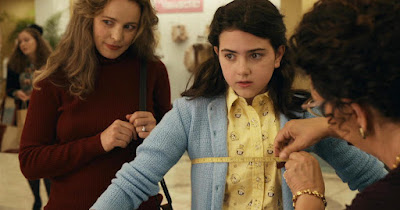
Much less metaphoric about growing older is Are You There God? It’s Me, Margaret, in which burgeoning young adulthood is a source of much literal curiosity and angst. Here’s a movie tenderly attentive to the tenderest of times in a girl’s life. Based on the classic Judy Blume book, it tells the story of Margaret (Abby Ryder Fortson), a sixth grader whose life seems to be nothing but changes. Her parents (Rachel McAdams and Benny Safdie) have moved her from New York City to suburban New Jersey. She has a new school with new kids, and suddenly she’s getting crushes on cute boys and needs to ask her mom to go bra shopping for the first time, and her new friend group is made up of popular girls jealously testing their new ideas. Their gossipy preoccupations are starting to make Margaret nervous about when, exactly, she’ll be getting her period. Writer-director Kelly Fremon Craig keeps the movie loose, light, and episodic, so casually specific about moments in this girl’s life that there’s a generosity of insight just in the act of watching it unfold. There’s a comforting normality to what feels like, to its lead character, the first time anyone’s ever gone through such outsized changes. I suppose it’s true that, though most women go through this, for every woman it’s a once-in-a-lifetime discovery. This movie respects that balance.

But, also true to life, Craig keeps the movie balanced on all manner of youthful preoccupations—grades, parties, holidays, family dynamics, friendships, gossip, and vacations. Here’s a movie about a year in a life that doesn’t hurry toward big climactic melodramas, but instead leans back into the usual ups and downs of young adolescent life. Craig, whose previous film was the sharp and unusually perceptive teen comedy The Edge of Seventeen, in which a high schooler’s life goes flailing after her brother starts dating her best friend, is a writer-director smartly able to balance the intensity of youthful emotions with the perspective to see them clearly in a more mature context. So here the girls’ fluttering of fears and fantasies is both intensely focused and cut with cute dramatic ironies. They don’t know what they don’t know, and it’s exciting and exasperating all at once for them, and their loved ones. The movie becomes a fully realized world for Margaret, a cozy 70s period piece that doesn’t condescend to its times or its characters. It simply lets them be.

Here’s a movie that knows life is a continual process of self-discovery. As such, it has the conviction to also dig plainly into thornier issues of family and spirituality, as our lead finds herself questioning whether she should be Christian like her mother or Jewish like her father. Neither parent particularly cares, but her loving paternal grandmother (Kathy Bates) and estranged maternal grandparents certainly do. The movie has a multi-generational generosity as it brings to life a story of mothers and daughters—especially in McAdams’ glowingly natural performance, built entirely out of lovely grace notes and simple gestures that communicate so much love and good intentions built out of an aging uncertainty. It ties Margaret and her mother together, as potential adolescent conflicts share space with an older vision of daily social struggles. Here’s a movie that says you’re never too old to feel awkward, and never too young to start discovering your confidence. You just have to find those who love you either way. Craig’s compassionate and clear approach is both respectful and honest—just the encouraging balance a young audience might need, and their parents can appreciate. This is a charming movie—so sweet and simple that it casts the gentlest of spells, and clears space for earning its characters’ learning.

Wednesday, August 4, 2021

Head Games: THE GREEN KNIGHT

As an Arthurian legend, the English lit staple Sir Gawain and the Green Knight is a chivalric stress test. It takes the self-professed weakest Knight of the Round Table, nephew to the King himself, and puts him in a simple supernatural contest that eventually tests his every vice. Thus, it makes sense The Green Knight, David Lowery’s new adaptation of this tale, is down in the gnarled moral complications and ponderous deep sorcery. It authentically inhabits the central tension between the upward pull of virtue and the the downward thrust of temptation. Watching it, so unusually structured, sticking more or less to the progression of events, with some embellishment and changes to the specifics, as laid forth in the 14th century poem and steeped in the symbolism and priorities of its characters’ moral perspective, the film starts to feel like what a medieval poet might’ve conjured if they knew about cinema. Lowery, whose works are so often atmospheric and moody in this particular hazy way, from big stuff like Disney remake Pete’s Dragon (perhaps the finest of its ilk) to intimate high-concept experiments like the spectral time-bending A Ghost Story, visualizes a stately verdant and chilly world, where the medieval muck of mud and blood is already dotted with crumbling buildings and moss-covered brick between vast stretches of pale fields and dark forests. The characters speak in murmurs, intone grave importance, cast spells, recite prayers, and send each other off with symbols and speeches, ritual perhaps grown hollow with the passing years. Arthur, too, is near the end, speaking in a sickly whisper; Sean Harris plays him with teeth hurting and breath cracking. When he stands at the Round Table for a Christmas celebration we can see the respect the Knights and Ladies have for him, but can only triangulate his charisma and power as things of the distant past, already passing into legend.

We can also see how the young man at his side, Gawain (Dev Patel), theoretically in the early heights of vigor and power, can’t quite measure up. Yet. That’s why he takes the challenge put forth by the surprise visitor, the Green Knight, who asks to receive a blow from a weapon, a strike he will repay one year hence. Gawain, afraid of those consequences, beheads the guest, who promptly recapitates himself and reminds all listening of the deadline. A deal’s a deal. The rest of the story involves Gawain diligently following through, trudging north after this magical figure in order to remain a man of his word. Along the way, as Lowery adds details to his laborious journey, including encounters with bandits, giants, and spirits, among others including a seductive Lady and Lord (Alicia Vikander and Joel Edgerton), it’s easy to wonder if living up to his promise is worth the cost. All this trouble just to lose one’s head. Patel makes a marvelous Gawain, handsomely smoldering with a wet-haired puppy-eyed fear and hidden hard-nosed ambition; he can be courageous, but when he is, it’s almost despite himself. He anchors long wordless stretches of dread wandering and enigmatic fantasy in the margins. 

Between the moody visuals and sluggish pace, the film becomes a slowly unfurling episodic parable, or maybe a clammy waking nightmare. More than once, the camera drifts and supernatural events are presented ambiguously. Lowery imbues the proceedings with a sense that the line between reality and unreality, truth and legend, is thinner the closer we get to the climax. And even there, where he adds a poignant riff on the idea of a life flashing before his eyes, you might initially scratch your head about what, exactly, you’re seeing. But it makes a certain intuitive, emotional, moral sense. The movie is so plain about what’s on its mind, and presents violence and sexuality so plainly (that and its narrative tweaks ensure it won’t be classroom viewing), that the big questions it tackles are never lost in the mists of a film that’s both magisterial and base. Can an impulsive young coward grow into a great knight? Can one easily drawn into mistakes learn from them and become a good man? What, in the end, are we to make of Gawain's plight? The questions are left naggingly unresolved in ways new and old here. Besides, we Gawain scholars have been wrestling with it for 600 some years. Here’s a striking reason to return.

Sunday, August 14, 2016

Where the Wild Things Are: PETE'S DRAGON


When Disney tasked David Lowery, director of 2013’s hushed and self-consciously artsy crime movie Ain’t Them Bodies Saints, with remaking their half-remembered 1977 live-action/animation-hybrid roadshow musical Pete’s Dragon they must’ve known they’d be getting a radical reinterpretation. The original movie, a simple boy-and-his-dog story in which the dog is a friendly, occasionally invisible, hand-drawn dragon, is a broad, galumphing, protracted, insufferable, fumblingly wacky thing. Lowery’s update is a complete improvement, excavating the title and central relationship, changing and elevating the rest. I’d go out on a limb and suggest the result is far better than even the wildest studio expectations. Here’s a movie that’s sensitive and tender, about a boy who is orphaned in a car wreck and left to fend for himself in the woods of the Pacific northwest, making an unlikely friend in a big, furry, green dragon. Lovingly and patiently told, the movie is reverent with tough material artfully suggested, and an impressive respect for the mind of a child.

Firstly, Lowery and his co-writer Toby Halbrooks approach the movie with a great degree of seriousness in representing the mindset of their lead. While Pete grows to love and trust this creature, we see the confidence and tenaciousness of childhood innocence enduring in the face of trauma. After six years in the woods, he’s discovered by people from the nearby town, including a forest ranger (Bryce Dallas Howard) who takes him in while investigating his situation. He’s at a loss upon returning to the human world after several years as a wild child, his long hair and fiercely intense stare telling the story of his troubles and his survival. He yearns for a family, but separated from his dragon he can only think of running back to the home he knows. Lowery works with young actor Oakes Fegley to make a wholly convincing performance that’s unlike other kids’ roles in big CG-heavy spectacles. It’s closer in tone and effect to Jacob Tremblay in Room, or a similarly feral boy in Truffaut’s The Wild Child. Here’s a real boy in unreal circumstances.

This leads to the movie’s second welcome expression of respect for children’s minds. It’s a movie that understands a young audience’s ability to be drawn in by quiet and contemplation pitched at their level without a hint of condescension. Lowery has cinematographer Bojan Bazelli (The Lone Ranger) make still, soft poetry out of sun-dappled forests, which are ultimately as magical as its central effects’ performance. It paints a world of wonder, majesty, and scale, a young boy dwarfed by the natural world and then slowly coaxed out of it into society once more. There’s a real beauty and appeal to the world of the trees and hills, and a real boys’ adventure understanding of building a life there. It knows that fear of the unknown can hold you from living a better life, but the soft fear of the everyday can hold you complacent in a situation that’s not ideal. Tough stuff, but the filmmakers expect children to follow. Lowery is allowed the confidence to make effects secondary and bring to the fore human-scale emotions so elemental and simple that he need not surface them explicitly. For once, a family film leaves its emotional underpinnings unspoken, with faith in the intuitive interpretative power of children.

It works because the movie is so precisely cast, with Fegley’s strong child performance anchoring a sharp and clear ensemble. Dallas Howard projects maternal warmth, and it’s easy to see why the boy would be drawn to her as a protector and a sympathetic ear. She’ll be needed to protect him and his dragon from hunters (led by Karl Urban) who wish to capture the legendary beast. Other kind adults include Robert Redford, bringing decades of weathered stardom to a subtle and warm effort of grandfatherly charm, and Wes Bentley as Howard’s husband, a man who hardly believes in the magic around him. Then there’s their young daughter (Oona Laurence), who is skeptical but eager to get involved in helping this strange boy. It’s a movie about childlike sense of wonder and possibility, but with grounding in reality. Confidently moving in its portrait of the good parents can do, and the pain a friendship can alleviate, it’d be a fine drama without the dragon.

But there is a dragon, and it’s the last piece in the movie’s emotional core. The movie turns on the relationship between a kid and a special effect, and it works as well as it did in E.T., Free Willy, and The BFG (Disney’s other good soft-spoken wonderment about an orphan and a towering magical being this summer). Lowery makes the smart choice to shorthand the emotional connection by making the impressively tactile CG creature not an impish animated sidekick but a big, furry, endearing, overgrown puppy dog. An early scene finds the fantastical animal quizzically tipping his head to fit a log he’s carrying between his teeth through a narrow opening between two trees. It’s such a dog-like action, as are his soft cries when Pete goes missing, and his wet-eyed search for the boy as he softly wings his way towards town. He’s playful and protective, capable of cute energy and growling loyalty. It’s smart to make him at once oversized astonishment, and a down-to-earth pet.

The movie embraces stillness and silence, has long passages of human emotion set to wistful folk music and a melancholy mood, but it somehow doesn’t diminish the dragon or make him seem out of place. As the movie escalates to effects and a flourish of climactic action, it still places him in the frame as just another character. (One shot even holds him out of focus in the background while humans tearfully reunite, a sight so casual it takes a moment to realize how daring it is to spend part of the animation budget on a shot where it’s not the focus.) We’re to be amazed not only by what happens, but how it plays out in its characters’ feelings and relationships. This is a rare family movie of restraint. It doesn’t rush manically from setpiece to setpiece or gag to gag. It unfolds patiently, allows itself the time to let characters inhabit believable physical and emotional spaces, and trusts in its audience’s ability to care without any more handholding than a soaring score and strong performances at its heart. If this is what can happen when you give a remake’s reigns to smart filmmakers with real vision and something meaningful to communicate, than Disney should do this more often.