

Showing posts with label Rachel McAdams. Show all posts
Showing posts with label Rachel McAdams. Show all posts
Wednesday, January 28, 2026
Job Insecurity: SEND HELP

Monday, May 1, 2023
Puberty Blues: PETER PAN & WENDY and
ARE YOU THERE GOD? IT'S ME, MARGARET.

Perched on the precipice of puberty—Peter and Wendy are here cast in the last possible week they can be simultaneously the oldest children and youngest adolescents possible, depending on the angle—here’s a movie that pushes on the urgency of aging. They’re at an age where choices and fantasies mingle—and where growing up might be the biggest, bravest adventure. There’s the usual tangle of business with Lost Boys and Captain Hook and Tiger Lily, though all that’s done with a graceful shorthand. And the beautifully casual diversity of the Boys—some are even girls—and the melancholy backstory for Hook (Jude Law, with more real pain than sneering cartoon) feeds into the ideas of aging as a process by which you discover truths about yourself. To deny yourself, or others, that adventure, even through fantasy, is, after all, a kind of conflict that Lowery’s happy to explore outwards with some fairy tale logic and a bit of piratical swordplay. The film’s most moving moment finds Wendy, having walked off the plank, seeing her life flash before her eyes—but forward, not back. That’s a perfectly sentimental moment. And so, though the movie has swashbuckling with weight and peril, and a grand, old-fashioned Kids’ Adventure spirit, it falls back on that smaller, tremulous time where anything is possible, and the passage of time is just about to fall in with the limits of age and nothing can stay the same.
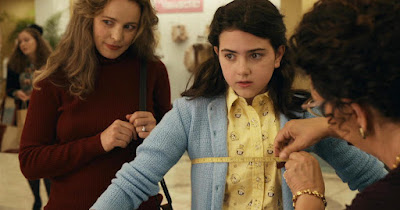
But, also true to life, Craig keeps the movie balanced on all manner of youthful preoccupations—grades, parties, holidays, family dynamics, friendships, gossip, and vacations. Here’s a movie about a year in a life that doesn’t hurry toward big climactic melodramas, but instead leans back into the usual ups and downs of young adolescent life. Craig, whose previous film was the sharp and unusually perceptive teen comedy The Edge of Seventeen, in which a high schooler’s life goes flailing after her brother starts dating her best friend, is a writer-director smartly able to balance the intensity of youthful emotions with the perspective to see them clearly in a more mature context. So here the girls’ fluttering of fears and fantasies is both intensely focused and cut with cute dramatic ironies. They don’t know what they don’t know, and it’s exciting and exasperating all at once for them, and their loved ones. The movie becomes a fully realized world for Margaret, a cozy 70s period piece that doesn’t condescend to its times or its characters. It simply lets them be.
Here’s a movie that knows life is a continual process of self-discovery. As such, it has the conviction to also dig plainly into thornier issues of family and spirituality, as our lead finds herself questioning whether she should be Christian like her mother or Jewish like her father. Neither parent particularly cares, but her loving paternal grandmother (Kathy Bates) and estranged maternal grandparents certainly do. The movie has a multi-generational generosity as it brings to life a story of mothers and daughters—especially in McAdams’ glowingly natural performance, built entirely out of lovely grace notes and simple gestures that communicate so much love and good intentions built out of an aging uncertainty. It ties Margaret and her mother together, as potential adolescent conflicts share space with an older vision of daily social struggles. Here’s a movie that says you’re never too old to feel awkward, and never too young to start discovering your confidence. You just have to find those who love you either way. Craig’s compassionate and clear approach is both respectful and honest—just the encouraging balance a young audience might need, and their parents can appreciate. This is a charming movie—so sweet and simple that it casts the gentlest of spells, and clears space for earning its characters’ learning.
Sunday, June 28, 2020
Silly Season: MY SPY, SCOOB!, &
EUROVISION SONG CONTEST: THE STORY OF FIRE SAGA


Along the way to the expected results — a long, long way, running just over two hours — we get many elaborate production numbers cut with all the grace of a live awards show, silly costumes and props, wobbly accents, patter from rivals (like a slinky Russian pop star played with swivel-hipped sleaze by Dan Stevens), and loopy asides (like repeated references to a belief in elves that escalates to a Will-Ferrell-ian payoff). It’s all shot and paced rather indifferently by director David Dobkin (Wedding Crashers) in an over-lit, flat style. Strangely, the cinematography looks better as a TikTok ad than on my 4K TV, for whatever that’s worth. It has the cheap Netflix look of their lesser programmers. And the plot itself is bone-deep derivative, certainly not worth the emotional investment it keeps trying to jolt to life with its estranged parents and scoffing suits and preening overdogs. It just doesn’t jell with the loose silliness of boat explosions and elaborate stage flops and endless cul-de-sac plot turns. Still, like the contest itself, the movie is never less than affectionate toward these misfits, and the songs are where it’s at. There’s a killer soundtrack of these goofy things — “Lion of Love,” “Volcano Man,” “Coolin with the Homies,” “Hit My Itch” — including a high-point faux-impromptu cameo-stuffed mashup singalong party. A leaner, tighter musical comedy would keep the good times rolling without the downtime for lumpy asides. But, hey, we’ll always have “Jaja Ding Dong.” And, if you squint a little, it’s almost like we got a Eurovision this year after all.
Friday, February 23, 2018
Games People Play: GAME NIGHT

Game Night is
comedy played fast and tight, an action thriller paced like a farce and
overflowing with choice one-liners and witty banter. It’s a hoot. My favorite
running joke involves various characters over the course of one-crazy-night
falling into surprisingly sturdy glass tables. There’s such a satisfyingly
goofy thunk as a body goes bouncing off where every other movie would give us a
pleasing shattering smash. The action around this funny thread – just one of
many, and besides the movie is so fast-paced all the jokes could count as
running jokes – involves a group of friends whose weekly get-together goes
very, very wrong. A competitive husband and wife (Jason Bateman and Rachel
McAdams) find their game night (pals played by Billy Magnussen, Sharon Horgan, Lamorne
Morris, and Kylie Bunbury) invited to a murder mystery night by his rich,
arrogant brother (Kyle Chandler). But, on the night in question, before the man
can even explain all the rules past the ominous “it will look real,” actual criminals barge in, beat him up,
and kidnap him. Now the group jets off on what they think is a scavenger hunt
to find where a group of actors have taken him, but are instead pulled deeper
and deeper into a black market conspiracy where the guns, blood, cops, criminals,
car chases, and stolen goods are all-too real.
Directors John Francis Daley and Jonathan Goldstein (helming
a superior project to their Vacation)
take seriously the goofy script by Mark Perez (The Country Bears, improbably enough). Watch with the sound off and
you might convince yourself you’re watching a Fincher knockoff. The shots are
crisp, the violence bruises, and the lighting is dramatic shadows and
rain-slick streets. But then there is the rapid-fire patter of bickering
friends, treating it with all the tension and drama that’d be a little
exaggerated were it a game of Monopoly
or Trivial Pursuit, but is
dramatically underplayed given the life-and-death situation of which they’re
barely aware. Gradually, as they realize how in-over-their-heads they really
are, the comedy is in the sudden scared flailing they have to keep in check in
order to survive the night. That they’re also still so competitive that they
can’t help but continue sniping little digs at one another is a fine touch.
Beyond the high-energy excitement and the high-spirited joke-a-minute dialogue
shot through with visual wit and whimsy – game board tilt-shift establishing
shots; composited one-take mad-dash chases – the movie finds itself smartly
rooted in the genuine affection of its participants. No matter how harried and
dangerous the proceedings become, Bateman and McAdams are allowed to keep the
suspense entirely out of their relationship. They’re a close-knit pair, clearly
in love, adorably competitive with one another in a way that shows them to be
enjoying playing the games because they actually like each other. The same
extends to the friend group itself, which might get at each other’s throats,
but never more than any gathering around the Sorry board. Even when a thug gets bloodily killed, there’s a nod
to the stakes without skipping a laugh. This is big, broad, studio
comedy-making operating at a consistently entertaining high.
Friday, November 4, 2016
Stranger Things: DOCTOR STRANGE

Behold Doctor Strange,
the first movie in the Marvel Cinematic Universe to grow significantly better
in its action sequences. This massive franchise of interlocking superhero
series tends to stuff appealing comic book conceits full of bantering character
actors for fun setups that dim through endless pro forma digital destruction.
The best keep the same light touch from zinging dialogue in the violence
choreography, but they often err on the side of wearing out their welcome. Strange, though, finds itself dealing
with cosmic transdimensional threats above the Avengers’ pay grade, so the
movie is free to spiral out into wild visual invention. And somehow Marvel has
allowed director Scott Derrickson – shifting tone from his usual horror beat – enough
room to create some appealing, mind-boggling popcorn adventure images. Maybe
the entire creative team was carried away by the intoxicating silliness of
sorcerers, ancient magic, enchanted relics, pulpy gobbledygook jargon, and
loopy fantasy. This isn’t a great film, but it’s a pleasant surprise to see Marvel’s
ossifying superhero formula find some glimmers of new life.
The plot itself is standard origin story stuff, with quippy
arrogance humbled by exposure to great power and great responsibility. Doctor Stephen
Strange (Benedict Cumberbatch) is a hotshot brain surgeon who struts onto the
operating theater like all his life is a show devoted to his brilliance. He
plays his medical prowess as a Sherlockian neurologist, like Dr. House crossed
with Tony Stark. So of course he’s distraught when a hyperbolic car crash – his
sleek sports car pinwheeling off a cliff, down a ravine, through a shack, and
into shallow water – leaves his hands smashed to bits. Recovery is slow, and
will likely never allow him to wield a scalpel again, let alone with anything
remotely approaching his former skill. Out of options, he journeys to Katmandu
where he’s heard tell of a magical healer, a guru known only as The Ancient One
(Tilda Swinton, otherworldly as ever, bald and beautiful, and maybe the best,
coolest MCU performance yet). He’s initially put off by her ideas about astral
projection, chakra alignment, and infinite alternate dimensions, but soon can’t
deny the power she offers him. Open your mind, she says. He doesn’t even
hesitate long enough to ask if she takes his insurance.

Moving through the typical training montages, Derrickson
(from a screenplay he co-wrote with Jon Spaiths and C. Robert Cargill) finds
hallucinogenic imagery. As Strange trains with The Ancient One and her talented
acolytes (Chiwetel Ejiofor and Benedict Wong) in the ways of the Sorcerer
Supreme, he encounters glowing spells floating in the air, energy fields,
swirling portals, glowing martial arts weaponry, mirrored dimensions fracturing
the world in front of his very eyes, and abstract flourishes of phantasmagorical,
mind-bending, reality-contorting travel. Marvel steers into the visual
possibilities opened up by this concept, letting Derrickson and crew stage
creative adventure. You can see in the effects’ department’s talented
kaleidoscopic manipulation of matter – a city bending and warping in on itself,
time moving backwards for some and forwards for others in the same frame,
doorways to anywhere – Inception’s topsy-turvy
hallway fight and Matrix bullet time
plus Fantastic Voyage’s titanic
molecules and 2001’s trippy wormhole.
Here landscapes shift, tile patterns double and redouble, reality blurs and
slurs, slips and slides. This isn’t dull shooting and punching interrupting fun
characters’ hangouts. It’s, well, a visual Marvel much of the time.
And yet as much as it is fun to watch, it’s still in service
of business as usual plot machinations. Strange’s training is about to come in
handy, and the groundwork the early going lays for the imaginative imagery will
pay off, when the villain (Mads Mikkelsen, with his eyes surrounded in a craggy
dark glitter) appears, threatening the entire world with total destruction.
He’s the type of bad guy who is splintering our dimension in exchange for
immortality promised to him and his followers by an alternate universe ruled by
a writhing purple goop monster. The conflict plays out like you’d expect, with
fun side characters cycling in and out seeding future entries and forthcoming
conflicts. (No less than Rachel McAdams, Benjamin Bratt, and Michael Stuhlbarg
appear in such foreshortened subplots I couldn’t help but wonder if they’re
only there for the promise of sequels.) But the details of the narrative, and
the regular Marvel blend of light humor and apocalyptic stakes, take a back
seat. It’s their usual crowd-pleasing formula done up with a genuinely pleasing
visual snap. Compare it to their flat, dishwater grey, CGI airport tarmac in Civil War and it’s even more like a
whole new dimension of possibilities opening up in a dull world.
Like the Thor movies,
Doctor Strange is swept up in its
terrifically silly/serious concoction. Moments like a slapstick fight involving
a sentient red cape or a head-spinning M.C. Escher chase through a scrambled
sideways New York City are right up there with Asgardian rainbow bridges and pseudo-Shakespearean
Norse god mythos as the closest the whole MCU behemoth gets to massive pop art
spectacle, eye-popping splash-page fantasy filmmaking driven by an imaginative
use of screen space instead of the overused and overfamiliar slam-bang drudgery.
Strange is best when it lets its
visuals overpower its plot, taking off into uncharted cosmic wilderness. No
wonder it leaves behind its characters’ emotional journeys and down-to-earth
formulaic interactions by the end, consigning their mortal problems to get
sorted out later. It has a multicolored psychedelic lightshow to stage,
stretching out across a 3D IMAX screen every which way and then some. Its
spectacle may be no more or less empty than any other MCU smash-‘em-up, but at
least it’s entertaining spectacle used strikingly, surprisingly, and enjoyably down
to the last pixel.
Wednesday, December 2, 2015
Let it Shine: SPOTLIGHT

Unadorned filmmaking of burnished and unobtrusive
professional polish, Tom McCarthy’s Spotlight
is a good example of how little you have to do to create an absorbing
movie, provided you have the right story and the right cast. Writer-director
McCarthy, who, when not being a terrific character actor, spends his time
making nice small character dramas (The
Station Agent, The Visitor, Win Win), takes for his material here the
true story of the Boston Globe’s 2001
investigation into allegations of child abuse committed by Catholic priests
which resulted in a detailed and powerful series of exposés. He, with co-writer
Josh Singer (The West Wing), turns
this into a movie about people simply doing their jobs, removing all narrative
adornments a more conventionally crowd-pleasing picture would require: artificial
drama, character arcs, a main character, grand pronouncements, easy symbolism,
cheap moralizing. Instead he simply shows us an ensemble of journalists working
studiously and methodically, making sure they get the facts right before going
to print. They know they’re onto something big, a story of massive importance
and moral imperative, but it’s also just their job.
The result of McCarthy’s approach is an inspirational story
about journalism at its finest boiled down to tense scenes of research,
interviews, and fact checking. This is a procedural about workaday reporters
doing the best they can, a movie committed to being something like an accurate
portrayal of the daily grind of a noble profession done right. The Globe’s editors (Liev Schreiber, John Slattery) task the in-depth investigative reporting “Spotlight” team (Michael Keaton, Mark
Ruffalo, Rachel McAdams, and Brian d’Arcy James) to take a closer look at a
small court case involving a tenacious lawyer (Stanley Tucci) suing the local
Catholic Archdiocese on behalf of clients who were abused by priests. As the
reporters track down sources and gather archival background information, they
discover a pattern of priests pulled from parishes under suspicious
circumstances and quietly reassigned. It’s a clue that something’s rotten, and
as a number of victims agree to interviews, it’s clear they’re about to uncover
a devastating conspiracy of abuse and cover-ups, staggering in scope,
heartbreaking in depth.
Every step of the way, these men and women make sure to get
every detail right, to ensure the story is airtight. They’re working in secret,
trying to avoid raising the suspicions of local Catholic officials who form an
integral part of Boston’s civic and philanthropic society. Some lawyers for the
church (Billy Crudup, Jamey Sheridan) are suspicious, refusing even to
corroborate basic details. As the undeniable facts of the case start to add up,
the journalists are even more driven to follow facts, beyond assumptions or
pre-existing worldviews, into the simple, pure, disturbing truth. McCarthy
simply sits back and lets the actors go to work in a movie of conversations –
cautious interviews, heated arguments, tense debates, tricky negotiations – as
the reporters struggle to get a handle on the story’s reach and implications,
as well as deciding how best to break the news to the people. It’s unshowy. The
blocking is simple, the editing briskly functional, the photography bright and
clean. The filmmaking is so uninsistent, Howard Shore’s score, which would seem
sparse in any other film, sounds overbearing. The focus is only on process.
The performers are subtle, natural, inhabiting real people
whose day jobs are a combination of craft and calling. Keaton sinks into a
tired newsman’s humble fortitude, McAdams carries quiet confidence, Ruffalo
leans into inquisitive doggedness, and d’Arcy James wears sturdy moral force.
There are no heroes, just normal people patiently doing what they must to root
out hidden facts. Here’s a movie about nothing more than the value of a job
well done. The job in this case just happens to be one that uncovered one of
the most significant news stories of this century. A telling moment comes when
September 11, 2001 rolls around, sending the newsroom scrambling in the wake of
that day’s tragedy. It pushes the Spotlight team’s work on the backburner, and
yet McCarthy treats this huge moment of recent history as a background detail.
It’s a moment of world-changing impact, sensitively and appropriately somber in
its portrayal, but the decades of spiritual and sexual abuse uncovered by their
investigation is just as monumental.
Aside from one poignant montage set to “Silent Night,”
featuring what has to be cinema’s most moving and upsetting Excel
spreadsheet-making scene, the movie doesn’t push buttons. It speaks as clearly
and directly as its characters, knowing the details will speak for themselves. It
knows the actors are dialed-in to both the import of their characters’ jobs and
the processes of doing them. It has faith in the inherent compelling nature of
carefully piecing together a news story, trying to be fair to subjects, and do
right by the people of the world by telling the truth. Spotlight may not be quite as richly rewarding a cinematic
experience as other great newspaper movies like All the President’s Men and Zodiac,
but it belongs on the same Journalism 101 syllabus. Scene by scene, line by
line, McCarthy finds a quietly gripping approach, building to a low-key finale
both triumphant and daunting. The article has gone to print. But the work
continues.
Sunday, July 26, 2015
Fight Night: SOUTHPAW

I suppose it was inevitable Antoine Fuqua would direct a
boxing picture. The one thing that connects his diverse (and uneven)
filmography – from fine genre fare like Training
Day and King Arthur to lesser
junk like Olympus Has Fallen and The Equalizer – is intense, gory,
bruising violence. So when an early shot in Southpaw
has Jake Gyllenhaal looking straight into the camera, howling in slow motion as
blood and sweat rain off his straining muscles, it’s clear we’re in a place of
macho intensity. Fuqua shoots the boxing matches with reasonable force, and
wisely uses the camera to teach the audience how to read the strategies
involved. But the story between the bouts is merely programmatic, a broad and
bludgeoning collection of tropes. It’s a boxing picture. What do you want, a
roadmap?
It starts with Gyllenhaal’s boxer at the top of his game –
undefeated, even. Soon, he’s fallen on hard times due to a set of tragic
circumstances and his own bad habits – temper, alcohol, and so on. He loses his
wife (Rachel McAdams), is abandoned by his sleazy manager (Curtis “50 Cent”
Jackson), and has his daughter (Oona Laurence) taken away. Now he has to rely
on a tough-but-fair wise old trainer (Forest Whitaker) to help him get back in
fighting shape. If you already think this all ends with a big comeback fight
against a perfectly loathsome rival (Miguel Gomez), you’ve definitively seen a
boxing picture before. Besides, Gyllenhaal’s surname here is Hope. You’ve got
to know where the symbolism is pointing. Sons
of Anarchy showrunner Kurt Sutter’s screenplay plays every note you’d
expect, doing so with a swaggering clobbering melodrama, confident in its
ability to use an audience’s emotions as its speed bag. It thumps away.
Fuqua obliges the formulaic intentions of the material while
keeping the visual interest on the performer’s bodies. He focuses attention on
McAdams’ relaxed sensuality, Jackson’s broad-shouldered business posture, and
Gomez’s slippery fighting stance. But most of all Fuqua takes in Gyllenhaal’s
ripped musculature, a painful display of tense tautness. He clearly worked hard
for this role, and is eager to show off every bit of the gain from the pain.
But it also serves a purpose in telling us everything we need to know about this
boxer. He likes the pain. Thanks to the announcers helpfully shouting out the
subtext during the fights, we learn boxing fans know it’s not a Hope match
until he’s bleeding. His wife tells him he needs to retire before he’s
irreparably punch-drunk. But we soon learn how desperately he needs to keep
going.
We get plenty of Hope’s frustration with his situation,
followed by training montages as he works his way back to some semblance of
normalcy. With a daughter’s happiness imperiled, it’s easy to root for him. But
I appreciated the film’s ability to look somewhat askance at its protagonist,
wondering if his cyclical bad behavior is something that can be fixed. But of
course it can, and he can learn to control his temper in everyday life by
learning to fight better in the ring. Instead of settling into the reality of
its characters’ lives, the movie hops to the next expected beat. It never feels
like a real situation, but an artificial construct built to fit the needs of
its subgenre. It doesn’t breathe like the best of its brethren, where Rocky or Raging Bull or Million Dollar
Baby (or even Real Steel) color in the specifics of their environments.
Southpaw is on a
one-way track to the Big Match. It’s an athletic, well-coordinated display.
Gyllenhaal can land convincing blows, and, because the emotions involved are so
big, heavy, and unsurprising, the stakes are completely clear. The result is a
good replica of a boxing match. It’s exciting and visceral, punches booming so
forcefully in the sound mix I wondered what the Foley artists had to do, every
jab timed to the usual orchestra of crowd reactions. It’s well made without
being completely involving. I sat admiring the technique more than feeling the
tension. Because the way there is so pro-forma, it’s hard to stay invested. The
movie remains a glossy, well intentioned, but over-familiar narrative beginning
to end.
Friday, May 29, 2015
Hello Goodbye: ALOHA

Aloha is another
Cameron Crowe picture about a successful man who finds his professional life in
jeopardy while his inner life is restored by romance. Furthermore, it’s another
of his romantic comedies spiked with office drama, like Jerry Maguire was
falling in love while negotiating sports agent business and Matt Damon fell for
Scarlett Johansson while she helped him with his zoo in We Bought a Zoo. There’s also Orlando Bloom’s disgraced suit
meeting Kirsten Dunst in Elizabethtown,
and you could throw the reality-scrambling Vanilla
Sky into the mix, with publisher Tom Cruise crushing on Penelope Cruz, if
you view its twisty ending optimistically. In Aloha, a depressed defense contractor (Bradley Cooper) survives an
explosive encounter in Kabul and is reassigned to Hawaii, where he’s to
negotiate a new roadway through Native Hawaiian territory. His military liaison
is a bright charming young woman (Emma Stone). If you already think he’ll fall
in love and grow a conscience, you’ve been paying attention.
Because Crowe is a warm writer sincere in his
sentimentality, he can usually make his formulaic tendencies work. (Of course,
he’s even better when drifting away from formula. It’s why Say Anything… is still his best film.) What’s most peculiar about Aloha is how everything around this
central romance plot is much more fascinating and effective than what is inside
it. Cooper and Stone have fine chemistry playing two people who have to fall in
love because they’re the stars of the movie and the script keeps pushing them
together. It’s largely unconvincing, following a period of initial irritation,
then intense love, then a tearful misunderstanding, and so on. What’s far more
interesting is watching Cooper’s interactions with other characters in a
breezy, low-key, undemanding story of a man slowly regrowing his conscience.
This growth takes root as Cooper works with his boss (Bill
Murray), a tycoon trying to launch a satellite with the armed forces’
help. One gets the impression Cooper has been unscrupulous in the past. Half-articulated military industrial commentary abounds in a guardedly
biting way, as the rich man’s real aims are hidden from the brass (Danny
McBride and Alec Baldwin). Meanwhile, both public and private interests are all
too willing to manipulate Native Hawaiians to go along with their schemes, trading
them land and assistance to wave construction through sacred spaces. This
thread is far more interesting than whether or not the girl will fall for the
guy, especially when their relationship is so thinly sketched and taken for
granted. The story is dusted with a few intimations of magical realism that
never amounts to anything, and is resolved far too neatly and softly to retain
its teeth, but is a more intriguing element in every way.

Better still is a subplot involving an ex-fiancé of
Cooper’s, played by Rachel McAdams with glowing happiness tinged with a hint of
regret. It's been a dozen years since their break up. She has two kids (Danielle Rose Russell and Jaeden Lieberher) with a
military man (John Krasinski). She loves her family. And yet the appearance of
her old love gets her thinking. This storyline features the best writing and
acting in the film, Crowe at his best drawing relationships that play out with
real compassion and unexpected developments. It’s a reflection of where the
main character’s life went wrong, a cozy family unit he’s invited to spend time
with, but left just on the outside of embracing. There’s too much history
there, and too much pressure to get his job done. If the corruption he
encounters is the seed of his moral reawakening, seeing the love he left is the
fertilizer for this new growth.
There are plenty of worthwhile pieces to Aloha, but Crowe doesn’t put them
together. They play like separate elements instead of a cohesive whole,
connected by character and only faint echoes of each other. It’s telling that
the conclusion finds several final moments, tying up individual threads – an
arrest, several reconciliations, a tearful reveal – without a feeling of
overall finality. This is a film of gentle rhythms and light tropical breezes.
French cinematographer Eric Gautier captures lovely island landscapes and
floats between the performers with ease. Crowe writes a handful of terrific
lines and finds some nice cuts from his record collection for the soundtrack. It’s certainly well
intentioned. But why does it feel so slight and disconnected? The writing lacks
a certain sparkle, and lingers in disjunction between disparate elements. There
are strange asides – a grisly toe injury, a ghostly vision – distractingly out
of place, appearing once, then never mentioned again. Hardly a disaster, it’s
perhaps best to approach Aloha as a
sweet, earnest jumble, likable parts in search of a whole.
Thursday, August 21, 2014
Spies World: A MOST WANTED MAN

Based on the book by John le Carré, A Most Wanted Man is another of his spy stories that turn on
complicated clockwork plotting but play out as deliberately paced character
studies. It’s what makes his Tinker
Tailor Soldier Spy a landmark for the genre. In Tomas Alfredson’s masterful
2011 adaptation of that novel, a Cold War-era British spy played by Gary Oldman
quietly, methodically maneuvers a mole into the light of day. It’s a tricky,
deeply felt work that sits entirely on the shoulders of its characters,
watching for the slightest adjustments of body language to reveal undercurrents
of emotion and truth.
A Most Wanted Man
does something similar with the late, great Philip Seymour Hoffman in one of his final roles as Günther,
a tired German spy stationed in Hamburg who goes about his daily life with the
weight of the world on his shoulders. He’s very good at his job and confident
in his conclusions. There’s a quiet moment in which he consults with a United
States operative (Robin Wright) at a café. He matter-of-factly takes a flask
out of his pocket, pours some liquor into his coffee, and takes a sip, all the
while laying out his plan to use an illegal immigrant (Grigoriy Dobrygin) to
determine how a professor (Homayoun Ershadi) is sending money from his charity
to terrorist groups. It’s risky, but it just might work. He’s so confident, he
doesn’t need to hide his functional alcoholism from his colleague.
Director Anton Corbijn, whose last film was the gripping Le Samourai-esque art house George
Clooney assassin movie The American,
sets the gears of the plot turning with considered patience. We meet several
characters working with skill and precision, playing their parts in parallel
plans that converge with the icy grip of Andrew Bovell’s screenplay. There’s a
banker (Willem Dafoe), a human rights lawyer (Rachel McAdams), and several
spies (Daniel Brühl, Nina Hoss, Mehdi Dehbi, Martin Wuttke). It’s all one big
high-stakes chess game, people moving pawns into position, hoping to make it to
the end with their careers, if not their lives, intact. But with this great
cast and excellently controlled direction, the result is merely serviceable.
The espionage thriller moves slowly and confidently through
its knotty plotting. Characters trudge about as pieces gradually drop into
place. I could appreciate its terse, subtle character work from the ensemble
and grimly chilly imagery from cinematographer Benoît Delhomme. But the movie
remained firmly on screen. It never grabbed me or pulled me in. I was entirely
unmoved and disinterested. There’s geopolitical specificity and lived-in
performances, and yet it somehow feels fuzzy. We see actions and reaction, but
little to impact the world beyond these characters.
It has to do with the point of view. While Le Carré’s
methods of plotting are great for distant Cold War analog spying, making the
cat-and-mouse genre pleasures a current War on Terror digital prospect grows
disquieting. The film raises important questions without paying much attention.
It shows us a broken world of imperfect systems and flawed people given
horrible power and great responsibility. And yet it never grapples with this
observation beyond the grist for character work.
We sit with the characters on their level, the better to see
that these people have remarkable and frightening power. It’s upsetting, but
played off as mere plot mechanics. A lawyer is grabbed off the street, thrown into
the back of an unmarked van, and held captive. An innocent man never learns his
apartment is bugged with hidden cameras. Hoffman’s character says he runs a
secret department dedicated to going outside the law to keep Europe safe from
terrorists. But his team has the suspects’ best interests at heart. A rival
department just wants to spirit them away forever to some undisclosed
top-secret interrogation detainment. In the end, we’re supposed to feel
disappointment that things didn’t work out the way our leads wanted. It
suggests that our civil liberties may be trampled at the slightest whim of an
agent, but at least the good spies feel bad while they do it. Cold comfort.
Subscribe to:
Posts (Atom)
