When Disney wants a live-action version of an animated classic to have some weight and elegance and freshness, it turns out David Lowery is the writer-director on whom to call. His Pete’s Dragon was a lovely, low-key coming-of-age fantasy that turned its fantastical conceit into something shaggier—a boy-and-his-dragon tale. Lowery’s non-Disney work, like The Green Knight, also proves he’s a literate, sensitive filmmaker. He can dig into a classic text and draw out its deep, resonant inner life while making it his own. And with these skills, he can, in the case of Peter Pan & Wendy, hook into authentically Edwardian romanticism while cleverly adapting the mythos to make it resonant for his purposes. He doesn’t exactly revive J.M. Barrie’s original text, or Disney’s animated version, beat for beat, though there’s a flourish of “You Can Fly” in the score. Nor does he draw out everything that makes the work last, the work of a scholar who might capture it by pinning it down. But what he does do is provide it a sense of life and space with windswept verisimilitude—location photography that’s lush and vivid on grassy cliffs and verdant forests full of moss and shadow. And within this convincing locale captured with a filmic eye, he pulls on one simple lively thread from the classic story of a girl who’s given a glimpse of Neverland: the dread of growing older.
Perched on the precipice of puberty—Peter and Wendy are here cast in the last possible week they can be simultaneously the oldest children and youngest adolescents possible, depending on the angle—here’s a movie that pushes on the urgency of aging. They’re at an age where choices and fantasies mingle—and where growing up might be the biggest, bravest adventure. There’s the usual tangle of business with Lost Boys and Captain Hook and Tiger Lily, though all that’s done with a graceful shorthand. And the beautifully casual diversity of the Boys—some are even girls—and the melancholy backstory for Hook (Jude Law, with more real pain than sneering cartoon) feeds into the ideas of aging as a process by which you discover truths about yourself. To deny yourself, or others, that adventure, even through fantasy, is, after all, a kind of conflict that Lowery’s happy to explore outwards with some fairy tale logic and a bit of piratical swordplay. The film’s most moving moment finds Wendy, having walked off the plank, seeing her life flash before her eyes—but forward, not back. That’s a perfectly sentimental moment. And so, though the movie has swashbuckling with weight and peril, and a grand, old-fashioned Kids’ Adventure spirit, it falls back on that smaller, tremulous time where anything is possible, and the passage of time is just about to fall in with the limits of age and nothing can stay the same.
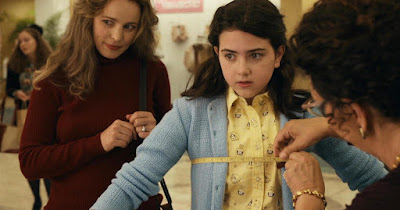
Much less metaphoric about growing older is Are You There God? It’s Me, Margaret, in which burgeoning young adulthood is a source of much literal curiosity and angst. Here’s a movie tenderly attentive to the tenderest of times in a girl’s life. Based on the classic Judy Blume book, it tells the story of Margaret (Abby Ryder Fortson), a sixth grader whose life seems to be nothing but changes. Her parents (Rachel McAdams and Benny Safdie) have moved her from New York City to suburban New Jersey. She has a new school with new kids, and suddenly she’s getting crushes on cute boys and needs to ask her mom to go bra shopping for the first time, and her new friend group is made up of popular girls jealously testing their new ideas. Their gossipy preoccupations are starting to make Margaret nervous about when, exactly, she’ll be getting her period. Writer-director Kelly Fremon Craig keeps the movie loose, light, and episodic, so casually specific about moments in this girl’s life that there’s a generosity of insight just in the act of watching it unfold. There’s a comforting normality to what feels like, to its lead character, the first time anyone’s ever gone through such outsized changes. I suppose it’s true that, though most women go through this, for every woman it’s a once-in-a-lifetime discovery. This movie respects that balance.
But, also true to life, Craig keeps the movie balanced on all manner of youthful preoccupations—grades, parties, holidays, family dynamics, friendships, gossip, and vacations. Here’s a movie about a year in a life that doesn’t hurry toward big climactic melodramas, but instead leans back into the usual ups and downs of young adolescent life. Craig, whose previous film was the sharp and unusually perceptive teen comedy The Edge of Seventeen, in which a high schooler’s life goes flailing after her brother starts dating her best friend, is a writer-director smartly able to balance the intensity of youthful emotions with the perspective to see them clearly in a more mature context. So here the girls’ fluttering of fears and fantasies is both intensely focused and cut with cute dramatic ironies. They don’t know what they don’t know, and it’s exciting and exasperating all at once for them, and their loved ones. The movie becomes a fully realized world for Margaret, a cozy 70s period piece that doesn’t condescend to its times or its characters. It simply lets them be.
Here’s a movie that knows life is a continual process of self-discovery. As such, it has the conviction to also dig plainly into thornier issues of family and spirituality, as our lead finds herself questioning whether she should be Christian like her mother or Jewish like her father. Neither parent particularly cares, but her loving paternal grandmother (Kathy Bates) and estranged maternal grandparents certainly do. The movie has a multi-generational generosity as it brings to life a story of mothers and daughters—especially in McAdams’ glowingly natural performance, built entirely out of lovely grace notes and simple gestures that communicate so much love and good intentions built out of an aging uncertainty. It ties Margaret and her mother together, as potential adolescent conflicts share space with an older vision of daily social struggles. Here’s a movie that says you’re never too old to feel awkward, and never too young to start discovering your confidence. You just have to find those who love you either way. Craig’s compassionate and clear approach is both respectful and honest—just the encouraging balance a young audience might need, and their parents can appreciate. This is a charming movie—so sweet and simple that it casts the gentlest of spells, and clears space for earning its characters’ learning.
Showing posts with label Kelly Fremon Craig. Show all posts
Monday, May 1, 2023
Sunday, November 20, 2016
Teen Life: THE EDGE OF SEVENTEEN
It’s hard being a teen. Brining in hormones transforming a
person from child to adult heightens emotional stakes. Every decision seems to
weigh heavily on the future, relationships feel like they have life and death consequences,
urges can lead to reckless decisions. Caterpillars are lucky no one can see
them inside the cocoon. For us unlucky humans, we grow into new bodies, new
thoughts, and new behaviors with gangly guesswork. Part of Nadine’s problem in The Edge of Seventeen is thinking she’s
the only one hit hard by teenage changes. She compares herself to her handsome
older brother – popular, sporty, fit, charming – and comes up short. She’s
awkward, disheveled, with bouts of acne. And she has only one friend, the same
one since second grade when they bonded over – metaphor alert! – a caterpillar
they plan to raise together only to suffocate a few hours later. All these
years later, and Nadine is sure she’ll be like that caterpillar: snuffed out in
one way or another before she can flower into the confident young adult she
doubts she’ll ever be.
Hailee Steinfeld stars, and it’s her best role since her
debut in the Coen’s True Grit. She
has a perfect face to play this exasperated young woman coming apart at the
seams. She has a sympathetic openness cutting easily into sharp edges of pain
and meanness. She’s able to send her dark eyes flitting between beleaguered and
bitter, humble and harried, open fumbling flirtations, deep pain, and howling
rage. She always struggled with feelings of isolation and loneliness, but now,
in the years following her father’s death, she’s been lost in a fog of
depression as well. Snark is her primary coping mechanism, throwing up a layer
of derision, eye rolling, and mean quips to protect herself from further
emotional damage. She affects an attitude of carelessness, because it’d hurt
more if people knew she cared. But then her only friend (Haley Lu Richardson)
starts dating her brother (Blake Jenner), and she finds herself adrift, no one
to turn to. Her mother (Kyra Sedgwick) is too busy, and too lost in her own
problems, to connect. Even her favorite teacher (Woody Harrelson) has only
deeply sarcastic rebuttals to her flawed attempts to ask for advice.
As writer-director Kelly Fremon Craig unfolds the warm and
prickly comic teen drama around Nadine, she captures an authentic adolescent
attitude of perpetual crisis. We’re joining the lead’s life at a moment of
snowballing emotional pain, which has its roots in sadness of the past, but
escalates now at the brink of adulthood. She’s all-too-aware of her struggles,
and in fear that no one cares. She thinks she’s the only person with problems
this bad, even though her mom’s weak advice is to remember that everyone’s as
empty as she is. (“They’re all just better at pretending.”) A low-key, dead-on
portrayal of high school depression and angst, the movie proceeds in funny
bantering exchanges between characters as Nadine huffs and sulks through her
latest dramas. She’s witty, perceptive, intelligent, but the sort that leads a
teen to pull back from peers, explaining away her self-imposed exile through self-loathing
masking a feeling of superiority. (In one deeply sad moment, she confesses, “I
just realized I have to spend the rest of my life with me.”) This feels far
more real and raw than the usual teen movie constructions, and lets the comedy
fall easily into cutting spikes of sadness.
There’s a feeling of honesty permeating the film’s
decisions. Craig knows how to duck and weave in the teen comedy formula, when
to fulfill expectations and when to subvert them. Jokes land hard, then
emotions hit harder, because it marries the sharp comic timing of a Mean Girls or Easy A with the more nuanced emotional dexterity and direct
dramatic appeal of, say, a James L. Brooks film. (He was a producer here.) It
starts on the level of wardrobe, with Steinfeld wearing believably haphazard
adorable rumpled teen wardrobe: baggy sweatshirts, cute clashing patterns,
eccentric layering. She’s an understandable relatable teenage girl,
recognizable in her look and convincing in the psychology driving her. She’s
clearly suffering, and there’s no easy answer to any of her problems. Some will
fade with age and maturity. Others will take a little more work. And Craig’s
screenplay is wise about allowing her to come to realizations on her own terms,
without expecting an easy solution to end the film on an artificial
happily-ever-after.
This isn’t a smartest-teen-in-the-room movie. It’s sweet and
sour, candid and heartbreaking, often very funny, but true to the way real
teenagers talk. And it surrounds Nadine with a whole family unhappy in their
own ways, complicating what might appear at first glance to be standard stock
types with smart casting and clever writing. We first see the brittle mom, cool
brother, torn friend, cute crush (both the Good Guy (Hayden Szeto) and Bad Boy
(Alexander Calvert) varieties), and cranky teacher as the best possible version
of what you’d expect from their apparent narrative function, tangential to our
lead’s world. But soon they’re complicated with compassionate, empathetic
nuance. It’s a lot like Kenneth Lonergan’s Margaret
in that way, another movie about a girl who learns that she has an effect
on others, too. They’re not just figures in her life. She’s in theirs. This new
awareness is the dawning of maturity, and though it’s not easy to get there,
it’s fulfilling to make even one more step in the right direction.
Subscribe to:
Posts (Atom)
