You’d never accuse a Spike Lee film of doing too little. Even a movie as relatively lean and focused as Highest 2 Lowest, a melancholic crime thriller, is overflowing with ideas. It’s not one of his State of the Union films stuffed with commentary on every contemporary concern, but Lee is so unfailingly current that it nonetheless plugs into a well-observed confluence of anxieties. Here he’s remaking Akira Kurosawa’s High and Low, itself adapted from Ed McBain’s pulp novel King’s Ransom. Each version is almost forensically interested in the haves and have nots of a particular place and time. Lee transplants the plot into modern day New York, where the business tycoon in the palatial penthouse apartment with a wall of windows is a music mogul played by Denzel Washington. He brings his usual charismatic combination of intimidation and charm, here starting at imperiously confident, dials up to false bravado and down to genuine doubt, discovering renewed intensities and determination as the line between risk and reward gets vertiginous. He’s secretly negotiating to leverage his life’s savings to buy back shares in his company to head off his partners’ interest in selling the whole thing off to corporate vultures who’ll feed it to the algorithm. It’s a tension between the human touch record executive and the soulless asset extraction of easy paydays. “All money ain't good money,” Washington warns. It’s in this moment of financial precarity that his 17-year-old son is kidnapped outside a basketball camp. Then comes the ransom request: $17.5 million. Paydays all the way down. Anyone familiar with the story’s earlier iterations won’t be surprised by most of the twists and turns that follow. But Lee’s telling makes them his own with the specificity of New York, and digs into Washington’s character in ways that complicate the construction of moral dilemmas around him.
The twin questions of paying the ransom and finding renewed artistic authenticity find a neatly paired suspense, and Lee works them through tense negotiations and investigations toward some fine-tuned answers that are both surprising and inevitable. He gives the telling such a relaxed style here, less insistent and forceful than his peak, with low-key simmer that nearly swallows up important beats as it builds to some ecstatic aesthetic moments and his usual citational energy. It starts with a slow, dreamy montage of daybreak skyline shot in gleaming digital precision and set to “Oh, What a Beautiful Mornin’” covered by Norm Lewis. There the movie’s concerns are laid out in one elegant moment: the camera drifting away from the streets and toward a luxury apartment (adorned with portraits of Ali, Basquiat, Morrison, and more) while a typically white Broadway ballad is lifted up by a famous black voice. It's all there: New York as a vector of race and class, business and art. Later a police chase on street and subway will be intercut with the Puerto Rican day parade, the soundtrack blending a band’s percussive music with baseball fans chanting “Let’s go, Yankees!” Lee keeps up overlapping layers of New Yorker experience, building tensions between Washington and his colleagues, his investors, cops, his driver (Jeffrey Wright), a striving low-level rapper (A$AP Rocky). And then he locates the tensions between all of them, too, the suspicions and fears and jealousies that motivate and separate. But it’s all done in a pretty casual style, tossed off in the margins of behaviors and montage as the movie builds to its conclusions. Lee’s typically bold, restless style is here so chill and relaxed, riffing on the High and Low while percolating at its own pace, then switching up the look and feel, going from cold sleek digital to grainy film stock and back again. He gets layers out of every choice, and can make even less seem like more. His characters here, all trapped in hustles of their own making on the hunt for something more real, are trying to get there, too.
Showing posts with label Jeffrey Wright. Show all posts
Sunday, August 17, 2025
Monday, July 28, 2025
Family Business: THE PHOENICIAN SCHEME
In a filmography full of flawed father figures, there’s a good case to make for The Phoenician Scheme’s Anatole Zsa-Zsa Korda (Benicio del Toro) as the most flawed Wes Anderson father yet. He’s a rapacious international tycoon, brazenly skirting laws and regulations to exploit the world by any means necessary for his business interests. Those interests? Getting more. Little wonder his cold disregard for others leaves him dodging assassination attempts. They’re so frequent he practically yawns as he shrugs off others’ concerns about dangerous developments. “Myself, I feel very safe.” That we’ve seen an employee of his literally exploded in half in the opening moments makes us wonder where he finds that sense of safety. But it nonetheless must be this sense of mortality that drives him to invite his estranged daughter Liesl (Mia Threapleton) for a visit where he insists she leave her intention to become a nun and instead be his official heir. He takes her, and a nerdy tutor-turned-assistant (Michael Cera) on a whirlwind tour of a fictional Middle Eastern country. At each stop he renegotiates with various scoundrels and business interests (a diverse group including Tom Hanks, Riz Ahmed, Jeffrey Wright, Scarlett Johansson, Benedict Cumberbatch, and more) to fund parts of an enormous real estate and public works project that he claims will be his legacy. Of course he brings gifts to grease the wheels: complimentary hand grenades.
You may at this point have suspected that this sounds a little harsher than the usual Wes Anderson picture. Indeed, it is his coldest picture, with a hard edge and, despite his usual visual whimsical specificity, little of his obvious sentimentality. Even his masterful Grand Budapest Hotel, with its parable of encroaching fascism, found a bit more lightness in its step. Here the characters speak in the deadest of deadpan, extreme even for his style, and the emotion buried deep within is deeper still. Sure, the film is stuffed with his usual love of still-life, dioramas, old-fashioned effects, and mid-century frippery, contained in his dryly funny framing and hyper-specific structural eccentricity. (This one is built out of a series of plans kept in small, ornate boxes.) One goes to a Wes Anderson film to delight all over again at his cohesive and coherent style or one doesn’t go at all. But here in The Phoenician Scheme he’s taking a hard look at a bad man and asking what could stop the greed in his heart. All of the capitalists, con men, and crooks he meets have some stage of the same affliction. Greed is an insatiable monster. Contemplating the monster makes for a movie that’s darkly cynical, with violence tossed off as casual gags and an imperious Del Toro unflappably determined to bulldoze any obstacle in his way. In true Wes Anderson fashion, he has an intricately imagined procession of obstacles and eccentrics to reveal along that route. Is there hope for Korda? Perhaps the only thing that’ll make a bad man even a little bit better is if he could possibly be forced to have nothing at all.
Unfortunately, Korda’s in the business of more, more, more, and has a habit of corrupting all relationships toward this aim. This gives the movie an interest in the state of the soul, with religion and business and politics twisting around for purchase in materialistic persons. It’s a movie filled with schemers surrounded by paintings and literature and classical music. What beauty could a businessman possibly leave behind? Contemplating mortality, this spiritual dimension is underlined by the movie’s most startling and moving element: visions of an afterlife in blocky black-and-white where bearded sages, deceased family, and God himself sit in judgement of Korda. Whether or not his near-death experiences could help him come to a sense of self-improvement is up in the air. Like Royal Tenenbaum and Steve Zissou before him, Anatole Korda thinks he has it all figured out and needs no such self-reflection, convinced that he’s the father who knows best. But his daughter challenges him to be more of an actual, not just a theoretical, father figure, even if he may have murdered her mother. The ways in which their personalities collide and converge is a source of interest in the movie which clearly has lineage and legacy on its mind. Korda also makes mention of an unseen late father of his own whose influences on his son continue to reverberate in his decisions. (That lends poignant echoes to the short conversation which he has with God. Oh, how sons are treated.) The movie, though clever and bemused, is not as immediately lovable as Wes Anderson’s best works, so wedded as it is to its discomfiting, closed-off characters. But the ending finds Korda’s logic collapsing, and there just might be tentative hope in the wreckage.
Friday, March 11, 2022
Dark City: THE BATMAN
Even after all these years of superhero movies, Batman remains perhaps the most uniquely cinematic. Take Bruce Wayne, the Caped Crusader, striking fear in the hearts of Gotham City’s villainy, all the way back to his early comic book origins. He’s always been at the intersection—thematically, visually, tonally—of gangster pictures, German expressionism, and film noir. He’s accrued Art Deco shadows and grungy urban doom. It’s sometimes dialed up to goofy midcentury camp (hello, Adam West), sometimes dialed down to mumbling Michael Mann skyscraper canyons (howdy, Christian Bale), sometimes drawn out in luxuriously complicated Saturday morning cartoons (the Animated Series and Beyond) or stretched out in gargantuan backlot artifice (holy Tim Burton, Batman!). But it’s always recognizably this stew of influences, plus his costume a simple silhouette with silent film recognizability. His gadgets and gumshoe approach to avoiding the pain of the orphaned billionaire boy grown up collide with the sick and sicker in his crumbling home metropolis. Even the bad Batman movies are still often fun visions of this world, engaging as pulpy interiority blown out to blockbuster dimensions. The latest, directed and co-written by Matt Reeves, and starring Robert Pattinson as the angular chin and brooding eyes hidden within the cape and cowl, is maybe the most downbeat and dreary version yet, once again stumbling down dark alleys in pursuit of something like justice that’s forever out of reach.
There’s something pessimistic at the core of this hero. When talking DC’s icons, Superman is what we hope America can be. Batman is who we fear America is. No high-flying truth and justice here. Bruce Wayne and his alter ego can suit up and punch villains every night, but the sad truth of capitalist corruption and crime—a city where the cops and robbers are often one and the same, and everyone from the Mayor to the District Attorney to the mob bosses are all part of the same pool of dark money and influence—just won’t budge. So Reeves, an intelligent big budget filmmaker coming off of two interestingly textured and thoughtful Planet of the Apes pictures, visualizes these ideas by making his Gotham constantly overcast, usually raining, generally nocturnal. (It has to be a close cousin to the unnamed city in Fincher’s compellingly gross serial killer thriller Se7en.) There’s always a cloud hanging over the scenes, and the slow, patient drip of detective information about the central mystery takes precedence over slam-bang action. That makes the one fun car chase all the more thrilling, a welcome sparking rattling roar of an engine revving to life as the Batmobile makes its long-awaited appearance tearing off after a slimy bad guy. And it leaves the proceedings to move at a steady trudge, resisting the usual fanfare. To its credit, this downbeat affair that creaks by at a long three-hour run time, is trying for something genuinely wiggly and unsettling in the middle of so much iconography and cliche.
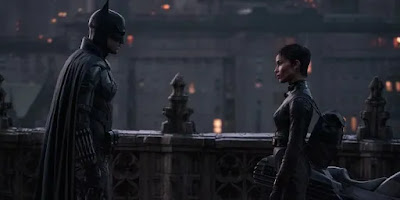
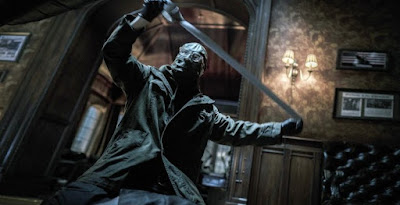
The whole thing kicks off with the murder of the mayor by a mysterious killer known only as The Riddler (Paul Dano). More victims follow. At each, he’s recording viral videos and leaving taunting clues in greeting cards at the scene for lead detective Gordon (Jeffrey Wright) to give to The Batman. Together, the two men hunt for clues and chase down leads. Sometimes they cross paths with a slinky nightclub waitress Selina Kyle (Zoe Kravitz), whose cat burglar outfit is the best since Pfeiffer’s. She has her own reasons to investigate the goings-on at a club run by the town’s top gangster (John Turturro) and his waddling underling (Colin Farrell buried in a fat suit). Reeves leans into the tight-lipped pathos of these pathetic, wounded characters creeping around the shadows of society, looking for leverage over each other in an attempt to make things a little brighter by any means necessary. Unlike the usual comic book dichotomy—or pat mirroring that leads villains to the inevitable “we’re two sides of the same coin” monologuing—this movie makes clear that everyone’s inevitably shaped by societal forces beyond their control. Batman, Catwoman, The Riddler, Detective Gordon—all are willing to bend rules and skulk around to reshape Gotham toward their ends, some for slightly better, some for way worse. There’s never a sense anyone will actually unambiguously triumph. Michael Giacchino’s pounding score takes that cue, edging along Elfman horns while plucking some “Tubular Bells.”
Here’s a city possessed with an urban rot that no one can escape. This makes for a brooding, brutal, cynical, ice-cold, paranoid and conspiratorial picture. It’s not fun, exactly, but from its opening montage of vandals and muggers spooked by the sight of the Bat-signal in the sky, to an ending where Gotham is significantly worse off than before the movie started, there’s a grimly compelling fatalism that gets its hooks in, even as the plot dwindles to a hesitant close. It’s all of a piece—a mumbled noir narration, a dimly fuzzy filmic-by-way-of-digital-and-back-again look, a sumptuously gaunt color palate, a murmuring collection of careful performances, a superhero movie that resists the overfamiliar spectacular climaxes we’ve come to expect. Like Pattinson’s sunken performance—a rare Wayne that’s not even a little sparkling—The Batman is obsessive, haunting, and unresolved. Sure, that’s partly the usual superhero move of making one feel like a first entry is so much prologue for promised future story. (And, sure, I’ll take another one with this cast and vibe.) But here that lack of resolution has tonal and thematic sense, too. Gotham, as we’ve long known, has deeply rooted systematic problems. No wonder its citizens, good and bad alike, are going mad. Who can relate?
Saturday, October 30, 2021
Off the Press: THE FRENCH DISPATCH
The French Dispatch is an impeccable handcrafted artifice somehow turning into the purest sincerity at the same time. It is, in other words, a Wes Anderson film. He’s a filmmaker who can make intricate dollhouse constructions over the darkest of melancholies. He’s one of our great appreciators of style and tone, able to take a gleaming picture of theatrical techniques and literary flourishes, pack it dense with allusions and yet give it surface pleasures all its own. He’s best at building out little pocket worlds—an eccentric wealthy New York family in The Royal Tenenbaums, a brotherly train tour of India in The Darjeeling Limited, a tiny New England island community in Moonrise Kingdom, or, his best, the towering, luxurious European mountain getaway in The Grand Budapest Hotel. Within he can indulge his eye for design—a blend of vintage mid-century aesthetics informed by a well-curated artistic intellect—while building up beautiful sadness and delightful serendipities. There’s no wonder the astonishing emotional power he can build—whether a gentle reconciliation between father and child, or a bittersweet acknowledgement of encroaching fascism bringing a golden age to a close—can catch viewers by surprise, if they can see it at all, beneath his dazzling, droll surface precision.
His latest takes as its conceit the last issue of a fictional magazine, The French Dispatch, upon the death of its founder, editor, and chief benefactor. The old man (Bill Murray) willed it so. One gets the sense it wouldn’t have the money to keep going without him. He expired near the end of editing the latest volume of what we’re told is an outgrowth of a weekend supplement for his late father’s Kansas-based newspaper that became, over the course of fifty years, its own periodical run out of storybook-perfect, snow-globe-pretty Ennui, France (the sly Francophilia is from the heart). It was a haven for the sort of literary journalists and essayists that flourished in the early to mid twentieth century. (The first card of the end credits lists, in tribute, several who serve as inspirations for Anderson’s inventions, from E.B. White and Lillian Ross to A.J. Liebling and James Baldwin.) The film becomes an amusing, eclectic mixture of that era’s art, music, design, and politics run through the typical Andersonian styles. But above all it is driven by evoking long, discursive, artfully poetic journalistic inquiries, some terse typewriter clatter, others honeyed descriptive detail. This kind of magazine writing has been practically driven extinct, save a few New Yorker-style holdouts, over the last few decades of rapacious hedge fund buyouts and relentless internet erosion of readership and attention.
It’s this sense of a bygone era that animates the movie’s wistfulness. As it begins with a death, it feels all the more like an end of that era. The movie is set in 1975, a time when a magazine like this still seemed almost the norm. Anderson begins with the editor’s obituary, and then dramatizes the four articles that make up the farewell publication. Each begins with the title positioned in crisp type, and is greeted with lovely pastiche prose that sounds just right for the period and style. They’re narrated by the journalists—a laid-back observational man-about-town (Owen Wilson), a snooty and secretly wild art expert (Tilda Swinton), a persnickety quasi-radical researcher too close to her subjects (Francis McDormand), and a refined, poetic appreciator of appetites (Jeffrey Wright). Each section is thus framed as a nesting doll—authors recounting stories within their essayistic impressions to interlocutors in faded color stock, bursting into beautiful black-and-white reportage that still further blooms into vivd color at key moments of artistic transcendence.
Thus these dispatches proceed as a collection of lovely little short stories told in a collage of filmmaking techniques. They mix film stocks and aspect ratios, split-screen juxtapositions, vigorous intuitive montage, miniatures, rear projection, slide-away stage walls, freeze frames made by actors standing still, stop-motion and hand-drawn animation. It’s a Whitman’s sampler box of a film: a sturdy, segmented container with a place for each bite-size bit of everything Anderson can do, every little nugget crafted for distinct aesthetic appeals and bittersweet surprises bursting when bit into and chewed over. The resulting stories are all in their own ways about the oddities of human experience and the dilemmas in which eccentrics and artists can find themselves. They’re over-brimmed with petty disappointments, deep wells of sadness, and grand attempts at connection outside oneself. First is a bicycle tour through the town of Ennui. The next takes us to the world of a prisoner (Benicio del Toro) painting his muse, a beautiful guard (Léa Seydoux). An art dealer (Adrian Brody) wants to invest. The next has a college activist (Timothée Chalamet) who wants to change the world, or maybe just find a lover, as he’s groping toward a manifesto. Then we get the tale of a taste test in a police kitchen (run by chef Steve Park and cop Mathieu Amalric) interrupted by an urgent kidnapping investigation. (That one gives new meaning to the term pot-boiler, eh?) The stories never quite go the way you’d think, and take detours into the silly, the tragic, and the profound, sometimes even all at once. Each ends back in the editor’s office as he mulls over some suggestions. His favorite is one all good English teachers should adopt: “Try to make it sound like you wrote it that way on purpose.”
That’s what Anderson does, too. He makes movies with rigorous structure and visual whimsy, together drawing out his whip-smart dry dialogue, textured thematic concerns, and layered images with clear intentionality and a crystal clear unity of form and purpose. This latest is deceptively light, the stories tossed off and slighter than the richness of his character work in other films. But as it draws to a close, it has a cumulative effect. Throughout, we see characters engaged in all kinds of artistic pursuits—painting, cooking, philosophizing, writing—and appreciations—viewing, eating, buying, reading. We see madness in pursuit of new tastes and new visions, and we see the comfort of finding those who understand you through your ideas, your perspective, your words. In these ways, the segments speak to each other, and build to a lovely epilogue that ties the larger portrait together. It’s about art’s capacity to draw us outwards and upwards toward the beautiful, no matter how fleeting. And it’s the story of a man through the work he shepherded—a true editor’s funeral. And it’s a filmmaker at the height of his powers, in total control over his techniques. One can sit and marvel: look at it go. In the list of artistic pursuits it demonstrates and venerates, it makes sure filmmaking is always one of them.
Wednesday, November 25, 2015
A Dino and His Boy: THE GOOD DINOSAUR
In the same year they gave us Inside Out, one of their most clever and emotionally complicated
films, Pixar has turned around and given us The
Good Dinosaur, their simplest and most visually lush, telling a spare story
that doesn’t skimp on the gorgeous design or generous feeling. What a way to
show off their range! Twenty years after inventing the very idea of a computer
animated film with Toy Story, the company
remains on the cutting edge. The artists have been pushing water, fur, faces,
cloth, and landscapes into impressively textured and convincing places, but by
now we’re well aware they’re doing more than admirable demo reels. They tell
stories, high-tech razzle-dazzle built on sturdy construction. Technical
brilliance is always in the pipeline. But those lines of code, those digital
breakthroughs, are made to live and breathe and, in doing so, move audiences of
all ages. They’ve done it again. Pixar’s latest is about a little dinosaur
named Arlo in a heartfelt narrative told through dazzling visuals.
Arlo (Raymond Ochoa) is the smallest and weakest of his
siblings, who are stronger, faster, and tougher. In this cozy green apatosaurus
family, his proud father (Jeffrey Wright) and mother (Frances McDormand) are
encouraging, letting his brother (Marcus Scribner) and sister (Maleah
Nipay-Padilla) do important chores around the farm. Poor Arlo’s too scared to even
feed the chickens properly, but his parents smile gently, telling him he’ll
grow into his confidence and capabilities. It’s an idyllic country life, surrounded
by dramatic natural beauty: pine forests, rolling prairies, distant mountains, and
a roaring river. Now, you might be asking yourself why this dinosaur family is
farming. The answer is simple. The asteroid that wiped out their species never
hit, allowing dinos to remain the dominant species. They’ve learned
agriculture, while humans are nowhere to be seen. Well, almost nowhere. Some
varmint is eating their corn, a pre-verbal feral wild child, growling and
spitting, barking at them when cornered. What a pest.
It’s a fine high-concept colored in quickly and wordlessly,
no fuss. We’re thrown into this pastoral world, and because Pixar’s animators
are as good as anyone at characterizing their fanciful designs with warm eyes,
and detailed gestures, it feels instantly real. Arlo moves his bright round
head on his long stalk of a neck with a shy bobble, ashamed he’s not as helpful
as the others. They’ve already made their marks, allowed to add their
footprints to a silo Poppa made. Arlo’s too fearful, timid, doubtful, yet to
accomplish a chore great enough to feel important. The movie’s invested in this
little guy’s feelings of inadequacy, while keeping an eye on nature around him,
crops growing, critters scurrying, and even a family member’s sudden death. (A bit of Bambi there.) This is treated with gravity, solemnly taken in as a sad fact of life. We see a
humble grave with a wooden marker sitting off to the side of the dinos’
property, like something out of a Western. Life on the frontier is hard.
In his grief, Arlo gets careless and falls into the river,
quickly swept far from his family. So there’s the story in a nutshell: lost
dinosaur must find his way home. Along the way he befriends the wild child,
also lost, who acts like an eager puppy, fetching, tracking, and protecting his
big buddy. It’s a boy-and-his-dog, except the boy is an apatosaurus and the dog
is a boy. You can guess how this Incredible Journey will develop. Also not
surprising is how Pixar’s technicians are able to imbue this wordless
friendship with great interior feeling, allowing the creatures to bond, play,
express sympathy, and grow close. When the muddy little boy crawls next to the
dinosaur, looks up at him with big wet eyes, and slowly embraces him, there’s a
genuine emotional charge. Here are two vulnerable creatures – the kid is the
only human in a world of massive animals, the dino has trembling legs and weak
ankles – clinging to one another for comfort and safety.
Not pushy or insistent, director Peter Sohn (a longtime
Pixar employee making his feature debut) and screenwriter Meg LeFauve (also a
writer on Inside Out) allow a
patient, episodic pace. The two characters – another of the studio’s reluctant
buddy team-ups – encounter other dinosaurs: a nutty triceratops (Sohn), a
sneaky pterodactyl (Steve Zahn), a t-rex (Sam Elliott), and more. Just as unpredictable
as strangers are cliffs, storms, mudslides, and raging rapids. Through each new
obstacle we find the pair growing closer, and the good little dinosaur adding
ever more bravery to emotional toolkit. Keeping with the Western theme, the film
is filled with beautiful silences and vast pretty terrain – buttes and valleys,
fields and canyons. When the film looks out over a forest of gently swaying
pines, the dense blue sky (arranged with software for “volumetric clouds”), or
a buffalo stampede backlit by a vibrant red sunset, you’d almost think you were
looking at the real thing. Add in a soft fiddle-heavy score by Jeff and Mychael
Danna, and it’s all of a relaxed southwestern piece.
How many animated kids’ movies can be compared to John Ford or
Budd Boetticher films’ straightforward pace, clear conflict, and wide framing?
There’s also a little Old Yeller here
in easy morals and the coming-of-age-through-pet-ownership and
proving-yourself-a-worthy-frontiersman aspects. (Thankfully not so much rabies,
though.) By taking a calm and classical approach where others would go manic
and jokey, Pixar’s filmmakers once again prove their unique talents. The movie has
real danger and heft. When Arlo is hit in the head with a rock, it looks like
it hurts. We see his bruises purple up over the course of his journey home. But
the characters also have a faintly rubbery cartoony quality that keeps it from
feeling dour and frightening. It’s a cozy, energetic movie, dryly funny – a
t-rex says, “If you’re pulling my leg, I’ll eat yours” – and with slapstick
peril located right next to real danger. The friendship in the center is
appealing and the yearning for home is strong. It’s touching and sweet, with
tough uncomplicated lessons and colorful kid-friendly charm.
Friday, November 21, 2014
Games Over: THE HUNGER GAMES: MOCKINGJAY-PART 1
With each installment, The
Hunger Games series gets more complicated and more interesting. The latest,
The Hunger Games: Mockingjay – Part 1,
based on the first half of the last novel in Suzanne Collins’ trilogy, finds
Katniss Everdeen (Jennifer Lawrence) regrouping after a rebel cell sprung her
from her second Hunger Games, a position she found herself in after
inadvertently inspiring a revolution with her first win. In this film, she’s
confused and distraught. Her friend and ally, Peeta (Josh Hutcherson), is
captured, a hostage of President Snow (Donald Sutherland) in the ostentatious
Captiol. She’s hunkered in an underground bunker in the wilds of District 13,
helping the rebels plan how best to use her popularity to galvanize the whole
Panem country and foment open warfare against the tyrants who’ve oppressed them
for so long.
Returning director Francis Lawrence, this time with a
screenplay adapted by Peter Craig and Danny Strong, turns this dilemma into the
stuff of potent political allegory. The series has grown increasingly
ideologically fascinating, starting as a surface-level jab at class conflict
and reality TV competitions and evolving into what is now a radicalized story
of class warfare waged through propaganda battles, lopsided bombing campaigns,
and surprise attacks. It’s a grab bag of geopolitical reference points, but the
central image of downtrodden working class folks rising up against wealthy
tyrants is a stirring one. This feature, which picks up right where the last
left off and builds towards yet another cliffhanger, extends the conflicts’
emotional damage while gearing up for the grand finale to hit theaters this
time next year. It plays upon our sympathies built up in previous installments
and our understanding that there’s more to come.
The film devotes most of its runtime to Katniss struggling
with what the movement needs her to be and the conflicted feelings roiling
inside her. She never asked to be a leader. In the first film, she was a symbol
for the Capitol. The second film found her a symbol for Panem. In both cases,
she had no say in the matter. Now, the leaders of the burgeoning rebellion
expect her, the Mockingjay symbol incarnate, to appear in their stirring
propaganda campaign, smuggled over the airways into the tinderboxes that are
the increasingly violently oppressed districts ready to explode. It’s a movie
about how heroes are not just born to lead, but built and shaped for their
movement’s needs. We’re introduced to a team of commando cameramen (lead by
Natalie Dormer) intent on following Katniss into guerilla warfare, capturing
great galvanizing images to broadcast. These dispatches look an awful lot like
an ad campaign for a Hunger Games movie,
so you know they’re effective.
As the rebellion gets ready to make their next step, Katniss
talks with familiar returning characters. She sees a friend (Liam Hemsworth), a
mentor (Woody Harrelson), her image consultant (Elizabeth Banks), her sister
(Willow Shields), and fellow Games’ victors (Sam Claflin, Jeffrey Wright).
They’re a collection of great character actors involved in scheming, debating,
giving orders, and delivering speeches. Most poignant is the late Philip
Seymour Hoffman in one of his final roles as a canny political operative
strategizing the rebellion’s next move. The rebel leader (Julianne Moore,
sporting long grey hair) is a new addition, another forceful but sympathetic
voice echoing in Katniss’ head.
This could all be static, marking time until the real action
can ramp up for the presumably fiery climax of Mockingjay – Part 2. Indeed, it grows cramped and a little
repetitive at times. (Tell me why Katniss needs to take a nearly identical tour
of ruined District 12 twice?) And the emotional journeys the characters take
are mostly minor adjustments that leave them better ready to launch into the
next film. But with such great actors involved, especially Lawrence, Moore, and
Hoffman, the political calculations of a growing rebellion feel meaningful.
Most effectively, the filmmakers have an even greater sense of the world’s
details. The spaces feel lived in and thought through. There’s a sense of
weight and import to characters’ discussions, real meaning to the sporadic
splashes of violence. It’s best when opening up the contained bunker dramas, showing
us other parts of Panem carrying out strikes against the forces of Capitol-ism.
In one moving scene, a folk song becomes a rallying cry in one of the more
unblinking representations of uprising I’ve seen in recent years. There’s real
impact to their decisions.
Perhaps we’ll eventually be better off thinking of Francis
Lawrence’s three Hunger Games films
as one three-part story instead of discreet units. For now, though, it’s fun to
simply be back in an engaging world with smart ideas and some stirring action
bouncing around a well-constructed blockbuster. I was pulled into the film’s
space and enjoyed occupying it for a couple of hours, even if by the end I
would’ve much rather watched another couple hours right then and there instead
of having to wait a whole year to see it reach an actual conclusion. What’s
most exciting about the story told here is the way the filmmakers – and
Collins, in her books – are not afraid to change the dynamics, alter the
scenario, and do things differently. Here, the games are over, the characters
are on the run, with no hope of safety until they see things through to the
end. And that’s where they leave us, eager to see where that end will be.
Friday, November 22, 2013
The Capitol Strikes Back: HUNGER GAMES: CATCHING FIRE
It’s always a pleasant surprise to see a sequel not only
learn from the mistakes of its predecessor, but to move forward exploring the
aftermath of its initial narrative. In the case of The Hunger Games: Catching Fire it is a modest improvement, but
improvement nonetheless. I suppose when you make nearly $700 million dollars
worldwide, you can afford an upgrade in the scale and believability of your
special effects. But more than that, director Francis Lawrence, taking over for
Gary Ross, brings a clarity of vision and the script – adapted this time by
Simon Beaufoy and Michael DeBruyn – finds a leaner and tougher approach to
plunging us into the tangle of potent sociopolitical allegory. The filmmakers
have, of course, the novel by Suzanne Collins to work from, but the film’s
sequel represents a step up in quality, something not represented in the
books. I get the feeling that the ideal director for this material would be the
violent satiric Paul Verhoeven of Robocop
or Starship Troopers, but Lawrence,
having directed Constantine and I am Legend, is no stranger to character
based spectacle. He gets the details and surface excitement right and the
adaptation keeps character and politics balanced.
When we last saw The Hunger Games, an annual children’s fight-to-the-death
put on by the Capitol to keep the 12 Districts of dystopian future nation Panem
in line, Katniss Everdeen (Jennifer Lawrence) and Peeta Mellark (Josh
Hutcherson) became unprecedented double-victors. They managed to finagle a fake
love story for the Capitol’s cameras that caused a rule change when the
gamemaster balked at televising the Games’ first double suicide conclusion. Catching Fire picks up as Katniss and
Peeta are sent on a victory tour in advance of the next year’s Games, a tour
that ignites tremors of rebellion throughout the country. News of the Capitol’s
loosening grasp, as represented by these two kids who beat the system, only
brings down the violence of the state all the harder. Because Lawrence (the
director, not the star, no relation) holds the camera steady as the screenplay
allows the film to let the mournful anguished aftermath of the first to linger,
it’s impactful in its stillness.
Transparently evil President Snow (Donald Sutherland) feels
so threatened by these victors, he commissions a new gamemaster (Philip Seymour
Hoffman) to devise a set of rules for the upcoming Hunger Games that’ll leave
the Districts shaking and complacent with fear once again. These two actors
spend their screen time chewing over every evil growl as they scheme a way to
eliminate Katniss from the situation. So it’s back to the arena again, only
this time the tributes competing are not kids, but former champions, some still
young, like our heroes, others elderly, unfairly thrust back into the battle.
Katniss and Peeta, plagued by guilt and post-traumatic stress dreams, are
forced to fight once more. But now the Captiol’s men behind the curtain seem
determined to kill them all. The arena – with its man-eating monkeys, poison
fog, and other disasters that make for good CGI spectacle – is as deadly as the
competitors, who feel betrayed by the society that’s coddled them in the years
since their victories. It’s a volatile situation, vibrantly dramatized in a
sequel that’s unafraid to complicate its premise and slowly radicalize its
characters.
The first film was about a girl learning to game an unfair
system to survive. The sequel is a film about how she responds to finding
herself an accidental symbol of burgeoning revolt. She agrees with the ideas she
has come to represent, but can’t figure out how to best position herself (if at
all) as the savior the people crave. Lawrence (the star, not the director, no
relation) lets us see her fear and resolve as she feels her way towards
becoming the rebellion she represents. She doesn’t want to hurt those she
loves, like her sister (Willow Shields) and best friend (Liam Hemsworth), but
as the Capitol conspires to restrict her choices, she’s left with only her own
resilience to guide her as she must decide who to trust.
Woody Harrelson, as a drunken mentor, Elizabeth Banks, as a
flibbertigibbet slowly growing a conscience, Lenny Kravitz, as a charitable
designer, and Stanley Tucci, as a teeth-flashing talk show host, reprise their
roles. New to the scene are Jeffrey Wright and Amanda Plummer as techie
middle-aged tributes, Sam Clafin, as a handsome young tribute who may be an
ally, and Jena Malone as an entirely fearless tribute furious about her
situation and ready to tear down the Capitol on live broadcast if possible.
It’s a whole lot of character and situation storming about the film, but
because the world of Panem has ever so slightly grown more complicated it can
more than accommodate the additional interest.
It becomes, at times, a fairly moving picture of resistance
and defiance in the face of sickly opulent fascism that’s willing to put the
underclasses to work and, when they won’t, put them down. The metaphor of
sociopolitical traps – have-nots violently encouraged to submit to the haves –
is potent, as is its mass mindless entertainment as purposeful distraction of
serious injustice. Like its predecessor, Catching
Fire largely separates its ideas and its action, forcing the audience to
think and feel through an hour of politics and satire sitting tantalizingly on
the surface, before plunging into crisp, relentless action and danger in the
back half. The bifurcation works, loading up the back half with busy thrills
after slowly pulling tension out of scenes in which some of our finest
character actors in sometimes silly costumes say serious and goofy things
surrounded by spare sci-fi future chic.
It’s all anchored so strongly in Katniss, her journey, and
her determination that it doesn’t get lost in the precision campiness of the
Capitol, the constant – and coherently photographed – action of the Games or
the sometimes misshapen narrative. For in true middle-chapter franchise
fashion, Catching Fire, for all its
melodrama and movement, doesn’t begin or conclude. It starts in the aftermath
of the first and ends by excitingly trumpeting into a cliffhanger teasing more
story to come. But it has enough surprises along the way that it doesn’t feel
like a cheat so much as the exciting promise of escalation to come.
Wednesday, March 28, 2012
Too Soon: EXTREMELY LOUD & INCREDIBLY CLOSE
I had Extremely Loud
& Incredibly Close on my list of films to see before I finalized my top
ten list for 2011, but after the waves of critical negativity greeted its
limited release, I took it off the list. The trailer, which for some reason
seemed to play before at least a half-dozen films I saw during the fall, hadn’t
been promising. But the pedigree (based on a Jonathan Safran Foer novel of some
note, starring a bunch of Oscar winners and nominees that I quite like,
directed by thrice-nominated Stephen Daldry) still had me interested. I had
marked it down as a low priority and was all ready to move on when the Oscar
nominations were announced. Surely the big surprise of that morning, the film
made it on the list of nine nominees for Best Picture. Having seen the other
eight titles, I once again felt the begrudging need to head out to the theater
and see for myself.
I caught it in a mall multiplex near the end of its
theatrical run. I’m glad I did. The film is not without it’s flaws. That’s
putting it mildly. But I found it to be a compelling and even moving
experience. Is it mechanical and manipulative in its use of a recent tragedy to
give weight to its otherwise flimsy story? Certainly. But it barreled past my
objections and worked on me. I can’t deny that it’s heavy handed, that it might
just be too slick for its own good, that it meanders and sometimes bobbles its
tone. But it’s also often powerfully acted and quietly absorbing in ways that
surprised me given all the noxious critical reactions that surrounded its
release.
The film is about a young boy (Thomas Horn) whose father
(Tom Hanks) had a meeting in the World Trade Center on September 11, 2001. In
the opening scene he expresses disgust that his mother (Sandra Bullock) decided,
since no body was recovered, to bury an empty coffin. His father’s death seems
to resist closure. It is a wound that won’t heal, a scab at which he keeps picking
away, hiding a makeshift shrine to 9/11 in the uppermost corner of his bedroom
closet. For him, the idea of closure is at once intensely necessary and to be
resisted. There can be no closure. The most wounding moment of the film comes
in a scene that’s the least heavy-handed and the best acted in which the boy
finds just the right words to hurt his mother, to lash out at the only person
who can share his pain. In that scene, Horn is capably upset and Bullock's reaction is
devastating. It’s a moment of emotional impact that I wouldn’t want to shrug
off lightly.
Before 9/11, the father would create scavenger hunts to help
the shy, awkward, but intelligent child learn how to go out into the world and
find his way around obstacles. In his father’s death, the son finds the biggest
scavenger hunt of all. He wants to find meaning in the tragedy, to find a way
to make sense of his father’s death while honoring their relationship. He finds
a key in a small envelope in the closet where his mother left his father’s
belongings. Inside is a key. He thinks it will have all the answers. The
poignancy comes from knowing that there are no answers to come, knowing that even
if he does manage to find a lock that fits the key, he will eventually arrive
at disappointment.
The envelope has one word written on it: “Black.” So, the
boy looks up all of the people with the last name “Black” in the phone book and
sets out to find them all, sneaking around his mother to do so. The concept of
a little boy wandering by himself all over New York City is an oh-so-precious
one, gaining what seems to be only strained precociousness with the addition of
a neighbor, a mute, elderly Holocaust-survivor (Max Von Sydow) who takes it
upon himself to look after the kid on some of these expeditions. And yet, the
boy’s encounters with all manner of New Yorkers are just compelling enough to
survive the sentimentality. Each person who decides to stop and hear his story
contributes to this messy portrait of cross-cultural wounds in the wake of
tragedy. The most affecting of these vignettes belongs to Jeffrey Wright and
MVP Viola Davis, who once again proves that she can give depth and humanity to
any role in which she’s cast.
But the quest of the key is ultimately, for me, beside the
point. What really works here is the way the film circles around the tragedy,
returning to it as the boy’s traumatic memories of the day continue to swirl in
his head. Eventually, we get the full story of its impact on this family, of
the way they first heard the news, the way they reacted to it as they began to
realize they would never again see husband and father. Is it ultimately
shamelessly manipulative? Undoubtedly. There’s a cringe-worthy shot in which
Tom Hanks falls towards the camera, dropping out of the unseen World Trade
Center and hurtling through a clear blue sky in slow motion. Yikes.
But there’s also a scene when Bullock spies the burning
towers through a window at her workplace that’s an intensely sad and well
staged moment. And there’s also a scene in which a phone cuts out at the same
moment a TV in the background of the shot shows one of the towers collapsing.
The sonic and visual trauma of the moment is effective and potentially
overwhelming, much like the small catharsis that comes when Davis and Wright
reappear in the narrative towards the conclusion. It’s a film in which people
try to make their own sense out of tragic events, but that sense is inevitably
smaller and more personal than the shared trauma.
This is a film that’s constantly teetering on the edge of
disaster, not just the disaster of its subject, but a disaster of filmmaking as
well. I found it to have some moments of great acting, especially from Davis
and Bullock. I found it a film slightly more moving than cloying, slightly more
emotional than egregious and, so, my reaction to the film ultimately tips
slightly into the positive. Clearly, though, with material this volatile an
approach so sturdy and oblivious, and a central character so potentially
cloying, your mileage will most definitely vary. But reader, it held my
attention and, by the end, I was surprised to find myself emotionally involved
and moved. To report otherwise would be a disservice.
Saturday, April 9, 2011
Strangers on a Train: SOURCE CODE
Duncan Jones’s directorial debut, 2009’s Moon, was a sci-fi study in loneliness and isolation anchored by a wonderful performance by Sam Rockwell as the one-man crew of a lunar mining platform coming to the end of his three-year shift. He slowly finds cracks in the corporate messages and, though he’s more than ready to go home, discovers that it might not be so simple. I didn’t see the film during its small release and didn’t catch up with it until it had been on Blu-ray for a few weeks. But when I had caught up, I found myself wishing I could have seen it on the big screen. It’s a strong effort, a quiet, grey film with which Jones manages to evoke an epic sense of endless emptiness on a relatively small budget.
Now here comes his sophomore effort, Source Code, another sci-fi effort focusing on a man stuck in a difficult job. Jake Gyllenhaal is that man, a soldier who wakes up on a Chicago-bound commuter train in the body of another man. The woman sitting across from him (Michelle Monaghan) seems to know him, or rather know that man that he sees when he spies his reflection. Before he can figure out what kind of displacement has befallen him, an explosion rips through the train.
But Gyllenhaal does not die. Instead, he wakes up in some kind of dark clammy capsule, receiving instructions from a mysterious military officer (Vera Farmiga) who has a suspicious-looking scientist (Jeffrey Wright) looking over her shoulder. They tell him that he is wired into a program they call Source Code. It is explained that he has become part of a baffling experiment that enables a person to relive the last eight minutes of a person’s life (making use of the brain’s post-mortem afterglow and some parabolic calculus, along with quantum mechanics, naturally).
It might not make a lot of sense but it enables the film to engage in narrative loops that send us spiraling back into the same time span with plenty of variation. The bomber must be found and identified since, Gyllenhaal is told, the explosion was only the first of a wave of attacks that have been threatened. The Source Code, however, is not time-travel. It merely creates an alternate space within reality for the participant to relive the past. What happened happened; there’s nothing that can be done to stop the explosion, to avert disaster. This is a prevention program, not a cure. This causes problems for Gyllenhaal, especially as he starts to fall for the woman on the train.
This is a swift, engaging film that’s a nice twisty puzzle that has a solid level of craftsmanship behind it, cleanly photographed, featuring some nice special effects and a using a likable score. I enjoyed its surface pleasures – it’s filled with pleasingly displayed technological gadgetry and, at times, a cool demeanor of confusion – but it’s hard to care too much about the situation. The ticking-clock is ill defined and the characters aboard the train were already dead (nothing can change that, we are often told) so every failure to stop the explosion was just like watching a friend fail a level on a videogame.
What imbue the situation with dramatic weight are the chemistry between Gyllenhaal and Monaghan and the growing frustration he feels with the futility of his mission. There’s a sense of dismay to be found in the pattern of events that make up the action of this thriller. It’s brisk and energetic but also fundamentally sad. Jones, working from a script by Ben Ripley, may not have equaled his debut feature but he’s managed to make a film that works fairly well on its own terms.
Subscribe to:
Posts (Atom)