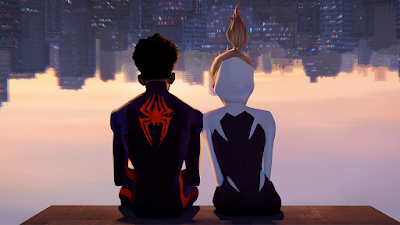
Plunging head first into the tangled webs of superhero canon,
Spider-Man: Across the Spider-Verse tells, improbably, the best superhero story the big screen has seen in ages. It does so by turning around and directly confronting the very nature of its telling. It features one of its antagonists sounding a lot like one of those whiny fandoms that complains about every deviation from the formula, and every divergence from the previously established canon. This guy gives a serious, glowering monologue in which he lays out the idea that certain characters simply must die, because that’s the way these stories are supposed to go. They die in every story, in every timeline, to serve the same purpose. In our world, that satisfies the conservative fanboy in the audience, and, indeed, a middling serving of cameos and connections is enough to keep the whole machinery of these franchises turning. But this group of filmmakers, including screenwriters Phil Lord and Christopher Miller (
The LEGO Movie) and co-director Kemp Powers (
Soul) among dozens of talented collaborators, are thinking beyond that here. What
Across the Spider-Verse does by placing this idea at the center of its conflict is stirring stuff—and the kind of bold, inventive, imaginative storytelling that these sorts of stories are supposed to be about in the first place.
This clever eruption of animation and excitement builds beautifully off the distinctive pleasures of its predecessor,
Into the Spider-Verse, that introduced us to dimension-hopping Spider-Men through the eyes of Miles Morales (Shameik Moore), a Brooklyn teenager bit by a radioactive spider. So far, so familiar to the Peter Parkers we’ve known, albeit with a cool cultural specificity that is a modern-day, teenaged, half-Black, half-Puerto Rican New Yorker. But because his special spider fell through a hole between parallel universes, it immediately involved him meeting a selection of alternate Spideys—a Peter Parker (Jake Johnson), an anthropomorphic pig, a Japanese mech suit, and so on, including a crush-worthy spider-powered Gwen Stacy (Hailee Steinfeld). That movie had its instantly lovable and sympathetic hero in Miles—as at home in his sleek form-fitting black suit as he is in Nikes and a hoodie—fitted in a stylish animated world that had a fluid hand-drawn-over-CG aesthetic complete with comic book affectations like faded overlapped multi-dot colors and zippy split-screen and text boxes with narration and onomatopoetic emphasis. The Spider-people from other worlds came trailing their own distinct styles—jagged CG and jumpy anime and inky black and white and so on. The sequel starts with Miles alone in his own universe, where he has plenty of quotidian Spidey troubles juggling school, family, and his secret identity. Soon enough, though, a seemingly dopey villain—voice with blasé nefariousness by Jason Schwartzman—opens damaging portals between universes, and it all tumbles into potential chaos again. The story quickly bests the original vision in two directions at once—digging deeper into Miles’ world and inner life, while exploding out in a dazzling variety, swirling with inventive style and cultural melange as a secret inter-dimensional squad (led by Oscar Isaac and Issa Rae) senses trouble in the multiverse.
The result is a movie that’s a non-stop visual delight surrounding its sympathetic core. Each new world feels pulled from a different designer. There’s a scratchy parchment renaissance character, a Brit punk Spidey sketched on rumpled paper and traveling via collage, stiff-armed Hanna-Barbera style vintage beings, brief glimpses of stop-motion and even live-action worlds, and, my favorites, a dazzlingly detailed Indian metropolis and a world where wet watercolor backgrounds drip expressionistically as characters try not to cry. But at the center of it is one kid, trying his best to do right for his family, his friends, his crush, and his city. And isn’t that so authentically Spider-Man? There’s genuine capital-R Romance here, in all the outsized adolescent emotions that this particular superhero has always done so well. Think about the best moments in any previous Spider-Man movie. It’s not the action, per se. It’s the beats between, where characters really matter, and the stakes are built, not out of the world ending, but about a particular person’s place in the world. This movie knows that deeply—allowing for long scenes to breathe and accumulate real investment in the relationships on display in voice performances that are universally warm and committed. For all its wild and creative action—and there’s more here in even the first sequence than we get in most full length spectacles of this size—there’s the beating heart yearning for connections. Every twist and complication as the story expands and explodes earns its weight from this source—a boy who wants to make his parents proud, impress the girl, and save, not the world, but his world. This is Spider-Man storytelling at its finest, including a great cliffhanger that left me eager for the next issue.