Showing posts with label Jake Johnson. Show all posts

Friday, June 2, 2023

Great Power: SPIDER-MAN: ACROSS THE SPIDER-VERSE

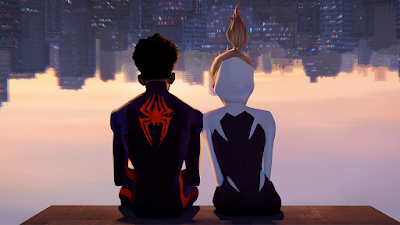
Plunging head first into the tangled webs of superhero canon, Spider-Man: Across the Spider-Verse tells, improbably, the best superhero story the big screen has seen in ages. It does so by turning around and directly confronting the very nature of its telling. It features one of its antagonists sounding a lot like one of those whiny fandoms that complains about every deviation from the formula, and every divergence from the previously established canon. This guy gives a serious, glowering monologue in which he lays out the idea that certain characters simply must die, because that’s the way these stories are supposed to go. They die in every story, in every timeline, to serve the same purpose. In our world, that satisfies the conservative fanboy in the audience, and, indeed, a middling serving of cameos and connections is enough to keep the whole machinery of these franchises turning. But this group of filmmakers, including screenwriters Phil Lord and Christopher Miller (The LEGO Movie) and co-director Kemp Powers (Soul) among dozens of talented collaborators, are thinking beyond that here. What Across the Spider-Verse does by placing this idea at the center of its conflict is stirring stuff—and the kind of bold, inventive, imaginative storytelling that these sorts of stories are supposed to be about in the first place.

This clever eruption of animation and excitement builds beautifully off the distinctive pleasures of its predecessor, Into the Spider-Verse, that introduced us to dimension-hopping Spider-Men through the eyes of Miles Morales (Shameik Moore), a Brooklyn teenager bit by a radioactive spider. So far, so familiar to the Peter Parkers we’ve known, albeit with a cool cultural specificity that is a modern-day, teenaged, half-Black, half-Puerto Rican New Yorker. But because his special spider fell through a hole between parallel universes, it immediately involved him meeting a selection of alternate Spideys—a Peter Parker (Jake Johnson), an anthropomorphic pig, a Japanese mech suit, and so on, including a crush-worthy spider-powered Gwen Stacy (Hailee Steinfeld). That movie had its instantly lovable and sympathetic hero in Miles—as at home in his sleek form-fitting black suit as he is in Nikes and a hoodie—fitted in a stylish animated world that had a fluid hand-drawn-over-CG aesthetic complete with comic book affectations like faded overlapped multi-dot colors and zippy split-screen and text boxes with narration and onomatopoetic emphasis. The Spider-people from other worlds came trailing their own distinct styles—jagged CG and jumpy anime and inky black and white and so on. The sequel starts with Miles alone in his own universe, where he has plenty of quotidian Spidey troubles juggling school, family, and his secret identity. Soon enough, though, a seemingly dopey villain—voice with blasé nefariousness by Jason Schwartzman—opens damaging portals between universes, and it all tumbles into potential chaos again. The story quickly bests the original vision in two directions at once—digging deeper into Miles’ world and inner life, while exploding out in a dazzling variety, swirling with inventive style and cultural melange as a secret inter-dimensional squad (led by Oscar Isaac and Issa Rae) senses trouble in the multiverse.  

The result is a movie that’s a non-stop visual delight surrounding its sympathetic core. Each new world feels pulled from a different designer. There’s a scratchy parchment renaissance character, a Brit punk Spidey sketched on rumpled paper and traveling via collage, stiff-armed Hanna-Barbera style vintage beings, brief glimpses of stop-motion and even live-action worlds, and, my favorites, a dazzlingly detailed Indian metropolis and a world where wet watercolor backgrounds drip expressionistically as characters try not to cry. But at the center of it is one kid, trying his best to do right for his family, his friends, his crush, and his city. And isn’t that so authentically Spider-Man? There’s genuine capital-R Romance here, in all the outsized adolescent emotions that this particular superhero has always done so well. Think about the best moments in any previous Spider-Man movie. It’s not the action, per se. It’s the beats between, where characters really matter, and the stakes are built, not out of the world ending, but about a particular person’s place in the world. This movie knows that deeply—allowing for long scenes to breathe and accumulate real investment in the relationships on display in voice performances that are universally warm and committed. For all its wild and creative action—and there’s more here in even the first sequence than we get in most full length spectacles of this size—there’s the beating heart yearning for connections. Every twist and complication as the story expands and explodes earns its weight from this source—a boy who wants to make his parents proud, impress the girl, and save, not the world, but his world. This is Spider-Man storytelling at its finest, including a great cliffhanger that left me eager for the next issue.

Tuesday, June 13, 2017

Dead on Arrival: THE MUMMY


Every few years, Universal decides to do something with its roster of classic monster movies – Dracula, Frankenstein, The Wolf Man, and so on – beyond rereleasing the original 30’s and 40’s films on whatever new home video format has arisen since the last time. Lately that means we get 2010’s Wolf Man and 2013’s Dracula Untold, attempts to make new effects pictures out of the old creatures, and maybe even spark a new franchise along the way. Now this had led to The Mummy, the newest attempt to make a whole monster mash adventure series on the solid foundation of hoary old horror tropes. Hey, it worked in 1999 when Brendan Fraser headlined a charming, good old-fashioned Indiana Jonesy period piece action serial about dodging undead Egyptians and their various mythological curses. This time around, in addition to some archeological creepiness the premise requires, director and co-writer Alex Kurtzman (who has had a hand in screenplays for a half-dozen franchises) makes a picture that is a modern Tom Cruise movie, which means it’s at least as interested in hurtling action as it is any simmering supernatural suspense. The movie opens on the star fighting ISIS for control of an ancient Mesopotamian burial site where evil incarnate waits hidden beneath a pool of liquid mercury. Once out, the long-dormant mummified witch (Sofia Boutella, an acrobatic and comitted highlight) will inevitably unleash havoc. That’s enough for a good time, at least until the whole enterprise – growing thinner and duller by the sequence – thoroughly wears out its welcome well before the finish line. And they want to make more of these? Hopefully they’ll be improving as they go.

The main problem with this movie – which has a grinding workmanlike competence to the expected pattern of hectic, noisy collisions of conflict punctuated by droopy exposition spouted by famous faces – is how schematic it is. You can see all too transparently the contract negotiations, marketing decisions, franchise planning, and formulaic plotting on screen. It gives Cruise reasons to take off running from explosions, get into rollover accidents, and smirk at his colleagues before getting likably pummeled. It also has Russell Crowe show up and call him a young man, despite Cruise being two years older (a neat showbiz trick). Crowe is here playing Dr. Jekyll, a clear tip of the hat to a brewing monster meetup in the planned future installments, what with his laboratory with Creature from the Black Lagoon flippers and vampire skulls floating in specimen jars. The film also gives Cruise his usual bantering love interest/professional rival (Annabelle Wallis) and comedic sidekick (Jake Johnson). The script never successfully turns all this into real characters or clear motivations or easily comprehendible MacGuffins, settling for just moderately diverting nonsense and the inexorable pull of blockbuster spectacle sequence-hopping logic. There’s no sense of escalation or danger or invention, just dutifully hitting the marks. 

A constant churn of action works in the exceedingly excellent Mission: Impossible series (probably the most consistent franchise Hollywood currently has running), but those movies use Cruise’s hardworking, hard-charging action demeanor in a series of escalating and cleverly deployed stunts and creatively twisty heist plots. Here it’s just lumpy, car chases and plane crashes and shootouts and howling effects jolting a half-hearted Mummy-stalking feature into the shape of a generic summer movie. In the context of a theoretically spooky monster movie, dripping with zombies and ancient curses and a “who-is-possessed-and-unwittingly-prepared-to-channel-an-evil-Egyptian-god?” plot engine, it starts to feel like two competing ideas smashed unsuccessfully into one. The better idea is the Cruise vehicle, where his charisma and star power can carry along a thin character, and his effortlessly effortful forward momentum can paper over leaps of logic and plot holes big enough a supernatural sandstorm can be seen through them. The lesser idea, alas, is the one that wins out in the end, weakly hitting rote monster beats while hedging its bets, teasing future story and failing to live in the moment long enough to give us a movie worth watching in the here and now. There’s just barely enough for an only mildly disappointing brainless night at the movies, but it’s certainly not enough to crave more.

Friday, June 12, 2015

Safety Not Guaranteed: JURASSIC WORLD


Why is it so difficult to make a good sequel to Jurassic Park? It's been 14 years since Joe Johnston made a half-decent B-movie-ish III, and 18 since Spielberg himself brought us The Lost World, a collection of good images in an underwhelming whole. Sure, the great original 1993 blockbuster benefited from one of those perfect confluences of creative people at the height of their powers. It has Spielberg’s eye for beautifully shaped spectacle, an iconic John Williams’ score, an appealing creature-feature structure of exquisite set-ups and pay-offs, and a hugely likable cast able to turn stock characters into warm and sympathetic people we want to see escape danger in one piece. But it’s not like the core idea – theme park stocked with resurrected dinosaurs descends into chaos – is unrepeatable. And yet here we are with Jurassic World, the third unsuccessful attempt to recapture the magic.

World, directed and co-written by the forgettable indie Safety Not Guaranteed’s Colin Trevorrow in his first big-budget excursion, is the largest, loudest, and fastest Jurassic movie thus far. It’s also the emptiest. It tells the story of corporate greed reopening the dinosaur island and creating Jurassic World, a larger theme park with more creatures and better security. It’s a hit. The new park is swarming with crowds delighted by the dinosaurs. But the owners want more profit, forcing the geneticists to cook up brand new monsters to advertise. (Sort of like injecting new filmmakers into an old franchise, no?) There’s an early scene in which the icy head of operations (Bryce Dallas Howard) sells the naming rights to their new “Indominus Rex” and assures her boss (Irrfan Khan) the beast has “more teeth.” Most Hollywood blockbusters engage in a little double think, but here it is rampant, a corporate calculation scoffing at corporate calculations.

Jurassic World is about nothing more than itself, attempting to preempt some criticism by acknowledging its nature as a product. It creates a bland self-serving parody theme park, realistically kitsch and poking fun at its own existence. It’s an old idea resurrected for the sake of big profits. Get it? We’re to giggle at parallels between the film and the park, laughing at business excesses dazzled by technology while dazzled by the technology of a film made for business excess. The World has a monorail and hamster-ball safari pods. It has a massive aquatic beast in a big tank. It has a resort hotel, chain restaurants, holograms, flat screens, and a raptor trainer (an unsmiling Chris Pratt). This film expects an audience to enjoy a fake theme park as much as the original film wanted us to thrill at dinosaurs. We even have two boys (Ty Simpkins and Nick Robinson), Howard’s character's nephews, to follow through the attractions as they stare mouths agape at CGI busyness. I’m glad someone’s enjoying it. 

This is how it always starts, with oohs and aahs. But then there’s running and screaming as, inevitably, the big, bad “Indominus Rex” gets loose. It’s predictable, and worse, witless. The crisis escalates, soon enveloping the whole park, entirely due to bad decisions characters make. Every effort to contain the mess goes stupidly wrong. It’s a collection of dino attacks, spectacularly visualized in fine effects work, but hollow in impact. Countless people are devoured and animals are gunned down or torn up. It’s sometimes visceral and exciting, but where’s the care? There’s no impact when it’s only there for a thrill without considering the weight of the moment. (Contrast that with Gareth Edwards' much better work with scale and staging in last year's great Godzilla.) Rampaging dinosaurs and hundreds of imperiled tourists make for awfully small thinking when there’s no sense of stakes. It’s full of competent visuals, but has uninteresting characters and set-pieces without suspense because it doesn’t take the time to matter.

Our characters, stereotypical and humorless, enter with dopey stock plotlines both overfamiliar – the boys are worried about their parents divorce – and vaguely offensive – the business woman, always clad in a tight white suit and high heels, is repeatedly told to loosen up and let a man save her. They mix with familiar types – an antagonist with secret commercial goals (Vincent D’Onofrio), a comic relief computer guy (Jake Johnson) – but the likable cast is given lifeless material. Where are the ripples-in-the-water moments? There’s no time for awe, for sublime anticipation. We’re just racing to the next tyrannosaur-sized brawl, the next cruel kill. They’re faced with routine violence they can’t even begin to contain. It saps the urgency to know a convenient contrived deus ex machina is the only way out. They’re not racing to restore power or call for help. They’re just bumbling through the jungle hoping not to get eaten by dinosaurs we barely get to know. And what about the park’s guests? The movie doesn’t care. They’re just background screams.

There’s never any sense of danger, just bright colors and loud noises. There’s a moment when an anonymous woman is plucked out of the crowd by a loose pterodactyl, then dropped into a pool, and dragged up and down until an even bigger dino munches them both. It’s cruelly elaborate. And what purpose does it serve? It’s not thrillingly shaped or given emotional weight. It just exists because the filmmakers could do it, not because they should. There is more tension and personality in one shot of Jurassic Park than all of Jurassic World’s wide shots of impersonal computerized spectacle intercut with dutiful reactions. It’s over-thought – self-amused, loaded with references to its predecessor – and under-imagined.

Saturday, March 17, 2012

Held Back: 21 JUMP STREET

Being forced to repeat high school would be something of a waking nightmare for many of us. But isn’t it even the slightest bit tempting to get a second chance at what is, let’s face it, an important, but not that important, part of life? Surely everyone at least entertains the idea of a do-over for some piece of his or her past. To be forced back into the halls of high school would basically be a rubber-stamped approval for extended adolescence, or at least that’s what happens to the undercover cops in the movie remake of the late-80’s high concept cop show 21 Jump Street. They may be immature, but that’s kind of their job now, right?

The series ran on Fox from 1987 to 1991 and starred Johnny Depp as a fresh-faced cop assigned to go undercover as a high school student. The new big budget R-rated Hollywood comedy keeps the show’s high concept and plays it louder and faster, in a way that's more blatantly goofy, vulgar, and violent (sometimes shockingly so). And it works. It’s a slick, competent, surface-level entertainment, a smart adaptation that turns the basic plot hooks into a loving homage to buddy cop movies driven straight through a raunchy high school comedy. If the series was Miami Vice by way of Square Pegs, than the movie remake is Bad Boys in Superbad.

It starts in 2005, a time when a dweeb (Jonah Hill) and jock (Channing Tatum) barely interacted except for the times when the jock laughed at the dweeb for getting a brutal rejection from a pretty girl. They weren’t enemies; they just moved in vastly different circles. But now it’s present day and they’re both in the same police academy. They find they actually get along now. The dweeb helps the jock with the written work and the jock helps the dweeb with his physical trials and marksmanship. They’re so very excited to be cops that when their boring, low-stakes park patrol turns into a bungled drug bust, they’re dismayed to find themselves passed off into a secret program run by a mean stereotype of a commanding officer (Ice Cube) who informs them that they’re going undercover as high school students to track down a new drug ring.

To make matters worse, they’re posing as brothers. They’re a little too old. They’re a little too dissimilar. Yet pass themselves off as teen brothers they must. It’s a rich set-up for comedy and the script from Michael Bacall and Jonah Hill takes funny zigs and zags through a teen comedy terrain that is rife with youthful temptations for the rookie cops. They can’t help but fall back into their own petty high school mentalities but find themselves in an odd type of culture shock. As one who actually was in high school in 2005, I found myself gripped with a kind of mild terror. Could things be that different already? It hasn’t been that many years, has it? Time flies.

Suddenly Tatum’s cool jock style won’t fly and the nervous dorkiness of Hill is oddly appealing. You see, bullying, even of the mild variety, isn’t a surefire ticket to popularity that Tatum seems to think it is. Hill, on the other hand, marvels that the cool crowd is all about caring for the environment. Kids these days. So the two guys are startled to find themselves at the opposite ends of the teenage totem pole. The jock hangs with the chemistry nerds while the dweeb gets closer to the popular kids, especially a sweet girl (Brie Larson) who happens to be in a relationship with the main pusher (Dave Franco, James’s younger brother).

That the two undercover cops are opposites is a typical buddy cop trope. That they’re in a high school, forced to work out old differences and form new ways of social navigation, not to mention learn how to get along and how to be good at their fairly new jobs, creates a fun tension. Of course, it wouldn’t work at all without the winning chemistry between Tatum and Hill who have such a terrific brotherly rapport that they ping off each other with equal parts simpatico bluster and clashing competitiveness, an aggressive but loving friendship that develops in convincing ways. They’re both so game and eager to please that their timing develops the satisfying snap of an agreeable, comfortable comic partnership. I wish the supporting cast could have been used more memorably – Nick Offerman, Parks & Rec’s great Ron Swanson himself, appears in a single scene – but the main protagonists are wonderful anchors.

The plot is basic cop stuff complete with a couple of well-deployed twists, some mostly routine car chases and shootouts, and some perfect, absolutely perfect, cameos. The high school jokes are sometimes obvious – of course parents turn around and interrupt a raucous party – but they too are filled out with such specific and odd details amongst the students and faculty that it transcends its obviousness and finds new funny details in the corners of the hurtling pace of the rough detective through line. I especially liked the exasperated principal (Jake Johnson), the giggly chemistry teacher (Ellie Kemper), and the small gang of science geeks who have permission to go to the chemistry lab early in order to play Bakugan. I’m not sure what that is, but I know it’s some kind of game, which is better than Tatum, who angrily demands to know if it’s drugs.

This is hardly a perfect film – it’s lumpy and shambling in spots and fairly thin overall – but there’s an incredible energy to the way it’s put together. The script joins the two main threads in a self-aware way that draws out the implausibilities to often-great comedic effect. Directed by Phil Lord and Chris Miller, they bring some of the same inventiveness and willingness to variously reject and embrace cliché for laughs that they displayed in Cloudy with a Chance of Meatballs. They know sometimes the funniest thing is to do just what’s expected only to pull back at the last second. Yes, the directors behind the most hilarious animated family film in recent memory have created a pretty good live-action R-rated romp of an action-comedy. 21 Jump Street may not be as polished or dense with jokes (and certainly not as family friendly) as Cloudy, but it’s still a stylish, fast-paced entertainment of its own   

Sunday, January 30, 2011

There's Always a Catch: NO STRINGS ATTACHED

It could just be the recent drought of good romantic comedies that is affecting my judgment, but I found No Strings Attached to be a surprisingly solid effort in the genre. It’s no great thing, and of course it falls back on cliché more often than it should, but the movie is stacked with a talented supporting cast and a likeable lead in Natalie Portman, all of whom are far too good to sleepwalk through what could otherwise have been a mediocre project. It’s not much, but its good enough.

It almost goes without saying that Natalie Portman is considerably more relaxed here than in Black Swan. She’s believable as an ambitious young professional who prefers one-night stands to commitment, believing relationships to be too complicated to mess with. This is the one small change screenwriter Elizabeth Meriwether brings to the genre, making the woman the lead who is afraid to commit to the relationship and the man the dewy-eyed heart-on-the-sleeve romantic who really, really wants to settle down with the right person. It seems like that should be an awfully trivial change for a 2011 rom-com, hardly worth mentioning, except that it points out how awfully retrograde recent efforts have been, especially if they starred Katherine Heigl.

But now that I’ve brought up the flipped genre-dictated gender roles I may as well mention the actor’s name. He’s Ashton Kutcher, every bit as bland as ever. Kutcher and Portman play characters who briefly met as kids at summer camp, saw each other years later at a University of Michigan frat party, and then bump into each other after a few more years, discovering that they both currently live in Los Angeles. After quite a bit of set-up, the two of them decide to start a relationship but keep it purely physical. This is treated in the advertising as an edgy, sexy plot development, but in reality the movie plays out as if this is merely a brief stop on the road to true love and happy endings. Or rather, it’s just a minor complication in the route of boy gets girl, boy loses girl, and…I won’t spoil the ending, will I? It feels much safer and much more comfortably ensconced in genre convention in practice than it sounds in theory. The end, for better or worse, upholds all conventional romance norms.

Portman and Kutcher have some nice chemistry. Luckily, the movie proves that Kutcher isn’t necessarily an inherent source of irritation, especially when much better performers surround him. Per rom-com dictates, each lead gets a group of loveably goofy friends and family. In this case, these characters are a group of comedy ringers who attempt, and often succeed, in wringing humor from even the stupidest of punchlines. Kutcher gets a goofy semi-celebrity father (Kevin Kline), a dotty co-worker (Lake Bell), a ditzy ex (Ophelia Lovibond) and two drinking buddies (Jake Johnson and Chris “Ludacris” Bridges). Portman’s even better off in the funny friends department, rooming with The Office’s Mindy Kaling and indie darling Greta Gerwig, Between the three of them, Portman, Kaling, and Gerwig have such a wonderfully warm and amusing relationship I almost wished the movie could have dumped Kutcher and followed these ladies into far funnier places.

Anyways, the plot’s awfully conventional – it’s gears turn far too slowly in the third act – but its pleasantly charming cast is committed to their roles. The tone of the movie is not hard-R raunchy, but more of a barely-R sweetness. After early attempts with uneasy crudeness, it settles down nicely. The romance at the core is believable, the actors are likable, the score by John Debney is quiet and pleasant, and the time passes by rather smoothly under the slick, professional direction of Ivan Reitman. I had long thought that we had left him in the 80’s, back when he made comedy classic Ghostbusters. After all, his output since has been spotty to say the least with such forgotten flops like Six Days, Seven Nights and My Super Ex-Girlfriend. He had aged out of his window of relevance and couldn’t recapture what made his own work good. No Strings Attached is a nice surprise, though I hesitate to call it a return. It’s a simple, predictable effort, and not nearly as edgy as it thinks it is, but it finds a nice tone and plays to the strengths of its cast.