With Poor Things, director Yorgos Lanthimos returns to his pet themes: freedom and control, society and individualism, intellect and appetite. Within them, the Greek provocateur loves to push buttons and test the boundaries of discomfort. He sets up rigid systems and see his characters squirm under their demands. His international breakthrough Dogtooth is a tragedy set in a worst-case scenario disinformation-based homeschooling setup, while his dreary The Lobster is a depressing world of romantic pressure in which unlucky singles are turned into animals, and his gripping Killing of a Sacred Deer finds eerie body horror revenge inflicted on an alienated nuclear family unit by an unsettling interloper. Even his biggest hit to date, period piece of royal courtly intrigue The Favourite, drips with a devilishly funny satire of politicking and interest peddling within his usual concerns. In Poor Things he pushes his ideas to fanciful Frankensteined abstraction in a steampunk fantasy Europe of an imagined Industrial Revolution past—a little Mary Shelley, a little German Expressionism, a little Tim Burton, a little Jean-Pierre Jeunet. But it’s all of a piece for a work about a revived body stumbling into the world and slowly learning what life is all about.
Shot with his favored fisheye lenses and pushy, panning, zooming, looming cameras—and scored with a calliope-meets-theremin brio—the movie finds a mad scientist (Willem Dafoe) bringing a beautiful corpse (Emma Stone) to life with a mind made freshly tabula rasa. Named Bella Baxter, she flails and stumbles and babbles, trying to master language and motor skills, like a grown woman with a toddler’s mind. It’s quite a spectacle, funny and sad and off-putting and compelling all at once. It might give you a sense of Lanthimos’ approach here that the mad doctor’s new assistant (Ramy Youssef) takes one look at her and gasps: “what a beautiful retard.” The movie gawks and scowls at its characters’ madnesses and eccentricities. As Bella grows into her body, society fills her mind with ideas. She strains against the confines of her experimental status and demands to be let out into the world. There she encounters a variety of men—buffoonish seducers (Mark Ruffalo) and suave cynics (Jarrod Carmichael) and nasty brutes (Christopher Abbott)—who want to have her and control her and affect her and mold her. And yet Bella is so stubbornly, persistently herself that she’s uncontainable by societal standards. She hasn’t been indoctrinated with the shame she’s expected to feel and stereotypes to which they assume she'd conform. There’s some pointed commentary in the fact that she’s most desirable to the men when she’s at her least capable. The more she learns, the more she confounds their expectations, the more they go mad for her, in all senses of the word. She navigates a series of gross-out gags and slapstick and drama and sexual encounters with a growing awareness and a blissfully inquisitive need to take it all in and understand.
The potentially simple concept is exquisitely elaborated and vividly imagined in all its complications and contrasts. The screenplay by Tony McNamara, who brings some of The Favourite’s charmingly mean ear for dialogue, takes clear delight in running Bella through a crash course in philosophical constructs, a one-woman Enlightenment living the concepts Rousseau and Locke and Hobbes and Voltaire had to merely ponder. And it’s all so fleshy, too, with Lanthimos’ usual preoccupation with bodily fluids and functions, making her a Candide in situations that’d blush with frank vulgarity but in fact give nary a flinch. She likes to copulate as much as she cogitates. But for all the overt mixture of the highfalutin philosophizing and lowdown dirtiness, the movie’s at its most fun as it dances across that chasm. It’s a riot of production design—weird vehicles and elaborate sets—and costumes—all frills and flowing cutaways and cinched edges. And within that, the performers turn loose in masterfully silly eruptions of straight-faced shock and delicate pratfalls and casual nudity. It’s Stone’s show—a stunningly technical and deeply felt play with high drama and fearless comedy. But everyone in the cast joins in the fun. Every line reading turns into candy, and every serious swerve of intellect is chased with a grinning irreverence. Ultimately, this is Lanthimos’ most hopeful picture, embodied with a stubborn, grinning belief that the stuff of life is pleasurable and, though people may be as cruel as they are curious, the right fresh mind is capable of positive change. As Taylor Swift wrote, "we were built to fall apart / then fall back together."
Showing posts with label Jarrod Carmichael. Show all posts
Monday, December 18, 2023
Thursday, April 7, 2022
Say Gay: BETTER NATE THAN EVER and ROTHANIEL
The bigotry inherent in Florida’s Republican “Don’t Say Gay” Bill, recently signed into odious law, is in the central premise of restricting schools’ ability to even reference the existence of LGBT+ people as if they are definitionally inappropriate subjects, using vague language that would allow any aggrieved parent to sue teachers directly with accusations. It operates from the assumption that denying youth information about same-sex affection will stop them from developing it. This is further underlined by the bill’s proponents’ and defenders’ falsely claiming with drooling insistence that anyone opposing the measure is inculcating victims in what some still stubbornly believe is a lifestyle choice instead of a simple fact of life. Just when those of us who recognize that romantic and sexual desires are complicated and fluid elements of being alive—even beyond labels of gay, straight, and between—thought that concept had finally lodged into mainstream understanding and acceptance—to look at all reputable polling over the last decade, it has!—these backwards-looking revanchist culture warriors are on the march. Emboldened by the political ugliness unleashed by the worst among us of late, they’re eagerly hoping to reverse the gains of the open-minded plurality and impose their cruel policies and prejudiced views on us all, by any anti-democratic, minority-rule measures they see fit.
Not content with their victorious stuffing the courts to the point where they’re about to end a right to safe, legal abortion in this country, they’re moving in multiple federal and state cases to restrict discussions of race and LGBT+ issues, and making noise about pulling back on interracial marriage and birth control, too. Scary times. These conservative activists—some usual confluence of moral panic, internet trolls, moneyed distraction, and rank prejudice—wish to ignore those who make them uncomfortable. But ignoring people doesn’t make them disappear or die out. There’s that other old homophobic trope—that new gays aren’t born, but recruited. They might be confusing that with right-wing reactionaries. (One must be carefully taught that way of thinking.) Ignoring those ugly ideas hasn’t made them disappear either.
In light of this, what can the movies do? After all, that’s where Disney CEO Bob Chapek said the difference can be made, after employees raised concern that the studio, Florida’s largest employer, stayed uncharacteristically silent about the legislation. Previous CEO Bob Iger at least knew it was better business to say the right things from time to time, and would advocate for humane policies and against inhumane ones, so long as they didn’t ask the company to, say, raise wages for their theme park employees. Chapek instead said they’d stay neutral on attempts to erode civil rights materially and focus on “creating a more inclusive world...through the inspiring content [they] produce.” (Never mind the creatives who later divulged how the corporate brass asked them to downplay gay characters in some projects of late, I suppose.) The symbolic gesture isn’t nothing, and it’s true that representation of all kinds in a good movie can shine a light on oft unseen peoples or circumstances, invite empathy for others, and point people toward possibilities they’d never before understood. There’s magic there. It can’t materially improve conditions, but maybe creates a way of thinking that could help someone feel accepted. A fight for a better world can’t happen only through some well-intentioned movies without actually pushing back on the laws and politicians preventing that better world, or dragging us back toward constricting corruptions of public goods.
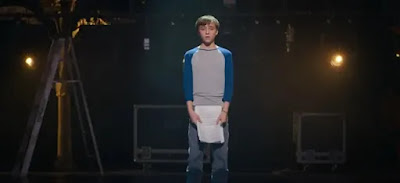
Maybe Chapek was thinking about Better Nate Than Ever when he mentioned projects showing “a more inclusive world.” The newest straight-to-Disney+ live-action family movie—the sort of thing that would’ve played in theaters back in the days of Max Keeble’s Big Move or Confessions of a Teenage Drama Queen, though it’s smaller and thinner and more in line with the Disney Channel Original Movies of the time—is a cute comedy about a flamboyant middle schooler with big Broadway ambitions. The theatrical boy (Rubey Wood) hears about auditions for child actors to play in an upcoming stage adaptation of Lilo & Stitch so, when his parents leave him with his butch brother (Joshua Bassett) for the weekend, he sneaks off with his best friend (Aria Brooks). They get to the Big Apple, where luckily they run into his estranged aunt (Lisa Kudrow, funnier than the material deserves) who reluctantly helps him stay for his chance at treading the boards. Much prolonged silliness ensues.
The movie never quite says gay, but it’s all over the broad sitcom antics—the squeaky-voiced boy loves Designing Women in addition to show tunes and constantly undercuts the heteronormativity of his lumbering brother. (When older bro glowers that it’s unfair his younger sibling can sleep over at a girl’s house, their father admits, Nate’s not going to get in trouble with that.) And it’s in the wide-eyed naive showbiz stardust sparkling over everything. So it’s a sweet little movie with its heart in the right place—even if its corporate synergy says everyone is equal…in that they’re able to experience the magic of Disney. (Surely not a coincidence there’s a live action Stitch in the pipeline, natch.) Even the setbacks are bright and buoyant and no underdeveloped sadness can last. Writer-director Tim Federle—of High School Musical: The Musical: The Series—gives the thing an up-tempo glossiness and squeaky-clean simplicity. There are modest musical numbers, some gentle joking, and an ending calculated to give the kids who’ll see themselves in such a picture the self-esteem boost needed. I wasn’t entirely unmoved to see this plucky kid succeed. I’m glad it exists for those who’ll find in it permission to be themselves.
For those of us wanting more introspection engaged in the thorny difficulties of exploring one’s sexual orientation, and of coming out—to oneself, as much as to family, friends, and the world at large—there’s Jarrod Carmichael’s latest stand-up special: Rothaniel. In it, the 35-year-old comedian, perhaps most famous for The Carmichael Show, his excellent three-season multi-cam comedy on NBC from a few years ago, reveals that he’s gay. That drops early in the hour. The rest is a reckoning. He arrives there after a winding preamble about his family secrets, including the affairs of both of his grandfathers and his father, with the attendant sense of betrayal and complicity he felt in holding that in. He goes on to unravel how various family and friends reacted to his revelation. The hour covers a lot of ground: his internalized homophobia, how his sexuality interacts with his Christian faith, how he senses friction from some family members. Even loving responses can feel cold when it’s wrapped in layers of disappointment, distance, or confusion. He tip-toes up to explicit confessions, crosses lines and then slips back, a little embarrassed he waited so long, or divulged so much, but recognizes the complicating factors of social structures and family expectations that constructed his closeted years. This isn’t easy.
It is personal material, often going stretches without punchlines, amusing only for Carmichael’s natural easygoing charm. He has the same sitcom brilliance in his delivery he did on his show, shades of Lear (Norman, not King), that let him get away with provocative political needling without losing the aw-shucks, All in the Family, real talk, just-having-fun thinking-out-loud magic trick. Somehow it’s also still so real and immediate and raw, a sense of an unfolding personal extemporaneous working-out of deep emotional pain and promising release. The balancing act wobbles and teeters at times, but never quite steps off. And he never loses a sense of the audience reaction. He plays to them even as he slips into impromptu therapy. And he has a killer last line in his back pocket the whole time, even as you might wonder where he’s going. Even as he might be, too. He knows it’ll land, even if he’s not sure where he will. He talks himself into a more truthful language of his being.
In this way, Carmichael turns in on himself as he comes out. The filmmaking by director Bo Burnahm emphasizes the effect of the spotlight in intimate closeups as the intensity of the bulbs cause a heat that fades colors and washes out the background into a milkiness. The camera also draws attention to Carmichael’s posture as he speaks, sometimes even interacting with a largely unseen crowd that’s rapt and a little off-balance, sometimes shouting out questions or affirmations at him. He sits in a folding chair, often leaning back, other times shrinking into himself, slouching, his hand sometimes running over his face and neck or teasing his collar in a nervous fidget. He’s the center of attention, suddenly his full self in the public eye for the first time. It’s the opposite, then, of Burnham’s excellent mad musical comedy of indoor pandemic creative expression Inside; you could call this Out. Carmichael’s not sure what he’ll do there, but the very fact of speaking the truth about himself creates a power, and a permission, to grow into the man he is before our eyes. And maybe that’s what scares the people who, as George Eliot once wrote, “would have every man's life ordered according to a particular pattern, and…are intolerant of every existence the utility of which is not palpable to them.” In this special, a man explains an existence that can’t be ignored.
Not content with their victorious stuffing the courts to the point where they’re about to end a right to safe, legal abortion in this country, they’re moving in multiple federal and state cases to restrict discussions of race and LGBT+ issues, and making noise about pulling back on interracial marriage and birth control, too. Scary times. These conservative activists—some usual confluence of moral panic, internet trolls, moneyed distraction, and rank prejudice—wish to ignore those who make them uncomfortable. But ignoring people doesn’t make them disappear or die out. There’s that other old homophobic trope—that new gays aren’t born, but recruited. They might be confusing that with right-wing reactionaries. (One must be carefully taught that way of thinking.) Ignoring those ugly ideas hasn’t made them disappear either.
In light of this, what can the movies do? After all, that’s where Disney CEO Bob Chapek said the difference can be made, after employees raised concern that the studio, Florida’s largest employer, stayed uncharacteristically silent about the legislation. Previous CEO Bob Iger at least knew it was better business to say the right things from time to time, and would advocate for humane policies and against inhumane ones, so long as they didn’t ask the company to, say, raise wages for their theme park employees. Chapek instead said they’d stay neutral on attempts to erode civil rights materially and focus on “creating a more inclusive world...through the inspiring content [they] produce.” (Never mind the creatives who later divulged how the corporate brass asked them to downplay gay characters in some projects of late, I suppose.) The symbolic gesture isn’t nothing, and it’s true that representation of all kinds in a good movie can shine a light on oft unseen peoples or circumstances, invite empathy for others, and point people toward possibilities they’d never before understood. There’s magic there. It can’t materially improve conditions, but maybe creates a way of thinking that could help someone feel accepted. A fight for a better world can’t happen only through some well-intentioned movies without actually pushing back on the laws and politicians preventing that better world, or dragging us back toward constricting corruptions of public goods.
Maybe Chapek was thinking about Better Nate Than Ever when he mentioned projects showing “a more inclusive world.” The newest straight-to-Disney+ live-action family movie—the sort of thing that would’ve played in theaters back in the days of Max Keeble’s Big Move or Confessions of a Teenage Drama Queen, though it’s smaller and thinner and more in line with the Disney Channel Original Movies of the time—is a cute comedy about a flamboyant middle schooler with big Broadway ambitions. The theatrical boy (Rubey Wood) hears about auditions for child actors to play in an upcoming stage adaptation of Lilo & Stitch so, when his parents leave him with his butch brother (Joshua Bassett) for the weekend, he sneaks off with his best friend (Aria Brooks). They get to the Big Apple, where luckily they run into his estranged aunt (Lisa Kudrow, funnier than the material deserves) who reluctantly helps him stay for his chance at treading the boards. Much prolonged silliness ensues.
The movie never quite says gay, but it’s all over the broad sitcom antics—the squeaky-voiced boy loves Designing Women in addition to show tunes and constantly undercuts the heteronormativity of his lumbering brother. (When older bro glowers that it’s unfair his younger sibling can sleep over at a girl’s house, their father admits, Nate’s not going to get in trouble with that.) And it’s in the wide-eyed naive showbiz stardust sparkling over everything. So it’s a sweet little movie with its heart in the right place—even if its corporate synergy says everyone is equal…in that they’re able to experience the magic of Disney. (Surely not a coincidence there’s a live action Stitch in the pipeline, natch.) Even the setbacks are bright and buoyant and no underdeveloped sadness can last. Writer-director Tim Federle—of High School Musical: The Musical: The Series—gives the thing an up-tempo glossiness and squeaky-clean simplicity. There are modest musical numbers, some gentle joking, and an ending calculated to give the kids who’ll see themselves in such a picture the self-esteem boost needed. I wasn’t entirely unmoved to see this plucky kid succeed. I’m glad it exists for those who’ll find in it permission to be themselves.
For those of us wanting more introspection engaged in the thorny difficulties of exploring one’s sexual orientation, and of coming out—to oneself, as much as to family, friends, and the world at large—there’s Jarrod Carmichael’s latest stand-up special: Rothaniel. In it, the 35-year-old comedian, perhaps most famous for The Carmichael Show, his excellent three-season multi-cam comedy on NBC from a few years ago, reveals that he’s gay. That drops early in the hour. The rest is a reckoning. He arrives there after a winding preamble about his family secrets, including the affairs of both of his grandfathers and his father, with the attendant sense of betrayal and complicity he felt in holding that in. He goes on to unravel how various family and friends reacted to his revelation. The hour covers a lot of ground: his internalized homophobia, how his sexuality interacts with his Christian faith, how he senses friction from some family members. Even loving responses can feel cold when it’s wrapped in layers of disappointment, distance, or confusion. He tip-toes up to explicit confessions, crosses lines and then slips back, a little embarrassed he waited so long, or divulged so much, but recognizes the complicating factors of social structures and family expectations that constructed his closeted years. This isn’t easy.
It is personal material, often going stretches without punchlines, amusing only for Carmichael’s natural easygoing charm. He has the same sitcom brilliance in his delivery he did on his show, shades of Lear (Norman, not King), that let him get away with provocative political needling without losing the aw-shucks, All in the Family, real talk, just-having-fun thinking-out-loud magic trick. Somehow it’s also still so real and immediate and raw, a sense of an unfolding personal extemporaneous working-out of deep emotional pain and promising release. The balancing act wobbles and teeters at times, but never quite steps off. And he never loses a sense of the audience reaction. He plays to them even as he slips into impromptu therapy. And he has a killer last line in his back pocket the whole time, even as you might wonder where he’s going. Even as he might be, too. He knows it’ll land, even if he’s not sure where he will. He talks himself into a more truthful language of his being.
In this way, Carmichael turns in on himself as he comes out. The filmmaking by director Bo Burnahm emphasizes the effect of the spotlight in intimate closeups as the intensity of the bulbs cause a heat that fades colors and washes out the background into a milkiness. The camera also draws attention to Carmichael’s posture as he speaks, sometimes even interacting with a largely unseen crowd that’s rapt and a little off-balance, sometimes shouting out questions or affirmations at him. He sits in a folding chair, often leaning back, other times shrinking into himself, slouching, his hand sometimes running over his face and neck or teasing his collar in a nervous fidget. He’s the center of attention, suddenly his full self in the public eye for the first time. It’s the opposite, then, of Burnham’s excellent mad musical comedy of indoor pandemic creative expression Inside; you could call this Out. Carmichael’s not sure what he’ll do there, but the very fact of speaking the truth about himself creates a power, and a permission, to grow into the man he is before our eyes. And maybe that’s what scares the people who, as George Eliot once wrote, “would have every man's life ordered according to a particular pattern, and…are intolerant of every existence the utility of which is not palpable to them.” In this special, a man explains an existence that can’t be ignored.
Wednesday, June 21, 2017
Here Comes the Boom:
TRANSFORMERS: THE LAST KNIGHT
Now five films deep, it’s hard to call the Transformers series anything more than
“barely narrative.” Sure, there are recurring motifs and a familiar ensemble of
returning characters, but any sense of a coherent story or mythology capable of
being grokked stopped in the end credits of the first – and best – installment.
With Transformers: The Last Knight,
director Michael Bay seems more than ever invested in the movie only insofar as
it allows and affords him the ability to stage whatever kind of bombastic set
piece he wants. This is franchise filmmaking as a bajillion-dollar playground
where he can build, play with, and blow up anything: a submarine, a castle, a
small town, Stonehenge. Why not? He can get away with this because he’s such a
great imagemaker. There’s nothing like seeing his brand of spectacle – the
grade-A Bayhem – carted on screen by the metric ton. Frame by frame this movie
sparkles with sunsets and vast vistas and impressive effects and awestruck hero
shots. But, of course, it’s also in service of a series that’s long since
passed into irretrievably convoluted gobbledygook. This iteration doesn’t reach
the heights of its predecessors, but it doesn’t scrape the barrel’s bottom like
their lows, either. A middle of the road Transformers
it is then.
At least the screenplay cobbled together by four writers
recognizes that the Transformer destruction playing out over the last four
films would leave the world rattled. We join the story in progress, with the
world terrorized by all the gigantic alien shapeshifting automotive robots who
have landed and continue to arrive on a seemingly unstoppable basis. With
Optimus Prime (Peter Cullen) missing, the Autobots just roam the planet doing
whatever, getting into scrapes with Decepticons who still have their leader,
Megatron (Frank Welker). That Transformers are sufficiently mindless to need
their strong leaders to give them purpose is certainly strange, and makes them
dangerous. Humans have decreed them illegal, and deputized an international
paramilitary force to hunt them and anyone helping them. The conflict is that,
once again, there’s a world-ending calamity coming, provoked by bad ‘bots, and
the humans must allow the Transformers to fight it out for the fate of the
planet. Tagging along with the junkpiles gurgling crass one-liners in the
voices of beloved character actors (John Goodman, Ken Watanabe, Steve Buscemi,
Jim Carter) are the token humans: last movie’s hero (Mark Wahlberg’s
hilariously named Cade Yeager), the military liaison from the first three
movies (Josh Duhamel), and new characters like a scrappy orphan teen (Isabela
Moner), a scatterbrained Englishman (Anthony Hopkins), and a supermodel, in good looks and frequent inexplicable wardrobe changes,
historian (Laura Haddock). Bay needs these human-sized caricatures to sell the
plot’s stakes and scale.
There’s no need to recap the nonsense except to say it
hurtles through frantic globe-trotting (Chicago! South Dakota! England! Cuba!
Africa!) and alternative history digressions (Bay squeezes in a lengthy King
Arthur prologue and a World War II
flashback) on its way to the expected oversized explosive finale with alien
floating weapons and enormous energy pulses and endlessly complicated competing
schemes to destroy and/or save the planet. It’s cut together with manic editing
and an eardrum-quaking sound design. Get Bill Hader’s Stefon to describe it.
This Transformers has everything:
fire-breathing baby dino-bots, a potty-mouthed steampunk robo-butler, a
floating alien tech witch, comic relief characters played by funny guys (like
Jarrod Carmichael and Tony Hale) for whom no one wrote jokes, the United States
freeing evil robots on a Dirty Dozen work program, bean-bag-shooting drones, a
three-headed dragon built from a dozen interlocking mechanical Knights of the
Round Table, John Turturro. Any movie
that starts with Stanley Tucci playing Merlin (and yet he’s not an ancestor of
the character Tucci played in the last movie?) and gets to Mark Wahlberg
sword-fighting a Transformer (and that’s before Stonehenge blows up as the
nexus of ancient robot evil) is certainly following its own bizarre id. The
movie is all hollering and hurtling, cleavage and calamities, in between Bay’s
usual aggressive humor and loud exposition and leering camera ramping up even
small dialogue scenes as concussive clattering exertions.
By the end I stumbled out dazed, deafened, and defeated by
the volume (in noise and dimension) of the experience. But it was not entirely
unenjoyable to sit back and allow the pummeling. Bay’s genius, and it is genius,
is as one of the only modern blockbuster filmmakers who has figured out how to
make digital and physical effects work together to create a sense of weight and
scale. (Just look at any given Marvel movie, which will be competently handled,
and maybe even a better coherent story most of the time, but will have all the
tangible qualities of a CG laser light show.) Bay places figures – or spinning
bodies, clouds of debris, blasts of fire, and so on – in frames arranged to
provide contrasts, to accentuate size and scope, to emphasize motion and speed.
Then he sets out sealing the deal with stomach-churning heights and dips,
awe-filled low-angle shots of towering monstrosities, precision chaos. He makes
the IMAX screen a massive mural tribute to action cinema. A car chase is filmed
from as low to the pavement as possible, feeling the grit of the roadway as a
character hangs out the door while Bumblebee shoots an evil cop car. A squadron
of drones are placed just so to allow a character to leap from one to another,
saving himself after getting thrown out the glass back panel of an elevator. A
massive structure rising from the ocean drips waterfalls human figures must
dodge as they, soaked, run to the aid of their robotic allies. Though not as
memorable as the series’ high-water marks, these are sights you might find worth
seeing and feeling, but only if you’ve already committed to sitting through the
whole jumbled pandemonium anyway.
Subscribe to:
Posts (Atom)


