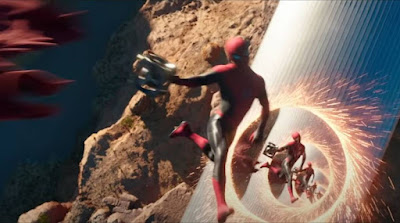
Here’s a Spider-Man movie about how much fun earlier Spider-Man movies were. Sure, it’s also about second chances (for Spider-Men) and learning from your (Spider-Man) mistakes and finding the people who truly love you for who you really are (Spider-Man). But I guess that makes it all the more a movie that begins and ends with nothing but Spider-Man and references to Spider-Man and cheap hits of nostalgia for Spider-Men we’ve loved and lost before. By the finale of Spider-Man: No Way Home, which brings together a cavalcade of cameos for web-swinging acrobatic action and pretends it built (or re-built) characters along the way, it made me, as someone who, I’ll admit, would call Spider-Man my favorite superhero, want the impossible: less Spider-Man.
This oddly flat and clunky project, the latest in the ongoing Marvel Cinematic Universe, opens up a live-action Spider-Verse to tromp around in. Peter Parker (Tom Holland) asks Dr. Strange (Benedict Cumberbatch) to help the world forget he’s the friendly neighborhood superhero. The spells goes wrong and results in characters from previous Spidey pictures stumbling in disoriented and wondering what to do with themselves. There’s Doc Ock (Alfred Molina) and Green Goblin (Willem Dafoe) and Sandman (Thomas Haden Church) from the Tobey Maguire movies and Electro (Jamie Foxx) and Lizard (Rhys Ifans) from the Andrew Garfield ones. The movie’s best idea is also what saps it of energy: these guys are way too confused to be much of a real threat. Instead, Strange and Spidey argue over how best to solve the problem. The wizard doctor wants to zip-zap them back from whence they came where they’ll meet their doom, while good ol’ Peter thinks he can save them. They’re scientists, after all, victims of one misfiring experiment or another. (This movie thinks their villainous natures can be subsumed under the audience’s affection for the characters and performers.) Practically, however, it’s a movie going around in circles, hoping to keep an audience’s interest by trotting out these cameos and lingering long enough for applause breaks before giving each returning face pretty much nothing to do.
And, for how befuddled they should be, and are at first, about getting ripped out of their universe and into another, these villains quickly get pretty casual and blasé about the situation. In typical MCU fashion, there are long scenes of actors standing around trading quips, smirking and giggling at the outsized sci-fi suspense whipping up around them. There’s nothing so heavy—not even the death of a major character—that can pause the deflating jokes for too long. And these have to be the cheapest and emptiest cracks, as Peter’s pals picked to help present possible solutions to this whole mess—MJ (Zendaya) and Ned (Jacob Batalon)—find themselves scoffing in disbelief at names and powers from these inter-dimensional interlopers. It want to both play off how much people love the earlier Spider-Man iterations and set itself up as the best one. (That they start calling Holland “Spidey 1” gets a little funny in that regard when he’s literally sharing the screen with people whose movies worked way better than this one.) No Way Home wobbles between these two modes: reverent celebration of what came before, and goofy puncturing of any possible seriousness. The entire multiverse is threatening to collapse on itself, and it feels about as monumental as channel surfing. That leaves vast swaths of the movie to clunk along in scenes that aren’t shaped so much as plugged into place, and moments of real high drama played off so abruptly and drearily—there are deaths and magical amnesia that’d hit harder with better track laid for it—that one forgets these are supposed to be real characters to care about and not just action figures clattering around.
Worst has to be the movie’s total lack of interesting style. Much has been made of the MCU’s bland house style, closer to network procedurals than cinema spectacle during downtimes between animated action. The style can be pushed here and there—one could parse the fine gradations between a Johnson, Gunn, or Waititi and a Russo bro—but often settles into a bland TV-style over-the-shoulder conversational tone mixed with quick-cut action in sets that trend to muddy grey. (That this year has found the theatrical and TV sides of the universe ever more immeshed makes this homogenized smallness ever more apparent.) This one’s pretty ugly most of the time: photographed with rarely more than three or four actors in frame together, and dialogue often in alternating tight medium or close up shots. Maybe it’s the fact the whole thing was shot last fall taking COVID precautions, but the look ends up cramped—few extras, smallish sets, and tons of flat blocking that has performers so separated from each other that they might’ve been green-screened in separately. When it comes to Big Names swanning in trying to steal scenes in this airless environment, it feels all the worse.
This ill-fitting sense of where to put people in the frame and how to track their behavior extends to the larger sense that nothing much matters herein. When any character can be whatever the plot needs and come flying in on magic sparkle dust from any other movie of which they want to remind you, it doesn’t much matter what happens to them. There’s something hollow at the core, and no amount of emoting can fill it. There’s a silly scene where characters from three different universes seriously compare iterations of advice from dead mentor figures, all tearing up and nodding sagely and talking about how meaningful the franchise’s triplicate pop psychology is. It goes for heavy meaning, but instead piles up comic cliche until it triple-underlines the silliness because the story’s only connection to anything real or human in its movements are to what it means for Spider-Man. And the collision between different visions of the character ends up highlighting how directors Sam Raimi and Marc Webb, for whatever missteps one might concede, were making real movies with their earlier versions, and Jon Watts, on his third go around, is stuck making a product. When characters from the earlier pictures arrive it’s from a different world entirely—one where these superhero movies weren’t only about themselves and pitched for a blandest possible homogeneous outcome. They interact awkwardly with the MCU world because they carry with them messy tendrils of style and substance that can’t entirely get polished away by the shallowness they’re asked to play.
Showing posts with label Rhys Ifans. Show all posts
Sunday, December 19, 2021
Friday, September 16, 2016
Secrets and Lies: SNOWDEN
Edward Snowden makes perfect sense as an Oliver Stone
protagonist. Like JFK’s dogged
district attorney Jim Garrison or Born on
the Fourth of July’s veteran turned war protestor Ron Kovic, Snowden is a
man whose pursuit of what he sees as unambiguous and truthful duty to country
causes him to endure outer skepticism and scorn, and inner destabilizing life
changes. Like Savages, The Doors, Platoon, and two Wall Streets, it’s about a young person drawn into a career with exciting
upsides, but with downsides readily apparent as well. Like Nixon and W. and World Trade Center and Alexander it’s about a man driven by and
ultimately fated to be crushed under the weight of history and expectation. But
unlike those previous movies, Snowden finds
Stone at his most restrained. He views the proceedings from a remove, not
digging into the psychology as deeply, or using filmmaking flash as
ostentatiously. It’s a movie that sees the spreading web of surveillance with a
mournful paranoia. Look at what our government can do and has done, it says,
lauding its hero while wondering if what he did will actually matter in the
long run.
To best make the case for their protagonist as a
misunderstood hero, Stone and co-writer Kieran Fitzgerald (The Homesman) begin by showing us Snowden (Joseph Gordon-Levitt) at
the point of his earliest civic duty. In 2004 he’s discharged from boot camp
after a painful leg injury, after which his drive to serve his country leads
him to transfer to the C.I.A. He’s a smart, unassumingly confident computer
nerd who defends George W. Bush, gently teases his liberal girlfriend (Shailene
Woodley) about her beliefs, and admits to a fondness for Ayn Rand. (It’s not
hard to read this material as Stone inviting conservatives into the story with
a “See? He’s one of you?”) The movie then follows Snowden’s gradual
disillusionment with the intelligence community as he moves from one contract
job to the next, finding increasingly shadier tactics used in gathering and
deploying data scooped up from a global dragnet. Each new revelation gives him
waves of anxiety that seem to pass, but slowly and steadily accrues in the back
of his mind until he has to act.
The movie becomes a portrait of a man whose work anxiety
grows so potent his only recourse is to exorcise it by releasing it into the
world. There’s something of the terror I remember feeling then to this telling
now. (If his revelations about the wide-ranging surveillance tactics at the
fingertips of our country (and others) didn’t have you slap a piece of tape
over your webcam, I don’t know what would.) Because we know what Snowden did –
and what we don’t know remains Top Secret and therefore a ripe target for
Stone’s mythologizing speculation – there’s little surprise to the film. It’s
even structured as flashbacks around scenes of documentarian Laura Poitras
(Melissa Leo) filming Snowden’s secret whistleblower interview with The Guardian’s Glenn Greenwald (Zachary
Quinto) and Ewen MacAskill (Tom Wilkinson), footage which would become the
Academy Award-winning film Citizenfour.
This creates a strangely sedate sense of dutiful reenactment, making the
characters mere pawns in historical inevitability. Gone is the volatile
conspiratorial frenzy of Stone’s heated political films or the schlocky gusto
of his genre fare. Here there’s an almost serene sense of data flowing, history
written in bits and clicks, coded to produce this outcome.
This calm befits what is Stone’s fastest turnaround for
contemplation on a flashpoint in modern American history, beating WTC (another of his eerie calm films) by
two years. Anthony Dod Mantle (frequent Danny Boyle collaborator) makes images
of clean simplicity, cut with occasional smeary doubling or reflections through
layers of screens and glass. Snowden is trapped in a digital world made
tangible, with information glowing and streaming, collected and collated. His
personal dramas – simple fights with his girlfriend, a late-breaking health
issue – are halfhearted, well-acted but beside the point. The most vivid crisis
points are when his work life intrudes with unwelcome force on his home life.
He can’t take his medication to prevent seizures because it slows his response
time. A woozy snap zoom interrupts a heated love scene as he catches the
unblinking cam eye of an open laptop, the extreme close up of the tiny black
circle showing their nakedness reflected in it. There are standard thriller
elements of people avoiding surveillance, befitting a news story that’s already
informed dozens of action movies from Jason
Bourne to Captain America 2 and Furious 7. Its tension remains at a
constant low-boil, mystery dulled by unavoidable outcomes.
It all adds up to a movie that’s vital and turgid, obvious
but with flickers of surprise and life. The known facts of the story are bulked
up with lesser-known or fictionalized incidents, inconvenient truths and
convenient fictions pumped through with enjoyable personalities. Around even
corner is a likable recognizable face bringing fine energy opposite their scene
partners. Part of the fun is wondering who’ll show up next: Rhys Ifans, Nicolas
Cage, Timothy Olyphant, Scott Eastwood, Keith Stanfield, Logan Marshall-Green,
Ben Schnetzer. Each is used by Stone to keep interest and curiosity flowing,
never quite sure whether each new co-worker is a sympathetic ear or a reason to
raise Snowden’s disillusionment. They create a pattern to the movie’s pulsing compelling/dull,
scary/stale info-dumps (the best of which is an abstract swirling animation of
social media chatter and secret metadata flowing into a black hole that slowly
forms an eye, the sort of image so hypnotizing it doesn’t matter how blatant
the symbolism), playing key roles in the process and personifications of
various view points.
In the end it’s another Stone movie of weary patriotism. It’s
about the burden of being a good American, about loving the country so much it’s
worth wishing it were better. Clinging stubbornly to ideals is difficult,
especially when calling into question the ratio of security to liberty from
within the government can make you a target for, at best, criticism and stress,
and at worst jail or exile. Stone makes Snowden a figure unambiguously good, leaking information as a last-ditch
effort to improve what he sees as a slippery slope to tyranny. After the deed
is done he literally has Snowden walk out of the dark data center into gleaming
white sunlight. And yet the unsettled aftermath – stuck in Russia,
communicating in warnings from a robotic screen – creates uncertainty, ending
on a slightly more ambiguous note. He receives applause and attention, yes, but
isolation and confusion, too. He thought it was important we hear what was
happening. Now we know. Now what?
Thursday, August 27, 2015
Jokes Without Laughs: SHE'S FUNNY THAT WAY
She’s Funny That Way
is funny in that way where you can see where all the jokes are supposed to be,
but can’t quite figure out where to laugh. It’s an old-school screwball
attempt, lousy with references to Lubitsch, Astaire and Rodgers, and Charles
Boyer, without ever living up to its great inspirations. It turns itself in
knots introducing a web of interconnected New York neurotics. We meet an
aspiring actress working as a call girl (Imogen Poots) who is cast by her
former john playwright (Owen Wilson) in a production he’s mounting starring his
wife (Kathryn Hahn) and her ex-flame (Rhys Ifans) with the boyfriend (Will
Forte) of the call girl’s psychiatrist (Jennifer Aniston). So far so good, a
near perfect farcical setup that proceeds to fizzle out for the remaining 90
minutes.
Its director and co-writer is Peter Bogdanovich, a critic
and historian who has made several great movies. His debut decade or so of work
includes a disturbing mass shooting horror picture (Targets), a charming caper (Paper
Moon), a tender small town drama (The
Last Picture Show), a documentary (Directed
by John Ford), a screwball comedy (What’s
Up, Doc?), and a farce (They All
Laughed). Not a bad track record, but he’s spent the last thirty-plus years
infrequently making films that simply don’t live up to his early promise.
Presently he’s slightly more interesting as a public figure, where he can
occasionally be found blogging, lecturing, acting, or playing himself in one of
the otherwise terrific The Good Wife’s
worst scenes. His latest film is his first theatrical feature since 2001. I
suppose he thought this would make for a fun little movie.
And it does at times live up to its potential. With
co-writer Louise Stratten he’s concocted vaguely pleasant and moderately
charming scenarios in which misunderstandings, deliberate misdirection, and relationships
falling together or apart are enacted through juggled phone calls and slamming hotel room
doors. There’s even a bubbling subplot involving detectives that recalls the
best loopy moments of his They All
Laughed. And what a cast assembled to pull it off! You don’t get the
aforementioned grouping of usually reliable charmers assembled without
generating a few smiles, at the very least. They’re terrific at what they do,
holding the screen, digging out avenues for amusement while zipping towards
emotional truths of their characters’ conflicts. It’s just a shame that the
writing and filmmaking surrounding them is so lifeless, casual, and musty.
No scene is entirely successful. They are strings of
mismanaged performances fumbling through fuzzy characterizations in a stumbling
pile-up of frazzled lines. No one is miscast, exactly, but they can’t quite
manage to make their thin types really pop in a way to be successful broad
farce, or deep enough for real drama. This makes the film ultimately too shrill
and too airless. Bogdanovich has the right idea, and a lot of the right notes,
to make his nostalgia for Lubitsch movies into pleasant throwback comedy, but
the rhythm and tempo is all off. Poots plays charming accent whack-a-mole,
Wilson seems to have floated in from his Woody Allen collaboration, and the
rest wrestle admirably and amiably with grating miscommunications. When farce
goes bad, it goes very bad, indeed. At a certain point, I stopped struggling to
have a good time and simple sat back and waited it out.
Tuesday, July 3, 2012
With Great Power: THE AMAZING SPIDER-MAN
At last, a big budget superhero movie that doesn’t seem to
be holding anything back for the sequel. Unlike the planning and groundwork
that consumed so much of even the best of Marvel’s pre-Avengers films – those films were all leading up to the admittedly
spectacular climax that was all two-hours-plus of this summer’s biggest hit – The Amazing Spider-man tells a good
story all the way through. There are peaks and valleys with escalating,
relatable stakes every step closer to a spectacular, surprisingly moving action
finale. It’s a film that takes it’s time to build characters, lives with them,
thinks through the impact of the plot’s events on them, and creates a wholly
convincing fantasy world in which superpowers can come along and be the biggest
blessing or the most horrible curse.
It’s only been ten years since Sam Raimi helped kick off the superhero
blockbuster craze with a buoyant, charming, action film, only eight years since
his Spider-man 2, quite possibly the
greatest superhero movie ever made, and only five years since his Spider-man 3 was a modest disappointment
to fans like me. That series, with Tobey Maguire as Peter Parker, the teen nerd
who gets bitten by a radioactive spider to become the titular hero, is still so
fresh in my mind that the biggest problem I had with this new version was
clearing the old out of my mind. It didn’t take too long before I had and soon
enough I was swinging right along with this fresh take. It may not contain
anything as iconic as the rain-soaked upside-down kiss, but it has plenty of
emotional heft to call its own.
Director Marc Webb made his debut three years ago with (500) Days of Summer, one of the best
romantic comedies in recent memory. He may not be the most obvious choice to
helm such a colossal effects-oriented undertaking, but he handles that showy,
explosive material quite well. The impact of his first film can be felt in the
nicely observed early stretches of this film where we’re introduced to our new
Peter Parker (Andrew Garfield) as he shuffles and mumbles his way through his
average life with his Uncle Ben (Martin Sheen) and Aunt May (Sally Field). It’s
been said many times before, but bears repeating, that Spider-man is the best
of all superheroes precisely because of his everyman qualities. He has
problems with family, with school, with girls. For him, being bitten by that
spider (the exact details of the new version need not be recounted here) is
both an exhilarating puzzle of an athletic workout, puzzling over new skills
and powers, and a deeply dangerous worry. Swinging from building to building may be fun, but once you
start to take on greater responsibility, danger to himself and the ones he
loves become all too real.
The plot of the film (the screenplay is from James
Vanderbilt and Alvin Sargent, who worked on Raimi’s Spideys and Steve Kloves, who adapted the Harry Potters) involves Dr. Connors (Rhys Ifans), a man without an
arm who is desperately trying to find a way to regenerate tissue in humans by
crossing with a patient’s genes the DNA of animals like lizards, who can grow
back lopped off limbs whenever they please. Peter’s late father used to work
for Connors, so he’s drawn into the scientific plot fairly early, and is soon
after committed to help fix things after they, of course, go wrong, as they
must in a superhero movie. One thing leads to another and the good Dr. becomes
a slimy villain. At least his schemes doesn’t grow too outlandish and, though
his own physical attributes gain something like superpowers, he can’t exactly
be called a supervillain, He’s a mad scientist who becomes a force of nature.
Complicating the issue is that his intern is one Gwen Stacy (Emma Stone), a
pretty girl from Peter’s school who picks up on his Spidey confidence and asks
him out. Their relationship develops tenderly, in beautifully played scenes
that dance between comedy, romance, and awkwardness. Peter woos her, even
confides in her, to a point, despite the tension of her police chief father
(Denis Leary), who is currently on the hunt for both Connors and the masked
vigilante known as Spider-man.
As you can tell, the movie tells a fairly routine superhero
origin story, but it tells it with such a depth of feeling and passion. The
effects are convincing, yes. But the real attraction here is the warmth and
emotion behind the suit and mask, the real sense of physicality and danger in
the chases and confrontations. The cinematography from John Schwartzman is
nimble and acrobatic, swinging through New York’s concrete caverns and slipping
with clean, clear movements through fast-moving, mostly comprehensible action
sequences. The actors are uniformly terrific, from the parental compassion in
Sheen and Field, to the beautiful brainy Emma Stone and her pragmatic, funny
tough-guy dad in Leary. And Garfield, for his part, carries the movie, selling
the transformation from socially paralyzed underdog to superpowered, sometimes
overconfident, underdog as well as his soft romanticism, sharp smarts, and
heavy guilt.
I never expected to like The
Amazing Spider-man to the extent I did, loving as I do two-thirds of what
Raimi did with this classic comics’ character over the past decade. (As much as I liked it, Amazing has nothing on Raimi's first two Spider-man films.) And yet
this happens all the time in comics where one writer or illustrator ends his or
her run on a series and a new artist (or group of artists) comes on board to
make the character new again. That’s what happens here, thrillingly,
refreshingly so. Marc Webb has made a terrifically compelling superhero movie
with genuinely tense action set pieces, many with vertiginous heights and scary
drops, and a welcome focus on characters that helps ground it all in very high
stakes. What a thoroughly enjoyable spectacle. At the risk of sounding too
corny, this Spider-man is amazing,
indeed.
Monday, April 30, 2012
Love and Marriage: THE FIVE-YEAR ENGAGEMENT
Lacking the focus and bite that gave Nicholas Stoller’s bad-break-up
island-getaway comedy Forgetting Sarah
Marshall its notable power, his newest film, The Five-Year Engagement, starts strong, but gets softer and
lousier the longer it goes on. It follows Tom (Jason Segel, also the co-writer)
and Violet (Emily Blunt), who keep pushing back their wedding date whenever
they encounter new obstacles. He’s a chef in San Francisco, but she gets a job
offer at the University of Michigan. Why not take the job, move across the
country and delay the wedding? The timing just doesn’t work out, but they love
each other. They’re devoted and supportive. But why rush? They’ll be spending
their whole lives together, after all. What’s another year? Or two? Or three?
As the story slips through events that take place over the
course of what is eventually the five years of the title, it becomes a
relatively lengthy, shapeless movie that meanders from scene to scene. At first
it’s a rush of parties and preparations, but then time stretches out and
seasons turn. Tom’s parents (great character actors Mimi Kennedy and David
Paymer) and Violet’s parents (Jim Piddock and Jacki Weaver, so frightening in
her Oscar-nominated role as the crime family matriarch in Animal Kingdom) would like to see them married sooner rather than
later. The wedding is always on the horizon, but the distance to it never seems
to shrink. Tom sees his goofy friend (Chris Pratt) receive the promotion he
would have gotten had he remained in San Francisco. Violet sees her sister
(Alison Brie) get married and have a baby.
But those happenings are more than half a country away from
Ann Arbor, Michigan, a great city in its own right. It’s a charming college
town that nonetheless provides wintry challenges to these Californians. And the
people they meet are certainly friendly and challenging in ways related to
their individual eccentricities. Violet’s boss (Rhys Ifans) and colleagues
(Mindy Kaling, Kevin Hart, and Randall Park) and Tom’s newfound friends
(including pothead sandwich maker Brian Posehn and stay-at-home dad Chris
Parnell) are supportive, if eccentric. They know their way around local bars
and hunting weekends respectively. The couple tries again and again to get
wedding plans off the ground, but for one reason or another the date is pushed back again and
again.
A wobbly mix of shapelessness and sharpness gives the movie
its lackadaisical approach. The main problem here is the way it
becomes clear that Tom and Violet have a pretty good relationship. I’m glad
that the filmmakers at first steer clear of stupid movie-plot conflicts as ways
to push back the wedding. It seems perfectly reasonable to avoid rushing into
marriage, especially when Tom’s struggling to restart his chef ambitions in
their new environs and Violet is trying to navigate the start of a promising
career in academia. They love each other and, even if professional goals
frustrate them at times, it doesn’t seem to effect their essential
compatibility or their enjoyment of each other’s company, even when they argue.
In the film’s most quietly funny and painfully accurate scene, Tom lashes out,
complaining about his seemingly stagnant path in life, and finally says that
he’d like some alone time. Violet gets up to go into the next room, but he
calls after her. “Where are you going? I want to be alone here with you.”
What’s so unexpectedly sharp and recognizably humane about
this film is the way it soberly approaches romance from a practical standpoint. This isn’t a swoony love-conquers-all Hollywood concoction. This is a movie
that acknowledges in a serious, albeit in a mostly comedic context, the
difficulties of blending two lives into one, especially when the people
involved are struggling to get their lives as individuals started. It’s a movie
about the futile pursuit of future perfection when the present is pretty good
already.
By the movie’s back half, though, the sweetness and
laid-back observation of this couple living their lives becomes just another
romantic comedy. Contrived conflicts arise that divide the two, causing them to
rethink their entire relationship. The plotting devolves into a distended
version of the standard strained crisis before eventual reconciliation that can
be found in so many romantic comedies, even some of the good ones. What’s
particularly disappointing about this change is that the movie starts as a
nicely unconventional look at romance, questioning a pressing need for
matrimony when things seem to be so unsettled. The easy charm of the cast and
the likable rapport of Segel and Blunt remain, but the supporting cast has been underdeveloped and the jokes have been a bit undercooked and so they just can’t carry the
slow switch into formula. The whole thing starts to take on a feeling of an affable but lumbering episodic mess.
Sunday, November 28, 2010
The Beginning of the End: HARRY POTTER AND THE DEATHLY HALLOWS PART 1
The filmmakers of Harry Potter and the Deathly Hallows have been telling us that the decision to split the film into two parts was made with purely creative reasons, the better to faithfully reproduce J.K. Rowling’s text, but having seen Part 1 I can only think that the reason had to have been Warner Brothers’ desire to double their profits. This is a decision that has only hobbled the creativity. Sure, Stuart Craig’s production design is outstanding. The cast is excellent. But director David Yates and screenwriter Steve Kloves don’t quite know what to do with all this extra screen time on their hands. They create some really wonderful moments but separate them with meandering and wheel spinning that distracts and, ultimately, makes the experience feel like a let down. Alexandre Desplat’s score can barely even manage a few bars of John William’s great original themes. It’s like someone promised fireworks only to set off a couple of firecrackers and call it good enough.
Oh, the fun one swift three-and-a-half-hour finale could have been. Instead, we have been served up a two-and-a-half hour prelude to next summer’s main attraction. There’s a lot of monotonous exposition to be found here. The film begins by picking up where last year’s wonderful Harry Potter and the Half-Blood Prince left off. Harry (Daniel Radcliffe), Ron (Rupert Grint), and Hermione (Emma Watson) are facing a posthumous task from Headmaster Albus Dumbledore (Michael Gambon) to destroy the devices that allow the evil Voldemort (Ralph Fiennes) to remain immortal. Meanwhile, evil forces are gathering, taking over the Ministry of Magic, installing the snaky Severus Snape (Alan Rickman) to the position of Headmaster of Hogwarts, striking fear in the hearts of all good wizards and witches, and spilling menace into the Muggle world.
Our three heroes are unsure how to proceed. A host of British character actors are there to help them, at first. Returning once again are, among others, David Thewlis, Brendan Gleeson, Robbie Coltrane, Julie Walters, Mark Williams, John Hurt, and Toby Jones. New to the cast are Rhys Ifans as a threatened publisher and Bill Nighy as the new Minister of Magic. The adults are used most sparingly in the film. Even the villains, including Helena Bonham Carter, Jason Isaacs, Helen McCrory and Timothy Spall, are rarely glimpsed. The film features our three heroes alone for much of the run time, saddled with a somewhat repetitive, often perfunctory, script. Luckily, by this point they’re wonderful actors. I suppose growing up around all these supremely talented thespians will do wonders from a young actor.
But the rich ensemble is greatly missed, as are the magical riches of Craig’s sets for Hogwarts. I know they’ll be utilized to a far greater extent in the next installment, but that knowledge did little to ease the empty feeling where Hogwarts belongs. There’s a sense that the filmmakers, taking their cues from Rowling, are deliberately thwarting series-finale nostalgia by shaking up the form of the series, sending our characters adrift into the Muggle wilderness, hunted and stalked. Indeed, there are many affecting and effective moments to be found here. A memory-changing spell opens the film on a sad note, a daring infiltration into the Ministry of Magic is thrilling, a coffee shop shootout is tense, a small dance as a respite amidst danger is tender and touching, and a deadly dark cloud of fear that bursts forth from an evil enchantment sets the stage for a harrowing emotional high point for the film.
I’m sure that the film sets up the narrative and emotional points needed to launch into the conclusion proper. Having read the books, I can see that the filmmakers haven’t lost the thread of the plot. Having loved the movies, I can tell that the technical qualities of this entry are as good as any. What’s missing is a sense of shape, of drive, of a journey. So many of the books’ subplots have been stripped away from the previous adaptations that it’s hard to have a film that tries to make some of them matter without prior introduction. (Have we even seen the character Mundungus before?) The details don’t always feel properly relevant. We begin the film knowing that Harry and his friends are in danger from an increasingly powerful source of evil and end the film with little gained or lost. There are some nice moments, sure, but the film, as a whole, should feel a whole lot livelier. It leaves much to be desired. I don’t know what I was expecting, heading into the film knowing full well that this was only half a Harry Potter movie and fully aware that it would likely be a faithful adaptation of the dullest patch of plotting in the book series. As should have been expected, the film is the first of the series to not feel densely packed with characters, plot points, and magic.
Like the first several hundred pages of the book, Deathly Hallows Part 1 begins to set up a finale. Just as those pages alone would not make a satisfying book, this is not a satisfying film. After the full story is complete, the film could look retroactively rosier, but as of right now the experience of seeing the film is more than a little tedious. This film can’t, and maybe shouldn’t, stand alone, but I wish it did a little more to stand out as something better than a mere mechanical set-up for the forthcoming resolution. Sure, it’s nice to see these characters and this world once again, but I’m looking ahead. I’m looking forward to (hopefully) having more time to luxuriate in the world’s imaginative details, enjoy the deeply talented ensemble, and to experience the magic once again.
Subscribe to:
Posts (Atom)


