Showing posts with label John Magaro. Show all posts

Friday, June 30, 2023

Time After Time: PAST LIVES

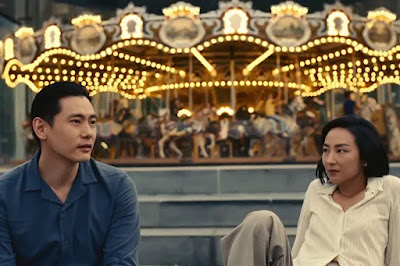
Thirty-six is young enough to feel like a massive life change is still possible, but also old enough to have a lot of vivid “what ifs” that have closed off some possibilities entirely. I’m sure I’m not the first to draw a metaphor comparing living your life to catching a flight. If your childhood is the runway, and your twenties are takeoff, then your thirties have to be the point where you feel you’re at cruising altitude. You’re far enough along to relax into a routine, see the shape of the horizon, while still knowing you have a long way until you reach your final destination. What if? There’s still time. Here’s Past Lives, a wistful and fragile little movie borne aloft by those doubts and those “what ifs” as its 36-year-old characters turn inwards, and backwards, for just a few days. They’re in a blend of nostalgic reverie and deep contemplation that, together and apart, cause them to reflect on their lives’ routes so far, and the other paths that had to be foreclosed to get there.

It starts at the turn of the 21st century, where two 12-year-old South Korean classmates’ friendship is teetering on the edge of romantic feelings. They sit close in class. They talk on their slow walks home. Their moms arrange a date in the park. She cries after getting a lower grade on a test than she’d expected, and he calmly stands there, awkwardly, silently, supportive. It’s all very sweet and cute, a first blush of real, deep connection in a pre-adolescent way that arises out of affection and proximity. When her family immigrates to Canada before the next school year, they don’t see each other, they don’t speak, they don’t stay in touch. More than a decade passes. The movie’s main drama—softly spoken, precisely observed—happens in two following parts: a fleeting long-distance friendship, and a long-awaited reunion on the streets of New York City a decade after that. In their mid-thirties for the film’s present tense culmination, she (Greta Lee) is a married American, and he (Teo Yoo) has just broken up with his girlfriend back in Seoul. The emotional tension swells through the two time jumps ellipsis, empty narrative space we fill in with the context clues, and the nuanced performances in which whole decades well up through body language and eye movements, as every silence swells with the unspoken.

Though it has the raw material of overheated melodrama, the confident grace and simplicity of writer-director Celine Song’s debut feature carries off a poised empathy. It’s not building to the stuff of high drama, but of small realizations, shifts in thoughtful connection, self-knowledge, and lost potentials. It embodies the melancholy wonderings of a wandering mind, traveling back to those moments in life where another choice would’ve taken you an entirely different direction. This isn’t even a movie about regrets, per se. Her husband (John Magaro) is as well-adjusted and empathetic as you could ask. This allows for a movie about the headspace a reunion can generate—and Song’s sensitive writing and cozy filmic lensing allows for the characters to explore their complicated emotions kicked up by the grown person before them being simultaneously the tween they once knew, and a stranger they’ve never known. They see some lost part of themselves reflected back in a stranger’s eyes. The movie’s generous enough to play that out with compassionate contemplation, and the final emotional release is all the more potent for it.

Wednesday, October 6, 2021

Shadows Searching: THE MANY SAINTS OF NEWARK

In 2007, David Chase’s classic New Jersey mobster drama The Sopranos left us with a last supper. Now, it returns to us with The Many Saints of Newark, a prequel. It’s nothing if not consistent—a sprawling story deeply engaged with struggles of masculinity, family, moral weight, and the agonizing dissatisfying guilt the comes from a lifetime of sin. It’s religious and contemplative, torn between atonement and destruction, the holy and profane. That it’s also a multi-generational story of America in decline, a sad pack of boomers chasing the glory of their fathers and leaving less and less opportunity or exit strategy to their children, makes it uniquely suited to chronicle its moment and prefigure ours. But it’s also, at its core, and perhaps at its most appealing, a series about a husband, a wife, their children, and extended family connections; it’s the domestic dramas set up as counterpoint and intersection with the gangster plot lines that are the glue that holds the audience’s affection together. A viewer invested in them as a family, and the accumulation of character detail and thematic concerns consistently streamed forth from that font. A reason why the sudden cut to black in the series’ final episode is so shocking—still a jolt, a chill—is that it not only amplifies the ambiguity long embedded in the show’s philosophical concerns, but denies us closure on the people who, however deeply imperfect and morally compromised, have a humanity we learned to care about. Cold comfort it may be to know the cut to black is headed for us all no matter what we do. But it’s good to know life goes on and on and on and on until then, and for others after.

I like that Chase maintains the mystery of that moment, to the extent that any continuation of the Soprano family story simply had to go back in time. For a family, and a business, to concerns with legacy and lineage, it’s still a rich vein to mine. It feels haunted by future events, an inevitability that what’s set in motion here will reverberate down through the generations. There’s preordained tragedy in the mob life, a foreshortening of life and opportunity when the family and The Family are inextricable, petty crime and petty slights in the same terrible chain of cause and effect. Many Saints finds its main character in Dickie Moltisanti (Alessandro Nivola), a father and uncle whose absence, having long been whacked when Sopranos began, shaped some of his descendant’s actions and perspectives. Here he’s still in the prime of his life. It’s the late 60s. (Chase’s other major feature film effort, 2012’s Not Fade Away, sets its tender musical coming-of-age story against the time’s cultural upheaval.) In this new film Newark is burning. Gangsters are scheming. The world seems to be coming apart, and for the members of the interconnected Jersey crime families their underworld black market power is the thing that gives their lives structure and some sense of control. You can see why a young Tony Soprano (here played by the late, great James Gandolfini’s son Michael in a finely tuned performance) would think this time was a golden age of sorts, although the deaths and prison sentences might make one think it’s no better than his own.

This anxiety of influence as it relates to generations cycles of dysfunction and distress animates Chase’s screenplay, co-written by Lawrence Konner and directed by Alan Taylor, series' vets both. It becomes a movie about people who almost know the way to do the right thing, but, mirroring the show’s Zeno’s paradox of morality, never can get there. Here it’s Dickie, who clashes with family and rivals, gets entangled in affairs and crimes alike, and who ultimately presents himself so slickly that the more impressionable around him might see in him a reason to perpetuate what is the cause of both the family’s wealth and its doom. That Dickie is given an almost literal angel and devil dispensing advice, in the form of a father and his twin brother (in a well-differentiated dual role for Ray Liotta) emphasizes the weight of his choices, and two potential futures. (That the whole movie is narrated from beyond the grave by another character related to him—the thing literally starts floating over gravestones where we overhear ghostly monologues—gives the project that extra weight of funereal fate.) Around him is a cavalcade of character actors playing younger versions of the old guard who haunted Tony’s adulthood: his intimidating father (Jon Bernthal) and snapping mother (Vera Farmiga), his bald bespectacled—and dangerous—Uncle Junior (Corey Stoll), and young up-and-coming gangsters like Paulie (Billy Magnussen) and Silvio (John Magaro). The extra-textual sense of winking inevitability is sometimes a nudge to the fans, but is also often adds to the overarching doom that settles around the ice-blue images and the sturdy mid-century design.

The movie is a relatively brisk two hours, but rambles and expands and never quite digs in to its shuffling surfaces. There’s something uneven—at once too much and too little—about its design, tracing a standard gangster set of concerns with hits and schemes and twists, against a larger family tapestry. It slips through time a bit, and finds pockets of characterization in which to get turned around. Without the space of a season of television, the scenes of sly humor and dark juxtapositions, simple philosophizing and earnest psychologizing, take up inordinate space. Though the movie leans on its Sopranos prequel status in ways that make this particular picture sometimes incomplete, there’s something alive in its ungainly design, especially as Chase introduces Leslie Odom, Jr. as a Black associate of the mobsters. He has his own through line that criss-crosses the other plots, and serves as intriguing counterpoint and counterbalance to their privilege, as well as valuable historical context. One scene finds a hit carried out in an army recruitment center where the flummoxed solider behind the desk yelps that Vietnam’s not his fault. Another has a white man drive a car with a dead body in the passenger seat through a line of riot cops too busy pointing artillery at protestors to notice. These ideas of whose behavior is policed, and who is allowed to get away with what, is emphasized and mirrored by the story of an innocent Italian immigrant (Michela De Rossi) who is brought into the Moltisanti family and becomes part of the mob lifestyle (with all the danger that entails) even as she dutifully takes classes to improve her English and assimilate. Even here there’s a sense that the events—moments of grace, and moments of betrayal—will continue to haunt the family, casting a long shadow.

Friday, September 30, 2016

Blast from the Past: CRISIS IN SIX SCENES


Woody Allen’s latest production, Crisis in Six Scenes, has his best premise since Midnight in Paris. Set in the late 1960s, the social unrest of the times comes right into the house of a stuck-in-their-ways elderly couple. Their cozy home in upstate New York becomes a refuge for a radical when the daughter of an old friend breaks in. She’s wanted by the government for her membership in a left-wing protest group whose activities include, in addition to the usual demonstrations and rabble rousing, bomb building, cop wounding, and sedition fomenting. The elderly couple wants to help the poor girl out, the more open-minded marriage counselor wife (the wonderful Elaine May in her first role in 16 years) eager to keep her hidden, while the paranoid ad man husband (Allen) descends into a stubborn bundle of helpless nerves as the youthful firebrand (Miley Cyrus) slowly unravels their lives’ predictable patterns. It’s all a great excuse for Allen to explore his usual interest in intermingling relationship tangles with philosophical inquiry.

By far his longest narrative project – clocking in at well over two hours total – it is a six-part miniseries for Amazon. (The shift in form would seem more of a leap if the consistency of his filmmaking over decades – the repetitive themes, recurring character types, the regular font, the usual jazz scores – weren’t already a version of television’s comforting familiarity.) He introduces a large cast of characters with competing loyalties, like the conservative business major (John Magaro) who is smitten by the fetching fugitive, much to the dismay of his debutante fiancĂ© (Rachel Brosnahan). And then there’s a cornucopia of familiar and fun faces as neighbors, patients, parents, cops, and protestors (Becky Ann Baker, Lewis Black, Max Casella, David Harbour, Nina Arianda, Christine Ebersole, Joy Behar, Michael Rapaport, and more). It’s stuffed with personality, but not every character comes to life with as much fullness as the time could permit, like soggy and underdeveloped romantic triangles amongst the younger characters.

There’s also the matter of political rhetoric, for as loaded and provocative as it could be it is instead cozy and comfortable fuzzy hindsight. The prickliest it gets is an early lament about how divisive and polarized the country’s politics are, a wry what-goes-around-comes-around smirk at our circular national crises and our inability to move past them. The great premise is just an excuse to knock contentedly humdrum characters into frazzled situations. I imagine such areas of thinness would be excused if this were a shorter feature. With so much time on his hands, though, there’s simply too much room here for dead air, stiff setups, tone-deaf teasing (a tossed off one-liner about a troubled adopted daughter lands poorly), and lackadaisical reaches for obvious developments. In order to go about stretching this tight little farce over so many segments the plot takes some meandering and the zip in the tension falls slack.

Then there is, of course, the slight stiffness and stodginess that’s crept into Allen’s filmmaking of late, a half-theatrically stilted, half-literary dustbin approach in which exposition is a little too plainly displayed and some zingers come wheezing to the punchline. But even when the writing gets a tad stale, the cast is so energetic and pleasantly amusing, it coasts along on comfortable charms and relaxed charisma. Allen is the quintessential Allen type, May is totally at ease playing the slightly frazzled upper-middle-class pseudo-intellectual (her comfort zone since her Nichols and May days), and Cyrus is just the right young, earnest, half-idealistic/half-cynical goof to send them spinning. Per usual, the right ensemble can carry over slightly below par Allen writing, and this one is overflowing with the exact right casting to elevate the downtimes, the patches that could’ve used another draft or two.

The stage is set for the characters’ conflicts to pile up quite swimmingly, and find occasion in the unevenness for some of the funniest scenes Allen has written in a while. May’s counseling sessions are perfect little sketches, and recurring scenes with her lovable, and increasingly politically rambunctious, little old ladies’ book club are a terrific throughline. Allen and Cyrus spar over food, consumerism, and communist ideals in agreeably prickly wars of words. There’s even a scene in which May scrambles over rooftops after a briefcase of contraband Cuban currency, so this is the sort of story that escalates in sometimes satisfyingly silly and unpredictable ways. Allen has some fun with the historical context, dusting off old quips about Vietnam, hippies, Nixon, Black Panthers, war protestors, and Latin American revolutionaries. (There’s an echo of Bananas there, I suppose.) By the final twenty minutes, which include a sustained and hilarious homage to the Marx brothers’ famous Night at the Opera stateroom sequence, the whole fitfully farcical storyline has arrived at a satisfying crescendo that’s well worth the wait.

Saturday, January 30, 2016

Watership Down: THE FINEST HOURS


Like a Norman Rockwell painting poured over The Perfect Storm, The Finest Hours is a sturdy, old-fashioned picture. Based on the true story of a 1952 Coast Guard rescue of a tanker split in two by horrendous winter weather, the film tells its tale in a rather conventional way. We meet a stubborn do-gooder guardsman (Chris Pine) and the sweet girl (Holliday Grainger) who’d like to marry him. Then the storm hits, the tanker is in trouble, and the man’s commanding officer (Eric Bana) sends him out on a small boat with a small crew (Ben Foster, Kyle Gallner, and John Magaro) to do the impossible. Their boat is tossed about by the waves and winds, equipment malfunctions, and the sun sets. Meanwhile, the men on the tanker (over 30 of them, including Casey Affleck and John Ortiz) are struggling to stay afloat, with no way to make contact, and thus no way of knowing if help is even on the way. It’s a simple story, but the story is simply engaging.

A live action Disney movie, it looks and feels more or less like it would if the company made it in 1956, 66, 76, 86, 96, or 2006, modern tech aside. There’s a fine layer of timeless Hollywood gloss over it, and a proficient element of spectacle as special effects buffet the boats out in the storm and softly falling snow coats the coast in a sparkling snow globe lighthouse look. And in the midst of this is a dependable cast playing people who are largely identifiable types, but given just enough personality and interior lives for rooting interest beyond making it out alive, and to suggest a reality beyond the big studio lights on the sets and CG. The situation is inherently dramatic – true life-or-death stakes, with survival hinging on how well these people can do their jobs, and on the whims of nature. The screenplay (by The Fighter’s Eric Johnson, Scott Silver, and Paul Tamasy) is smart not to undercut the proceedings. It crests perilous waves of clichĂ© to find clear sailing to the heartstrings.

It borders on corny, but it never quite gets there, kept afloat by its forward momentum and reliably sturdy construction. Who’d have thought Craig Gillespie, the director of the Ryan-Gosling-in-love-with-a-RealDoll movie Lars and the Real Girl and the fun Fright Night remake, would turn into a decent helmer for Disney based-on-a-true-story fare? With Finest Hours he improves on his dull sports movie Million Dollar Arm, this time telling an interesting and compelling narrative with good clarity for its process and perspective. We follow each boat’s progress through the storm, cutting between them, and some judicious glimpses of those fretting on the shore, hoping against hope that their guys will make it back alive. There’s a chaste romance at stake, and a couple dozen souls stranded in a rapidly failing craft. That’s plenty heart-tugging drama to get invested in, and a cast willing to play it earnestly.

The sequences on the listing half-tanker are the strongest, Javier Aguirresarobe’s camera and Tatiana S. Riegel’s editing crisply following a committed cast of character actors chewing on accents and sloshing around a convincingly dangerous waterlogged set, coming to terms with the long odds confronting them. The film is full of towering waves, howling winds, groaning bulkheads, straining chains, swinging beams, straining rudders, whirring propellers, and spasms of sparks and smoke. Gillespie focuses on these tactile details, in sharp, routine frames constructed to show off the heroic efforts taken by various crewmembers to save as many lives as they can. It’s a film that feels the movement of the bobbing waves, the strain on an engine as a boat takes on weight, and the taxing whir of overpowered pumps slowly letting water creep higher up the engine room. It’s an engaging film of sturdy craftsmanship, the sort of feel-good inspirational fact-based family film I’m glad Disney hasn’t entirely given up on making in the shadow of their mega-blockbuster fantasies.

Thursday, December 10, 2015

House of Cards: THE BIG SHORT


The world economy collapsed in 2008, brought down by the banking industry’s unchecked power to make gigantic risky bets on the housing market, an investment they’d somehow deluded themselves into thinking was a sure thing. Bankers decided to treat the savings and loans of millions upon millions of people as poker chips in their own personal casino. Eventually, they lost, and we were stuck bailing them out. But maybe poker is a bad metaphor. Maybe it was like they were playing blackjack, or spinning the roulette table. No, perhaps it’s more accurate to say they were playing Jenga, and when people in over their heads couldn’t make payments on subprime mortgages, the whole tower fell down. Wait, maybe it would help you understand it better if you thought of bankers bundling bad debt to resell as investments like chefs repurposing leftovers and hoping no one would be the wiser. But forget the metaphors for a second. Would you rather hear all this from a gorgeous woman in a bathtub?

Writer-director Adam McKay tries out every metaphor above and more too, even stooping to cutting to a lady in the bath to spice up exposition, as his latest movie, The Big Short, attempts to explain the 2008 financial crisis in a narrative feature form. You’d think the whole thing would be better suited to a documentary. (That’d be Charles Ferguson’s masterfully comprehensive doc Inside Job.) On the basis of this film, you’d be right. McKay’s clearly burning with anger over the conditions of unchecked, unregulated greed that led to these problems, and the stasis that led to exactly nothing being done to fix them in the years since. He communicates this fervor by bringing a raucous pace to scenes (shot in jittery style by cinematographer Barry Ackroyd) of men in suits sitting around talking numbers. But he also doesn’t trust his audience to follow along, and so drags down a rapid-fire pace and zippy editing with endless narration, fourth-wall breaking lectures, snarky asides, and endless explanations.

Inspired by the well-reported book of the same name by Michael Lewis (Moneyball), McKay, with co-writer Charles Randolph (Love & Other Drugs), focuses the story on the handful of people who, in the early 2000s, saw the housing bubble growing and braced for the impact of the burst. There’s an eccentric hedge fund analyst (Christian Bale), an angry money manager (Steve Carell), a high-stakes trader (Ryan Gosling), and more (including Brad Pitt, Hamish Linklater, Finn Wittrock, and John Magaro). They’re not really fully formed people, more like representations of worldviews and information, conduits through which we are shown aspects of the larger looming problem. Bale and Gosling concoct a scheme to short securitized subprime mortgages. Carell and his employees get in on the action, then research the instability in the housing market on the ground, visiting sleazy loan sharks, underemployed homeowners, and shallow realtors. Everyone’s laughing them out of meetings for betting against the housing market. But the more the characters we follow uncover about the financial system, the more they’re convinced catastrophe is around the corner.

These guys are smart enough to figure out the problems, but only use this knowledge to make themselves money off the inevitable calamity. Sure, they try to tell people about their discoveries – colleagues, journalists, credit rating agencies – but nothing is done to avert the crisis. No one wanted to hear. Powered on frustration and fury, McKay builds an argument that the economy as we know it is essentially a mass delusion built on stupidity and fraud. We the people will believe anything if it’s in rich people’s interest to make it seem true. As difficult as it is to watch this recent history reenacted, it’s even harder to take realizing it could easily happen again. The large ensemble does fine work communicating these ideas, condensing and dispensing piles of spreadsheets at the expense of becoming actual characters, but the movie goes ahead and overexplains anyway.

He’s usually directing comedies (Anchorman, Talladega Nights), but here McKay shifts to a serious message movie out of clear passion. After all, he’s the guy who put in the end credits of his 2010 buddy cop comedy The Other Guys a biting PowerPoint presentation explaining how Wall Street is essentially a Ponzi scheme. The Big Short is well intentioned, and argues a sharp political point. But it’s so tediously expositional and smirkingly condescending. The narration acts like the information it recounts is boring or complicated, often pausing to say, “Confusing, right?” It’s a faux jocular tone that assumes the audience will quickly lose focus on the jargon or get lost in the overflow of technical dialogue. McKay loads the film with celebrity cameos explaining concepts, characters lecturing to the camera, and rapid-fire pop culture signifiers representing the passage of time. It’s basic, but overcomplicated, a deeply irritating approach. I’m not saying the roots of the financial crisis are necessarily simple or quick to grok, but I bet the sorts of people who would go see this movie in the first place might be interested enough to keep up.

Sunday, October 31, 2010

Quick Look: MY SOUL TO TAKE

With My Soul to Take, the story of a dead schizophrenic serial killer who may or may not have returned from the dead after sixteen years just to kill a group of high schoolers, Wes Craven’s offering up leftovers from his greatest accomplishments. It’s a little Nightmare on Elm Street here, a little Scream there. I had a good time. It’s a fairly shaggy slasher picture, but it’s sort of charming in its steady, almost anachronistic style. And its straight-faced use of red herrings and obvious twisty horror plotting makes it a bit of an earnest, unselfconscious throwback. The killer’s prey is a carefully diverse group of teenagers (all in their twenties, of course). There’s a jock (Nick Lashaway), popular girls (Emily Meade and Paulina Olszynski), an Evangelical Christian (Zena Grey), a geek (John Magaro), and a blind kid (Denzel Whitaker). Our main point of entry into the story, which is partly a bleary coming-of-age story, is a troubled teen played by Max Thieriot, who handles quite well a part that calls for a blend of high emotion and low pop-psychological semi-supernatural oddness. He’s given several moments that could very well have become accidental camp in lesser hands. The cast has some nice banter mixed in with some real clunkers, like a failed bon mot from the Christian girl suggesting relief from the heat of their crisis with some “prayer conditioning.” But above all, Craven’s film works in its erratic, loopy way as a look at a community that is literally haunted by memories of sudden and scarring violence. Its high point comes not from a particularly frightening scare or a squeamishly gross gash of gore, but instead from a scene that finds a brother and a sister, both marked by the town’s killings of sixteen years prior, smashing apart the last relics of their tainted memories.