

Showing posts with label Brad Pitt. Show all posts
Showing posts with label Brad Pitt. Show all posts
Tuesday, July 22, 2025
Need for Speed: F1

Monday, January 30, 2023
Hollywood is Burning: BABYLON
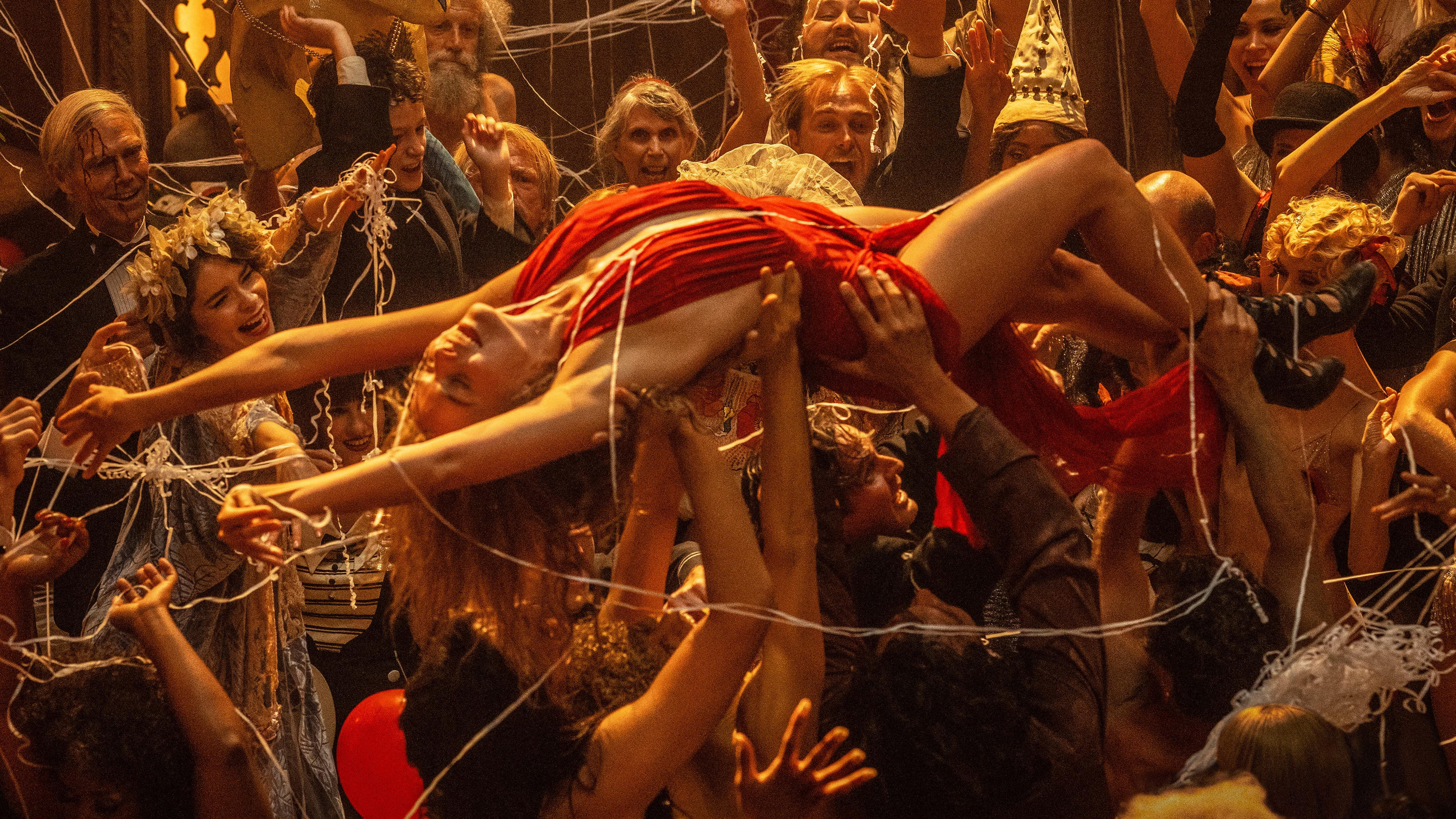
This confusion results from a simplistic story—Singin’ in the Rain without the jokes—spread out over a long, rambling episodic structure—Boogie Nights’ plotting without the well-worn melancholy. The actors almost pull it off anyway. Amid a sprawling ensemble, Brad Pitt plays a Don Lockwood type floating along as a silent idol, drunkenly stumbling around behind the scenes until his cue when lights and camera assemble a perfect take where his eyes smolder and visage cuts through the chaos. Margot Robbie is a fresh-off-the-bus nobody who wiggles and winks her way to sexpot status as a silent comedienne. They’re connected by love and business to a striving Mexican immigrant (Diego Calva) who wants to work his way up to studio executive someday. The stars are burdened with tabloid melodrama lives, and that ends up taking their careers on the ups and downs you’d expect. Ultimately, the only smart characters opt out entirely. (Although, as also the only characters of color, they don’t always take that option by choice.) The others meet nasty ends of one sort or another.
Chazelle views the struggle of old Hollywood from the 20s through the 50s with a grand sweep and cynical eye. He clearly loves the movies—he’s an obvious case of millennial Turner Classic Movies and Karina Longworth love—and his film drinks in a period look, though it sloshes anachronistically from time to time. He also thinks he’s being clever re-staging some Singin’ gags—an extended bit with a talkie’s mic problems, for instance—but in a more protracted, profane way that’s lesser than the original. It’s all a mad jumble—loud and flashy and propulsive, but also thin and trite and tiring. That’s the strange paradox of the project. It’s at once a watchable display of pyrotechnic filmmaking, and a wearisome confusion. Chazelle’s as strong a talent as we’ve had debut in the last decade, as demonstrated in the false glamor of La La Land, the elegiacally technical First Man, and the hard-charging percussive Whiplash (still his best). Here he stages inventive and breathless sequences of excess—parties out of control, sojourns into boozy despair and snakebitten foolhardiness, and behind-the-scenes farce whipped up like Noises Off strung out and tweaked up. He has Movie Stars swanning about with broad vaudeville-by-way-of-Cassavetes performances in striking garb in enormous sets and flashy lights, all set to a booming, driving, jazzy score from his usual composer Justin Hurwitz (easily his best work). It’s all very capital-M Movie in a glitzy show-off display of technique. But his imagination behind the camera outpaces the writing, which dwindles off into the blank-headed pastiche of better pictures before circling the drain.
This confused push-pull is never more evident than the film’s ending. The final stretch—in which a gangster pitching a movie (a goofily committed cameo from a recognizable actor) takes an exec to a near-literal hell, conflating a trite addiction drama’s beats with the showbiz milieu as if moviemaking itself is a drug—finds its rock bottom in a literal geek show in improbably dank quarters. Then it pivots to a future reverie in which a character, years after surviving with his sanity by leaving the business entirely, goes to see the classic movie that the movie’s been aping all along, and, as he weeps at the wonder of it all, Chazelle’s film drifts into an ecstatic montage of “Hooray for Hollywood” proportions like Chuck Workman broke into the editing bay with one of his Oscar tributes. As the score works itself into a clanging frenzy, we see quick flashes of everything from Un Chien Andalou to Avatar. All the pain and abuse and bodily fluids behind the scenes, all the bodies ground up to feed the machine, all the contortions asked for the genius of the system, lead to this. (Somehow, heartbreak feels good in a place like this?) The movie’s exaggerations and excesses add up to nothing but an argument that we might hate the process, but the final products can be transcendent magic. I suppose it’s fitting that this movie feels the same. I disliked a lot of it, and wouldn’t mind seeing it again.
Sunday, August 7, 2022
Shooting Stars: THE GRAY MAN and BULLET TRAIN

That their newest feature has distinguishable characters in something like real-world places serves their talents well. It’s a Spy vs. Spy setup with Ryan Gosling defecting from a covert assassin job and subsequently hunted by an unhinged rival assassin, played by Chris Evans. The Russos know they’re dealing with two marquee Movie Stars, and shoot with all due reverence. The men are shot from flattering angles, in perfect dramatic lighting, and spring into action in fluidly faked, CG-assisted prowess. And each role plays to the actors’ strengths. Gosling gets his earnest smolder, his underdog confidence. He’s been able to dial that in one direction (Drive) or another (First Man) or another (La La Land) throughout his appealing lead roles. Here he’s every bit the capital-s Star. On the other hand, Evans gets a gum-chewing character turn, cranking his Captain America gee-whiz can-do attitude into a malevolent Team America villainy. There’s some actual crackle to their antagonism. Then their world is filled out with choice supporting turns for familiar faces filling familiar roles for this genre. There are potential Deep State allies (Billy Bob Thornton and Ana de Armas), shadowy suits (Jessica Henwick and Regé-Jean Page), a girl in danger (Julia Butters), and an elder statesman with important information (Alfre Woodard). They’re all talented enough to be a little bit memorable but otherwise just exactly what they need to be to keep the shootouts and chase sequences flowing.
It’s all of a piece—a little samey, totally artificial, everyone written at the same de rigueur canted angle toward seriousness. Which is to say that it’s a blockbuster whose relationship to the world is only other blockbusters. To the Russos, and their screenwriters and craftspeople, the high-stakes shoot-‘em-up globetrotting is all about the real world and real stakes only insofar as we can glimpse them through a mirrored simulacrum—pointing backwards and through the Bourne movies and Bond pictures and so on and so forth. Sure, there’s something pleasingly frictionless about an entirely phony chase in, around, and through a train running down tight turns on cobblestone European streets. Cars flip and spin, sparks fly, bullets careen, and the leads shimmy away from rampaging computer effects. (It’s a little bit clever some of the time, too, like when Gosling uses his reflection in passing windows to guide his aim into the train.) It’s a weightless charge of motion and faux-danger.
That’s the case with all of the action scenes here. They have the form and pace of excitement, but are of mere passably diverting interest. I didn’t exactly have a bad time watching it, though. Its cliched convolutions and obvious developments, acted out by pros who could do this in their sleep, is, as the kids might say, totally smooth-brained. It slips right off the old dome painlessly and without interrupting one with anything worth thought or reflection. That’s right in the Netflix mode these days, as their plummeting stock price has resulted in the board room making noise that they want to cut back on expensive auteurist art pieces (sorry to Baumbach, Scorsese, Coens, Campion, etc.) and instead focus on these time-passing mass-market baubles. As far as their efforts there go—think Red Notice or The Adam Project—this one’s at least thoroughly fine.

On the train are hitmen and schemers in a variety of styles and quirks. The cast is loaded with familiar faces and voices—Brian Tyree Henry, Aaron Taylor-Johnson, Joey King, Logan Lerman, Hiroyuki Sanada, Michael Shannon, Sandra Bullock, Bad Bunny, and a few fun cameos, too. Each is given a splashy title card announcing their name, a scattered assortment of quick-cut flashbacks, and one or two whimsical character details. (One is obsessed with Thomas the Tank Engine, for example.) I’ve seen this movie’s manic post-modern approach referred to as if it was in the late-90s and early-aughts trend of snarky post-Tarantino, post-Ritchie crime pictures. But I think we should remember that that was twenty to thirty years ago, and in this case counts as a throwback. I didn’t mind that too much. The movie’s eccentricities fly by as quickly as its speeding set.
The result is a Rube Goldberg machine of an action comedy. Every actor and prop introduced circles back around at least once for another payoff, some expected and some surprising. The straight line simplicity of the main plot, one MacGuffin and one Final Destination in perpetual motion, is interrupted by a jumble of obstacles in each train car, some recurring irritants and some a constant danger. Meanwhile the story curlicues with unexpected doubling-backs—sometimes cutaways within cutaways or long montages that build backstory for a sudden reversal or reveal. This results in some enjoyable scrambling, separating or delaying effects from causes or vice versa. It’s all quite clever and pleased with itself, and the movie bounces along with the music of comedy without quite the words to make it really sing. It’s a constant juggle of witty cutting and awful violence—a kind of cold karmic comeuppance for its largely disreputable and dangerous cast of characters.
Director David Leitch has made this jocular mood for bloody combat cleverness his stock-in-trade. After co-directing the dizzying choreography of John Wick, he’s given us the likes of Atomic Blonde, Deadpool 2, and Fast & Furious: Hobbs & Shaw. He shoots action brightly and legibly and knows how to frame with and hold for impact. But those pictures all have a rather flippant bravado, charging hard at action while characters skip across the implications. They leave a high body count behind them while twisting out of spectacular slam-bang dangers. Any respect for human life is gone, the better to gawk at all the ways bones snap and vehicles crash. Bullet Train might be Leitch’s best post-Wick effort simply for giving in to that breezy carelessness entirely. It treats the smacks and thuds and stabs as staccato punctuation—literal punch lines—for sleazy characters ground under by twists of fate. Pitt floats above it all, desperately trying to talk it out, and inevitably pulled back into violence. That he survives any of his attackers' onslaughts is almost an accident. And all the while he keeps bemoaning his bad luck. I guess it really is all in how you look at it. As far as violent distractions go, this one at least starts at a fast pace and never lets up.
Saturday, November 26, 2016
Spies Like Thus: ALLIED

It is fitting Allied,
a glossy new film from Robert Zemeckis, opens on Thanksgiving weekend, because
its appeal is not dissimilar from a Macy’s parade. The movie is a shiny empty
spectacle in which two performers of balloon-sized star power are paraded down
a straightforward, unsurprising route. Zemeckis is too skilled a technician to
make it badly, but for all the sharp, clear staging and gleaming period detail,
he hasn’t thought through a way to make the screenplay jump into anything
resembling life. It’s beautifully inert, handsomely dull. He’s clearly out to
make a grand old-fashioned entertainment, a World War II spy picture that –
colorful widescreen use of the R-rating aside – could’ve been made in the forties.
It starts in Casablanca – a real statement of purpose, that – with two Allied
spies (Brad Pitt and Marion Cotillard) meeting on sand-swept streets. They are
to play husband and wife Vichy sympathizers, get invited to the German
ambassador’s upcoming party, and then kill every Nazi in the place. That’s a
great hook, and afterwards it’ll spin out in what should be gut-wrenching
consequences, but instead dwindle to boredom.
The peculiar tension of Zemeckis’s artificial approach is
highlighted in the opening shot, a slow move around Pitt parachuting into the
desert as he slowly, gracefully, lands upright on two feet with a soft puff of
sand. It looks as if he’s standing still with scenery composited in around him,
like a promo shot for a Virtual Reality headset. But it’s also a terrifically
entertaining dose of stardom as Pitt – perfectly coiffed and tailored – is met
by a car in the middle of nowhere. He’s driven to town where he meets
Cotillard, who is wearing a glossy dress stunningly draped over her figure.
Zemickis is in full command of his dazzling technique, letting the two spies
get drawn into a real romance flowering under their cover story. Asked how she
can be such an effective spy, Cotillard responds that she keeps the emotions
real. Indeed, the same goes from the opening hour of the film, which features
elaborate camera fakery and intimate collisions of charisma, climaxing in two moments.
First, they finally make love in the back of a car, the camera spinning around
the vehicle while a howling digital sandstorm whirls outside. Second, they gun
down Nazis at a blood-splattered party. Fun times.
After a decade spent making (underrated) animated films,
Zemeckis is now three films into his return to live action. He’s clearly
enjoying the full CG complement of tools at his disposal to finally create complex
camera moves he’s been working towards his whole career. Think about the
trickery on display in Back to the
Future, Forrest Gump, and Contact
and watch how much bigger, longer, and more complicated the artifice can be in Flight’s wild plane crash or The Walk’s vertigo-inducing skyscraper
tightrope. He’s not doing anything so elaborate here, instead concocting with
cinematographer Don Burgess’s scrubbed smooth images a sort of vintage
throwback spy movie, with patiently filmed polished backlots and wardrobe, perfect
and shiny, the better to complement his movie stars. There’s just nothing like
putting a real person in an elaborately imagined feat of moviemaking. (Perhaps
it’s worth pointing out Zemeckis’s three post-animation films contain nude
scenes. I suppose that’s making use of the live
in live action?) So when sharply dressed people watch the sun rise over the
sand dunes, Nazis get blown apart, or London’s skies light up with enemy fire,
there’s a charge to seeing the layers of phony visual interest designed for our
amusement.
But for such a good-looking film, it grows tedious the
instant it introduces its most gripping complication. Pitt and Cotillard return
from Casablanca to England, where they promptly decide to get married. A year
passes, during which they have a child, born during an air raid in one of the
movie’s best hyperbolic set pieces. Then, one fateful Friday, Pitt is called
into a secret meeting where his superiors (Jared Harris and Simon McBurney)
tell him his wife is most likely a Nazi spy. They’ll know for sure by Monday
morning. He’s to act like nothing’s out of the ordinary, but if she’s found
guilty he’ll be the one pulling the trigger. If he doesn’t, he’ll face
indictment for conspiracy. This should be gripping material, like Mr. and Mrs. Smith in reverse, dazzling
espionage funneled into a comfortable domestic life instead of the other way
around. Every minute of this weekend should be loaded with portent. And yet writer
Steven Knight (Dirty Pretty Things)
has designed a screenplay that separates the couple for large portions of this
second half, sending Pitt on increasingly inane attempts at investigating that
are both useless and fruitless. For such a great spy, it takes him a dreadfully
long time putting the clues together.
Zemeckis has the right cast and crew to pull off a stylish
WWII thriller, but the screenplay tunnel visions into its least interesting
aspects. It privileges a limp mystery over a rich vein of emotional marriage
metaphor lingering untapped below the surface. In sidelining Cotillard, it shoves
the romantic tension and the questions of betrayal far into the background. In
isolating Pitt it leaves him adrift in a plot beyond his control despite all
attempts to gin up conflict to wander into. (A late breaking jaunt behind enemy
lines is especially dunderheaded, adding nothing to the plot while separating
him from where the entirety of the film’s dramatic interest sits.) As the movie
enters its long, slow, concluding sequences, it finally succeeds in choking off
personality and promise while snoozing through dull revelations and last minute
attempts at shocking turns of events. After such dazzling artifice and dopey
movie pleasure up front, it’s depressing to watch it all fade to nothing by the
end. It’s simply a great idea – and some polished, confident filmmaking – going
to waste.
Thursday, December 10, 2015
House of Cards: THE BIG SHORT

The world economy collapsed in 2008, brought down by the
banking industry’s unchecked power to make gigantic risky bets on the housing
market, an investment they’d somehow deluded themselves into thinking was a
sure thing. Bankers decided to treat the savings and loans of millions upon
millions of people as poker chips in their own personal casino. Eventually,
they lost, and we were stuck bailing them out. But maybe poker is a bad
metaphor. Maybe it was like they were playing blackjack, or spinning the
roulette table. No, perhaps it’s more accurate to say they were playing Jenga,
and when people in over their heads couldn’t make payments on subprime
mortgages, the whole tower fell down. Wait, maybe it would help you understand
it better if you thought of bankers bundling bad debt to resell as investments
like chefs repurposing leftovers and hoping no one would be the wiser. But
forget the metaphors for a second. Would you rather hear all this from a
gorgeous woman in a bathtub?
Writer-director Adam McKay tries out every metaphor above
and more too, even stooping to cutting to a lady in the bath to spice up
exposition, as his latest movie, The Big
Short, attempts to explain the 2008 financial crisis in a narrative feature
form. You’d think the whole thing would be better suited to a documentary.
(That’d be Charles Ferguson’s masterfully comprehensive doc Inside Job.) On the basis of this film,
you’d be right. McKay’s clearly burning with anger over the conditions of
unchecked, unregulated greed that led to these problems, and the stasis that
led to exactly nothing being done to fix them in the years since. He
communicates this fervor by bringing a raucous pace to scenes (shot in jittery style
by cinematographer Barry Ackroyd) of men in suits sitting around talking
numbers. But he also doesn’t trust his audience to follow along, and so drags
down a rapid-fire pace and zippy editing with endless narration, fourth-wall
breaking lectures, snarky asides, and endless explanations.

Inspired by the well-reported book of the same name by
Michael Lewis (Moneyball), McKay,
with co-writer Charles Randolph (Love
& Other Drugs), focuses the story on the handful of people who, in the
early 2000s, saw the housing bubble growing and braced for the impact of the
burst. There’s an eccentric hedge fund analyst (Christian Bale), an angry money
manager (Steve Carell), a high-stakes trader (Ryan Gosling), and more
(including Brad Pitt, Hamish Linklater, Finn Wittrock, and John Magaro).
They’re not really fully formed people, more like representations of worldviews
and information, conduits through which we are shown aspects of the larger
looming problem. Bale and Gosling concoct a scheme to short securitized
subprime mortgages. Carell and his employees get in on the action, then
research the instability in the housing market on the ground, visiting sleazy
loan sharks, underemployed homeowners, and shallow realtors. Everyone’s
laughing them out of meetings for betting against the housing market. But the
more the characters we follow uncover about the financial system, the more
they’re convinced catastrophe is around the corner.
These guys are smart enough to figure out the problems, but
only use this knowledge to make themselves money off the inevitable calamity.
Sure, they try to tell people about their discoveries – colleagues,
journalists, credit rating agencies – but nothing is done to avert the crisis.
No one wanted to hear. Powered on frustration and fury, McKay builds an argument
that the economy as we know it is essentially a mass delusion built on
stupidity and fraud. We the people will believe anything if it’s in rich
people’s interest to make it seem true. As difficult as it is to watch this
recent history reenacted, it’s even harder to take realizing it could easily
happen again. The large ensemble does fine work communicating these ideas, condensing and dispensing piles of spreadsheets at
the expense of becoming actual characters, but the movie goes ahead and
overexplains anyway.
He’s usually directing comedies (Anchorman, Talladega Nights),
but here McKay shifts to a serious message movie out of clear passion. After
all, he’s the guy who put in the end credits of his 2010 buddy cop comedy The Other Guys a biting PowerPoint
presentation explaining how Wall Street is essentially a Ponzi scheme. The Big Short is
well intentioned, and argues a sharp political point. But it’s so tediously
expositional and smirkingly condescending. The narration acts like the
information it recounts is boring or complicated, often pausing to say,
“Confusing, right?” It’s a faux jocular tone that assumes the audience will
quickly lose focus on the jargon or get lost in the overflow of technical
dialogue. McKay loads the film with celebrity cameos explaining concepts,
characters lecturing to the camera, and rapid-fire pop culture signifiers
representing the passage of time. It’s basic, but overcomplicated, a deeply
irritating approach. I’m not saying the roots of the financial crisis are necessarily
simple or quick to grok, but I bet the sorts of people who would go see this
movie in the first place might be interested enough to keep up.
Friday, October 17, 2014
They Were Expendable: FURY

Ayer’s previous films, from his screenplay for cop thriller Training Day to his minor directorial
efforts like End of Watch and Sabotage, feature ensembles of tough
professionals, but the men of Fury
are his best, most fully realized group. They’re men beaten down by war.
They’re depressed, mournful, battle-hardened, and shell-shocked. Their gruff,
scarred, paternal leader (Brad Pitt) bites off his words, reminiscing about
starting out killing Germans in Africa, then France. Now they’re moving towards
Berlin, taking one town at a time. A typical demographic cross-section WWII
squad, there’s a devout Christian (Shia LaBeouf), a Latino (Michael Peña), and
an itchy trigger finger (Jon Bernthal). But they transcend their types by not
making a big deal about them. They blend as a team, brotherly, on-edge, and
ready to kill.
It’s fine ensemble work, presenting a group of men who know
one another from spending time in close quarters building relationships forged
in battle. They’re trapped in a tank, taking and returning enemy fire for brief
moments, but mostly sitting, anxious, ready for anything for long stretches of
time. Camaraderie is as tangible as their pain. The film opens on a quiet
battlefield littered with carnage. The tank is broken. One of their gunners is
dead. Slowly the tank roars to life, moving across the smoking ruins of so many
men and machines. The battle was won, but their friend was lost. Back at camp,
they’re assigned a new team member, a fresh-faced recent recruit pulled out of
the typing pool (Logan Lerman). They don’t quite know what to do with him. He’s
inexperienced, and has clear distaste for violence.
The new kid is instantly sympathetic, and not just because
the frightened, bookish, idealistic young solider is always the character I’m
most certain I would be in these types of movies. He’s hesitant to shoot at
suspected threats. He is intimidated by the tough guys around him. Yes, they’re
worn out, violent, grey, and grimy, but they also have a mumbly, closed-off rapport
that seems difficult for a newcomer to penetrate. They have their routines,
their procedures, their shorthand. Lerman’s character arc is familiar, but
compelling. The movie follows his discovery of war and his new brothers in arms
as their tank moves to another skirmish, then into a small German town for some
urban warfare, then on to another mission. All the while, they seem so worn
out, exhausted by the war’s violent ending. They don’t know the war’s final
conclusion is around the corner, but the sense of finality is pervasive.
Free of most typical heroics associated with World War
II features, Ayer creates a movie rooted firmly in the tangible dirtiness of it
all. It’s gory, bullets ripping flesh and explosions sending torn fragments of
body and cloth through the air. The men are constantly covered in mud and
grime, dried blood and sweat. They have cuts and scrapes, haunted looks in
their eyes, and weights on their shoulders. The immediacy of the detail and
sense of place is accentuated by Roman Vasyanov’s striking, often hauntingly
gorgeous cinematography that alternates tight close-ups inside the tank with
wide shots of foggy forests and fields. And the guys look like they’ve been
cooped up for years, smelly, claustrophobic, and tense. One brief moment allows
the group a dinner table, around which we see reflected in their behaviors who
among them retains kindness, and who is lost in the brutality of war.
It’s undoubtedly a cynical movie, in which death comes
unpredictably, where people lay down their lives and become just another corpse
to be piled up, dumped off, or left to rot. Of course our team navigates the
conflict in typical war film ways, but the sense of loss is palpable
throughout. Even as the battle sequences are shot and edited in steady,
propulsive action filmmaking, they’re as mournful and scary as they are
exciting. The climax, especially, is gripping and thrilling, but is also the
ultimate expression of the film’s obvious war-is-hell thesis. It’s a last stand at
night, the only light from a raging fire, as smoke mingles with gunfire and
blood splatter. It’s hellish, and the closest Ayer comes to the brutal poetry
of a nihilistic Hemingway or grindhouse gravitas. Sorrow and fear are welcome
notes in this masculine genre, creating a film that’s both hard-edged and
ambivalent, painful either way.
Saturday, June 22, 2013
Dawn of the Zed: WORLD WAR Z

Hollywood’s latest rehearsal of total worldwide destruction
is World War Z, a globetrotting
zombie film that approaches the zombie problem as a plague to be contained and
cured. It has more in common with the techno-thriller novels (turned films,
usually) of Michael Crichton – Jurassic
Park, The Andromeda Strain – than
the gross-out shock satire horror films of George Romero – Night of the Living Dead, Dawn of the Dead. In the detail-oriented,
goal-driven throughline, we follow a representative of the United Nations
played by Brad Pitt travelling through countries ravaged by zombie attacks hot
on the trail of Patient Zero and, hopefully, a way towards understanding the
outbreaks in order to stop them. The film is grimly satisfying, hopping from
one nice suspense sequence to the next, treating the destruction soberly and
the stakes with a sad weight.
It works because of the humane star power of Pitt. He’s
playing a role that Robert Redford or Warren Beatty would have played if it was made in the 1970s with, say, Alan J. Pakula or Sydney Pollack behind the
camera. Pitt’s aged into a still, strong, warm everyman persona very well. In
this film he’s a man defined by his profession, a humanitarian, and his family,
a wife (Mireille Enos) and two daughters (Sterling Jerins and Abigail
Hargrove). His crisis-activated goals dovetail easily. He wants to keep his
family safe and stop the developing worldwide calamity as best he can. That’s
easier said than done, which gives us more than enough reason to root him on as
he reluctantly leaves his family in the care of a refuge ship and flies around
the world in a military plane, stopping in various countries, trying to trace
the outbreak back to its source. At each stop, zombie attacks are inevitable.
He meets character actors (like David Morse, Peter Capaldi, and Fana Mokoena) with
helpful information (or not) to impart and traces the mystery as far as he can.
Then zombies swarm into the picture in moments built out of small jolts and
massive setpieces, and we’re off to the next stop.
Loosely based on a novel by Max Brooks, the film’s troubled
production caused it to take on screenwriters like a sinking ship takes on
water. The end result gives story credit to such heavy-hitters as Matthew
Michael Carnahan (The Kingdom), Drew
Goddard (Cloverfield), Damon Lindelof
(Lost), and J. Michael Straczynski (Babylon 5). That makes it hard to say
who I should credit with coming up with tremendously effective sequences like the
opening in downtown Philadelphia in which a traffic jam erupts in violence, or the
late-night rainstorm attack on a darkened runway, or the scene in which a tidal
wave of zombies scramble like ants against a protective wall meant to keep them
out. Director Marc Forster, used to helming prestige dramas (Finding Neverland), likable mainstream
oddities (Stranger Than Fiction), and
widely disliked Bond films (Quantum of
Solace), along with editors Roger Barton and Matt Chesse, have somehow
created a film that’s slick and propulsive all the same. Some combination of
rewrites, reedits, and reshoots has left the film shiny and slick, with little
evidence of behind the scenes squabbles.
Creepy and overflowing with horrifying imagery both
on-screen and, more often, implied, World
War Z has such an overwhelming approach to its devastation that it’s wise
to keep it small on a scene to scene basis. We get the impression that
calamities are occurring without needing endless shots of total disaster to
understand. (Though there is one of those big disaster-movie control room maps
that light up the biggest problem areas in red. I always like picking out my
area of the country on those things just to make sure I’d be caught up in any
given mess.) As we dash around the world following the main mission, I
appreciated the matter-of-fact global respect on display here as characters
from different countries and backgrounds get to be real people instead of
stereotypes. Also appreciated is the way in which the filmmakers understood and
valued the effect of the large-scale havoc they conjure. It’s not cheapened
into a tunnel vision hero’s tale with collateral damage brushed aside as long
as the wife and kids are fine in the end. The burden of stopping this plague
weighs heavy on Pitt’s shoulders.
And this is no usual zombie plague of shuffling undead. The
zombie effects are modern and twitchy, the once-human creatures swarming like
deadly insects and chattering their dead jaws with bone-snapping sound effects.
This makes for a primal, animalistic dread in their heavily-CG pack behavior,
but it’s never mined for the kind of body-horror, living-dead drama so
successfully vivid in Romero’s films or Danny Boyle’s 28 Days Later and its sequel. Here the zombie virus is nothing more
than an existential threat. It could be anything, even the flu of Soderbergh’s Contagion or the aliens of Spielberg’s War of the Worlds. In fact, WWZ often plays like a clever cross of
those two better films. But it’s also a competent success all on its own, a
kind of gripping summer blockbuster that kicks up a great deal of mood and
suspense in moments intense and frightening, before fizzling out slightly into
the end credits. The effect doesn’t linger, but it’s strong and engaging enough
while it lasts.
Sunday, December 2, 2012
Criminal Minds: KILLING THEM SOFTLY

It’s immediately obvious that Dominik is going to hammer
home his thematic intent with all the subtlety of blunt force trauma, throwing
a sharp elbow into the audience’s side shouting “Get it?” To say it has subtext
would be too kind. Luckily, the film, a small, tough work of quiet tension, is
just good enough to sustain itself in the face of its auteur trying a little
too hard. Besides, I far prefer a film that’s trying a little too hard to a
film that’s too lazy to leave much of an impact. Here, the ultimate
entrepreneurial criminal is represented by Brad Pitt playing a dark, smoking, and
professional hitman. He rides into the picture to the tune of Johnny Cash on
the soundtrack, ready to clean up the mess caused in the underworld by this
first-act robbery. Negotiating with a lawyer for shadowy interests (Richard
Jenkins), Pitt agrees to bring in a big-shot out-of-town killer (James
Gandolfini) to help take down three conspirators and one scapegoat. Nobody’s
going to stick up a card game in this town and think they can get away with it.
Not on his watch, not as long as he gets his money.
Pitt’s performance is controlled, unshowy work that forms a
quietly dangerous center around which the other characters can turn. The film
is structured around scenes of men glowering across tables and cars at each
other, talking through long-winded monologues and dialogues about what they’re
about to do or what they’ve just done. The writing in these moments is
alternately humdrum and prickly, occasionally finding laughs so easily that if
it weren’t such a carefully scripted picture you’d think it was by accident. In
roundabout discussions and unexpected twists of language, the movie works. In
between these scenes of tightly wound wordiness are directorial flourishes of
fades, slow motion, jarring edits, and surprising jolts of sound design. Much
like last year's Drive, this is a kind
of distillation of crime movie tropes built back up with self-conscious
moodiness and stylishly upsetting splashes of violence.
Though Dominik gets fine performances out of his cast and
puts them through tough, crisp crime plotting of a fairly satisfactory kind,
the film is in the end only an argument for itself. The closed loop of plotting
leaves it all feeling empty, like drab pessimism for nothing more than the sake
of drab pessimism. The coldly cynical underpinnings that reverberate throughout
the film are often electrifying, juxtaposing speeches by then-candidate Barack
Obama or news reports about the freefalling economic conditions with the story’s
matter-of-fact preparations and negotiations leading up to theft and violence.
But such stabs at weightier intent and broader implications are as exasperating
as they are electrifying, both too obvious and too muddled. Cynicism comes
cheap, something made especially clear when a general air of disaffected,
inconclusive unhappiness is really all this particular film is up to in its
grumbling thematic content.
It’s a good thing that Dominik just about makes up for the
thematic mud underneath his glossy images and appealingly (type)cast group of
sad, violent, greedy men. Even if by its conclusion, the film comes up emptier
than you’d expect, it’s still a competent genre exercise, suspenseful and
engaging all the way through. Its characters are unapologetically looking out
for nothing more than reasons to advance in their criminal occupation of
choice, to get the job done and get paid. As such, it’s a small film that only
steps wrong when it tries to act bigger than it is.
Friday, November 18, 2011
Dance of the Penguins: HAPPY FEET TWO

The singing penguins of 2006’s computer animated Happy Feet, having been taught to
embrace dancing by that film’s outcast turned hero Mumble (Elijah Wood), are
back singing and dancing in Happy Feet
Two. The first film’s popularity – not to mention it’s Oscar for Best Animated
Film over the far superior Cars and Monster House – has been mostly
inexplicable to me. Baby penguins are cute and the film’s brightly colored with
some nice music, but it’s also slow and turgid with a pat “be yourself” message
awkwardly shoved into an episodic plot that ends in a belabored deus ex machina. It has a few good
sequences, but it’s an awfully uneven experience. Needless to say, I was hardly
eager to return to that film’s world.
It’s a small surprise, then, that I found the sequel to be a
more enjoyable experience. This time, it’s Mumble’s son, Eric (Ava Acres), who
feels like an outcast. The film opens with all the penguins singing and dancing
and spinning around in celebration of life on their little patch of Antarctica while little
Eric just watches. Encouraged to dance, he finally, timidly taps his feet until
he gets them tangled up. He falls down and wets himself while the crowd tries
not to laugh too hard. Embarrassed, Eric and a couple of his friends head off
to another penguin’s territory, where some of the population sounds like Robin
Williams.
Mumble goes off to find them, which means that he and the
kids aren’t at home when a big chuck of iceberg breaks off of the continent and
rides a tidal wave right into the side of the penguins' home. All of the penguins are
trapped, surrounded on all sides by towering walls of ice, the iceberg blocking
their only path away from their home and to the sea. They will surely,
inevitably die of starvation unless help arrives. This is upsetting material
for a kid’s film, made all the more so when little Eric, with his dad and pals,
make their way back to the now-trapped tribe and look down, beaks quivering.
“Mama?” Eric whimpers. They’re so close and yet so far, stuck with the
possibility of sitting helpless while everyone they know starves.
Unlike the first film, which so often struck me as aimless
in plot and obvious in theme, Two benefits
from such an urgent and defined crisis. The plot, after a detour involving a
heart-tugging encounter with an elephant seal (Richard Carter) and his cubs,
follows the birds’ attempts to feed and hopefully free their flock, attempts
that involve the other penguins’ tribe and a puffin masquerading as a flying
penguin (voiced with typical ace goofy-accent work from Hank Azaria). This bird
is given a terrific flashback that’s animated with great skill, eventually
seamlessly integrating him into live-action footage of human researchers.
Returning from the first film, director George Miller has created a new film of quite lovely
animation that makes good use of the 3D technology, creating an effortless depth
and some playful moments that send water, bubbles, flippers or fish towards the
audience. Underwater scenery pops in especially striking ways, such as in the
jokey running subplot involving two little krill (Brad Pitt and Matt Damon) who
decide to run away from the swarm. They’re introduced as just two in a rolling
sea of krill that fills the entire screen and seems to extend infinitely
forwards and backwards on the screen and past the heads of the audience. Scenes
of schools of fish and of penguins hunting, or being hunted, beneath the waves
take similar striking advantage of the CG fluidity and 3D depth.
The script from Miller and three others is tighter, faster, funnier,
and more suspenseful than the first go around with these penguins, though it’s
still kind of uneven. From time to time I felt only distracted, not
entertained, though the film feels even brighter, more musical and more
colorful than its predecessor. The variety of the music is jarring at times. How
did the penguins learn all these songs? But the numbers are often unexpected,
entertaining, and occasionally have real emotional impact. I especially loved a
moment in which the film stands still and regards a little penguin belting out
some Puccini. This is a film with visuals and sound that get definite benefit
from the big screen experience.
The sequel’s altogether a smoother production than the
original. It goes down easier despite the weighty concerns that drive the plot. Despite some broad humor, it's a subtler film. The themes never feel overly obvious. And it was the right choice to keep the main character a little penguin the whole
time, unlike his father who started small and grew up over the course of his film. I can hardly tell the adult penguins apart in close up, let alone in
their gigantic production numbers, but the little ones make up for anonymity
with adorability. The children are all fluffy and precocious and so very cute. They’re
closing in on Owl Jolson territory as far as rooting interest goes. *
The thematic concerns of the film hit the global warming
angle hard, and it makes more of an impact this time. From the tiny krill to
the lumbering elephant seals and the towering humans, all are affected by the
changing climate. It’s telling that the humans, who appear in the final moments
of Happy Feet to save the day and
preserve a happy ending, make only fleeting appearances in Happy Feet Two. People could be the heroes, but they just aren’t
able to help. These animals are left to deal with the changing landscapes all
on their own. They might dance their way to survival this time, but the
long-term prospects for their home is gloomy.
*Owl Jolson is the star of the great 1936 Warner Brothers’
animated short I Love to Singa,
included in this week’s hilarious, indispensible Blu-ray release Looney
Tunes Platinum Collection: Volume 1, which puts to shame the CGI
Sylvester and Tweety short that screens before Happy Feet Two.
Tuesday, September 27, 2011
Base Hit: MONEYBALL

Baseball may be a sport, but Moneyball is not really a sports movie. To be sure, it’s based on the book
by Michael Lewis about the modestly budgeted Oakland Athletics’ 2002 season in
which, against the objections of manager Art Howe, their general manager Billy
Beane tried out an untested new method of signing players, focusing on statistics
more than stars. It was a risky gambit of the kind that makes or breaks careers
and, assuming you may not be knowledgeable about recent baseball history, I
wouldn’t dare think of telling you the outcome. Though this movie covers the
territory of men trying desperately to eke out enough wins to contend for the
championship, though it follows training, strategizing, and yes, even some Big
Games, this is not a sports movie. It’s a movie about business.
Major League Baseball is a multi-billion dollar business.
It’s America’s pastime, and we love to pay for it. The crux of the film is the
Athletics’ budget. As a team, they are dramatically outspent by bigger, more
financially flush teams like the New York Yankees and the Boston Red Sox. What
Beane decides to do is to hire a recent college grad, a Yale economics major to
be precise, to crunch the numbers. He, composite character Peter Brand, is a
nice, pudgy guy who has never played baseball but loves the number game. He
tells Beane that they shouldn’t be focused on buying players, but instead to
focus on buying runs. He pours over tapes, analyzes the data, and is confident
that he can identify underestimated, and therefore undervalued (and thus
affordable) players.
Beane is played by Brad Pitt as a driven man with a desire
to do right by his team, but there’s a part of his initiative given over to
bucking baseball’s conventional wisdom. We see Little League pictures of him
proudly wearing an A’s hat on his sandy blonde hair. We learn that he signed a
Major League contract right out of high school, but that his career didn’t pan
out. So maybe he has an all-too-personal understanding of the difference
between skill and potential, about the damage under- and overvaluing players
can do to a team and its members. Maybe there is some of this underdog spirit
to his decision to hire the sweet, serious, and shy Brand (a character played
quite nicely by Jonah Hill), and in his agreement to find players that no one
else wants, like a catcher (Chris Pratt) who can no longer throw, and find new
life for their careers.
His underdog spirit carries over into the A’s organization,
where Beane finds himself butting heads with the team’s longtime scouts and the
recalcitrant manager (Phillip Seymour Hoffman). Moneyball is at its best when it’s a movie about men at work, about
people forming partnerships and rivalries along the basis of their business
philosophies as much as true friendships, which are forged in the fires of
professional camaraderie. This is not a movie with notable female roles, aside
from a couple sweet scenes between Beane and his daughter (Kerris Dorsey). This
is not even a movie that follows closely too many baseball games, though that
makes the ones that are so very satisfying. This is a movie with its most
suspenseful scene one of a telephone call with two men in one office
negotiating player trades.
The script, which was written by Steven Zaillian and Aaron
Sorkin, balances the romance of baseball, the pulse-quickening athleticism and
the leisurely pace, with the eggheaded tables, graphs and charts of its endless
stats. Is there any other sport so beautiful and so wonkish, so skillful and so
nerdy? There’s a tension between the themes that is pleasantly dissonant. The
film comes from two terrific screenwriters and sometimes I could feel the
uncomfortable tension between their approaches to the material, or maybe I was
just trying to pin down blame for why I felt the film a little lumpy, pokily
paced and overlong. But director Bennett Miller, of Capote, smoothes things over with his resolutely unshowy visual
style, which serves to call attention to the small, likable moments the actors
bring out of the well-written scenes. Those scenes are hit out of the park, but
the rest of the time I was merely interested, not involved. I was expecting a
great baseball movie, a real home run, but what I got was a nice, solid base
hit of a middlebrow drama.
Wednesday, July 20, 2011
Life, the Universe, and Everything: THE TREE OF LIFE

When I reminisce about my childhood, I don’t tend to
remember specific scenes. No, what my mind conjures up are images, fragments,
sounds, sensations, and emotions. Out of this noise arise scenes, moments,
narratives informed by the stories and anecdotes that I remember and that I’ve
been told that contextualize almost all. The genius of Terrence Malick’s The Tree of Life is how it builds a
story of a family out of such a collage of impressions, fragments of time,
space, and sound. It leaves contextualizing to the audience, to gather clues
from concrete details and allow them to slowly, inexorably, build up into a
larger picture. The film carried me into its rhythms, its patterns, its moods, its
swirling classical score and flowing montage, creating within me a deep sense
of calm, a hushed reverence for the immensity and complexity of life. This is
not merely cinema; this is a reverie, a trance, a meditation, a prayer.
Malick, a rare auteur indeed, has released just four films
in the past four decades. He creates works that in other hands could be the
stuff of cheap pulp, a killing spree (Badlands),
a love triangle (Days of Heaven), a
world war (The Thin Red Line), and a
historical romance (The New World).
His work exhibits a patience that builds upon philosophy, romantic visions of
the natural world, and deep inquiries into the human experience, imbued with
the rigor of intellectualism curled into pure emotion. These are films that
feel engaged on a deeper than usual level with the characters within them. These
are characters that don’t simply feel real; they feel imbued with a soul, a
tangible spiritual nature that informs the core of their very being. In his
latest film, Malick takes this one step further, giving us a tender, earnest
look at the interior life of man across the vast reaches of time and space.
The Tree of Life
opens on the face of a little girl who will become a mother and eventually lose
a son, three decades in as little as three blinks of an eye. We are introduced
to the slow, ragged early stages of mourning as the world moves along without
this boy. The camera is subjective, but through whose eyes are we seeing?
Attention is pulled towards shadows, towards neighbor kids. Are we searching
futilely for this lost boy? His mother (Jessica Chastain) talks to an older
relative (Fiona Shaw) who, in a cold close-up, tells her to be thankful she has
two other sons. This is no consolation. His father (Brad Pitt) tells those
offering condolences to move along, that they’ll be fine, but there’s a small hint
of doubt in his eyes. The family has been wounded by this mysterious loss that
laps at the edges of the frames, the circumstances of which never to be
explored. This is a loss that can never be explained. A sudden death is never
quantifiable, understandable, and yet it is carries with it nothing but
meaning, an existential fracture that can never be fully repaired.
We see one of the surviving sons years later. He (Sean Penn)
moves through a world of modern architecture, all cold angles, glass, metal, and
white, dry walls. We gather that the anniversary of his brother’s death is
approaching, that it may even be this very day. Has this man been imagining the
pain his parents felt when they first heard the news? How could his brother
have left them? What purpose could it have served? What has this trauma done to
him, to his family? “Where were you?” is the whispered question that rattles in
his head in his mother’s voice. Who is “you?” Is it his brother? The universe?
God?

As if to answer such a question that echoes from deep within
a place of unimaginable pain and loss, Malick’s film flashes back, back before
the death, back before birth, back to the birth of the universe. Nebulas swirl.
Planetary bodies collide. Volcanoes erupt. Soon, though, life begins.
Single-celled organisms soon give way to wriggling sea creatures that are soon
enough giant sea creatures then, before long, dinosaurs. Then, though, a mother
gives birth. It’s Texas. It’s the 1950’s. It’s a boy.
Once again, we are privy to a subjective camera. Now we have
a viewpoint to match that of a young child. The camera is low as we follow an
infant’s gaze, which becomes a toddler’s tottering gait, which becomes a
rambunctious schoolchild’s run. We see large adult faces looming down, a jack
o’lantern’s toothy grin held low, bubbles, grass, a cake, a plate, a candle, a
lantern, a chair that seems to move itself, what must be an unseen adult’s hand
kept out of frame. Under Malick’s direction Emmanuel Lubezki’s camera is
inquisitive and roaming, catching bits of light and dust in its search for
tangible details from Jack Fisk’s production design, Jeanette Scott’s costumes,
from nature itself, as it grows gradually taller, smoother, more often tightly
focused. Our gaze grows older alongside this young boy. Its restless curiosity
finds deeper motivations, deeper questions. The grass has weeds that must be
plucked; smiles and braids, even a slip, belong specifically to a
girl-next-door; the commonplace mass of humanity has within it the disabled,
the criminal, the wounded.
As he gets older, he (now Hunter McCracken) is allowed to
roam more freely. “I found a dinosaur bone!” he shouts, holding a large rock he
has plucked from an overgrown field. There’s an intense imaginative connection
to the world in this boy. At play, he’s free. At home, he becomes withdrawn,
carefully sizing up his father’s expression at the dinner table, constantly
checking to make sure that he’s within an acceptable range of behavior. His
mother, a kind, sweet, gentle presence, encourages his gentility. His father,
harsher, tougher, more burdensome with the weight of his expectations,
encourages a kind of self-doubting perfectionism. “You can’t be too good,” he
tells his three sons. He’s rough, maybe even hurtful at times, but he’s just trying
to show his love the best that he can. He doesn’t want to see in his sons a
reflection of his own perceived failings.
Throughout the childhood seen here, the boy is often in the
company of one of his brothers (Laramie Eppler), a companion in his adventures. The
specter of death hangs heavy over their relationship and, though we know it is
inevitable, it may even be our reason for being cast back into this sea of
memories, the fact of his death oftentimes fades away. There are good times.
There are bad times. But always his brother is present. There’s great love
between them, but also rivalry, great caring, but also great potential for
pain. When one coaxes the other into a dangerous situation that causes a sudden
hurt, there is immediate remorse. “You can hit me if you want,” he says,
offering his brother a plank of wood. The brother considers it, but tosses it
aside. There may be hurt but there is forgiveness as long as they’re together.
Later, we will see the brothers beaming at each other from opposite sides of a
window, tapping on the glass. It’s in moments like this, a moment of solid and
clear separation, that the brother’s eventual fate is brought back to mind.
 This is a film that nestles an intensely personal human
drama, sharply cutting to the bone, brushing strongly against the nerves, within
the context of the entirety of existence, from birth to death, from the
beginning of time, to an imagined reconciliation with all that came before.
This juxtaposition shows how infinitesimally small individual human stories are
in comparison to the grand sweep of time, and yet how each aspect of history,
the personal and the universal, are just as profoundly moving and impactful,
are just as mysterious. The mysteries of nature, the mysteries of the universe,
the mysteries of God and the meaning of life, the mysteries of mankind, and the
mysteries of what makes a man that which he becomes, all are equally ephemeral,
unknowable, and endlessly ponderable. Can the sadness of the modern man
brooding in a skyscraper be tied back directly to events of his childhood? Can
the trauma of modern lives trace roots back to the dawn of the dinosaurs? Here
is a film of questions that provoke deep, lingering lines of inquiry and yet
never once moment-to-moment feels overly calculated.
This is a film that nestles an intensely personal human
drama, sharply cutting to the bone, brushing strongly against the nerves, within
the context of the entirety of existence, from birth to death, from the
beginning of time, to an imagined reconciliation with all that came before.
This juxtaposition shows how infinitesimally small individual human stories are
in comparison to the grand sweep of time, and yet how each aspect of history,
the personal and the universal, are just as profoundly moving and impactful,
are just as mysterious. The mysteries of nature, the mysteries of the universe,
the mysteries of God and the meaning of life, the mysteries of mankind, and the
mysteries of what makes a man that which he becomes, all are equally ephemeral,
unknowable, and endlessly ponderable. Can the sadness of the modern man
brooding in a skyscraper be tied back directly to events of his childhood? Can
the trauma of modern lives trace roots back to the dawn of the dinosaurs? Here
is a film of questions that provoke deep, lingering lines of inquiry and yet
never once moment-to-moment feels overly calculated.
Malick’s masterful technique here allows the moments, the
shots, the scenes, the emotions, to flow intuitively. If I had to step back and
explain away every transition, every fragmentary inclusion, I might be hard
pressed to do so. After three viewings, I’m still not entirely sure what to
make of the conclusion which offers a reunion and reconciliation but exists on
a heightened imagined plane that seems either too literal or too vague. (It
also feels somehow inevitable and perfect to me). But who cares about
explaining away the magic of the film’s trancelike power, its hushed prayer for
understanding and earnest exploration of the emotional landscapes of modernity?
Each cut, each movement, feels so right. The film unspools like a memory, like
a revelation, poetic, simple yet deep, densely enigmatic and utterly personal.
Sunday, November 7, 2010
Super Bad: MEGAMIND

These days, as long as an animated production has a large supply of studio money flowing in, the movie will at the very least look amazing. That’s the case with Megamind, the latest disappointment from Dreamworks Animation, which is nonetheless blest with bright primary colors and detailed designs. Director Todd McGrath, who previously co-directed the two lame Madagascars, and screenwriters Alan J. Schoolcraft and Brent Simons bring little of interest to the story, which is little more than warmed-over scraps from better animation studios’ far superior efforts. It’s takes the superhero comedy of Pixar’s The Incredibles and the inept supervillain plot of Illumination Entertainment’s Despicable Me and then drains them of wit, speed, and likability.
In fact, it’s hard not to think of the creatively underachieving Dreamworks Animation as Megamind begins with two alien infants fleeing a cataclysmic event, essentially flying through a parody of Superman’s first act on their way to Earth. One is a handsome little tyke for whom it’s all smooth sailing, landing gently under a wealthy couple’s Christmas tree. The other is a blue boy with a bulbous head who has a rocket that clatters through an asteroid field and lands in a prison. They grow up to be superpowered nemeses with the charmed life of hero Metroman (Brad Pitt) being a source of envy for the clumsily diabolical Megamind (Will Ferrell) who constantly wonders how that guy sails effortlessly to acclaim while he has to stew in the shadows. It’s easy to think that the creative team at Dreamworks would have reason to sympathize with Megamind, since their films are so critically underwhelming while their closest rival Pixar puts out films that are consistently acclaimed.
I would have been only too happy to praise Dreamworks latest film. In fact, earlier this year their How to Train Your Dragon was a film that was pleasantly surprising, great fun and the best film they’ve ever produced. (Though maybe the credit should mostly go to Chris Sanders and Dean DeBlois, who definitely left their auteuerist mark on the project.) Megamind, on the other hand, is basically indefensible. It’s sluggish and grating with flat, uninspired vocal performances that sometimes inspire stiff animation. It’s also a film with thin characterization and a deeply uninteresting plot that does little to encourage an atmosphere of fun. It plays like a creation from people who know all the notes to hit when creating a family film but they can’t for the life of them actually figure out how to play the song.
Despite its visually precise and often lovely to regard locations and textures - I especially liked a moment when thousands of flying robots form a face in the sky - this is a nearly unfathomably uninvolving movie. It plays out in fits and starts of clichés and halfhearted jokes. The main battle-of-good-and-evil plot gets off to a fairly promising start with a sequence that finds Megamind, along with his talking fish (David Cross), finally besting Metroman and reacting like a dog that has for once actually caught the car he was chasing. He has no idea what to do next. The filmmakers are right there with him.
Early promise is squandered on a squirmy love-triangle between a disguised Megamind and a sloppy cameraman (Jonah Hill) battling for the affections of a local news reporter (Tina Fey). This plotline then becomes needlessly convoluted with a wholly unconvincing attempt to jump-start the superpowered conflicts. The characters are simply not defined enough to feel convincing. The stakes aren’t imbued with any real sense of danger. Even when the big climax comes and characters are literally swinging buildings around, I found it of some small visual interest but entirely empty of emotion.
Thursday, August 27, 2009
Inglourious Basterds (2009)
.jpg)
Quentin Tarantino’s Inglourious Basterds is pure bliss, the kind of cinematic magic that sends me out of the theater lightheaded and smiling, thinking all is right with the world. It’s intoxicating, running over 150 minutes, yet seeming to last barely more than 70. It’s bold, rambunctious, and energized from frame one, filled with nothing more than great filmmaking. It’s the rare type of film that’s so pitch perfect, so fully realized in every detail, that it lifted me into an incredibly good mood that has yet to wear off. Just typing these words, I’m getting so excited I need to take a deep breath. I need to see this movie again, not just to give added boost to my excitement, not to mention my good mood, but to get my head around it. This isn’t a movie that gently allows you to slowly comprehend. This is a movie that assaults you with entertainment, kicks you upside the head with pleasure, and sends you reeling out of the theater while begging for more. I haven’t been able to stop thinking about it.
Tarantino has crafted an enormous yet intimate World War II action epic that brings his talents and obsessions into good use and tight control. He’s never been more in control over the elements of filmmaking. In his use of sound, color (those reds!), and composition the film, at times, comes across like a sort of dream collaboration between Curtiz, Hitchcock, Godard and DePalma: Casablanca and Foreign Correspondent meets Made in U.S.A. and The Untouchables. But, for the first time since Jackie Brown, a Tarantino film is much more than the sum of its influences. This is a passionate film, full of beautifully rendered and lovingly detailed characters saying and doing memorable things. This is a patient film, allowing for long, sizzling and suspenseful dialogue passages. This is a perfect apotheosis of Tarantino’s filmmaking, a chance for him to, at long last, put cinema itself in the forefront (a film critic becomes a suave spy at one point!), for Inglourious Basterds is, if nothing else, a grand love letter to an art form, a film where the transient yet permanent impact of film can be both a major theme and a major plot point, summed up beautifully with the shot showing a ghostly image of a face projected on a wall of smoke in a burning theater.
Going in to the film, one can be accused of anticipating a pure blood-and-guts, men-on-a-mission exploitation film, given the marketing focused on the elite team of Jewish soldiers – nicknamed “the Basterds” – dropped behind enemy lines to put fear in the hearts of the Nazis. Even though the Basterds, led by Lt. Aldo Raine (Brad Pitt, in a great, charming, character-actor performance), do their fair share of scalping and bludgeoning in the film, the emotional heart comes from Soshanna (a radiant Mélanie Laurent), a Jewish teen who flees the massacre of her family to eventually become the owner of a movie theater. That theater becomes an important location for the fiery finale, but Soshanna provides an emotional link throughout the film. We follow her growth from a frightened teen to a confident young woman. We care about her and about the plan that she creates in the kind of deep way that only the greatest fictions allow.
The link between Soshanna and the Basterds is the suave and sneaky Nazi detective Colonel Landa – nicknamed the “Jew Hunter” – who comes to us in a brilliant performance by Christoph Waltz, a middle-aged European actor who remains unknown on these shores. He’ll be unknown no longer. In a film filled with great performances, he’s the best. He’s quick witted, hilarious and menacing, delivering Tarantino’s dialogue with perfection. But Tarantino’s strong suit has always been unexpectedly perfect casting which leads to some wonderful performances. Here, he coaxes interesting performances out of such differing people as horror director Eli Roth, Diane Kruger (previously of Troy and National Treasure), and even Mike Myers.
But to get back to Waltz, his Landa (a great character that I loved to hate) shows up in all of the five chapters that Tarantino has broken the film into. Each chapter has only a few scenes, each given a lengthy dialogue scene as its major set-piece. These dialogues – Glenn Kenny has clocked them at about fifteen to thirty minutes each – are tense, funny, suspenseful, riveting and thematically rich. They feature some of the best writing that Tarantino has ever produced, memorable and distinctive while furthering character and plot and, at the same time, allowing the scenes to rise and fall with a sense of natural realism. The dialogue is heightened without being too “Tarantino,” playfully teasing out echoes to films of the 40’s, Leone, and more. These scenes play out like perfectly crafted short stories (chapters, if you will). The dialogue comes in a multitude of languages, all subtitled, and flows with an easy musicality. Often suspense comes from which characters can understand which languages and there’s great fun to be had in following the shifting power structure within the conversations. Through all this talk, talk, talking, the anticipation of the ultimate execution of the main plot grows unimaginably high. There are short bursts of action within each chapter but not until the fifth chapter do all the plotlines – and surviving characters – converge upon a grandly orchestrated and perfectly executed set-piece of suspense and action shot through with humor both quintessentially Tarantino and Marxian (Groucho, Chico, and Harpo, not Karl).
Even with all this subtitled dialogue, and subtle performances, and long scenes infrequently riddled with stylistic embellishments and fast-cut flashbacks (not to mention the score that borrows from Morricone and Bowie), this is the biggest crowd-pleaser I’ve seen in a long time. Every scene was received wonderfully by the audience with which I saw the film. It’s always fun to hear over one hundred people reacting to a film in the same way that you are. We all stared up at the screen and laughed, gasped, screamed and squirmed together. Tarantino knows that an audience – an ideal audience – can be trusted to follow complex lines of questioning and long-winded monologues, to laugh at subtlety and jump on command. Is his film manipulative? You bet. But it’s just as much fun as when Hitchcock famously said he loved playing an audience like a piano. When manipulated by an expert filmmaker, one who’s pushing perfectly crafted buttons, who cares if it’s manipulative?
In its unstoppable pacing and relentlessly entertaining style and craft, Inglourious Basterds reminded me of Raiders of the Lost Ark. Together, they are two World War II movies, in touch with their filmic lineage, that cheerfully warp historical reality in order to go for the jugular. They are unafraid to entertain, and unafraid to get the crowd stirred up and energized by the sight of Nazis getting beat up, shot up, and melted. (Both of them pull from the long tradition of Nazis as villains in pulp fiction including The Dirty Dozen, wherein partying Nazis find themselves torched).They are both the works of filmmakers in total control and using that control to create total perfection in the realm of pure entertainment.
That comparison also brings me to the common criticism of the film that has been heating around the Internet in the days leading up to the film’s release but seems to have cooled some now. Some have said that the movie’s brutality is amoral in the ferocity with which the Basterds treat the Nazis and in this film’s equivalent of the Raiders Nazi meltdown. That’s not an unexpected criticism, especially given the bloodlust bent of the advertising, but it’s completely unfounded by the film itself. The movie is much tamer than you’d expect, especially if you’ve seen the Kill Bill movies or Death Proof (I say that not as a criticism of the violence in those films, but as a means of comparison). Sure, it has its occasional violent moments, and they do earn the film its R-rating, but they don’t exploit World War II itself, nor do they create an irrational hatred of Nazism. The sense of revenge is well-justified, both within and outside the world it creates.
The movie is made up of earned suspense that builds to quick, restrained, flashes of violence. It also contains a built in rebuke, in its final, and most violent, chapter, to audience members who will get a kick out violence for violence’s own sake. (There are spoilers through the end of the paragraph). The characters are sitting in the theater watching a German propaganda film in which a sniper is killing dozens of Allied soldiers. The Nazis go wild, cheering with a ferocity that’s as frightening as it is morbidly comedic. Then Tarantino allows the Basterds’ and Soshanna’s plans to go into simultaneous effect, pulling a sick joke on the characters who had just been enjoying the massacre on screen by making them the recipients of one. This has long been Tarantino’s unsung gift, to at once rebuke and relish screen violence, and he uses it elsewhere in the film, as well, such as a scene where, preceding a Nazi bludgeoning, Aldo Raine tells the doomed man that it is “the closest thing we [the Basterds] have to going to the movies.” (That it’s Eli Roth doing the bludgeoning adds another tricky layer to the moment).
There’s so much to discuss with Inglourious Basterds, so much excitement attached to the way my synapses can’t stop firing with thoughts and memories of the film. I desperately need to see this again. In fact, I should stop typing what has become the longest review I’ve written for the blog thus far, and just go see it right now. It’s the best, most interesting, most entertaining film of 2009 so far, a film well worth discussing and dissecting. At the very end of the film, a character smirks into the camera and says “this might just be my masterpiece.” It’d be a cocky flourish of a finish to the film if it weren’t totally earned.
Subscribe to:
Posts (Atom)
