Showing posts with label Laura Dern. Show all posts

Saturday, January 10, 2026

Scenes from a Marriage: IS THIS THING ON?

Bradley Cooper’s Is This Thing On? is his third directorial effort, and the one that really clarifies his interests as a filmmaker. It also confirms he’s turning into quite a reliably good one. It’s another midlife crisis relationship movie, after his debut A Star is Born remake found an alcoholic country singer on a downward trajectory paused by a whirlwind romance, and his sophomore effort Maestro took composer Leonard Bernstein through biopic struggles with a long-suffering wife. This new one finds Will Arnett as a New Yorker with a finance job who, while stumbling towards divorce, discovers a new hobby: doing stand up comedy at open mics. Meanwhile, his soon-to-be-ex wife (Laura Dern) considers returning to her passion: coaching volleyball. This makes them a fit for Cooper’s other recurring interest: the ways in which the pursuit of performing something cultural and larger than one’s self can make, shape, break, and maybe, just maybe, heal a person. Cooper sees the tension between private lives and public personas; naturally, as one of our last great Movie Stars, he knows a thing or two about that. But in these movies he traces characters’ big emotions and big ideas with a fluid style that matches their moods, and a subtle sense of life. There’s none of the muscular musicality of A Star is Born or theatrical flourishes of Maestro here, and naturally so. 

As a smaller movie about intimate moments, Is This Thing On? Is a movie so low-key and unassuming in its scenes and shape, and yet so beautifully big screen in its bright, supple, unobtrusively professional cinematography, that it serves as a reminder that Hollywood craft put toward broad, but appealing, human stories are an abidingly pleasant pastime. Here’s a generous movie about people living lives, shot through with some gentle satire and loving specificity. It cares about them, and wants to see how they navigate life changes, bouncing off supporting characters—well-cast character actors forming a jostling friend group (including a very funny small role for Cooper himself as an endearing dope) and a warmly prickly family—with some crackle and sweetness. Arnett and Dern are two fine actors doing good work in observant and attentive dramatic scenes. Cooper’s feeling for performance, letting actors inhabit a scene and breathe life into fleeting moments, lets the movie lift above its looming sense of the familiar. How often have we been asked to think about the inner lives of comedians in our culture the last couple decades? He finds an interesting angle by simply inhabiting the experience here, watching how it’s therapy both as a compliment and insult, and willing to drift away from that, giving us a picture of a couple with a marriage falling apart as they each activate something deeper and more satisfying in their sense of professional possibilities. The movie’s warm and prickly and funny and ultimately a comfortable slice of uncomfortable life. 

Friday, June 10, 2022

Age of Extinction: JURASSIC WORLD DOMINION

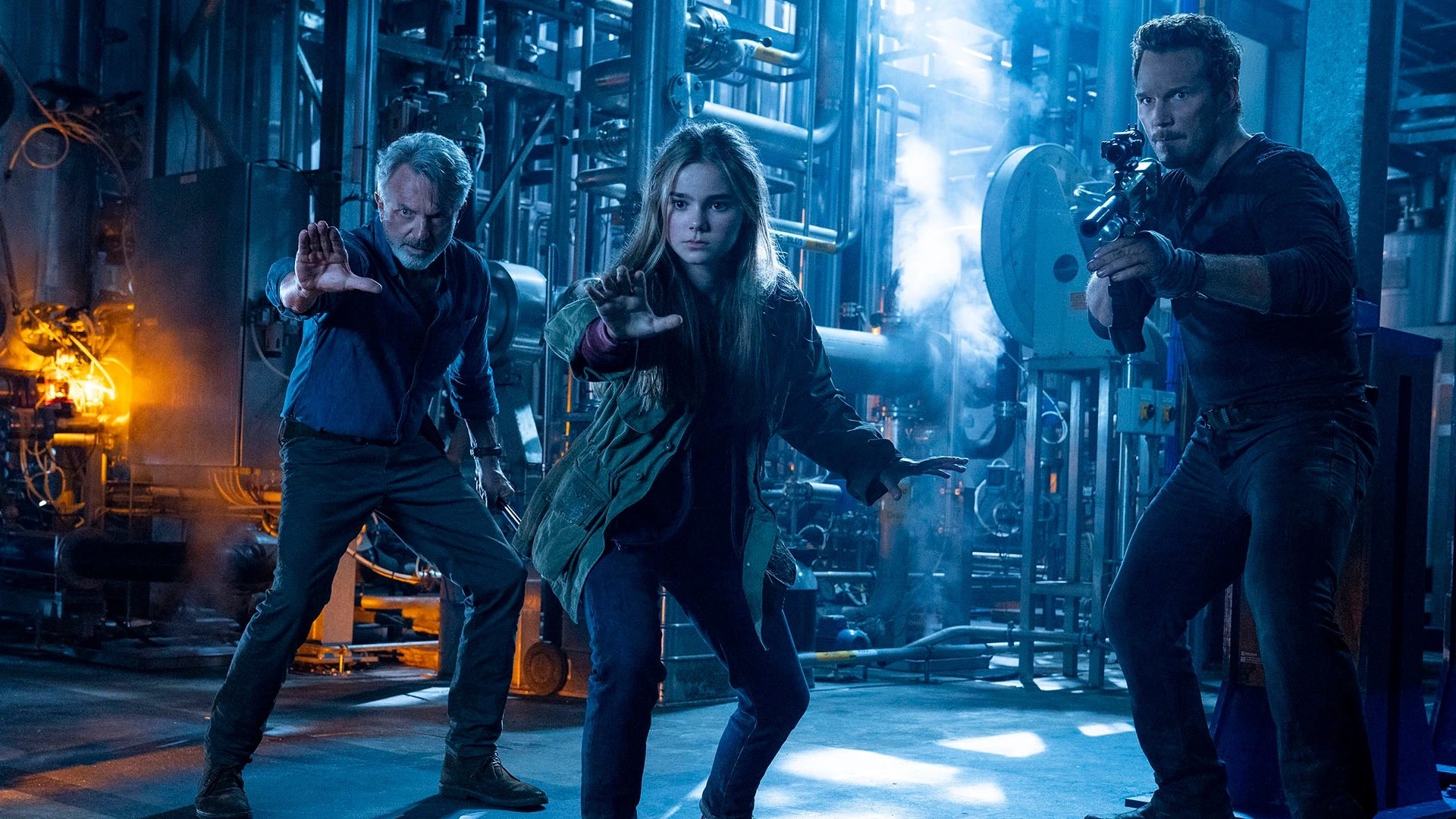
Used to be, when you got to the Part 6 of your movie series it was a bunch of random nonsense with basically no one from the original involved. Now it has to be styled as a Grand Finale with as many original cast members as possible, and lots of talk playing at the idea that this convoluted culmination was a logical possibility all along. It weighs a movie down, forcing it to contrive moments like a character from 1 and 3 sitting down with a character from 5 and acting like she knew her when she was a baby. Okay. Used to be, when you made a dinosaur picture, you kept things fairly simple—somehow, dinosaurs have returned. And now people have to deal with that. You don’t even have to go back to Harryhausen or King Kong for that beautiful simplicity. That was enough for the first few Jurassic Parks. (To that point, Spielberg’s original remains such a paragon of tightly crafted and visually astute big budget thrills, that we’ve long since stopped hoping a sequel could ever match it.) Now, though, this prehistoric creature feature has to be engaged in deep lore, connected through a dozen little references, and building to a potential End Of Life As We Know It. Ah, apocalypse, that old standby of what feels like every blockbuster of the last dozen years. It makes a movie like Jurassic World Dominion overstuffed and, not under-baked, but so over-baked and under-stirred that instead of a smooth, tasty blend, you somehow taste every component ingredient as you chew it over.

The movie may be bursting with references and exposition, but the series, under the guidance of writer-director Colin Trevorrow, has written itself into a tough spot where it has to get weighted down to move forward. Last time, 2018’s Fallen Kingdom, ended with dinosaurs finally fully escaped off the island and becoming the ultimate invasive species worldwide. Quite a cliffhanger. This one picks up by handwaving it a little, skipping over that potential awesome spectacle by saying, eh, we got used to it for the most part. The truly troublesome herds are shipped off to a remote mountain research facility in Italy. It’s here that a science company is fiddling with dino DNA, having secretly engineered a plague of locusts to take out competitors’ crops. This is what catches the eye of the original cast members (Laura Dern, Sam Neill, Jeff Goldblum) who are dragged back into this whole thing to investigate. It’s fun to see them, all in fine form, and quite a contrast to the other returning cast members, Chris Pratt and Bryce Dallas Howard from these last couple. They play a raptor trainer and a dinosaur right’s activist, respectively, and in three movies have accumulated roughly a tenth of the rooting interest that the older cast got in their first scenes thirty years ago. The movie keeps the two casts on separate tracks for most of the movie, as the younger players are chasing after their kidnapped adopted daughter (Isabella Sermon). You may recall that last time they saved a little girl who was an experimental clone of a dead scientist. See how this series has gotten so convoluted?

The wonder, then, is that the movie roars out from under this weight and delivers some actual pulp thrill in its outsized spectacles. The screenplay by Trevorrow and Emily Carmichael may clunk along connecting dots and communicating mostly in undigestible expository dialogue instead of finding ways to communicate ideas visually. But the ideas for action are pretty good, and decently assembled. These include: super-locusts swarming some farm kids; raptors chasing vehicles through the streets of Malta; a cool mercenary pilot (DeWanda Wise) facing off against these terrifying giant lizards by land, sea, and air; and our heroes sneaking through labs, tunnels, corridors, and finally, a forest fire, dodging dinos all the way. Trevorrow is a much better filmmaker now than he was when he made the first Jurassic World, a movie that was more hectic, crowded, and busy than it was well-judged from a visual sense. In Dominion, these action sequences have some momentum and legible direction, pushing along the characters from one plot point to the next with a high-energy rumble and tumble, crash and splash, that matches the needs of the moment. If you just want to see some familiar faces run around with big dinosaur spectacle, well, here they are.

I didn’t have a bad time for most of the time, as I enjoyed the enormous effects of it all. But in the back of my head I was suspecting that I didn’t care about these empty figures and oversized stakes as much as I did the far smaller, simpler, clearer, and more gripping ones back in ’93. (That’s why the clone girl, as weird a swing as it may be for the series, is a more interesting emotional hook than the end of the world. Go figure.) Thus, each sequence works pretty well, and it’s carried along by its size and speed, but cumulatively lands with a thud. It is, in other words, a proficient and enjoyable time in the moment. I was happy to have seen it, even as I found myself walking out, the full impact sinking in, feeling like the Talking Heads, asking myself: how did we get here? This sort of blockbuster should someday feel as dated as the bloated epics at the end of the studio system in the middle of the last century—loaded with technical prowess of high artifice, with good actors playing at phony, and talky, outlines of real ideas against a backdrop of excess. Feels like maybe this could be the end of the line to this sort of thing. Guess that makes it a dinosaur, too.

Wednesday, January 1, 2020

Now and Then: LITTLE WOMEN

Greta Gerwig’s Little Women faithfully adapts that novel’s cozy qualities, its warm-hearted temperament, closely observed sentiment, and its easy grip on its audience’s sympathies. The story of the four March daughters and their quiet domestic pleasantries and tragedies, relationships and developments, is put across faithfully with great spirited sisterly energy, as loving and honest as the best, closest sibling friendships. Certainly, Louisa May Alcott’s beloved novel of Civil War-era family life has produced plenty faithful adaptations before. Gerwig casts well, keeps a good pace, shepherds expert production design and textured cinematography, dramatizes every memorable scene, and has a keen eye for filmic detail. But what really lifts it off and sets it apart is the structure. She takes the two halves of the book — the early younger days where the young ladies are first flowering into adolescence and figuring out themselves and world; and then as slightly older young women as they mature into the adult lives they’ll live — and places them side by side. There are many other adaptations to reiterate the text in sequential order. Here it’s both familiar and fresh, enlivened by the contrast. Cutting intuitively between these two periods of time, each with their own conflicts and concerns, yet intertwined through the personalities of the women involved, there are echoes and comparisons, connections and collisions. Viewing the events in this way is a freshly productive way of understanding the classic story, of seeing anew how the decisions and personalties of girlhood directly inform and shape the outcomes of womanhood as they grow and change, either fulfilling their early dreams or deciding to go about them in a different way.

There’s great maturity and inquisitiveness here, seeing the grown-up concerns of money and careers and family obligations set against the children’s imagination and fervor and mood. It also serves to stack moments of great emotional peaks on top of each other, weddings atop funerals, recoveries atop deathly sickness, reunions atop separations, loneliness atop togetherness. And yet each scene works splendidly on its own, apart from the brilliant structural conceit, Gerwig imbuing the moments with tender humanity and deep wells of feeling. Saoirse Ronan (Jo), Emma Watson (Meg), Florence Pugh (Amy), and Eliza Scanlen (Beth), deftly balancing between the timelines with depth, energy, and poise, make believable sisters, jostling their differing personalties and divergent paths against each other over a consistent underpinning of love. (The rest of the cast — Laura Dern, Meryl Streep, Chris Cooper, Bob Odenkirk, Louis Garrel — is perfectly assembled out of character actors who bring their decades of good work and reliable screen presences to the overwhelming sense of comfort and compassion, even in hard times, in this telling.) With an enveloping spirit of goodwill, charting the family’s dramas in sweet, sharp episodic detail, Gerwig builds to a climax of such tricky dexterity, an intertwining of plot catharsis with a sweetly considered, effervescently casual metatextuality that pays off with delicate, simple visual flourishes and an overflow of emotion. It sees passionately in Jo a creative spirit, all too aware of the compromises expected of her gender and class, headstrong in pursuit of her ambitions, and heartrendingly perceptive about her strengths and weaknesses, borne aloft in the end by the strength of her own story. What a thrill that Gerwig has not only built a fully satisfying, deeply moving retelling of a classic novel, but also builds into the bones a compelling argument about it.

Saturday, December 16, 2017

A New Hope: STAR WARS: THE LAST JEDI


I didn’t know they had it in them, but I’m grateful to be proven wrong. Star Wars: Episode VIII – The Last Jedi is the first great Star Wars movie since creator George Lucas sold his company to Disney. Though run by Lucas collaborators and acolytes – from an ILM and Skywalker Sound stocked with Wars veterans to a story group built out of the prequel days, to a longtime producing partner in Kathleen Kennedy overseeing it all – the results thus far have been mostly successful recreations of franchise sensations past. They were nostalgic, fleet, and fun enough. JJ Abrams managed to introduce a handful of bright and promising new characters along the way in Episode 7 – the searching Rey (Daisy Ridley), stewing dark-sider Kylo Ren (Adam Driver), turncoat stormtrooper Finn (John Boyega), and hotshot pilot Poe (Oscar Isaac). Gareth Edwards and company cobbled together a decent margin note in the franchise’s canon with the heisting of the Death Star plans in Rogue One. But for all that potential, it took writer-director Rian Johnson (whose Brick and Looper marked him as an original voice to watch) to return the sense of surprise to the galaxy. He makes a movie following Abrams’ new characters and some of Lucas’ classic ones into a roller coaster of creative developments.

Where Johnson succeeds is in his molecularly precise evocation of the Star Wars style, not by simply copying faithfully what’s come before, but by returning to the source. He realizes the series is a suis generis blending of Westerns and World War II movies, gangster pictures and samurai films, high fantasy and low serialized sci-fi. He returns to these inspirations for whip-smart visual language, spirited tone, and adventurous spirit, shot through with zen portent and seriousness of mythological import. So once more unto the Star War we go, the sinister First Order seeking to crush the rebellious Resistance once and for all. General Leia (the late, great Carrie Fisher), hoping for the return of her brother Luke (Mark Hamill, soulful and unpredictable), leads the surviving rebels across space, pursued by the evil Supreme Leader Snoke (Andy Serkis). The usual sturm und drang of space battles and aliens worlds follows, with a healthy dose of Jedi mysticism on a far-flung planet where a Master hides from his mistakes and an earnest would-be Padawan desperately seeks his help. He’s their only hope. The Rebels assemble for dogfights and showdowns; the Dark Side and the Light ready their laser swords with patient, spiritual connections in The Force; nefarious characters plot backstabbings and pure-hearted beings become the sparks that will light up the darkness. In the middle is Rey, an ever more exciting new hero movingly unmoored from a sense of destiny, hoping to find her place in all this while Kylo Ren, similarly lost, circles with roiling bad vibes. 

This is rich emotional territory mined with crisp, clear storytelling in painterly precision and elegantly lensed filmic cinematography. It’s big, broad, immediately satisfying storytelling in the tradition of the series’ best moments. Every step of the way, Johnson finds visual invention for his gripping sequences and compelling settings – a bombing run is so crisply, efficiently unfolded, the fate of a character we’ve never before met and who hardly speaks is intensely felt; a dazzling casino world drips in military-industrial power and is larded with slimy monsters of all sorts (and a jazzy alien band to boot); a colony of frog-like nuns caretake a crumbling village surrounded by a sea of squawking bird-beings; a salt-covered planet is streaked in billowing red dust as a battle rages; a red-walled throne room is draped in ominous Dark Side intent; a hyperspace jump shatters plans – and minds. In these thrilling images and places are a host of creatures and more new characters, from a mysterious pink-haired admiral (Laura Dern) to a big-hearted rebel recruit (Kelly Marie Tran) and a slippery thief (Benicio Del Toro). Johnson imagines fun adventures, tense escapes teetering on massive stakes, and pleasing grace notes – First Order office politics, a melding of prequel lore in sequel minds, loving glamour shots of vehicles and tech – while never stepping wrong. 

What a deeply felt outpouring of the finest Star Wars anyone not named George Lucas has managed to get on the big screen! This isn’t a film entirely coasting on old nostalgia (though the familiar sounds of lightsabers, TIE fighters, and the like are powerful generators of it). Nor is it content to simply doodle in the margins of the expected. Johnson uses the old as a runway for new adventure to take off. In the end, I found it poignant to consider how he’s skillfully built in an old franchise a space for new imagination, while connecting to the childlike wonder at the sense of grandiose unfolding mythology that makes it evergreen. Johnson has pulled off a perfect balancing act – a reverent brand deposit that pushes all the right nostalgic buttons while fearlessly unfurling satisfying surprises. It’s a sensation as pure and as real as a kid, head swimming in the galaxy far, far away, picking up a broom and, for a fleeting moment, imagining it a lightsaber.

Thursday, October 13, 2016

Lost and Found: CERTAIN WOMEN


Kelly Reichardt is one of our finest filmmakers. Her keenly judged eye for detail and sense for powerfully felt interiority imbues her films with casual and precise empathetic observation. Her latest is Certain Women, a trio of gem-like short stories so patiently unfolded and deeply considered, each moment, each shot, each breath is used to further their gripping emotional trance. Like the best short stories – these are adapted from the works of Maile Meloy, whose direct prose is of such concision and power she reads to me like nothing less than an Alice Munro, or a modern woman Hemingway – they turn on small shifts of emotion or perception, tremble with unspoken or thwarted desires, and snap shut with satisfying finality nonetheless played with notes of ambiguity. These are stories of isolation and loneliness, of women who need to make connections, feel satisfaction in their lives of quiet desperation. Set in beautifully austere small towns and open spaces of the northern midwest, Reichardt visualizes the quotidian with a poet’s spirit, and understands her characters’ deepest yearnings down to a molecular level.

Here’s a movie that inhabits its characters lives. We don’t just observe their strife or contemplate a crisis. We live with them, understand the rhythms and dramas of their days, and become so closely attuned to their personalities it’s possible to feel the entire weight of a story change in a silence, a stillness, a pause. Reichardt sees these women with great warmth and understanding. We meet a lawyer (Laura Dern) whose troubled client (Jared Harris) is frustrated by lack of progress on his disability claim. Then we spend time with a woman (Michelle Williams) who is scouting limestone for a house she’s building out in the country with her husband (James Le Gros). A stone pile they find belongs to an old man (Rene Auberjonois) with an emotional attachment to the building it once was. Then there’s a young professional (Kristen Stewart) stuck as an adjunct night class instructor, driving hundreds of miles in the dark to and from the course no one else wanted to teach. One student (Lily Gladstone) comes in from tending horses all week looking for a fleeting moment of human connection.

Every role is perfectly cast, sensitively observed, and naturally performed. Watch as Dern sneaks back into work after a long lunch with her lover, her shirt untucked on one side. We can tell that’s unusual, but there’s something about the way she goes about her exasperated day that tells us it’s not the first time she’s let a small detail slip. Later, as her case files are used in a way loaded with danger, we wonder if her drive toward honesty is going to lead her to a bad outcome. (She confides she wishes she was man, but only so her professional life would be easier since a client would listen to her and say, “okay,” instead of continuing to debate.) Williams sneaks in a smoke before meeting her husband, then watches as he presses the old man to make a sale a little farther than she’s comfortable with. This is hardly a showy drama. It’s a story about the subtle pushes and pulls of an awkward encounter. They’re not saying all they could, or maybe should. Everyone has little secrets, small competitions, carefully tentative lines of inquiry.

The thematic strands of the first two stories coalesce in the last, and best. As the inexperienced teacher, Stewart looks uncomfortable with the gaze of the class on her. She shifts and squirms, consults her notes a bit too faithfully as she avoids direct eye contact. (She is cautious and self-conscious about opening up, as evident in a scene in a diner where she wipes her mouth with the napkin without unwrapping it from the silverware.) Gladstone – her open expressions and clenched voice, a shyness barely cracking open in the presence of what she feels, or hopes, is a kindred spirit – is desperate for someone to talk to. Her job isolates her in the fields and the barns, hard work for poverty wages. She looks forward to the class not because she’s passionate about the subject – truth be told, she’s not even technically enrolled – but because she likes exchanging small talk with the instructor. It comes to a head with a long drive, and an agonizingly heavy pause.

Here’s a film with its key capstone suspense sequence simply a long silence while the audience – if on the right wavelength – stretches in rapt engagement wondering if someone will close the gap and say what they need to say. All three stories patiently consider hushed, routine, repetitive lives into which sudden emotional surprises build slowly to small shifts in approach or understanding. It’s an entire feature spun out from a recognizable, relatable, small but fraught instant: the tremulous moment where you’re standing across from a person you’d like to know better and just can’t find the words to bridge the distance. Reichardt has cinematographer Christopher Blauvelt frame the proceedings with a calm camera, aware of the vast the landscapes and the psychological distances between people. She is a tender filmmaker whose restraint has a relaxed rigor. She tells stories of everyday life for people on the margins – at a forest retreat (Old Joy), in poverty (Wendy and Lucy), on the Oregon Trail (Meek’s Cutoff), and in an eco-terrorist enclave (Night Moves). In each, her close attention to the smallest of shifts in mood and demeanor subtly and respectfully draws out the profundity of lived experiences. Certain Women is her best work to date.

Sunday, October 11, 2015

Inequality for All: 99 HOMES


Michael Shannon and Andrew Garfield are opposing economic forces in 99 Homes, a deliberate and obvious recessionary American thriller set in the scraggly, ugly, ragged edge of the popped housing bubble. The older man is a Grim Reaper of real estate, evicting exhausted homeowners in a flurry of bullying panic, the better to flip the house for a nice profit. He’s colluding with banks, police, and lawmakers to line his pockets, exploiting loopholes, cheating the system, and calling that winning. The younger man is one of his victims, a single dad who, along with his son (Noah Lomax) and mother (Laura Dern), is thrown out of his family home after an unsuccessful appeal. Desperate to make money any way he can, he takes a job working for the very man who so slimly kicked his family to the curb. The young guy wears jeans and smokes; the older guy wears suits and vapes. They’re a study in contrasts, naïveté versus cynicism, good intentions versus heartless greed, together making the Faustian bargain we call the American dream.

Painting in big strokes, writer-director Ramin Bahrani combines the low-key observation of his breakthrough indies, films like Man Push Cart and Chop Shop, intimate class-conscious portraits of marginalized urban poverty, and the swaggering melodrama of his overripe corporate-agriculture-fighting-family-farms message movie, the pleasurably outsized At Any Price. The blend is an uneasy mix of scene chewing monologues and pokey naturalism. We follow Garfield as the need for money draws him into the shady underbelly of Florida real estate, the vulture capitalists preying on misfortune sown by the very industry in which they operate. “We don’t bail out the losers!” Shannon snaps, as if he’s prepping to open a Trump fundraiser. He’s made to speak the film’s moral perspective by shouting the opposite, unblinking in the face of the tragedy Bahrani wants to portray. Garfield, on the other hand, is asked to simply inhabit its lessons.

Towering over his new employee, Shannon’s shark lays out his worldview: America is a nation “of the winners, by the winners, for the winners!” It’s screaming blunt moralizing, while the movie’s message is better imbued in Garfield’s uneasy posture and embarrassed expressions as he’s forced to serve eviction notices, suddenly on the other side of the very shock he experienced not so long ago. He is living in a cheap motel room with his son and mother, surrounded by other similarly displaced families. Then he heads out on the job, where he’s creating insecurity in lives of people just like him. It’s a nasty position in which to be, especially when the siren song of material success shows him McMansions glittering for those who are able and willing to step on others to get there. This is the sort of deeply felt hot-button message movie that so cleanly and clearly lays out an obvious wrong, that its most agonizing moments caused bile to build up in the back of my throat.

Watching economic devastation and its exploitation is hard to take, especially as Garfield’s pained expression and torn conscience run up against the cold eyes of Shannon’s harsh money-grabbing, property-cheating worldview. It’s all too real, and yet Bahrani pushes past the immediate feeling of right and wrong, overemphasizing the devilish bargain with overheated speeches and undercooked characters. They’re symbols, no matter how good the actors are. Garfield is every blue-collar worker shoved out of a comfortable life, and Shannon is every suit who did the pushing. There’s not a lot of nuance here in the design, a defeatist plot loaded with coincidences, built only to shine a light on a murky corner of wrongdoing presented in obvious dichotomies. The muddy digital photography, at times a nearly unwatchable storm of fuzzy washed-out pixels, is an inadvertent compliment to the film’s unsatisfying approach: it’s too bright, and too smeared, starkly revealing too much while flattening the picture.

Still, what keeps this well-intentioned monotonous one-note movie marginally interesting are the performances. Garfield and Shannon are allowed space to breathe complexities into their characters that aren’t necessarily inherent in the material. The former reveals mild shark-like ambition through his psychological and economic turmoil, shaking off sadness to earn some dough, while the latter lets sneaking warmth bleed in around the edges of his evil eye for exploiting his worst tendencies. Then there’s Dern who plays the pure conscience of the movie, with literally nothing more to do than register the wrongness of what’s going on around her. She somehow makes that into something like a real character, a minor miracle. But what Bahrani does with these characters is so schematically obvious, clashing two mirrored men in an uneasy business relationship to the breaking point, the better to leave us wrung out with reminders of our country’s debased and broken response to continually deepening inequality.

Wednesday, December 3, 2014

Walkabout: WILD


Wild is a movie about a troubled woman who sets off by herself and walks over 1,000 miles in three months. It’s a literal journey of self-discovery. The most admirable aspect of the film made out of this trip is its willingness to downplay the discovery in favor of the experience of the isolation. We see her trudge across the wilderness of the Pacific Crest Trail reflecting on her life, cataloging her mistakes, confronting her regrets, and emerging on the other end with a greater understanding of herself. She’s not an immediately better person, but we see the seeds of awareness that will hopefully be flowering in her future. Because the movie’s based on author Cheryl Strayed’s bestselling memoir of the same name, we know she’s about to see better days. The movie doesn’t linger overmuch on her change, giving center stage to the steps along the way.

We meet Cheryl (Reese Witherspoon) as she begins her long hike, struggling to stand up after overloading her backpack, a rookie mistake. In other words, she’s dealing with some heavy baggage. Get it? We don’t know why she feels the need to attempt this walk, but there’s a real unease in Witherspoon’s demeanor, a hollowed out rawness that’s about to be bruised and blistered by her chosen ordeal. She’s always been a smart performer, even in movies so breezy or junky (like Legally Blonde or Fear) that it was easy to take her for granted. There’s intelligence behind her bubbliness, her charm, her bright eyes and petite stature. Here, she’s tapping into a shrewd wounded intelligence that’s flatter and glummer than we’ve seen her in quite some time. Her character is in a mental space that slowly reveals itself as coming from a place of addiction and grief.

It’s a terrific performance that anchors what is essentially a character study with a mystery at the center. Who is she? What brought her to this place? That was enough to keep me at least mildly interested. As we follow Cheryl’s walkabout, her backstory is filled in with non-chronological flashes of past. It becomes clear she’s a person whose life hasn’t gone the way she’d hoped, hitting a rough patch of unwanted pregnancy, divorce, substance abuse, and infidelity. We see her relationship with her ex-husband (Thomas Sadoski), and her free spirit mother (Laura Dern). Other figures from her past (like Gaby Hoffmann) come to her mind. Meanwhile, in the present, she encounters all sorts of characters on the trail, fellow hikers, farmers, hippies, college kids, and a guy who says he’s a reporter for The Hobo Times. It’s uneven by its very nature. When it works, fine, but when it doesn’t, I was wishing it would hurry up and move on to the next stop.

Whatever small restraint screenwriter Nick Hornby (About a Boy, An Education) and director Jean-Marc Vallée (Dallas Buyers Club) show in refusing to find easy lessons in a real life’s complications is partly undone by their stumbling approach caught halfway between sentimental uplift and artful impressionism. It’s a wobbly mix of earnest self-help sparkle and collage of memory and pain. It neither solves the problem of the episodic repetition of depicting the long, mostly lonely, walk, nor uses the grinding monotony of her journey as experiential aesthetic. It gives her moments of insight, danger, despair, and connection, but seems to be trudging along, hitting its emotional mile markers more than it is evoking her mental and physical state.

She’s broken down spiritually, and has to break down bodily to begin to build back up again. That’s moving. Witherspoon’s performance sells it. But the movie itself is at a loss as to how best maximize that asset. Hornby’s script makes fine connections and moving juxtapositions, but Vallée’s direction is so self-consciously loose and scruffy, slipping from past to present with a flat-footed sense of obviousness. He’s simply pointing his camera at ideas of womanhood, literature, illness, and wilderness without actually engaging with the content. It’s representation, not interpretation. Perhaps that’s why he’s so good at capturing great performances and then diluting their potential impact by entombing them in glossy but flavorless movies, like McConaughey in Dallas Buyers Club or Emily Blunt in The Young Victoria. Wild is the best of the three, especially worth seeing for Witherspoon successfully stretching her acting muscles. But I wished it could’ve been a wilder, more adventurous movie to better match the material and be worthy of its lead’s good work.

Saturday, June 7, 2014

Love, Cancer Style: THE FAULT IN OUR STARS


They’re young. They’re in love. They have cancer. She meets him in a support group for kids with terminal illnesses. She needs an oxygen tank to breathe. He has an artificial leg. They’re in remission, but for God only knows how long. She’s only alive because of an experimental treatment. No one knows if and when it’ll stop working. He’s only alive because he gave up part of his leg. They hit it off right away. Their chemistry is immediate, obvious, and overwhelming. They feel comfortable together. Maybe it’s because for them love means never having to say you have cancer.

That’s the basic premise of The Fault in Our Stars, a teen romance wrapped tightly around a disease-of-the-week weepy. What makes it work is the strength of the performances, which are clear-eyed and emphatic, and the writing, which is sappy and sentimental, but never loses a sense of humor and perspective. This isn’t a blinkered story of doomed true love. It’s a story about two sick kids who make a connection in what just might be their final days. Rather than letting this possibility weigh the film down, it’s simply accepted as a reality. They’ve been living with their diagnoses for years now. They’re used to it.

The girl, Hazel, is our entry point into the story. Played by Shailene Woodley, she’s a bookish, contemplative girl who appreciates the time she’s given, while wondering why she can’t have the freedom to be a little more of a normal teen. She certainly doesn’t want to go to the support group in the bottom of a church basement, where the sweet man with testicular cancer (Mike Birbiglia) makes everyone listen to his acoustic guitar playing. She goes anyway, and meets Augustus (Ansel Elgort). They can’t keep their eyes off of each other. Afterwards, they hang out. Soon, they text back and forth. It’s a typical modern teen flirtation sliding easily into romance. If it weren’t for the cancer, it’d almost not be worth telling. The disease gives their flirtation underlying, unspoken, urgency.

Woodley and Elgort’s performances are appealing and comfortable. Woodley makes even the corniest narration sound like nothing more than what a reasonably intelligent teenager might be thinking. She has an open face and wet eyes that communicate a sadness and wonder, convincing as a person who has been sick since she was a child, and is tentatively forging a new relationship despite her worry about hurting one more person with her death. Elgort’s hugely charming, playing the type of cocky that can only be compensating for fear. And yet he seems totally at ease. He has to be the dreamiest, most Tiger Beat-ready cancer patient I’ve ever seen, confident and glowing with a love of life. They look good together, banter well, and are easy to root for.

The supporting cast is filled with terrific actors as parents and fellow support group members. Laura Dern is especially good in a role of maternal warmth and care as a woman for whom caring for a terminal child has become second nature. She has a devastating flashback scene, weeping while trying to comfort her hospitalized daughter, that’s so good it’s repeated twice. Nat Wolff, who between this and Palo Alto is cornering the market on troubled-best-friend teen roles, plays a kid with cancer of the eyes, nervously awaiting surgery that’ll leave him blind. That he’s good comedic relief should tell you something about the movie’s approach. It’s not morose or death-obsessed. It’s about people living their lives one day at a time complete with tiny triumphs, interesting anecdotes, sad setbacks, and funny jokes.

There’s nothing visually interesting about the movie. It’s simply lit and full of medium and close-up two shots, what we’d more easily call TV-like before TV went and got a smidge more cinematic at its upper edge. Director Josh Boone gets fine performances out of his cast and keeps the style merely functional, stepping out of the material’s way. It’s based on a popular novel by John Green, who wrote a well-oiled melodrama machine. I mean that in a good way. Screenwriters Scott Neustadter and Michael H. Weber (of (500) Days of Summer and The Spectacular Now) retain its most appealing elements, faithfully flavoring a low-key and sympathetic story about families living with a sick child with fantasy romance elements. The main characters have an idealized perfect teen love that’s all the more intense for the cold reality of cancer potentially growing within them.

The movie has a brisk pace, humanizing detail, and a good-humored snap to the dialogue. It hits metaphors a little too hard – a scene drawing a parallel to Anne Frank is misjudged – but, in its simple scenes of characters interacting, it is often deeply felt. It’s gooey, sappy at times, intent on wringing a tear or two out of the audience. But it’s warm, appealing, and never loses sight of the characters, balancing their youthful vitality and the deadly stakes of their conditions. Most importantly, they’re rarely reduced to their types. They’re presented as people who laugh, dream, plan, hope, think, and love. They try not to let their disease define them. That the movie doesn’t either is to its credit. And that’s what makes this glossy, bright, manipulative Hollywood drama an engaging entertainment that can hit authentic, tearful notes.

Saturday, April 6, 2013

When Dinosaurs Ruled the Multiplex: JURASSIC PARK


Returning to Steven Spielberg’s Jurassic Park, back in theaters for its 20th anniversary, is a hugely enjoyable experience. The by-now classic story of a theme park of cloned dinosaurs descending into chaos one stormy weekend is not simply the fun dinosaur picture I had thought it was as a younger person renting the VHS. Seeing it dwarfing my senses on the big screen reveals it to be an uncommonly skillful work of blockbuster engineering. Its building blocks are stock schlock spectacle with a pulpy Michael Crichton novel streamlined by the author and David Koepp into a screenplay of B-picture archetypes: the noble scientists, the kindly mad billionaire, the smarmy lawyer, the slimy saboteur, and the cute kids. What Spielberg and his collaborators understand is that just because a scenario lends itself to certain tropes doesn’t mean it can’t transcend them through masterful craftsmanship.

This time through, I was struck most of all by the film’s structure. At the time of its release, some complained that it got to the point too quickly, unlike the long tease of Spielberg’s Jaws. Why, the scientists gape at a living, breathing CGI brachiosaurus first thing upon arrival at Jurassic Park, after all. Those critics were so dazzled by the effects that they felt they were a distraction. Now, though, when CGI spectacles can and do cram digital doodads into every cranny of the frame and modern pacing would have a full-blown dinosaur setpiece in the first reel, it’s easier to see how the time in the Park is so carefully built up. For a long period of time, we follow Dr. Grant (Sam Neill), Dr. Sattler (Laura Dern), and Dr. Malcolm (Jeff Goldblum) as the white-haired rich man (Richard Attenborough) introduces them to the way the theme park operates and the audience gets to hear all about each of the dinosaur species and their behaviors. Spielberg dips into pleasant popcorn philosophy – chaos theory, “life will find a way” – and introduces cute, instantly sympathetic kids (Joseph Mazzello and Ariana Richards) while casually situating lived-in performances into a just-convincing-enough sci-fi scenario.

Part of what gives pleasant weight to these quickly sketched and off-handedly fully-formed characters is the sense that the performers are finding ways to put unexpected twists on the sometimes clunky lines. They may be archetypes, but they feel pleasingly low-key and real, or at least real enough. Goldblum’s always been a master at putting an offbeat cadence to his dialogue, looping words around as if they’re arriving in his head so quickly that they back up while he decides if he’ll second guesses each clause as he speaks them. Dern is always quite good as well. At the time, she was coming off a string of eclectic performances in the likes of Peter Bogdanovich’s Mask and David Lynch’s Wild at Heart and here provides a center of glowing capability. She, like Sam Neill (also doing great work), provides the film with a great center point. They’re sympathetic and knowledgeable professionals and it helps ground the film in a feeling of determined professionalism. I especially like the subtle arc their relationship has. It’s romance underplayed marvelously. Between that and the fairly restrained Grant-learns-to-like-kids sub-subplot, those who fault Spielberg for hitting emotional beats too hard should find some pause.

When the dinosaurs attack, the scientists and park technicians for the most part maintain a sense of scientific curiosity and harried practicality. They leave the freaking out to the audience. And what a freak out it is. When the power goes out and the storm rolls in, the movie about a theme park gone mad turns into the ultimate amusement park ride, delivering jolts of perfectly orchestrated creature feature horror at irregular intervals. By now, we’re well aware of what the park’s limitations are and what the dinosaurs are capable of. Spielberg has been operating with the knowledge that the best roller coasters aren’t all high-speed dips and loop-de-loops. You need plenty of time to build there through a meticulous climb. It can make the drop all the more fully, memorably terrifying to be aware of the danger well beforehand. Say the words “raptors in the kitchen” to anyone who has seen Jurassic Park and the whole tense sequence comes rushing back.

To the tune of John Williams’s tremendous score, Spielberg, with cinematographer Dean Cundey and editor Michael Kahn, brings a wit to the staging and a satisfied snap of no-nonsense visual competence to the setpieces. The utilitarian pop art beauty of the imagery captures visible beams of Spielbergian high-powered flashlights and casually emphasizes gadgets and weaponry, making vivid figures of action out of convincingly real-world workaday academics and scientists. The film becomes a relentless thrill machine that builds terror as much through anticipation as on screen happenings. In a film of spectacular (and largely still convincing) dinosaur effects (a blending of practical and then-new computer graphics), one of the most memorable images is the simplest, the sight of vibrations rippling in a cup of water, an ominous impact tremor of foreboding, foretelling the arrival of a T. Rex on its way. Because we’ve come to know and care about the characters and are well aware of the potential carnage the prehistoric creatures can bring, Spielberg can make the sight of a character staring past the camera at something unseen by us so nerve-wracking. And then, out pops the dinosaur, teeth chomping, roar rattling the theater’s speakers. It’s worth the build up to be so startled.

Spielberg’s a master filmmaker not because he can get these responses, but because he can modulate so quickly without losing a grip on the audience’s emotions. Take, for instance, the sustained terror of the first T. Rex attack. Its massive head has burst through the sunroof of the first jeep, pinning two screaming children underneath its gnashing teeth. We cut to the second jeep for a split second as Goldblum wipes fog off the windshield so he can see what’s going on. It’s such a slight release that it registers as both a funny throwaway gag and a minor escalation of tension by denying information about the real danger for that moment. Jurassic Park is perhaps the best creature feature of the last two decades, much like Spielberg’s own Indiana Jones films are the best adventure serials of the last three. He, to paraphrase Hitchcock, another master audience manipulator, gets pleasure out of playing the audience like a piano. It works just as well today as it did when it was first released. Just ask my sister, who saw it for the first time ever when I took her with me to the multiplex yesterday. She was quite literally on the edge of her seat.

Note: The rerelease is unfortunately in largely superfluous 3D. It subtly pops the depth in a few moments and sometimes a blurry object in the foreground will appear marginally closer that it should. I, for one, was happy that it was unobtrusive enough that I quickly forgot it was 3D at all and simply enjoyed seeing the movie again.