Showing posts with label Meryl Streep. Show all posts

Sunday, February 6, 2022

Falling Skies: MOONFALL and DON'T LOOK UP

Moonfall is so perfectly awful I was almost charmed. In this high-gloss chintzy approximation of an A-level blockbuster 90s disaster picture, the moon has been knocked out of its orbit. Every time it circles the Earth, it gets closer. That thing’s bound to crash. It’s such total lunacy—and gets weirder by the reel—presented with casual pomposity stretching beyond its budget. It has a choppy opening hour that over-complicates every subplot and races through exposition as if it half-heartedly realizes we won’t care about its convolutions. As the ensemble is brought on stage and the moon looms larger, the vast cast is sketched in with shorthand and cliche. There’s disgraced astronaut Patrick Wilson and glamorous NASA chief Halle Berry and annoying pudgy British wannabe scientist John Bradley, each with a part of the solution as to how to get the moon restored to its proper place before it touches down. Also in the mix are the usual ex-wives, step-fathers, elderly mothers, conspiracy theorists, foreign exchange students, troubled adult sons, adorable moppets, and a general with a key to the nukes and a reluctant trigger finger. All the while, passable effects whip up CG floods as tides go wild, flooding cities of panicking refugees and looters before, during, and after the gravitational disruption kicks off earthquakes.

Where once these sort of big-screen natural disasters lingered on their big effects moments, now they can just wallpaper indiscriminately until it leaves little impact. It’s the kind of movie that relocates the top of the Chrysler building and barely blinks an eye. (The best moments are the most novel, in a crackpot derivative way: a space shuttle outracing an enormous gravity wave, or exploring the secret inner chambers of the moon.) But there’s an odd underplaying throughout, like when a son looks at his father, on the brink of potential apocalypse, at the moment a last-ditch plan has fallen through and shrugs: “I’m sorry that didn’t work out.” The second hour is a little zippier, and moderately wilder, as the apocalyptic stakes cut between a daring mission into the center of the moon, and a family trying to get what appears to be a mile or two down the road back on Earth. The imbalance is a little funny. Par for the course is when the general stares down a guy who wants to bomb the moon and says: “You can’t do that! My ex-wife’s up there!!”

So it’s good for a few laughs, and it might remind you passingly of better sequences in other movies like it. But that the production is helmed by Roland Emmerich, a king of the industrial-strength big budget ensemble disaster flick, having Independence Day, The Day After Tomorrow, and 2012 on his resume, gives it the distinct feeling of a director making his own knockoff. It hasn’t the balance between the spectacle and melodrama that the better versions of the disaster ensemble can pull off. Heck, even his own former co-writer Dean Devlin did a better spin on the all-star global calamity space-junk explode-o-rama with the under-appreciated gargantuan cheese wheel that was Geostorm a few years back. One of that movie’s stars, Gerard Butler, even did it well in a more serious register with the oddly affecting meteor-on-the-way thriller Greenland from Christmas before last. (It went VOD, like the bulk of that season’s offerings, so who knows how many actually saw it?) Just goes to show you we are in a little boom for talking our destruction to death. Gee, what could cause that? We can't expect every attempt to work well.
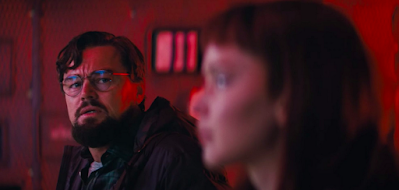
At least all of the above are better than Don’t Look Up. That movie imagines a world-ending calamity is on the way, and getting people to care about or even accept the reality of the situation, let alone examine possible solutions, is nigh impossible. Sounds familiar. Adam McKay wrote the movie as a climate change parable, but the intervening pandemic and its response surely fed into it as well. Here we open on two scientists at Michigan State University (Leonardo DiCaprio and Jennifer Lawrence) identifying a planet-killing meteor that’ll hit Earth in a matter of months. They try to alert the government, but the president (Meryl Streep) is too image-obsessed and election-focused to care and demands the information hidden. (The movie’s funniest joke is her son (Jonah Hill) insisting on double checking the info with experts from a better college. Ha.) So the scientists try to leak it to the media, but most outlets don’t care, and the best they can do is getting laughed off a morning show whose hosts (Cate Blanchett and Tyler Perry) can’t bring themselves to understand what their incongruously serious guests are trying to say. There’s clear anger in this telling, a well-intentioned ranting about humanity hurtling toward its doom and too ignorant and selfish to face it and fix it.

But as the movie spirals and complicates for over two hours, it stays on that grinding pitch of justified anger. It starts to seem less sharply targeted and more tiresomely mismanaged. The characters, no matter how well-acted by an all-star cast, are broad caricatures, and McKay’s rush to condemn doesn’t leave time to actually understand their motives. This is a bloated political cartoon stumbling backwards toward preordained conclusions. Compare it to, say, Dr. Strangelove, and you’ll see how Kubrick’s classic dark comedy of nuclear annihilation is a witheringly hilarious look at nightmarish Cold War logic precisely because it understands how fallible and specific personality types could stumble toward accidental apocalypse. Here, though McKay has understandable outrage at the prevailing forces of prevaricating pundits and the corrupt short-term individualism eroding all sense of common good, he’s made a movie that’s the equivalent of a “raising awareness” campaign. Yeah, I know, and I agree, somewhat, I think. But now what?

This sociopolitical comedy is still somehow McKay’s best of that sort, though this, Vice, and The Big Short are all considerable steps down from his Anchorman, Talladega Nights, and Step-Brothers heyday. He no longer makes exuberantly goofy comedies with serious subtext. Now he’s making self-serious political comedies where his Big Ideas are all on the surface where they won’t stop needling, jabbing, scalding, and condescending at the expense of entertainment and, just as deadly, a point that can get past the surface of the matters on display. Attacking shallowness with shallowness without even the deceptive nuance that, say, Verhoeven might bring, is awfully wearisome. He’s clearly an intelligent and passionate thinker—but when his works about Wall Street corruption or Dick Cheney flatten out the issue as they scream to the choir that it’s all our fault, too, well, if you’re going to think so little of your audience, at least you could actually be better than them. These movies are both contemptuous and scatter-brained. He really thinks he’s telling you something new and vital instead of repackaging common complaints. It looks at massive systemic issues and futilely wags its finger at the viewer. We’re all implicated, yes, but now what do I have to do about it?

As Don’t Look Up widens its lens, with some vigorous absurdities that sparkle here and there, it bogs itself down and clutters itself up with characters and plot lines all pushing in the same direction at the same grim pitch: our society is incapable of saving itself. Everyone’s pathetic and cringingly one-dimensional. There are red-meat military men (Ron Perlman) and weary astronomers (Rob Morgan) and social media celebrities (Ariana Grande and Scott Mescudi) and right-wing propagandists (Michael Chiklis) and progressive journalists (Himesh Patel) and a tech billionaire cutting a real Musky Zuckerbergian Bezoar (Mark Rylance), among others. No one can meet the moment. Of course there’s even a right-wing messaging movement to just avoid the issue entirely. “Don’t Look Up” becomes their rallying cry. (Years of “if climate’s changing, why do we have winter?” and “if masks and vaccines work, why is there still COVID?” make even that sadly believable.) To watch a government and society flailing in the face of overwhelming disaster is painfully familiar. That the movie is willing to condemn a shallow media, lying right-wing authoritarians, and neoliberal corporate shills is not nothing. But the cast is stranded in a movie with ugly blocking and clanking rhythms, scenes that feel hacked together and indifferently covered, unable to build up character or perspective beyond the movie’s insistence that all of these horrible, fallible people are worthy of our scorn.

Though there’s plenty of blame to go around, the movie ends up somehow too much and not enough. Yes, this is a close match to the lunacies we’ve seen lately, and it carries that out to its logical calamitous conclusion on an apocalyptic scale. But it’s not exactly a thrill to see a movie as mean and absurd and judgmental as those it’s trying to condemn. Its final image of cynical comeuppance—spoilers: a nude body double standing in for a beloved actress getting chomped by a CG creature—is the ultimate grotesquerie. By then, the whole final stretch of the film leading up to it, a wild mix of surprise unearned sentiment and nihilistic cynicism and cheap nasty gags, has already made it clear the movie has nothing meaningful to explore or suggest. What a bracingly stupid movie: whipping up a frenzy of ugliness to serve as a funhouse mirror of our current problems and expecting us to thank it for its meager insight. Hey, at least it has a couple laughs, too.

Monday, April 12, 2021

Myth, Legend, Man: HEMINGWAY

Ernest Hemingway was only a man, after all. How’s that for a lede Hemingway himself might’ve enjoyed? For a writer interested in masculinity — a writer of tough, lean, declarative sentences so stripped and spare and straight-to-the-point that one can practically hear the clattering typewriter painstakingly stamp out each letter — he lingers in the public imagination as everything complicated suggested by that designation. At this point he’s passed into cultural assumptions and cliches. We remember him for bull fighters and trench ambulances, for drinking and womanizing, for excursions and adventures, for hunting and fishing, for boating and safari, for shooting and killing. He puffed himself up through self-mythologizing, then sometimes lived up to it. But above all else, he’s a writer and a man. He wrote what he knew. He observed closely, keenly. He wrote careful prose, confronted the difficulties of life. He’s a great writer. And like all great writers he is both exactly what we remember him for, and so much more. He may be a lion of literature, a legend of letters, but he is still only a man and all the complications and contradictions that implies. He was talented — a once-in-a-generation-if-we’re-lucky author who, as Tobias Wolff says, “rearranged the furniture” of American literature. And he was mortal, troubled, fallible, complicated. He was capable of writing about people and places, inner lives of men and women alike, with such vividly drawn and precisely rendered minds suggested in evocative detail drawn in poetic simplicity. And yet he could also treat those around him — his wives, his children, fellow writers, even himself — with breathtaking cruelty. He was masculine to the max, and interested in understanding women, and playing with androgyny. He was quintessentially American, and loved nowhere more than Paris and Cuba. To wrestle with his work is to recognize his genius, and to acknowledge him as a man wrestling with himself.

He’s a figure perfectly suited to the Ken Burns style, intersecting as he does with so many of the great documentarian’s usual thematic interests: Americana, war, letters, literature, the ways social forces and big personalities impact each other. Burns, surely among the most consistent  of working documentarians, and his usual collaborators (co-director Lynn Novick, historian Geoffrey C. Ward, narrator Peter Coyote) load up the six hours devoted to Hemingway with their usual style and technique: perfect pans across striking photographs and documents, well-curated historical footage, an all-star voice-over cast (Jeff Daniels, Meryl Streep, Keri Russel) bringing writings to life, and a handful of literary critics, academics, and writers speaking to the history. Burns’ sturdy filmmaking is not surprising in its construction, but builds to wonderful revelations all the same—a soft, poetic joining of ideas and images that invites contemplation. It may not approach the majesty of his masterpieces (his epic The Roosevelts — a wide ranging, big-picture historical view with all the moving intimacy of close, personal portraiture — is his finest hour in my book), but there’s value to his approach to historical documentary. This particular work digs deep into the man’s life and work, treating both with the rigorous criticism and beneficial biography that builds a full portrait. Brushing past the easy received wisdom — confronting his family’s perspective, allowing debate over some works, acknowledging his blind spots and blurred lines — it leaves you with a good sense of the man and his times, and why, exactly, his work was and remains such an important moment in literary history.

It’s like the best professorial lecture on the topic at hand. There’s a firm steadiness in Burns’ filmmaking that slows the breathing, quiets the mind, and makes one open to listen and interpret, make connections, push back on claims or welcome new information. It also makes the few bum notes — like the late John McCain saying he understands why Hemingway would kill himself — clang. Yet one only needs to see how dry, slow, scattered or undigestible Burns’ imitators’ films are to see what makes his team’s series special. He brings an immediacy to the artifacts, an intellectual engagement to the voices he selects, and a willingness to contrast talking heads. For instance, here Edna O’Brien, who earlier speaks emotionally and persuasively about the short story “Up in Michigan,” scoffs at The Old Man and the Sea, immediately followed by Mario Vargas Llosa declares it his favorite. Burns is building a careful, dense, and thorough picture. But the whole grand sweep of it becomes like sitting in on a great conversation about a notable figure, several hours marching through the chronology of a fascinating life in the company of interesting people arguing for a great writer. Best of all, it sent me back to my bookshelf, to pluck down a volume of Hemingway’s stories and reread them with renewed eyes and even deeper appreciation.

Sunday, December 13, 2020

Dance Revolution: THE PROM

If nothing else, The Prom is a testament to the irresistible power of a great schmaltzy Broadway finale. For even though the movie loses its way for most of the second act, when the cast finally gathers as a group to belt out their big cathartic final number, the confetti flying and everyone getting their happy ending and a few bars to contribute to the whole, I teared up, tapped my toes, and felt pretty good about the whole thing. Based on Bob Martin and Chad Beguelin’s chipper stage musical of recent vintage, the movie has been directed by Ryan Murphy, whose usual gonzo go-for-broke faux-camp artificial wildness (the reason his TV work’s promising potential is usually sooner (Glee) or later (American Horror Story) driven off a cliff) is tamped down by the fact he’s not the writer. That’s why his work on The People vs. O.J. Simpson and Pose is his finest to date; he’s a talented technician when he has someone around to keep the narrative consistent. He loves bold colors and broad performances, a camera that glides on greased tracks to push in, fly back, or spin around characters, poking at touchy subjects with a heavy handed light touch in a style that stops well short of the apoplectic opulence of a Baz Luhrmann, but cuts quick and flashy enough all the same. Here the material is his sunniest, most cheerful, most actually optimistic instead of the not-so-hidden cynicism undergirding his previous trips back to high school. It has big “It Gets Better” energy. Perhaps it is because the satire is so mild, and largely contained in the outsized presence of a quartet of Broadway has-beens and never-weres at the center. Here’s Meryl Streep and James Corden and Andrew Rannells and Nicole Kidman — an odd combination — swanning into small-town Indiana hoping to soak up some free rehabilitating social media buzz by coming to the loud defense of a lesbian student (Jo Ellen Pellman) who won’t be allowed to go to prom with her date. The sneering down-the-nose condescension of the stars is good for a laugh, as they steal focus while declaiming that this scene isn’t about them, and the movie sometimes forgets it isn’t, too.

The plot deftly balances their pomposity with chipper prom prep and the small-town dilemmas of being gay in a conservative area, albeit with some recognition that the town wouldn’t homogeneously be opposed (Keegan-Michael Key is a warm-hearted theater-loving principal in contrast to the clenched PTA president, Kerry Washington). The first hour flies along with buoyant good spirts and toe-tapping numbers—a dancy promposal roundelay past lockers and bleachers; a clandestine closeted love ballad; a giddy getting-ready song in an unrealistically bustling mall; a wide-eyed tribute to the transportive and transformative ability of a great Broadway show. And it all reaches a great, sympathetic Act I climax that’s one of those beautiful win-but-lose send-em-to-intermission buzzing numbers. Unfortunately, most of the good songs are in that first hour, and the rest is a drag of tedious character beats that forces one to realize the characters are thin stock types, and the balance of Broadway divas to small-town teens goes a little awry. What are we to make of mean popular kids changing their homophobic ways just because an actor sings jokes about the Bible at them in a food court? It’s a cute number, but elides complications, and builds up the movie’s gleaming theatrical falseness. Still, we’re on our way to a great finale, and the cast is so high-energy, hoofing it well and selling corny theater punchlines. And the heart of the matter remains such a lovely open-faced introductory star turn from a young actress playing a likable girl whose struggles with being out and ignored in her cramped Indiana town resonates through the second act doldrums. I left humming the good songs and remembering the good times. Like a troupe of theater kids, it means well and has a good time, even if it's annoying sometimes.

Wednesday, January 1, 2020

Now and Then: LITTLE WOMEN

Greta Gerwig’s Little Women faithfully adapts that novel’s cozy qualities, its warm-hearted temperament, closely observed sentiment, and its easy grip on its audience’s sympathies. The story of the four March daughters and their quiet domestic pleasantries and tragedies, relationships and developments, is put across faithfully with great spirited sisterly energy, as loving and honest as the best, closest sibling friendships. Certainly, Louisa May Alcott’s beloved novel of Civil War-era family life has produced plenty faithful adaptations before. Gerwig casts well, keeps a good pace, shepherds expert production design and textured cinematography, dramatizes every memorable scene, and has a keen eye for filmic detail. But what really lifts it off and sets it apart is the structure. She takes the two halves of the book — the early younger days where the young ladies are first flowering into adolescence and figuring out themselves and world; and then as slightly older young women as they mature into the adult lives they’ll live — and places them side by side. There are many other adaptations to reiterate the text in sequential order. Here it’s both familiar and fresh, enlivened by the contrast. Cutting intuitively between these two periods of time, each with their own conflicts and concerns, yet intertwined through the personalities of the women involved, there are echoes and comparisons, connections and collisions. Viewing the events in this way is a freshly productive way of understanding the classic story, of seeing anew how the decisions and personalties of girlhood directly inform and shape the outcomes of womanhood as they grow and change, either fulfilling their early dreams or deciding to go about them in a different way.

There’s great maturity and inquisitiveness here, seeing the grown-up concerns of money and careers and family obligations set against the children’s imagination and fervor and mood. It also serves to stack moments of great emotional peaks on top of each other, weddings atop funerals, recoveries atop deathly sickness, reunions atop separations, loneliness atop togetherness. And yet each scene works splendidly on its own, apart from the brilliant structural conceit, Gerwig imbuing the moments with tender humanity and deep wells of feeling. Saoirse Ronan (Jo), Emma Watson (Meg), Florence Pugh (Amy), and Eliza Scanlen (Beth), deftly balancing between the timelines with depth, energy, and poise, make believable sisters, jostling their differing personalties and divergent paths against each other over a consistent underpinning of love. (The rest of the cast — Laura Dern, Meryl Streep, Chris Cooper, Bob Odenkirk, Louis Garrel — is perfectly assembled out of character actors who bring their decades of good work and reliable screen presences to the overwhelming sense of comfort and compassion, even in hard times, in this telling.) With an enveloping spirit of goodwill, charting the family’s dramas in sweet, sharp episodic detail, Gerwig builds to a climax of such tricky dexterity, an intertwining of plot catharsis with a sweetly considered, effervescently casual metatextuality that pays off with delicate, simple visual flourishes and an overflow of emotion. It sees passionately in Jo a creative spirit, all too aware of the compromises expected of her gender and class, headstrong in pursuit of her ambitions, and heartrendingly perceptive about her strengths and weaknesses, borne aloft in the end by the strength of her own story. What a thrill that Gerwig has not only built a fully satisfying, deeply moving retelling of a classic novel, but also builds into the bones a compelling argument about it.

Sunday, August 9, 2015

Drift Away: RICKI AND THE FLASH


Ricki and the Flash is a humane family drama, warm and sympathetic, and without easy answers or cheap dramatics. It’s low-stakes and character-centric, attuned to relationships shifting slowly, in which an emotionally constipated family’s mostly buried grievances burble up and quiet back down again. When the credits roll, there’s no simple sense of closure. I don’t think this family has fully reconciled their disagreements, but I do believe they’re a little closer to happy than they were at the movie’s start. It’s comfortable mainstream entertainment smart about the way big life changes happen not through momentous milestones, but through small decisions that recalibrate mood and intention. Some of the characters are vaguely defined, and the ending is rushed, but there’s a solid center.

The film’s mostly focused on Ricki (Meryl Streep), a intermittently rude, barely solvent rocker who long ago was poised to be a Big Deal. Now she’s working in a grocery store by day, playing in a bar band, The Flash, by night. Decades earlier she left her husband (Kevin Kline) and children behind in the Midwest to pursue her rock and roll dreams in California. Ever since she’s been on the periphery of their lives, watching from afar as they’ve moved on while dreams of stardom passed her by. We see her getting some enjoyment out of playing with the band, filling a bar with the sounds of Tom Petty’s “American Girl” in the opening scene. But next, with a sarcastic look to her bandmate/hookup (Rick Springfield), she reluctantly launches into “Bad Romance,” tweaking her set in an obviously ill fitting attempt to stay relevant. An opportunity to regain her relevance as far as her family is concerned comes in the form of a bad-news phone call.

Her ex tells her their daughter (Streep’s actual daughter Mamie Gummer) is getting divorced, the husband having cheated. This left the young woman understandably distraught, so in flies Ricki to bring a mother’s touch to loosening depression. This causes all sorts of long-settled feelings of resentment, abandonment, and inadequacy to get unsettled once more. Ricki’s a source of well-intentioned messiness, an uneasy fit with a straight-laced family that has thrived without her. Though fighting, her daughter and ex find themselves reluctantly drawn into her charisma, while her other children (Sebastian Stan and Nick Westrate) and their stepmom (Audra McDonald) find themselves drawn into testy discussions. The family’s dynamics are sketched in with patient blocking and lengthy shots that breathe with the sweetly barbed dialogue.

Director Jonathan Demme is attuned to the hurt feelings behind their conflicts. But he’s most acutely aware of the issues of class at play. Ricki, a leather-wearing, heavily made-up bar singer, is on the precipice of declaring bankruptcy. She could barely afford the plane ticket. Meanwhile her bourgeois polos-and-khakis ex-husband’s incredibly successful job has gotten him a mansion so deluxe establishing shots could’ve been filmed at a golf resort. This contextualizes feelings, but Demme doesn’t denigrate any character or their position. No one is in the right, or in the wrong. He brings a collaborative spirit, allowing the actors a relaxed rhythm. It doesn’t have the snap of his early comedies (like 1986’s Something Wild) or the ensemble depth of his most recent family drama (2008’s Rachel Getting Married), but it has a comfortable feeling despite a screenplay that treats everyone as background to Ricki’s narrative.

Supporting characters are thinly developed, but filled with such pleasant, instantly appealing, performances. So good with what little they’re given, I wished Kline, Gummer, McDonald, and Springfield had more. They’re solid presences holding down predictable arcs, the better to draw attention to the character work Streep’s doing, I suppose. Screenwriter Diablo Cody shows fine detail in filling out Ricki’s life and the effect her decisions had on those around her, but also the ways in which she’s held to a double standard based on her gender. Cody’s writing typically shows a sharp observation of women’s lives. In Juno, Jennifer’s Body, and Young Adult we see specificity in varieties of female experience beyond typical Hollywood fare. That’s what’s best about Ricki and the Flash, in the end a small, sentimental, and even slight comic drama that isn’t nearly as interesting as an ideal confluence of its three main talents. (Demme, Cody, and Streep have all been better.) But it has a warm affection, inclusive and quiet, that puts it in a cozy place multiplex fare all too rarely finds. When Ricki steps on stage, able to express through her covers what she can't as herself, it hits all the right notes.

Friday, December 26, 2014

Uses of Enchantment: INTO THE WOODS


After over a decade of box office success with revisionist fairy tales of one sort (Shrek) or another (Snow White and the Huntsman) or another (Maleficent), I suppose it was about time Hollywood got around to adapting Stephen Sondheim’s original Grimm mashup, Into the Woods. That musical, co-written with James Lapine, was first produced in 1986. It took long enough for something so cinematic and imaginative as this series of head-on collisions between a variety of classic tales made it to the screen. Perhaps the delay was simply how much further the material takes its revisionist impulses, to a place darker and more destabilizing to the very idea of fairy tales than those others dare.

Disney, no stranger to wonderful fairy tales, but rarely willing to overtly dig down dark, has brought the stage to the screen with director Rob Marshall, whose Chicago put a layer of dreamy glitz on a sordid murder musical. The resulting Into the Woods adaptation, scripted by Lapine with music supervision by Sondheim, gets at what’s most provocative about the story, stripping away layers of feel-good fantasy while attempting to still let some sentimental magic in around the edges. It’s a partial equivocation to crowd pleasing in a more conventional sense, pulling back from a few of the nastier moments, but remains admirably committed to being a big feel-bad musical, a bunch of great lyrics and melody with a bittersweet aftertaste.

The opening sets a collection of familiar characters – Little Red Riding Hood (Lilla Crawford), Cinderella (Anna Kendrick), Jack who will have the Beanstalk (Daniel Huttlestone), Rapunzel (Mackenzie Mauzy) – off on their recognizable stories. The first twist is placing them all in the same world, crossing paths, each story’s simple patterns trailing ripple effects through the others’. The second twist is a baker (James Corden) and his wife (Emily Blunt), childless because of a witch (Meryl Streep) and her curse, heading out into the woods to get the curse reversed. The ingredients they must collect: a cow as white as milk, a cape as red as blood, hair yellow as corn, and a slipper pure as gold. This quest brings them into direct conflict with the other plotlines, further complicating simple tales.

By the midpoint, every story has reached its happy ending, everyone happily married off or with child or rich. The only people disfigured or blinded are wicked stepsisters. But then the real story begins, revealing happily ever after to be short lived. Their wishes have been granted, and yet their lives are no easier, and choices they made to get there have unintended consequences. The easy morality of fairy tales leaves these characters unprepared for dissatisfaction, revenge, abandonment, infidelity, and death. That’s the sour note of real life infecting giddy childhood fantasy. And so the movie follows suit, buzzing with clever Grimm knottiness for an hour before tipping over into sadness and upsetting developments. Sondheim’s play is about the limits of life lessons gleaned from these tales, and how destabilizing it can be to feel alone in the world without easy answers to guide you.

The movie version gets there, but it’s by its very nature flashier, cutting between storylines quickly and inelegantly, making an occasional jumble out of its various strands. Trims to the plot, especially in the back half, foreshorten motivations and rush the revelations. But there are smaller miscues of editing. Early on we’re told about a prince, singular, throwing a festival. Then a few cuts later, we meet a prince, a different one. In the last third, two characters die in different ways, presented so obliquely it may as well be off screen. Their fates aren’t clear until other characters tell us later. One literally falls out of frame, later revealed to have been a fatal plunge from a cliff, not a trip over a branch as one could reasonably assume.

Stumbles of staging aside, there’s a fine patina of fakery to it all. The woods never feel like a real place, just a soundstage. I didn’t mind it much.  The set has its charms and Marshall finds real emotional engagement between his actors that enlivens the glittering falsehoods around them. Corden and Blunt’s bakers are especially good, with breezy repartee and excellent timing. Kendrick’s charming as always, this time as a flustered indecisive young woman. These three are the heart of the picture, shouldering the burden of the tonal shifts while Streep hams it up howling and cackling in the background as the witch goads the stories forward. Elsewhere, there’s room for small but juicy comic parts played with aplomb by Chris Pine, Christine Baranski, Tracey Ullman, Johnny Depp, Lucy Punch, and more. They’re welcome flavoring to this world.

Marshall steps out of his cast’s way and lets them spill forth with Sondheim’s delectable wordplay, rhyming, punning, and clattering with all manner of delightful alliterations that trip off the tongue and sweet simple poetic constructions that sit pleasantly on the ear. The big musical moments land because of the writing, and the skill with which the performers feel it. These little moments, aching with yearning and surprise, work wonders. But the big picture doesn’t cohere in the way it should. The story’s pacing’s off and the staging imprecise, but the hopeful bittersweet conclusion is affecting, even if the remaining pieces feel a tad forced to fit. Masterpieces of one medium rarely retain that status in the leap to another. That Into the Woods is a good movie, but not a great one, is only a minor disappointment.

Sunday, August 17, 2014

Future Past: THE GIVER


The recent spate of films adapted from young adult dystopian fiction created the economic conditions necessary for a movie based on Lois Lowry’s beloved 1993 book The Giver. That book, with its special teen receiving wisdom about the oppression underpinning the pristine homogonous future world in which he lives, laid the groundwork for future YA tentpoles like The Hunger Games and Divergent. But as is often the case, tracing the fad back to the source reveals a starker, stranger, and more ambivalent and ambiguous work than its imitators. And so, superficial similarities to those recent YA films aside, this film has more in common with small scale 70’s sci-fi or an extended Twilight Zone episode with its earnestly metaphorical nature and careful tone.

In this future, the entire known world is only a town full of modular buildings and imagineered flora. The people, dressed in the same drab pajama-like clothes, never leave because they have no reason to. They have no concept of geography or history or memory. They don’t perceive emotion and can’t see color. Their daily injections keep them anesthetized and compliant. Ignorance really is bliss. Even the leader (a frosty Meryl Streep) blindly follows their institutional memories of How Things Are Done. The rules allow one person access to memories of life before, understandings of human nature – love, hate, peace, war – and creation – art, music, philosophy – for which the general public simply has no need. Living alone on the edge of town in a small book-lined house, he (Jeff Bridges, looking like he’s carrying the weight of the world on his shoulders) is only called upon when the leader needs advice.

It’s a clearly metaphorical place, a cautionary tale about smoothing over humanity’s rough patches in the pursuit of a blind form of conflict-free sameness. It’s not Orwellian as much as it is right out of Huxley, who feared in his novel Brave New World that the future would find knowledge devalued and the populace passive through nothing more than a regular dose of happy ignorance. No one would question the system because no one would think to. You don’t need thought police once the people have forgotten how to have thoughts. Putting The Giver’s world on screen, director Phillip Noyce, finding a balance between his character-driven dramas like The Quiet American and rip-roaring actioners like Salt, shoots in black and white, representing the cognitive state of the people. It’s a grey world, seductively crisp and eerily blank.

When 18-year-old Jonas (Brenton Thwaites) is handpicked to be the new Receiver of Memory, he begins to get access to the history of human thought and experience. It’s dangerous. The former Receiver (Taylor Swift) mysteriously disappeared rather than keep receiving enlightenment. Bridges warns the boy about the dangers, and then grabs his forearms and beams psychic transmissions into his protégé’s brain. Rushes of knowledge are represented by colorful blasts of high-def nature photography, pixilated home video snippets, and grainy archival footage. As his understanding grows, Jonas sees color slowly seep into the frame. He stares at his best friend (Odeya Rush). Her hair is a soft red in an otherwise black and white frame (a la Pleasantville). Soon pale green grass and soft blue sky appear in the film’s imagery. Then, eventually, the film is in full color. It’s a nice visual representation of one of the book’s most interior concepts.

Jonas goes off his meds and discovers stirrings of romantic interest that set him apart even further. His parents (Katie Holmes and Alexander SkarsgÃ¥rd) look at him confused and worried. He’s moved beyond their unknowingly small perceptions of life. It’s a clever metaphor not only for oppression, but for growing up, moving out, and becoming your own person distinct and yet still a part of your family unit. Eventually, Jonas must decide what to do with all this newfound knowledge, and that’s where the movie begins to dumb itself down to get into the category the marketplace needs it to fit.

Screenwriters Michael Mitnick and Robert B. Weide ramp up some of the movie’s more contemporary YA adjacent ideas, creating a pro forma romantic triangle that’s admirably restrained given the characters’ flat affects, but distracting nonetheless. Then the climax gussies the small, allegorical plot up with a few chase scenes and a nonsense race-against-the-clock climactic save-the-future goal that runs counter to the material’s tantalizingly philosophical ambiguities. I could feel the movie straining against its commercial impulses as it tries to find a happy ending in what is a muted and ambiguous vision. It ends up feeling cheaper and more familiar than the intriguing opening suggests. But it retains enough of a glimmer of its source material’s introspective personality and distinctive mood to wish it was willing to be less derivative, instead of chasing the past success of the book’s successors. 

Friday, January 24, 2014

Family Matters: AUGUST: OSAGE COUNTY


In adapting his Pulitzer Prize and Tony Award-winning play August: Osage County to screenplay form, Tracy Letts, who has also adapted his Bug and Killer Joe into movies, trimmed the runtime by an hour but kept a great deal of its rich selection of meaty dialogues and monologues. The resulting film gathers a hugely talented ensemble and sets them before this all-you-can-act buffet and lets them chew. It’s theatrical, obviously finely written and overacted to the rafters. The story kicks off with the disappearance of the old patriarch of a large Oklahoman family. We glimpse him, played by Sam Shephard, in a brief introductory scene during which he reads us some T.S. Eliot in voice over. But now he’s gone, and his pill-popping cancer-patient wife (Meryl Streep) calls her grown daughters (Julia Roberts, Julianne Nicholson, and Juliette Lewis) home to wait and worry. Showing off its stagebound roots by trapping the ensemble in a stuffy house – you can almost feel the dusty stillness of the oppressive late-summer air – the film is eager to show us these great actors delivering great dialogue.

The screen is crowded with characters and none escape emotionally unscathed. Streep’s matriarch has cancer of the mouth and early on shouts that the pain has her feeling like he tongue is on fire. Hoo boy, is it ever. She spits unfiltered invective at everyone and everything, screwing up her face as if sucking on a lemon before the acid bubbles out of her, eating away at her family members. She feels neglected. She feels unappreciated. She feels abandoned. She’s shockingly mean and caustic under the mistaken belief that she’s simply telling the truth. You can feel sorry for her while completely understanding why two of her three daughters would want to move so far away. Roberts, who flies in with her husband (Ewan McGregor) and daughter (Abigail Breslin), is anxious and depressed. Lewis, the flightiest daughter, arrives with a stranger (Dermot Mulroney) she introduces, to her family’s surprise, as her fiancé. Nicholson, the most reserved and quietly dutiful of the daughters, has been helping her mother’s caretaker (Misty Upham), to what many characters assume is the detriment of her personal life. Streep’s sister (Margo Martindale), brother-in-law (Chris Cooper), and nephew (Benedict Cumberbatch) arrive as well, casserole in tow.

The centerpiece of the film is a lengthy disastrous dinner scene in which everyone gets to masticate over their lines with great delight as they start slow and build to a great roaring cacophony of spitting, wailing, teasing, lamenting, hollering, accusing, reminiscing, and snapping. In this scene, and many that approach its intensity of character and feeling, the acting is energetic, enthusiastic, and convincing in a beautifully theatrical way. It wouldn’t work if the ensemble was not so nicely balanced, some (Streep, Roberts, Martindale, Lewis) going so big, teeth tearing at every bit of scenery that crosses their paths, that others (Cooper, Nicholson, Breslin) can lean back and go low-key and small. There’s a sense of generosity, the actors pitching their performances at just the right levels to blend wonderfully without a sense that anyone is trying to out act their castmates. It’s gloriously hammy in the best sense of theatricality and the film is wise to step back and let them roar.

That’s precisely what the film is best at giving us: a talented ensemble chewing its way through delicious writing. It’s not much in the way of visually interesting, but that’s hardly an attempt on my part to pin the movie’s faults on staginess. On the contrary, I found the film’s theatrical roots to be better the more clearly and simply shown. This is only the second film from director John Wells, a longtime TV writer, director, and showrunner most famous for NBC’s E.R. and currently of Showtime’s Shameless. He shoots the film only functionally, with little personality. He stays out of the way of the crackling chaos in the familial war of words as old resentments erupt, spilling over into freshly growing fissure vents.

Even after slightly over two hours, there’s not much clarity in the geography of our surroundings or the house’s architecture. And the few attempts to open up past the proscenium – just a couple of car trips, really – seem too desperate an attempt to make it play at some imagined ideal of cinematic interpretation. Wells’s inexpressive direction dutifully captures the performances and allows for appreciation of Letts’s writing, but more imagination in the visual staging, and maybe even a better sense of claustrophobia by heightening the theatrical roots, would’ve brought the whole endeavor up to the same level as the material and the performances. He traffic-cops the cast capably, coaxing a fine-tuned sense of energy and a great underlying tension in the straining relationships. But in the end, I found myself appreciating the performances and the writing more than being moved by the whole.

Thursday, August 9, 2012

Couple's Retreat: HOPE SPRINGS

It’s always nice to see a Hollywood film about adults with adult problems handled in reasonably mature ways. That provides a break from all the movies about kids, teens, and adults who act like kids and teens. But I think Hope Springs goes beyond the pat demographic longing that informs so many comments from people desiring a more grown up look at characters. It brings a slow, mellow mood that for the most part simply looks on as an aging couple struggles to keep the spark of marriage alive. Meryl Streep and Tommy Lee Jones play a wife and husband who sleep in separate rooms, go about mostly separate routines, never really say what’s on their minds, and never physically connect for anything longer than a peck on the cheek. Even a hug seems to be too much to ask.

Change comes when Streep forces Jones to go with her to a couples’ retreat in Maine for intensive therapy with a renowned marriage counselor. Steve Carell plays him. A great deal of the film is devoted to these three actors sitting in a therapist’s office. In mostly medium shots, Carell calmly asks questions and then we cut across the coffee table to Streep and Jones answering them. After each session, husband and wife walk around the small tourist town and struggle to enact the intimacy challenges that the therapist has just given them. This is a gentle, mildly comic drama that plays out. We watch as two people who have not so much grown apart as grown uncommunicative and then formed some deep ruts of routine try mightily to find their way out, a way to rekindle the romantic sensations of the early years of their marriage, times that are nearly thirty years in the past.

Though the film didn't ultimately win me over, I admire the seriousness with which director David Frankel (of The Devil Wears Prada) and screenwriter Vanessa Taylor (of several TV shows, most recently Game of Thrones) approach this material. There’s little strain for humor or uplift. It’s a film on an even keel that trusts good actors to bring the charm and conflict that will let the gentle humor bubble up rather naturally. Though the humor is there at times, it doesn’t arrive from the simple fact that older people might want intimacy or from a point of view that mocks the couple’s dysfunctions. It’s essentially a quiet and compassionate little movie. Streep and Jones give gentle performances that go a little against type, but because they’re such total professionals who take the whole thing as seriously as the director and writer, it basically works.

She is a woman who has been closed off for so long that her daring to take the journey to get help feels like a radical act. She’s willing to do what it takes to make their marriage work. At first Jones seems to be playing his typical craggy curmudgeon role. He complains about everything all the way there and for a good while after they arrive. But soon it becomes clear that he’s just as hurt as she is. In a career of tough guy wisecracking, here’s a role that calls for real vulnerability. That he pulls it off so well is further proof, if for some reason you need some, that he’s just as much a national treasure as his co-star.

But for all there is to admire about Hope Springs, it sadly felt hollow to me. For all of the therapy sessions and emotional revelations, we don’t really get to learn much about the characters. An intriguing scene of the couple telling their romantic history to the therapist quickly becomes a montage that’s basically the film in a nutshell. It’s interested in using its concept for quick engagement rather than the kind of deeper, character-based work that the actors appear more than capable of exploring. This is not a season of the underrated psychiatrist show In Treatment condensed into 100 minutes. No, this is a movie that’s content to appear serious, show off solid performances, but never really dig in and turn into something really special.

In what is probably the most disappointing narrative choice, the therapist character never becomes a character at all. Forget that Carell, a charming screen presence himself, fills the role. He has nothing to do. If the film ever gives him a line of dialogue that is not related to asking the couple questions or ever reveals anything about him other than his profession, I must have missed it. There’s no good reason why he’s in the movie at all. Streep and Jones might as well be talking to a robot or reading marriage advice out of a how-to book. But who can blame Carell for wanting to act in the same room as these legends? They’re certainly the only good reason to see the movie. And even that’s not quite enough of a reason for me to recommend it in any way other than half-heartedly.

Monday, January 30, 2012

London Calling: THE IRON LADY


Meryl Streep gives a great performance as the first female Prime Minister of Great Britain, Margaret Thatcher, in The Iron Lady. It’s another uncanny celebrity inhabitation, like her Julia Child in Julie & Julia, in which what could easily have been nothing but imitation (and don’t get me wrong, it is imitation) goes much further with a genuine spark of emotional interiority. She’s utterly compelling, a flesh and blood human presence at the center of what would otherwise be a totally flat history lesson. What’s a shame about this film is how it so completely lets Streep down. It’s great acting in a film that’s little more than a rote biopic mediocrity. And that’s too bad.

Like Clint Eastwood’s J. Edgar, this is a film that tackles a controversial figure of fairly recent history by placing the narrative near the end of life. Here, Streep is in layers of convincing old-age makeup as Thatcher, slowly succumbing to her dementia, has flashes of memories that, luckily for us, progress in a rough chronological order. We see her as a young woman (Alexandra Roach) first getting interested in politics through her grocer father’s conservative stump speeches.

On the evening of her first (failed) election, Thatcher sits despondent until a charming young colleague (Harry Lloyd) that she’s been sort of dating sidles up to her and proposes marriage. That’s quite the consolation prize. They stay married until his death, eight years before we first see the elderly Thatcher in the opening scene. Throughout the film she hallucinates his presence as a sweet, daffy, amiable old man (Jim Broadbent) who gives her someone to talk to as we move in and out of flashbacks.

We see Thatcher as a housewife with two small children who soon wins a seat in Parliament, then becomes Secretary of Education, and, finally, Prime Minister. Key events play out in matter-of-fact reenactments that plod along one after the other. Fighting against institutionalized sexism? Advocating for spending cuts during a recession? Reacting to IRA bombings? Commanding a conflict in the Falkland Islands? Each political scuffle is dramatized and discarded. The film is directed by Phyllida Lloyd, a theater director who made her feature debut with Mamma Mia!, one of the worst directed films in recent memory. Iron Lady doesn’t suffer that fate. It looks rather nice and is an entirely watchable film, a handsomely inert historical scrapbook.

I wasn’t bored; I just wasn’t all that interested. Instead of building into a larger, more nuanced, portrait of a political figure for which there were strong opinions on both sides, the thin script by Abi Morgan tries to walk straight down the middle in a way that only muddles its message and dims the admirable humanity that Streep brings. It’s possible to feel sympathy for a figure of ambiguously negative historical impact without condoning the actions taken. (See the aforementioned J. Edgar). But this film, try as it might, can’t get out of its own way to get there.

The film is devoted to detailing her rise and fall as a political figure but it’s strange to see how glancingly the film deals with her actual politics. This is the biggest source of the film’s muddling. Refusing to take a stance or form an opinion on her policies, let alone fully explaining them, reduces the film to scenes of buzzwords and hackneyed political turns of phrase. We never get a sense from the film as to the substances of her political decisions so that by the time Londoners are rioting we don’t get a good sense as to why. Outside knowledge is a necessity to decoding the film, which only makes its failings clearer. By not exploring the political ideologies and historical context of Thatcher’s reign, it’s an implicit endorsement that doesn’t sit too well with me.

I respect her accomplishments while not agreeing with most of what she did once she was in power. But the movie neither affirms nor challenges my preconceived notions of Thatcher. By not exploring her legacy, the film hedges itself into a corner. It’s may be a movie about a tough woman, a determined woman, an iron lady, if you will, but it’s a fatally soft movie that all but disappears on impact. It has no point of view, nothing to say, nothing it wants to explore, nothing, even, that it particularly wants to show us. If it weren’t for Meryl Streep giving it her all, the film would be hardly worth mentioning. Her performance is moving and memorable in ways the film can only pretend to be.

Saturday, January 9, 2010

IT'S (a little) COMPLICATED


She’s been divorced for ten years but now, on the eve of her youngest child’s college graduation, this intensely successful baker has started an affair with her ex-husband, even though she might be about to find romance with the architect who’s designing her new kitchen. See, that wasn’t so complicated, and yet Nancy Meyers, or some studio executive, has named the movie It’s Complicated anyways. The title is a clue to the true intentions of the movie, though, which is in the spirit of screwball comedies and door-slamming farces where the plot is only as complicated as the characters choose to make it, as they go so far out of their way to hide what they know, or think they know, that they run the risk of running right back into the truth. That spirit is very much present in the movie but Meyers hasn’t a good enough script to stand proudly among the traditions she intends to uphold. To these ears, the movie is probably pretty flat on the page. What saves the movie, making it a very pleasurable and enjoyable experience, is the sheer luminosity of the stars involved.

The baker is Meryl Streep, genuinely radiant here, bouncing delightfully off of the ex-husband played by a pitch-perfect Alec Baldwin. Together, they take the drabbest scenes and spruce them up through line readings and twinkling eyes into something approaching believable. They sparkle and crackle their way through the plot with cheery good-nature and glistening precision. They’re impossible to hate. Steve Martin as well, as the architect, turns what could have been a one-note milktoast role into a small work of much charm. Continuing the trend of elevating the material is John Krasinski, as Streep and Baldwin’s soon-to-be-son-in-law, getting some of the biggest laughs with his charm and delivery, rivaling all on screen for sheer likability. The movie’s at its best when it winds up the characters and lets the personalities bounce off each other in believably entertaining ways. The funniest moment involves an unexpected combination of characters getting stoned at a graduation party, which also makes it the funniest on-screen drug trip of the year.

It’s too bad Meyers doesn’t do her cast any favors by shooting the film as blandly slick as possible and stranding them in palatial settings of barely believable wealth and prosperity. She even mucks around with the plotting until the long sizzling of the plot comes to an unsatisfying rushed ending that seems to cut corners and denies the opportunity for the truly marvelous payoff that feels owed. The way the whole situation is finally unveiled to all of the characters is too neat and tidy, and the choice Streep makes ultimately feels too hurried. But even all that doesn’t take the shine off of the good times. It’s a very slight, completely inconsequential movie, but it becomes an enjoyable one through the seemingly effortless work of its stars.