As if Taylor Swift wasn’t already a big deal, the Eras Tour further cemented her already secure place as one of the top pop acts of this century. Every stop on her concert brought out thousands of screaming fans lucky (or wealthy) enough to score a ticket. There they’d witness a lengthy whirlwind tour of each album in her career’s evolution—from her debut albums as a Fearless country teen to her bopping twenties Reputation and folksy early-thirties Evermore as global pop superstar. Putting it all in a row—in a pleasingly shaped achronolgical order with each album given its own set—and in such quantity—a breathless three-hour extravaganza with only the shortest of quick changes for breaks—throws in even greater relief the skill of her song-craft. Every pop star has hits. She has an oeuvre. There’s a consistency of vision across the evolving sound—recurring images, ideas, preoccupations, personality quirks, poetic turns, and stylistic tics. Her songs are at once joyful and melancholic, personal and universal, so specific and vivid that in speaking to experiences, real or imagined, she creates whole stories, whole emotional worlds, in just a few lines. At her best, we feel along with her all too well. As concertgoers experience 40 some songs spanning 17 years, the energy and excitement is a swirling mix of the awestruck and the intimate, the spectacle and the singular. She commands the stage alone with a guitar or piano as well or better than with fireworks and lightshows. Either way, there is one figure—no stretch to compare her to Dylan or Madonna at this point—who commands attention across generations, in every iteration, while remaining only herself.
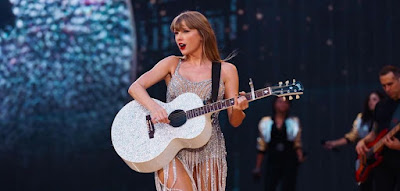
If nothing else, Taylor Swift: The Eras Tour is a movie as a work of cultural preservation. A concert is ephemeral. Cinema feels like forever. For those who couldn’t find, or afford, tickets to the tour, and for current and future people wondering what the fuss was about, this movie preserves the experience. For those of us who want to relive the concert, it’s an effective, transporting reminder. It’s a loud, and bright, and relentless machine of a movie—the most efficient music delivery device on this scale since Beyoncé played Coachella. It’s sheer pop pleasure. It also affords the best seat in the house, sitting in awe of her command of the stage, how the slightest gesture sets off ecstatic reactions for adoring fans. The camera’s constantly panning, spinning, tracking, appreciating. The editing can be percussive, chopping on the beat to the musical climaxes or restraining to capture a big flourish of stagecraft or stillness. The image is frequently moving in for close-ups and medium shots of Swift that celebrate and admire without leering at her statuesque stance, her ebullient back up dancers and singers, her strutting, flouncing confidently limited dance moves, and her wardrobe—from sparkly dresses and frilly coats to a snaky bodysuit. But the sound design—so clear and concussive—balances the crowd noise just enough to give you a taste of the size and scale of the experience as the background constellation of multicolor light-up bracelets rarely leaves the frame. A faithful capturing of the performance in all its detail is what’s valuable here.
As a work of filmmaking, it’s clear who the auteur is. It’s not director Sam Wrench, a veteran of simply and unobtrusively capturing live performance, having helmed concert specials for Brandi Carlile, BTS, Billie Eilish, and some episodes of American Idol. He may have gathered the slick footage, and assembled it far more professionally than the shaky amateur clips that dripped out over the summer. But the driving personality is clearly Swift herself. She’s a filmmaker in her own right—having taken the chair for her last several music videos and a pandemic-era performance of her Folklore album. Here she’s content to be the star, knowing that she has a show to put on that’ll satisfy even when the electric live element is removed. The moviemaking of The Eras Tour film bends to the force of the concert, with no stylistic flourishes, cinematographic personality, or contextual perspective of its own beyond bringing the live experience into the preservation of this form. I thought of a passage from the great French filmmaker Robert Bresson’s book Notes on the Cinematograph: “A film cannot be a stage show, because a stage show requires flesh-and-blood presence. But it can be…the photographic reproduction of a stage show. The photographic reproduction of a stage show is comparable to the photographic reproduction of a painting or of a sculpture…[They are] historical documents whose place is in the archives…” It’s not the same, but what a document! As the communal, flesh-and-blood presence of the concert dissipates, the archives will have this fun record.
Showing posts with label Taylor Swift. Show all posts
Monday, October 16, 2023
Thursday, July 29, 2021
Hit Record: SUMMER OF SOUL, Taylor Swift (x2), BILLIE EILISH, TINA, SPARKS, and MCCARTNEY
Regard a recording of a musician at work — movement and sound inextricably tied, plus the magic trick of seeing beautiful melody and rhythm plucked out of thin air, and the artist-magicians who conjure it up despite, or maybe because, of their problems. How cinematic. The best music documentaries give us a sense of being present with the art form as it is expressed — and the very best help us hear what makes it interesting. Although the greats in the genre are fine works of style and function on their own terms, there are plenty more that are hardly better than actually spinning the record or pulling up to a concert. But since the live show has been rightfully paused of late, it’s made it not quite so bad that the past couple years we’ve been drowning in these films. I bet the fans of the artists so chronicled don’t mind. If music be the food of love, play on, and all that. It’s no wonder Questlove’s Summer of Soul, which bounces with high spirits between retrospective and contextualizing interviews and long excerpts from footage of a 1969 summer concert series in Harlem with a star-studded lineup of Black musicians, has struck a satisfied nerve for some audiences. In these long, slow, frustrating days that are what we hope might be the end of our current epidemic, just the sight of a huge crowd of people gathered anxiety free to get transported to a place of pure delight through the charisma and style of the people there to play for them is a delight. That the movie might overreach in some of its claims — the concert was, contrary to the subtitle, televised — doesn’t diminish Questlove’s high-energy treatment of the standard talking head style. When a music doc is really cooking, it makes the best of the charisma of performance and interplay with audience. It makes a musician look good.
The artists, too, must love that treatment, since they’ve so often been guiding these projects as an extension of brand management and reputation burnishment. Take Taylor Swift, whose busy 2020 included two documentaries. The better was the pre-pandemic Miss Americana, Lana Wilson’s relatively open look at the process of Swift developing Lover after the comparatively less well-received Reputation. (An unfair knock, I’d say. There are, as the kids say, some real bops on that record.) Throughout, the backdrop of These Times In Which We Live play out, and force her to confront her fear of going the way of The (Dixie) Chicks if she gets too overly political. We see the pressures to open up — and stand up. And we see how it adds stresses to her professional and personal circles. But we also see an artist at work, noodling through melodies and lyrics with casual professionalism, flowing talent, and steely determination. It’s the kind of carefully crafted drops of personal revelation and behind-the-scenes machinations that makes for an interesting watch. Her Folklore: The Long Pond Studio Sessions, coming on the heels of the first of her surprise lockdown-made albums last fall, is more straightforward—a cozy, simple performance of a solid album interspersed with some brief comments about each track, clearly a way to do an intimate concert for her fans in a way that’s impossible at the moment. Taken together, the two films are a fine picture of a few years in the life of an interesting pop figure. Unlike, say, Demi Lovato’s YouTube doc Dancing with the Devil, an awkward blend of harrowing detail and glossy remove which presents candor as a value in and of itself while being edited so slickly and choppily that it’s hard to think about anything but the packaging, Swift has opened up in ways more akin to the usual pop star realism.
Similarly, and even better, is R.J. Cutler’s
At the other end of a career is Daniel Lindsay and T.J. Martin’s Tina, an authorized biography interviewing Tina Turner about the trials and tribulations of her career. We also hear tape of 80’s conversations she had with Kurt Loder when he helped write her autobiography. She’s always present, but the movie does a good job making it more than a long self-narrated career retrospective. (Not that I would’ve minded that, necessarily. Spike Jonze made a good version of that form with the surviving Beastie Boys for last year’s fun Beastie Boys Story.) For Tina, we pause at all the hits and see great footage of her in concert and TV appearances at every stage of her career. The film deftly weaves in an understanding of her challenges and assets, contextualizes her talent in the business of the time, and watches as she rises from professional and relational struggles to become a self re-made woman. It touches upon her experiences with domestic violence without lingering on unseemly details and crafts a fine sparkling uplift out one of the great singers finding her voice as a singer and an independent woman. It’s fast-paced and full of well-chosen archival footage (among the highlights has to be an interview promoting her great villain turn in Mad Max Beyond Thunderdome where she discusses the angry man in her past while Mel Gibson sits silently next to her) and knows to let the songs play. They speak more than anything else can. When she struts up to the microphone and pours every ounce of her grit and perseverance into her singing, you don’t want to be listening to anyone else. She earns the legend status the awestruck movie takes as its underlying thesis. We don’t need another hero, indeed.
Another in the what-a-career style comes from Edgar Wright, that most inventive and original of filmmakers, he of Hot Fuzz and Scott Pilgrim vs. the World and other visually zippy and creatively cut genre fare. He’s a big fan of the oddball underground rock band Sparks and sets out to tell us why they’re great. He does so through The Sparks Brothers in a relatively standard style, with talking heads (of critics and fans and bandmates and contemporaries) and tons of archival footage, with a chronological stop at each and every one of the band’s albums for discussion about the hit singles, underperforming disappointments, sonic experimentation, or oddball genre swerves. They’re a band that turns falsetto loops over sharply ironic lyrics on albums that run the gamut from glam rock to proto-punk to early synth. They’ve had eccentric chameleonic abilities to anticipate shifts in sound, while simply following their creative bliss. This sometimes puts them ahead or behind the times—or way off on their own doing their own thing.. This has left them the status of having incredible longevity despite being, for most people, a name they might’ve heard once or twice, or a novelty song they might distantly remember more than a going concern. As a whirlwind fanboy tour, Wright does a good job introducing the world to why these guys are of note. It’s clear Sparks has passion and creativity and originality and it’s fun to see them emerge from the underground cult status to something like a mainstream spotlight. As a movie, it’s pretty standard stuff. Even Wright’s cute touches are less inventive than his wont, tending toward the trendy animate filigrees and recreations that clutter so many modern docs. (I did like best how he credits each member of Duran Duran in their interview as just one Duran each.) But it did make me cue up a couple Sparks albums on Apple Music afterwards, so there you go.
My favorite music docs, if you follow the trend, tend to be the ones that, through context or focus, attention or expression, teach you how to understand what you’re hearing, not didactically but sensorily, opening up new ways of comprehending what might’ve ear-wormed pleasingly without a second thought to the complexity. And in doing so it brings the artists into a more revealing light. So it is I’ve probably most appreciated Hulu’s McCartney 3,2,1, a short series of six half-hour episodes shot in evocative black and white, the better to focus in on every note in the sound mix. Loosely organized, each part finds Paul McCartney in conversation with record producer Rick Rubin as they play back tapes of Beatles cuts and solo stuff. As they run, he talks about inspirations and collaboration, the decision behind certain choices of instrumentation and intonation, and approaches a seemingly genuine humbleness when he half-embarrassed, half-proud admits that he’s grown into a fan of his own work. The production might lean a little heavily on Rubin’s starstruck wonderment at some of McCartney’s tales and tidbits, but, hey, I’d would be doing the same, too, wouldn’t you? The show lets these classic songs come back to life. I’d never really heard the bass line in “While My Guitar Gently Weeps” until all of a sudden Rubin pulls it out of the mix and lets it live alone in all its crunchiness. Or felt how fast the guitar rushes through its lick in “A Hard Day’s Night” until McCartney explains its speed. (If these bits of trivia have been told before, I hadn’t heard them.) I savored every note of this doc, and could’ve watched another three hours easily. Sometimes you just want to hear one of the greats talk about his work. We’ve never before had so much access to our biggest stars—it’s nice to see some of these music docs put that to good use.
The artists, too, must love that treatment, since they’ve so often been guiding these projects as an extension of brand management and reputation burnishment. Take Taylor Swift, whose busy 2020 included two documentaries. The better was the pre-pandemic Miss Americana, Lana Wilson’s relatively open look at the process of Swift developing Lover after the comparatively less well-received Reputation. (An unfair knock, I’d say. There are, as the kids say, some real bops on that record.) Throughout, the backdrop of These Times In Which We Live play out, and force her to confront her fear of going the way of The (Dixie) Chicks if she gets too overly political. We see the pressures to open up — and stand up. And we see how it adds stresses to her professional and personal circles. But we also see an artist at work, noodling through melodies and lyrics with casual professionalism, flowing talent, and steely determination. It’s the kind of carefully crafted drops of personal revelation and behind-the-scenes machinations that makes for an interesting watch. Her Folklore: The Long Pond Studio Sessions, coming on the heels of the first of her surprise lockdown-made albums last fall, is more straightforward—a cozy, simple performance of a solid album interspersed with some brief comments about each track, clearly a way to do an intimate concert for her fans in a way that’s impossible at the moment. Taken together, the two films are a fine picture of a few years in the life of an interesting pop figure. Unlike, say, Demi Lovato’s YouTube doc Dancing with the Devil, an awkward blend of harrowing detail and glossy remove which presents candor as a value in and of itself while being edited so slickly and choppily that it’s hard to think about anything but the packaging, Swift has opened up in ways more akin to the usual pop star realism.
Similarly, and even better, is R.J. Cutler’s
Billie Eilish: The World’s a Little Blurry
. It’s a fly-on-the-wall as the teenager emerges from her childhood bedroom with some powerfully catchy hooks and moves toward stardom with a winning reluctance. Within baggy clothes and behind rolling eyes, she’s every bit the reluctant rock star, overflowing with obvious talent and yet skeptical of the hoops through which she’s jumped. The film shows her parents as cautious and supportive, her older brother as protective, and Eilish herself a lively, excited, sarcastic, surly, and altogether real young person. Surely that’s good for the brand. But it also feels real enough. It preserves a sense of authenticity even as she’s pulled into concert tours and music videos and Grammy awards. It has tons of footage of her testing talents at a young age, her giddy bewilderment as her songs catch on, and her hard-working drive that can send her limping backstage with an ice-pack, or leaning on the emotion her young audience pours back at her. See, too, her mix of pop star posturing and starstruck fawning when Justin Bieber’s people reach out for a potential collaboration. Come to think of it, this film is a more earnest version of the Biebs’ Never Say Never, a similar look at a turning point that took a teen from a young person’s social media phenom to a global sensation. Eilish's doc, true to its title, presents a blurry sense of sudden ascension, and the tensions it creates, a push-pull in the life of an abnormally normal star-on-the-rise. Somehow she’s still coming across as relatable and real despite the skyrocketing trajectory of her stardom. As a picture of a new star, it’s an interesting document. No matter where she goes from here, it’ll be an engaging marker of this moment in time.At the other end of a career is Daniel Lindsay and T.J. Martin’s Tina, an authorized biography interviewing Tina Turner about the trials and tribulations of her career. We also hear tape of 80’s conversations she had with Kurt Loder when he helped write her autobiography. She’s always present, but the movie does a good job making it more than a long self-narrated career retrospective. (Not that I would’ve minded that, necessarily. Spike Jonze made a good version of that form with the surviving Beastie Boys for last year’s fun Beastie Boys Story.) For Tina, we pause at all the hits and see great footage of her in concert and TV appearances at every stage of her career. The film deftly weaves in an understanding of her challenges and assets, contextualizes her talent in the business of the time, and watches as she rises from professional and relational struggles to become a self re-made woman. It touches upon her experiences with domestic violence without lingering on unseemly details and crafts a fine sparkling uplift out one of the great singers finding her voice as a singer and an independent woman. It’s fast-paced and full of well-chosen archival footage (among the highlights has to be an interview promoting her great villain turn in Mad Max Beyond Thunderdome where she discusses the angry man in her past while Mel Gibson sits silently next to her) and knows to let the songs play. They speak more than anything else can. When she struts up to the microphone and pours every ounce of her grit and perseverance into her singing, you don’t want to be listening to anyone else. She earns the legend status the awestruck movie takes as its underlying thesis. We don’t need another hero, indeed.
Another in the what-a-career style comes from Edgar Wright, that most inventive and original of filmmakers, he of Hot Fuzz and Scott Pilgrim vs. the World and other visually zippy and creatively cut genre fare. He’s a big fan of the oddball underground rock band Sparks and sets out to tell us why they’re great. He does so through The Sparks Brothers in a relatively standard style, with talking heads (of critics and fans and bandmates and contemporaries) and tons of archival footage, with a chronological stop at each and every one of the band’s albums for discussion about the hit singles, underperforming disappointments, sonic experimentation, or oddball genre swerves. They’re a band that turns falsetto loops over sharply ironic lyrics on albums that run the gamut from glam rock to proto-punk to early synth. They’ve had eccentric chameleonic abilities to anticipate shifts in sound, while simply following their creative bliss. This sometimes puts them ahead or behind the times—or way off on their own doing their own thing.. This has left them the status of having incredible longevity despite being, for most people, a name they might’ve heard once or twice, or a novelty song they might distantly remember more than a going concern. As a whirlwind fanboy tour, Wright does a good job introducing the world to why these guys are of note. It’s clear Sparks has passion and creativity and originality and it’s fun to see them emerge from the underground cult status to something like a mainstream spotlight. As a movie, it’s pretty standard stuff. Even Wright’s cute touches are less inventive than his wont, tending toward the trendy animate filigrees and recreations that clutter so many modern docs. (I did like best how he credits each member of Duran Duran in their interview as just one Duran each.) But it did make me cue up a couple Sparks albums on Apple Music afterwards, so there you go.
My favorite music docs, if you follow the trend, tend to be the ones that, through context or focus, attention or expression, teach you how to understand what you’re hearing, not didactically but sensorily, opening up new ways of comprehending what might’ve ear-wormed pleasingly without a second thought to the complexity. And in doing so it brings the artists into a more revealing light. So it is I’ve probably most appreciated Hulu’s McCartney 3,2,1, a short series of six half-hour episodes shot in evocative black and white, the better to focus in on every note in the sound mix. Loosely organized, each part finds Paul McCartney in conversation with record producer Rick Rubin as they play back tapes of Beatles cuts and solo stuff. As they run, he talks about inspirations and collaboration, the decision behind certain choices of instrumentation and intonation, and approaches a seemingly genuine humbleness when he half-embarrassed, half-proud admits that he’s grown into a fan of his own work. The production might lean a little heavily on Rubin’s starstruck wonderment at some of McCartney’s tales and tidbits, but, hey, I’d would be doing the same, too, wouldn’t you? The show lets these classic songs come back to life. I’d never really heard the bass line in “While My Guitar Gently Weeps” until all of a sudden Rubin pulls it out of the mix and lets it live alone in all its crunchiness. Or felt how fast the guitar rushes through its lick in “A Hard Day’s Night” until McCartney explains its speed. (If these bits of trivia have been told before, I hadn’t heard them.) I savored every note of this doc, and could’ve watched another three hours easily. Sometimes you just want to hear one of the greats talk about his work. We’ve never before had so much access to our biggest stars—it’s nice to see some of these music docs put that to good use.
Saturday, December 21, 2019
Cats & Dogs: CATS and TOGO
Cats is questionable on every level you can imagine: narrative, musical, aesthetic, anatomical. Only a movie so convinced of its tony, glossy, respectable, good-taste nature could fail on all counts so completely. It’s some kind of amazing. Those who set out to make a midnight movie inexplicable on purpose will be jealous, standing in awe for a true blue unintended wild pitch, a cracked cult classic in the making. I’m almost glad it exists for no reason but that there’s nothing else like it. It’s boring and fascinating, confusing and striking in equal measure. If it was an obscurity dug up decades hence — think bonkers musical movies past like The Apple and so forth — we might be better prepared to take its sheer unlikely collection of bad decisions as quaint eccentricity rather than an assault on our senses. It’s both, of course.
Built from one of Andrew Lloyd Webber’s most dubious musicals to begin with, the picture matches the stage version’s patchy story and sluggish pace. It’s about a group of cats milling about on the night of their yearly ritual in which their pseudo-supernatural queen (Judi Dench, so good she’s believable) chooses one lucky cat to die and be reincarnated. While they await her decision, one cat at a time steps forward and performs a little song and dance introducing their name and some quality they posses. There’s an abandoned young cat (ballerina Francesca Hayward). There’s a cat that lays around all day (Rebel Wilson), one that eats garbage (James Corden), another that likes milk (Jason Derulo) — all normal cat behavior. Then there’s a cat that rides on a train (tap dancer Steven McRae), and one that sits in a theatre (Ian McKellen). Fair enough. Then there’s a cat that’s a magician (Laurie Davidson) and a cat that’s some sort of evil sorcerer (Idris Elba) with a slinky henchwoman (Taylor Swift). The lonely old cat (Jennifer Hudson) is the best, because she gets to sing the musical’s one good song — “Memory,” the only one anyone unfamiliar with the stage production has heard going in. That’s the full extent of the movie, a weird shapeless thing faithful to its oddball roots. And yet what elevates it — or lowers it, your milage varying — is every cinematic decision that compounds disbelief by the second. Director Tom Hooper, of The King’s Speech and the excellent musical Les Miserables, demonstrates powers of mad erratic imagination his earlier, safer prestige projects have heretofore shown little inclination toward.
He shoots it on a big unreal stage in scope from low angles, accentuating the feline perspective, and then proceeds to populate the proceedings with singing and dancing CG-human hybrid monstrosities straight from the uncanny valley. They are not the stage’s leotard and makeup creations; nor do they use digital wizardry to transpose motion-captured movie stars into the bodies of vaguely realistic cats. It’s instead a layering of digital fur over the bodies of the performers so that we have plenty of time to consider the human form ensconced in this animal texture. They never look like cats, and never like people. Instead of a digital extension of the artifice provided by stage makeup, it gives long close-ups and medium shots of expressive dancing and emotive singing an odd push and pull. How often do we actually stare at quivering lips and wrinkling noses as they fill the frame? We also get long opportunities to trace the contours of the muscles in hips and torsos as they ripple under artificial skin? The dancer’s posteriors, too, are distractingly human under long, twitching tails, in bodies both real and unreal, human and not. Their bodies are only further accentuated by the cats occasionally wearing snazzy little hats or coats, drawing attention to their otherwise completely bared fur. What a marvelously unhinged visual distraction, appealing and revolting in equal measure, depending on the movement or the camera angle. It’s an image of partially-real creatures — too human to be cat, too cat to be human — dancing in partially-real sets — occasionally extending into gleamingly fake city streets where the cats are either half the size of an average person or a fourth of the size of the average house pet. It’d be worth seeing if it wasn’t put to use for such baffling lack of effect for production numbers that rarely add up to much in a story that never coheres for characters that never develop. What an expensive boondoggle. It sure is something.
Far more conventionally satisfying animal filmmaking is Togo, a humble based-on-a-true-story programmer slipped out onto Disney+ in the shadow of splashier family fare at the multiplex this holiday season. If you recall Universal’s 1995 animated picture Balto, about a sled dog racing to deliver much-needed medicine into the wilds of 1920s Alaska, you know the gist, although this movie will tell you Togo did far more than him. Here Willem Dafoe is a stoic human face guiding his good dogs across the wilderness as the children of small town Nome sit afflicted with diphtheria, a fatal diagnosis if left untreated. He’s the sort of sensitive, stubborn man so driven, and so good at inspiring his dogs, that he’ll holler one of Shakespeare’s most famous speeches over the sound of the whirling winds and cracking ice. Flashbacks fill in the details of the lead dog’s life, as he goes from an energetic pup in need of training to an underdog with the unlikely spirit and skill to lead the team through treacherous terrain at the behest of his kind owner. It’s a dog story, a real adventure told with low-key pace, rugged faces against awesome landscapes, natural hues, and beautiful nature-photography appeal. Director/cinematographer Ericson Core has a keen eye for these details. There’s great Jack London verisimilitude to the real dogs and settings, and the progression through the details of making such a journey at such a time with these resources. We meet a variety of grizzled characters and see tenderly realized portraits of townspeople doing what they can to help. And we see the toll it can take on those who do good despite the odds, even after their deeds are done. Throughout there’s great skill and tension on display, a driving forward momentum pinned to its elemental man (and dog) versus nature tale. It has a quiet, patient sense of narrative and emotional clarity as pure and simple as the task at hand. Just goes to remind you there’s nothing like a good old fashioned story told cleanly and simply.
Built from one of Andrew Lloyd Webber’s most dubious musicals to begin with, the picture matches the stage version’s patchy story and sluggish pace. It’s about a group of cats milling about on the night of their yearly ritual in which their pseudo-supernatural queen (Judi Dench, so good she’s believable) chooses one lucky cat to die and be reincarnated. While they await her decision, one cat at a time steps forward and performs a little song and dance introducing their name and some quality they posses. There’s an abandoned young cat (ballerina Francesca Hayward). There’s a cat that lays around all day (Rebel Wilson), one that eats garbage (James Corden), another that likes milk (Jason Derulo) — all normal cat behavior. Then there’s a cat that rides on a train (tap dancer Steven McRae), and one that sits in a theatre (Ian McKellen). Fair enough. Then there’s a cat that’s a magician (Laurie Davidson) and a cat that’s some sort of evil sorcerer (Idris Elba) with a slinky henchwoman (Taylor Swift). The lonely old cat (Jennifer Hudson) is the best, because she gets to sing the musical’s one good song — “Memory,” the only one anyone unfamiliar with the stage production has heard going in. That’s the full extent of the movie, a weird shapeless thing faithful to its oddball roots. And yet what elevates it — or lowers it, your milage varying — is every cinematic decision that compounds disbelief by the second. Director Tom Hooper, of The King’s Speech and the excellent musical Les Miserables, demonstrates powers of mad erratic imagination his earlier, safer prestige projects have heretofore shown little inclination toward.
He shoots it on a big unreal stage in scope from low angles, accentuating the feline perspective, and then proceeds to populate the proceedings with singing and dancing CG-human hybrid monstrosities straight from the uncanny valley. They are not the stage’s leotard and makeup creations; nor do they use digital wizardry to transpose motion-captured movie stars into the bodies of vaguely realistic cats. It’s instead a layering of digital fur over the bodies of the performers so that we have plenty of time to consider the human form ensconced in this animal texture. They never look like cats, and never like people. Instead of a digital extension of the artifice provided by stage makeup, it gives long close-ups and medium shots of expressive dancing and emotive singing an odd push and pull. How often do we actually stare at quivering lips and wrinkling noses as they fill the frame? We also get long opportunities to trace the contours of the muscles in hips and torsos as they ripple under artificial skin? The dancer’s posteriors, too, are distractingly human under long, twitching tails, in bodies both real and unreal, human and not. Their bodies are only further accentuated by the cats occasionally wearing snazzy little hats or coats, drawing attention to their otherwise completely bared fur. What a marvelously unhinged visual distraction, appealing and revolting in equal measure, depending on the movement or the camera angle. It’s an image of partially-real creatures — too human to be cat, too cat to be human — dancing in partially-real sets — occasionally extending into gleamingly fake city streets where the cats are either half the size of an average person or a fourth of the size of the average house pet. It’d be worth seeing if it wasn’t put to use for such baffling lack of effect for production numbers that rarely add up to much in a story that never coheres for characters that never develop. What an expensive boondoggle. It sure is something.
Far more conventionally satisfying animal filmmaking is Togo, a humble based-on-a-true-story programmer slipped out onto Disney+ in the shadow of splashier family fare at the multiplex this holiday season. If you recall Universal’s 1995 animated picture Balto, about a sled dog racing to deliver much-needed medicine into the wilds of 1920s Alaska, you know the gist, although this movie will tell you Togo did far more than him. Here Willem Dafoe is a stoic human face guiding his good dogs across the wilderness as the children of small town Nome sit afflicted with diphtheria, a fatal diagnosis if left untreated. He’s the sort of sensitive, stubborn man so driven, and so good at inspiring his dogs, that he’ll holler one of Shakespeare’s most famous speeches over the sound of the whirling winds and cracking ice. Flashbacks fill in the details of the lead dog’s life, as he goes from an energetic pup in need of training to an underdog with the unlikely spirit and skill to lead the team through treacherous terrain at the behest of his kind owner. It’s a dog story, a real adventure told with low-key pace, rugged faces against awesome landscapes, natural hues, and beautiful nature-photography appeal. Director/cinematographer Ericson Core has a keen eye for these details. There’s great Jack London verisimilitude to the real dogs and settings, and the progression through the details of making such a journey at such a time with these resources. We meet a variety of grizzled characters and see tenderly realized portraits of townspeople doing what they can to help. And we see the toll it can take on those who do good despite the odds, even after their deeds are done. Throughout there’s great skill and tension on display, a driving forward momentum pinned to its elemental man (and dog) versus nature tale. It has a quiet, patient sense of narrative and emotional clarity as pure and simple as the task at hand. Just goes to remind you there’s nothing like a good old fashioned story told cleanly and simply.
Sunday, August 17, 2014
Future Past: THE GIVER
The recent spate of films adapted from young adult dystopian
fiction created the economic conditions necessary for a movie based on Lois
Lowry’s beloved 1993 book The Giver.
That book, with its special teen receiving wisdom about the oppression
underpinning the pristine homogonous future world in which he lives, laid the
groundwork for future YA tentpoles like The
Hunger Games and Divergent. But
as is often the case, tracing the fad back to the source reveals a starker, stranger,
and more ambivalent and ambiguous work than its imitators. And so, superficial
similarities to those recent YA films aside, this film has more in common with
small scale 70’s sci-fi or an extended Twilight
Zone episode with its earnestly metaphorical nature and careful tone.
In this future, the entire known world is only a town full
of modular buildings and imagineered flora. The people, dressed in the same
drab pajama-like clothes, never leave because they have no reason to. They have
no concept of geography or history or memory. They don’t perceive emotion and
can’t see color. Their daily injections keep them anesthetized and compliant.
Ignorance really is bliss. Even the leader (a frosty Meryl Streep) blindly
follows their institutional memories of How Things Are Done. The rules allow
one person access to memories of life before, understandings of human nature –
love, hate, peace, war – and creation – art, music, philosophy – for which the
general public simply has no need. Living alone on the edge of town in a small
book-lined house, he (Jeff Bridges, looking like he’s carrying the weight of
the world on his shoulders) is only called upon when the leader needs advice.
It’s a clearly metaphorical place, a cautionary tale about
smoothing over humanity’s rough patches in the pursuit of a blind form of
conflict-free sameness. It’s not Orwellian as much as it is right out of
Huxley, who feared in his novel Brave New
World that the future would find knowledge devalued and the populace
passive through nothing more than a regular dose of happy ignorance. No one
would question the system because no one would think to. You don’t need thought
police once the people have forgotten how to have thoughts. Putting The Giver’s world on screen, director
Phillip Noyce, finding a balance between his character-driven dramas like The Quiet American and rip-roaring
actioners like Salt, shoots in black
and white, representing the cognitive state of the people. It’s a grey world,
seductively crisp and eerily blank.
When 18-year-old Jonas (Brenton Thwaites) is handpicked to
be the new Receiver of Memory, he begins to get access to the history of human
thought and experience. It’s dangerous. The former Receiver (Taylor Swift) mysteriously disappeared rather than keep receiving enlightenment. Bridges warns the boy about
the dangers, and then grabs his forearms and beams psychic transmissions into
his protégé’s brain. Rushes of knowledge are represented by colorful blasts of
high-def nature photography, pixilated home video snippets, and grainy archival
footage. As his understanding grows, Jonas sees color slowly seep into the
frame. He stares at his best friend (Odeya Rush). Her hair is a soft red in an
otherwise black and white frame (a la Pleasantville). Soon pale green grass and soft blue sky appear
in the film’s imagery. Then, eventually, the film is in full color. It’s a nice
visual representation of one of the book’s most interior concepts.
Jonas goes off his meds and discovers stirrings of romantic
interest that set him apart even further. His parents (Katie Holmes and Alexander
Skarsgård) look at him confused and worried. He’s moved beyond their
unknowingly small perceptions of life. It’s a clever metaphor not only for
oppression, but for growing up, moving out, and becoming your own person
distinct and yet still a part of your family unit. Eventually, Jonas must
decide what to do with all this newfound knowledge, and that’s where the movie
begins to dumb itself down to get into the category the marketplace needs it to
fit.
Screenwriters Michael Mitnick and Robert B. Weide ramp up
some of the movie’s more contemporary YA adjacent ideas, creating a pro forma
romantic triangle that’s admirably restrained given the characters’ flat
affects, but distracting nonetheless. Then the climax gussies the small, allegorical
plot up with a few chase scenes and a nonsense race-against-the-clock climactic save-the-future goal that runs counter to the
material’s tantalizingly philosophical ambiguities. I could feel the movie
straining against its commercial impulses as it tries to find a happy ending in
what is a muted and ambiguous vision. It ends up feeling cheaper and more
familiar than the intriguing opening suggests. But it retains enough of a
glimmer of its source material’s introspective personality and distinctive mood
to wish it was willing to be less derivative, instead of chasing the past success of the
book’s successors.
Thursday, March 8, 2012
Unless: THE LORAX
It’d be harder to believe that a slim, lovely little Dr.
Seuss book was turned into 90 minutes of empty calories if Universal hadn’t
already done it twice before. How the
Grinch Stole Christmas and Cat in the
Hat became garish live-action patience testers. Now it’s The Lorax’s turn, but it’s escaped that
fate. The studio was smart to hand it over to Illumination, a recently
established computer animation studio that gave them a surprise big, and
well-earned, hit a couple of years ago with Despicable
Me. The resulting Lorax movie
bears more than a passing resemblance to prime Seussian illustrations, but the
gem of ecological melancholy inherent in the small, powerful book is surrounded
by a story about a boy who zips around on a scooter and has run-ins with a
despotic mayor. If that doesn’t sound quite like the Lorax you remember, you’d be right.
Seuss’s book is a simple fable, a wistful, hesitantly
hopeful story of a greedy businessman, the Once-ler, who deforested the land as
far as the eye can see and drove the happy wildlife far, far away. He tells his
tale to a curious boy, a tale of a failed intervention on behalf of the flora
and fauna by the Lorax, a sad little creature whose environmental advocacy fell
on deaf ears. Though the book ends with the boy receiving a single seed, from
which the forests can begin to grow once again, Seuss offers us no such
release. This is only hesitant hope. The fact of the matter is, ecological
damage is terrifying in its totality. One seed may not be enough. What is
necessary is people who care a whole awful lot.
I’ve found The Lorax to
be one of Dr. Seuss’s most powerful works, a clear statement that is hardly
moralizing. It’s vivid, beautiful illustrations highlight the loss that has
happened to the environment these characters inhabit while the rendering of the
Lorax himself is heartbreaking in the despondency the poor guy feels when he
realizes that disaster has not been averted. The look is what directors Chris
Renaud and Kyle Balda have gotten mostly right in their adaptation. It’s a
bright colorful world of plants and creatures in flashback, but in the present
it’s a barren place of smog and dust. What they’ve added is a city of plastic
and technology, a walled-off place that has insulated itself from the harsh
realities outside.
In this new environment, they have embellished the story by
giving the boy a name, Ted (as in Theodor Geisel, perhaps?), a scooter, a wacky
family, the voice of Zac Efron, and a dream. He wants to impress the girl down
the street (Taylor Swift) by finding her one of those trees of legend, not one
of the plastic, inflatable, electric plants that fill the town, but the living
kind thought long extinct. His grandmother (Betty White) tells him to go see
the Once-ler (Ed Helms), so Ted escapes town and rides into the beginning of
Seuss’s story.
We then get a flashback with the Lorax (Danny DeVito) trying
his hardest to stop the Once-ler (and his wacky family), to no avail. The Lorax is given more to do,
but it dilutes his impact. Now he’s a jokester and a blustering prankster, not
just a righteous, sad, spokesman. But, back to the boy, who has an extended
climactic sequence in which he zips around town with the seed, but soon has the
seed stolen by the evil mayor (Rob Riggle) who has made his fortune selling
bottled air. This leads to a big chase scene that has lots of action and
slapstick to go through.
And there’s where the embellishment of the adaptation steps
wrong. It becomes a story about a boy who needs to plant the last seed, not a
story about the Lorax. The film swallows him up in order to end on a note of
happiness and hope. Hooray! The environment is saved! There’s no room for the
overwhelming sadness that he represents here. No need to simply hint at hope,
the film makes it concrete instead. And, though I found myself still moved by
the final scene which, yes, brings the Lorax back in a small, touching way,
there’s something to be said for the exciting lack of this resolution in the
book that is lost in favor of a Hollywood ending. Even the power of the
regretful villainy of the Once-ler is diluted by the addition of the goofy
mayor antagonist, who has no such complexity.
Still, I’d rather not judge the movie solely on the ways it
bungles Seuss’s tone, something the 1972 animated special got more or less
right. I’d rather not just be comparing versions of the story against one another
and, besides, I’d be a fool to expect a perfect transcription of the book.
Taken on its own terms, this new Lorax actually
works fairly well. It’s a highly competent family film that’s fast, cute, and
often quite appealing. It’s also a musical. It was a big surprise to me when,
in the first scene, the townspeople burst into song in a big, fun, introductory
Broadway-style opening number. There are a few other numbers sprinkled
throughout less successfully, but the finale is a rousing, satisfying showstopper.
It’s very likable.
I didn’t dislike this movie, I just found myself frustrated
by its competing impulses. On the one hand, it is a solid, standard, modern, musical,
CG, 3D, Hollywood family film. On the other hand, it hints at the greatness of
its source material, like with the first appearance of the Lorax, a nice, small
moment in which he solemnly makes a fresh stump into a tribute to a fallen
tree. So The Lorax is an agreeable
movie, but its so close to great I couldn’t help but leave feeling I had just
watched a bit of a missed opportunity.
Subscribe to:
Posts (Atom)


