Darren Aronofsky’s Caught Stealing is atypical for him since it’s shorn of self-conscious ambition. He’s a filmmaker usually loaded down with style while straining for abstractions and existential metaphor. When it works it works. Consider the Biblical fantasy of Noah or epic existential time-spanning sci-fi The Fountain or the panicked pressure-cooker allegory of mother! or the twirling mirrored ballet nightmare of Black Swan. He’s an energetic image-maker, expert at enveloping with consistent mood and getting committed performances out of talented casts. For better and worse, there are no small choices in an Aronofsky film. The hysteria of his addiction dramas, the manic druggy Requiem for a Dream and doom-laden overeating of The Whale, is maddeningly misjudged. But the jumpy intensity of the grit and grain to his character drama The Wrestler is intensely focused. When his choices hit, they hit hard; otherwise they’re painful wild swings that totally miss. So it’s fun to see his newest feature be his breeziest and least burdened by weighty themes. It’s an up-tempo, low-level thriller set on the streets of New York City. It’s 1998 and an alcoholic ex-baseball player (Austin Butler) is barely making it work as a bartender with a nice girlfriend (Zoe Kravitz). Too bad, then, that he makes the mistake of agreeing to watch a pet cat for his punk neighbor (Matt Smith). This gets him caught between competing drug dealing gangsters (Bad Bunny and some Russians on one side; Hasidic Vincent D’Onofrio and Liev Schreiber on the other) who think the punk left him a clue to their cash.
It sets off a mad, darkly funny, increasingly violent scramble to get out of trouble. Not even a weary cop (Regina King) seems much help. He’ll have to do it himself. Butler makes such a fine, sympathetic presence at the center of the tension. He’s stepped confidently into leading man mode, using his physicality to get and hold attention in the frame with an easy charm and casual energy that’s somehow both perfectly posed and totally relaxed. Now there’s a Movie Star. He holds the center easily as the thriller plotting pops off around him. Aronofsky gives it all a hurtling momentum, like a madcap After Hours take (there’s even Griffin Dunne) on the kind of scrappy, chatty, irreverent post-Tarantino thrillers that would’ve been on screens in 1998. Now that’s commitment to period accuracy. It’s a movie of small choices with big effects: the crack of a bat to bring our lead out of a recurring nightmare; an affinity for elegant long tracking shots; a well-spun collection of needle drops; a steady teetering between lighthearted eccentric characterizations and heavy deadly twists and turns. The movie has speed on its side; the thing doesn’t feel thin until the credits have ended and you’re walking back to the parking lot. If it’s ultimately just glossy genre pulpiness for the sake of it, then at least it’s done with such a high level of confident skill. I could get used to this style of Aronofsky.
Showing posts with label Zoe Kravitz. Show all posts
Monday, September 1, 2025
Wednesday, September 4, 2024
Fatal Attraction: STRANGE DARLING and BLINK TWICE
JT Mollner’s Strange Darling is a dark, nasty, self-satisfied little thriller. Its commitment to squirming through discomfort and violence—teasing a line between adult play and assault in frank ways—is often gripping. But its empty-headed reversals and surprises grow pretty vile when taken in total. It opens with a man hunting a woman. He chases her down a country road with a rifle and then stalks through forest and field as she tries to hide. Even to suggest that all is not as it seems would be unfair to the movie, which tells its story in 6 chapters deliberately scrambled so as to hide its transparently obvious twist. That it works at all is a testament to a crackling filmic look, and the actors who inhabit it. The man is Kyle Gallner, who is such a reliable horror presence. (The Haunting in Connecticut, Jennifer’s Body, the Nightmare on Elm Street remake, Red State, Scream 5, Smile…is he an honorary Scream Queen?) Here he’s able to dial up the intensity of his menacing gaze, while retaining the possibility of a wounded frustration, even embarrassment, to instantly slip back into his eyes. The woman (Willa Fitzgerald, of the short-lived Scream TV show) is similarly slippery, in a blind panic in some chapters, while we soon enough get a flashback look at the rough-housing she’s hoping for when she first picks up the guy in a bar. Its self-consciously a movie about gender stereotypes and the possibility of sexual violence, about safe-words and mind-games. But as the movie’s scatter-shot timeline clicks into place, it’s a pretty straightforward, predictable movie, for all its bloodshed and self-impressed flourishes. That leaves the final stretch awfully tedious, then just awful as its final twists of the knife turn on some mean-spirited gags. It is a lot of effort spent on getting nowhere.
A lively contrast to such tediousness is Blink Twice. Zoe Kravitz makes a fine feature debut as director in a Jordan Peele mode—a high concept thriller with social commentary on its mind. The results here may not be as layered and complex as Peele wears so casually and confidently—it’s too surface level flimsy for that, and even the not-as-it-seems is more or less as it seems. But the film is stylishly photographed with glamour shots and prickly shadows, and is cut with a razor-wire jumpiness. It’s easy to buy into its stakes and watch invested in what happens next. The plot is set in motion quickly, trapping characters in a bad situation that gets its tense charge from contemporary conversations about navigating identity, power, and consent. It follows a cater waiter (Naomi Ackie) who catches the eye of a billionaire (Channing Tatum) whose fundraising dinner she’s working. He invites her and a friend (Alia Shawkat) to be in a group of pretty ladies joining his pals (Christian Slater, Simon Rex, Haley Joel Osment) for a vacation on his private island. Sounds fun, she thinks, with apparently no negative associations with the words: billionaire’s island. (It made me want to rewrite a famous 30 Rock quote: never go with a billionaire to a second location.) Days spent lounging poolside, eating gourmet meals, and drinking constantly refilled cocktails are a kind of pleasure for quite some time. So is the flirty atmosphere with the super-rich host. She thinks he might actually be falling for her. Why, then, is there this ominous feeling of something ugly beneath the tropical fun? One of the other pretty guests (Adria Arjona) finds herself with tears welling up in her eyes as she finally admits that it’s all fun, “except…not.” The nefarious intent of their hosts comes tumbling out in torrents of revelations and the climactic conflagration is the kind of violent eruption that’s the inevitable result of escalating bad vibes. Kravitz gives the movie a breezy, on-edge shimmer and lets the sickening implications land not as flip twists, but with their due weight.
Friday, March 11, 2022
Dark City: THE BATMAN
Even after all these years of superhero movies, Batman remains perhaps the most uniquely cinematic. Take Bruce Wayne, the Caped Crusader, striking fear in the hearts of Gotham City’s villainy, all the way back to his early comic book origins. He’s always been at the intersection—thematically, visually, tonally—of gangster pictures, German expressionism, and film noir. He’s accrued Art Deco shadows and grungy urban doom. It’s sometimes dialed up to goofy midcentury camp (hello, Adam West), sometimes dialed down to mumbling Michael Mann skyscraper canyons (howdy, Christian Bale), sometimes drawn out in luxuriously complicated Saturday morning cartoons (the Animated Series and Beyond) or stretched out in gargantuan backlot artifice (holy Tim Burton, Batman!). But it’s always recognizably this stew of influences, plus his costume a simple silhouette with silent film recognizability. His gadgets and gumshoe approach to avoiding the pain of the orphaned billionaire boy grown up collide with the sick and sicker in his crumbling home metropolis. Even the bad Batman movies are still often fun visions of this world, engaging as pulpy interiority blown out to blockbuster dimensions. The latest, directed and co-written by Matt Reeves, and starring Robert Pattinson as the angular chin and brooding eyes hidden within the cape and cowl, is maybe the most downbeat and dreary version yet, once again stumbling down dark alleys in pursuit of something like justice that’s forever out of reach.
There’s something pessimistic at the core of this hero. When talking DC’s icons, Superman is what we hope America can be. Batman is who we fear America is. No high-flying truth and justice here. Bruce Wayne and his alter ego can suit up and punch villains every night, but the sad truth of capitalist corruption and crime—a city where the cops and robbers are often one and the same, and everyone from the Mayor to the District Attorney to the mob bosses are all part of the same pool of dark money and influence—just won’t budge. So Reeves, an intelligent big budget filmmaker coming off of two interestingly textured and thoughtful Planet of the Apes pictures, visualizes these ideas by making his Gotham constantly overcast, usually raining, generally nocturnal. (It has to be a close cousin to the unnamed city in Fincher’s compellingly gross serial killer thriller Se7en.) There’s always a cloud hanging over the scenes, and the slow, patient drip of detective information about the central mystery takes precedence over slam-bang action. That makes the one fun car chase all the more thrilling, a welcome sparking rattling roar of an engine revving to life as the Batmobile makes its long-awaited appearance tearing off after a slimy bad guy. And it leaves the proceedings to move at a steady trudge, resisting the usual fanfare. To its credit, this downbeat affair that creaks by at a long three-hour run time, is trying for something genuinely wiggly and unsettling in the middle of so much iconography and cliche.
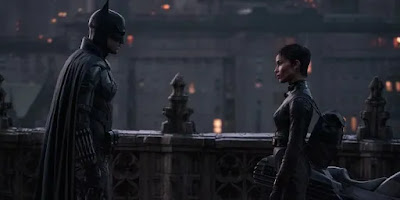
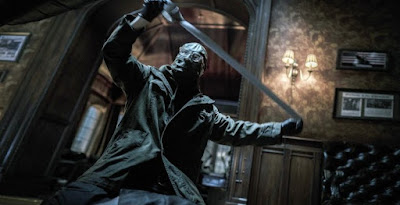
The whole thing kicks off with the murder of the mayor by a mysterious killer known only as The Riddler (Paul Dano). More victims follow. At each, he’s recording viral videos and leaving taunting clues in greeting cards at the scene for lead detective Gordon (Jeffrey Wright) to give to The Batman. Together, the two men hunt for clues and chase down leads. Sometimes they cross paths with a slinky nightclub waitress Selina Kyle (Zoe Kravitz), whose cat burglar outfit is the best since Pfeiffer’s. She has her own reasons to investigate the goings-on at a club run by the town’s top gangster (John Turturro) and his waddling underling (Colin Farrell buried in a fat suit). Reeves leans into the tight-lipped pathos of these pathetic, wounded characters creeping around the shadows of society, looking for leverage over each other in an attempt to make things a little brighter by any means necessary. Unlike the usual comic book dichotomy—or pat mirroring that leads villains to the inevitable “we’re two sides of the same coin” monologuing—this movie makes clear that everyone’s inevitably shaped by societal forces beyond their control. Batman, Catwoman, The Riddler, Detective Gordon—all are willing to bend rules and skulk around to reshape Gotham toward their ends, some for slightly better, some for way worse. There’s never a sense anyone will actually unambiguously triumph. Michael Giacchino’s pounding score takes that cue, edging along Elfman horns while plucking some “Tubular Bells.”
Here’s a city possessed with an urban rot that no one can escape. This makes for a brooding, brutal, cynical, ice-cold, paranoid and conspiratorial picture. It’s not fun, exactly, but from its opening montage of vandals and muggers spooked by the sight of the Bat-signal in the sky, to an ending where Gotham is significantly worse off than before the movie started, there’s a grimly compelling fatalism that gets its hooks in, even as the plot dwindles to a hesitant close. It’s all of a piece—a mumbled noir narration, a dimly fuzzy filmic-by-way-of-digital-and-back-again look, a sumptuously gaunt color palate, a murmuring collection of careful performances, a superhero movie that resists the overfamiliar spectacular climaxes we’ve come to expect. Like Pattinson’s sunken performance—a rare Wayne that’s not even a little sparkling—The Batman is obsessive, haunting, and unresolved. Sure, that’s partly the usual superhero move of making one feel like a first entry is so much prologue for promised future story. (And, sure, I’ll take another one with this cast and vibe.) But here that lack of resolution has tonal and thematic sense, too. Gotham, as we’ve long known, has deeply rooted systematic problems. No wonder its citizens, good and bad alike, are going mad. Who can relate?
Sunday, February 13, 2022
Tech Help: KIMI
Of course now is the perfect time for a paranoid thriller. Leave it to director Steven Soderbergh to find a sharp way to shoot one in an anxious modern telling, and consummate blockbuster writer David Koepp to construct one so involvingly tightly-wound and lockbox sealed that it proceeds so quickly and craftily by its own clever logic and is practically over before it even begins. Kimi is the model of gripping efficiency, setting up a contained space and a clear set of variables that then twist the knife and speed the inevitable. And it's so of-the-moment it feels like it was shot next week. Set in a very now Seattle, with COVID on the wane and some small sense of normality slipping back into life, it finds its lead not quite ready to leave the comfort of her apartment. She (Zoe Kravitz) was dealing with trauma-induced agoraphobia before the pandemic, and the anxieties of disease and social distancing understandably didn’t help matters. Besides, she has a work-from-home job resolving mismatched commands recorded by an upstart smart speaker company. What could go wrong?
With these 30-second eavesdrops on people’s lives, she hears the usual mumbled commands and silly A.I. misunderstandings. (The machine seems a lot better than an Alexa or a Google bot, but here’s a movie that’ll do nothing to dissuade those of us who’d rather not invite a surveillance machine into our homes.) The plot takes a modern Rear Window turn (in a way much more smartly updated than the otherwise fine Disturbia from, oh, 15 years ago now?) when she thinks she overhears a crime. Shades of Blow-Up and Blow Out and The Conversation follow as she pushes and prods at the file to make it make sense, and figure out her next move. More than a touring riff on the great classics of paranoia-driven suspense pictures of this ilk, Kimi is an of-the-moment character piece told in fine detail and expert shorthand, wedded to the unrelenting momentum of its story.
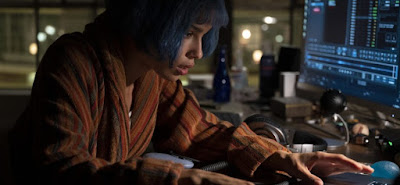
Here’s a woman shaken up by the experiences of the past couple years, which have only exacerbated issues stemming from an assault prior to that. Kravitz plays the comfortable discomfort of her routine well, and then sells the physically taxing idea of stepping out with a skin-crawling sense of being trapped in her own skin. Why, even a FaceTime from a therapist sends her itching. An early scene sees her carrying on a flirtatious text chain with a neighbor from across the street, but she can’t make herself even open her door to meet him outdoors at a food truck. So of course she gets lost in something she thinks she can better control: the mystery in that audio file. We see her apartment decorated with the tools of the trade, but also masks and hand sanitizer and wipes. She’s a product of our times. I could relate to her reluctance to step out. So she digs deeper into her new technologically aided project? It does sound like a crime, after all. The better audio window she gets into the anonymous user, the more rattled she becomes. Soderbergh expertly situates steady, locked-down shots of her daily routine, the better to feel the sense of danger creeping into them, and to upend them with hurtling handheld anxiety on the outside.
When she inevitably, reluctantly has to leave her apartment to further her investigation, the camera zooms towards her like something out of Evil Dead, whips around her at canted angles, and races past only to spin around and catch her again. Other people in public can be discomfiting enough nowadays, even without the layer of unease she’s added on top of the usual. She’s trapped further by the thriller mechanics, and a cast of looming potential threats—a Romanian tech guy, a spying neighbor, an upstairs construction site, a sniveling tech company stooge, its smarmy CEO and his shady fixers. It’s all laid out skillful and credibly; it’s the kind of edge-of-your-seat suspense that is both totally enveloping in the moment, and completely sensible in retrospect. Because the filmmakers have hooked so powerfully into the mindset of their lead, and dove-tailed it so seemingly effortlessly with Soderbergh’s pet themes—here’s another of his dramatic expressions of contemporary ills in vivid genre tropes and character detail, like Unsane or Magic Mike—there’s a terrific sense of hurtling escalation. When we get to the climax, these elements are drawn together wonderfully in a cathartic final sequence that more than pays off everything that’s been set up.
This is an especially satisfying thriller all the way, with the nerve to say that our problems aren’t just the pandemic, per se, but the whole jangling anxiety of our overstimulated tech-captured and corporate-enraptured now. More than once, people or things are not what they seem, and not just because of the movie’s needs. We casually are shown staged Zoom backdrops and faked Instagram feeds in the course of this story’s telling, and not even as plot points. That’s just how it is these days, where the ground of our shared reality can feel like it’s shifting beneath our feet as we get lost in the layers of real unreality on our screens. (At one point, Kravitz dryly quips she can handle herself—“I used to be a content moderator for Facebook.”) No wonder we’re paranoid. Kravitz, who holds the screen as compellingly as ever, carries off this sense of constant tension, even in the quotidian, so intently and intensely that we don’t just want her to solve the case and dodge the complicating dangers. We want her to feel like she’s back, and safe, on solid ground. And don't we all?
Labels:
David Koepp,
Steven Soderbergh,
Zoe Kravitz
No comments:
Friday, March 18, 2016
Diversion: THE DIVERGENT SERIES: ALLEGIANT
Blandly proficient brand extension, The Divergent Series: Allegiant was presumably made because they’d
already made two of them and there was one more book in the YA series by
Veronica Roth. The predecessors didn’t flop, so why not? It even splits that final
book in two, pushing the back half to another film to be released next year
sometime. Hey, Harry Potter, Twilight, and The Hunger Games did it. Since The
Divergent Series was already an
amalgamated knockoff of every other teen-centric genre franchise, why not copy
them right down to the money-grabbing two-part finale? The trouble is it’s not
nearly as imaginative or interesting as its inspirations. A calculating lack of
passion bleeds into every frame of the film, in which a talented cast and crew
are here mostly because they’ve already signed the contracts, enacting a
remarkably uneventful story somehow swollen to 121 empty minutes.
As the movie starts, the previous movies’ routine teen
dystopia, a crumbling far-future Chicago, once made up of a populace divided
into temperament- and talent-based factions, has collapsed. The very special
person at the center of the collapse is Tris (Shailene Woodley), who fought off
mean Kate Winslet’s efforts to take over the city. Now, though, a new leader
(Naomi Watts) is determined to reshape the populace under her control,
installing puppet courts and whipping her followers into a frenzy with wild
prejudice and violent impulses. “You’ve incited a mob. I hope you can control
it,” says her son, who also happens to be Tris’s lover (Theo James). Together
the tough lovebirds – along with returning cast members Ansel Elgort, Miles
Teller, ZoĆ« Kravitz, and Maggie Q – decide to flee the deteriorating society
and jump over the gigantic wall into the wild unknown, leaving poor Octavia
Spencer behind to deal with the trouble they started.
Considering that each of these movies so far has ended by
intimating that we were going over that wall, it’s about time. Once they get
there they find a muddy red desert where in our world is Lake Michigan. They
wander around just long enough to give Elgort the chance to stare dumbly at a
bubbly puddle and utter the following line: “This hole looks radioactive, or it
was some time in the last 200 years.” I wrote that down immediately, relishing
its pulpy sci-fi nonsense. Anyway, the teens end up getting taken to a gleaming
grey-and-white futurist building which a man in a suit (Jeff Daniels) tells
them was once O’Hare International Airport. Why that should be a detail worth
telling to these future kids is beyond me. They don’t know what that is. In
this future world it’s the home of a militarized band of scientists who confess
that Chicago and its factions are really their experiment to see if they can
undo humanity’s downfall: customized genes. It’s not exactly the most
thrillingly examined idea.
It all turns out to be a nefarious set-up by which
genetically perfect people want to keep the damaged dopes locked away in city-sized
labs. Obviously Tris won’t have any of this and, after well over an hour spent
wandering around this dully-developed new location, finally decides to do
something about it. Screenwriters Noah Oppenheim, Adam Cooper, and Bill Collage
glumly hit all the expected bits of a film like this in a creakingly mercenary,
sparsely developed plot. The arc of each of these Divergents is identical. An evil adult has bland middle-management
style and a plan to wipe out her or his inferiors, while Tris slowly learns
that she’s not only special and the only one who can save the world, but she’s
even more perfect than she’d last been told. This all happens while pretty
people stomp around anonymous sets – warehouses, mostly – and interact with flavorless
effects, trading clunking dialogue and staring at each other with what I can
only assume is a mixture of boredom and brooding.
Director Robert Schwentke returns from the last time, still
happy to merely keep things brightly lit and occasionally move the camera in
surprising ways. He finds a few interesting images, throwing in some unexpected
split focus diopter shots early on, filming a decontamination room in inky
silhouettes, and visualizing the effects of a memory-wiping mist by making a
man’s recollections float next to him while slowly burning away. But mostly he
just dutifully watches what has to be one of the most bored casts I’ve ever
seen sleepwalk through endless exposition and fuzzy motivation. During a scene
in which the teens catch a ride to future-O’Hare in glowing bubbles, Teller
gapes at a CGI spire and gasps the least convincing “gadzooks” you’ll ever
hear. (Really.) Later a pro forma dogfight of sorts is accompanied by
lackluster shouts and screams from the leads, sounding like completely
nonplussed theme park patrons trying to whip up their enthusiasm for an
underwhelming roller coaster’s dips and swerves. There’s so little going on here,
just charismatic performers resigning themselves to the lifeless nonsense
around them.
Saturday, June 20, 2015
Straight Outta Inglewood: DOPE
In many ways, Dope is
a standard coming-of-age American indie, right down to the buzzy Sundance
premiere and self-consciously precious stylization. What saves it from growing
insufferable is its energy and perspective. Writer-director Rick Famuyiwa (The Wood, Brown Sugar) gives the proceedings a loping eccentricity
informing each meandering step through a fraught Inglewood odyssey. It stars a
good kid in a bad neighborhood, who is pulled away from his path to Harvard through
a series of accidents and coincidences, then must work his way back. Complications
pile up, and a variety of subplots and supporting characters push each other
off screen for puzzling periods of downtime. It’s a movie with too much, finding time in its loose plot for narration on everything from
racial authenticity to gay rights, drug dealers debating the morality of
drones, and Pharrell-penned musical interludes. It’s too much, but when it
settles into an easy groove, it’s a pleasure.
Set in modern day Los Angeles County, high-schooler Malcolm
(Shameik Moore) and his buddies (Kiersey Clemons and Tony Revolori) look like
they stepped out of Yo! MTV Raps in
the early 90’s. Self-described black geeks, they love old school hip-hop,
playing in a garage band they started after dropping out of marching band, and
shopping for vintage gear. The opening narration (delivered smoothly by Forest
Whitaker) tells us they aren’t in a gang and don’t do drugs, spending their
days dodging dangerous characters while working towards good SAT scores, a fun
prom, and going to college. But, with their adolescent urges, they’re always
looking for ladies. When a nice girl from the block (Zoƫ Kravitz) invites them
to a birthday party down at the club, they can’t help themselves, even though the
guest of honor is a notorious local dope dealer (A$ap Rocky).
Their plans for the future are thrown into doubt when the
police break up the party and the dealer stashes his dope in Malcolm’s bag. Our
leads escape, but soon those dangerous characters draw near as the trio
scrambles to stay alive and get rid of the drugs in a way that’ll get them out
of trouble with both cops and criminals. They’re caught between a dealer and a
law place. For a while it’s a madcap scramble to get the bag back to its owner,
a goal complicated by a rival dealer (Amin Joseph), a slimy businessmen (Roger
Guenveur Smith), a high rich girl (Chanel Iman) and her aspiring producer
brother (Quincy Brown), and Malcolm’s mom (Kimberly Elise). A tight focus on
this crisis, in a one-crazy-After Hours-day
mode, rockets the movie along, but soon drifts away as the film swells with misjudged
comedy and overcrowded subplots – romantic, academic, criminal, and more –
which drain the threat of immediacy.
A sort of slow-motion caper movie, with a supporting cast
too sporadically deployed and stereotypically defined to really pop, the key
source of interest is Malcolm. Rachel Morrison's smooth cinematography keeps him the center of attention as Moore delivers a loose, funny, charismatic
performance. It’s easy to root for the meek geek in over his head in situations
out of his control, and Famuyiwa finds workable tonal slipperiness by allowing
the central character such fine consistency. Through a gauntlet of disreputable
scenarios by turns comic, suspenseful, and sexy, we watch this young
man attempt to wrest back agency in his own life and prevent damaging his Ivy
League dreams. The way there takes too many detours, but Moore’s allowed to be
the sort of performer who immediately draws attention and sympathy whenever
he’s on screen. His climactic recitation of his college application essay, looking straight out at the audience before pulling up his hoodie and walking away, is
such a powerful moment of rhetoric. It’s almost excusable how uninvolving the film’s
back stretch – involving a dumb hacker (Blake Anderson), and some far-fetched
contrivances – grows, plus the few extra endings beyond that point.
The telling may be shaggy, but there’s still some appeal in
the framing. Matching the main trio’s throwback vibe, Famuyiwa’s direction is
similarly inspired by early-90’s culture, specifically the particular indie
sensibility birthed by the early successes of Spike Lee, Quentin Tarantino,
John Singleton, and Kevin Smith. There was a period of a few years where all
you needed to launch a tiny film project was semi-comic violence, ironic
distance, loud politics, dialogue saturated with pop culture patter, and
liberal use of split-screens, title cards, arch narration, and malleable
chronology. Few of the derivative works were as good as their inspirations, and
even some of them weren’t that good.
But somehow, twenty years on, there’s some freshness in seeing the old tropes
again, especially when brought to a slick hipster synthesis speaking to
uniquely modern discourse on race and opportunity (and technology, though
dropping the word “bitcoin” a hundred times doesn’t make it as successful a
topic here). There’s personality to spare, enough to almost cover up its sloppier
parts.
Saturday, May 16, 2015
We Don't Need Another Hero: MAD MAX: FURY ROAD
There are moments in Mad
Max: Fury Road where I sat gaping at the screen in exhilaration and awe,
convinced this film is the car chase masterpiece to which all of cinema has
built. That's heat-of-the-moment hyperbole, but it sure is
indicative of how enveloping and sustained this exhilarating action film is. I
thought back to the jaw-dropping truck chase climax in writer-director George
Miller’s first Mad Max sequel, 1982’s
The Road Warrior, and how blown away
I was as a hurtling pyrotechnic stunt display neared its twentieth minute. Fury Road pushes past its fortieth
minute, then its ninetieth, racing towards two hours with no signs of taking
its foot off the pedal. People careen between tanker trucks, zoom souped-up
jalopies and armored muscle cars protruding jagged metal and long, pendulous
spears as guns fire, knives jab, bombs explode into the desert, and vehicles
crash and flip. Every rest is simply a suspenseful pause before the chased spy
their pursuers roaring over the horizon.
Miller returns to the sand-swept post-apocalyptic outback he
left behind in 1985’s Beyond Thunderdome,
summoning up every ounce of his prodigious imagination, filmmaking prowess, attention
to fantastical detail, and moral heft to create the most soulful and exciting
action film in ages. The Mad Max
films’ worldbuilding works wonders by staying small and specific, with stakes
tactile and personal. We follow the taciturn rover Max into unique and
fascinating corners of the ruined world each time out. Here we discover yet
another place where water and gas are currency, and where human life has been
organized in convincingly cruel and cracked ways. Max (Tom Hardy, flawlessly
taking over for Mel Gibson), suffering PTSD from his earlier exploits, finds
himself captured by War Boys and held prisoner in their automotive death cult
in a cavernous oasis they call The Citadel.
A persuasive and disturbing dystopian society fully
thought-through, The Citadel is ruled by an evil warlord, Immortan Joe (Hugh
Keays-Byrne), who breathes with a tooth-studded oxygen mask and has his putrid
body sealed in plastic armor. He controls the water, and therefore his
subjects, men covered in tumors and scars willing to die for a drink and
promise of an automotive Valhalla afterlife. The women are treated as property,
good for breeding with the Immortan and providing milk. These enslaved young
women (Zoƫ Kravitz, Rosie Huntington-Whiteley, Riley Keough, Abbey Lee, and
Courtney Eaton) sneak off with a rare free female, Imperator Furiosa (Charlize
Theron), in her tanker. The women flee across the desert, Joe’s vehicular army
close behind. One driver (Nicholas Hoult) straps Max to the front of his car,
muzzled and dripping blood as he’s reluctantly pulled into this conflict.
Miller, writing with Brendan McCarthy and Nick Lathouris,
has concocted a story perfect for a feature-length chase, lean and expressive.
It’s a tour de force of perpetual motion, briskly characterizing its
participants through actions while organizing witty, complicated fast-paced visual
spectacle. Always on the move, but never exhausting, the film varies its speed
in natural, and suspenseful, ways. Filming real cars barreling across a real
desert, Miller finds terrific weight in every movement, a sense that violence
matters. This makes the most visceral of crashes and smashes, and every moment
with people crawling around and between vehicles, feel impactful and dangerous.
Cinematographer John Seale’s wonderfully textured images capture the brilliant
stunt work (comparison to Buster Keaton’s The
General seems apt), sweeping across vast spaces and squeezing into tight
corners. Editor Jason Ballantine elegantly whips up suspense and finds poetry
in motion amidst the growling engines, grisly gore, saturated colors, and CGI
enhancements. As new combatants join the chase, the momentum keeps things
hurtling along with nerve-wracking, teeth-rattling, white-knuckle thrills.
The visual and moral clarity of Fury Road is impressive. We know at every moment what dangers
confront our characters, drawn in broad strokes and colored in with Miller’s
creative specificity. Wild leather outfits, bright streaks of makeup and motor
oil, and steam-punk prosthetics are the ensemble’s costumes. Within them are
fiercely primal performances. Theron’s the best, tearing through the scenery as
an avenging warrior, bold, bald, smart, wielding a burning glare and artificial
limb with deadly serious intent. The villains are grotesque men, sickly
dripping disease and rot in impressively gross makeup effects. Their fleeing
victims are angelic innocents wrapped in flowing white cloths (though never
mere damsels in distress). And then there’s Max, in his cool jacket and affect,
perhaps the last noble man left on Earth. He’s principled and troubled, is reluctant
to fight, always wanting to save his own skin, and yet unable to ignore the
danger faced by those around him. The moral stakes of all this turmoil is
agonizingly clear.
It’s this strong, simple core that makes the action of Mad Max: Fury Road so particularly
intense. Not only does Miller stage spectacular crashes and explosions,
communicating an invigorating sense of pain and drive, but he quickly makes it
matter. I was drawn into the fascinating world he created, cared deeply about
the characters in peril and what becomes tenderly moving about their
relationships. The movie charges forward, asking an audience to lean in and
catch up. How exciting to enter a fully drawn world with an immediately
gripping scenario of emotional and thematic weight, and find absorbing chaos. This
is popcorn filmmaking at the highest level, a master filmmaker proving
relentless noise and fury can be artfully shaped, and carry a genuine,
meaningful wallop. Miller considers his characters' choices as carefully as he
choreographs their cars, in both cases as exhilarating for what they do as how
they arrive there.
Friday, June 10, 2011
Mad Mutants: X-MEN: FIRST CLASS
With X-Men: First Class the franchise that started in 2000, peaked with 2003’s X2 and then went on to finish off a trilogy and limp through a prequel, has looped around to a second prequel that finally gets down to showing how a group of mutants formed the X-Men in the first place. This is all expositional dialogue from earlier movies tweaked, fleshed out, and made into one mostly coherent feature, but unlike 2009’s X-Men Origins: Wolverine, First Class is still capable of surprise. Rather than dutifully double-knotting loose ends that have already been tied, this movie takes a lot of pleasure in its comic-book style mythmaking.
It strikes me that the X-Men series now cumulatively is the best page-to-screen adaptation of the feel of a comic book series with its complicated, overlapping backstories, its ever evolving retconning, and its intricate, sometimes gap-filled, puzzle of exposition spread out across five installments. This new film starts off with several sequences that feel like separate issues of a comic that slowly merge into one storyline. We see a young Erik Lensherr in a World-War-II concentration camp bending a metal gate and then brought before a devious Nazi who, in a jarring edit that crosses the 180 degree line to good effect, is revealed to be a bit of a mad scientist interested in discovering and experimenting with mutated powers. We then see a young Charles Xavier using his telepathy to discover a shape-shifting orphan that has snuck into his cold family’s cavernous mansion, bring some hope to an alienated child.
From there, the movie flits between the two boys who quickly are shown to be young men. It’s the late 50’s. Lensherr (Michael Fassbender) is hunting down hidden Nazis while Xavier (James McAvoy) is working on his thesis at Oxford. They have different approaches towards using their mutations. Lensherr uses his for the power and violent revenge it allows him. Xavier, on the other hand, uses his seamlessly and secretively to give him an (unfair) advantage in social situations. One is all about making himself known; the other prefers to calmly blend in. What’s nice about these early-years portions of the film is the way it reveals their character traits through action. This helps propel the momentum ever forward without (or at least rarely) getting bogged down in the gooey nonsense of characters talking overtly about themselves in unconvincing ways.
Moving forward, into the 60’s, the film is jam-packed with plot and exposition. While good use of the period bric-a-brac allows for fashion, technology and music to flesh out the setting, the film has curiously little use for the civil rights struggle. You would think that would be the clearest allegory for mutants, much like Bryan Singer’s first two films in the series used mutants as a stand in for gay rights. This film has little time for allegory outside of a few dull stabs at social import that are mostly cringe-worthy, like the treatment of the film’s only African American. But in a movie this dense with plot, themes have a tendency to get ignored and when attention is finally, fleetingly, turned upon them, it feels awfully ham-fisted.
Aside from building (and rebuilding) characters and the universe, this is essentially a spy movie. The film busies itself with C.I.A. intrigue involving some well-intentioned agents (Rose Byrne and Oliver Platt) who want to recruit some mutants. To start with, they need a scientist who specializes in researching and theorizing about human mutations. They find one in Charles Xavier. They’re interested in using his knowledge to help in dealing with the devious Sebastian Shaw (Kevin Bacon!) who, reconnaissance tells them, just might have a group of mutant henchmen helping to heat up the Cold War. Why else would he hang around with three surly thugs (January Jones, Alex Gonzalez, and Jason Flemyng) who can provide mysterious, otherworldly enhancements to their intimidations?
This is a large cast, but all of the key elements fall into place in a pleasing manner. Fassbender and McAvoy, fine actors both, never condescend to their roles. With great seriousness, and more than a little bit of obvious pleasure, they command the screen with their fantastic presences. Fassbender, especially, has a kind of epic glower and a muscular suaveness that, in conjunction with his turtlenecks and leather jackets, feels just about as close to a resurrection of 60’s-era Steve McQueen or Sean Connery as we’ll ever get. As for the villain, Kevin Bacon hams it up – he’s clearly having a blast – but he manages to be an awfully serious threat at the same time.
The rest of the cast, while often less noteworthy, tend to be well equipped for what they’re asked to do. The “First Class” itself doesn’t even show up until not too long before the climactic action. But as the team assembles throughout the movie, despite the new characters receiving far less characterization that the main men, it’s fun more often than not to see both young versions of established characters like Mystique (now Jennifer Lawrence) and Beast (now Nicholas Hoult) as well as new-to-the-screen characters like the howling Banshee (Caleb Landry Jones) and the energy-beam-shooting Havoc (Lucas Till). (Shortchanged is Zoe Kravitz as the flying and fireball-spitting Angel who is given the least heroics to do). True to the series pattern of creating eccentric ensembles with powers of varying believability, the group is a fine mix of sci-fi powers that end up working together in fun combinations in the final blast of action.
Despite the heavy amount of plot placed upon the film, it still manages to deliver the summer-movie goods at a rapid-fire pace. Director Matthew Vaughn (who directed last year’s superhero semi-satire Kick-Ass, a movie I enjoyed but slowly slightly soured on) concocts with his five co-writers a pleasing succession of smashing action beats that crash forward with a reassuring regularity. This is a big budget effects-heavy film that features some fine acting and some pleasing action. It’s also the rare franchise film that’s light on its feet despite the weight of accrued details.
It manages a brisk pace and can be quite funny at times, even finding ways to have some small fun with its occasional comic-book corniness (a telepath-blocking helmet is very cool, somewhat menacing, and fairly silly, all in the same instant). The vibrant, saturated colors and a smidgeon of self-conscious winking in the production design (including brief nods to Dr. Strangelove and Basic Instinct of all things) and small cameos do much to further the sense of both continuity and originality. It’s a prequel that’s most satisfying precisely because it finds a good balance between paying homage to all that’s come before and striking out on its own. There are enjoyable nods towards the franchise’s past while laying great groundwork for its potential future.
Subscribe to:
Posts (Atom)