With Superman, writer-director James Gunn tries restarting the DC cinematic universe with the third attempt at this original hero in the last twenty years. To do so, he reimagines a colorful world with several superhero plot lines already in progress. He figures audiences can get up to speed without belaboring origin stories all over again. So here we are, three years into Superman’s career as a hero. David Corenswet brings the right golly-gee jawline to the upright iconography of the hero and aw-shucks humility of his bespectacled Clark Kent disguise. He’s already entangled in a romance with newspaper colleague Lois Lane (Rachel Brosnahan) and embroiled in a one-sided rivalry with billionaire Lex Luthor (Nicholas Hoult). He has a friendly-but-frosty relationship with some other heroes knocking about his corner of the universe: Green Lantern (Nathan Fillion), Hawkgirl (Isabela Merced), and Mr. Terrific (Edi Gathegi). There are robots and giant monsters and portals to parallel universes and cameos form upcoming spinoffs an lots of glowing gadgets and opportunities for vivid, cartoony, splash-panel spectacle. There’s even lots for Krypto the super-dog to fetch. It’s all done in a coherent Gunn style, tonally more Suicide Squad than Guardians of the Galaxy, but recognizably in wide angles and blocky frames, overflowing with his smirking sincerity and hurly-burly earnest pop culture spirit. The result is a zippy, zany comic book eruption of excess. The movie’s chaotic and overstuffed, but with its heart in the right place.
It really does care about the totally authentic goodness of its Superman, and lets the conflicts rise up organically out of a world that’s not built to take goodness seriously or even believe in it. There are puffed-up corporate interests and snarling foreign dictators and slimy pundits and rival do-gooders and they’re all jostling for the kind of authority and attention that Superman gets just by being himself. There’s something pure and lovely about that. Even as Gunn is less interested in the character as a symbol or an idea, he’s more interested him as a person who's a vision of how to do your best to be a force for good in a world falling apart at the seams. In doing so, he succeeds in making a big, bright movie full of likable characters, but as the scenes hustle by and supporting characters flit in and out and the movie hurtles through scenes of digital destruction, I found myself thinking it’s all a bit much. A little deadening digital destruction goes a long way. I’ll take a slow-mo shot where Superman swoops down and stops a little girl from being hit by debris over dozens of minutes of punching robots and super-beings every time.
Coincidentally Marvel is also going back to one of its earliest comics for their latest superhero movie. It, too, is the third attempt in twenty years at getting these characters right, and eschews an origin story to just get down to business. Fantastic Four: First Steps starts four years into their heroism. They live in a retro-futurist alternate universe that looks like its just upstream from a Jetsons aesthetic. There the stretchy scientist Mr. Fantastic (Pedro Pascal), his sometimes-invisible wife (Vanessa Kirby), flammable brother-in-law (Joseph Quinn), and rock-monster best friend (Ebon Moss-Bachrach) are celebrities for defending the planet from all manner of comic book threats. There’s a charming rapid-fire montage that opens the movie blitzing us with glimpses of enough villains and action sequences to fill a few movies. Instead, it settles into a weirdly low-key family drama intercut with apocalyptic stakes, but keeps up the rapid-fire CliffsNotes style, racing through exposition and slaloming through plot lines and complications other movies might spend a whole run time developing. The whole movie has a feeling that it’s trying to make up for lost time.
The period-piece sci-fi aesthetic gives the movie a fine visual look, and gives the midcentury comic book its best outing on the big screen. (Though arriving so late puts it deep in the shadow of the far superior Incredibles movies, which got to the look, and a Michael Giacchino score, better and first. ) The actors are all likable enough, and inhabit the familiar dilemmas of their characters without given the chance to really stretch out and play to those dramas. We do get to some extremely comic book sequences, though, including an invisible woman giving birth in zero-gravity while her brother shoots lasers at a space woman surfing behind their spaceship as it slingshots around a black hole. It caused me to reflect on the days when comic book movies were afraid to even use the costumes from the illustrations on screen. Now they’re doing spectacular sci-fi looniness without batting an eye. This one paradoxically goes all in on these enormous fantastical ideas while keeping the movie incredibly small.
The ginormous intergalactic villain Galactus (Ralph Ineson’s voice rumbling the subwoofers) wants to gobble up Earth, sending the Silver Surfer (Julia Garner, cool with an eerie shimmery stillness and metallic intonation) to herald his impending arrival. We get a tossed-off reference to a Galactus cult forming, and crowds debating making a sacrifice to him, and the whole movie operates under this cloud of world-ending stakes. But the movie is content to leave that as the backdrop to the shot-reverse-shot predictability of its leads talking strategy and family dynamics. Solutions seem to arrive easily for our characters, side-characters are cut to glorified cameos, and, though the weight of the word hangs heavily on their shoulders, complications become backup plans in a blink. The movie’s in too big a hurry to get to the next thing, even by the end of the movie when it’s still just setting up promises that it’ll hopefully pay off next time. If there’s anything in the movie that most feels like typical Marvel Cinematic Universe routine, there it is. What’s here is just enough to count as a movie, and just charming enough to make these likable characters again, and just busy enough to feel like we’ve had the kind of blinking lights and flashy colors that make popcorn go down easy. But it is also relentlessly manipulative with an imperiled infant (and a shockingly shoddily composited one, at that) used as shorthand for us to care instead of investing in building depth for the plot’s complications and implications. Maybe the next movie can find a story instead of a collection of things that happen.
Showing posts with label Nicholas Hoult. Show all posts
Friday, July 25, 2025
Tuesday, December 10, 2024
Hate Crime: THE ORDER
The Order is a tense and absorbing real-life thriller set against a backdrop of the American northwest, with stunning views of mountains and forests and rivers and farms on which plays out a standard procedural about good men with guns in pursuit of the bad men with guns. This gives it the feeling of a Western, albeit one with machine guns and pickup trucks from its mid-80’s milieu. It’s only fitting for a true crime story that’s about the very conflicts that continue to drive our country’s madness to take on the trappings of a genre that’s always about American identity. This picture finds an FBI agent (Jude Law) investigating the works of a white-supremacist militia. He’s a grizzled and exhausted veteran who rolls into town and soon teams up with a boyish local cop (Tye Sheridan) to start asking the right questions, and some wrong ones. The militia under suspicion is a recent breakaway group from a larger, slightly more sedate hate group. It’s led by a hot-headed extremist (Nicholas Hoult) who’s leading his small band of men in robberies and bombings, leading up to planned assassinations and more. Ominously, there’s a shot of blueprints for the United States capitol tacked up on his bulletin board. I half expected a title card at the end to tell us one of their group would go on decades later to storm it. Or be elected to Congress.
Director Justin Kurzel is a good fit for the material with his interest in man’s capacity for violence and the ways in which aimless men can bond over a sense of duty, misguided or not, that can emerge from its pursuit. (This makes for an interesting companion to Kurzel’s Macbeth, Assassin’s Creed, and True History of the Kelly Gang in its exploration of bloody codes of conduct and grim perspective.) He has a straight-faced somberness of tone and a steady grip on suspense erupting into violence. Here are long, crackling sequences of law enforcement jargon and investigation, jostling personalities behind the scenes of cops and criminals alike, and then the inevitable shootouts and bombings and chases. (There’s also an event that’ll be familiar to anyone who knows it inspired Oliver Stone’s electric underrated Talk Radio.) Kurzel moves the plot with a well-paced progression of clues and escalations, keeping a close eye on the revealing gestures of the performances. Law convincingly plays an older agent who was hoping to slow down, but finds he just can’t stay out of the game. He moves like an old pro, interrogates with a gruff edge, and runs with a hard-charging fervor that had me worried the character would give himself a heart attack. Sheridan is a fine youthful idealist coming into his own, making a fine pair with Law’s grizzled determination. (Jurnee Smollett is a good by-the-book third wheel when they call for backup.) They’re easy to root for. As their Hoult is scarily blank, a void of charisma that nonetheless has other racist young guys enthralled to his promise of a better, whiter America. There’s a sick dread to the FBI’s righteous pursuit of their group, as we know the sick appeal of their target's evil message will continue to linger past this particular flashpoint.
Tuesday, November 5, 2024
Justice for All: JUROR #2
Clint Eastwood spent the first three decades of his career starring in movies about retributive justice, and the last three decades directing movies problematizing that notion. How beautifully consistent, the iconographic cowboy cop whose might made right aging into a thoughtful interrogator of the systems whose corruption supports such misguided notions, and the kinds of steady professional cooperation that can truly save the day. The distance between Dirty Harry—grizzled, violent, taciturn, impulsive—and Sully—warm, calm, communicative, expert—says all you need to know. He’s always been drawn to darker, more complicated figures, but in his older years, his films slowed down, grew melancholic and doubtful, cast about in the shadows and grays he brought to his images for glimmers of light and truth that still shine through despite the flaws. This receives a clean, clear, lovely, and maybe final, expression in Juror #2, a movie that in decades past would’ve been a basic studio programmer—a legal thriller with a great hook and few fine performances. Now, given the rarity of that form, and the credentials of its 94-year-old director, it gathers an old-fashioned sense of craft and consideration. It finds a juror (Nicholas Hoult) listening intently to the arguments in a murder case, tracking the back and forth between a prosecutor (Toni Collette) and defense attorney (Chris Messina) about the behavior and character of the accused (Gabriel Basso). As the juror hears the facts of a body found by the side of the road on a dark and stormy night some months prior, he begins to suspect the deer he thought he hit on that very day was in fact this victim. What follows in Jonathan Abrams’ script is a sturdy courtroom procedural of motions and objections and testimony and cross-examination and closing arguments and deliberations.
Eastwood makes it a subtle study of actors faces and gestures. And building off such a compelling moral quandary gives the genre’s standard moves a charge of genuine high-stakes philosophical inquiry. To come forward would save an innocent man’s life at the expense of his own. Will he make the right choice? As we learn more about Hoult’s home life and back story, as well as the defendant’s, the movie twists the lines of sympathy as we see the goodness and flaws of each. The right thing starts to feel not so clear cut. What Eastwood’s driving at here is that of faith in the justice system—watching attentively as it goes wrong in this extreme circumstance, and watching patiently to see if just enough will go right. How fitting for an American moment in which we wonder if we’ll ever see justice for what’s so clearly wrong. Eastwood earnestly believes in the goodness of people trying to do a good job, and trying to do what’s right. It may not be a perfect system, and we are certainly not perfect people. But it’s the best we’ve got, and we are all we have. Eastwood builds his case with methodical clarity, adjusting the characters and situation with low-key confidence in letting their complications energize a well-constructed concept. It’s a textured satisfaction as the movie finds its way to a close and lets the fullness of its implications linger in a final moment of harrowing uncertainty and pregnant silence. And yet, because he actually believes there is civic goodness in even a flawed system—he has us watch the jury duty promotional video with his characters, after all—we can, too.
Friday, April 28, 2023
Dead Alive: RENFIELD and EVIL DEAD RISE
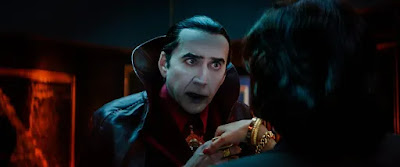
Quite fitting that the horror genre is our most proficient at resurrecting dead franchises. Sometimes it’s a lively jolt. Other times, though, are just as gross and unnatural as the metaphor implies. Take Renfield, a noxious reworking of the Dracula mythos. It’s got exactly one good idea: casting Nicolas Cage as the famous vampire. Explicitly nodding toward the original Universal Monster performance by Bela Lugosi, the movie allows Cage to gnash into his lines with a grinning menace and a blasé affectation. You get the sense that Cage and Dracula alike have been involved in outsized phantasmagorias for so long now that they can do it in their sleep. Unfortunately, the movie never matches Cage’s potential, and ends up dulling his ability to go gleefully over-the-top by sticking him on the sidelines of a manic, hollow, formulaic antihero story. His familiar undead assistant Renfield takes center stage. He’s played by Nicholas Hoult in another of his failure-to-launch leading man roles. Renfield is now little more than a meek serial killer serving up victims for his master, until one day, through unconvincing love-at-first-sight with a cop (Awkwafina) and some vague self-help talk, he decides to kill the old vampire instead. There’s also a whole mess of flimsy story about a preposterous New Orleans mob family and their hair-trigger son (Ben Schwartz) mucking around town that mainly exists to populate the picture with more undifferentiated victims. It’s such a boring slop of a picture, that it can’t even muster the energy to give its setting any real local color among its other unimaginative faults.
The result is waves of gunfire, and goons dismembered in geysers of blood by the lead character as he aw-shucks assures us that he’s doing it for the right reasons. The result is a grindingly predictable movie with smirking attitude toward mayhem and murder that nonetheless asks us to imagine its characters are good and right. Seeing Renfield stand atop a pile of dismembered corpses and claim the moral high ground sure is something. The movie’s incessant jumpiness and inability to take anything seriously runs amok. Its discordant hollowness makes every half-hearted joke clang, every ugly shot composition or smear of muddy color and harsh light harder to watch, and ever self-satisfied cynicism wrapped in sentiment grosser by the second. To see a villain kicked so hard in the stomach that the contents blast out above and below simultaneously is an accurate reflection of all this movie has to offer. A moment like that makes me wonder what the intended reaction is. A laugh? A retch? An admiration that it’s willing to be so sophomorically scatological? In practice it’s a nonstarter, so over-the-top in a deadening film that’s never not at that fevered lack of imagination nothing lands with any impact. What a waste.
Better is Evil Dead Rise, which revivifies the eponymous cult classic series in a new setting. Instead of the cabin in the woods, we get a condemned high-rise apartment on its last few weeks before the remaining few residents have to move out. It’s a dank, creaky place full of ghost stories and dodgy electric work. And that’s before the demons swoop in from the other side. Their victims are even more sympathetic than the youths up for the slaughter in the previous outings. Here it’s a single mom with her teenaged older kids and one sweet moppet, and a pregnant aunt, too. If you think that’ll save them all from possession, zombification, and gruesome deaths, you’d be right for only two of them. Director Lee Cronin does his best to swoosh the camera around and linger on gnarly injuries here and there. A key recurring image is a glowering, brow-forward look that the mutilated corpses get when staring down their prey. It stretches tension as the baddies salivate with the promise of viscera exploding every which way. They’re eager to get to the gore, and Cronin knows how to hold back the pace and keep his few splashy effects to their most effective uses for maximum surprise.
It doesn’t have the hysterical gonzo goofball gore of Raimi’s original trilogy or the squirmingly sustained excessive bodily specificity of Fede Alvarez’s remake. It also doesn’t push as hard, settling into long stretches of suspense and fleeting splatters and queasy insert shots. But it chooses its moments wisely, and shares with its predecessors a giddy fatalism, cut loose from the expected safety. Its respect for human life comes from its willingness to see the desperation on its characters’ faces as the curse comes crashing down with bloody inevitability. Then the fun is, once more, squirming with them. When Cronin swings with a wild idea—a boy choking to death on an eyeball—it lands with the shock and awe that’s the franchise’s calling card. But truly only in an Evil Dead movie can it be a little disappointing when a whirring tattoo gun misses its sensitive mark. (At least the cheese grater hits its mark—ouch.) Still, if the least one of this series is reasonably compelling, slightly underwhelming tension and bloody release, that’s not so bad.
The result is waves of gunfire, and goons dismembered in geysers of blood by the lead character as he aw-shucks assures us that he’s doing it for the right reasons. The result is a grindingly predictable movie with smirking attitude toward mayhem and murder that nonetheless asks us to imagine its characters are good and right. Seeing Renfield stand atop a pile of dismembered corpses and claim the moral high ground sure is something. The movie’s incessant jumpiness and inability to take anything seriously runs amok. Its discordant hollowness makes every half-hearted joke clang, every ugly shot composition or smear of muddy color and harsh light harder to watch, and ever self-satisfied cynicism wrapped in sentiment grosser by the second. To see a villain kicked so hard in the stomach that the contents blast out above and below simultaneously is an accurate reflection of all this movie has to offer. A moment like that makes me wonder what the intended reaction is. A laugh? A retch? An admiration that it’s willing to be so sophomorically scatological? In practice it’s a nonstarter, so over-the-top in a deadening film that’s never not at that fevered lack of imagination nothing lands with any impact. What a waste.
Better is Evil Dead Rise, which revivifies the eponymous cult classic series in a new setting. Instead of the cabin in the woods, we get a condemned high-rise apartment on its last few weeks before the remaining few residents have to move out. It’s a dank, creaky place full of ghost stories and dodgy electric work. And that’s before the demons swoop in from the other side. Their victims are even more sympathetic than the youths up for the slaughter in the previous outings. Here it’s a single mom with her teenaged older kids and one sweet moppet, and a pregnant aunt, too. If you think that’ll save them all from possession, zombification, and gruesome deaths, you’d be right for only two of them. Director Lee Cronin does his best to swoosh the camera around and linger on gnarly injuries here and there. A key recurring image is a glowering, brow-forward look that the mutilated corpses get when staring down their prey. It stretches tension as the baddies salivate with the promise of viscera exploding every which way. They’re eager to get to the gore, and Cronin knows how to hold back the pace and keep his few splashy effects to their most effective uses for maximum surprise.
It doesn’t have the hysterical gonzo goofball gore of Raimi’s original trilogy or the squirmingly sustained excessive bodily specificity of Fede Alvarez’s remake. It also doesn’t push as hard, settling into long stretches of suspense and fleeting splatters and queasy insert shots. But it chooses its moments wisely, and shares with its predecessors a giddy fatalism, cut loose from the expected safety. Its respect for human life comes from its willingness to see the desperation on its characters’ faces as the curse comes crashing down with bloody inevitability. Then the fun is, once more, squirming with them. When Cronin swings with a wild idea—a boy choking to death on an eyeball—it lands with the shock and awe that’s the franchise’s calling card. But truly only in an Evil Dead movie can it be a little disappointing when a whirring tattoo gun misses its sensitive mark. (At least the cheese grater hits its mark—ouch.) Still, if the least one of this series is reasonably compelling, slightly underwhelming tension and bloody release, that’s not so bad.
Labels:
Awkwafina,
Nicholas Hoult,
Nicolas Cage
No comments:
Saturday, November 19, 2022
Out of Service: THE MENU and TRIANGLE OF SADNESS
In this new Gilded Age, the rich are a fat, juicy target for any satirist. But in fact, the obscenely wealthy hoovering up our resources and headlines are often far more ridiculous than any satirist could invent. It doesn’t take a political cartoonist to balloon their buffoonery; they’re already doing that on their own. Still, it leaves plenty of room for an astute storyteller to put them before us anew and bite with sharp portraiture to draw bitter laughs. That’s the project of The Menu and Triangle of Sadness, two complementary, and similarly half-successful, movies that take service industry jobs as their window into the one-percenters’ transactional heartlessness that’s at the core of so many societal ills. The willingness to diminish a person to their job is a hop, skip, and a jump from not seeing their humanity at all.
Revenge is the dish served in The Menu, in which a high-level chef (Ralph Fiennes) has invited a collection of horrible people to dinner. Each course ramps up the tension as his cultish cooks and servers twist the knife—sometimes literally—by slowly revealing that 1.) the guests are trapped in the restaurant, and 2.) each tiny, artsy, deconstructed course is designed to steadily reveal ever more of their personal foibles and secrets. There’s a smorgasbord of character actors (Janet McTeer! John Leguizamo! Reed Birney! Judith Light! Nicholas Hoult! And more!) for the ensemble as crooked tech bros, apathetic blue bloods, a snooty food critic and her editor, a washed up actor and his embezzling assistant, and a misogynistic foodie realize they’re being led to a slaughter. The one innocent (Anya Taylor-Joy) is a hired date of one of the diners. So at least there’s one person for whom to wish survival. The characters are all thinly sketched, leaning on our prejudices for implied critiques, and that puts a cap on the sick pleasures it could offer.
There’s a lack of specificity in its energy, and its understandings of its characters. It’s like they know they’re posing for a fiction. The chef himself is an unfair Gordon Ramsey riff, what with his employees shouting “Yes, chef!” upon every command as they run around a kitchen and dining area that looks like a cross between Hell’s Kitchen and Masterchef sets. But it’s never clear what his grievance is, other than, as he says late in the picture, that his guests are the kind of people ruining the art of food. The result is a satire that’s pretty clever line to line—one of the screenwriters comes from the world of Late Night talk shows—and works well enough scene by scene. But it doesn’t really add up to much, with a visual style and pace that’s as smoothly stereotypical as its characters. The movie’s ultimately too pleased with its glibness to dig in and mean something of any consequence. I’ve seen lesser Saw sequels with a better sense of social commentary. Shame this one’s so undercooked.
Triangle of Sadness gets off to a better start because writer-director Ruben Östlund knows how to spin up types and let them crackle with specificities. That’s what makes his best film, Force Majeure, so bleakly funny with its story of a vacationing family’s tensions after a mishap at a ski resort reveals way more about deep character flaws than anyone could’ve anticipated. His The Square does a similar thing with incidents set in a hollowed-out, corporatized, faux-transgressive art world. Sadness has a male model (Harris Dickinson) and his influencer girlfriend (Charlbi Dean) bickering over money before they arrive at a luxury yacht. The middle portion of the movie is dedicated to sharply needling vignettes in which they, or the other insanely privileged, preposterously selfish guests aboard the cruise, are blind to the needs of workers around them. Meanwhile, the smarmy customer service mangers wrangle and cajole their underlings to plaster on those fake smiles and never say “no.” All of these scenes are as precisely observed as they are darkly amusing. By the time Woody Harrelson exits his cabin as the alcoholic leftist captain, the movie’s setting up some pretty obvious ideological collisions, especially as he starts trading Communist critiques with a crooked Russian capitalist’s Thatcherite babbling.
There’s always a sleek intentionality to Östlund’s images, and a stately chill that lets the squirming satire scrambling within them twist all the more uncomfortably. That works right up until it doesn’t in this case. The movie builds up a healthy head of steam on its outrage over inequality. That bursts on a turbulent night that sends these rich folk tumbling through vomit and sewage. That’s a pretty hilarious as a fit of scatological schadenfreude. But it’s the film’s endless final third that slowly unravels anything potent about the early going. Set post-shipwreck on a small tropical island, it thins out its class critiques with a reductive tromping through human nature as a struggle to survive. This doesn’t level the playing field, but reverses it in a reductive, and vaguely condescending way. The result is basically a less astute Lord of the Flies with assholes. And then it concludes—or really just peters out—with a limp joke and some inscrutable ambiguity. That’s the sort of ending that not only is unsatisfying in the moment, but retroactively makes the early going feel weaker, too. It misses the mark.
Revenge is the dish served in The Menu, in which a high-level chef (Ralph Fiennes) has invited a collection of horrible people to dinner. Each course ramps up the tension as his cultish cooks and servers twist the knife—sometimes literally—by slowly revealing that 1.) the guests are trapped in the restaurant, and 2.) each tiny, artsy, deconstructed course is designed to steadily reveal ever more of their personal foibles and secrets. There’s a smorgasbord of character actors (Janet McTeer! John Leguizamo! Reed Birney! Judith Light! Nicholas Hoult! And more!) for the ensemble as crooked tech bros, apathetic blue bloods, a snooty food critic and her editor, a washed up actor and his embezzling assistant, and a misogynistic foodie realize they’re being led to a slaughter. The one innocent (Anya Taylor-Joy) is a hired date of one of the diners. So at least there’s one person for whom to wish survival. The characters are all thinly sketched, leaning on our prejudices for implied critiques, and that puts a cap on the sick pleasures it could offer.
There’s a lack of specificity in its energy, and its understandings of its characters. It’s like they know they’re posing for a fiction. The chef himself is an unfair Gordon Ramsey riff, what with his employees shouting “Yes, chef!” upon every command as they run around a kitchen and dining area that looks like a cross between Hell’s Kitchen and Masterchef sets. But it’s never clear what his grievance is, other than, as he says late in the picture, that his guests are the kind of people ruining the art of food. The result is a satire that’s pretty clever line to line—one of the screenwriters comes from the world of Late Night talk shows—and works well enough scene by scene. But it doesn’t really add up to much, with a visual style and pace that’s as smoothly stereotypical as its characters. The movie’s ultimately too pleased with its glibness to dig in and mean something of any consequence. I’ve seen lesser Saw sequels with a better sense of social commentary. Shame this one’s so undercooked.
Triangle of Sadness gets off to a better start because writer-director Ruben Östlund knows how to spin up types and let them crackle with specificities. That’s what makes his best film, Force Majeure, so bleakly funny with its story of a vacationing family’s tensions after a mishap at a ski resort reveals way more about deep character flaws than anyone could’ve anticipated. His The Square does a similar thing with incidents set in a hollowed-out, corporatized, faux-transgressive art world. Sadness has a male model (Harris Dickinson) and his influencer girlfriend (Charlbi Dean) bickering over money before they arrive at a luxury yacht. The middle portion of the movie is dedicated to sharply needling vignettes in which they, or the other insanely privileged, preposterously selfish guests aboard the cruise, are blind to the needs of workers around them. Meanwhile, the smarmy customer service mangers wrangle and cajole their underlings to plaster on those fake smiles and never say “no.” All of these scenes are as precisely observed as they are darkly amusing. By the time Woody Harrelson exits his cabin as the alcoholic leftist captain, the movie’s setting up some pretty obvious ideological collisions, especially as he starts trading Communist critiques with a crooked Russian capitalist’s Thatcherite babbling.
There’s always a sleek intentionality to Östlund’s images, and a stately chill that lets the squirming satire scrambling within them twist all the more uncomfortably. That works right up until it doesn’t in this case. The movie builds up a healthy head of steam on its outrage over inequality. That bursts on a turbulent night that sends these rich folk tumbling through vomit and sewage. That’s a pretty hilarious as a fit of scatological schadenfreude. But it’s the film’s endless final third that slowly unravels anything potent about the early going. Set post-shipwreck on a small tropical island, it thins out its class critiques with a reductive tromping through human nature as a struggle to survive. This doesn’t level the playing field, but reverses it in a reductive, and vaguely condescending way. The result is basically a less astute Lord of the Flies with assholes. And then it concludes—or really just peters out—with a limp joke and some inscrutable ambiguity. That’s the sort of ending that not only is unsatisfying in the moment, but retroactively makes the early going feel weaker, too. It misses the mark.
Sunday, May 16, 2021
The Lady Grieve: THE WOMAN IN THE WINDOW and THOSE WHO WISH ME DEAD
It’s a total fluke of Hollywood’s pandemic scheduling that brings to streaming this weekend two mid-budget studio thrillers with movie star turns for middle-aged actresses. That they both center on women drawn into strangers’ high-stakes dramas while suffering from their own near-debilitating flashbacks to past trauma is just another coincidence, I suppose. If only they were both terrific. Alas, Netflix got the short end of the stick there, having picked up The Woman in the Window as damaged goods when it was sold off to the highest bidder. (20th Century Fox made the adaptation of the bestselling mystery novel back in 2018 — we don’t even need to go into the even wilder story of how the author was later exposed as a habitual con artist and fraudster in a lengthy New Yorker piece — before getting acquired by Disney, which forced reshoots that delayed the release, at which point the theaters were closed and, well, here we are.) Even if you didn’t know it was a troubled picture, it’d be clear right away it’s a muddled one. Director Joe Wright (Atonement) and screenwriter Tracy Letts (August: Osage County) have been given a pretty junky piece of source material, a transparent Rear Window rip-off in which an agoraphobic child psychologist (Amy Adams) spies some suspicious behavior from her new neighbors. The filmmakers treat the set-up as an excuse to swoop through a creaky townhouse, peer out windows, and glide across dark rooms as reality gets slippery. Eventually we get a host of marquee actors (Gary Oldman, Julianne Moore, Jennifer Jason Leigh, Anthony Mackie, Wyatt Russell, Brian Tyree Henry) cycling through Adams’ home as she gets increasingly confused about what, exactly, is going on across the street.
With hysterical accusations, devious deceptions, potential psychosis and psychopathy, and convoluted conflicts, every scene could, and maybe should, be an excuse to chow down on ham, but the film somehow never delivers on that potential. The actors stand around waiting for the main course that never arrives. The whole thing is routine as can be, with dark and stormy nights, and gaslighting suspects, and circular arguments, pile-ups of red herrings, and boy, I wonder if Hitchcock himself could’ve made Google searches a compelling source of thrills. The picture looks as dim and muddy as its plotting. Wright doesn’t even bring his usual stylish flourishes with any consistency, which makes for a curiously restrained and sleepy spelunking into bloated paperback surprises. At best it’ll throw a clip from a Hitchcock movie on our lead’s TV, which might be a cute tip-of-the hat if it wasn’t merely a reminder of how far craft has fallen in a case like this. Even the big twists just meekly peek out and slide off, one more shrug before you go. At least Adams, much better served here than by the dismal Hillbilly Elegy, for whatever that’s worth, gets to put the entire lousy picture on her shoulders and nearly carry it solo to the finish line. She inhabits every loose nerve ending and boozy pill-popping distraction as her character’s unraveling unconvincingly brings her closer to actually leaving the house.
Much better is the straight shooter Those Who Wish Me Dead. Its opening act is a bow drawn simply back; the next 75 minutes or so are a direct flight of an arrow to a fiery conclusion. There’s something admirable about its easy confidence and sturdy execution. The thing delivers where it counts. The story starts with a boy and his father (Finn Little and Jake Weber) on the run from bad guys (Nicholas Hoult and Aidan Gillen) who want them dead. They flee to Montana, where you just know they’ll cross paths with the small-town cop (Jon Bernthal) and the troubled forest service firefighter (Angelina Jolie) whose introductions have been cross-cut with the rising action. Directed and co-written by Taylor Sheridan (Hell or High Water), with author Michael Koryta from his novel, the quick blooded tension rises fast. Soon enough, the film becomes a deadly cat-and-mouse game — machine gun hunters and their vulnerable prey — stalking through the woods. Shades of fairy tale logic, perhaps, with a little boy lost in the forest, wolves on his heels, a woodsman caught in a trap, and a beautiful lady by a lake who just might be able to help him survive. But the thing is too much a grizzled non-nonsense snap of a genre effort to push overmuch on its potential fable qualities. Instead, it rests on Jolie as an engine of redemption, a woman given a desk job, of sorts, after a deadly fire outcome that weighs heavily on her mind. Now there’s a rattled child who needs rescue. It’s easy to root for them.
The movie is short and simple, and all the more effective for knowing just how to lean on its best elements. It helps that Jolie, one of our great modern movie stars, has rarely had a straightforward starring role in the last decade—just four times above the title in live action and two of them were as Maleficent. She commands the screen and exudes competence, even in a role that’s so thinly drawn that there’s nothing else but her star power to generate interest. The plot itself, too, is built from stock parts, but Sheridan knows how to stage his thrills with brutal efficiency. The tension — close up threats against the wide open national park spaces — builds on a steady upswing as the various participants try to keep their cool and their control through strategies that eventually lead to gun fights and, by the end, a raging forest fire. There are efficient thrills to the sturdy brutality of its inevitable violence, the quickly sketched sympathy for the victims, and the consistently well-timed escalations of danger. If the movie still finds time for some loose ends — what’s in the letter? and did that Big Name villain just drive off after his one scene in hopes of a sequel? — there’s pretty much nothing important that isn’t driven to its logical conclusion. We don’t get solid mid-level star vehicles often enough any more. At least this one’s pretty good.
With hysterical accusations, devious deceptions, potential psychosis and psychopathy, and convoluted conflicts, every scene could, and maybe should, be an excuse to chow down on ham, but the film somehow never delivers on that potential. The actors stand around waiting for the main course that never arrives. The whole thing is routine as can be, with dark and stormy nights, and gaslighting suspects, and circular arguments, pile-ups of red herrings, and boy, I wonder if Hitchcock himself could’ve made Google searches a compelling source of thrills. The picture looks as dim and muddy as its plotting. Wright doesn’t even bring his usual stylish flourishes with any consistency, which makes for a curiously restrained and sleepy spelunking into bloated paperback surprises. At best it’ll throw a clip from a Hitchcock movie on our lead’s TV, which might be a cute tip-of-the hat if it wasn’t merely a reminder of how far craft has fallen in a case like this. Even the big twists just meekly peek out and slide off, one more shrug before you go. At least Adams, much better served here than by the dismal Hillbilly Elegy, for whatever that’s worth, gets to put the entire lousy picture on her shoulders and nearly carry it solo to the finish line. She inhabits every loose nerve ending and boozy pill-popping distraction as her character’s unraveling unconvincingly brings her closer to actually leaving the house.
Much better is the straight shooter Those Who Wish Me Dead. Its opening act is a bow drawn simply back; the next 75 minutes or so are a direct flight of an arrow to a fiery conclusion. There’s something admirable about its easy confidence and sturdy execution. The thing delivers where it counts. The story starts with a boy and his father (Finn Little and Jake Weber) on the run from bad guys (Nicholas Hoult and Aidan Gillen) who want them dead. They flee to Montana, where you just know they’ll cross paths with the small-town cop (Jon Bernthal) and the troubled forest service firefighter (Angelina Jolie) whose introductions have been cross-cut with the rising action. Directed and co-written by Taylor Sheridan (Hell or High Water), with author Michael Koryta from his novel, the quick blooded tension rises fast. Soon enough, the film becomes a deadly cat-and-mouse game — machine gun hunters and their vulnerable prey — stalking through the woods. Shades of fairy tale logic, perhaps, with a little boy lost in the forest, wolves on his heels, a woodsman caught in a trap, and a beautiful lady by a lake who just might be able to help him survive. But the thing is too much a grizzled non-nonsense snap of a genre effort to push overmuch on its potential fable qualities. Instead, it rests on Jolie as an engine of redemption, a woman given a desk job, of sorts, after a deadly fire outcome that weighs heavily on her mind. Now there’s a rattled child who needs rescue. It’s easy to root for them.
The movie is short and simple, and all the more effective for knowing just how to lean on its best elements. It helps that Jolie, one of our great modern movie stars, has rarely had a straightforward starring role in the last decade—just four times above the title in live action and two of them were as Maleficent. She commands the screen and exudes competence, even in a role that’s so thinly drawn that there’s nothing else but her star power to generate interest. The plot itself, too, is built from stock parts, but Sheridan knows how to stage his thrills with brutal efficiency. The tension — close up threats against the wide open national park spaces — builds on a steady upswing as the various participants try to keep their cool and their control through strategies that eventually lead to gun fights and, by the end, a raging forest fire. There are efficient thrills to the sturdy brutality of its inevitable violence, the quickly sketched sympathy for the victims, and the consistently well-timed escalations of danger. If the movie still finds time for some loose ends — what’s in the letter? and did that Big Name villain just drive off after his one scene in hopes of a sequel? — there’s pretty much nothing important that isn’t driven to its logical conclusion. We don’t get solid mid-level star vehicles often enough any more. At least this one’s pretty good.
Friday, May 27, 2016
Days of Alternate Past: X-MEN: APOCALYPSE
X-Men: Apocalypse
lives up to its name, putting the entire globe in jeopardy, but also proving
high stakes spectacles work if you tap into the dread of them. There’s a
sequence here where an all-powerful ancient superbeing launches every nuke in
the world and it’s shot with such solemn gravity, taking in the faces of
regular humans looking up in awe at their imminent possible demise, that it has
weight and terror many films of this ilk either skip right past or take for
granted. When Bryan Singer’s X-Men was
released in 2000 it was considered acceptable stakes for a sci-fi action movie
to merely menace a small gathering of dignitaries in New York. But recently,
with movies like Batman v. Superman
and the Transformers and Avengers regularly tearing up entire cities,
there’s been something of a superhero stakes race, threatening ever more danger
and destruction for less and less of an effect. When everything’s the end of
the world, nothing is.
Now, returning for his fourth time directing this series,
Singer knows every other superhero movie somehow takes outsized cataclysms and
boils down to the same punching and shooting. Apocalypse understands we really want to see psychic energy swords,
teleportation, shape shifting, bolts of lightening, and two telekinetic beings
fighting each other on a mental battlefield. It ends with a symphony of
superpowers, creatively sent into battle against others in clever combinations.
And this CGI slugfest is earned by taking time to introduce its menagerie of
mutants, adroitly and organically integrating a dozen or more characters,
giving them each great splash page show-off moments as well as an emotional
grounding for interwoven arcs. Singer crafts compelling images interested in
the visceral horror and whimsical delight of having these powers, never losing
sight of either’s impact on the characters in the face of glowing effects-heavy
sequences.
This is all part of Singer’s approach to the X-Men, now in its ninth iteration,
counting spinoffs. He set a template for the movie world of mutants trying to
find acceptance and family. Saving the world is simply an outgrowth of their
interpersonal dramas, calamities brought about by their angst. As this movie
begins – on a reset timeline after the time-travel loop-de-loop of Days of Future Past – Professor Charles
Xavier (James McAvoy) is running his school for mutants, including new students
like Jean Grey (Sophie Turner) and Scott Summers, who will become Cyclops (Tye
Sheridan). Teachers include Beast
(Nicholas Hoult) and Havoc (Lucas Till). Meanwhile, chameleon Mystique
(Jennifer Lawrence) is running an underground rescue operation for abused or
captured mutants like young teleporter Nightcrawler (Kodi Smit-McPhee), while
Magneto (Michael Fassbender) is in hiding, living a quiet small-town life in
Poland. They just want to live comfortably and secretly with their powers, and
Singer, with a screenplay by Simon Kinberg, finds time to seriously consider
their attempts at understanding their powers.
Alas, peace is not to be, as the aforementioned superbeing
who wants to destroy the world awakens with much fanfare. He is Apocalypse
(Oscar Isaac under a pile of blue makeup), the world’s first mutant, an ancient
Egyptian worshiped as a God for all his wild powers, then buried comatose under
a pyramid for thousands of years. When he wakes up to be the villain of this
1983-set alt-history, he wants to destroy the world, but only because he’s lashing
out from jealousy and a God complex. While a CIA agent (Rose Byrne)
investigating his return warns Professor X about the looming danger, Apocalypse
wanders around gathering up rogue mutants for his army, using his power to
tempt them to the dark side by amplifying their gifts. He finds: Storm
(Alexandra Shipp), an orphan who can control the weather; Angel (Ben Hardy), a
cage-fighter with an impressive wingspan; and Psylocke (Olivia Munn), a psychic
with energy blades. As he picks them up, he gives them makeovers and snazzy
costumes he conjures out of thin air, a neat, convenient trick.
Apocalypse – a fairly one-note villain, but at least he’s
new – gains in power, eventually convincing Magneto to join his crusade to
remake the world by bringing it to an end, the better to start over with proper
mutant worship again. Magneto is torn between a desire to avenge his tragic
past – which adds another heart-wrenching trauma early on here – and a need to
prove his power and the potential for mutant dominance. He excavates his pain
in a sequence at Auschwitz that’s borderline tasteless before gaining eerie pop
power as the conflicted villainous man pulls the entire concentration camp
apart in a cloud of debris as exorcism. Fassbender does admirable work bringing
real sorrow and grief to his portrayal of Magneto, and makes it fit seamlessly
into a big Hollywood sci-fi action confection in which a team of superhero
teens led by a bald man in a wheelchair must stop an ancient blue God from
ending humanity. Singer maintains an engaged and gripping thriller pace slowly
drawing many strands together to the inevitable climactic conflagration.
It sounds complicated, bringing so many characters together
and sending them into conflict with each other in a tone that’s both gravely
serious and goofy fluff. But Singer pulls off this balancing act while
confidently shrugging off baggage of prior films and wearing expectations of so
much muchness lightly, engaging in straight-faced comic book appeal without
pandering to nerds or apologizing to everyone else. He cares about using the
characters in interesting and creative ways, whether it’s sending Quicksilver
(Evan Peters) through an exploding building, in a fine repeat and escalation of
the last film’s show-stopping slow-mo sequence, or setting Cyclops loose at a target,
reveling in the surprise force of his uncontrollable laser-vision. Apocalypse puts aside Civil Rights
subtext for a gripping globetrotting adventure on its way to an electric light
show spectacle shot for wonderment and dopey-cool impact. But because Singer
and his team treat the whole project earnestly – cinematographer Newton Thomas
Sigel shooting brightly and steadily, capturing performances and effects alike
in images that takes in the whole movement and expression of the actions – it
has a convincing result.
In a time when superhero movies are churned out as mere content, Singer
still makes movies. Apocalypse isn’t
short on incident or timeline triangulation. But rather than hitting
preordained marks and providing coverage with enough space for teasing future
features, he shapes a narrative, building characters to care about with
problems to invest in, sending them through varied crescendos and climaxes in
setpieces rewarding viewers’ interest with real consequences and fine setups and payoffs contained
within the borders of its runtime. (There are echoes and cameos to flatter
franchise knowledge, but they aren’t integral to their effect, and add to a
genuine comic sense of unashamed retconning.) He deploys polished and poised frames
that stand back and handsomely photograph superpowers while understanding that
having them and using them takes an emotional toll. It’s fun and involving, all
of an exciting, entertaining piece. This isn’t like Captain America: Civil War where characters pop up, show off a
power, and then disappear with a tease for their own offshoot. It’s one of the best X-Men movies yet, a full and
satisfying ensemble spectacle unto itself.
Saturday, May 16, 2015
We Don't Need Another Hero: MAD MAX: FURY ROAD
There are moments in Mad
Max: Fury Road where I sat gaping at the screen in exhilaration and awe,
convinced this film is the car chase masterpiece to which all of cinema has
built. That's heat-of-the-moment hyperbole, but it sure is
indicative of how enveloping and sustained this exhilarating action film is. I
thought back to the jaw-dropping truck chase climax in writer-director George
Miller’s first Mad Max sequel, 1982’s
The Road Warrior, and how blown away
I was as a hurtling pyrotechnic stunt display neared its twentieth minute. Fury Road pushes past its fortieth
minute, then its ninetieth, racing towards two hours with no signs of taking
its foot off the pedal. People careen between tanker trucks, zoom souped-up
jalopies and armored muscle cars protruding jagged metal and long, pendulous
spears as guns fire, knives jab, bombs explode into the desert, and vehicles
crash and flip. Every rest is simply a suspenseful pause before the chased spy
their pursuers roaring over the horizon.
Miller returns to the sand-swept post-apocalyptic outback he
left behind in 1985’s Beyond Thunderdome,
summoning up every ounce of his prodigious imagination, filmmaking prowess, attention
to fantastical detail, and moral heft to create the most soulful and exciting
action film in ages. The Mad Max
films’ worldbuilding works wonders by staying small and specific, with stakes
tactile and personal. We follow the taciturn rover Max into unique and
fascinating corners of the ruined world each time out. Here we discover yet
another place where water and gas are currency, and where human life has been
organized in convincingly cruel and cracked ways. Max (Tom Hardy, flawlessly
taking over for Mel Gibson), suffering PTSD from his earlier exploits, finds
himself captured by War Boys and held prisoner in their automotive death cult
in a cavernous oasis they call The Citadel.
A persuasive and disturbing dystopian society fully
thought-through, The Citadel is ruled by an evil warlord, Immortan Joe (Hugh
Keays-Byrne), who breathes with a tooth-studded oxygen mask and has his putrid
body sealed in plastic armor. He controls the water, and therefore his
subjects, men covered in tumors and scars willing to die for a drink and
promise of an automotive Valhalla afterlife. The women are treated as property,
good for breeding with the Immortan and providing milk. These enslaved young
women (Zoë Kravitz, Rosie Huntington-Whiteley, Riley Keough, Abbey Lee, and
Courtney Eaton) sneak off with a rare free female, Imperator Furiosa (Charlize
Theron), in her tanker. The women flee across the desert, Joe’s vehicular army
close behind. One driver (Nicholas Hoult) straps Max to the front of his car,
muzzled and dripping blood as he’s reluctantly pulled into this conflict.
Miller, writing with Brendan McCarthy and Nick Lathouris,
has concocted a story perfect for a feature-length chase, lean and expressive.
It’s a tour de force of perpetual motion, briskly characterizing its
participants through actions while organizing witty, complicated fast-paced visual
spectacle. Always on the move, but never exhausting, the film varies its speed
in natural, and suspenseful, ways. Filming real cars barreling across a real
desert, Miller finds terrific weight in every movement, a sense that violence
matters. This makes the most visceral of crashes and smashes, and every moment
with people crawling around and between vehicles, feel impactful and dangerous.
Cinematographer John Seale’s wonderfully textured images capture the brilliant
stunt work (comparison to Buster Keaton’s The
General seems apt), sweeping across vast spaces and squeezing into tight
corners. Editor Jason Ballantine elegantly whips up suspense and finds poetry
in motion amidst the growling engines, grisly gore, saturated colors, and CGI
enhancements. As new combatants join the chase, the momentum keeps things
hurtling along with nerve-wracking, teeth-rattling, white-knuckle thrills.
The visual and moral clarity of Fury Road is impressive. We know at every moment what dangers
confront our characters, drawn in broad strokes and colored in with Miller’s
creative specificity. Wild leather outfits, bright streaks of makeup and motor
oil, and steam-punk prosthetics are the ensemble’s costumes. Within them are
fiercely primal performances. Theron’s the best, tearing through the scenery as
an avenging warrior, bold, bald, smart, wielding a burning glare and artificial
limb with deadly serious intent. The villains are grotesque men, sickly
dripping disease and rot in impressively gross makeup effects. Their fleeing
victims are angelic innocents wrapped in flowing white cloths (though never
mere damsels in distress). And then there’s Max, in his cool jacket and affect,
perhaps the last noble man left on Earth. He’s principled and troubled, is reluctant
to fight, always wanting to save his own skin, and yet unable to ignore the
danger faced by those around him. The moral stakes of all this turmoil is
agonizingly clear.
It’s this strong, simple core that makes the action of Mad Max: Fury Road so particularly
intense. Not only does Miller stage spectacular crashes and explosions,
communicating an invigorating sense of pain and drive, but he quickly makes it
matter. I was drawn into the fascinating world he created, cared deeply about
the characters in peril and what becomes tenderly moving about their
relationships. The movie charges forward, asking an audience to lean in and
catch up. How exciting to enter a fully drawn world with an immediately
gripping scenario of emotional and thematic weight, and find absorbing chaos. This
is popcorn filmmaking at the highest level, a master filmmaker proving
relentless noise and fury can be artfully shaped, and carry a genuine,
meaningful wallop. Miller considers his characters' choices as carefully as he
choreographs their cars, in both cases as exhilarating for what they do as how
they arrive there.
Friday, May 23, 2014
Future Shock: X-MEN: DAYS OF FUTURE PAST
Its first entry was released 14 years ago in the summer of
2000, making Fox’s X-Men the only superhero
franchise to not be concluded, rebooted, remade, or canceled. There have been
spin-offs and prequels, but all have fit into one universe, separate and
distinct from the other superhero franchises crowding into the multiplexes with
increasing regularity. Perhaps because their cinematic origins predate the
flat, noisy, homogenous sci-fi slugfests that make up so much of the subgenre,
the X-Men movies have managed to
retain their idiosyncrasies. Following the plight of mutants, people who are
born with strange and varied powers, from as helpful as telekinesis or
regeneration, to as useless as a frog-like tongue, there’s an obvious and potent
metaphor at the center. A minority group fights for the right to peacefully
coexist with the majority. These movies work best when they tap into that real
emotion and empathy.
The first sequel, 2003’s X2,
has a quiet and unexpected scene in which a teenager comes out as a mutant to
his family. (“Have you ever tried not being
a mutant?” is his mother’s response.) It’s moving and human, an example of the
kind of scene few other superhero movies have room for. Director Bryan Singer,
who helmed the first two entries, got the series off on the right note, with
slickly designed thrills and the characters showing off their powers in
grounded yet comic-book ways, while taking the metaphors very seriously. It’s a
good combination. After 11 years and 4 films of varying quality without him, the
franchise is once again under Singer’s direction with the latest, X-Men: Days of Future Past, an attempt
to bring together the various strands of timelines and plotlines the series has
accumulated.
Days of Future Past
is serious, a little silly, and geekily detailed. Simon Kinberg’s script
features authentically comic-bookish storytelling, quickly lining up a thinly
sketched conflict, presenting the powers, winding up the scenarios and then
getting tied in time-travel knots before exploding in big full-page spreads of
colorful commotion. It begins in a dystopian future where Sentinels, giant
mutant-killing robots, have gone wild. Ruthless machines, they’ve turned the
world into a wintry hellscape not unlike the future of The Terminator, filled with stray skulls and bands of resistance
fighters. It is this dark future from whence the cast of the first few X-Men pictures, including
on-again-off-again allies Professor X (Patrick Stewart) and Magneto (Ian
McKellen), must send the ever-repairable adamantium-claw-wielding Wolverine (Hugh
Jackman) back in time to prevent the mass-extinction.
Conveniently, that sends him back into the 1970s where the characters
of X-Men: First Class, including
young Prof. X (James McAvoy) and Magneto (Michael Fassbender), are about to inadvertently lay the
groundwork for the Sentinels. The key line comes from Kitty Pryde (Ellen Page),
who uses her powers to project Wolverine’s consciousness back into his 1970’s
body. (See, I told you this was comic-booky.) “Whatever you do becomes our
past,” she says to him. That line frees the movie from real-world history and
its franchise backstory. Anything can happen. The movie includes the Vietnam
war, Paris peace talks, and references to the Kennedy assassination. Richard
Nixon consults fictional weapons manufacturer Bolivar Trask (Peter Dinklage,
sporting a great 70’s stache) and unscrupulous scientists. It’s a free and
excited blend of alternate history and retcon loop-de-loops enjoyable enough to
distract from how completely incomprehensible it is the more you think about
it.
It’s a movie that embraces possibilities for fun throwaway
details in its plot. A Paris disco blares a Francophone cover of a Motown hit.
How many blockbusters have time for that? It’s a movie in which a bunch of
great actors chew over dopey expository dialogue and earnest character work
with such gravitas and enjoyment that it reads as simply entertaining. The
movie takes itself the right amount of serious, willing to wink in amusement at
itself. Take this exchange between the fuzzy blue mutant known as Beast
(Nicholas Hoult) and the time-travelling Wolverine. Beast: “In the future, do I make it?” Wolverine: “No.”
It’s all treated sincerely enough to keep the plot gears
turning, characters intriguing, and action interesting. The filmmakers have thought
through the ways various mutant powers can be used in action sequences,
allowing the movie to escape the sameness that creeps into these kinds of
movies. If heroes and villains are capable of great sci-fi/fantasy feats, why
do so many movies of this type culminate in endless point-and-shoot, punching
bag calamities? Any old hero can do that, no superpowers required. Here there are fine pop visuals, including a great sequence with a super-fast mutant who can zip around a room and take
out a whole squadron of bad guys in the space of a blink. At one point Singer
slows the action down, letting him get through a confrontation while all the regular-speed folks are moving so imperceptibly as to not be moving at all. It’s
a neat concept cleverly staged.
Most welcome is the way the plot hinges on preventing
violence to save the future. It doesn’t come down to a knockdown drag-out
fight, but rather a race-against-the-clock to prevent an inciting incident that
will lead to bloodshed decades later. There’s no shortage of action, with the
shape-shifting Mystique (Jennifer Lawrence) playing the part of globetrotting
villain and the 70s X-Men giving chase while, 50 years in the future, X-Men
ready themselves for a confrontation with a massive fleet of Sentinels. But the
thrust of the film is still the metaphoric, with mutants continuing to stand in
for any oppressed minority group fighting over how best to fight for rights and
protections. Days of Future Past adds
to the mix commentary on drones, with the mindless robots meant to protect
going horribly bad, and drug addiction, featuring a subplot with a character
hooked on a substance that dulls mutant powers presented in a way that looks a
lot like heroin.
That’s all just flavoring, though. After a certain point, Days of Future Past doesn’t have time
for quieter human moments. It’s content to borrow emotion with quick flashes of
previous entries as it hurtles to the plot contortions necessary to tangle
together the various loose ends it’s required to bring together in order to
move the franchise forward. This is a movie that slowly loses cleverness as it
creaks towards necessary plot points and tidy franchise care. Its time travel
narrative carefully clears one table while setting two or three more. That wore
me out by the end, and makes my head spin trying to piece together the web of
alternate universes and timeline fractures implied by the events. Those burdens hold this solid entertainment back from being one of the X-Men’s best.
Of course, maybe the novelty has just worn off. This one has
the feel of a curtain call about it, bringing everyone back on stage for one
last bow. It’s warm and comfortable to see old cast members returning, even as
it’s coasting on the nostalgia of seeing actors inhabit characters they haven’t
in nearly a decade. In the feeling of completion that’s brought about by the
end, it feels like a satisfying series finale. And yet, barring catastrophe, it
will go on. I’ve had affection for these movies, the first two buying a lot of
goodwill through subsequent highs and lows. But after this one acts far more
enjoyably like a conclusion, I’m not sure how much more I want or could take. At any rate,
the X-Men will go on, borne back ceaselessly into days of future past. This
entry is fun, even as it adds layers of complication and continuity wrinkles in
the name of streamlining and simplifying. The characters are sharp, the acting
sharper, the metaphors workable, and the spectacle bright and clear. It hits its
marks well.
Saturday, March 2, 2013
Hill of Beans: JACK THE GIANT SLAYER
When it comes to recontextualizing an old tale as a modern
would-be blockbuster, Bryan Singer’s Jack
the Giant Slayer is way better than Hansel
& Gretel: Witch Hunters, but doesn’t even come close to the
entertainment value of Snow White and the
Huntsman. I suppose that’s the very definition of middling. I may not have
liked it much, but it’s certainly not worth disliking, not when it’s so
colorful and good natured, a kind of square, clear-eyed spectacle, a red-blooded adventure that wouldn’t have looked too out of place in the 50s with
Harryhausen animation instead of blandly intricate CGI fakery. In this new
telling, the story of Jack, the farm boy who trades his horse for magic beans which
then grow into a beanstalk that leads to a land of giants, is the basic seed of
story which sprouts into a typical hero’s journey complete with damsel so
hopelessly distressed and a terribly modern extended action climax that drones
on and on through noisy digital destruction.
But before it gets there, it starts simply, with a nicely
crosscut sequence of a little boy in a farmhouse and a little girl in a castle,
each being read a legend of giants and the king who forged a crown out of a
melted giant’s heart to order them back to their realm high in the sky. The boy
grows up to be Jack (Nicholas Hoult). The girl grows up to be the princess (Eleanor
Tomlinson). She, through a series of events I shan’t relay here, ends up stuck
at the top of the beanstalk when it smashes up through Jack’s small house. The
king (Ian McShane) orders his best knight (Ewan McGregor) up the stalk with a
team of men with the mission to save the princess at all costs. Among the group
are the girl’s clearly villainous betrothed (Stanley Tucci, who doesn’t twirl
his mustache, but might as well) and Jack, who has taken a liking to the girl
and wants to impress her by joining the rescue party. He also feels a little
responsible. After all, he’s the one who lost track of the bean that started
the whole mess.
At the top of the beanstalk there be giants, of course. The
giants’ world is a playground for standard adventure beats, with the men
scurrying to and fro through setpieces that play with scale in all the ways
you’d expect. There’s a smattering of silly visual moments – I especially liked
one involving pigs in a giant’s oven – and a handful of fine action beats. The problem that Singer and his screenwriters Darren Lemke, Christopher
McQuarrie, and Dan Studney don’t quite get around to solving – until the
charming, unexpected epilogue, that is – is how to overcome the feeling that
we’ve been here before. If not literally here, then we’ve at least been in the
neighborhood. The characters never rise to the level of even fully inhabited,
memorable one-dimensional types. The plot never shakes off the feeling that
it’s all just a thin fable that’s been blown all out of proportion and along
with it, the tone’s gone all misshapen too. It’s at once oversized and modest,
an odd combination for something so ostentatiously expensive, dripping with
state-of-the-art effects that are what they are. The stalk vines its way into
the sky with a convincing slither, the giants stomp with motion captured
weightless weightiness, and the humans more or less convincingly occupy the
same spaces as all of the above.
As the movie marches forward, with the humans and giants
scrambling about in the forest in the sky and back on the ground the kingdom’s
citizenry assemble a sort of Ace in the
Hole carnival atmosphere around the stalk’s base, the tone grows into what,
if I’m feeling charitable, I’d call relaxed, or, if I’m not, I’d call half
baked. Still, it allows some of the performers to really pop. I enjoyed McGregor’s
smirking swashbuckling and his delight playing his character’s personality as
somewhere between a flip Obi-Wan Kenobi and an excessively dashing Errol Flynn.
His answer “Not just yet,” to the question “Are we dead?” is one of the movie’s
most memorable moments, as is his laughter in a later scene as he watches a
giant get repeatedly stung by bees. In a movie with bounteous visual trickery,
he’s the best effect. Everything else, from the bland leading roles to the broadly
sketched supporting roles and all the borrowed fantasy frippery in between, is
so much sleepiness that’s so close to being fun that it’s all the more
disappointing for falling short.
Friday, February 1, 2013
Undying Love: WARM BODIES
When R (Nicholas Hoult) meets Julie (Teresa Palmer), he
doesn’t know what to say. He’s understandably tongue-tied, and not just because
she’s a smart, capable, pretty blonde in tight jeans. He’s dead. Well, he’s not
dead, exactly. He’s undead. Warm Bodies,
written and directed by Jonathan Levine from the novel by Isaac Marion, takes
place some years after the dawn of a zombie apocalypse and R is just one of
many reanimated corpses shambling about the ruins of civilization. He’s an unusual
zombie since his brain seems to be rattling about with a fair amount of
activity. There’s enough going on in there, at least, to provide us with a
chatty narration that his rigor mortis won’t allow him to vocalize properly. We’re
in his head and can tell he’s instantly in love with Julie even though she and
her friends are being attacked by his kind, judging by the way the scene drops
into slow motion and an 80’s pop ballad fills the soundtrack as she fires her
rifle, hair blowing, cheeks rosy.
Warm Bodies would
be more of a satire of the kind of paranormal romances that have flourished in
these post-Twilight days if it didn’t
work pretty well as a rather surprisingly charming romance itself. R protects
Julie from having her brain turned into a snack, sheltering her in a crashed
airplane where he keeps his record collection. (The movie has a nice soundtrack
to go with those stacks of vinyl.)
She’s understandably scared at first. Her dad (John Malkovich) is the
leader of their walled-off, heavily armed city of survivors. She’s been trained
to shoot to kill the undead without hesitation. She’s weaponless behind zombie
territory when R saves her. And he’s kind, clearly making an effort, straining
to be understood through his hunched body language and groaning monosyllabic
vocabulary. She decides he’s not so bad for a dead guy.
Though the resolutely PG-13 film has a fair amount of guts
and gore kept just out of frame, this is a zombie movie for people who don’t
like zombie movies. It’s a sweet and hopeful post apocalypse with appealing
lead performances. Hoult makes for a likable monster in that he never comes
across like one. Sure, he munches on brains, but our access to his inner
monologue makes him seem appropriately conflicted about it. And as his
relationship with Palmer grows hesitantly warmer, so too does his yearning to
be free of the curse of being a zombie. This sets into motion a strangely
off-handed search-for-a-cure plot that helps to move the film towards its
conclusion. Along the way we meet other zombies who are starting to spark back
to life, including a funny Rob Corddry, playing a likable zombie in what
amounts to his most restrained performance ever, grunting out barely half a
word at a time, but nonetheless getting some of the film’s biggest laughs.
Since we’re expected to like these zombies, there are also
roaming packs of plague-ridden antagonists in the form of rotted out skeletons,
undead too far gone, who are irredeemable and therefore suitable cannon fodder.
It works to tie up the plot and force a conclusion through fairly standard
action beats that are the least inspired aspect of this altogether pleasant amusement.
What works best is the genuinely heartfelt chemistry at the core. Despite
bordering on sappy with its insistence that true love can break through even
cold, dead zombie hearts, Hoult and Palmer give appealing performances that are
heartwarming enough to buy it. Levine, whose last feature was 50/50, a largely, and improbably,
enjoyable comedy about a young man with cancer, knows how to find comedy out of
tough scenarios and directs here with a light touch that never pushes too hard
against material so pleasingly slight and likably diverting.
Friday, June 10, 2011
Mad Mutants: X-MEN: FIRST CLASS
With X-Men: First Class the franchise that started in 2000, peaked with 2003’s X2 and then went on to finish off a trilogy and limp through a prequel, has looped around to a second prequel that finally gets down to showing how a group of mutants formed the X-Men in the first place. This is all expositional dialogue from earlier movies tweaked, fleshed out, and made into one mostly coherent feature, but unlike 2009’s X-Men Origins: Wolverine, First Class is still capable of surprise. Rather than dutifully double-knotting loose ends that have already been tied, this movie takes a lot of pleasure in its comic-book style mythmaking.
It strikes me that the X-Men series now cumulatively is the best page-to-screen adaptation of the feel of a comic book series with its complicated, overlapping backstories, its ever evolving retconning, and its intricate, sometimes gap-filled, puzzle of exposition spread out across five installments. This new film starts off with several sequences that feel like separate issues of a comic that slowly merge into one storyline. We see a young Erik Lensherr in a World-War-II concentration camp bending a metal gate and then brought before a devious Nazi who, in a jarring edit that crosses the 180 degree line to good effect, is revealed to be a bit of a mad scientist interested in discovering and experimenting with mutated powers. We then see a young Charles Xavier using his telepathy to discover a shape-shifting orphan that has snuck into his cold family’s cavernous mansion, bring some hope to an alienated child.
From there, the movie flits between the two boys who quickly are shown to be young men. It’s the late 50’s. Lensherr (Michael Fassbender) is hunting down hidden Nazis while Xavier (James McAvoy) is working on his thesis at Oxford. They have different approaches towards using their mutations. Lensherr uses his for the power and violent revenge it allows him. Xavier, on the other hand, uses his seamlessly and secretively to give him an (unfair) advantage in social situations. One is all about making himself known; the other prefers to calmly blend in. What’s nice about these early-years portions of the film is the way it reveals their character traits through action. This helps propel the momentum ever forward without (or at least rarely) getting bogged down in the gooey nonsense of characters talking overtly about themselves in unconvincing ways.
Moving forward, into the 60’s, the film is jam-packed with plot and exposition. While good use of the period bric-a-brac allows for fashion, technology and music to flesh out the setting, the film has curiously little use for the civil rights struggle. You would think that would be the clearest allegory for mutants, much like Bryan Singer’s first two films in the series used mutants as a stand in for gay rights. This film has little time for allegory outside of a few dull stabs at social import that are mostly cringe-worthy, like the treatment of the film’s only African American. But in a movie this dense with plot, themes have a tendency to get ignored and when attention is finally, fleetingly, turned upon them, it feels awfully ham-fisted.
Aside from building (and rebuilding) characters and the universe, this is essentially a spy movie. The film busies itself with C.I.A. intrigue involving some well-intentioned agents (Rose Byrne and Oliver Platt) who want to recruit some mutants. To start with, they need a scientist who specializes in researching and theorizing about human mutations. They find one in Charles Xavier. They’re interested in using his knowledge to help in dealing with the devious Sebastian Shaw (Kevin Bacon!) who, reconnaissance tells them, just might have a group of mutant henchmen helping to heat up the Cold War. Why else would he hang around with three surly thugs (January Jones, Alex Gonzalez, and Jason Flemyng) who can provide mysterious, otherworldly enhancements to their intimidations?
This is a large cast, but all of the key elements fall into place in a pleasing manner. Fassbender and McAvoy, fine actors both, never condescend to their roles. With great seriousness, and more than a little bit of obvious pleasure, they command the screen with their fantastic presences. Fassbender, especially, has a kind of epic glower and a muscular suaveness that, in conjunction with his turtlenecks and leather jackets, feels just about as close to a resurrection of 60’s-era Steve McQueen or Sean Connery as we’ll ever get. As for the villain, Kevin Bacon hams it up – he’s clearly having a blast – but he manages to be an awfully serious threat at the same time.
The rest of the cast, while often less noteworthy, tend to be well equipped for what they’re asked to do. The “First Class” itself doesn’t even show up until not too long before the climactic action. But as the team assembles throughout the movie, despite the new characters receiving far less characterization that the main men, it’s fun more often than not to see both young versions of established characters like Mystique (now Jennifer Lawrence) and Beast (now Nicholas Hoult) as well as new-to-the-screen characters like the howling Banshee (Caleb Landry Jones) and the energy-beam-shooting Havoc (Lucas Till). (Shortchanged is Zoe Kravitz as the flying and fireball-spitting Angel who is given the least heroics to do). True to the series pattern of creating eccentric ensembles with powers of varying believability, the group is a fine mix of sci-fi powers that end up working together in fun combinations in the final blast of action.
Despite the heavy amount of plot placed upon the film, it still manages to deliver the summer-movie goods at a rapid-fire pace. Director Matthew Vaughn (who directed last year’s superhero semi-satire Kick-Ass, a movie I enjoyed but slowly slightly soured on) concocts with his five co-writers a pleasing succession of smashing action beats that crash forward with a reassuring regularity. This is a big budget effects-heavy film that features some fine acting and some pleasing action. It’s also the rare franchise film that’s light on its feet despite the weight of accrued details.
It manages a brisk pace and can be quite funny at times, even finding ways to have some small fun with its occasional comic-book corniness (a telepath-blocking helmet is very cool, somewhat menacing, and fairly silly, all in the same instant). The vibrant, saturated colors and a smidgeon of self-conscious winking in the production design (including brief nods to Dr. Strangelove and Basic Instinct of all things) and small cameos do much to further the sense of both continuity and originality. It’s a prequel that’s most satisfying precisely because it finds a good balance between paying homage to all that’s come before and striking out on its own. There are enjoyable nods towards the franchise’s past while laying great groundwork for its potential future.
Friday, February 19, 2010
Quick Look: A Single Man (2009)
A Single Man, the directorial debut of fashion designer Tom Ford, is art directed and artfully edited to within an inch of its life. This is a suffocatingly persnickety film; Ford turns everything into a prop, lingering on the physicality of every performer and every object with the same intense gaze. He slows moments until they sizzle with a vibrancy and then past any such aesthetic pleasures until they are no longer indelible moments, but instead merely fussy ones. The only sense of urgency in the film is the heart-pounding sense of being fully immersed in the thoughts and feelings of the main character, a man planning to kill himself since he is distraught over the death of his lover. This man is played by Colin Firth, a fine actor who recently received an Oscar nomination for this very performance. The nomination makes a certain amount of sense to me, since Firth carries the film. His face and physicality show far more emotion than it first appears the filmmaking will allow. There’s genuine anguish and pain here, in the softly etched lines on Firth’s face, in the slow frowns and the slightly furrowed brow. Firth effortlessly made me care, bringing me in to the character’s plight in ways the overly designed film barely allows. Ultimately, the movie’s unsatisfying. It’s the kind of movie that’s so determined to leave an impact it leaves almost nothing at all. Potentially great supporting performances by the likes of Julianne Moore, Matthew Goode, and Nicholas Hoult are buried under the art design and the frustratingly oppressive score by Abel Korzeniowski. Tom Ford has a strong, confident directorial style, but I wish he could just get out of his own way a little bit. Too often I felt like I was watching a deadly serious perfume ad.
Subscribe to:
Comments (Atom)