We’re swimming in phonies these days. Watch the pundits duly reciting talking points in defense of truly ridiculous and patently false premises—like, say, that the 2020 election was stolen, or that it’s normal for an ex-president to lie about returning topic secret documents he snuck into his golf resort—and you have to wonder if even they believe the preposterous things they’re saying. That tension has always been at the sleazy center of the televangelist, a push-pull between genuine religious sentiment and a straight up con. It seems as good a place as any to drill down into the sludge of disingenuous holier-than-thou demeanors that are so irritating in our culture. That’s the vein of hypocrisy and sympathy that The Eyes of Tammy Faye mined in its biopic stylings of a true scandal, ultimately finding the humanity in its lead’s good intentions. It’s also the richly hilarious terrain of the ongoing HBO comedy The Righteous Gemstones, a satiric, vulgar, and preposterous Southern Gothic King Lear in a tacky megachurch that’s somehow lovable, too. (That’s the Danny McBride special, I suppose.) And it finds perhaps its most literal expression of late in Honk For Jesus. Save Your Soul. Writer-director Adamma Ebo, expanding a short of the same name, makes a movie that splits its time, and sometimes even its scenes, between a flat digital parodic mockumentary and a more nuanced and compelling character drama unfolding in stark grainy scope.
Switching between these two modes is the story of a couple desperately spinning artifice to get out of a calamitous series of revelations. Preening pastor Childs (Sterling K. Brown) and his wife (Regina Hall) have closed their big Atlanta church following revelations of sexual impropriety on his part. Now they’re planning an Easter Sunday comeback, complete with a carefully stage-managed semi-confession and plea for PR redemption. Thus the camera crew following them around, catching grinning smiles hiding the panic behind their eyes. These scenes are full of frantic spin and empty braggadocio. They’re in full prosperity gospel mode, a greedy sermon building a monument to their own material success and calling it God’s. We’re meeting them past a scandal that has left them with only five members, and struggling to get the message out that they’re on the way back. But what we see of their flailing in front of the camera from these angles is all artifice slipping away. We’re presented standard ideas about materialism—a tour of an expensive wardrobe, a fleet of sports cars, two enormous golden thrones—and hypocrisy, like slipping out an expletive when stepping in gum. There are also surface glosses of mindless sermons. We never get a clear sense of their religious beliefs, beyond one blatantly homophobic speech setup for an ironic disjunction. Nor do we see if there’s any real missionary zeal beyond their need to be set apart as the focus of donations and attention.
That’s why the “real” scenes within the movie are a such a relief. Away from the self-conscious performances-within-performances of the faux-doc style (and in practice, that stuff is sitcom simple anyway), Hall and Brown are allowed to let their characterizations breathe. Hall, especially, is quite good as a woman clinging to a sinking relationship, trying to see her way toward staying, even, and despite, the deep pain that’s still there. The movie never quite tips its hand with the full details of the pastor’s indiscretions—just hints that he’s wooed young men with lavish gifts, and one semi-seduction scene that’s full of squirming suspense. So it’s difficult to ultimately judge for what he’s asking to be forgiven. Characters hint that they know more than we do, and the couple themselves certainly won’t confess on camera. But the scenes without the doc conceit let the implications linger, as they characters drop the act and talk frankly. They sing along to hardcore rap, explore sexual dysfunction, and cringe as they can’t prevent confrontations with the truth of what they’ve done from slipping out in conversation with former congregants in ways both shady and sharp. Hall sells the tough edges of resolve, the stubborn denial of trauma, and the uncertainty of potential forgiveness. Brown, for his part, is a fine unreflective peacock of a preacher, also skating just one slip from doom. The actors lift the script beyond the routine. If the movie’s halves cohered as well, and with as much depth and nuance, as its leads' performances, it’d really be something. So it’s two approaches to the same material in one film. Shame only one’s nearly worth it.
Thursday, September 1, 2022
Saturday, August 27, 2022
Tale Spin: THREE THOUSAND YEARS OF LONGING
George Miller’s Three Thousand Years of Longing is stories within stories within stories. It’s about a woman—a professor of narrative, no less—who gets caught up in a fantasy story of her own. On a trip to a conference in Istanbul, she takes a neat little blue glass bottle back to her hotel room. There she discovers her souvenir contains a djinn who promptly offers her the customary three wishes. Being a learned reader of myths and fables, she wisely demurs at first, all too aware that stories about wishes are always, as she says, “cautionary tales.” And so he sets out to win her trust by telling her tales of his life. She’s bound to this mythical being through the rules of his existence, and drawn deeper into his spell by the magic of his stories, and his willingness to hear hers. The latter are more familiar—an imaginary friend, an illness, a faded relationship. Tilda Swinton plays her with a sturdily mousy fragile determination, as she explains how she’s settled into the disappointments and satisfactions of her life with what she claims is contentment. That’s her story, at least.
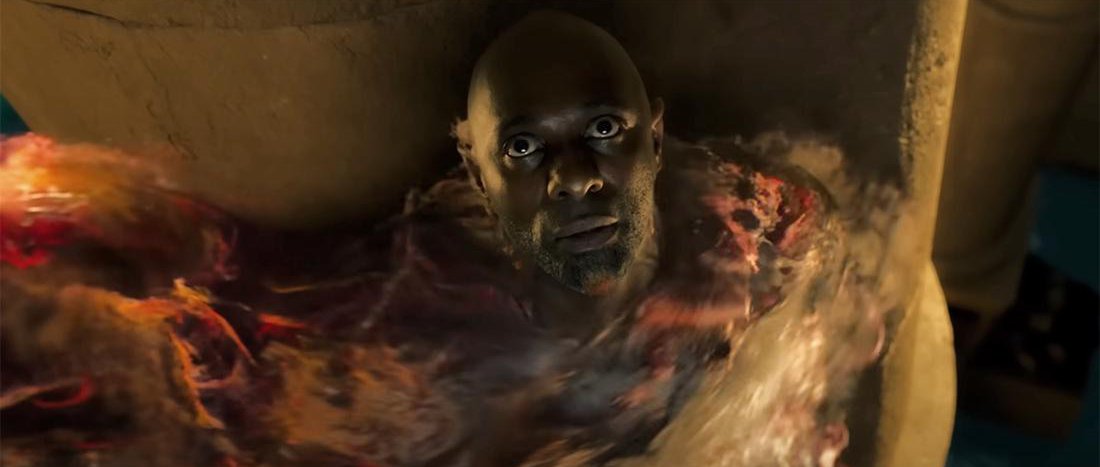
His stories are where the fantasy takes flight. Idris Elba plays the djinn with a stone-faced rubbery surrealism, literally smoldering from the ears or fingertips at times as he lounges in a hotel robe in our present, while spinning phantasmagoric narratives of his past. Miller brings these tales alive with vivid imagination casually deployed. (It’s worth remembering the man who gave us Mad Max and Babe and Happy Feet loves framing his stories as legends and fables remembered and recounted.) These sequences swoop into imagined histories populated with interesting faces and off-hand unreality—swirling spells, a stringed instrument that partially plays itself, a spider-wizard who hatches from the head of a guard, an ostrich-man whispering secrets into a genie’s ear. They cross ancient sex and violence—battlefields and bedrooms—to find the djinn constantly close, and yet so far, from the release of freedom in the midst of their fantasy melodramas. Somehow these kings and queens and warriors and slaves and bards can’t quite get to that third wish that will let him go. In these twisty narratives, Miller finds an earthiness, a sensuality to the images, a mythopoeic scope to the pronouncements, and a beguilingly sly dark humor to the whimsy of it all that keeps us drawn in while on edge. How much of this is to be taken at face value, and how much is mere seductive doodling around the edges of our collective memories of epic poetry past?
It’s compellingly drawn out on that razor’s edge of disbelief, enough to invest in while resolutely meta-textual, teetering its way toward an earnest outcome. That’s fitting considering the audience for these tales within the film itself. The professor listens eagerly. We’ve seen her semi-solitary existence, enlivened by books and the occasional colleague. She lives for the ways these ancient modes of storytelling reverberate and resonate even in our more scientific age that’s dimmed their spirits. Here she’s met her match for personifying the magic of fiction. Forget wishing; maybe that’s enough. They’re each Scheherazade by way of Joan Didion—telling stories in order to live. Miller brings out this connection between the central pair. They both need the fictions—or are they their realities?—to exist for each other. Come to think of it, it’s also how they exist for each other. (The possibility that it’s all in her head is held out in a tantalizingly unresolved ambiguity that remains plausible throughout without undercutting the sentiments within.) The tellers, and the tellings, have power.
Isn’t that an immortal truth of stories? We create them. They exist as long as they are passed along, and by our telling and retelling of them, they keep something about our humanity alive long after we depart. How poignant, then, to watch an embodiment of stories brought forth anew into our world—and see that he might survive despite modernity’s ambient distractions’ best efforts to sap his strength. He explains himself without demystifying his magic. If nothing else, his audience of one remembers why she loved such a thing—deeply, truly, beautifully. The longing at the movie’s core is for a fantasy’s freedom, to be heard and understood and loved. And it’s in the curious place within each of us that always yearns to be satisfied by a story well-told.
His stories are where the fantasy takes flight. Idris Elba plays the djinn with a stone-faced rubbery surrealism, literally smoldering from the ears or fingertips at times as he lounges in a hotel robe in our present, while spinning phantasmagoric narratives of his past. Miller brings these tales alive with vivid imagination casually deployed. (It’s worth remembering the man who gave us Mad Max and Babe and Happy Feet loves framing his stories as legends and fables remembered and recounted.) These sequences swoop into imagined histories populated with interesting faces and off-hand unreality—swirling spells, a stringed instrument that partially plays itself, a spider-wizard who hatches from the head of a guard, an ostrich-man whispering secrets into a genie’s ear. They cross ancient sex and violence—battlefields and bedrooms—to find the djinn constantly close, and yet so far, from the release of freedom in the midst of their fantasy melodramas. Somehow these kings and queens and warriors and slaves and bards can’t quite get to that third wish that will let him go. In these twisty narratives, Miller finds an earthiness, a sensuality to the images, a mythopoeic scope to the pronouncements, and a beguilingly sly dark humor to the whimsy of it all that keeps us drawn in while on edge. How much of this is to be taken at face value, and how much is mere seductive doodling around the edges of our collective memories of epic poetry past?
It’s compellingly drawn out on that razor’s edge of disbelief, enough to invest in while resolutely meta-textual, teetering its way toward an earnest outcome. That’s fitting considering the audience for these tales within the film itself. The professor listens eagerly. We’ve seen her semi-solitary existence, enlivened by books and the occasional colleague. She lives for the ways these ancient modes of storytelling reverberate and resonate even in our more scientific age that’s dimmed their spirits. Here she’s met her match for personifying the magic of fiction. Forget wishing; maybe that’s enough. They’re each Scheherazade by way of Joan Didion—telling stories in order to live. Miller brings out this connection between the central pair. They both need the fictions—or are they their realities?—to exist for each other. Come to think of it, it’s also how they exist for each other. (The possibility that it’s all in her head is held out in a tantalizingly unresolved ambiguity that remains plausible throughout without undercutting the sentiments within.) The tellers, and the tellings, have power.
Isn’t that an immortal truth of stories? We create them. They exist as long as they are passed along, and by our telling and retelling of them, they keep something about our humanity alive long after we depart. How poignant, then, to watch an embodiment of stories brought forth anew into our world—and see that he might survive despite modernity’s ambient distractions’ best efforts to sap his strength. He explains himself without demystifying his magic. If nothing else, his audience of one remembers why she loved such a thing—deeply, truly, beautifully. The longing at the movie’s core is for a fantasy’s freedom, to be heard and understood and loved. And it’s in the curious place within each of us that always yearns to be satisfied by a story well-told.
Labels:
George Miller,
Idris Elba,
Tilda Swinton
No comments:
Sunday, August 14, 2022
How High: FALL
All you need to make a movie is a girl and a gun, as the old saying sometimes attributed to Jean-Luc Godard goes. Fall says, how about two girls and a decommissioned radio tower? The movie is very simple, but only a little stupid. It thrills in its way to the possibilities of low-brow cinema’s charms. It’s about a pair of young women (Shazam’s Grace Caroline Currey and Runaways’ Virginia Gardner) who love to go rock climbing like that guy in the vertiginous documentary Free Solo. There’s an accident in the first scene, reminiscent of Vertical Limit’s opening deadly mountain climbing mishap. A year later, they decide to shake off their mourning by climbing a 2,000 foot antenna in the middle of the Arizona desert. Seems like a bad idea. Their trip up is bad enough, each rusty prong and rattling screw reason enough to make staying put on solid ground look the better option. They don’t see that, though. The movie shamelessly serves up those insert shots and sound effects of groaning metal for us, the better to twist the suspense. Even if you haven’t seen the previews, you know they’ll be stuck at the top. Indeed, when the last few hundred feet of ladder inevitably break away immediately upon contemplating their return journey, we’ve been set up well to squirm. The stakes are transparently obvious: we hope they don’t fall. The curiosity driving the movie forward is also totally plain: how will they ever get down?
The big screen vertigo of it all is a sweaty-palmed, lizard-brained use of a theatrical release’s scale—so much so I was glad a few of the effects shots in this cheap programmer are a smidge dodgy, the better to prevent me from completely succumbing to my fear of heights. Sometimes director Scott Mann and his co-writer Jonathan Frank try to gin up extra complications by having some rote interpersonal conflict wedged into discussions of survival strategies, but those moments are mercifully brief. The movie never loses sight of the young women’s plight. It stays perched on a sliver of metal with them, the ladies huddled just below a blinking red light warning away aircraft. You know that’s high. The project works its little premise for cheap thrills—with plenty of time to contemplate the dangers, wonder about the upper body strength required for some of the women’s feats, and consider how cold they must be in shorts or leggings and low-cut shirts. The slim story complicates, and resolves, with a fine sense of B-movie surprise, the kind that had me chuckling at its willingness to just go there. So it all adds up to a decent time at the multiplex—a simple hit of tension and release. There’s no stretching for metaphors or larding up flashbacks or leaning overly hard on sentimentality. It just looks down with knee-shaking wooziness and wonders how in the world they’ll get out of this one.
Sunday, August 7, 2022
Shooting Stars: THE GRAY MAN and BULLET TRAIN
Netflix’s latest big attempt at making a summer blockbuster is The Gray Man, for which they’ve recruited Anthony and Joe Russo, the directors of Captain Americas 2 and 3 and Avengers 3 and 4. Those were huge financial successes, so I can see why the streamer thought their directors would be a good choice to helm an action spectacle the company hopes can compete with the usual warm-weather multiplex fare. A problem, though, is that the Russo brothers are comedy directors, and you can tell in their leaning on light quipping attitudes and a reliance on medium shots and close-ups. They started in sitcoms and never quite shook it. The best moments in Avengers: Infinity War, far and away their most enjoyable Marvel effort, are all the characters-in-a-room stuff, and the way it builds to satisfying character entrances and exits that even leave room for the audience applause the way a filmed-in-front-of-a-studio-audience series would. Their sense of spectacle is entirely farmed out to effects people pinned in by the lack of decisions—a flattening and deadening of space and place, the better to slot in their swarms of indistinguishable enemies. That means it’s better when it’s outer space or Wakanda than when they just set generic power contests on a wide open parking lot or civic center.
That their newest feature has distinguishable characters in something like real-world places serves their talents well. It’s a Spy vs. Spy setup with Ryan Gosling defecting from a covert assassin job and subsequently hunted by an unhinged rival assassin, played by Chris Evans. The Russos know they’re dealing with two marquee Movie Stars, and shoot with all due reverence. The men are shot from flattering angles, in perfect dramatic lighting, and spring into action in fluidly faked, CG-assisted prowess. And each role plays to the actors’ strengths. Gosling gets his earnest smolder, his underdog confidence. He’s been able to dial that in one direction (Drive) or another (First Man) or another (La La Land) throughout his appealing lead roles. Here he’s every bit the capital-s Star. On the other hand, Evans gets a gum-chewing character turn, cranking his Captain America gee-whiz can-do attitude into a malevolent Team America villainy. There’s some actual crackle to their antagonism. Then their world is filled out with choice supporting turns for familiar faces filling familiar roles for this genre. There are potential Deep State allies (Billy Bob Thornton and Ana de Armas), shadowy suits (Jessica Henwick and Regé-Jean Page), a girl in danger (Julia Butters), and an elder statesman with important information (Alfre Woodard). They’re all talented enough to be a little bit memorable but otherwise just exactly what they need to be to keep the shootouts and chase sequences flowing.
It’s all of a piece—a little samey, totally artificial, everyone written at the same de rigueur canted angle toward seriousness. Which is to say that it’s a blockbuster whose relationship to the world is only other blockbusters. To the Russos, and their screenwriters and craftspeople, the high-stakes shoot-‘em-up globetrotting is all about the real world and real stakes only insofar as we can glimpse them through a mirrored simulacrum—pointing backwards and through the Bourne movies and Bond pictures and so on and so forth. Sure, there’s something pleasingly frictionless about an entirely phony chase in, around, and through a train running down tight turns on cobblestone European streets. Cars flip and spin, sparks fly, bullets careen, and the leads shimmy away from rampaging computer effects. (It’s a little bit clever some of the time, too, like when Gosling uses his reflection in passing windows to guide his aim into the train.) It’s a weightless charge of motion and faux-danger.
That’s the case with all of the action scenes here. They have the form and pace of excitement, but are of mere passably diverting interest. I didn’t exactly have a bad time watching it, though. Its cliched convolutions and obvious developments, acted out by pros who could do this in their sleep, is, as the kids might say, totally smooth-brained. It slips right off the old dome painlessly and without interrupting one with anything worth thought or reflection. That’s right in the Netflix mode these days, as their plummeting stock price has resulted in the board room making noise that they want to cut back on expensive auteurist art pieces (sorry to Baumbach, Scorsese, Coens, Campion, etc.) and instead focus on these time-passing mass-market baubles. As far as their efforts there go—think Red Notice or The Adam Project—this one’s at least thoroughly fine.
A little better than fine is Bullet Train. This one’s a glossy theatrical studio picture with Brad Pitt in the lead. Now there’s a Movie Star. He knows how to hold the frame’s attention without even seeming to try. (His oft-commented upon blend of character actor charm and matinee idol good looks is one of modern movies’ great constants.) Here he’s a reluctant gun for hire who won’t even take his gun with him now that he’s taken some time off to work on himself. Wearing a bucket hat and glasses, talking almost exclusively in therapy speak—“hurt people hurt people”—he has easy, shaggy charm while cutting an odd figure for an action movie. But then again the whole movie is full of such figures. Based on a pulpy Japanese novel, the movie puts Pitt’s mercenary on a speeding bullet train from Tokyo to Kyoto. The mission: get on board, take a briefcase full of ransom money, and get off at the next station. If you suspect it won’t be so easy, you’d be right.
On the train are hitmen and schemers in a variety of styles and quirks. The cast is loaded with familiar faces and voices—Brian Tyree Henry, Aaron Taylor-Johnson, Joey King, Logan Lerman, Hiroyuki Sanada, Michael Shannon, Sandra Bullock, Bad Bunny, and a few fun cameos, too. Each is given a splashy title card announcing their name, a scattered assortment of quick-cut flashbacks, and one or two whimsical character details. (One is obsessed with Thomas the Tank Engine, for example.) I’ve seen this movie’s manic post-modern approach referred to as if it was in the late-90s and early-aughts trend of snarky post-Tarantino, post-Ritchie crime pictures. But I think we should remember that that was twenty to thirty years ago, and in this case counts as a throwback. I didn’t mind that too much. The movie’s eccentricities fly by as quickly as its speeding set.
The result is a Rube Goldberg machine of an action comedy. Every actor and prop introduced circles back around at least once for another payoff, some expected and some surprising. The straight line simplicity of the main plot, one MacGuffin and one Final Destination in perpetual motion, is interrupted by a jumble of obstacles in each train car, some recurring irritants and some a constant danger. Meanwhile the story curlicues with unexpected doubling-backs—sometimes cutaways within cutaways or long montages that build backstory for a sudden reversal or reveal. This results in some enjoyable scrambling, separating or delaying effects from causes or vice versa. It’s all quite clever and pleased with itself, and the movie bounces along with the music of comedy without quite the words to make it really sing. It’s a constant juggle of witty cutting and awful violence—a kind of cold karmic comeuppance for its largely disreputable and dangerous cast of characters.
Director David Leitch has made this jocular mood for bloody combat cleverness his stock-in-trade. After co-directing the dizzying choreography of John Wick, he’s given us the likes of Atomic Blonde, Deadpool 2, and Fast & Furious: Hobbs & Shaw. He shoots action brightly and legibly and knows how to frame with and hold for impact. But those pictures all have a rather flippant bravado, charging hard at action while characters skip across the implications. They leave a high body count behind them while twisting out of spectacular slam-bang dangers. Any respect for human life is gone, the better to gawk at all the ways bones snap and vehicles crash. Bullet Train might be Leitch’s best post-Wick effort simply for giving in to that breezy carelessness entirely. It treats the smacks and thuds and stabs as staccato punctuation—literal punch lines—for sleazy characters ground under by twists of fate. Pitt floats above it all, desperately trying to talk it out, and inevitably pulled back into violence. That he survives any of his attackers' onslaughts is almost an accident. And all the while he keeps bemoaning his bad luck. I guess it really is all in how you look at it. As far as violent distractions go, this one at least starts at a fast pace and never lets up.
That their newest feature has distinguishable characters in something like real-world places serves their talents well. It’s a Spy vs. Spy setup with Ryan Gosling defecting from a covert assassin job and subsequently hunted by an unhinged rival assassin, played by Chris Evans. The Russos know they’re dealing with two marquee Movie Stars, and shoot with all due reverence. The men are shot from flattering angles, in perfect dramatic lighting, and spring into action in fluidly faked, CG-assisted prowess. And each role plays to the actors’ strengths. Gosling gets his earnest smolder, his underdog confidence. He’s been able to dial that in one direction (Drive) or another (First Man) or another (La La Land) throughout his appealing lead roles. Here he’s every bit the capital-s Star. On the other hand, Evans gets a gum-chewing character turn, cranking his Captain America gee-whiz can-do attitude into a malevolent Team America villainy. There’s some actual crackle to their antagonism. Then their world is filled out with choice supporting turns for familiar faces filling familiar roles for this genre. There are potential Deep State allies (Billy Bob Thornton and Ana de Armas), shadowy suits (Jessica Henwick and Regé-Jean Page), a girl in danger (Julia Butters), and an elder statesman with important information (Alfre Woodard). They’re all talented enough to be a little bit memorable but otherwise just exactly what they need to be to keep the shootouts and chase sequences flowing.
It’s all of a piece—a little samey, totally artificial, everyone written at the same de rigueur canted angle toward seriousness. Which is to say that it’s a blockbuster whose relationship to the world is only other blockbusters. To the Russos, and their screenwriters and craftspeople, the high-stakes shoot-‘em-up globetrotting is all about the real world and real stakes only insofar as we can glimpse them through a mirrored simulacrum—pointing backwards and through the Bourne movies and Bond pictures and so on and so forth. Sure, there’s something pleasingly frictionless about an entirely phony chase in, around, and through a train running down tight turns on cobblestone European streets. Cars flip and spin, sparks fly, bullets careen, and the leads shimmy away from rampaging computer effects. (It’s a little bit clever some of the time, too, like when Gosling uses his reflection in passing windows to guide his aim into the train.) It’s a weightless charge of motion and faux-danger.
That’s the case with all of the action scenes here. They have the form and pace of excitement, but are of mere passably diverting interest. I didn’t exactly have a bad time watching it, though. Its cliched convolutions and obvious developments, acted out by pros who could do this in their sleep, is, as the kids might say, totally smooth-brained. It slips right off the old dome painlessly and without interrupting one with anything worth thought or reflection. That’s right in the Netflix mode these days, as their plummeting stock price has resulted in the board room making noise that they want to cut back on expensive auteurist art pieces (sorry to Baumbach, Scorsese, Coens, Campion, etc.) and instead focus on these time-passing mass-market baubles. As far as their efforts there go—think Red Notice or The Adam Project—this one’s at least thoroughly fine.
A little better than fine is Bullet Train. This one’s a glossy theatrical studio picture with Brad Pitt in the lead. Now there’s a Movie Star. He knows how to hold the frame’s attention without even seeming to try. (His oft-commented upon blend of character actor charm and matinee idol good looks is one of modern movies’ great constants.) Here he’s a reluctant gun for hire who won’t even take his gun with him now that he’s taken some time off to work on himself. Wearing a bucket hat and glasses, talking almost exclusively in therapy speak—“hurt people hurt people”—he has easy, shaggy charm while cutting an odd figure for an action movie. But then again the whole movie is full of such figures. Based on a pulpy Japanese novel, the movie puts Pitt’s mercenary on a speeding bullet train from Tokyo to Kyoto. The mission: get on board, take a briefcase full of ransom money, and get off at the next station. If you suspect it won’t be so easy, you’d be right.
On the train are hitmen and schemers in a variety of styles and quirks. The cast is loaded with familiar faces and voices—Brian Tyree Henry, Aaron Taylor-Johnson, Joey King, Logan Lerman, Hiroyuki Sanada, Michael Shannon, Sandra Bullock, Bad Bunny, and a few fun cameos, too. Each is given a splashy title card announcing their name, a scattered assortment of quick-cut flashbacks, and one or two whimsical character details. (One is obsessed with Thomas the Tank Engine, for example.) I’ve seen this movie’s manic post-modern approach referred to as if it was in the late-90s and early-aughts trend of snarky post-Tarantino, post-Ritchie crime pictures. But I think we should remember that that was twenty to thirty years ago, and in this case counts as a throwback. I didn’t mind that too much. The movie’s eccentricities fly by as quickly as its speeding set.
The result is a Rube Goldberg machine of an action comedy. Every actor and prop introduced circles back around at least once for another payoff, some expected and some surprising. The straight line simplicity of the main plot, one MacGuffin and one Final Destination in perpetual motion, is interrupted by a jumble of obstacles in each train car, some recurring irritants and some a constant danger. Meanwhile the story curlicues with unexpected doubling-backs—sometimes cutaways within cutaways or long montages that build backstory for a sudden reversal or reveal. This results in some enjoyable scrambling, separating or delaying effects from causes or vice versa. It’s all quite clever and pleased with itself, and the movie bounces along with the music of comedy without quite the words to make it really sing. It’s a constant juggle of witty cutting and awful violence—a kind of cold karmic comeuppance for its largely disreputable and dangerous cast of characters.
Director David Leitch has made this jocular mood for bloody combat cleverness his stock-in-trade. After co-directing the dizzying choreography of John Wick, he’s given us the likes of Atomic Blonde, Deadpool 2, and Fast & Furious: Hobbs & Shaw. He shoots action brightly and legibly and knows how to frame with and hold for impact. But those pictures all have a rather flippant bravado, charging hard at action while characters skip across the implications. They leave a high body count behind them while twisting out of spectacular slam-bang dangers. Any respect for human life is gone, the better to gawk at all the ways bones snap and vehicles crash. Bullet Train might be Leitch’s best post-Wick effort simply for giving in to that breezy carelessness entirely. It treats the smacks and thuds and stabs as staccato punctuation—literal punch lines—for sleazy characters ground under by twists of fate. Pitt floats above it all, desperately trying to talk it out, and inevitably pulled back into violence. That he survives any of his attackers' onslaughts is almost an accident. And all the while he keeps bemoaning his bad luck. I guess it really is all in how you look at it. As far as violent distractions go, this one at least starts at a fast pace and never lets up.
Wednesday, August 3, 2022
Picture Perfect: NOPE
Writer-director Jordan Peele’s latest feature, Nope, starts with a scary bit of monkey business. The taping of a fictional 90’s sitcom co-starring a chimpanzee is violently interrupted by the sudden snapping of said animal costar. We see, mostly hidden behind the set’s blood-splattered sofa, the unmoving legs of a presumably mortally wounded cast member. The chimp sits, almost bewildered at its own actions, nudging the unmoving body. Then it turns and looks straight down the lens, as if seeing us, the audience, aware of our presence observing this awful spectacle. Wait, you might think at this point, isn’t this a movie advertised with the promise of a UFO? This chimp is, indeed, narratively superfluous to that core idea, but is also a key to the whole thing. This unsettling moment, brought back in a longer flashback late in the picture, has a connection to the backstory of a minor supporting character. But it’s also priming us to see this as a movie about people’s attempts to control the uncontrollable, in doomed attempts to capture the wilds of nature by taming it within the images we are used to.
As great as Peele’s previous pictures are—and Get Out and Us are certainly deserving of their critical hosannas and box office appeal—they do love plainly presenting, even openly declaiming, their allegorical intents. A thrill of Nope is its wide open spaces in look and story—big blue skies against a western backdrop, and plot and character and theme left with evocative implications. It’s a film of images about images. It’s rich in negative space, literal and figurative, it can fill in with sublime suspense and awe, and room to plant ideas and connections and deepening understandings to grow in the viewers’ minds. It’s a movie, then, about the futility of bringing the unimaginable down to earth through our capacity to document it. Peele is confident enough in his filmmaking, his concept, and his cast to let scenes play out with relaxed rhythms that slowly constrict into pinpoint tension, and for ideas to slowly amble until they’re suddenly crystal clear. It’s evident Peele is solidly one of those filmmakers with such a sure hand that, no matter where he takes us, we can trust he’ll make it worth our while.
The film’s grounding in the interplay between the moving image and lived experience is immediately apparent. Set on a ranch in rural California, it follows siblings (Daniel Kaluuya and Keke Palmer) who’ve just inherited the property after the death of their Hollywood horse wrangler father (Keith David). They know about artifice, and the power of the camera, and respect for wild creatures, having inherited those, too. This is knowledge that should serve them well as they continue the family business. (They claim their ancestor was the unnamed jockey in the first moving picture experiments.) But what’s that in the clouds above? It sure looks like a UFO. The siblings know immediately they need to capture it on film. This self-reflexivity, a movie about moving images, is the engine for a thrilling genre piece—a work of process for how one goes about trying to get an elusive shot, and a work of horror-adjacent sci-fi enchanted by the tantalizing prospect of a big unknown lurking beyond the realm of the possible.
Peele frames many great shots of looking, staring, or averting one’s gaze, with the tall IMAX frames extending beyond characters’ fields of vision, a human face or form one small element in a towering blue expanse. The movie, though small in cast—Brandon Perea, Steven Yeun, and Michael Wincott are the only others of note—and limited in location, has a grandeur of intent and a towering mystery as we watch the skies. As the film slowly unspools its secrets, Peele crafts sequences with hairs-on-the-back-of-the-neck tingling suspense from nothing more than waiting for an element of the image to shift, to reveal new information or for the inscrutable UFO to emerge again.
In the vastness of the movie’s frames, riffing on Western iconography while inviting some vintage Spielberg by way of Carpenter comparisons, Kaluuya and Palmer are given compelling and charismatic characters to inhabit. The sibling interplay is full of loving teasing and real affection, but also the kind of prickly carefulness that can creep into grown familial tensions. There’s a charge from their contrasts. He’s thoughtful, slow to speak, with outer strength covering over his emotional pain. She’s excitable, making schemes within schemes, prone to rattle on and on in good times and bad. We can read all sorts of backstory in what’s not said between them, and the film’s final moments are a satisfying snap as their connection is suddenly drawn tight.
Peele builds to a simultaneous crescendo of character, theme, story, and style, and suddenly the mystery of it all is solved with answers that retroactively make every stray detail and detour lock into place. Peele’s honed his craft to make, if not his most powerful movie yet, his tightest and least immediately obvious in a still-entertaining package. Here’s a movie about our modern tendency to want the enormity of our world’s traumas reduced to the size of a screen—to process through gawking spectacle instead of crying through catastrophes. Instead of bringing us closer together, it can pull us further apart. So here’s Nope, with its grieving siblings confronted with enormous problems beyond the terrestrial norm. Can they survive long enough to get a picture? Maybe. Will that give them control over the situation? You can answer that in a single word. Guess which one.
As great as Peele’s previous pictures are—and Get Out and Us are certainly deserving of their critical hosannas and box office appeal—they do love plainly presenting, even openly declaiming, their allegorical intents. A thrill of Nope is its wide open spaces in look and story—big blue skies against a western backdrop, and plot and character and theme left with evocative implications. It’s a film of images about images. It’s rich in negative space, literal and figurative, it can fill in with sublime suspense and awe, and room to plant ideas and connections and deepening understandings to grow in the viewers’ minds. It’s a movie, then, about the futility of bringing the unimaginable down to earth through our capacity to document it. Peele is confident enough in his filmmaking, his concept, and his cast to let scenes play out with relaxed rhythms that slowly constrict into pinpoint tension, and for ideas to slowly amble until they’re suddenly crystal clear. It’s evident Peele is solidly one of those filmmakers with such a sure hand that, no matter where he takes us, we can trust he’ll make it worth our while.
The film’s grounding in the interplay between the moving image and lived experience is immediately apparent. Set on a ranch in rural California, it follows siblings (Daniel Kaluuya and Keke Palmer) who’ve just inherited the property after the death of their Hollywood horse wrangler father (Keith David). They know about artifice, and the power of the camera, and respect for wild creatures, having inherited those, too. This is knowledge that should serve them well as they continue the family business. (They claim their ancestor was the unnamed jockey in the first moving picture experiments.) But what’s that in the clouds above? It sure looks like a UFO. The siblings know immediately they need to capture it on film. This self-reflexivity, a movie about moving images, is the engine for a thrilling genre piece—a work of process for how one goes about trying to get an elusive shot, and a work of horror-adjacent sci-fi enchanted by the tantalizing prospect of a big unknown lurking beyond the realm of the possible.
Peele frames many great shots of looking, staring, or averting one’s gaze, with the tall IMAX frames extending beyond characters’ fields of vision, a human face or form one small element in a towering blue expanse. The movie, though small in cast—Brandon Perea, Steven Yeun, and Michael Wincott are the only others of note—and limited in location, has a grandeur of intent and a towering mystery as we watch the skies. As the film slowly unspools its secrets, Peele crafts sequences with hairs-on-the-back-of-the-neck tingling suspense from nothing more than waiting for an element of the image to shift, to reveal new information or for the inscrutable UFO to emerge again.
In the vastness of the movie’s frames, riffing on Western iconography while inviting some vintage Spielberg by way of Carpenter comparisons, Kaluuya and Palmer are given compelling and charismatic characters to inhabit. The sibling interplay is full of loving teasing and real affection, but also the kind of prickly carefulness that can creep into grown familial tensions. There’s a charge from their contrasts. He’s thoughtful, slow to speak, with outer strength covering over his emotional pain. She’s excitable, making schemes within schemes, prone to rattle on and on in good times and bad. We can read all sorts of backstory in what’s not said between them, and the film’s final moments are a satisfying snap as their connection is suddenly drawn tight.
Peele builds to a simultaneous crescendo of character, theme, story, and style, and suddenly the mystery of it all is solved with answers that retroactively make every stray detail and detour lock into place. Peele’s honed his craft to make, if not his most powerful movie yet, his tightest and least immediately obvious in a still-entertaining package. Here’s a movie about our modern tendency to want the enormity of our world’s traumas reduced to the size of a screen—to process through gawking spectacle instead of crying through catastrophes. Instead of bringing us closer together, it can pull us further apart. So here’s Nope, with its grieving siblings confronted with enormous problems beyond the terrestrial norm. Can they survive long enough to get a picture? Maybe. Will that give them control over the situation? You can answer that in a single word. Guess which one.
Sunday, July 24, 2022
Winners and Losers:
THOR: LOVE AND THUNDER and THE PRINCESS
A few dozen movies and TV shows in, the Marvel Cinematic Universe of colorful heroes and interconnected can-kicking narratives has basically nothing to do with anything recognizably human. It goes all the more awry when a project wants to nod back in the direction. Hence Thor: Love and Thunder. He was heretofore one of the MCU’s most consistently entertaining characters—his appearances in first two Shakespeare-by-way-of-Jack Kirby entries (or vice versa), his goofier Guardians of the Galaxy-lite Ragnarok, and best-in-show appearances in multiple Avengers pictures. Star Chris Hemsworth always provides him an appealing gym-bod arrogance in an oblivious goofball beneficence, a boisterous buffoonery that can still kick out the action when called upon. But that force of personality alone can’t lift a movie completely miscalculated from the jump. This new Thor movie is a near-stupefyingly ill-considered collection of inanities and tropes broken up by the most rankly manipulative sentiments.
Writer-director Taika Waititi, whose distinctively silly style from early genre-benders like What We Do in the Shadows worked well enough for Thor last time, shamelessly trots out cheap buttons to push. Here there’s a supporting character with cancer—nothing specific, just “cancer”—that’s used as mawkish motivation when it’s important and dropped entirely for antics when not. (As fine an actress as Natalie Portman is, she can’t get something from nothing.) Here there are kids in danger—kidnapped and held in a dark cave by a murderous villain who himself is motivated by the senseless death of his only child. We see the latter in a raw moment of mourning in a stark prologue. Christian Bale, as the grieving father, is almost too good at making us want to see him succeed in taking out his anger on the gods who remain indifferent to the suffering of the common man. The movie’s endless violence, indifferently handled seriousness, and badly calibrated humor merely prolongs the suffering for us all.
After all, the movie’s villain pokes holes in growing MCU blindspots, problems that have reached a nadir here. When the heroes skirt past consequences in order to continually churn new installments, nothing matters. The life of a normal person must be terribly unsettled—to be at the whims of these larger-than-life super-beings. How awful. Love and Thunder is an especially cluttered and confused outgrowth of this problem. It’s flatly imagined and deadened by its blunt pathos steamrolled by the studio’s house style of weightless gloop, bad blocking, and cheap wisecracks. Waititi opens his movie with a character angry when gods laugh at his pain, and then makes a movie in which characters constantly laugh off pain—giggling at dangers and hand-waving murders. This flippancy is self-defeating. It robs the potential for real character depths—not that the movie’s dull repetition of previous Thor arcs, like learning humility and forging a makeshift family, is anything to mine for such—by treating everything with the heaviest-handed light touch imaginable.
Somehow both thin and overcomplicated, the story takes forever to get nowhere, and grates with its wildly uneven stumbling through inscrutable digital noise and incomprehensibly cheap staginess. (There are whole sequences where it’s difficult to tell who’s doing what to what effect to whom.) It gathers up the requisite cameos, crowds the sloppy frame with little moments for a dozen characters to shuffle on stage, get off a joke that flops, and limp away. Even an evocative villain, and a potentially witty foil in a fatuous Zeus (Russell Crowe in a lisping Grecian accent), are used for little and, ultimately, naught. Of course the gods must be crazy—and careless—to kick off the story of a man who wants revenge on them. But the movie lacks the courage of its premise’s convictions, completely refuses to engage with its implications, and feels all the emptier and annoying for it. The villain is inadvertently proven right. This is nihilism togged up as forced frivolity. It says, yes, the gods don’t care, the world is devoid of hope for mere mortals, but, hey, at least Thor joked around with his pals before the love of his life kicked the bucket to inspire him.
Better heroism with a sense of style and perspective can be found in The Princess, a 20th Century Studios movie ignominiously sent straight to Hulu. (Sheesh, is it a bummer than Disney has turned that once-great studio into a feeder for its streaming services. Even a modestly received theatrical run still boosts a movie’s profile more than these straight-to-digital premiere.) It stars Joey King as a princess whose castle has been taken over by snarling villains. Their leader (Dominic Cooper) wants to marry her and take her kingdom. He’s locked her in a tower and menaces her parents and younger sister in the palace below. Good thing she knows how to fight back. This R-rated action flick, overseen by Vietnamese director Le-Van Kiet, becomes a rollicking rolling action sequence bursting with kicks and punches, whips and chains, tumbles and tangles as she has to fight down the tower, through layers of goons, to save the day. It’s neatly composed and briskly choreographed, rarely pausing for breath, or much psychological complexity.
But its simplicity is its own asset, allowing it to focus narrowly on its strengths. It sure has personality, and the kind of bristling no-sweat casual feminism that its premise implies. King is a fine physical presence and fits the demands of the hard-charging role, playing up the exertion and panting effort of each move. And the supporting cast—key sidekicks for both good (Veronica Ngo) and bad (Olga Kurylenko)—is well-chosen in complementary skills with neat bladed weaponry and reasonably believable relationships to the leads. Here’s a movie that’s perched on the point where a teenage feminist fairy tale—The Princess Saves Herself in This One—meets vertical action levels—Die Hard meets The Raid. It knows what it wants to do, gets the job done, and leaves quickly before outstaying its welcome. The result is a slender and modestly satisfying genre effort.
Writer-director Taika Waititi, whose distinctively silly style from early genre-benders like What We Do in the Shadows worked well enough for Thor last time, shamelessly trots out cheap buttons to push. Here there’s a supporting character with cancer—nothing specific, just “cancer”—that’s used as mawkish motivation when it’s important and dropped entirely for antics when not. (As fine an actress as Natalie Portman is, she can’t get something from nothing.) Here there are kids in danger—kidnapped and held in a dark cave by a murderous villain who himself is motivated by the senseless death of his only child. We see the latter in a raw moment of mourning in a stark prologue. Christian Bale, as the grieving father, is almost too good at making us want to see him succeed in taking out his anger on the gods who remain indifferent to the suffering of the common man. The movie’s endless violence, indifferently handled seriousness, and badly calibrated humor merely prolongs the suffering for us all.
After all, the movie’s villain pokes holes in growing MCU blindspots, problems that have reached a nadir here. When the heroes skirt past consequences in order to continually churn new installments, nothing matters. The life of a normal person must be terribly unsettled—to be at the whims of these larger-than-life super-beings. How awful. Love and Thunder is an especially cluttered and confused outgrowth of this problem. It’s flatly imagined and deadened by its blunt pathos steamrolled by the studio’s house style of weightless gloop, bad blocking, and cheap wisecracks. Waititi opens his movie with a character angry when gods laugh at his pain, and then makes a movie in which characters constantly laugh off pain—giggling at dangers and hand-waving murders. This flippancy is self-defeating. It robs the potential for real character depths—not that the movie’s dull repetition of previous Thor arcs, like learning humility and forging a makeshift family, is anything to mine for such—by treating everything with the heaviest-handed light touch imaginable.
Somehow both thin and overcomplicated, the story takes forever to get nowhere, and grates with its wildly uneven stumbling through inscrutable digital noise and incomprehensibly cheap staginess. (There are whole sequences where it’s difficult to tell who’s doing what to what effect to whom.) It gathers up the requisite cameos, crowds the sloppy frame with little moments for a dozen characters to shuffle on stage, get off a joke that flops, and limp away. Even an evocative villain, and a potentially witty foil in a fatuous Zeus (Russell Crowe in a lisping Grecian accent), are used for little and, ultimately, naught. Of course the gods must be crazy—and careless—to kick off the story of a man who wants revenge on them. But the movie lacks the courage of its premise’s convictions, completely refuses to engage with its implications, and feels all the emptier and annoying for it. The villain is inadvertently proven right. This is nihilism togged up as forced frivolity. It says, yes, the gods don’t care, the world is devoid of hope for mere mortals, but, hey, at least Thor joked around with his pals before the love of his life kicked the bucket to inspire him.
Better heroism with a sense of style and perspective can be found in The Princess, a 20th Century Studios movie ignominiously sent straight to Hulu. (Sheesh, is it a bummer than Disney has turned that once-great studio into a feeder for its streaming services. Even a modestly received theatrical run still boosts a movie’s profile more than these straight-to-digital premiere.) It stars Joey King as a princess whose castle has been taken over by snarling villains. Their leader (Dominic Cooper) wants to marry her and take her kingdom. He’s locked her in a tower and menaces her parents and younger sister in the palace below. Good thing she knows how to fight back. This R-rated action flick, overseen by Vietnamese director Le-Van Kiet, becomes a rollicking rolling action sequence bursting with kicks and punches, whips and chains, tumbles and tangles as she has to fight down the tower, through layers of goons, to save the day. It’s neatly composed and briskly choreographed, rarely pausing for breath, or much psychological complexity.
But its simplicity is its own asset, allowing it to focus narrowly on its strengths. It sure has personality, and the kind of bristling no-sweat casual feminism that its premise implies. King is a fine physical presence and fits the demands of the hard-charging role, playing up the exertion and panting effort of each move. And the supporting cast—key sidekicks for both good (Veronica Ngo) and bad (Olga Kurylenko)—is well-chosen in complementary skills with neat bladed weaponry and reasonably believable relationships to the leads. Here’s a movie that’s perched on the point where a teenage feminist fairy tale—The Princess Saves Herself in This One—meets vertical action levels—Die Hard meets The Raid. It knows what it wants to do, gets the job done, and leaves quickly before outstaying its welcome. The result is a slender and modestly satisfying genre effort.
Sunday, June 26, 2022
If He Can Dream: ELVIS
Baz Luhrmann’s Elvis is made with an energetically heightened reality that bursts through the cliches of the rock ’n roll biopic and the overfamiliar caricature that is its subject. It restores life and vitality to both, making something enormous and earnest and enveloping. This is a perfect match of filmmaker and subject. Luhrmann has a brand of cinematic theatricality in which wall-to-wall music covers a visual feast. Every shot is a riot of movement and color, frames are filled with flashing lights and flashy design, and every performance is goaded higher and higher until most gestures are big and broad. Elvis Presley, for his part, was a shock to the system. He defined the mold that continues to mint music stars as part of a wave of midcentury entertainers who began to scramble ideas of race, sex, and gender for the mainstream. His life, too, was as outsized as his stardom. Every facet of it has passed into iconography and a cartoon of fame: his mansion, his marriage, his movies, his scandals, his eccentricities. The modern version of celebrity culture is yet another element of our world he was at the right place and time to pioneer. This movie is a huge, swaggering tour of the familiar stages of Elvis’ life and career. It goes on for nearly three hours and doesn’t dig deeper into arcane trivia or thornier contradictions. But what it does instead is recreate the sensation of the shock of the new, and the societal and showbiz tensions the shaped and destroyed him. Luhrmann’s excesses match this mood, and this project: to build a shining monument to an icon of Americana—and to see how the darkness surrounding his becoming swallowed him whole.
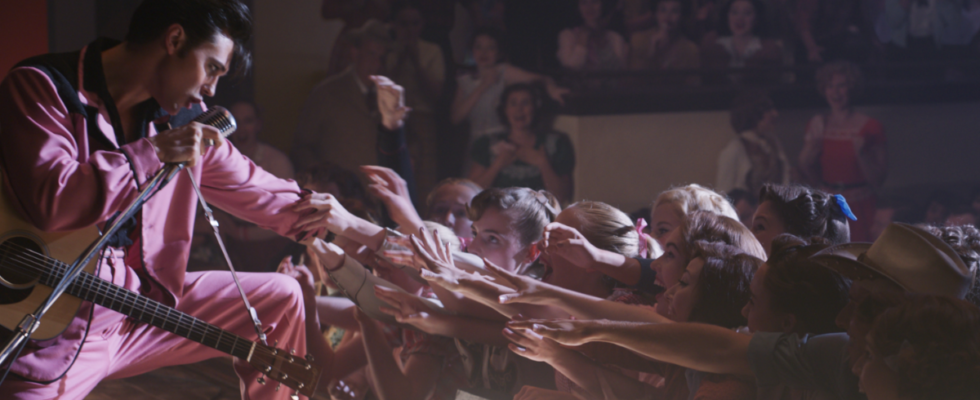
The result is a rock opera and historical panorama that sells the intensity and immediacy of Elvis’ impact and the titanic complicated edifice of his legacy. Shot like a diamond-studded kaleidoscope’s view, this three-hour music montage flows from one number to the next, chopped and remixed and covered and tracked, amped up, stripped down, or played straight. When it lingers on a specific performance—his first big break winning over an audience with his rhythmic wiggling on stage; a triumphant comeback with lush orchestrations and pounding crowd-pleasing stamina—it is electrifying. So often these musical biopics tell us a moment was important by assuming we’ll know it was by the recognizable hit covered by its lead. Here, Luhrmann actually makes us understand 1.) how much hard work it takes to make that sort of impact, and 2.) why his subject was a huge deal. Austin Butler plays Elvis with pretty looks and expert timing, often drenched in sweat on stage, hair flopping, legs twitching, hips plunging. We feel the exertion of putting on a show, and also can get swept up in it. All the smash-zooms in on screaming young women—partly hollering for their fresh crush, but also in surprise at the reaction they’re having—and erupting crowds in dizzying editing or split-screens doesn’t come across as parody, but genuine live-wire enthusiasm. You’d think 2007’s great poison-pen satire of the sub-genre, Walk Hard, would’ve killed these stories dead. But watching Butler come alive on screen, inhabiting the appeal of this star so fully and convincingly, one might realize it’s worth grinding through all the bad versions of these movies just to get to one this remarkable.
In Butler’s compelling performance we see anew why Elvis became who he was. He’s surrounded by Black artists as he grows up, but his whiteness gets him chances they don’t. This is partly why he courts controversy from the segregationists of the time—and one wonders how the racists right-wingers of our time won’t see themselves in the portrait of sniveling politicians complaining about how he’s exposing their white children to ideas of blackness. He’s a white man performing rhythm-and-blues, a bridge between jazz and country as he helps forge a whole new style on the backs of those who get less credit, less fame, less money. But he’s a racially ambiguous figure over the radio, and in live performance is also playing on some unspoken androgynously provocative visual appeal. He’s a hip-thrusting young man at once forceful and smooth, pulsing staccato guitar strumming with loose-limbed pleasure in his own talents, singing in a sensitive baritone timbre from soft, delicate features. (A great evocative moment finds a nasty senator’s teenagers in front of the TV, lost in desire for this new figure of lustful interest.) Subsequent rock stars would blur these lines in more overt and outré ways; but here’s a movie that restores the sexual and racial fault lines of his times in order to bolster its argument for why his stardom was such a lightning rod.
That’s the benefit of Luhrmann providing a movie that’s gloriously artificial and reverently specific as it sloshes around. He’s so good at movies that drip performative sex appeal and sexual tension, of high-gloss spectacle, loud music that resonates in the chest, expressive complicated camera moves you can hardly take in at once, and emotional dynamics you can believe in an instant. He’s also fond of tragic romantics destroyed by the troubles of their times. In his Romeo + Juliet and Moulin Rouge! and The Great Gatsby we see swooning melodrama, preening showmanship, and bombastic glamour. That’s where he loads in the opulent period style, gilded cages remixed with anachronistic fervor. And locked in the center are these tortured beautiful people who want to love and be loved. Here it’s Elvis, who searches in his family and his lovers and his audiences and, yes, even his sneaky, villainous manager (Tom Hanks) for that approval, that what he’s doing matters and will last. He’s a sensitive and artistic young man taken in, lifted up and exploited by a charismatic scheming promoter into the life of an international superstar. Hanks acts chummily threatening from within layers of makeup and a fat suit, speaking with a marble-mouthed accent and wielding a cane with a snowman top. His narration flows through the picture as well, a frustrated unreliable narrator who can’t quite prove he’s not the bad guy here. He’s a clear contrast with Elvis, the business side of the singer’s show. Somehow, they need each other, even if it will leave them worse off, too.
The movie is totally swallowed up in Elvis’ life and times. It argues that, far from being the Singular Great Man, Elvis was a product of his culture and his collaborations, forged by forces beyond his control and the contributions of others. He’s constantly surrounded by family, friends, business people, audiences, cops, politicians, and hangers-on. In the few dark, quiet moments of empty solitude—stewing in a suite, or lonely in a spotlight on an empty stage—he’s surrounded by doubt. Here’s a celebrity biopic that vigorously sells the spectacle and excitement of such a life—and the fundamental unknowability of such a man, even to himself. What a show! What a cost.
The result is a rock opera and historical panorama that sells the intensity and immediacy of Elvis’ impact and the titanic complicated edifice of his legacy. Shot like a diamond-studded kaleidoscope’s view, this three-hour music montage flows from one number to the next, chopped and remixed and covered and tracked, amped up, stripped down, or played straight. When it lingers on a specific performance—his first big break winning over an audience with his rhythmic wiggling on stage; a triumphant comeback with lush orchestrations and pounding crowd-pleasing stamina—it is electrifying. So often these musical biopics tell us a moment was important by assuming we’ll know it was by the recognizable hit covered by its lead. Here, Luhrmann actually makes us understand 1.) how much hard work it takes to make that sort of impact, and 2.) why his subject was a huge deal. Austin Butler plays Elvis with pretty looks and expert timing, often drenched in sweat on stage, hair flopping, legs twitching, hips plunging. We feel the exertion of putting on a show, and also can get swept up in it. All the smash-zooms in on screaming young women—partly hollering for their fresh crush, but also in surprise at the reaction they’re having—and erupting crowds in dizzying editing or split-screens doesn’t come across as parody, but genuine live-wire enthusiasm. You’d think 2007’s great poison-pen satire of the sub-genre, Walk Hard, would’ve killed these stories dead. But watching Butler come alive on screen, inhabiting the appeal of this star so fully and convincingly, one might realize it’s worth grinding through all the bad versions of these movies just to get to one this remarkable.
In Butler’s compelling performance we see anew why Elvis became who he was. He’s surrounded by Black artists as he grows up, but his whiteness gets him chances they don’t. This is partly why he courts controversy from the segregationists of the time—and one wonders how the racists right-wingers of our time won’t see themselves in the portrait of sniveling politicians complaining about how he’s exposing their white children to ideas of blackness. He’s a white man performing rhythm-and-blues, a bridge between jazz and country as he helps forge a whole new style on the backs of those who get less credit, less fame, less money. But he’s a racially ambiguous figure over the radio, and in live performance is also playing on some unspoken androgynously provocative visual appeal. He’s a hip-thrusting young man at once forceful and smooth, pulsing staccato guitar strumming with loose-limbed pleasure in his own talents, singing in a sensitive baritone timbre from soft, delicate features. (A great evocative moment finds a nasty senator’s teenagers in front of the TV, lost in desire for this new figure of lustful interest.) Subsequent rock stars would blur these lines in more overt and outré ways; but here’s a movie that restores the sexual and racial fault lines of his times in order to bolster its argument for why his stardom was such a lightning rod.
That’s the benefit of Luhrmann providing a movie that’s gloriously artificial and reverently specific as it sloshes around. He’s so good at movies that drip performative sex appeal and sexual tension, of high-gloss spectacle, loud music that resonates in the chest, expressive complicated camera moves you can hardly take in at once, and emotional dynamics you can believe in an instant. He’s also fond of tragic romantics destroyed by the troubles of their times. In his Romeo + Juliet and Moulin Rouge! and The Great Gatsby we see swooning melodrama, preening showmanship, and bombastic glamour. That’s where he loads in the opulent period style, gilded cages remixed with anachronistic fervor. And locked in the center are these tortured beautiful people who want to love and be loved. Here it’s Elvis, who searches in his family and his lovers and his audiences and, yes, even his sneaky, villainous manager (Tom Hanks) for that approval, that what he’s doing matters and will last. He’s a sensitive and artistic young man taken in, lifted up and exploited by a charismatic scheming promoter into the life of an international superstar. Hanks acts chummily threatening from within layers of makeup and a fat suit, speaking with a marble-mouthed accent and wielding a cane with a snowman top. His narration flows through the picture as well, a frustrated unreliable narrator who can’t quite prove he’s not the bad guy here. He’s a clear contrast with Elvis, the business side of the singer’s show. Somehow, they need each other, even if it will leave them worse off, too.
The movie is totally swallowed up in Elvis’ life and times. It argues that, far from being the Singular Great Man, Elvis was a product of his culture and his collaborations, forged by forces beyond his control and the contributions of others. He’s constantly surrounded by family, friends, business people, audiences, cops, politicians, and hangers-on. In the few dark, quiet moments of empty solitude—stewing in a suite, or lonely in a spotlight on an empty stage—he’s surrounded by doubt. Here’s a celebrity biopic that vigorously sells the spectacle and excitement of such a life—and the fundamental unknowability of such a man, even to himself. What a show! What a cost.
Labels:
Austin Butler,
Baz Luhrmann,
Tom Hanks
No comments:
Subscribe to:
Posts (Atom)