Showing posts with label Tom Hanks. Show all posts

Monday, July 28, 2025

Family Business: THE PHOENICIAN SCHEME

In a filmography full of flawed father figures, there’s a good case to make for The Phoenician Scheme’s Anatole Zsa-Zsa Korda (Benicio del Toro) as the most flawed Wes Anderson father yet. He’s a rapacious international tycoon, brazenly skirting laws and regulations to exploit the world by any means necessary for his business interests. Those interests? Getting more. Little wonder his cold disregard for others leaves him dodging assassination attempts. They’re so frequent he practically yawns as he shrugs off others’ concerns about dangerous developments. “Myself, I feel very safe.” That we’ve seen an employee of his literally exploded in half in the opening moments makes us wonder where he finds that sense of safety. But it nonetheless must be this sense of mortality that drives him to invite his estranged daughter Liesl (Mia Threapleton) for a visit where he insists she leave her intention to become a nun and instead be his official heir. He takes her, and a nerdy tutor-turned-assistant (Michael Cera) on a whirlwind tour of a fictional Middle Eastern country. At each stop he renegotiates with various scoundrels and business interests (a diverse group including Tom Hanks, Riz Ahmed, Jeffrey Wright, Scarlett Johansson, Benedict Cumberbatch, and more) to fund parts of an enormous real estate and public works project that he claims will be his legacy. Of course he brings gifts to grease the wheels: complimentary hand grenades. 

You may at this point have suspected that this sounds a little harsher than the usual Wes Anderson picture. Indeed, it is his coldest picture, with a hard edge and, despite his usual visual whimsical specificity, little of his obvious sentimentality. Even his masterful Grand Budapest Hotel, with its parable of encroaching fascism, found a bit more lightness in its step. Here the characters speak in the deadest of deadpan, extreme even for his style, and the emotion buried deep within is deeper still. Sure, the film is stuffed with his usual love of still-life, dioramas, old-fashioned effects, and mid-century frippery, contained in his dryly funny framing and hyper-specific structural eccentricity. (This one is built out of a series of plans kept in small, ornate boxes.) One goes to a Wes Anderson film to delight all over again at his cohesive and coherent style or one doesn’t go at all. But here in The Phoenician Scheme he’s taking a hard look at a bad man and asking what could stop the greed in his heart. All of the capitalists, con men, and crooks he meets have some stage of the same affliction. Greed is an insatiable monster. Contemplating the monster makes for a movie that’s darkly cynical, with violence tossed off as casual gags and an imperious Del Toro unflappably determined to bulldoze any obstacle in his way. In true Wes Anderson fashion, he has an intricately imagined procession of obstacles and eccentrics to reveal along that route. Is there hope for Korda? Perhaps the only thing that’ll make a bad man even a little bit better is if he could possibly be forced to have nothing at all. 

Unfortunately, Korda’s in the business of more, more, more, and has a habit of corrupting all relationships toward this aim. This gives the movie an interest in the state of the soul, with religion and business and politics twisting around for purchase in materialistic persons. It’s a movie filled with schemers surrounded by paintings and literature and classical music. What beauty could a businessman possibly leave behind? Contemplating mortality, this spiritual dimension is underlined by the movie’s most startling and moving element: visions of an afterlife in blocky black-and-white where bearded sages, deceased family, and God himself sit in judgement of Korda. Whether or not his near-death experiences could help him come to a sense of self-improvement is up in the air. Like Royal Tenenbaum and Steve Zissou before him, Anatole Korda thinks he has it all figured out and needs no such self-reflection, convinced that he’s the father who knows best. But his daughter challenges him to be more of an actual, not just a theoretical, father figure, even if he may have murdered her mother. The ways in which their personalities collide and converge is a source of interest in the movie which clearly has lineage and legacy on its mind. Korda also makes mention of an unseen late father of his own whose influences on his son continue to reverberate in his decisions. (That lends poignant echoes to the short conversation which he has with God. Oh, how sons are treated.) The movie, though clever and bemused, is not as immediately lovable as Wes Anderson’s best works, so wedded as it is to its discomfiting, closed-off characters. But the ending finds Korda’s logic collapsing, and there just might be tentative hope in the wreckage.

Monday, November 4, 2024

Past Lives: WE LIVE IN TIME and HERE

Movies are uniquely situated to capture time. They’re built of finite moments, assembled with a definite end in mind. Unlike the open-endedness of television, the ephemerality of theater, the personalized pace of literature, or the stasis of paintings and sculptures, a movie is each moment in performance and photography and music temporally unified and held infinitely replayable. And yet to experience it in full is to move through time with its choices and for its ends. Its life-like qualities are also its greatest falseness—that we can return again to experience a life anew. It works on us by working it out through time. So when a movie leans into an idea about time, it’s meeting the medium at one of its great strengths.

This is the case with We Live in Time, which gets quite a boost by emphasizing clocks ticking and timers counting and calendars turning. It tells a pretty conventional tearful story about a couple who fall in love, have a kid, and live through illnesses. It swells with conventional sentiment. But it gets out of feeling cheap by embracing its centering of time. The story is told out of order, bouncing between high-emotion moments within the couple’s relationship. We get a wacky Meet Cute and a sober diagnosis, a wedding invitation and a pregnancy test, a career accomplishment and a medical setback. It adds to a sense of time slipping away, each discreet moment feeling so big and lasting in that moment, and yet so fleeting and short in the aggregate. The leads are played with lovely chemistry—sensual and sparkling with unforced intimacy and an easy flirtatiousness—by Florence Pugh and Andrew Garfield, who genuinely connect on screen with quiet teasing and fluttering sensitivity. They have eyes that water with unspoken fears and desires, and then run over when they’re finally spoken.

Director John Crowley (he might be best known for the lovely romantic Saoirse Ronan picture Brooklyn from about a decade ago) wisely frames the movie in warm tones and cozy close-ups, letting the performances breathe with natural interaction even as the high-gloss appearance and occasionally cliche moves tilt toward the conventional. There’s such depth of feeling to this acting duet. It adds up to quite a tear-jerking work-out, constantly teetering on the edge of melancholy even in the moments of satisfaction. It’s all those timers and tests and countdowns and waiting rooms and Save the Dates that end up important factors in so many scenes. We feel their time together slipping away. It made me acutely aware that we’re never truly cognizant of how little time we have with the ones we care about. How could we go on if we did? And how will those hundreds of little moments continue to resonate long after we’re gone?

That’s also the subject of Robert Zemeckis’ latest film: Here. In true Zemeckis fashion, it’s one of the more audacious visual experiences in recent multiplex memory. Would we expect any less from the guy who gave us Roger Rabbit’s believable hand-drawn cartoon co-stars, Forrest Gump’s proto-Deep Fakes, and three eye-boggling early motion-capture efforts? He’s been consistently pushing against the limits of popular cinema’s visual forms. This latest experiment, inspired by Richard McGuire’s graphic novel of the same name, tells the entire history of one particular spot. The camera doesn’t move. Its perspective is fixed at one angle, in one position, as everything from the dinosaurs’ extinction to the COVID pandemic plays out. It’s a simple observation, perhaps, but also a profound one, in its way, to recognize that through each and every spot on the planet the entirety of history runs. The movie draws this out by, from a flurry of images across all time, settling down into telling several stories in parallel, each with a small group of character who live here. We see: a prehistoric indigenous couple; a family in colonial America; a family in the early 20th century; a couple in the early 1940s; a family in the late-twenty-teens. Here is a home.

The film cuts freely between all of these stories, each told in chronological order, while the overall history of the place is suitably scrambled. A main storyline emerges telling the birth-to-elderly arc of one Baby Boomer (Tom Hanks) as he grows up in a childhood home that becomes his own in adulthood. He marries his high school sweetheart (Robin Wright) and then pulls a George Bailey trying to chase dreams that always lead him to stay. Life happens anyway. The cuts between the subplots and this main one tend to follow thematic threads—a man holds up his newborn so it can see the moon in one century, then another—or trace rhyming trajectories. Sometimes Zemeckis will draw a panel around one part of the frame, allowing it to stay frozen in time as the rest of the image moves, further exploiting these juxtapositions. Throughout are recurring motifs as we find the characters dealing with children, disease, technology, aging, money, work, dreaming, and despair. Same as it ever was.

The concept is so committed that I found myself tearing up at the sheer sentimental exercise of it all. (One could imagine a 60-second version repurposed for a life insurance commercial. See it and weep.) And yet the movie is also playing out at this formal distance, a tension between visual stillness and elaborate effects to age and de-age that location and its actors. Within these dense digital frames, the writing and performances are actually quite broad and theatrical, each story pretty obvious, each point triple-underlined in explicitly thematic dialogue. It’s presentational within the experimental frame. And yet I found myself so moved by its daring—crying more at the concept than the characters—that the uneven specifics’ sheer volume made up for any particular clanging miscalibration. At times Zemeckis and co-writer Eric Roth lean into their worst Gumpy tendencies, with a few scenes of cutesy cultural coincidence and a few fine ideas undone by their broadness. (Look at the scene with the grad students and wonder how those performers were possibly directed that way for the takes they used.) But the overall affect of the picture is one of visual playfulness and soft-hearted storytelling. Zemeckis is too charming a technician to take it all at face value—his roots in wacky comedies are here mixing it up with his prestige polish—and too much of a crowd-pleaser to risk letting his visual experimentation drown out the emotion. He pitches it all at such a heightened tone—even in blocking that cheats out toward the camera—that you can’t miss the overflow of human drama painted in primary colors. It’s a movie that works because of its big swings more than its small details. It just takes some time to adjust.

Friday, June 23, 2023

Story Telling: ASTEROID CITY

Asteroid City is something of a skeleton key for Wes Anderson’s approach to filmmaking. It consistently tells you the whole picture is artifice all the way down—and surfaces genuine emotion on the regular anyway. That’s the Wes Anderson way. He’s always doing that—using his dollhouse designs, symmetrical blocking, picture-book precision, handcrafted effects, nesting-doll framing devices, play with aspect ratio, and deadpan witty dialogue to dig deeply into ideas and emotions that hit all the harder for having been approached slyly and indirectly. An audience can be dazzled by the parade of delights he seemingly unfolds with great whimsy, only to realize the subtleties and nuances of the earnest, deliberate intentionality behind his grand designs. Detractors who misinterpret his methods as shallow affectation or meme-worthy ticks or airless style betray only their own lack of depth.

For in a Wes Anderson movie, the apparent limits are what instead allow limitless capacity for deep contemplation. He presents us perfectly designed jewel box settings and finds his characters’ melancholies radiating, uncontainable, as they, and we, are forced to confront the messiness of art, science, family, religion, sex, violence, and everything that makes life. After his Grand Budapest Hotel found bittersweet endings in its screwball capers and romantic nostalgias cut short memorialized by a writer’s work and The French Dispatch an anthology of aesthetic reveries in a funereal tribute for a magazine editor—both pictures as political and elegiac as they are surface fizz—this new film foregrounds its form and telling even further. In so doing, it also furthers Anderson’s commitment to exploring the power of storytelling—not as a pat inspirational cliche, but as the vital stuff of human existence.

Of course a playful movie so deeply and delightfully engaged in ideas about how we explain ourselves to ourselves, and how our senses of identity and purpose are constructed, would be self-conscious as it searches for deep meaning. The movie opens on a host (Bryan Cranston) telling us we are about to watch a rehearsal for a play. In boxy black-and-white framing with theatrical lighting, we see an author (Edward Norton) at a typewriter, and the large cast assembled, and the rigging and stagehands and fakery in the wings. And then, as the story-within-that-story begins, it transforms into widescreen color full of its own artificial tricks—matte paintings, miniatures, stop-motion, and a small town where every window and door is its own proscenium arch. Here, at Asteroid City in 1955, a quaint nothing town in what’s cheerfully described as “the middle of the California, Nevada, Arizona desert,” we find a troop of Space Cadets with parents and a teacher along for a Star Gazing meetup around an ancient asteroid. The tiny motor lodge with individual cabins, next to a gas station and across from an observatory, is just another stage on which life can play out its little eccentricities.

At the center is grief, with a sad photographer father (Jason Schwartzman) telling his nerdy teen son and three cute little daughters that their mother has died. Their grandfather (Tom Hanks) is going to meet them there and drive them home, a necessity because the car just died, too. C’est la vie. It’s building a picture of a world where, no matter how much we seek to quantify and contain, people die, machines break, and the universe never loses its capacity for surprise. A mechanic (Matt Dillon) confidently tells the family that there are only two possibilities for what’s wrong with the car, only to quickly run into trouble and declare that the problem is “a third thing.” (Late in the picture, a character will matter-of-factly comment on a makeshift invention: “Everything’s connected, but nothing’s working.) More than once, a character asked “why” will respond with “It’s unclear.” And as we track back into the black-and-white world for expressionistic reenactments of the dramaturgical process, one actor will admit to not understanding his character or even the play itself. His director tells him, simply, “keep telling the story,” a phrase of advice that radiates back down into the fictions-within-fictions, and back up to us, too.

The look and tone is a fine blend of mid-century influences—Western-themed architecture and vintage technologies and designs and non-stop cowboy folk songs wafting over the town’s radios—and reflexively playful about the kinds of melodramas, both abstract and overheated, that a mid-50s writer might conjure. Knowledgeable audiences might clock the relation to the sandy sunlit widescreen staging of John Sturges’ Bad Day at Black Rock or the Technicolor small-town anxieties in Vincente Minnelli’s Some Came Running, not to mention Thornton Wilder and Samuel Beckett and Tennessee Williams and Arthur Miller and so on. (The town also has a roadrunner who chirps “meep meep,” a fine cartoon wink to foreshadow and top off the drama’s impending dusting of sci-fi elements.) And yet, for all this meta-text, we’re seeing a television special inside reenactments inside a rehearsal inside a production about a fictional town populated by dreamers and actors and schemers and scientists, every layer lost in losses and daydreams, grief and preoccupations. Perhaps an ecstatic peak of all this is when a kid performs a song, and as his classmates and teacher join in the dance, we see they’re being watched on a closed-circuit television. It’s all performances within performances.

Anderson keeps these meta-fictions spinning as an expertly choreographed and brilliantly staged nesting doll of fakery. It layers the colorful whimsy of its central story—the Star Gazers and the locals are soon trapped in town by a bizarre series of events, Close Encounters by way of Buñuel—in fictions and their tellings. It allows the movie to access both the charms of its simply plotted southwestern magical realism and its characters’ aching emotional issues, and the dizzying effort the telling. It gets at fiction itself—stories we’re told and stories we tell—and how we can get lost in it by giving ourselves over to what’s real truth within them—even kitsch, even obscure artful gestures, even when we’re unsure but “keep telling the story.” The film finds all kinds of rituals—religious sentiments, scientific methods, philosophical musings, method acting exercises, military orders, keynote addresses, backstage gossip—and notices with great melancholic empathy we’re all looking for, or clinging to, something that’ll explain our place in the vast mysteries of the universe. We need to find ourselves in the right story.

Although many of Anderson’s prior pictures allow the audience to get totally carried along in a compelling narrative and invested in characters in his controlled style, here he utilizes the grinning delights of his aesthetics of geometrical camera movements and perpendicular staging to make us always aware we’re sitting on the fourth wall. (There are even fleeting eye-contacts with the camera.) And here’s the magic: I still cared, deeply, about the characters at even the deepest levels of the fictions. There are beautiful moments of performance and writing that suddenly bring tears to the eyes with their emotional honesty. Anderson’s ability to suggest with the subtlest shifts and swiftest shimmers of interiority, whole lives behind the eyes, deep wells of regrets and confusion, longing and yearning flowers beautifully. I know I’m watching an actor playing an actor playing a character—the movie reminds us constantly—and yet, suddenly, I’m drawn in by his grief, or her confusion, or his confusion. An actress (Scarlett Johansson) in the story-within-the-story asks to run lines with a new friend and suddenly those lines (a mere half-glimpsed excerpt of another story) are somehow moving, too. It’s marvelous, the entire movie constantly making hairpin shifts between cold cerebral conceit and warm sentiment—committing fully to both and serving the thoughtfulness of each equally. The whole movie is this magic trick only a master filmmaker could pull off. It’s deeply poignant and intelligently articulated, a heady blend of heart and mind. It’s a director delivering a disquisition on his style and its intended effects, that also lands those effects with the very best of them. We’re so lucky to have Wes Anderson telling us these stories as only he can.

Sunday, June 26, 2022

If He Can Dream: ELVIS

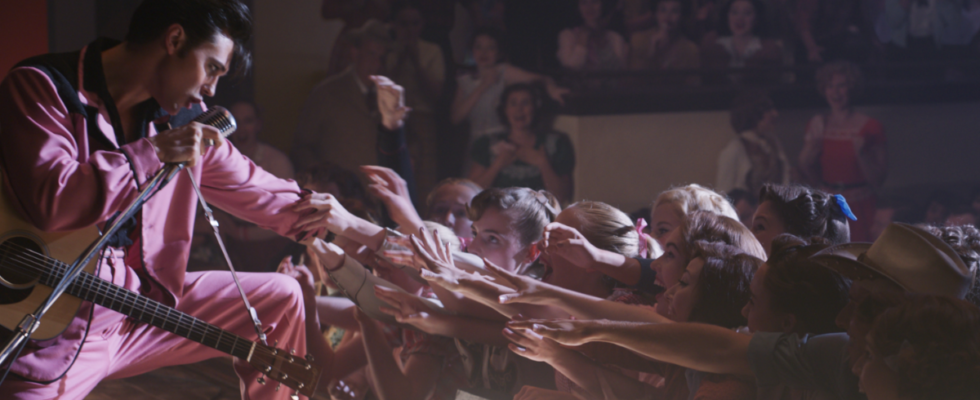
Baz Luhrmann’s Elvis is made with an energetically heightened reality that bursts through the cliches of the rock ’n roll biopic and the overfamiliar caricature that is its subject. It restores life and vitality to both, making something enormous and earnest and enveloping. This is a perfect match of filmmaker and subject. Luhrmann has a brand of cinematic theatricality in which wall-to-wall music covers a visual feast. Every shot is a riot of movement and color, frames are filled with flashing lights and flashy design, and every performance is goaded higher and higher until most gestures are big and broad. Elvis Presley, for his part, was a shock to the system. He defined the mold that continues to mint music stars as part of a wave of midcentury entertainers who began to scramble ideas of race, sex, and gender for the mainstream. His life, too, was as outsized as his stardom. Every facet of it has passed into iconography and a cartoon of fame: his mansion, his marriage, his movies, his scandals, his eccentricities. The modern version of celebrity culture is yet another element of our world he was at the right place and time to pioneer. This movie is a huge, swaggering tour of the familiar stages of Elvis’ life and career. It goes on for nearly three hours and doesn’t dig deeper into arcane trivia or thornier contradictions. But what it does instead is recreate the sensation of the shock of the new, and the societal and showbiz tensions the shaped and destroyed him. Luhrmann’s excesses match this mood, and this project: to build a shining monument to an icon of Americana—and to see how the darkness surrounding his becoming swallowed him whole.

The result is a rock opera and historical panorama that sells the intensity and immediacy of Elvis’ impact and the titanic complicated edifice of his legacy. Shot like a diamond-studded kaleidoscope’s view, this three-hour music montage flows from one number to the next, chopped and remixed and covered and tracked, amped up, stripped down, or played straight. When it lingers on a specific performance—his first big break winning over an audience with his rhythmic wiggling on stage; a triumphant comeback with lush orchestrations and pounding crowd-pleasing stamina—it is electrifying. So often these musical biopics tell us a moment was important by assuming we’ll know it was by the recognizable hit covered by its lead. Here, Luhrmann actually makes us understand 1.) how much hard work it takes to make that sort of impact, and 2.) why his subject was a huge deal. Austin Butler plays Elvis with pretty looks and expert timing, often drenched in sweat on stage, hair flopping, legs twitching, hips plunging. We feel the exertion of putting on a show, and also can get swept up in it. All the smash-zooms in on screaming young women—partly hollering for their fresh crush, but also in surprise at the reaction they’re having—and erupting crowds in dizzying editing or split-screens doesn’t come across as parody, but genuine live-wire enthusiasm. You’d think 2007’s great poison-pen satire of the sub-genre, Walk Hard, would’ve killed these stories dead. But watching Butler come alive on screen, inhabiting the appeal of this star so fully and convincingly, one might realize it’s worth grinding through all the bad versions of these movies just to get to one this remarkable.

In Butler’s compelling performance we see anew why Elvis became who he was. He’s surrounded by Black artists as he grows up, but his whiteness gets him chances they don’t. This is partly why he courts controversy from the segregationists of the time—and one wonders how the racists right-wingers of our time won’t see themselves in the portrait of sniveling politicians complaining about how he’s exposing their white children to ideas of blackness. He’s a white man performing rhythm-and-blues, a bridge between jazz and country as he helps forge a whole new style on the backs of those who get less credit, less fame, less money. But he’s a racially ambiguous figure over the radio, and in live performance is also playing on some unspoken androgynously provocative visual appeal. He’s a hip-thrusting young man at once forceful and smooth, pulsing staccato guitar strumming with loose-limbed pleasure in his own talents, singing in a sensitive baritone timbre from soft, delicate features. (A great evocative moment finds a nasty senator’s teenagers in front of the TV, lost in desire for this new figure of lustful interest.) Subsequent rock stars would blur these lines in more overt and outré ways; but here’s a movie that restores the sexual and racial fault lines of his times in order to bolster its argument for why his stardom was such a lightning rod.  

That’s the benefit of Luhrmann providing a movie that’s gloriously artificial and reverently specific as it sloshes around. He’s so good at movies that drip performative sex appeal and sexual tension, of high-gloss spectacle, loud music that resonates in the chest, expressive complicated camera moves you can hardly take in at once, and emotional dynamics you can believe in an instant. He’s also fond of tragic romantics destroyed by the troubles of their times. In his Romeo + Juliet and Moulin Rouge! and The Great Gatsby we see swooning melodrama, preening showmanship, and bombastic glamour. That’s where he loads in the opulent period style, gilded cages remixed with anachronistic fervor. And locked in the center are these tortured beautiful people who want to love and be loved. Here it’s Elvis, who searches in his family and his lovers and his audiences and, yes, even his sneaky, villainous manager (Tom Hanks) for that approval, that what he’s doing matters and will last. He’s a sensitive and artistic young man taken in, lifted up and exploited by a charismatic scheming promoter into the life of an international superstar. Hanks acts chummily threatening from within layers of makeup and a fat suit, speaking with a marble-mouthed accent and wielding a cane with a snowman top. His narration flows through the picture as well, a frustrated unreliable narrator who can’t quite prove he’s not the bad guy here. He’s a clear contrast with Elvis, the business side of the singer’s show. Somehow, they need each other, even if it will leave them worse off, too.

The movie is totally swallowed up in Elvis’ life and times. It argues that, far from being the Singular Great Man, Elvis was a product of his culture and his collaborations, forged by forces beyond his control and the contributions of others. He’s constantly surrounded by family, friends, business people, audiences, cops, politicians, and hangers-on. In the few dark, quiet moments of empty solitude—stewing in a suite, or lonely in a spotlight on an empty stage—he’s surrounded by doubt. Here’s a celebrity biopic that vigorously sells the spectacle and excitement of such a life—and the fundamental unknowability of such a man, even to himself. What a show! What a cost.

Sunday, July 12, 2020

Captain's Orders: GREYHOUND

With Greyhound, Tom Hanks has written a film perfectly fitted to his Movie Star persona. Like in his great recent films Sully and Captain Phillips, he’s playing a model of good leadership, built sturdily upon moral virtue, human and humane in the face of unbearable danger and terrible odds. This World War II thriller casts him in the role of a career Navy man captaining his first ship. The mission is to escort a convoy of supply ships from America to England. As the film begins, they’ve lost their air support from the States. It will be a few dark and stormy days until they meet up with the English planes that will take its place. During this time, they will be hunted by a pack of German U-boats, intent on picking off the convoy one by one, sowing confusion and wearing down their resources until they can move in for the kill. The enemy, heard only in ominous taunting radio transmissions, overtly declare themselves wolfish predators, but the sturdy filmmaking, from director Aaron Schneider (Get Low), makes them just as much shark-like, surfacing as if with a fin, circling like Jaws. Strategic aerial shots emphasize the game of cat-and-mouse on display, a bit of literal Battleship maneuvering. They’re on the open ocean, but the film is mostly claustrophobic. Close-quarters close-ups and medium shots in cramped situations have the men (from Hanks to second-in-command Stephen Graham and a host of young character actors) pressed against the bulkheads, straining against the waves, manning their battle stations.

The tension never slacks. It’s a barrage of snappy jargon and terse commands, every gesture and decision drawn with verisimilitude and effective B-movie snap. Based on a novel by Horatio Hornblower author, and WWII vet, C.S. Forester, it feels like it gets every detail right. The radar pings. The water crashes. The rudder shudders. Hanks commands the film with his quiet steady hand, a good man who feels the weight of responsibility, each life resting heavily on his shoulder, each mistake settling uneasily on his soul. His screenplay is a model of efficiency, starting as the mission crosses into its most dangerous passage, with only an exceedingly brief early flashback to humanize his character’s home life. It proceeds full steam ahead into an elegantly simple 80-minute suspense sequence. The clean, crisp frames and pulse-raising ticking clock make the slowly diminishing hours to rescue pass with the adrenaline of stalking enemies, exciting strategy, and painful losses. It’s an effective thriller, not because the whole war or a decisive battle is at stake, but because these particular boats, and the souls on them, matter. Because they’re full of people, and their captain cares, and every wasted round, every wasted second, is one precarious step away from their goal, we care. Every ounce of sentimentality, of relief, is hard-fought, and well-earned.

Sunday, October 30, 2016

Bored to Death: INFERNO


There are worse movies than Inferno, movies so inept, confused, ill-considered, or offensive they’re impossible to defend let alone sit through. But that makes it all the more depressing to realize Inferno is the only thing a movie can be that’s worse than bad. It is boring. I don’t mean to say it is slow or off-putting or strange or lazy. No, it is just deafeningly empty from the first frame to the last, completely devoid of interest or entertainment. If it was a bad movie it could at least kick up ludicrous silliness or something so mind-bogglingly tone deaf it’d be worth unpacking. Here we simply have a movie with no real reason to exist, incapable of making an argument for itself. It merely is, playing out with all the excitement and urgency of a talented group of Hollywood craftspeople signing off on a contractual obligation. It’s the kind of movie so tediously uninteresting you wonder if it was possible everyone was sleepwalking behind the scenes, or maybe trading sightseeing tips for their European downtime on Sony’s dime.

Clearly a commercial commitment, Sony couldn’t indefinitely sit on the rights to Dan Brown’s successful books about Harvard symbologist Robert Langdon, not after director Ron Howard and star Tom Hanks turned them into two good-sized hits already. The Da Vinci Code (2006) and Angels & Demons (2009) were not great thrillers, but at least they had their pulpy fun pretending their plot mechanics were wrapped in learning, with history lectures and Catholic conspiracy. Any movies that can feature both lengthy art appreciation monologues and Paul Bettany as a self-flagellating albino monk (in the first) or Ewan McGregor as a Cardinal parachuting out of an exploding helicopter (in the second) can’t be all bad. These were fairly self-serious works, B-movies impressed by their own footnotes and inflated with big budgets and big stars. Still, nothing prepared me for how exhausted and joyless Inferno was. Compared to this new film, its predecessors are models of humble, slight, and economical filmmaking. This one stumbles through an endless bleary plot without a single second of rooting interest, believable stakes, or photographic interest. 

It starts with Langdon (Hanks) waking up in a Florence hospital suffering amnesia from a head wound. His doctor (Felicity Jones) tells him he was attacked. Confused and suffering hallucinogenic flashes of horror imagery – the movie takes glum grotesqueries as humdrum – Langdon flees with his caretaker after a policewoman opens fire on them. Now he must remember why he’s now wrapped up in a globetrotting art-adjacent adventure, racing to prevent an apocalyptic event. Because he’s done sort of thing twice before he’s well equipped to get up to speed as he fumbles around the scrambled passages of his mind. Maybe it has something to do with the visual representation of Dante’s Inferno he finds in his pocket, and which has been altered to include clues to a hidden cache of plague virus that would wipe out 95% of the world’s population if unleashed. You can see why the World Health Organization, which this movie imagines operates as an international SWAT team, is hot on their trail. The mystery is why they think Langdon has something to do with it.

I can forgive many an incredulously strained plot, but see if you can follow this. Say you were a brilliant but eccentric sociopathic billionaire scientist with a goal of reversing the world’s overpopulation with your custom-made plague. You’ve hidden it in a bag that’ll blow up on a certain day and time. Would you: A.) tell no one, sit back quietly, and let it do its thing; or B.) throw yourself off a building, leaving behind an elaborate set of art-history scavenger hunt clues leading to your biological weapon of mass destruction? I get when Langdon is investigating a conspiracy with historical roots why sussing out clues in paintings and monuments is a helpful strategy, but why would Inferno’s villain (Ben Foster) create new clues on old art? If he was really intent on kickstarting the apocalypse, why leave room for a professor to figure it out and stop you? There’s little motivation behind anyone’s behavior in this movie, including WHO agents (Sidse Babett Knudsen and Omar Sy) and a mysterious fixer whose office is aboard a freighter in the Adriatic (Irrfan Khan). They change sides a couple times each for seemingly no reason other than cheap surprise.

Inferno is a movie that’ll test a lot of assumptions. Think between Ron Howard directing and David Koepp writing they could surely cobble together a half-interesting story? Think national treasure Tom Hanks could reliably deploy his star power? Think a supporting cast of fine actors could bring something to the table? Think some solid, reliable Hollywood craft – cinematography from occasional Howard collaborator Salvatore Totino, score from the busy Hans Zimmer – could at least render a movie watchable? Prepare to be disappointed. It’s an entire movie of people going through the motions. It can’t even make stunning locales in Florence, Venice, and Istanbul look like the good museum-hopping travelogue thriller it could’ve been. The movie is cramped and ugly – maybe the better to emphasize its villain’s complaint about too many people? – and the way the plot unfolds around an amnesiac hero is treated for mere confusion. This only serves to hobble what should be a swaggering Hanks by making him squint and stagger while reading clues to the other characters, dragged along by the boring plot without clear drive or goals of his own. He can’t remember why he’s there or why he should care, and I could relate. The only reason to see this movie is if you want a dark room in which you could nap for a couple hours.

Friday, September 9, 2016

Fly Hard: SULLY


A most unusually structured mainstream Hollywood effort, Clint Eastwood’s Sully is more than you’d expect from a based-on-a-true-miracle movie. It has the requisite stunningly realized and vividly recreated central reenactment of an amazing real-life event, in this case Captain Sully’s emergency water landing of a US Airways jet in New York City’s Hudson River on January 15, 2009. But Eastwood’s film isn’t interested in easy heroism. It’s about process, about skilled people doing their jobs to the best of their abilities and about the constant churning reliving of a traumatic event in its swirling aftermath. This is a movie that knows just because the outcome was a success – the reason the story is so memorable in the first place is not simply that a jet went down, but that every single passenger and crew member lived – doesn’t make the event any less rattling. And just because we know the outcome doesn’t make it any less harrowing.

The movie knows we know what happened and doesn’t take any steps to hide it. Todd Komarnicki’s screenplay begins in a nightmare, as Sully (Tom Hanks) awakes the morning after the miracle having dreamt it had gone wrong and they all went down in flames. A news report is hammering away with the real ending: all survived. This is a movie about what happened that day, told from a variety of angles, remembrances, and reenactments. Eventually the movie arrives at its centerpiece: a lengthy, involving, grippingly detail-oriented view of the event from boarding to takeoff to sudden bird strikes mere moments later that leave both engines useless and then a long, scary descent past the city and into the river. But first we see Sully and his co-pilot (Aaron Eckhart) interviewed by the National Transportation Safety Board (whose members include Mike O’Malley and Anna Gunn). They’re forced to tell their story, explain why they couldn’t make it safely back to a runway. This is a movie not about bold men taking decisive heroic action. It’s about instinct, knowledge, training, and group efforts. It’s about doing the job.

Circling the main event, Sully’s present tense follows the man recovering. We see the crash in dream, flashback, news coverage, interviews, interrogations, flight recordings, and simulations. It’s a sturdy evocation of a man whose mind continually, inevitably returns again and again to relive his trauma by personal choice and public need. He’s still in shock, stuck in a hotel waiting for the board’s investigation to complete so he can get back in the air. Meanwhile, strangers awed by his noteworthy feat stop to shake his hand or give him a hug, Katie Couric and David Letterman want him on their shows, and his wife (Laura Linney) calls to check up on him. But none of this interrupts his mind as he wonders if he did all he could. Did he make the right decisions? Could this have all been avoided? The answer is yes and no. He behaved perfectly under pressure, and accidents happen. But his work ethic is such that he simply can’t square the heroic image in public with his humble workaday private self. He’s just one man, who happened to have the right training and the right experience to allow him to make the right calls quickly and under pressure. He just wanted to make sure everyone was safe.

Eastwood lingers on this ordinary professionalism, using Hanks’ subtle humility and aw-shucks low-key Americana persona to great effect. Hanks projects a confident, compassionate, fatherly presence. It’s a strong, honest, hardworking masculinity that’s not bravado, but simply routine and behavioral. He’s warm and earnest, but not arrogant or aggressive. He’s simply nice. It’s a perfect part of the film’s portrait of process that reveals the everyday bravery of people who have skills, knowledge, expertise, empathy, and a moral sense of duty. (And like Eastwood’s other recent films – J. Edgar, Jersey Boys, American Sniper – it’s interested in the effects public feats have on private lives.) Sully is a movie that finds different perspectives beyond the leading man: the steady co-pilot, the efficient flight attendants, the alert traffic controller, the responsive passengers, the confident coast guard and quick-thinking ferry boat captains who race to the scene. Everyone plays an important part and living through it marks all. A Hawksian vision of humanity at its best and most cooperative, it’s a quietly moving movie about people in peril not succumbing to selfish panic, but taking one step at a time to safety. The film is understated, humane, warm, even softly funny, recognizing the normality of the men and women who experienced something that doesn’t normally succeed. The lead of the investigation eventually admits it’s the first time he’s listened to a black box while sitting next to the pilots.

Shot in bright and crisp digital full-frame IMAX by cinematographer Tom Stern, the movie’s most overwhelming when it puts the audience in the plane as it dives – at once terrifyingly fast and agonizingly slow – to the river. Eastwood increases the panic by tracing the plane’s arc past skyscrapers and skyline, even coming close to a bridge. The words 9/11 are never spoken in the film, but hang over the proceedings, never more so than in a moving passage during the centerpiece sequence that cuts to New Yorkers catching sight of the low-flying jet, the horror and surprise registering on their faces with a clear “oh, no, not again” feeling. It’s done largely silently, adding to the haunting reminder of how badly this could have ended. As the movie continues in its repetitions, finding new viewpoints from and techniques through which to view and explain the miracle, Eastwood lets the details accrue. Though it opens by reminding us of the outcome and then lets us see the events in so many ways so many times, it retains its suspense and its fascination the whole way through. It has the skill to show us an amazing feat, and the perspective to know the outcome was astounding through nothing more than capable people committed to doing the best they could with the circumstances given to them.

Thursday, December 12, 2013

Spoonfuls of Sugar: SAVING MR. BANKS


It’s no secret that Walt Disney Pictures has been creatively floundering as of late. The past decade saw their animation studio take a confused tumble after the heights of their 90’s renaissance while their live action filmmaking got only the rare hit (Pirates of the Caribbean) between failures both instantly forgettable (G-Force, College Road Trip, Prince of Persia) and unfairly maligned (the fun John Carter and misunderstood Lone Ranger). Despite their considerable charms, Tangled and Frozen alone do not a new golden age make. No wonder they want to cast their corporate eye backwards with Saving Mr. Banks, remembering a high point of creative and commercial success through rosy glasses and the glossiest of Hollywood polish. The movie considers the early 1960s, in particular the preliminary stages of the making of 1964’s Mary Poppins, not-so-coincidentally out now in a sparkling new transfer on Blu-ray. Banks twinkles through script notes, songwriting, and storyboard meetings, largely focusing on Walt Disney’s attempts to convince P.L. Travers, the author of the Poppins books, to sign over the rights.

Travers was notoriously reluctant to turn her beloved writing over to the hands of Hollywood in general and Disney in particular. The movie casts the generally likable Emma Thompson in the role. Her performance creates a woman walking through life in brisk and brittle judgment, but with the inevitable softening always just under the surface of her snapping. In the film’s opening, she has to be talked into flying to Los Angeles to take a meeting with Disney. We hear that her royalties are drying up and so could use the boost of income. That the sign of her financial troubles is her having recently fired her assistant is not necessarily the most sympathetic of hardships is no matter. The movie isn’t about her financial pressures giving her reason to sign the contract. It’s about how a controlling creative type meets another controlling creative type and learns to compromise for the good of creating a classic film.

For this is a movie aware at all times that Mary Poppins will become an all-time classic. When Mr. Disney (Tom Hanks, so well-liked on his own, all he has to do is show up in costume to communicate some of Disney’s showbiz charm) has Travers sit in on development meetings with co-writer Don DaGradi (Bradley Whitford), it’s clear that every decision the studio makes that we can recognize from Poppins is meant to be the correct decision. When Travers snaps at the songwriting Sherman brothers (B.J. Novak and Jason Schwartzman) over a small made-up word in one of the opening lyrics, they awkwardly glance at their pages of music, the camera dutifully focusing in on the word “Supercalifragilisticexpialidocious” as punchline. Saving Mr. Banks plays upon our knowledge for one of the studio’s crowning achievements – one of the company’s very best films and their best live action effort by a country mile.

Poppins is a movie of such pure delight that it can’t help but rub off on this one a little bit. Filled up with Poppins’ songs and winking references to specific lines and images, Banks and its charming cast carries a residual charge. So what if director John Lee Hancock (of The Rookie, The Alamo, and The Blind Side) shoots the film with very little cinematic inspiration of his own, dutifully shooting the script glossily and anonymously. All the better for Poppins movie magic to shine through. The script by Kelly Marcel and Sue Smith very nearly makes Travers into a simple killjoy. Sure, she taps her toes to “Let’s Go Fly a Kite,” but she threatens to cancel the whole project after learning the dancing penguins will be cartoons and not trained penguins. There’s sympathy to be found in her position – after all, Disney is playing a game of semantics telling her the movie will not be animated, and then eventually admitting “not animated” doesn’t necessarily mean “no animation.” 

Travers was so against the frivolity and sugar of Disney, especially when it came to adapting her books, that one imagines having her life turned into a Disney movie could be a posthumous indignity. If she fought so hard to preserve the most important details of her books, imagine what she’d have to say about this movie. It’s a case of history written by the winners, a true story about a woman who feared the company would take a good story, sand off the hard edges, and make it into simpleton schmaltz.  And yet Saving Mr. Banks, for all its borrowed charms in the occasionally repetitive showbiz scenes, works. The screenplay weaves in flashbacks of biographical detail, finding Travers as a young girl (Annie Rose Buckley) in the Australian outback with her depressed mother (Ruth Wilson) and alcoholic banker father (Colin Farrell). These scenes have the emotional charge the fizzy Hollywood storyline doesn’t, and when the film finds sequences in which the flashback past and filmmaking present collide, it’s surprisingly moving. Though a rough correlation between her story and her life is too mushy to work as literary analysis, it makes for fine sentimental cinema.

The film is ultimately about a peculiar paradox that can befall creative types. Travers and Disney are both so committed to their own visions for the project, they do not see the value in anything that varies from what’s already in their heads. They’re stuck talking past each other, unable to use their considerable creativities to compromise. This is an interesting conflict on which to hang a story, especially considering that there’s no reconciliation here. It’s a strange tone for a film to settle upon, on the one hand polishing its corporate reputation while still finding some degree of sympathy for the woman who felt so compromised by Disney. Travers simply softens enough to sign away and Poppins is made more or less as Disney decided. That in real life, she refused to sign over the sequel rights after seeing the film is perhaps indicative this new film concludes slightly sweeter than it should. In the end, I reacted to Saving Mr. Banks in much the same way it portrays Travers at the premiere of Poppins. What it does, it does well. What she finds disagreeable leaves her arms crossed with a face of stone. What she finds it gets absolutely right moves her.

Monday, October 14, 2013

Just Business: CAPTAIN PHILLIPS


Exhausting and exhaustive, Captain Phillips is a process-oriented film of unrelenting tension. Detailing the true story of how, in 2009, a band of Somali pirates managed to board an American freighter in international waters off the coast of Africa and ended up holding the ship’s captain hostage for four days, the film’s approach finds the distance between us and them drawing small. The opening scenes are all about world economics, with two groups of men setting sail with very different, but ultimately convergent, goals. The freighter is loaded with cargo while Captain Phillips (Tom Hanks) makes last minute checks, running down the corporate checklist. In a village in Somalia, a band of pirates are spurred to action by the local warlord, gathering boats and crew to go hunting for vulnerable targets in the ocean beyond their shores. They’re all in it for the money.

In the opening scene, the theme of global economic forces is made all too clear as clunky thematic exposition is spoken between Phillips and his wife (Catherine Keener). The world is changed, he says, wheels are moving, forces beyond their control. By the time the captain of the pirates (Barkhad Abdi) comes face to face with Phillips, he tells him their piracy is “only business.” Late in the film, he explains his boss will expect money when they return. “We’ve all got bosses,” Phillips replies. The film splits cleanly in two, the opening an extended setup that brings the freighter and the pirates into contact and crisis, leaving the second half dedicated to cutting between the military rescue operation and the increasingly claustrophobic and desperate events on board as a heist becomes a hostage situation. It largely shifts thematic gesturing to off-hand remarks, driving forward with ticking reportorial momentum.

The film reflects its preoccupations with process and business in its simplicity. A tense reenactment of a story that was all over the news in recent memory, there’s a factual frisson to the way the film unfolds. The screenplay by Billy Ray is, a clunky first scene aside, relatively restricted to jargon, strategy, and jostling for power and advantage in an increasingly difficult scenario for all involved. Though it could easily become an overpowering triumphalist picture, with one of the most likeable movie stars on the planet terrorized by third-world criminals and eventually rescued by the firepower of the United States, there is a remarkably balanced approach that finds the terror of the situation in how inescapable it becomes. Everyone is simply doing the job they’ve been given, responding to variables according to the best of their professional knowledge and abilities.

Hanks does strong, nuanced work here as a man with a professional imperative to keep his cool to save his crew and cargo, as well as an inner strength, his will to survive driving him to keep all parties from becoming irreparably inflamed. He’s not a hero, merely a smart, capable man who keeps a level head. The final stretch of the film, when he’s pushed past the breaking point and enters a state of shock, is some of the rawest acting Hanks has done in years. Abdi, as the leader of Phillips’s Somali captors, is clearly orchestrating a criminal and inexcusable act, but his performance captures shades of doubt and pride that prevent his characterization from becoming abstract villainy. He’s a desperate man in desperate circumstances, finding it hard to control a situation he thought would be easy ransom as it spirals out of control and it becomes clearer that it’ll be hard to make it out. It’s almost sad when, late in the film when it’s clear to all involved he and his men will more likely be captured or killed than receive riches, he’s asked why he continues to hold Captain Phillips hostage and replies that he’s come too far to turn back.

Directed by Paul Greengrass, the film jitters with his trademark shaky-cam verisimilitude. With exceptional action films The Bourne Supremacy and The Bourne Ultimatum, he helped set the standard for chaos cinema, painting action as scrambling sequences of elaborate franticness, pushing blockbuster cinema towards a standard of abstract adrenaline that few filmmakers could match. Many would borrow the techniques, but few could copy the effects. His you-are-there docu-thriller immediacy did claustrophobic wonders for his dread-filled United 93, a real-life disaster picture that valorizes the passengers who died diverting a hijacked airliner on September 11, 2001. In Captain Phillips, Greengrass brings a similar sense of weight and tension, a sense of enclosure of space and situation, cinematographer Barry Ackroyd's widescreen framing refusing to open up. Even wide shots of ships at sea feel trapped, the weight of the suspense crushing down even there.

The film uses its sensations to simply recreate a recent event and it’s admirable how even-handed it manages to be. Even better, how the film refuses to give easy relief. The final minutes are extraordinary. The saving gunshots come fast, leaving the scene bloody and resolutely resisting celebration. Hanks’ final scene is not one of calm, but one of safety slowly quaking its way into a body still shaking with unbelievable stress. Greengrass leaves us with scenes much like those we’ve been watching the entire runtime, professionals simply doing what must be done. Tension may be released from this particular narrative, but the world goes on just as before.

Monday, October 29, 2012

What is Any Ocean but a Multitude of Drops? CLOUD ATLAS


Starting with nothing less than a Homeric incantation in which a white-haired old man stares into a crackling fire and seems to summon the fiction into being, Cloud Atlas, an ambitious adaptation of David Mitchell’s tricky novel, is the kind of movie that’s easy to recommend and admire, if for no other reason than that nothing quite like it has ever existed and is unlikely to come around again any time soon. It wobbles at times, but luckily it’s ultimately better than the sum of its gimmicks. This is a complicated film about simple truths: love, ambition, knowledge, power. A major motif is a musical composition that one of the characters writes called “The Cloud Atlas Sextet.” It’s a lush, haunting piece of music that winds its way through the soundtrack and, by its very nature, echoes the major structural conceit of the film. A sextet is a piece of music to be played by six musicians. This film – like the novel before it – contains six stories, any one of which could easily expand into its own film, but together combine into one gorgeous whole.

Spanning centuries and genres, the film breaks apart the book’s chronological and mirrored presentation and instead places the six stories parallel to each other, cutting between the stories with a gleeful, witty, dexterous montage that recalls D.W. Griffith’s 1916 feature Intolerance in the way it so skillfully weaves in and out of varying plotlines. A massive undertaking, three directors, Tom Tykwer (of Run Lola Run and Perfume: The Story of a Murderer) and Lana and Andy Wachowski (of The Matrix films and Speed Racer) split the six sections among them, adapting and directing separately but from a shared common vision so that the story flows both stylistically and emotionally. Like some strange geometric object with many sides and layers, the film grows all the more epic by expanding outwards through time and space.

It takes us to the Pacific Ocean in the nineteenth century aboard a ship sailing towards America. Then, we’re in Europe in the 1930s, following a disinherited, but ambitious and talented, music student to the home of an elderly composer. Next, we’re in 1970s America, following an intrepid reporter into a conspiracy at a new nuclear power plant. On to the present, where we find a publisher who is the victim of a mean brotherly prank and stuck in an unexpected place. Then we’re to the future, where a clone slave describes her story of finding awareness of the consumerist dystopia she lives in. Finally, to the far future, where we find a post-apocalyptic world that has returned to clannish living in the wilderness, where the peaceful people are terrorized by a tribe of aggressive cannibals. Tykwer and the Wachowskis present each setting with handsomely realized production design and detailed special effects. Moving between them is anything but disorienting; it’s, more often than not, invigorating.

Almost too much to handle in one sitting, this film is a rush of character and incident, themes and patterns, echoes upon echoes, all distinctive melodies that fade and reoccur time and again. Some sequences play more successfully than others, but the film is largely fascinating and generally gripping as it becomes a symphony of imagery and genre, returning again and again to mistakes humankind makes, the benefits and constraints of orderly society, and the way underdogs try to find the right thing to do against all odds. The themes play out repeatedly in a flurry of glancingly interconnected genre variations. What appears as drama later plays as comedy, as action, as mystery, as tragedy. Tykwer and the Wachowskis have put the film together in such a way that the editing escalates with the intensity of each plotline, bouncing in an echoing flurry during rhyming plot points (escapes, reversals of fortune, setbacks, reunions) and settling down for more languid idylls when the plots simply simmer along. By turns thrilling, romantic, disturbing, suspenseful, and sexy, there’s a fluidity here that makes this a breathless three-hour experience. The film moves smoothly and sharply between six richly imagined stories that connect more spiritually and metaphysically than they do literally, and yet artifacts of one story may appear in another, sets may be redressed for maximum déjà vu, characters in one story may dream glimpses of another. This isn’t a puzzle to be solved, but rather a stylish assertion that people are inescapably connected to their circumstances and to those who lived before and will live after.

In order to underline its insistence upon the connectedness of mankind then, now, and always, the film features the same cast in each story, making it possible to get a sense of the progression of a soul through time, each reincarnation living up (or down) to the example of earlier experiences and choices. Through mostly convincing makeup, actors cross all manner of conventions, playing not just against type, but crossing race, gender, age, and sexual orientation in unexpected ways. (Some of the biggest pleasant surprises in the film are in the end credits, so I’ll attempt to preserve them.) For example, Tom Hanks appears as a crackpot doctor, then again as a thuggish wannabe writer, then again as a haunted future tribesman, among other roles. This is a large, talented and eclectic cast with Halle Berry, Jim Broadbent, Hugo Weaving, Keith David, Doona Bae, Jim Sturgess, Ben Whishaw, James D’Arcy, David Gyasi, Susan Sarandon and Hugh Grant delivering strong performances, appearing over and over, sometimes obviously, sometimes unrecognizably or for only a moment. This allows the filmmakers to dovetail the storylines even further, for what is denied in one (lovers torn apart, say) may be given back in the space of an edit (lovers, not the same people, but played by the same performers, reunited).

Though some will undoubtedly be turned away by its earnest (if vague) spirituality and messy philosophical bombast, this is the kind of film that, if you let it, opens up an endless spiral of deep thoughts. You could think it over and spin theories about what it all means for hours. To me, that’s part of the fun. It’s a historical drama, a romance, a mystery, a sci-fi epic, a comedy, and a post-apocalyptic fantasy all at once. In placing them all in the same film and running them concurrently Tykwer and the Wachowskis have created a moving and exciting epic that seems to circle human nature as each iteration finds characters struggling against societal conventions to do the right thing. The powerful scheme and rationalize ways to stay on top; those below them yearn for greater freedom and greater meaning. There’s much talk about connection and kindred spirits; at one point a character idly wonders why “we keep making the same mistakes…” It accumulates more than it coheres, and yet that’s the bold, beautiful mystery of Cloud Atlas, that it invites a viewer into a swirl of imagery, genre, and character, to be dazzled by virtuosic acting and effective filmmaking, to get lost amongst the connections and coincidences, to enjoy and perhaps be moved by the shapes and patterns formed by souls drifting through time and space.

Wednesday, March 28, 2012

Too Soon: EXTREMELY LOUD & INCREDIBLY CLOSE

I had Extremely Loud & Incredibly Close on my list of films to see before I finalized my top ten list for 2011, but after the waves of critical negativity greeted its limited release, I took it off the list. The trailer, which for some reason seemed to play before at least a half-dozen films I saw during the fall, hadn’t been promising. But the pedigree (based on a Jonathan Safran Foer novel of some note, starring a bunch of Oscar winners and nominees that I quite like, directed by thrice-nominated Stephen Daldry) still had me interested. I had marked it down as a low priority and was all ready to move on when the Oscar nominations were announced. Surely the big surprise of that morning, the film made it on the list of nine nominees for Best Picture. Having seen the other eight titles, I once again felt the begrudging need to head out to the theater and see for myself.

I caught it in a mall multiplex near the end of its theatrical run. I’m glad I did. The film is not without it’s flaws. That’s putting it mildly. But I found it to be a compelling and even moving experience. Is it mechanical and manipulative in its use of a recent tragedy to give weight to its otherwise flimsy story? Certainly. But it barreled past my objections and worked on me. I can’t deny that it’s heavy handed, that it might just be too slick for its own good, that it meanders and sometimes bobbles its tone. But it’s also often powerfully acted and quietly absorbing in ways that surprised me given all the noxious critical reactions that surrounded its release.

The film is about a young boy (Thomas Horn) whose father (Tom Hanks) had a meeting in the World Trade Center on September 11, 2001. In the opening scene he expresses disgust that his mother (Sandra Bullock) decided, since no body was recovered, to bury an empty coffin. His father’s death seems to resist closure. It is a wound that won’t heal, a scab at which he keeps picking away, hiding a makeshift shrine to 9/11 in the uppermost corner of his bedroom closet. For him, the idea of closure is at once intensely necessary and to be resisted. There can be no closure. The most wounding moment of the film comes in a scene that’s the least heavy-handed and the best acted in which the boy finds just the right words to hurt his mother, to lash out at the only person who can share his pain. In that scene, Horn is capably upset and Bullock's reaction is devastating. It’s a moment of emotional impact that I wouldn’t want to shrug off lightly.

Before 9/11, the father would create scavenger hunts to help the shy, awkward, but intelligent child learn how to go out into the world and find his way around obstacles. In his father’s death, the son finds the biggest scavenger hunt of all. He wants to find meaning in the tragedy, to find a way to make sense of his father’s death while honoring their relationship. He finds a key in a small envelope in the closet where his mother left his father’s belongings. Inside is a key. He thinks it will have all the answers. The poignancy comes from knowing that there are no answers to come, knowing that even if he does manage to find a lock that fits the key, he will eventually arrive at disappointment.

The envelope has one word written on it: “Black.” So, the boy looks up all of the people with the last name “Black” in the phone book and sets out to find them all, sneaking around his mother to do so. The concept of a little boy wandering by himself all over New York City is an oh-so-precious one, gaining what seems to be only strained precociousness with the addition of a neighbor, a mute, elderly Holocaust-survivor (Max Von Sydow) who takes it upon himself to look after the kid on some of these expeditions. And yet, the boy’s encounters with all manner of New Yorkers are just compelling enough to survive the sentimentality. Each person who decides to stop and hear his story contributes to this messy portrait of cross-cultural wounds in the wake of tragedy. The most affecting of these vignettes belongs to Jeffrey Wright and MVP Viola Davis, who once again proves that she can give depth and humanity to any role in which she’s cast.

But the quest of the key is ultimately, for me, beside the point. What really works here is the way the film circles around the tragedy, returning to it as the boy’s traumatic memories of the day continue to swirl in his head. Eventually, we get the full story of its impact on this family, of the way they first heard the news, the way they reacted to it as they began to realize they would never again see husband and father. Is it ultimately shamelessly manipulative? Undoubtedly. There’s a cringe-worthy shot in which Tom Hanks falls towards the camera, dropping out of the unseen World Trade Center and hurtling through a clear blue sky in slow motion. Yikes.

But there’s also a scene when Bullock spies the burning towers through a window at her workplace that’s an intensely sad and well staged moment. And there’s also a scene in which a phone cuts out at the same moment a TV in the background of the shot shows one of the towers collapsing. The sonic and visual trauma of the moment is effective and potentially overwhelming, much like the small catharsis that comes when Davis and Wright reappear in the narrative towards the conclusion. It’s a film in which people try to make their own sense out of tragic events, but that sense is inevitably smaller and more personal than the shared trauma.

This is a film that’s constantly teetering on the edge of disaster, not just the disaster of its subject, but a disaster of filmmaking as well. I found it to have some moments of great acting, especially from Davis and Bullock. I found it a film slightly more moving than cloying, slightly more emotional than egregious and, so, my reaction to the film ultimately tips slightly into the positive. Clearly, though, with material this volatile an approach so sturdy and oblivious, and a central character so potentially cloying, your mileage will most definitely vary. But reader, it held my attention and, by the end, I was surprised to find myself emotionally involved and moved. To report otherwise would be a disservice.

Friday, July 8, 2011

Special Education: LARRY CROWNE

The most dispiriting aspect of Larry Crowne, a dismal new comedy co-written and directed by Tom Hanks, who also takes the titular role, is the way it strides forward, places its finger on the pulse of modern America and then scurries away, never to contemplate such resonance again. This one well-pitched moment comes, fittingly enough, right at the film’s opening that introduces us to Larry Crowne. He’s a nine-time employee-of-the-month at U-Mart, a fitting string of commendations for a man who spent twenty years as a Navy cook. Called into the break room by his boss, fully expecting to be awarded yet again, Larry is dismayed to find that, due to his lack of a college education, he has been deemed insufficiently upwardly mobile within the corporation and therefore must be fired.

In a time of high unemployment, rampant corporate malfeasance, and an identity crisis within a certain section of the lower middle class demographic that has found well-paying jobs increasingly unavailable without college, the premise of Larry Crowne could not be timelier. Unable to find a new job Crowne sets off for the local community college, at the suggestion of his neighbors played by Cedric the Entertainer and Taraji P. Henson, and settles down, like so many of his real-life counterparts, to try to learn his way back into the job force.

Unlike the wild, experimental, and unexpectedly moving sitcom Community, one of my favorite current TV shows, which often achieves its impact ironically or through surprising detours, Larry Crowne is poised to use the terrain of community college for simple good old fashioned Capra-esque uplift. There’s the sad teacher (Julia Roberts) who just needs to pull her messy personal life together to, doggone it, inspire her students. There’s the strict teacher (George Takai) who has his students’ best interests at heart. There’s the hip gang of scooter commuters (led by Gugu Mbatha-Raw and Wilmer Valderrama) who are all too ready to embrace a middle-aged doofus like Larry and selflessly help him turn his life around and get back on his feet. This is the kind of cast that could be airlifted out and placed in a great movie. Instead, they’re stuck here.

The movie is awfully cutesy and wispy, to the point where each and every scene feels like a digression, scenes that start nowhere and in their flat, unremarkable visual style, work backwards to irrelevance. The characters are so simply, clumsily drawn by Hanks and his co-writer, the one-hit-wonder behind 2002’s My Big Fat Greek Wedding Nia Vardalos, that it feels hard to find any reason to care about these people or even believe that they would interact in the ways that they do. Friendship, respect, and romance all seem to be forced upon them by the screenplay. It’s as if Hanks and Vardalos came up with a great idea, sketched out a rough first draft and then decided to film it without further development. This is a loose and flabby picture that, despite being so earnest, is utterly devoid of backbone.

Friday, May 15, 2009

Angels & Demons (2009)

There’s an entertaining thriller somewhere within Angels & Demons, but it’s hidden behind a creaky pace. Tom Hanks is back, looking unusually exhausted and once again without his charisma, as Robert Langdon, the Harvard symbologist (ha!) who cracked the DaVinci Code. This time he has to stop a plot to destroy the Vatican. The movie is helped by the presence of a literal ticking-bomb scenario but why, then, does everything seem to happen at such a sleepy rate? The movie is intermittently thrilling but never really involving or frightening. By the time the movie turns splendidly pulpy in the last act, it’s too late.

There’s a solid cast of supporting characters. If there's one sure way to liven up a dull B-movie, it has to be: hire European character actors. Ewan McGregor and Armin Mueller-Stahl play officials of the Catholic Church who billow through the ornate cathedrals and archways with a grand sense of purpose and grave portentousness. Stellan Skarsgard is also on hand to huff and puff as head of security and Ayelet Zurer - as a bioentanglement physicist (double ha!) - gets to stand in the background of many scenes (sometimes she even gets to say something). On the whole, this movie is less ponderous and pretentious than DaVinci Code, which leads me to assume that director Ron Howard realized that, despite the high gross, all the people who found the first film a little on the stuffy side were correct. But Mr. Howard has not swung far enough the other way. This time, instead of quietly murmuring monologues of pseudo-historical hogwash, the characters shout it or gasp it while racing through Rome but it’s just as repetitive as the first film. “Blah blah blah cathedral! Blah blah blah statue!” Repeat. The film also helpfully reminds us of major plot points regularly, for the convenience of those who have nodded off between murders.

Speaking of murders, the movie manages to be quite bloodthirsty and the MPAA ratings board has had no qualms about giving the film a PG-13 despite lingering upon brandings, rats gnawing a fresh corpse, one bloody slit throat, and, oh yes, a delightful scene in which a man with a chest wound is given CPR that causes a spurt of blood to soak the face of our hero. And yet Slumdog Millionaire received an R? It would be one thing if the carnage here served a fun, fast plot but it's merely a sad attempt to liven up some dusty proceedings.

In the face of all that brutality, it’s a shock to find that the movie goes soft in other aspects. There’s a legitimate conversation to be had about the respective roles that science and religion play in modern life, and perhaps a summer blockbuster is not the appropriate place to have it, but this movie pays lip service to grander ideas, uses them to fuel its plot, but is never honest about the conflict or lack thereof. I can understand not taking sides so as not to offend any member of the audience, but Ron Howard, and his writers David Koepp and Akiva Goldsman, downplay both sides to such an extent that a member of the audience could be forgiven for assuming that neither side has any point at all. Though such intellectual dishonesty has long marred all movies focus-grouped beyond the point of making any statements about anything, it’s rare to stumble upon one that, if thought through, has the capacity to make one question the basic meaning of life. If both science and faith are wrong, where does that leave us? It’s a good thing that no one goes to these kinds of movies looking for answers to life’s big questions (I hope).

Grotesqueries and hypocrisies aside, the movie manages several scenes of competent thrills and spills amongst some gorgeous production design. Mostly taking place at nightfall, the characters run and stalk through settings choked with atmosphere: cobwebbed caverns and shadowy passageways with dramatic lighting (and dramatic camerawork) accentuate the beautiful architecture of the city. The plot is appropriately twisty and the last act, as previously hinted, goes pleasantly insane with some last minute twists, some Vatican backstabbing and skullduggery, an act of self-martyrdom, and one very large explosion. It’s too bad it takes so long to get there. There’s a fun summer movie to be had at times, and if you’re forced to see it, there are certainly worse ways to spend two conspiracy-minded hours (see, or rather, don't: National Treasure or The DaVinci Code). I just wish someone had been let into the editing room to shave thirty to forty minutes off this thing to make it sail past its tepid attempts to tackle serious topics and get us even faster to the fun.