Tuesday, November 14, 2023

Empty Man: THE KILLER

With The Killer, David Fincher renews his status as the premiere name in luxury brand pulp fiction. Here’s a film of cool surfaces and methodical plotting and a constant low-level thrum of tension. The lead character is a hit man who we meet as he sits in an abandoned Parisian WeWork loft, fastidiously and patiently waiting to snipe some rich guy in the penthouse across the nondescript street. Michael Fassbender plays the assassin-for-hire as a hollow-point threat, a no-nonsense man of coiled readiness, prepared to spring into action, but more often than sitting in ominous stillness ready to check off each step of his deadly to-do list. This hit goes wrong, though, and his mystery client subsequently tries to have him killed. So now the hit man turns on the client and works his way up the food chain to find him. (In that way, it’s also a movie about a gig economy worker deciding to stop freelancing and go it alone.) Each victim is reason for a well-cast supporting actor (Charles Parnell, Arliss Howard, and Tilda Swinton are among the instantly compelling figures) to make a quick, memorable impression in a scene or two before the inevitable threat of violence crescendoes. 

That’s a pretty simple, predictable, and familiar story for this sort of thriller. But each sequence is made with the bespoke attentiveness that Fincher is best known for. This is a film of icy remove and precise, digital sheen. Each image, each cut, clacks into place with eerie forward momentum and chilly matter-of-fact suspense. It may not reach the virtuosic heights—or is that more accurately the visceral, propulsive, twisting lows?—of his Gone Girl or Se7en, though it shares the latter’s screenwriter. But, as a return to form for a master of this form, its low-key, high-style blend functions as a sharp-angled pleasure from frame one to final cut to black. It’s Le Samourai plotting by way of Fight Club adjacent tone, with the surface cool of a terse Jean-Pierre Melville procedural animated by a terse, chatty, unreliable Gen-X voice over. Can this empty man of action ever find peace? He thinks so, controlling variables with his repetition and routine, reducing the mess of life and death into a checklist. He does yoga, builds his rifle, plugs in his playlist of The Smiths, and off he goes. Of course it’s not that easy. The film enjoys setting up complications and watching step by step as the killer thinks his way out. In the end, it’s another of Fincher’s pictures of process that has the luxury to be both admiring and afraid of what its lead can do.

Saturday, November 11, 2023

Switch Off: THE MARVELS

The Marvels arrives on a wave of bad buzz for the Marvel Cinematic Universe that has fans and critics and showbiz reporters wringing their hands about the troubled state of the series. What once prided itself on a kind of comic-book style improvised cross-over continuity has floundered as the movies and TV shows have felt less connected. And even when parts of a particular project hit big financially or creatively, which seems to happen less and less, there’s a prevailing sense of diminishment. (It’s easy enough to forget the pretty darn satisfying Guardians of the Galaxy 3 was released a mere 6 months ago.) The newest feature will do nothing to calm fans fears that this whole thing is on its way out. This effort to draw together threads from a variety of projects—it’s a direct sequel to both Captain Marvel and Avengers Endgame, pulls in television characters like the charming teen lead of Ms. Marvel and a key supporting player from WandaVision, and finds cameos from two other movies and one other show—plays like a heavily recut compromise that’ll please no one. Writer-director Nia DaCosta's underlying concept is clever enough: flying, energy-beaming Captain Marvel (Brie Larson) realizes her heroism from her first film inadvertently destabilized a planet’s ecosystem and created a new villain’s need to plunder resources from other planets. Said plundering leads to an accident in which Marvel gets her powers entangled with the two TV superheroes (Iman Vellani and Teyonah Parris), so now they switch places every time they try to use their super-talents. There’s a hint of clever body-switching stuff and some potentially provocative ideas about intractable intergalactic conflicts. There’s a role for Samuel L. Jackson to stand around, and some funny sitcom ideas floating around Ms. Marvel’s charming family. But everything is flattened by the hurrying nonsense plotting, deadeningly empty spectacle, and endless pattering exposition papering over leaps of logic and incomplete ideas. Even then there’s barely coherence to the jumble, leading to what’s less a story, more a number of sequences scotch-taped together as a string of random moments. Everything lands with a thud. It takes several planets near, to, or beyond the point of apocalypse with a shrug, and slams three charming leads off of each other with flat jokes and paint-by-numbers character beats instead of developing actual chemistry. It skips over the surface of every idea, and shreds every good concept under the weight of hurrying into the next scene. I watched in growing dismay as it sat dead and lifeless on screen. Even its attempts to shoehorn in fan-flattering cameos and long-awaited teases for future plot lines play limply, doomed to go nowhere and please no one. Its end credits scene feels like less of a promise and more like a threat to pile on complications past the point we care. I don’t think the MCU is doomed quite yet, but a few more flailing projects like this will do the trick.

Wednesday, November 1, 2023

In Loco Parentis: THE HOLDOVERS

Alexander Payne’s The Holdovers is a wintery character drama about feeling gloomy, and lost, and lonely. But it’s also full of warmth and sentimentality crackling like a warm fire in the form of human connection and memory. Of course it’s set at Christmastime. Payne here knows well what Charles Dickens knew with A Christmas Carol and Frank Capra knew with It’s a Wonderful Life and Charles Schultz knew with A Charlie Brown Christmas. To truly tap into the storytelling potential of the holiday season, one must place the cozy comforts of decked halls and twinkling lights against the snowy drifts and slippery walks and deep wells of sadness that come along with it. The holidays are full of light and mirth and high spirits and togetherness, but it’s also when the year is literally darkest, and so thoughts can turn to loss and regret, too.

So here’s The Holdovers, set on the campus of a wealthy private boarding school in New England in December 1970. The least-liked teacher (Paul Giamatti), a frumpy middle-aged expert in all things Ancient Greek and Roman, is stuck with the least-liked duty: babysitting the kids who won’t be going home for winter break. This year the group of left-behinds eventually becomes just one: a gangly student with more potential than diligence, whose stormy home life (dead father, absent mother) leaves him awfully emotionally delicate this holiday. Of course he lashes out with adolescent bluster, arrogant and ornery, going toe-to-toe with the weary grumpiness of his unhappy teacher. They make quite an awkward pair. Giamatti is a great sympathetic curmudgeon, a clearly intelligent man sulking under the competing pressures of his job. He cares about his students, and he takes a tough-love approach to molding their minds. But, like the book he wants to write but hasn’t started, there’s something incomplete about his life. His ward for the week is played by newcomer Dominic Sessa, who so perfectly fits the part of an equally intelligent youngster who just lacks the knowledge and experience to settle into the middle-aged ennui. He’s instead spikier and pricklier, prone to swings of emotion beneath a slippery exterior mask of bravado. Their scenes together are gently comic, warmly patient, and, through plenty of conversation about history—their own, mostly, but the world’s, too—allow them to gradually start to learn. It is a school, after all.

Although the contours of that concept might start to feel familiar, the movie manages to find a specific and sensitive mood beyond the cliche. The screenplay by David Hemingson is deftly drawn to allow these two to simply exist as people we come to know, and to see them let down their guarded preconceptions to recognize the humanity in the other. It’s a good fit for Payne’s direction, which has always been put to use as a fine observer of indie human drama in broadly appealing packaging. His quotidian comedy-dramas like About Schmidt, Sideways, and Nebraska are gently comic, smartly written, and full of memorable characters who feel vivid and real in their strip malls, farmlands, and suburban despair. They’re films rooted in specific spaces, and finding rich emotional detail within them. In this new film, Payne settles into the place and time with a style to match—early 70s dissolves, long takes, film grain on the image and Cat Stevens on the soundtrack. The detailed filmmaking ensures this doesn’t become a simple sentimental uplift story where the Spirit of the Season awakens an intergenerational friendship that cures their lives’ problems. Instead, it sits in their respective disappointments and depressions and slowly awakens a mutual understanding. The world is a confusing place full of problems and pitfalls. But it helps, a little, when you understand your place in it.

That’s where the third major character, a soft-spoken school cook (Da’Vine Joy Randolph), plays welcome counterpoint to the privilege lurking in the students and the setting. She put her son through school by working here, but couldn’t afford to send him to college. That’s how he ended up in Vietnam. There’s an early scene in the school chapel where the camera lingers on memorials for students killed in various wars. What’s the value of a quote-unquote good education if this fate is for what they’re being prepared? The movie is wise enough to match the warm melancholy of its mood, and generosity of spirit for these sad, lonely characters, to actually tackle that question. Here’s a rare movie set in a school that’s actually, in part, about education—not in the formal, curricular way, but actually to the heart of making a well-rounded liberal arts scholar in the classic sense. It’s about soul formation more than job training, about preparing students to see the world as it is, confront deep, lasting truths, and find a way to be content in that lifelong pursuit. And so it’s a movie that finds three characters in that pursuit, feeling the weight of a teacher’s words and of cultural inheritance, and the small joys and sadnesses of their holiday together. What they learn is a reason for the season—and the kind of fleeting realizations that make life worth living.

Sunday, October 29, 2023

Dead Reckoning: KILLERS OF THE FLOWER MOON

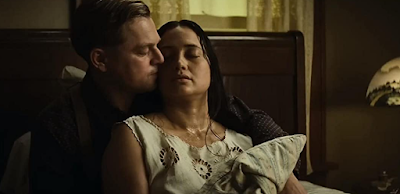
There’s a storm on the plains. Thunder and lightening rumble in the distance. Rain drops on the farmhouse in a steady drumbeat. The white man (Leonardo DiCaprio) goes to close a window. The indigenous woman (Lily Gladstone) stops him. The storm is powerful, she tells him. Give it your attention. It must be paid respect. And so they sit, she meditatively, he uncomfortably, as the rain falls. The sound fills the empty spaces in their awkward conversation, their fumbling flirtation. It’s a simple scene, and yet a key to understanding Martin Scorsese’s Killers of the Flower Moon. Here’s a movie about a metaphorical storm of violence and conspiracy and desire running through an Oklahoma community in the early 20th century. It gives us space to understand the conditions that created it, and the lasting consequences of it. The setting on the last bleeding vestiges of a wild west finds the moment when horses were traded for cars, fields for oil wells, and bartering for bank accounts. It’s a film about the transition, about beginnings and endings and who gets to lay claim to the land, and to the stories about it. Scorsese, always a director sharply interrogating human fallibility, fragility, and fearsome self-justification, here finds a moral righteousness driving underneath a knowing, provocative, and enveloping complexity. He finds the most staggering shifts of history sit squarely in the pressures of relationships and gestures.

It is a movie about real evil. It paints a damming portrait of the queasy intimate violence of greed and prejudice that built many a wealth in this country. It’s based a true story of an all-American evil—systematic murders in the early 20th century that chip away at the Osage tribe’s rights to Oklahoman oil money. We see a vibrant indigenous community living socially and economically intertwined with a rising white working class of maids and drivers and cooks and farmhands and bootleggers—and the wealthy white grifters rising to take advantage of them all. The wide frame, with ensembles in vintage attire and convincing locale looking for all the world like D.W. Griffith or John Ford had been building classical blocking in CinemaScope from day one, bustles with this activity of a society in flux. Notice how the scenes are full of Native Americans as the movie begins, and as it stretches on and on, the faces in the crowds are whiter and whiter. This time period finds freshly fading into the past the settlers’ mass exterminations and relocations of Native Americans in the poisoned name of Manifest Destiny. Now they’re in a stage of erasure as a more intimate kind—akin to domestic violence or terrorism. (No coincidence that the Klan has a big presence in the territory.) Here we see how a genocidal project can settle into a matter of encroachment. This is extermination by way of taking and taking and taking because it’s there and you want it and you can get away with it.

Scorsese locates deep-rooted pain of this history by making a sweeping movie that runs over three hours with a large cast and contains endless fascinating tributaries and details within its methodical momentum. He’s a filmmaker skilled with hard-charging historical panorama, sweeping scope in which he finds the up-close personal dynamics that drive the larger picture, whether with gangsters, financiers, filmmakers, priests, or Jesus. With Killers of the Flower Moon he situates, at the core, a real personal sense of betrayal. DiCaprio plays a World War I veteran returning stateside to work with his rich uncle (Robert De Niro). The older man is the one who suggests wooing Gladstone’s Osage woman. De Niro has never looked more sinister as an avuncular presence — loudly declaiming his support for the Osage, chummy condescension, while plotting their demise for the inheritance, and the insurance fraud. DiCaprio, for his part, has never let himself look more foolish, scrunching his face with the squint of half-comprehension, muttering and self-deceiving as he woos and eventually marries her and starts a family, without entirely understanding that his uncle hopes to murder the wife’s family to make sure their oil rights are passed to his. Does this husband love his wife more than money? The self-justification as he’s pulled deeper makes every tender moment with Gladstone all the more gripping and complicated and devastating. She plays the most multi-faceted role here, as a strong and observant woman who sees her friends and family die around her and yet is slow to implicate her own husband in her suffering. The stronger the love, the deeper the betrayal.

This is Scorsese at his best, as ever, with an ability to see a complicated world with clear-eyed understanding of its implications and resonances, and the supreme filmmaking skill to bring it to life in all its complexities. His emphatic camera moves and generous staging returns to his subjects of great moral complication and human nuance. His light touch with actors lets them get deeper, with richly textured performances and an easy rapport slipping easily between tenderness and toughness, dark laughs and darker depravity. It’s a story of crime and punishment, love and loss, ritual and art, religion and despair. The forward pull of its accumulating incident invites contemplation of the lingering effects of such tragedy. Here is history that’s not even a century old. We live with the after-effects. His telling overflows with memorable faces and enraging detail. He stages murders with vivid matter-of-fact brutality—a sudden pop, a splatter, a fall. He reveals culprits with a tilt of the camera or a quick, implicating cut. Because he draws out the humanity of its characters—lingering in uncomfortable grey areas with people making grave mistakes and planning, then taking, terrible action—it doesn’t allow us the comforting distance of historical perspective.

This picture has all the dimensions of historical horror, a potential for lurid melodrama held back by the restraint of cold, hard facts. It’s also a film that knows to explore the darkness that lurks in humanity, and the lengths to which people will go to build wealth and deny justice to their fellow man, is to explore its characters in all their dimensions. There’s immediacy to this discomfort. One of the darkest moments is an intimate domestic scene with a fire raging outside, their faces lit by flickering hellish orange through every window. Scorsese heightens the drama with this theatrical staging, and also looks close and sees them sweat. They’re only human, after all. We can’t safely put this in the past and feel better about our present enlightenment. The times may have changed, but the darkness remains. In the end, it’s about who gets to control the story, too. Whose narrative makes it to court, or the papers, or the True Crime retellings? Scorsese knows the importance of perspective, and the power of an image. Here is cinema put to powerful use, each formal flourish or patient development drawing fresh insight. Its final moments are moving and transformative in a way only cinema can accomplish. The film holds the audience in the middle of a storm and demands our patience as we pay it the attention it deserves. One leaves the theater still vibrating from its thunderous force.

Monday, October 16, 2023

Hits Different: TAYLOR SWIFT: THE ERAS TOUR

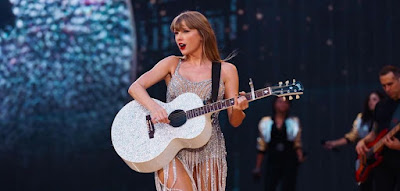
As if Taylor Swift wasn’t already a big deal, the Eras Tour further cemented her already secure place as one of the top pop acts of this century. Every stop on her concert brought out thousands of screaming fans lucky (or wealthy) enough to score a ticket. There they’d witness a lengthy whirlwind tour of each album in her career’s evolution—from her debut albums as a Fearless country teen to her bopping twenties Reputation and folksy early-thirties Evermore as global pop superstar. Putting it all in a row—in a pleasingly shaped achronolgical order with each album given its own set—and in such quantity—a breathless three-hour extravaganza with only the shortest of quick changes for breaks—throws in even greater relief the skill of her song-craft. Every pop star has hits. She has an oeuvre. There’s a consistency of vision across the evolving sound—recurring images, ideas, preoccupations, personality quirks, poetic turns, and stylistic tics. Her songs are at once joyful and melancholic, personal and universal, so specific and vivid that in speaking to experiences, real or imagined, she creates whole stories, whole emotional worlds, in just a few lines. At her best, we feel along with her all too well. As concertgoers experience 40 some songs spanning 17 years, the energy and excitement is a swirling mix of the awestruck and the intimate, the spectacle and the singular. She commands the stage alone with a guitar or piano as well or better than with fireworks and lightshows. Either way, there is one figure—no stretch to compare her to Dylan or Madonna at this point—who commands attention across generations, in every iteration, while remaining only herself.

If nothing else, Taylor Swift: The Eras Tour is a movie as a work of cultural preservation. A concert is ephemeral. Cinema feels like forever. For those who couldn’t find, or afford, tickets to the tour, and for current and future people wondering what the fuss was about, this movie preserves the experience. For those of us who want to relive the concert, it’s an effective, transporting reminder. It’s a loud, and bright, and relentless machine of a movie—the most efficient music delivery device on this scale since BeyoncĂ© played Coachella. It’s sheer pop pleasure. It also affords the best seat in the house, sitting in awe of her command of the stage, how the slightest gesture sets off ecstatic reactions for adoring fans. The camera’s constantly panning, spinning, tracking, appreciating. The editing can be percussive, chopping on the beat to the musical climaxes or restraining to capture a big flourish of stagecraft or stillness. The image is frequently moving in for close-ups and medium shots of Swift that celebrate and admire without leering at her statuesque stance, her ebullient back up dancers and singers, her strutting, flouncing confidently limited dance moves, and her wardrobe—from sparkly dresses and frilly coats to a snaky bodysuit. But the sound design—so clear and concussive—balances the crowd noise just enough to give you a taste of the size and scale of the experience as the background constellation of multicolor light-up bracelets rarely leaves the frame. A faithful capturing of the performance in all its detail is what’s valuable here.

As a work of filmmaking, it’s clear who the auteur is. It’s not director Sam Wrench, a veteran of simply and unobtrusively capturing live performance, having helmed concert specials for Brandi Carlile, BTS, Billie Eilish, and some episodes of American Idol. He may have gathered the slick footage, and assembled it far more professionally than the shaky amateur clips that dripped out over the summer. But the driving personality is clearly Swift herself. She’s a filmmaker in her own right—having taken the chair for her last several music videos and a pandemic-era performance of her Folklore album. Here she’s content to be the star, knowing that she has a show to put on that’ll satisfy even when the electric live element is removed. The moviemaking of The Eras Tour film bends to the force of the concert, with no stylistic flourishes, cinematographic personality, or contextual perspective of its own beyond bringing the live experience into the preservation of this form. I thought of a passage from the great French filmmaker Robert Bresson’s book Notes on the Cinematograph: “A film cannot be a stage show, because a stage show requires flesh-and-blood presence. But it can be…the photographic reproduction of a stage show. The photographic reproduction of a stage show is comparable to the photographic reproduction of a painting or of a sculpture…[They are] historical documents whose place is in the archives…” It’s not the same, but what a document! As the communal, flesh-and-blood presence of the concert dissipates, the archives will have this fun record.

Friday, October 6, 2023

Bedeviled: THE EXORCIST: BELIEVER

The reason why no sequel or spinoff of The Exorcist has managed to capture the deep, raw scares of the first is that William Friedkin’s original film of William Peter Blatty’s pulp religious fright novel is the only one that feels like it’s happening in something like the real world. Friedkin gives it the ominous undertones of religious epic—from its desert opening to the light-and-shadow gloom-and-doom of Catholic symbolism in priests cloaked in righteous doubt combating a puss-spewing demonic possession. Every film after it, despite being guided by such heavyweights as Deliverance’s John Boorman and First Reformed’s Paul Schrader and even Blatty himself, is about characters in an Exorcist movie. Moral tests and creepy-crawly imagery abound, but there’s always that guardrail sense that we’re seeing someone playing in a template. The best moments let the darkness crack through authentically—a real jangling jolt in the lives of tropes, when the likes of haunted priest Stellan Skarsgaard or Robert Mitchum or weary cop George C. Scott wield their immense melancholic charisma. But there’s also a lot of stomping around in the shadows waiting for the wiggly effects and loud clanging symbolism.

The latest attempt belongs to David Gordon Green, who was once a great maker of tender indie dramas and now balances raunchy comedy with studio horror. He was last seen making a trilogy of Halloween reboots that got somewhere interesting by the end. His The Exorcist: Believer is a basically proficient possession thriller. It has two 13-year-old girls go missing in the woods after school and, upon their return a few days later, they’re slowly revealed to be inhabited by evil spirits. Green does as well as anyone has with plumbing the basic concept for broad consideration of moral dilemmas, while transposing it for a modern world that’s somehow both more “spiritual,” broadly defined, and less religious, specifically. It means to move the ideas away from one particular denomination and more to a free-floating sense of good and evil. This gives the top-line talent—Leslie Odom, Jr and Jennifer Nettles as the father of one girl and the mother of the other, and Ann Dowd as a conflicted nurse with a troubled past — room to play with faith and doubt in the face of supernatural creepiness and jump scares. They sell the parental or faith-based pain with more investment than the formulaic plotting requires.

The fault, however, is that formula; it grinds the movie through the expected with little surprise other than a few predictable twists of the knife. (If you’ve seen one possession with croaking catchphrases and supernatural scarring, you’ve seen them all, apparently.) Worst is its pandering to the legacy sequel trend, bringing back the exceptional Ellen Burstyn, star of the original, to feature heavily in a handful of scenes that could be lifted out entirely and change the picture not at all. What a shame. Still, Green’s strong enough at marshaling the performances and mood, and the unsettled mystery of the early going is too potent to dissipate entirely. All that and some Tubular Bells had me just invested enough throughout, and willing to see if Green will come up with something more inventive and original next time. Although, I’m starting to suspect that, unlike the long running slasher franchises, The Exorcists might just spring from something too singular and serious and devilish to ever really sequalize like good, goofy genre heaven. Maybe we should cede that to Russell Crowe’s Pope’s Exorcist.

Monday, October 2, 2023

Love, Death & Robots: THE CREATOR

In a time of Hollywood spectacles that can conjure up incredible digital wizardry to populate all manner of fantasy worlds, it is dispiriting how often it feels like visual effects that can take us anywhere are so often used to take us to a generic nowhere. The same templates of gloopy magics and yawning vistas can be so indifferently framed and formulaically deployed that we might as well stay home and imagine for ourselves. Gareth Edwards films, however, are among the few of their blockbuster ilk suited to drop us into an invented world and almost immediately conjure a real sense of place and space. He shows us what it’s like to live there, placing his camera at a human level, letting it sweep back with a sense of proportionality with the elements in the frame. The people in his shots are dwarfed by the enormity and complexity of their lives interrupted by conflict on a fantastical scale. His scrappy indie debut Monsters and his American Godzilla alike let skyscraper-sized beings tower over his human figures to sell a sense of massive, threatening scale. Even his Star Wars spinoff Rogue One, a film of much-reported post-production compromise, has that visual element of believable dimension and size, never more than when an Imperial Walker or Death Star shakes the ground and blots out the sun. Here are movies that acknowledge the smallness of its human element as a way of not only heightening the believability and the danger of its sci-fi conceits, but to make the human spirit all the more indomitable in the face of it all.

And that’s what makes his latest, the totally involving widescreen stunner The Creator, such a fine work of speculative sci-fi action and thrill. It has ideas—a bit of pop jumble and genre play where imperious American military might is waging a war against third-world countries harboring banned Artificial Intelligence. And it has character—a wounded G.I. mourning his presumed-dead wife, holding out hope that one last mission might bring him back to her. And it has spectacle. Boy, does it have spectacle, wall-to-wall with the kind of visual effects that are so seamlessly convincing that I just completely bought into its every detail. It takes place in a future wherein artificial intelligence is embodied in humanoid robots that took the place of blue collar workers from factories to police forces. It was supposed to protect humans. For some reason that lead the machines to detonate a nuclear warhead in downtown Los Angeles. (Isn’t that always the way?) This kicks off the conflict we join in media res, with John David Washington’s grieving grunt reluctantly called into action to stop a top secret A.I. weapon from being unleashed by a rogue robotics expert who may or may not be related to his late wife (Gemma Chan). That human-sized sadness keeps the violent suspense sequences tied to something real that lets us believe the sci-fi trappings all the more.

Edwards makes propulsive proceedings in whirring and clacking military skulduggery of the hardest of hard sci-fi, a Vietnam-War-movie-inspired edge to heavily-armed squads helicoptering into humble rice paddies and Buddhist enclaves populated with robot refugees hiding from the omnipresent threat of American bombs. Into this grim quagmire drops a bundle of sentimentality—an adorable robot child who may be the one who can bring peace to this violent world. Edwards develops these ideas with a fine degree of complication, with characters torn between seeing A.I. creations as mere programming and those who say, even so, why must we be cruel? Villains Ralph Ineson and Alison Janney are perfectly nasty, brutal figures who want to kill at all costs. We see violent robots, but also ones who just want peace. Some have eerily emotive human eyes with whirring open gears behind their ears; others are blank-faced humanoid machines. Good thing they were all programmed to care. Washington’s a perfectly complicated figure, who slowly navigates the twists and turns until he settles on a feeling of moral righteousness. At every step along that way, the movie is so hard-charging and wide-eyed in detail that every walloping explosion and casually revealed tech enhances the absorbing world-design and the genuinely spectacular spectacle. And yet there’s that undertow of human soulfulness that finds these robots just might bring out the humanity in us—for worse, yes, but for better, too. This is genre filmmaking at a huge scale that for once lives up to its size and scope.