Showing posts with label Adam Sandler. Show all posts

Thursday, August 20, 2026

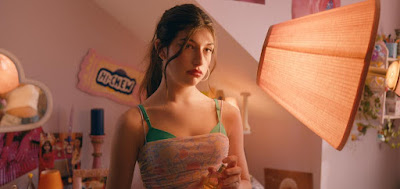
Girls Meet World: ROOMMATES
and DON'T SAY GOOD LUCK

Wordsworth said the child is the father of the man. Consider the case of Adam Sandler. His early movies were certainly childish. They were boyish goofs, crude, rude, and ultimately harmless. They could be fun, too! That at their laziest they grew to become excuses to hang out with buddies on the studio’s dime is just symptomatic of those adolescent impulses. But time marches on. He’s a dad of two grown daughters now. They’re both actresses and he’s used his clout to help get them started. I’m glad he did. They give nepo babies a good name, with screen personas that are winningly sensitive and open-hearted. The older, Sadie, has a slightly distant and deeper vein of irony she’ll play around with. The younger, Sunny, has a more closely-held tremulous innocence. They’re similar instruments playing slightly different notes in the same timber. Their movies also happen to be the most emotionally intelligent Sandler’s Happy Madison productions has made. Turns out these children helped remake the man. It’s clear he’s proud of his daughters, and it’s nice that he holds their screenplays to a higher standard than his own. He co-starred with them in the charming tween comedy You’re So Not Invited to My Bar Mitzvah and they co-starred with him in the shaggy belated Happy Gilmore 2. The parent-daughter material of each elevated the projects, taking the former to terrific and the latter to passable. This summer has each daughter starring in her own movie, each without her father in the cast. Sadie Sandler has college comedy Roommates. Sunny Sandler has high school drama Don’t Say Good Luck. Both films are from terrific indie directors and are fitted perfectly to their strengths. Each has a nicely textured balance between emotional honesty and well-earned laughs, though in different proportions. 

Roommates is an unusually thoughtful college comedy, getting something truthful about friendship struggles into the usual moves for such a picture. It has crude humor, raucous parties, bad behavior, and other expected hijinks. But it also has a sharp understanding of the subtle shifts of power and insecurity in the pressure cooker setting of a freshman dorm room. Sadie Sandler plays a shy girl who never really made friends in high school, pinning her hopes on meeting new people at college. Her roommate (Chloe East) is a confident loose cannon, who wears revealing clothes and boldly struts toward whatever, and whomever, she wants. Sandler is drawn toward her charisma, wanting to be friends, but also a little nervous about her unpredictability. The movie is directed with a bright studio comedy aesthetic married to a perceptive attentiveness to character dynamics. Filmmaker Chandler Levack, whose indies I Love Movies and Mile End Kicks are similar sweet-and-sour character comedies about particular cultural spaces (the video rental store and music journalism, respectively), brings her casually insightful eye to a glossier studio product. She gets really terrific performances out of the cast—both the collegiate pals and adult figures (Natasha Lyonne, Nick Kroll, Janeane Garofalo, Carol Kane). Sandler makes an intensely sympathetic figure; we see why she’d want to go along out of her comfort zone, but it makes each little heartbreak all the more impactful. But it’s East—you might recognize her as one of the trapped missionaries in Heretic or Sammy’s Christian girlfriend in The Fabelmans—who makes the most out of what a lesser comedy would make a mere whirling dervish of party girl energy. Instead she brings out a brittle fragility just barely hidden beneath the bravado. It’s something her impressed new roomie easily misses until it’s too late. The movie gets a little broad and silly at times—the finale and frame story are especially goofy—but it never loses that believable core. 

Although it’s ultimately a tearjerker of a drama, Don’t Say Good Luck has some traditional high school comedy moves. It has warmly funny theater kid supporting players, some wise supportive teachers, and a sweet sentimental family life to surround Sunny Sandler’s main character. She’s a teenager excited to get the lead role in her school musical production of Waitress and is prepping for a hectic practice schedule. And then her mom gets a potentially fatal diagnosis. The movie becomes a breezy movie of usual high school problems consistently undercut by jackknifing emotional intrusions. Sudden jabbing grief cuts deep into what should be quotidian teenage concerns, making every usual problem—crushes, homework, friend drama—both heightened by her emotional rawness and diminished in comparison to the literal life and death problems at home. It’s a potent mix, getting some laughs in amid the gut-punch dramatic moments. As the mother, Melanie Lynskey brings such a deep well of maternal energy channeled into a fluttering between fear for herself and care for her family. And it’s all the more moving for her underplaying the lines that a heavier hand would’ve turned mawkish. Similarly, the movie as a whole, benefits from a gentle lived-in look and tone. It’s not a simple movie of Brave Suffering or a mere march through realistic misery. It’s just charmingly real in a polished studio movie way, refreshingly honest about the rough edges and crosscurrent pressures of its believable situations. As the mother’s condition worsens and the show’s opening night grows closer, you can start to see the outlines of moving moments ahead. But when it steers hard into them, it pays off with a succession of lump-in-the-throat scenes that are deeply felt and honestly portrayed. (If you’re already aware the songs in Waitress are moving, just wait for the climactic deployment here.) Director Julia Hart (Stargirl) knows how to make a small-scale, big emotion, broadly appealing movie, and trusts her cast to pull it off with subtle, but no less devastating, impact. She knows it’ll feel good to have such a genuine cry. 

Wednesday, July 30, 2025

Par for the Course: HAPPY GILMORE 2

In 1996, Happy Gilmore told the story of a hockey player with anger issues who became an improbable golf star. Since then, we’re told at the start of Happy Gilmore 2, he won several more golf tournaments and had four kids with the love of his life. And it was all downhill from there. Now he’s a retired broke alcoholic single father who dreams of affording tuition for a fancy ballet school that’ll make his darling teen daughter’s dreams come true. The habit of legacy sequels ruining the lives of characters we last saw in a happy ending (think: Star Wars, Ghostbusters, Halloween, Indiana Jones…) can often seem a cruel way of resetting the stakes of a story. Giving Happy all this sadness gets the comedy plot rolling in a surprisingly low, reflective mood for all its insistent jocularity. It’s nonetheless predictable. If you think that his desperation will drive him back into a new lucrative golf tournament, you know the way these decades-late sequels go. What a difference three decades makes. 

The original movie was one of Adam Sandler’s first big hits, and is now something of a comedy classic, although at the time it was written off by critics as a louder, crasser, dumber brand of comedy. What arrived to some as a shock of the new is now a reflection of a style of moviemaking past. Time will do that. Yesterday’s young upstart is today’s old favorite. When big screen comedies are such a dying art that this surefire hit has been sent straight to streaming, it’s nice to see Sandler up to his reliable nonsense. His brand of salty and sweet comedy, more broad slapstick than clever wordplay, with shaggy plotting and cameos for his pals and a tendency to scream and flail and then smirkingly shrug into a sentimental finale, made early Sandler movies recognizably his own. Although in the middle of his career, they trended toward an excess of those qualities, some of his initial efforts have a neatly contained idea that reigns in his worst impulses. The sports’ movie structure Gilmore borrows and goofs on gives it a fine through line for its nonsense. And, against all odds, one could even care about this wacky character. 

The sequel, however, is definitely a latter day Sandler picture. It’s looser and shaggier than ever before, running nearly two hours with a meandering story lumbering from gag to gag. It has a pretty even hit-to-miss ratio. It can be amusing, but leans toward too much of not enough. It’s full of affection for its characters, tributes to late cast members and pals, and a love for Sandler’s wife and daughters, who get substantial roles. Some of Sandler’s comedies of late have successfully used that love of family to make warmer, sweeter movies in which he gets to play the charming dad, like in the crowded wedding comedy The Week Of or colorful teen comedy You Are So Not Invited to My Bat Mitzvah. To return to Happy Gilmore is to find a blending of his two modes, the earlier scrappy underdog eccentrics with wild crude set-pieces, grotesque supporting players, and wacky running gags, now with the lovable everyman father figure at the center. That’s what makes it so long and generously portioned. It has an enormous ensemble cast and lots of silly putting around. There's more than enough of everything. If you like famous people playing themselves, or a loopy caddy played by Bad Bunny (admittedly a highlight), or a mean waiter played by Travis Kelce, or a heckler played by Eminem, or an endless parade of Sandler regulars and SNL alum you’re going to get so, so much of it. No joke goes unrepeated. No opportunity for a flashback to the first movie is avoided. No old friend’s superfluous scene is cut out. Sandler is an affectionate Movie Star. He knows at this point that his fans just want to hang out with something familiar and here he serves it up over and over and over. 

Wednesday, September 6, 2023

Teen Time: BOTTOMS and YOU ARE SO NOT INVITED TO MY BAT MITZVAH

The crude, snarky R-rated teen comedy Bottoms has ideas gesturing toward the concept of funny without ever really getting there. It’s the sophomore effort for writer-director Emma Seligman, whose anxiously amusing Shiva Baby was one of the better debuts in recent memory. That movie, a nerve-pinching stress-laugh comedy of manners, was a fine star turn for young comedian Rachel Sennott and a cast of character actors stuck in the most awkward funeral reception imaginable—or at least since Neil LaBute remade Death at a Funeral. Seligman is a talented writer of filthy sharp-tongued barbs and a capable director of cringing exchanges. Her latest does well to continue developing her reputation as a filmmaker with a distinctive voice. But there’s small delight to find Bottoms is the kind of unsuccessful movie only a talented filmmaker could cobble together. It’s an excessive, exaggerated goof on the usual oversexed heteronormative teen comedy. The leads, played by Sennott and The Bear’s Ayo Edebiri, are the typical awkwardly virginal dork protagonists this sort of picture often brings, but this time they’re lesbians. That gives a slightly fresh—albeit hardly original—spin to the expect flop-sweat antics as they try to get the hot popular girls’ attention. The duo is funny enough in their slack, improvisational dirtiness and all-elbows casual-insult friendship to carry a lot of silliness. Their school, though, is a bloodthirsty hyper-masculine football cult—complete with a phallic mascot and double entendres on every flyer. The team prowls around school like a wolf pack, intimidating and blustering with bullying thin-skinned toxicity. And so it makes perfect sense in that permissive environment that the leads’ irresponsible teacher (Marshawn Lynch) would allow them to start a school-sanctioned all-girls Fight Club. Sure, that might get some of the hot cliques’ attention. But if you wonder if that’d lead to a Project Mayhem-style conclusion—well, an exploding van would let you know the answer well before a climactic bloodbath on the football field. The characters all stand perpendicularly to reality in a place that’s parallel to ours—an amped-up nonsense world of sex and profanity and violence that sails beyond the usual excesses of the genre into a nowhere land. It’s not exactly a satire of its form; nor does it have any clear thematic concerns beyond goofing around with how far it can push and pull different tropes into its bloody aims. I’m sure one could make a sharp point juxtaposing casually normalized sexualized youth with crowds willing to shrug off bloody teenagers—the movie dances around topical concerns before settling on vague nothings—but Bottoms is more interested in coarse insults, cynically casual outrages, and the sort of half-baked world-building that leaves something real and interesting—and funny!—stranded in an unconvincing simulacrum of a teen comedy.

Much more to my teen comedy liking is You Are So Not Invited to My Bat Mitzvah. It’s cute and clever, as its broadness and obviousness and good humor are hammered home in comforting style like a pleasing pop song over a sitcom montage. But the emotions in it are deep and true and resonate, too. The movie is a totally charming work of comic empathy with high emotional stakes and small family dramedy. It’s also, maybe first and foremost, a love letter from Adam Sandler to his daughters, who here play his character’s daughters. There’s something genuinely moving about how much this picture plays off of Sandler’s love for his family. He takes a supporting role, while his younger daughter, Sunny, plays an awkward middle-schooler navigating the world of quarreling besties, dreamy boys, and mortifying menstruation. All this and a looming Bat Mitzvah, too? What’s a girl to do? The movie comes on like a modern-day Are You There, God? It’s Me, Margaret updated for the Snapchat and TikTok generation. It’s not nearly as annoying as that might sound. There’s some earnest tangling with ideas of young womanhood and religious awareness, as well as the requisite dramas of junior high social strife. The movie is juvenile enough to bubble over with the giddy, all-consuming importance of these milestones and mishaps alike, but wise enough to step back with a sense of perspective and proportion. That’s the fine double act of having both the adorable, high-energy commitment of the 14-year-old Sandler playing the adolescent drama, yearning, and confusion at full tilt, while the elder statesman Sandler (having aged into the most lovably paternal form of his screen persona) does his most shaggily charming wise-acre father act cutting the tension and wryly dropping in punchlines with ease. The movie’s colorful high-gloss look and generous ensemble of funny familiar faces adds to the comforting sitcom style, while its widescreen sheen and pounding pop music soundtrack gives it enough silver screen oomph to make every outsized emotion fill the space. It swoons and spurns and embraces and learns right along with its lead, and smiles knowingly at how these emotions are so big only because they’re all new to her. All this it accomplishes with a fine teen comedy flair, with the best Sandler mix of knowing irreverence tied to deep sentimental commitment. This is easily one of his most appealing films, and one of the most delightful teen comedies to come along in a long time.

Saturday, May 28, 2016

Nope: THE DO-OVER


Has a movie star ever done less on screen than Sandler in any of his recent lackadaisical performances where he’s little more than a black hole of energy and appeal? Maybe, even after years of scraping near the bottom of the barrel with the dire likes of Grown Ups 2 and Blended, it was combined impact of the relative box office disappointment of his hard-R, but twisted funny, That’s My Boy in 2012 and the bad luck to stretch dramatic chops in two total flops, 2014’s Men Women & Children and 2015’s The Cobbler, that pushed him to do less than the bare minimum. Since then he’s slept through an action comedy (Pixels) and a western parody (The Ridiculous 6), each worse than the last. And each time around he fades under the spotlight, committing less and less to silly voices or high-concept goofiness. He lets the supporting players and desperate flop-sweat gross out gags do the heavy lifting while he appears to look forward to the next time the director calls cut so he can get on with his life.

I dutifully fired up Netflix to sample The Do-Over, the streaming service’s second film from a four-picture deal with Sandler. (Creatively it’s their worst original programming move, but since they keep the numbers secret there’s no telling if it pays off financially.) I quickly found that any attempt to write about it would be putting more thought and effort into it than anyone involved did. The story concerns two unlucky dopes (Sandler, sleepwalking, and David Spade, playing against type as a timid dummy instead of a sarcastic dummy) who fake their deaths to escape their miserable lives only to discover the plan goes awry when they end up in a conspiracy involving cancer drugs. If you think it sounds a bit more complicated than the typical Sandler material, you’d be mistaken. It’s a collection of dumb complications, sloppily plotted, lazily performed, and shot with all the flat visual interest of a stock photo with the watermark still attached. What would be worse: if Sandler has stopped trying, or if this is really the best he can do?

Why does it exist? Is it for the product placement, logos for cell phones and beers and others in a parade of brands prominently displayed? Is it to get attractive women, extras and featured performers (like Paula Patton) alike, in tight dresses, low-cut shirts, and bikinis? Is it to get Netflix to bankroll a trip? Long scenes take place on a tropical island, or in swimming pools, so it’s also another of his paid vacations with a little bit of a film shoot on the side. He’s brought along a host of his usual pals in front of the camera (Spade, Nick Swardson) and behind the scenes (director Steven Brill, veteran of Little Nicky and Mr. Deeds, lackluster comedies that seem better in retrospect compared to this).  It’s such a flaccid, baggy, boring movie, working in cameos for all sorts of people I just felt sorry for, like Kathryn Hahn, Sean Astin, Michael Chiklis, and Matt Walsh. I felt worst for the great character actor Luis Guzmán, who has an embarrassing scene involving sweaty testicles, one of many desperate R-rated jokes fruitlessly attempting to yank some life into this dud.

And then if you happen to take the story seriously for even one second, the whole thing is even worse than the lack of laughs and narrative or visual interest. It’s wrapped in toxic masculinity’s misogynistic expression, blaming the characters’ misfortunes entirely on women who exclusively wish to torment, tease, trick, and otherwise torture the men in their lives. It ends with Spade repeatedly punching a woman in the stomach while shouting, “I’m sick of women lying to me!” The whole thing’s nothing you couldn’t get if you asked a dozen of the worst commenters on a shady website to write a screenplay about how much they feel wronged by women. If out of perverse curiosity you end up watching this movie you have my condolences. To review Sandler films is too often an exercise in finding rock bottom move ever lower.

Friday, December 11, 2015

High Buffoon: THE RIDICULOUS 6


I can’t imagine The Ridiculous 6 will exist in the public imagination as much more than the response to a slew of trivia questions. It’s the answer to: What was Adam Sandler’s first direct-to-Netflix feature? What 2015 comedy had some of its Native American extras walk off the set in protest? What movie featured David Spade as General Custer, Vanilla Ice as Mark Twain, Blake Shelton as Wyatt Earp, and Dan Patrick as Abraham Lincoln? As you can see, the bar isn’t set too high for this Western riff starring and co-written by Adam Sandler, who continues his attempts to make comedies with as few jokes as possible. It’s part of a peculiar pattern in which a passable Adam Sandler comedy (like the nasty, gross, and more funny than not That’s My Boy) does worse at the box office than his movies that are lazy (Grown Ups 2) or lethargically offensive (Blended). At least with Netflix keeping a tight lid on their viewing numbers, it’ll be hard to say how much audiences respond to an irritatingly insensitive movie that’s mostly lukewarm Western tropes pushed a few inches further into silliness.

The plot is awfully simple. (If you think, “the better to hang a bunch of jokes on,” you’ll be sadly mistaken.) Sandler plays White Knife, a white boy raised by an Apache tribe after his mother died. He discovers his long lost father (Nick Nolte) only to find that the old man has run afoul of a mean band of bandits (led by Danny Trejo). In order to save his dad, he wanders around rounding up a Ridiculous posse of his six freshly-discovered half-brothers, the joke being that pop slept with such a variety of women in the Wild West that he’s the biological father of a diverse group of men including Terry Crews, Taylor Lautner, Rob Schneider, Jorge Garcia, and Luke Wilson. They get into arguments and confrontations in all manner of typical Western locales involving a whole bunch of actors (Harvey Keitel, Steve Zahn, Will Forte, John Turturro, and more) who must’ve decided they’d like a Netflix paycheck. No one on screen seems to care, projecting a low-energy void of interest in every direction.

Stretching out to two hours in length, the movie putters around saloons and High Noons, prairies and campfires, hangings and shootouts. Once in a while there’s a funny joke – an Apache chief says, “Sometimes the white man speaks the truth. Like one in 20, 25 times” – but mostly there’s dead air, or attempts to wring humor out of mental disabilities, musty racial stereotypes, and anatomical references (and fluids of every kind). It’s the sort of movie where Sandler’s attractive Native fiancé (Julia Jones) is named “Smokin’ Fox,” a tone-deaf, cringe-worthy hat-trick of objectification, appropriation, and ignorance. Sandler with co-writer Tim Herlihy (in their eleventh collaboration) could’ve straight-up parodied Westerns (the title clearly looks back to The Magnificent Seven and forward to The Hateful Eight) loading the frame with ZAZ-like anything-goes goofs Airplane! style. (Somehow I doubt Blazing Saddles social satire was ever within their reach.) Instead they often play things relatively straight, hoping peculiar casting, oddball characters with prominent physical traits (buck teeth, false eyes, etcetera), and disgusting gags (like decapitation or defecation) will elevate a subpar script into something funny.

It’s not actively repulsive, but the jokes aren’t there and the pace is beyond belabored. At least director Frank Coraci (who previously directed the star in Blended, Click, The Waterboy, and The Wedding Singer) provides filmmaking of a marginally less lazy type than usual Sandler fare, though not as smooth and fast as Chris Columbus did last summer with the better, but still mediocre, Pixels. More interested in looking like a Western than having good jokes, Ridiculous 6 hired cinematographer Dean Semler, whose work on the likes of Dances with Wolves and Young Guns certainly informs his widescreen landscapes here. It looks and moves like a real movie, which is faint praise, but when you’re comparing it to the inert overlit blandness of something like Grown Ups 2, it’s worth pointing out. But reasonably pleasant framing doesn’t alleviate the desert of humor so dry and slow tumbleweeds roll through with greater regularity than laughter. It's depressing and endless.

Saturday, September 26, 2015

Monster Cash (Grab): HOTEL TRANSYLVANIA 2


Hotel Transylvania 2 is the sort of movie that’ll satisfy some in the audience some of the time, but will satisfy no one all the time. It’s one of those cheerlessly and mercenarily divided family films where the jokes for parents and the jokes for their kids are completely separate. We get a joke about a butt, then a throwaway gag referencing childproofing. We get a joke about new parents needing alone time, then a joke about a zombie falling off a cliff. It’s broad in both cases, reaching for easy jokes and lazily winding its way down a set of obvious stereotypes. In its cartoony way it at least proves it’s willing to pander to everyone equally. But when I see Genndy Tartakovsky’s name in the credits, and think back to the great cartoons he’s been involved with – Dexter’s Laboratory, The Powerpuff Girls, Samurai Jack, Star Wars: Clone Wars – it’s hard not to wish this monster mash was more. This movie somehow doesn’t allow him the room to show off his visual pop, expressive action imagery, and effective all-ages plotting. It is dull, repetitive, and infantilizing.

It’s all too slack and aimless, the talented computer animators at Sony Animation finding nothing new to say in a world already fairly exhausted of potential last time. It picks up where the first Hotel Transylvania ended, with the cute vampire girl (Selena Gomez) having fallen in love with a dopey human boy (Andy Samberg) while her protective father (Adam Sandler) grew to be okay with it. Except he’s still harboring anti-human sentiments that doesn’t go away during the opening wedding, or through a few time jumps that bring him a grandson (Asher Blinkoff). See, the little kid with his big doe eyes and curly red hair is just too human for his grandpa’s (vam-pa’s) liking. Why, if the kid doesn’t sprout his fangs by his fifth birthday, he might be totally human. The vampa would be sad not to have his vampire genes passed on, but worse the kid might have to go live in the human world instead of a soft slapstick monster hotel. What’s a grandpa to do?

The screenplay by Sandler and Robert Smigel uses the monster/human tension to stage a too-cutesy metaphor for prejudice of all kinds. The boy’s parents will be okay letting their son be whoever he was born to be, but grandpa’s slow on the uptake. He conspires to sneak the kid out on a road trip with Frankenstein (Kevin James), The Mummy (Keegan-Michael Key), The Invisible Man (David Spade), The Wolfman (Steve Buscemi), and a gelatinous green blob. They go through the countryside showing the boy how much fun it is to be a monster, but because they’re all buffoons they actually show how irresponsible and soft they’ve become. A stop at a vampire camp is a weird crotchety skewering of overprotective parenting. Are we supposed to be on the monsters’ side when they scoff at sweet campfire songs and roll their eyes at a condemned tower the campers aren’t allowed to play on? Seems fine to me. Later, after the monsters collapse said tower and set the camp on fire, the counselor accuses them of child endangerment. Uh. Yeah.

All of this is in service of an obvious message to respect others’ differences and accept people’s identities no matter what. They were born this way. It’s a nice moral, and I guess there’s enough zipping around and potty humor to hold kids’ attention. But it’s both too adult and too childish, unable to find a good middle ground between limp slapstick shenanigans, loose sight gags, loud pop music, mild riffs on monster iconography, and what the MPAA might call “thematic material.” By the time Mel Brooks shows up as great vampa Vlad, wheezing in his recognizable exaggerated old man voice (which has only grown more authentic as the years pass) it’s clearly a movie haphazardly aiming at too many demographics to work. It’s just an uninspired attempt to milk more cash out of a hit. How else to explain the prominently displayed Sony brand cell phones the characters use? It’s not every day you see an animated movie with product placement.

Saturday, July 25, 2015

Space Invaders: PIXELS


Eighties nostalgia is weaponized in Pixels, a light sci-fi comedy that sees unknown aliens send giant arcade games to invade the earth. Why? Apparently they picked up some thirty-year-old signals and they took it as a threat. The attacks start with an enormous Galaga game raining destruction on an Air Force base in Guam, reducing everything in sight to glowing piles of multicolored blocks. It’s clearly a crisis for bumbling President Kevin James, who was once just a kid in an arcade cheering on his good buddies in their quest to be champion gamers. Now he’s a buffoon no one likes, with plummeting approval ratings. How he got to be president in the first place is anyone’s guess. And now there are these aliens threatening to destroy the planet. What follows is a nonsense adventure out to flatter every nerd in the audience for merely recognizing the references.

James recruits a goofy and improbable ensemble to fight back the aliens in elaborate large-scale replications of classic games. He finds his old arcade pals – now an AV technician (Adam Sandler), a conspiracy nut (Josh Gad), and a prisoner (Peter Dinklage, looking like Billy Mitchell) – and forces them to train Marines in video game strategy. The gruff general (Brian Cox) is hopelessly confused, but reluctantly lets a lieutenant (Michelle Monaghan) get special tech prepared surprisingly quickly. Soon the dweebs and the military have giant phallic laser guns blasting away at Space Invaders, Centipede, and the like as aliens demand three contests, winner takes planet. If you already find yourself asking questions like, “How?” or “Why?” or “Who cares?” this is not your movie.

The nerds, we’re told repeatedly, are the only ones who know how to play the games, and therefore the world’s only hope. This seems to me a misunderstanding of video games’ popularity. You’d think a group of Marines would know a thing or two about joystick-eye coordination, and could grasp the basic strategy of these old games, especially since it boils down in practice to shooting at large glowing objects. Plus, it sets up a dated nerds-rule/jocks-drool underdog fight that doesn’t make sense in our world of unfortunately male-dominated Silicon Valley and other bro-ish tech enclaves where the simple power categories of dorks and sports have scrambled. But I suppose this isn’t exactly the movie to go looking for logic or coherence. It doesn’t even bother to show us the aliens behind the DayGlo lightshow attacks, expecting us to enjoy the sight of it all while chuckling at its cast’s antics and not thinking about it too much.

The movie’s idea of nerds is as old as the games they’re fighting. But the action is rather well done, like a lighthearted riff on a Transformers plot structure in which incomprehensible extraterrestrial conflict tears through some major cities and their landmarks. I enjoyed seeing the vibrant geometric shapes colliding with earthbound obstacles. At least it is action different from what we usually see, collateral damage chaos smashing apart solid matter into bits of glowing blocks. There’s some charm to seeing a towering Pac-Man chomping through a maze of New York City streets, or cavernous red alien scaffolding arranging itself into a King Kong-sized Donkey Kong setup. But it goes on and on without feelings of real danger, and the characters just aren’t funny or interesting enough to earn our investment.

Remaking a French short film by Patrick Jean, writers Tim Herlihy and Timothy Dowling (frequent Sandler collaborators) create podgy connective tissue for silly spectacle in the form of limp childish comedy and halfhearted relationships. The jokes largely fall flat, without a sharp sense of perspective or humor. We’re supposed to care if these guys earn validation despite learning little more than that they’re good at thirty-year-old video games. And it’s yet another movie where goofy guys stumble their way to greatness while patient women stand next to the fun, scowling or smirking. This one goes the extra mile, casting people like Jane Krakowski, Ashley Benson, and Serena Williams (!) to show up in a few scenes and smile, like prizes to be won or symbols to be displayed. Playing into pessimistic nerd culture inferiority and resentment, the movie sets itself up as wish-fulfillment for people who wish playing arcade games could be enough to 1.) earn a living, 2.) make you an important public figure, and 3.) get you ladies to objectify.

So the human stakes are unconvincing and vaguely insulting. But at least the zippy adventure moments largely work. It’s not an altogether unpleasant experience, which most definitely cannot be said for most Sandler comedies of late. The director here is Chris Columbus, whose work on the first two Harry Potter films shows his facility with bouncy effects work and convincing design. He has a competent eye for faux-Spielberg awe and workmanlike entertainment, and proves once more that, when given a director instead of an enabler, Sandler is a decent everyman. As a schlub shooting 8-bit aliens, we can almost believe it. The problem is only when he stands next to painfully wisecracking sidekicks, or when we’re asked to care if he gets to woo the lady in uniform, win over her moppet, and get the respect of the world. When the movie’s in motion, it goes down easily. But then it stops, and there’s that hollow aftertaste.

Wednesday, October 22, 2014

Tech-ed Off: MEN, WOMEN & CHILDREN


It’s easy to see Jason Reitman’s ambition for Men, Women & Children to be a big statement about How We Live Now. The film is a Very Serious ensemble drama about a cross-section of characters living intertwined melodramas a la Crash or Babel. In this case they’re a bunch of high schoolers and their parents in suburban Texas – though really a vague Modern Anytown, USA – who live disconnected from their feelings and each other. We see lives of quiet desperation mediated by screens showing digital spaces that alternately soothe and exacerbate their problems. Fair enough, but despite fitfully operating as effective drama, it’s clearly a movie built thesis statement backwards into character and incident, frozen by its own sense of importance. Worse, there’s not much to its thesis, which is as muddled as it is trite, developing its emptiness with a heavy hand.

I suppose muddled moralizing speaks, even accidentally, to our societal ambivalence towards technology. It’d be an interesting idea around which to build a drama, but Reitman, adapting with Erin Cressida Wilson a novel by Chad Kultgen, creates a series of events that reflect bland reprimand, concerned handwringing, or vacuous same-as-it-ever-was resignation, sometimes all at once. Caught halfway between scolding and shrugging, it has a view of the Internet that feels so outdated and incomplete I almost expected to hear a modem dial up on the soundtrack. Plot threads involve infidelities, romances, repression, self-harm, painful yearning, and a variety of questionable decisions. Each is filtered through and aided by the Internet. That’s what gives it a patina of timeliness around which it spins rather empty, cliché stories saved only fitfully by strong acting across the board.

The best plotline, perhaps because it draws best on the small character work Reitman did well in better movies like Juno and Young Adult, involves two high school kids dealing with emotional issues. She (Kaitlyn Dever, of Short Term 12 and ABC’s Last Man Standing) is a loner, bookish, sweet, and under the surveillance of a technophobe mother (Jennifer Garner). He (Ansel Elgort, of The Fault in Our Stars) is a football player who quit the team when his mom left the family, leaving his dad (Dean Norris) inattentive to his son’s depression. The kids forge a connection that feels genuine, and twists around the tech in a reasonably convincing way. Other stories aren’t as successful. A bored married couple (Rosemarie DeWitt and Adam Sandler) each secretly turn to the web to find affairs, a plotline that’s a weird blend of shame and forgiveness and, unfortunately, does not turn into a “Piña Colada Song” situation. Their son (Travis Tope) is addicted to porn. His real-life crush is a fame-hungry cheerleader (Olivia Crocicchia) whose mother (Judy Greer) lets her start a modeling website. Meanwhile, a fellow cheerleader (Elena Kampouris) suffers from body image problems brought about by bullying and egged on by online friends.

With a sprawling Message Movie format, there is unevenness built into the structure. Individual stories or scenes work well, but the big picture is a muddle of good intentions, flawed observations, and bad decisions. It’s all tied together with arch narration (by Emma Thompson, speaking in a voice not too far from her Stranger Than Fiction storyteller) that prattles on against the backdrop of space, speaking about Carl Sagan as NASA hardware floats by. Then she’ll dip down with an edit into quotidian explanations about character thoughts and actions, drolly telling us details we can plainly see before us. Reitman’s repetitive screenplay includes heavy-handed, awkwardly inserted, digressions reflecting on 9/11 and “my, how much the world has changed.” Yes. And? It’s a dash of self-serious muttering.

The film’s worst tendencies are reflected in Garner’s character, who has a keystroke logger on her daughter’s devices and hosts fearmongering info sessions for fellow parents. She starts as a humorless paranoid scold who means well. Over the course of her storyline, she goes from spying on everything her daughter does to stopping cold turkey. In the world of this movie, it’s all or nothing, ignoring both the very real benefits of parental oversight and the virtues of trust and flexibility. It’s too uncomfortable lingering in grey areas, too eager to wrap up conflicts. So much so that for all its overt exploring of the screen-saturated culture’s impact on individuals – I liked a recurring image of crowds, everyone looking at screens, their apps hovering translucently above them like a cloud of distraction – the worst events any characters go through happen entirely (or almost entirely) offline.

The movie seems to want a Big Statement, but isn’t sure what to say. In some ways it’s progressive, acknowledging that sometimes lonely, socially isolated people can find solace online that can improve their real world well being. And it’s certainly true that one can get lost in the muck of the web’s worst tendencies. Our world is complex. But every story in this movie that resolves wraps up neatly with a pat Internet-good-for-this, Internet-bad-for-that judgment. Other storylines drop off without resolution, maybe for the best, since I don’t think the filmmakers, though they bring the subjects up, had meaningful discussion of body image, sexual fantasies, or sex work in them. What’s here is an attempt to pass off well-intentioned fumbling in the shallow end as an important deep dive.

Thursday, October 4, 2012

Monster Mush: HOTEL TRANSYLVANIA


You might not know it based only on the evidence of Hotel Transylvania, but Genndy Tartakovsky is one of the best animators of his generation. People around my age, especially, will recognize his powerful influence over his field if I mention the titles Dexter’s Laboratory, Powerpuff Girls, and Samurai Jack, three popular and influential animated series he directed for Cartoon Network in the 90s and early 00s. Characterized by fast, expressive movements and crisp, clean, caricatured figures moving through bold, colorful landscapes, these 2D, largely hand-drawn, shows play like they spring fully formed from a consistent, energetic vision.

But now, to the film at hand: Tartakovsky’s feature film debut. It’s a three-dimensional computer animated comedy about Dracula not wanting his daughter Mavis to leave the monster hotel he built to keep her away from dangerous humans. It’s clear that something went wrong during the making of Hotel Transylvania. You can tell by the gorgeous watercolor concept art that serves as a backdrop for the end credits. There’s certainly nothing that entrancingly good-looking in the film itself, a bland overly-familiar CGI animation effort that feels colorful and plastic in predictable patterns, where wacky character design looks like nothing more than a basket of McDonald’s toys. I like how broadly caricatured famous monsters like the mummy and Frankenstein look here, but they’re really only good for a sight gag or two before growing boring. Gone are Tartakovsky’s instantly recognizable drawings, subsumed in a cookie-cutter computer environment, his bold expressive 2D style ironically flattened out and homogenized in 3D.

The more-or-less one-joke plot (attributed to five writers) is as follows. A human wanders into Hotel Transylvania (a huge Scooby-Doo­-style castle) and catches the eye of Mavis, so Dracula tries in vain to keep the human away from the castle in order to protect his daughter from falling in love and to maintain his business model, which is built upon assuring the guests, monsters all, that humans are A.) universally dangerous and B.) never to be found on the grounds. The plot has thinning issues, growing less complicated as it goes along, settling far too easily into predictable grooves of narrative along paths that have been well trod. Stranger still are the moments when it eschews predictability to ill effect. Why not play around with the received pop-culture assumptions about these famous monsters? Why not go out on a rousing cover of “The Monster Mash?”

Voices heard here are grating, frenzied explosions of mismatched celebrity voices. As Dracula, Adam Sandler commits to one of his infamous grating accents, this time around a broad, sloppy Bela Lugosi vant-to-suck-your-blud style of loud mumbling. On the other end of the spectrum is Selena Gomez as daughter Mavis, who seems to have perhaps literally phoned in her lines in her normal speaking voice. The human who gets mixed up in door-slamming, pay-no-attention-to-the-guy-who’s-clearly-not-a-monster shenanigans is Andy Samberg who does a broad SoCal drawl. Elsewhere, cartoony monsters can be heard speaking like Steve Buscemi, CeeLo, Kevin James, Molly Shannon, Fran Drescher, David Spade, and Jon Lovitz. Weird, huh? Distracting too.

Hotel Transylvania is a movie both manic and sleepy, racing through turbocharged sub-Looney Tunes concepts so quickly and constantly that none of the gags have time to land, assuming they ever could have done so. I don’t know. When I see Frankenstein detach his legs and walk them behind the mummy to unleash a stinky blast of flatulence that is then sucked up by a witch with a bellows who then proceeds to use it to stoke a fire, I’m just not amused. Maybe that means I wasn’t on the right wavelength for this picture, but I tried. I really did. I like fast and silly, but this movie’s so much of both that it skips off the tracks and lands with a disappointing thud on the same old tracks we’ve been down hundreds of times before. Gee, parents and kids should better understand each other. People should not be hated for being different. It’s all wacky jokes, pleasant enough, but not too funny, in service of all the usual morals. That’s fine as far as that goes, but if you don’t have anything new to say, at least you could say it in an entertaining way.

Sunday, June 17, 2012

Bad Boys: THAT'S MY BOY


That’s My Boy, a new R-rated Adam Sandler vehicle, is an awful movie. But, when I sat there and watched it, I laughed. Sometimes I cringed, sure, and other times I gaped with something approaching admiration at the gleeful way the bar is consistently lowered, but I left the theater feeling something like satisfied. I can’t recommend this movie. I’m not even sure I want to defend it in any way. But I laughed and it is my duty to report that reaction. After all, as Roger Ebert once said, “If I laugh, I have to tell you it’s funny. I went to see Jackass, a shameful movie. I laughed all the way through it. I mean, I have to tell you that.”

I found That’s My Boy to be a movie so exuberantly vulgar, so excessively coarse and gross-out goofy that I could almost imagine the Farrelly brothers finding it a bit over the top. (It probably has more on-screen uses for bodily fluids than any comedy since their own There’s Something About Mary.) It’s all predicated on an off-putting inciting incident and then goes on to include a couple of twists that are just about as bad. And all through it, Sandler is doing one of his patented (and usually grating) braying-accent arrested-adolescent shticks. I usually don’t like Adam Sandler movies, but after such career nadirs as Grown Ups and Jack and Jill, truly awful movies following nearly two decades of awful movies, even a mild improvement feels pretty good. What can I say? This time around I found it funny, although not at first.

The whole thing starts in the mid-80’s when a teacher (Eva Amurri Martino) has an affair with a student (Justin Weaver) – a teenager named Donny who grows up to be Adam Sandler. It’s not every day a comedy starts off with some casually presented statutory rape, but there you have it. I wasn’t laughing yet, that’s for sure. It’s uncomfortable to say the least, especially when the teacher is shipped off to prison pregnant and the eventual baby is left in the custody of the kid and his deadbeat dad. Luckily we cut ahead over twenty-five years later so we don’t have deal with the whole immediate implications of this scenario, skipping through an opening credits montage that spoofs the culture’s gendered double standard about this sort of scandal. Donny gains immediate fame through the talk show circuit – Arsenio and Letterman – as well as selling the rights to his life story for a TV movie, but soon enough his fame has dried up and he’s no better off than his fellow has-been pal Vanilla Ice (as an exaggerated buffoonish version of himself).

When the movie proper picks up, Donny, a drunken mess of perpetual boorishness, has just learned that he owes $40,000 to the IRS since he hasn’t paid taxes since 1994. He’ll go to prison unless he pays off the debt by Tuesday. Stewing at his usual table at his favorite (but dilapidated) strip club, he notices the wedding section of the New York Times where who should he see but his estranged son (Andy Samberg). He’s now a rising hedge fund manager marrying a pretty young woman (Leighton Meester) from a wealthy family. In fact, the whole wedding party – the bride’s parents (Blake Clark and Meagen Fay), grandmother (Peggy Stewart) and soldier brother (Milo Ventimiglia), the groom’s boss (Tony Orlando), and some straight-laced co-workers (Will Forte, Rachel Dratch) – is staying in a mansion on the coast of Massachusetts for the ceremony this very weekend. Donny, in a desperate attempt to raise the necessary funds, convinces a tabloid TV show to meet him at the prison and stage a reunion between teacher, student, and son and sets off to trick his son into this plan, but soon finds he’s having a pretty good time just being reunited.

So Donny bumbles his way into the wedding party and throws everybody for a loop. It’s like The Hangover crash-landed into the middle of Meet the Parents. Director Sean Anders (writer of the so-so Hot Tub Time Machine) and writer David Caspe (who works for the sit-com Happy Endings) haven’t exactly made a comedy of errors. This is a comedy of sexual dysfunction, of non-stop profanity and raunchiness, of panicked social anxiety and endlessly protracted embarrassment. But rather than mere juvenile tittering and strange squeamishness of usual Sandler fare, this is an enthusiastically rude embrace of base instincts and bad behavior. The straight-arrow son running from his irresponsible father is drawn back into his web of debauchery and is shocked to find how much fun it can be, especially when so many of the wedding guests seem so charmed by his coarseness and party-animal antics. And, sure, father and son have a lot of learning to do from each other, learning to live a full life and yada yada (it’s basically an inverted Big Daddy without the moral), but the level of manic depravity on display here is truly staggering. And I laughed a lot.

This is no typical Sandler movie, which are usually somewhere between a PG and a PG-13, lightly vulgar, cheap, sentimental efforts with plenty of saccharine uplift and a safer-than-not gross-out sensibility. This movie puts the hard-R in hard-R comedy, leaning against boundaries cheerfully and with such unashamed commitment. And the cast is so game, tearing into this material with surprisingly appealing energy and timing. This is a shameful movie that starts so tasteless it can only go up, but it still finds plenty of ways to shock, through some appalling (and funny) revelations and sheer volume of vulgarity. But surprise of surprises, Sandler and Samberg have nice chemistry and the supporting cast is so willing to go along with the surprisingly amusing material which grows more complicated and picks up speed as the narrative hurtles towards the ceremony. (And, of course, we have to see teacher and student meet again, and she’s now played by an Academy Award winning actress about whom I wouldn’t have guessed we’d now be able to say is making a habit of this sort of thing.)

Where does that leave us? It’s a movie in which sometimes-funny people have a good time in material a smidge rougher than you’d expect, finding jaw-dropping lines to cross and combining what would be all the raunchiest bits of marginally cleaner movies into one long parade of impropriety. And it’s handled with such slickness and even good-natured nastiness at times. Other times there are jokes that don’t go over so well and are just plain nastiness. The movie’s based on a premise so cringingly awful that I wish the filmmakers could have found a premise that was somewhat easier to take but that still got us to the same destination. So we’re right back where we started. I completely understand where people who will hate this movie will be coming from. It’s awful. But I did laugh.

Monday, August 17, 2009

Funny People (2009)

With Funny People, his third film as director, Judd Apatow, the most prolific peddler of the modern R-rated comedy, has brought more ambition and less restraint, creating the type of generously textured, yet also turbulently messy, film that is precisely the type of film that deserves to be debated. It vibrates with a sense of vitality that at times makes up for the flaws. This isn’t exactly a masterpiece – I don’t like it quite enough to make that claim – but it’s the kind of interestingly tangled work – at once confidently controlled and dangerously personal – that a filmmaker can sometimes create that will inspire passionate, and justified, feelings both against and in defense. I will defend the film, for despite the genital-centered jokes that appear with inordinate frequency, as is the Apatow standard, this is a subtle and adult work, delving headfirst into tricky themes and remaining mostly unscathed.

The film stars Adam Sandler, in an oddly self-reflexive role, as successful comedian George Simmons, who has long since graduated from stand-up to land in the big-bucks studio comedies of precisely the kind in which Sandler has been known to appear. He’s the classic case of a man with everything he ever wanted, yet nothing that truly matters. As the film opens, we follow Simmons as he walks through a public space, stopping to take pictures or sign autographs for adoring fans. We end up with him in an examining room where he is told that he has a rare form of leukemia and only an eight-percent chance of surviving. We then follow him back into the world fully expecting, having been conditioned by countless disease-of-the-week dramas, for Simmons to grow and change, learning life lessons while battling the disease. This doesn’t happen, or at least, not exactly.

This is where we meet Ira Wright, a struggling stand-up comedian played by Seth Rogen. He lives with roommates, also comedians, one (Jonah Hill) his colleague in the amateur stand-up world, the other (Jason Schwartzman) relishing his glimmer of success with a mildly successful, if mostly derided, NBC sitcom. It is at the improv where George sees Ira’s act and later calls him and offers him a job as a joke writer. The film then follows George and Ira through an odd relationship, positioned somewhere between personal and professional, with interesting emotional pushes and pulls, naturally arising conflicts with uneasy resolutions. Apatow is unafraid to follow his characters down tangents in plot while in pursuit of emotional truth. In fact, the whole third act of the film could be considered a tangent, dealing with characters who, by that point, have been unseen (Eric Bana) or half-glimpsed (Apatow’s loveably cute daughters) and foregrounding a romance subplot involving Leslie Mann that is arguably unnecessary, but I went with it.

The movie is lumpy and misshapen, I won’t argue that point, but it rarely feels like it steps wrong. Even distracting cameos from real-world celebrities are easily ignored in the flow of the feelings the film evokes, in the rich texture of supporting roles like Aubrey Plaza, Aziz Ansari, and RZA who, though given few scenes, create fully realized characters that weave in to the greater tapestry. The film is not about plot. Instead, this is a film about character and emotion, tone and mood. Apatow, working with the great cinematographer Janusz Kaminski, has crafted a movie with understated beauty in the images and rhythm. How often can that be said about a big studio summer comedy? This isn’t just a comedy, but it’s also unfair to label it a dramedy, as some are quick to do. This is a drama, pure and simple. The characters happen to be quick-witted individuals who crack jokes as a default when dealing with any situation. These are funny people, no doubt about it, but they are living the same dramatic lives as any other set of people. Since Apatow started as a stand-up before becoming the success that he is now, it seems that Apatow sees himself in his two leads: Ira is who he was; George is who he all too easily could have become.

This is a film, in ways both subtle and sweet, about lives in transition. The arcs the characters travel never feel predetermined, they never creak with convention. Everyone knows by now that comedians are rarely the happiest members of humanity, and Apatow wisely avoids making this the theme of his film. Nor does he merely use the central question of disease and mortality to show us once again how confronting the abyss of death can cause radical change within an individual. With Funny People, Apatow isn’t content to restate. He’s interested in exploring the trickier, subtler terrain where people change in small, not big, ways. In doing so, though this is far from a perfect film, it casts a spell that only messy, tricky, passionately personal films can.