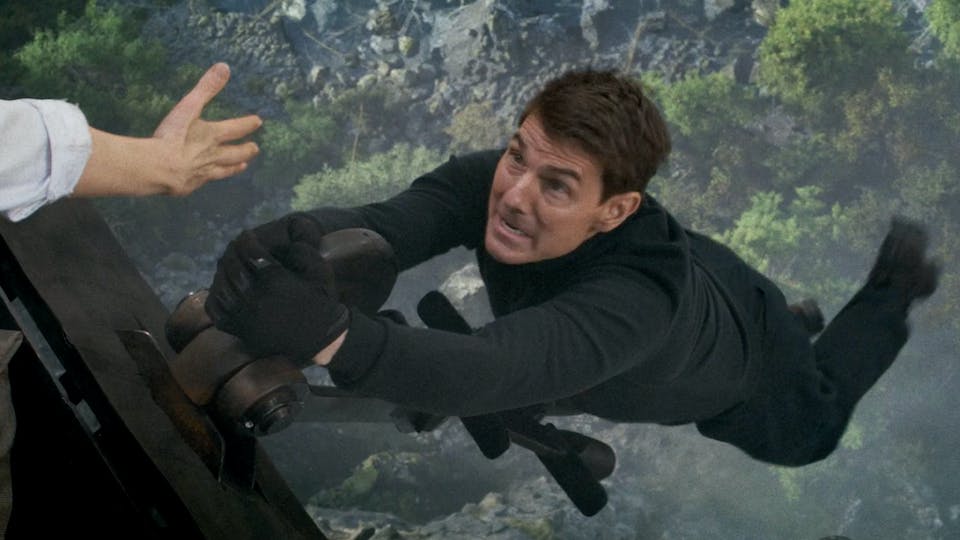
I tend to love when a long-running franchise finds its melancholy, and Mission: Impossible — Dead Reckoning Part One is no exception. The Tom Cruise action series has been reliably exciting, allowing his star persona to hone and sharpen along with his super-spy Ethan Hunt. They’ve fused as a man of singular focus and determination, willing to throw himself—literally his whole body—into pulling off incredible stunts. Hunt does it to save the world. Cruise does it to save the big screen blockbuster. Well done, both. The last few Missions Impossible, under the guidance of writer-director Christopher McQuarrie, have been sharply cobbled together with an excellent sense of escalating stakes, clever crescendos of momentum, and suitably coherent spectacular action—always with a sense of peril from a convincing over-the-top realism. These are top tier entertainments. The great success of Dead Reckoning Part One is that it doesn’t lose those attributes, and, in fact, by stretching out over three hours of rising action (this is only the first of a promised two-parter, after all) allows it to grow more complicated, and more emotionally engaged. The story is another MacGuffin hunt—two halves of a key that’ll unlock a missing server that holds the brains of a rogue military-grade artificial intelligence—but by pacing itself, it allows for that sadness to creep in. McQuarrie and Cruise have made Hunt a man driven by a desire to avoid loss—not just global, but personal—and here’s a movie that doubles and triples and quadruples down on that prospect.
It considers the effects of being a man for whom the impossible is pulled off in wild stunts of teamwork and the effects such constant danger and close calls have on himself and his only friends—those who work with him. Cruise has always played characters who think they can outrun the gravity of a situation’s reality. (Look no further than Top Gun: Maverick, in which that urge is proven correct.) Impossible has always been a series playing with the potential to flail in the face of danger—remember him dangling over the alarmed floor in the first one. This latest Mission runs toward and with that gravity. Its melancholy is a fine new flavoring that finally taps a rich vein at which the previous pictures have merely glinted. But this is still, as one might expect from these pictures, a rip-roaring adventure with some of the best action thrills anywhere, photographed cleanly and clearly, edited with energy and style, and keeping every aspect in vivid focus without losing the thread. Each sequence—from a sandstorm firefight to airport sleuthing, a car chase through Rome, and combat on a runway train that builds to Buster Keaton levels of astonishing chain reactions—are cleverly stacked with multiple variables, complications, and suspense elements—pursuers, ticking bombs, causes and effects—that make for delightfully complicated thrills.
For however heavy the undertow, the movie stays light on its feet, playful, and propulsive. The action is staged for impact of objects in dizzying motion that balance on a mix of danger and delight. Picture a tiny car tumbling down a massive stone staircase, causing its handcuffed passenger and driver to switch places, all while a massive Hummer smashes down after them. And yet it’s that underlying sadness that lets such giddiness play against a somber backbeat that finds these characters in an almost existential crisis when confronting their latest foe. (No wonder there’s no conclusion.) When a charming new character (Hayley Atwell) is given the choice to join the team for this mission, it’s presented with a somber touch. She needs to know the consequences. This earned level of sadness gives the hugely entertaining movie a genuine whiff of finality. In these endless franchise plays crowding our multiplexes, a few are starting to find satisfying stakes can be found by intimating an actual end is looming. All the pleasures of the momentum machine herein feel all the more weighted toward danger, and make the complications all the more delightfully compounded.
Showing posts with label Hayley Atwell. Show all posts
Friday, July 21, 2023
Saturday, March 14, 2015
Ella Good Tale: CINDERELLA
You know the Cinderella
story. Everyone does. Across centuries and cultures, it has existed in
hundreds of versions, perhaps none more famous than Disney’s 1950 animated
musical. That iteration, of the magic words “Bibbidi-Bobbidi-Boo” and the
helpful talking mice, is lodged in the public imagination as something of the
definitive squeaky-clean, paper-thin telling of the orphaned girl mistreated by
her stepmother and stepsisters, prepped for a ball by her fairy godmother, and
eventually married happily ever after to a prince. It’s familiar. But now
Disney’s made a lush live-action adaptation of the story. They’ve resisted the
temptations to either exactly duplicate their iconic earlier work or load it up
with postmodern winks. In the process, they’ve created a movie of strong and
simple sincerity, earnest in its conviction that Cinderella has been a tale good enough to stand on its own for so
long, there’s no need to mess with it now.
We meet Ella (Lily James), whose memories of her long-dead
mother (Hayley Atwell) and recently dead father (Ben Chaplin) are all she has to
sustain her in her present circumstances. Her wicked stepmother (Cate
Blanchett) keeps her as a servant, hardly worth regarding on anything like an
equal level with two blathering stepsisters (Holliday Grainger and Sophie
McShera). Ella isn’t even allowed to go to the ball where the handsome prince
(Richard Madden) will pick his bride. With some help from the fairy godmother
(Helena Bonham Carter), she’s sure to make it there anyway. The set-up is
classically familiar, and elegantly efficient. In this telling, the story is
content to be a lovely experience of comfortable rhythms.
The result is a movie that’s never a surprise, but always
gloriously old-fashioned. Cinderella
is in style and form a throwback, serious about the human emotions flickering
in a thin archetypal tale, but light on its feet when it comes to incorporating
shimmering, glittering widescreen wonders. The occasional CGI assist aside, it
could be the best live action fairy tale of 1962. It’s a softly sturdy
CinemaScope spectacle, beautifully appointed and handsomely photographed, Dante
Ferretti’s lush pseudo-historical storybook production design flowing in warm
colors and fine fabrics. Director Kenneth Branagh marries the pop sensibilities
of his Thor with the grandeur of his
Shakespeare adaptations, finding a comfortable space of serious lightness. He
treats each expected development with sentimentality and gravitas, lightly
confident in the story’s ability to operate effectively.
And indeed it does. The frame is filled with gorgeous gowns,
lovely waltzing, and a smooth tone of pomp and pageantry. I’ve never much cared
for the love story, but the film sells it as a fantastical escape from a
horrible circumstance, a dramatic reward of riches for one who so patiently and
kindly deserves happiness. I found myself transported into the uncomplicated
fantasy of it all, dodgy (mercifully speechless) CG animals and all. In the
midst of the usual plot beats and the terrific design, the screenplay by Chris
Weitz (About a Boy) provides some
degree of shading to the characters’ standard types. The film fleshes in some
additional motivations. The prince finally seems not just a handsome man in tight pants, but an actual character too, and a nice,
humble, emotional one at that. But the film achieves its most humane nuance simply by
bringing in reliably excellent character actors like Derek Jacobi, Stellan
SkarsgÄrd, and Nonso Anozie to elevate small but crucial roles.
Best is Blanchett who plays the stepmother in a wonderfully regal
Joan Crawford-esque performance halfway between Mildred Pierce and Lady Macbeth.
The script provides sympathy for her evil, an understanding of how her heart
has hardened that makes her less a pure villain and more a pitiable person
lashing out in pain and jealousy. That Ella is able to meet this nastiness with
sadness, but ultimately grace and compassion is part of her eventual
happily-ever-after. It’s because she’s not a shameless schemer or a callous
revenge-seeker that we can appreciate this gentle fantasy. I most liked this
sumptuous version for pivoting the theme away from True Love wish fulfillment and
towards an emphasis on the importance of kindness and forgiveness. That’s nice.
Here there are no songs and no subversion, just a straightforward, irony free,
gauzy retelling of this fairy tale at its most family friendly and least overtly
sexist. It’s inessential, but sweet.
Note: Disney has
paired Cinderella with Frozen
Fever, a new short film sequel to their
mega-popular – and pretty good – Ice Queen musical you’re still humming. It’s a
harmless handful of minutes, with a so-so new song and an inconsequential fresh
magical wrinkle. It’s mostly useless. Regardless of their recently announced intention
for a feature-length Frozen sequel,
this short is dull enough to make me wonder if, creatively at least, the
company should just let it…oh, you know.
Friday, April 4, 2014
S.H.I.E.L.D.'s Up: CAPTAIN AMERICA: THE WINTER SOLDIER
What keeps the movies in Marvel’s Avengers multi-franchise franchise somewhat fresh is the way each
film exists in a different setting and plays variations on different genres.
They’re all shot in a bright house style, the tone always serious enough to
generate suspense, but light enough to accommodate bantering between chummy
characters. In other words, going into one of these movies you know exactly
what you’re going to get, but not necessarily the way you’ll get it. Captain America: The First Avenger was a
B-movie World War II picture with snarling Nazis, martyred
scientists, and brave soldiers, with a square-jawed superpowered all-American
hero in the center. Now its sequel, Captain
America: The Winter Soldier, finds the star spangled man dropped into a
paranoid conspiracy actioner, danger from unexpected sources at every turn.
In this new film, the Captain is still the same old
patriotic freedom fighter he always was. Captain America may not be the role
Chris Evans was born to play, but, between his capacity for unsentimental
earnestness and obvious classically handsome features, it’s certainly the superhero role he was born to play. After being frozen in a block of ice for 70 years, thawed out, welcomed into
SHIELD (the fictional Strategic Homeland Intervention, Enforcement and
Logistics Division), and sent out to fight off an alien invasion with the help
of Thor, Iron Man, and the Hulk, he’s finding himself borderline disillusioned.
He asks Director Fury (Samuel L. Jackson) why the intelligence community is ramping
up pervasive worldwide surveillance, building a massive apparatus to predict
trouble and arrange preemptive strikes. Fury wearily tells him the world has
grown dangerous, and they must be prepared for anything. Cold comfort, that.
The film smartly pivots from stars-and-stripes propaganda to
clammy paranoia. In the first action scene Captain America and Black Widow
(Scarlett Johansson) free hostages on a freighter in a fanfare of military
might. But it’s not long before a high-ranking SHIELD official is gunned down
by an assassin, men in suits force good spies on dubious missions, and Fury
whispers to the Captain a stern warning: “no one can be trusted.” It’s a
surprisingly sharp – and totally on-the-nose – commentary on contemporary
concerns over NSA surveillance and intelligence agency overreach. Though,
shadowy governmental conspiracies aren’t exactly only current. Robert Redford,
with a history of appearing in paranoid thrillers from Three Days of the Condor and All
the President’s Men to Sneakers
and Spy Game, appears as a suit,
exuding gravitas in a fun echo of the genre’s past.
What follows is a tangle of twists and turns punctuated with
exciting, lengthy action sequences all around Washington D.C. as loyal SHIELD agents reveal dark intent
and showy conspiracies are yanked into the light. The blows land harder for the
film’s mercilessness when it comes to mortally wounding characters and
institutions you’d think the Marvel Cinematic Universe would want to keep
around. The script by Christopher Markus and Stephen McFeely moves quickly and
coherently, dragging in familiar franchise faces (Sebastian Stan, Cobie
Smulders, Hayley Atwell, and Jenny Agutter) while smoothly integrating new
characters into the action. I particularly enjoyed Anthony Mackie as a former
soldier who finds new reason to fight when Captain America calls upon him and
quickly establishes an easy, warm friendship between them. It’s nice the movie
takes time between the explosions and chaos to make new friends and keep
the old, interested in some small way in relationships and how they play out through slam-bang
rat-a-tat movement.
Directors Joe and Anthony Russo, sitcom veterans who, Community paintball episodes aside, make
a big action debut here, filming the action in a clean and comprehensible
style. The early boat-set sequence includes plenty of shots that refreshingly reveal
the entire action head-to-toe, sometimes for seconds at a time. In later car
chases, gun battles, fisticuffs, and aerial commotions, they cut rather deftly
between perspectives and don’t let chaotic close-up inserts confuse too badly.
The majority of the action – a one-against-ten fistfight in an elevator, a man
in a winged jetpack outsmarting heat-seeking missiles – is cleverly staged. It’s
all so engaging and enjoyable that it’s a bit of a let down to admit it’s
also all a tad exhausting in the end. It’s exciting and it wore me out. After over
two hours with often pervasive rounds of gunfire – minions just shoot and shoot
and shoot, the body count looming large – it grows wearying. By the time the movie is well into its big
blowout finale, twists and surprises largely in its rearview, I was ready for
the punching and shooting to reach their inevitable end. It’s fun, but I had my
fill.
Still, reliable and dependable, this Marvel
universe of interlocking franchises has dropped another quality product off of
the assembly line. At worst, these films can feel slight and predictable,
pinned in by the corporate dictates of the overarching narrative. Much as I’ve
enjoyed all of these movies to some extent or another, I’m interested, but not overly
invested in the big picture. In individual films, moments of straight-faced
near-campiness (anything Asgardian in the Thor
movies), side pleasures (the first Captain
America’s unexpected and delightful musical number), and funny supporting performances
(Tom Hiddleston, Sam Rockwell, Kat Dennings, Tommy Lee Jones), stick with me
the most. So it is to the filmmakers’ credit that in Captain America: The Winter Soldier they shake things up, providing
all the expected thrills and smiles along with a welcome modicum of complexity to the characters' primary-colors comic book world as it crumbles
around them in entertaining explosiveness.
Friday, July 22, 2011
Hope and Glory: CAPTAIN AMERICA: THE FIRST AVENGER

Captain America: The
First Avenger is the purest distillation of the serial adventure narrative aesthetic
since Raiders of the Lost Ark introduced
us to Indiana Jones (an adventure this new film obliquely references). To say Captain America isn’t as good as Raiders is merely saying that it isn’t
the best action movie ever made. That’s hardly too big a strike against it, is
it? This is a pulpy men-on-a-mission World War II picture with a big splashy
dose of period detail and winking homage to every little bit of its genre
roots. There’s always another cliffhanger around the corner, sometimes
literally, right up into the end credits and beyond and through it all storms
Captain America who, far from being yet another indistinguishable smirk in
tights, is actually built upon a full-fledged character worth caring about.
This, my friends, is the fully satisfying pure dose of superheroic adrenaline
that I’ve been craving all summer.
Before we even get to Captain America, and all the explosive
pyrotechnics that follow, first we must meet Steve Rogers (Chris Evans), a puny
guy with a good heart, who desperately wants to join the United States Army.
It’s 1942, you see, and Nazis are marching across Europe. (There’s conflict in
Asia as well of course, but the movie doesn’t have time to fight on two
fronts). While thousands of Americans are doing their part, Rogers is forced to
sit on the sidelines, placed there by his size, his asthma, and his basic lack
of muscle and toughness. He’s filled with a sense of justice and civic duty
that is unable to find full expression, but only until a kind military
scientist (Stanley Tucci) takes pity on him and allows him entry into a special
training camp that is looking for the right man on which to try out a new
program.
Under the direction of this scientist, as well as hotshot
engineer Howard Stark (Dominic Cooper), a lovely British intelligence officer
(Hayley Atwell), and a craggy general (Tommy Lee Jones), Rogers is dosed with a
specially formulated serum that adds musculature and stamina, lifting away his
physical weakness, creating a “super solider” out of him. He’s even better than
expected, which is good because the Nazi “deep science division” led by the
villainous Johann Schmidt (Hugo Weaving) is on the march, having discovered a glowing
cube of some import in a remote Norwegian village and developed it into a kind
of supercharged energy weapon.
Rather than allowing all this to become overly somber,
silly, or convoluted, the three most common errors in so many recent movies of
this kind, Captain America barrels
forward with a ceaseless sincerity and energy from moment to moment. It’s
tremendously exciting with great bits of character and comedy for seasoning.
But rather than mercilessly grinding its way through a chaos of effects and
computerized daffiness, this is a film with shape and emotion, a sense of set
up and payoff and of fully realized characters in a fully realized world. Each
action beat feels like a part of the plot in important ways, but even when the
Captain isn’t flinging himself and his men through combat, the movie is still
hugely entertaining.
Take, for instance, a detour on the way to the front lines
that finds the U.S. government parading Captain America across the country
promoting war bonds that’s a sequence of color and music that’s both a critique
of propaganda and essential character building. Rather than flinging the
audience straight into the action, the film has introduced us to scrawny
Rogers, moved him through science fiction hocus pocus into a superhero and then
takes its time in allowing the character to explore his new persona. The best
origin story films, like Richard Donner’s Superman,
Christopher Nolan’s Batman Begins,
and Sam Raimi’s Spider-man, allow the
character to feel his way towards the iconography, the outsized iconic persona
we all have in our heads on our way into the theater. And you certainly don’t
get much more iconic than the star-spangled Captain America who famously punched Adolf Hitler on the
cover of his very first comic book in 1941, an image that gets a nice little
reference here.
With a character so tied to the World War II iconography of
the culture’s imagination, it makes perfect sense for the narrative to reflect
the adventure serials of the day. But in its colorful Cinemascope presentation
it also feels visually similar to the retroactive glorification of the conflict
that occurred in the widescreen war flicks of the 50’s and 60’s. All of this
retro style and content is filtered through a sleeker, more modern effects
machine and then steeped in timeless sturdy craftsmanship. Here is a film with
clean, uncomplicated visual comprehensibility put to use telling a fully
realized story with characters charmingly acted that go through emotional arcs and events that
add up into a fulfilling climax. It’s popcorn pleasure of a high quality.
Director Joe Johnston, a solid if often unremarkable
filmmaker, has been in this territory before with his 1991 retro actioner The Rocketeer, a fun flop that has a
small and reasonable cult following. He bests his work there creating, I dare
say, the best film of his career by far. It’s all of a piece, fitting perfectly
between two genres, suiting each just fine. It’s both a crackling period piece
action film that smartly shies away from mindless jingoism and the most fully
engaging character-driven stand-alone puzzle piece in the larger superhero
universe that Marvel has been building with their other features like Iron Man and Thor. But that’s just added bonus to the simple fact that Captain America is flat out the most fun
I’ve had with a big budget studio adventure in a very long time.
Subscribe to:
Posts (Atom)