Showing posts with label Kenneth Branagh. Show all posts

Sunday, April 20, 2025

The Least of These: THE KING OF KINGS

The King of Kings is an unusual hodgepodge movie: a Sunday School-style Biblical literary adaptation twice removed made by a South Korean animator with Hollywood voice performances and released by Christian indie production company Angel Studios. All that to end up with a pretty routine retelling of the story of Jesus Christ in blandly produced, generic family-friendly digital images just in time for Easter. As is always the case with interpretations of religious texts, however, it’s most interesting, and revealing, for what it leaves out and for what it emphasizes. Furthermore, this one’s complicated by being based on a slim posthumous Charles Dickens book called The Life of Our Lord. That book is a charmingly Victorian effort, not up to the depths of feeling and wit of Dickens’ best work, but an earnest effort at distilling the importance of the Gospels’ message for an intended audience of his own children. The animated version makes Dickens (Kenneth Branagh) telling his youngest son (Roman Griffin Davis) the story of Jesus (Oscar Isaac) a framing device, and then puts the little lad, along with his doughy cat, in the New Testament tableaux as an unseen observer. There it hits all the expected highlights—the nativity, the baptism, the disciples, the loaves and fishes, walking on water, the last supper, the crucifixion, the resurrection. What’s more curious is the balance of what’s left out to what’s included.

Any condensing of these stories is inevitably going to pick and chose points of emphasis that shifts theological implications. For instance, Dickens didn’t have time for the Devil’s temptations in his book, but The King of Kings makes sure we hear about it, along with a flashback to Original Sin in the Garden of Eden. That’s fitting for a telling that’s all about the Power of Belief above all else. It puts weight on Christ the powerful—telling off the devil, expelling demons, raising the dead, and calming stormy seas. Christ the vulnerable, the compassionate, the defender of the meek and impoverished, gets shorter shrift, when it even appears at all. The end result is a movie that says Jesus should be worshiped because of what he can do for you, but doesn’t care too much about what he asks you to do for others. The Sermon on the Mount is glossed over, but skipped entirely are the Parables, and the Blessing of Children, and the Widow’s Mite, and the Woman at the Well, and nearly all moments of Jesus’ teaching that emphasize a need to care for those who’re marginalized or forgotten by societal norms.

The movie’s dry liturgical value, when it isn’t upstaged by the frame story, is clearly slanted in this one obvious direction, worshiping His power, but failing to mention that we should “Love thy neighbor as thyself,” and that “the last shall be first,” and what we “have done unto one of the least of these, we have done it unto [Him]”, and that “it is easier for a camel to go through the eye of a needle, than a rich man to enter into the kingdom of God.” Even the manger scene opening only has time for the genuflecting Wise Men, and not the shepherds. The ending resurrection has Jesus greet Dickens’ son in the garden instead of Mary. The filmmakers include a lot of the Greatest Hits of Jesus, but take most every opportunity to downplay or diminish women and the poor in them. (There’s time for many minutes devoted to the Dickens chasing that cat, though.) It says a lot about modern mainstream American Christianity to see what concepts are ignored when the idea is to make something broadly appealing and unobjectionable to the masses. I’d say it’s some upside-down accomplishment to make a Christian movie without wrangling with the actual tough questions of the faith, but that’s sadly par for the course.

Sunday, September 17, 2023

Dark and Stormy Fright: A HAUNTING IN VENICE

It’s fitting that such a theatrical ham of an actor as Kenneth Branagh, so good at making full course meals out of others’ words, would be drawn, as director, to inhabit others’ works. His directorial career is full of echoes and inhabitations both literary (Shakespeare, Shelley) and filmic (Hitchcock, Lean). This doesn’t always lead to a good movie, but he’s a man of ostentatious Good Taste in a jolly old English way as befits a graduate (and current president) of London’s Royal Academy of Dramatic Art. His latest work as filmmaker, A Haunting in Venice, is his third turn with an Agatha Christie novel, returning as director and star in the role of famous detective Hercule Poirot. It is the best of these three—after Murder on the Orient Express’s airless exercises and over-gilded energy, and Death on the Nile’s expansive melodrama and bitter undercurrent. Compared to those, it has the smallest ensemble (Tina Fey, Michelle Yeoh, Kelly Reilly, and a two-man Belfast reunion). But such spareness successfully builds on this series’ best assets: a sense of world-weary cynicism held back by a relentless cold detective logic that makes even the darkest edges and dreary deaths solvable with a sharp mind and steady investigation.

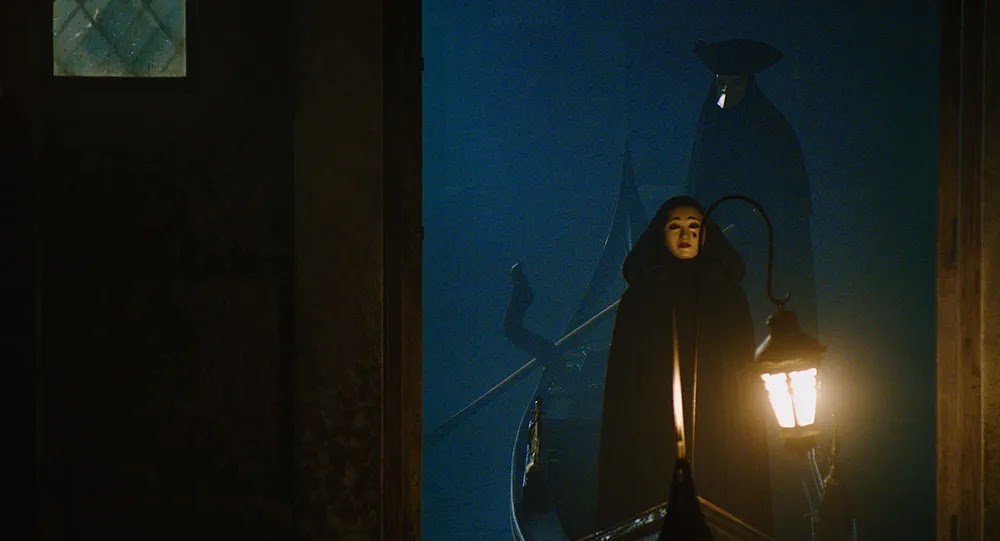
This one’s literally dripping in atmosphere. The setting is a damp Venetian palazzo on a dark and stormy night, the wind battering the windows, waves crashing into the walls, lights flickering, faucets dripping, interiors clammy and steps slippery. He films it like Welles might, in intense canted closeups reminiscent of Mr. Arkadin and snaky shadows like Touch of Evil. (To keep what Leonard Maltin might call the “Wellesian tomfoolery” going, a cut to a shrieking bird has to be a nod to Kane, and an early shot of a dramatic iron-gated gondola garage and a masked and robed figure is reminiscent of the only extant scene of Welles’ abandoned attempt at Merchant of Venice.) These surface pleasures are fun and potentially shallow, but Branagh finds plenty of percolating character beats and sneaky suspense to keep interest boiling with pop depths somberly intimated. In this locked-room mystery, Branagh is cranking up the spookiness and the sadness in equal measure, letting a blurry, bleary, midnight mood creep around corners and lurk in shadows.

As always in these stories, the murderer is in plain sight, and the cast of recognizable names stumble about in fear and suspicion, driven backwards into their frazzled psyches and paranoia as they try to survive the night. Christie’s sense of social status and class concerns takes a backseat to the tightening tensions and grief-stricken group. They were gathered for a seance: a mother who lost her daughter, a father damaged by war, a young son grappling with his father’s illness. (The seance itself is a fine, formulaic balance between sinister silence and sudden smashes.) Now they’re waiting out the storm while Poirot and his mustache must ask them enough questions to figure out the ghost of a clue. They’re as haunted by death and mystery as the film is by its influences—and its somehow a pleasing combination. For all the plot’s twists and turns, biggest surprise for me, though, was discovering that I’ve grown quite fond of Branagh’s broad take on Poirot with his puffed-up eccentricities and earnest melancholy. Beneath the starched facial hair and chewy accent there’s a real character there.

Monday, November 29, 2021

Boyhood: BELFAST and PROCESSION

In Belfast, Kenneth Branagh returns to the time and place of his younger days for a movie based on some boyhood impressions. And that’s what we get: impressions, fragments, glimpses, scenes warmly bathed in childlike innocence against the backdrop of sectarian strife that sets his parents’ minds toward leaving home and moving somewhere new. The movie is set in this obvious state of reminiscence, as the movie starts in clinical digital color and slowly fades to shiny black and white. He remembers some discussions of Catholics against Protestants and some cultural friction between Ireland and Britain. But above all else he remembers a cozy feeling of being surrounded by loving family. The movie finds the boy (Jude Hill) tromping around their working-class neighborhood, never more than out of earshot of his dear mother (Caitriona Balfe) calling him for dinner. He adores his father (Jamie Dornan), too, though the man is often away at work. He generally gets along with his moodier older brother (Lewis McAskie). He interacts with a swirl of cousins who’re always scampering about. He looks up to his grandfather (CiarĂ¡n Hinds) and grins at his grandmother (Judi Dench), two sweet old folks who give him lovely advice and good food. (His grandmother also takes him to see a play, reflected in full color in their eyes, a poignant moment from a director best known for his passionate Shakespearean adaptations.) Why, it’s just too bad that The Troubles had to mess with their perfect little world.

As the movie bumps along episodically, scenes don’t always feel complete or follow logically. It lingers in some moments and elides others, seemingly for no rhyme nor reason. It skips ahead, shifts to montage, or dawdles in minutiae. The result is, a handful of riots aside, a mild-mannered movie, gentle, soft, slight, and a little scattered. However, that feels true to its aims—not capturing a story so much as a collection of childhood memories, details, moments, conflicts, relationships, people. The sociopolitical implications are firmly background color and plot mechanic, while many supporting characters who appear and disappear sometimes at random remain at the level of surface impressions. Isn’t that just the way it is with a jumbled child’s-eye view of one’s own past? It may not build in scope or arrive at important revelation, but it’s ultimately a sweet movie about how much a grown man remembers being a little boy who loved his family with all his heart. No wonder he remembers them in gleaming black and white artifice, where his grandparents are wrinkled wisdom personified, and his father and mother are youthful and beautiful, singing and dancing, trying to do right by their little boy even as their world falls apart behind them.

Boyhood memories are much more fraught in Robert Greene’s Procession. His career as a documentarian has been concerned with performance as a way of processing reality. His Fake It So Real was about pro wrestling, while Actress and Kate Plays Christine dig deep into a performer’s process of building a role, and his Bisbee 17 had a small Arizona town reenact a 100-year-old massacre. (His work as an editor on sharply-written fictional character studies by Alex Ross Perry further bolsters his filmmaking’s psychological acuity.) His new film takes those ideas further into harrowing territory. In it, he collaborates with a group of men who have spoken about their past abuse by Catholic priests. Their stories are decades old now, but the pain is still fresh. Greene, working with a drama therapist and a lawyer, invites these men to script scenes that explore this element of their past. The documentary, then, is about filmmaking: writing, casting, location scouting. Yet every step is a journey into their pain. The men have long brainstorming sessions that double as a support group; they open up in heartbreaking ways, plumb the depths of their anger and betrayal, and share in the camaraderie and openness that only fellow survivors of such unimaginable violation can. The project gives them a way to orient their sharing toward a positive outcome. To share their stories, they think, is one more undeniable way to make a case for themselves and to give light and hope to others struggling with this burden. They talk of various court cases and legal wrangling with the Catholic Church, which, in each man’s case, has elements, if not entire claims, obfuscated, criticized, dragged out, downplayed, or ignored. Together they might be able to make art an act of grace, memory and truth an act of justice—grace and justice being two things Church officials seem slow to grant, or are unable to provide to these victims’ satisfaction.

We see the making of the men’s short films and the eventual final products—by turns testimony, nightmare, condemnation, explanation, reanimation, and act of self-forgiveness and letting go. They’ve explored their traumas, gone hunting for ways to represent the after-effects, literally retracing their steps in some cases. It’s difficult. But Greene films this so tenderly, and so plainly. He draws out their creative sides and, with professional assistance, makes art as a form of therapy. To do so, Greene doesn’t flinch from the heavy details; nor do the men hold back, though at times they pull away in self-preservation as they pick at emotional wounds that linger. A potentially upsetting variable, and yet so lovely in its act of protection and care, is the casting of a tween actor to play their stand-in. The scenes they’ve written have no explicit abuse in them, dealing more in implication, but are frank about the relational, spiritual, and emotional abuse that deviant priests inflicted upon them. (Some of the men even agree to play an abuser in these scenes, an obviously challenging prospect.) The young actor, surrounded by supportive parents and a generous crew, approaches the task with respect and care. The men bolster him, too, though all involved feel the seriousness on set. On the last day, the boy shakes the hand of a shaken older man and says in total sincerity: “I tried my best to tell your story.” That’s a powerful moment, and image—the present willing to attempt a healing of the past through the power of witness. The film finds its subjects excavating and exorcising their tragic pasts. It’s an unfailing honest and perceptive work. And it feels like nothing less than a personal reckoning that reverberates outwards and upwards towards a potential healing breakthrough.

Friday, December 18, 2020

Hello, I Must Be Going: TENET

In Christopher Nolan’s Tenet, backwards run sequences until the mind reels. It’s a time travel thriller, but not like you’re thinking. It’s about a magic box that can reverse the chronology of an item—or a person. Reverse entropy, they say. Inversion. The plot concerns a secret agent (John David Washington) recruited to stop a snarling Russian arms dealer (Kenneth Branagh) from reversing the flow of time for the entire universe. That’d destroy everything, one reluctant ally (Elizabeth Debicki) is told simply and slowly. She considers it for a moment and solemnly intones: “including my son.” It’s this collision of high-concept headiness and laughably simple personalities that sink the film, which is simultaneously one of Nolan’s most logistically jaw-dropping and emotionally flimsiest. (It’s also a narrative convolution, running backwards and forwards at the same time, and dazzling as much as it is deliberately obtuse.) For as much as he’s gotten a reputation as a cold technician, it’s not until confronted with a movie like this — which has none of the tragic backstory or family sentimentality or rule-setting exposition that some critics have dinged him for in the past — to see how essential those are for the Nolan formula. Here without that rooting interest or well-sketched setup, it’s rather empty, though all go-go-go M.C. Escher timeline. Cause and effect are ruptured in boggling ways. There are stunts and combat and strategizing, with some elements of the action behaving unusually: a bullet hole filling up as the ordnance flies back into the barrel; tumbling fisticuffs that cartwheel with unnatural grace as one combatant flies backwards when they should be ahead; a car zipping the wrong way through traffic after rolling back over from a crash, windows reconstructing as tires squeal in reverse. I found myself wondering what it’d be like re-edited in Memento style.

It’s a film that surprises and exhausts in equal measure. There are those wild visual flourishes, so convincingly done — although it did, on occasion, remind me of Bob Saget’s America’s Funniest Home Videos doing fun rewind montages — I barely could process them, but appreciated their effective  crescendos. Elsewhere there are agents rappelling up a building or spinning a sailboat or crashing a plane or maneuvering through a series or airtight vaults or hanging off the side of a moving firetruck to hop between cars. That’s all thrilling stuff. Would that there was any reason to hold onto the inventiveness other than sheer admiration for its construction, its impressive scope, its grounding sense of tactile reality even as the effects slip sense away. When you get past the scrambled visual conceits, the movie underneath is too straightforward to care about overmuch. There’s the protagonist and antagonist, sparsely characterized, fighting over a MacGuffin. It’s strikingly photographed globetrotting, with the hero and his partner in spies (Robert Pattinson) dashing and capable in slick suits and big action beats. The pounding score, booming bass, and enormous images have a Pavlovian effect—it’s exciting, and kicks up the energy of seeing a great Christopher Nolan movie, even if it doesn’t exactly reach those heights. By the ramp up to the enormous climactic action sequence, I was rather worn out. I found myself thinking about how thrilling it was to see Inception a decade back, and could understand why the temptation to make a whole movie out of that one’s hallway fight must’ve been tempting.

Friday, June 12, 2020

Neither Fish Nor ARTEMIS FOWL


Artemis Fowl goes the way of so many middling kids’ fantasy adaptations. It spends more time explaining itself than telling a story, sacrificing legible characterizations, comprehensible world-building, and even wonder itself in service of getting all of its information out there. And then it ends, at just barely 90 minutes, promising more adventures to come. But more what, exactly? Like so many of the bungled YA fantasy adaptations of the past fifteen years — Remember The Fifth Wave and I Am Number Four and The Seeker: The Dark Is Rising? — it's an elaborate prologue that theoretically saves all the good stuff for later pictures. And yet what chance is there we’ll get it if there’s nothing to grab on to the first time around? This film, directed at his least Shakespearean and most journeyman workmanlike by Kenneth Branagh in what’s-the-point? Jack Ryan: Shadow Recruit mode, adapts Eoin Colfer’s book series about a 12-year-old prodigy who gets tangled up in a magical underground of fairies, dwarves, and trolls. The magical beings want to remain a secret, so, as the film finally kicks into gear, there’s a bit of a tussle when Artemis (Ferdia Shaw) decides to finagle a way to get a magical doohickey in order to rescue his father (Colin Farrel) from menacing mystery abductors. The screenplay takes the premise and squeezes it into over-familiar moves, dusty archetypes, and a plot that seems to have a few screws loose and a number of pages missing. It's opportunity that's missed, too.

There’s a nugget of a fun story there, though, especially as the Fowls’ actions bring a siege from a fantasy army commanded by a tough old elf (Judi Dench, raspy and serious) and wielding sci-fi weapons, a sort of contemporary militarized spin on fairy tales of yore with energy beams and zip-zappers and time-bubbles click-clacked out with rum-pa-pum-pum pacing. But the movie falls into the trap of over-explaining and under-delivering. It begins with what feels like non-stop expository voice over, first from overlapping in-media-res news patter, and then from a gravelly Josh Gad half-joking, half-intoning backstory upon backstory as we get slivers of scenes papered over by his explanations. (It’s also, sadly, not the worst thing Gad will do with his mouth in this picture, given a nasty CGI maw that inhales dirt so he can fire it rapidly out his backside.) Cutting between the world of young Fowl — looking cool as a cucumber in his skinny black tie and glassy-lensed shades, but not exactly selling the emotional stakes — and a plucky young fairy cop (Lara McDonnell), before drawing their stories together, the movie gathers its small suspense. But there’s never a good sense of why the glowing magic doohickey is important or why the villains want it or even who the real villains of the piece are. The more it tells us, the less it makes sense. By the time the movie finds its action — a rampaging troll in a foyer, or some moderately enjoyable visual flourishes when characters get wobbly and elongated falling through bits and blobs of a disintegrating time-stop glob — there’s some fun to be had. But it’s all curiously disconnected from a reason to care, and ends soon enough telling us that there’s more of this to be had. That’s unlikely. The characters never come to convincing life, and there’s never a good sense of where it could or should go from here.

Saturday, November 11, 2017

Cold Case: MURDER ON THE ORIENT EXPRESS


I’d love an all-star murder mystery, which makes it hurt all the worse that Kenneth Branagh’s Murder on the Orient Express isn’t a good one. He takes Agatha Christie’s classic novel (to both direct and star as the persnickety, mustachioed, world-famous detective Poirot) and runs it through the handsome, high-gloss, literary-toned approach that served him so well in the past. He has treated familiar stories from Hamlet to Cinderella with the same tone of high-minded, playfully gorgeous, deliciously melodramatic classicism. They’re reverent, but impassioned, heavy and light in the same moment. But somehow the translation to screen for this latest adaptation is stuffy and slow, every emotion muted, every turn and twist of the whodunnit plot bungled and stumbled in a ham-fisted clumsiness that never lets the puzzle pieces click together with pleasing precision. Instead, amid the fastidious production design of a luxury train lovingly photographed in 65mm and cramped tracking shots of beveled glass and ornate dĂ©cor, he somehow never gets a good sense of the space. The characters are indifferently introduced; the investigation develops in fits and starts; the space is inelegantly portrayed – a jumble of close cuts and overhead shots that hardly gives us a window into the layout. The lumbering film neglects good mystery development at every turn. 

The story deals with a mystery of a murdered man on a snowbound train full of trapped suspects (including the likes of luminaries Judi Dench, Penelope Cruz, Willem Dafoe, Derek Jacobi, Olivia Colman, Michelle Pfeiffer, and on and on). Branagh never gets around to cluing us into who is in which compartment, the order of the cars, the timeline of the night in question. Part of the pleasure in a story such as this – understood by Christie and the best of her imitators and adapters – is to follow the clues as they stack up, then hold the big picture in our own heads as the detective tests theories and develops new leads. Here, the screenplay by Michael Green (Blade Runner 2049, a better expensive Hollywood detective story) simply asserts and accrues its mystery’s complications rather than presenting them in a more aesthetically or investigatively satisfying process. I barely had a sense of who the suspects were, let alone where there are on the train or with whom they trade meaningful red herrings. The cast is under-utilized, their star power and screen presence used to substitute or shorthand characterization, the film’s dull crackles of wit and tension carried over as best they can manage as little as they’re allowed. Why such a delicious intrigue is left to fizzle is beyond me. Branagh doesn’t even allow his Poirot more than a somnambulant personality. This prime place for some showboating (and, boy, is he one of our best showboats) is given over to soft, dry cracks and sleepy mumbling. There’s no spark of energy or life here, the big, fancy, unmoving train left stuck in the snow slowly turning away from any inherent suspense and into its own conspicuous metaphor.

Thursday, July 20, 2017

The Beach Front: DUNKIRK


Christopher Nolan’s Dunkirk is a logistical triumph about a logistical nightmare. The film tells the story of one of World War II’s nerve-wracking retreats. It’s 1940. British and French forces are repelled from the mainland, trapped on the beaches of Dunkirk with nothing but the water behind them. Off in the distance, perhaps, they can almost convince themselves England can be seen. Alas, it’s so close, yet so far away, with hundreds of thousands of soldiers sitting ducks for the Nazi bombers thundering overhead and the encroaching Axis ground forces held back by Allied gunners behind makeshift sandbag perimeters. As the film unspools, the desperate stranded men look for ways to help speed up their rescue, while we know that help is on the way agonizingly slowly. Nolan’s film has something of a Hemingway spirit about it. Dialogue is terse, to the point. The narrative is in the details, the soft surf of the tides and sea foam, the oil and explosions, the eerie quiet in the air and the dirt under fingernails, the wet hair and panicked expressions betraying stiff-upper-lip duty-bound effort. Nolan, operating at the height of his filmmaking powers, marshals his resources to not so much tell any single man’s story, but to orchestrate an experience that’ll do the real stressful cacophony justice.

He shows us this war story by land, by sea, and by air. With a deft structural trick, he weaves together three distinct speeds and perspectives with which to pass through this historical moment. By land, the soldiers (like those played by Fionn Whitehead, Cillian Murphy, and Harry Styles) and their commander (Kenneth Branagh) fret and plan and hope while under constant threat of enemy fire as they await evacuation, a story taking place over a week. By sea, we find British citizen sailors called in to help speed up the transporting of the troops (an event tenderly memorialized from the homefront’s point of view in William Wyler’s 1942 classic Mrs. Miniver) because the Navy’s destroyers can’t approach the shallows near the beach. We follow one of the boats (captained by Mark Rylance) as its crew makes its way into battle with a sense of dutiful patriotism and a solemn desire to help, a journey there and (hopefully) back again that takes a day. By air, we find the air force, strategically sending a small squadron (led by Tom Hardy) to provide cover in the final stretch of the rescue effort, a crucial dogfight taking place over the course of an hour. Nolan, with his usual crisp, precise, and confident cross-cutting (think Inception’s dream layers, Interstellar’s time change, or Memento’s backwards-and-forwards design), tells these three actions simultaneously, cutting between them to heighten suspense and danger, often in clever matches – floods of water, rat-a-tat guns, grim expressions. 

By the time the stories start to intersect, weaving details in and out, allowing us to see, say, a plane crash first as a moment from above, then floating next to it with another group of character’s later. Eventually, all three storylines converge, climax upon climax upon climax, every character’s peak danger and despair in the same moment of converging crescendos. This remarkably effective structure – experimental, but completely coherent in its logic and effects – is in service of an impeccably detailed recreation. Although the characters it focuses on are sketched quickly, fictional composite stand-ins for the masses of people involved and impacted, the overall sense of fastidious reenactment gives the film the historical weight under its immediacy. This is a lean, tense true-life thriller, every moment pulsing with the unforgiving tick, tick, tick of time running out (further emphasized by Hans Zimmer’s relentlessly simmering score). Shooting on film, and full IMAX film for many scenes, allows cinematographer Hoyte van Hoytema to craft shots of remarkable size and scale, with tangible texture and detailed grit, expansively filling the frame with eerie pale light, foreboding blank beaches, cavernous clear skies, and vast expanses of ocean. The men huddled against the forces of warfare are arranged in patterns and lines, formations and orders, holding steady to rules and regulations even in these desperate hours. 

These groups of men are buffeted by elaborate and concussive suspense sequences, immersive effects and booming sound design building dread out of the roaring engines of approaching bombers, the slow smack of waves against a tiny boat, the sputtering propellers of a struggling aircraft, an unforgiving howling wind whipping at frayed nerves. The individuals involved are merely part of the crowd. They aren’t given lengthy moments of backstory and exposition, or made into easy heroes and villains. In fact, the enemy remains unspoken, barely glimpsed behind their weapons of war. Nolan’s focus is on the effect the situation has on the groups of people involved under the vice grip of unceasing peril. They simply do what they must, in every moment, in hopes to see the next. This is an extraordinarily well-made, exceptionally well-crafted film of beautifully elaborate detail building a work of startling simplicity: three straight lines concluding in the same inevitable. It’s a film about process and strategy, how they hold together and fall apart under tough conditions when survival instincts kick in. It’s about how even in defeat you can find dignity, even in fear you can find small acts of heroism. Best of all, it’s an experience that’s uniquely cinematic, overwhelming in its scale and power.