Showing posts with label John Cho. Show all posts

Saturday, July 23, 2016

To Infinity and STAR TREK BEYOND


Star Trek Beyond is a fine entry in a venerable franchise that’s celebrating its fiftieth year. The movie is colorful and clever, with effective adventure sequences, cool visual concepts, and the core intelligence mixed with compassionate character moments that have allowed this whole endeavor to endure, from its original 1966 TV show through five more series and 13 movies with more on the way. Through its ups and downs, the late Gene Roddenberry’s creation remains sci-fi’s shining beacon of utopian spirit. What a pleasure in these dark times, when the world feels irreparably torn by forces of division, hatred, fear, and anti-intellectualism, to settle in for a journey to a possible future where the values of science, progress, and unity have built a better society. The values are comforting, but no less an adventure when the noble crew of the starship Enterprise find themselves drawn into a conflict in uncharted space. It’s a series that dares to dream of a better tomorrow, not one without conflict, but one in which the better angels of our nature can succeed through cooperation between heart and logic.

Beyond continues the recent string of Treks set in an alternate timeline of the first series, with J.J. Abrams’ 2009 entry sending time travel ripples imagining new rebooted, recast stories for familiar characters while avoiding tampering with or otherwise erasing classic lore. This time around director Justin Lin, fresh from making four Fast & Furious movies (including a few of that series’ best), takes a step back from his predecessor’s Into Darkness, a fast, exciting movie that was nonetheless more militarized, destructive, and paranoid than the franchise’s comfort zone. Lin’s film is more in line with the show’s original goals – to explore strange new worlds, to seek out new life forms and new civilizations, to boldly go where no one has gone before – in a movie that’s slightly smaller in scale, like a pleasing two-part episode with action blown out to blockbuster proportions between small character work and a journey through an alien landscape. Lin gets the spirit of the enterprise, and the simple appeal of sending a likable crew into a difficult situation and watching them think their way out.

It begins with Captain James T. Kirk (Chris Pine) feeling that life in year three of their five-year exploration mission is growing “episodic.” (That’s a cute meta wink.) He’s starting to doubt his desire to captain. Likewise, his crewmates, like stoic half-Vulcan Spock (Zachary Quinto) and irascible doctor McCoy (Karl Urban), wear the weariness of space heavily on their shoulders. The ship docks at a Federation station in deep space – a wondrously imagined thing that’s an idealized spacious metropolis complicatedly constructed on the inside arcs of a gigantic sphere, the tops of skyscrapers nearly meeting in the middle – for some rest and relaxation. But they must cut their vacation short when a distress call comes in from beyond an uncharted nebula. Duty calls, and so off they go, Uhura (Zoe Saldana), Scotty (Simon Pegg), Sulu (John Cho), Chekov (Anton Yelchin), and the rest, straight into an ambush. A mysterious creature calling himself Krall (Idris Elba under layers of grayish-blue makeup) attacks them with swarms of bug-like ships, which results in the crash of the starship and the capture of most of the crew.

The screenplay by Pegg and Doug Jung is a little undercooked, but still a cleverly paired down and contained conflict of a familiar Trek kind. The crew must learn about this strange villain’s behavior – why has he captured them? what does he want? where is his army headed next? – and explore the planet to figure out how best to escape and warn Starfleet that this unknown being is bent on its destruction. There are lengthy sequences of dazzling spectacle, Lin bringing considerable visual energy with shiny future surfaces, baroque CG fleets of vessels, and complicated layers of lights and screens. With his usual cinematographer Stephen F. Windon he finds freedom in the floating vacuum of space to turn the camera topsy-turvy, then locks down in the craggy terrain of the unknown planet. But it all depends in the downtimes on the chemistry between the loyal friends aboard the Enterprise, separated in the crash and trying to reunite with each other, trade the information they’ve gleaned, and escape the villain’s evil clutches.

Through three films together, this cast has gelled naturally. Pine’s brash Kirk, Quinto’s logical Spock, and Urban’s crackling McCoy are a perfect Trek trinity, not merely resting on nostalgia for the old cast’s interpretations, but with distinct familiarity of their own. Cho’s Sulu and Saldana’s Uhura are allowed shadings and complications on the margins that make them fresh, while Yelchin (despite his appearance tinged with melancholy brought on by his untimely death) is fun comic relief as the lively and irrepressible Chekov. He gets a moment where he taps his foot to a catchy tune while he confidently pilots the Enterprise just ahead of a wave of fiery doom, a fun needle-drop melded with a fleeting grace note. Lin’s confidence as an action filmmaker is easy to spot, but it’s his light touches with actors that really animates the thrills. Here it’s a pleasure to see this ensemble reunite, and new additions – like a young tough alien scavenger woman also marooned on this planet (Sofia Boutella) – quickly fit right in with the team. Even Elba is allowed just enough brief moments to take a seemingly one-dimensional MacGuffin hunter under a pile of makeup and project his charisma and compelling fascination through it.

Lin knows it’s the eye on humanity that makes for good Star Trek and here he delivers the goods. Beyond might be smaller and thinner than you’d expect after the more slam-bang large-scale entries that came before, but there’s a bright throwback appeal and energy to the whole piece similar to spotting an old rerun while flipping channels. The characters and their world are so engaging that I couldn’t help but be drawn in, intrigued to see how they were going to outsmart their attackers and keep the galaxy safe. In the end the dazzling action climax – zipping in and around an outer space locale in supremely clever use of its lovingly imagined structure – isn’t only about shooting and punching, but more importantly thinking through the best course of action and executing it to perfection by luck and by pluck. There are no grand character arcs or overly heavy thematic preoccupations. It’s simply good old-fashioned space adventure that’s light on its feet, loves its characters, and can tap into the uniquely Star Trek sense of exploring the galaxy with a group of likeminded individuals committed to caring.

Friday, May 17, 2013

Top Warp Speed: STAR TREK INTO DARKNESS

Undoubtedly the most breathless of all Star Trek pictures, Star Trek Into Darkness is a nonstop barrage of spectacle, movement, and noise. It’s manipulative, relentless and a fun time at the movies. It gets the job done. With 2009’s Star Trek, director J.J. Abrams got a great deal of entertainment value out of dropping a wormhole into Trek continuity, scattering the familiar pieces every which way and providing a shock of delight as the pieces snapped back into place. It’s about as clever as a combination sequel, prequel, reboot, and remake of a nearly 50-year-old franchise could be. While Into Darkness can’t have the same pleasurable jolts of fresh perspective, what it lacks in discovery it makes up for in chemistry. The cast crackles through energetic banter and terse exposition as they’re forever running up and down the gleaming corridors of the starship Enterprise, desperate to solve the latest crisis in which they’ve found themselves.

With a plot that’s in some ways an extended riff on a classic bit of Trek – to even say whether it’s a movie or a TV episode would probably be enough for Trekkers to spring the film’s secrets sight unseen – the screenplay by longtime Abrams collaborators Roberto Orci, Alex Kurtzman, and Damon Lindelof is packed with dramatic incidents and fan-friendly winking. It’s an expertly calibrated event picture that hurtles from one bit of action or humor into the next without any room to slow down. We start urgently in the middle of a high-energy action sequence with Captain Kirk (Chris Pine) and Dr. McCoy (Karl Urban) fleeing an angry alien tribe while Spock (Zachary Quinto) proceeds logically into a volcano to shut it down and save this foreign world. As the sequence plays out, all of the returning cast – Zoe Saldana’s Uhura, Simon Pegg’s Scotty, John Cho’s Sulu, and Anton Yelchin’s Chekov – get their little moments to shine. It’s like stumbling into the last few exciting minutes at the end of an episode and then sticking around for the next couple in the marathon. There’s recognizability and comfortability the cast has in the roles and with each other that provides an instant anchor and funny rapport amidst the chaos around them.

Chaos quickly comes in the form of a terrorist attack on Earth that blows up a Starfleet base in London. The man responsible is John Harrison (Benedict Cumberbatch), one of their own who clearly has his secret motives for turning against them. The scheming scenes leading up to and including these surprise attacks have a scary edge. As the film progresses and Cumberbatch gets to put his sonorous voice into full intimidating villainy, the relationships his character develops take a few interesting twists and turns. Meanwhile, back at Starfleet, the good admiral (Bruce Greenwood) and crusty admiral (Peter Weller) agree to let Kirk take the Enterprise after the attacker in a rare show of force from this research and peacekeeping group that finds a new science officer (Alice Eve) escorting top secret missiles on board. They’re not out boldly going where no man has gone before. They’re on a manhunt.

This streamlined feature slams through its sequences of energetic intensity with sensational special effects and top-notch sound design expected from a Hollywood blockbuster in this budget range. Abrams, not particularly invested in the more cerebral, allegorical aspects of Trek lore, sees fit to deliver a slam-bang spectacle with phaser battles, whooshing warp drives, and brusque threats around every corner. This leaves plenty of time for the film’s politics to be a little muddled, if benign, with the exception of a weirdly misjudged bit of disaster overkill in the final stretch. It’s one thing for a movie like this to destroy a chunk of a metropolis, sending skyscrapers crumbling to the ground. It’s another thing entirely to do so almost off-handedly, skip the aftermath, and then put a strange title card in the end credits proclaiming tribute to post-9/11 workers. (Seriously, what’s going on there?) It’s a film that summons up War on Terror paranoia (potential drone strikes, brief pointed debates about killing terrorists without trial) and twisty conspiracy theories, but uses it only as set dressing for a plot that’s all present tense forward movement. Gone is the Cold War-era utopian optimism of Roddenberry’s original concept. This time it’s all about fear, dread, and explosions.

But it’s amazing how far momentum alone can take you. Abrams has made a film that’s a crackling roller coaster that’s all dips, dives, drops, and top-speed loops with an excellent, blaring score from the ever-reliable Michael Giacchino. The intensity never slows, even when the movie self-consciously incorporates a debate with itself about what kind of mission this Trek is following. “This is clearly a military operation,” Scotty disappointedly tells Kirk. “Is that what we are now? I thought we were explorers.” The fact of the matter is that Trek on TV had room to be as eggheaded as it wanted (at best, thrilling so), whereas the movies have always largely been about elaborate revenge schemes and potentially world-ending super-calamities. This just happens to be a particularly single-minded action adventure that’s constantly chasing the next thrill. And that works.

It works not just because Abrams and crew are skilled technicians, but because of the people on screen as well, with characters filled wonderfully by the talented cast working from borrowed cultural awareness without much original characterization in this particular script. (There’s an assumption, rightly or wrongly, that the audience will know who these characters are and what they mean to each other, so that all emotional development can be left to shorthand.) These characters have lived long and prospered in the cultural imagination for a good reason. The core of the film is the crew, the group of professionals thrown together by duty, bound together by the friendships that developed. Even at their prickliest, when Kirk and Spock speak sharply to each other, engaging in their expected debate between reason and emotion, there’s a core of respect and love that’s a comfort and a constant, even when everything is constantly blowing up around them.

Sunday, February 10, 2013

Take it On the Run: IDENTITY THIEF


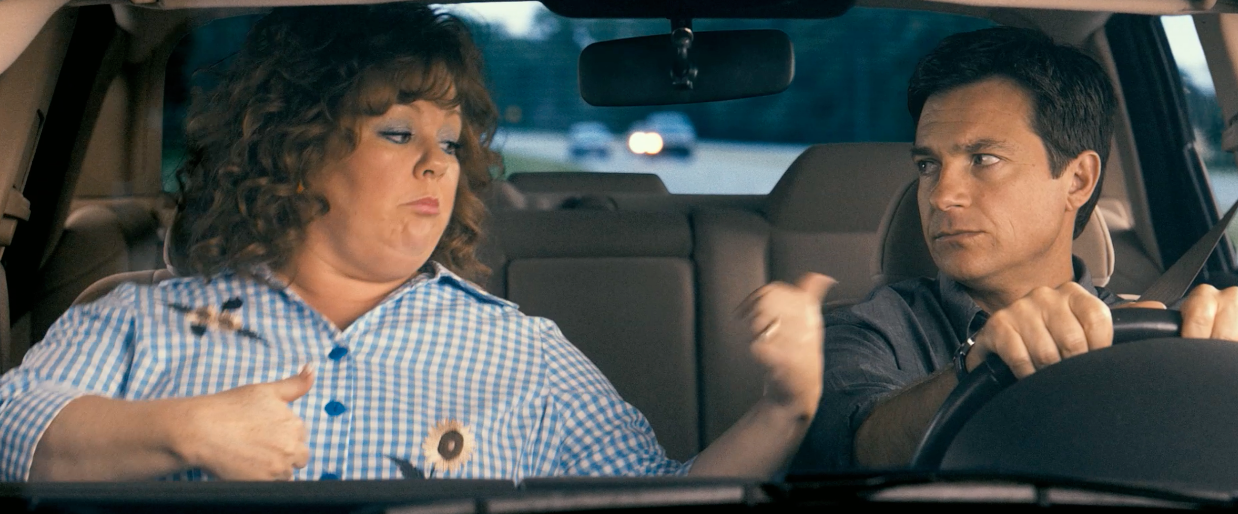
Melissa McCarthy is a talented performer, a funny, versatile woman who brings a full commitment to each and every part she plays. She deserves every bit of success that her breakout Oscar-nominated role in Bridesmaids is bringing her, but hopefully that success includes better roles than the one she has in Identity Thief. She co-stars in the title role as a woman who hijacks identities, wrings out all their financial potential, and then leaves her unknown-to-her victims to sort out the mess that’s left of their livelihoods. The movie wants to get big laughs out of her repulsive antagonistic sociopathic behaviors and then draw the audience in with sympathy for her simply through affection for the actress underneath. It’s not only a step too far for the film’s emotional journey, but it’s unfair to the character and the audience as well.

It’s a movie held together by one of those only-in-the-movies plots that exists only as an excuse to force two actors through an episodic series of run-ins with eccentric caricatures. Jason Bateman finds that his credit cards are maxed out, his credit rating just hit rock bottom, and he’s wanted for assault in Florida. As he’s in Colorado and definitely not the woman in the mug shot on file, he’s let go. The police tell him that unless the criminal who stole his identity showed up in their office, it could take a year or more to get his finances back in order. This is unacceptable to him, what with the pending promotion and a pregnant wife, so he heads off to find the thief and trick her into going back to Denver with him and confessing. It’s the kind of premise that invites far more questions than the script has any interest in answering.

Now, why his credit card company didn’t immediately flag the Florida charges as potentially fraudulent, I’m not sure. Why, as a reasonably intelligent character who works in finance, would we see him in the first scene giving his social security number over the phone to a person who called him claiming to be from a fraud detection agency? Who knows? It all exists simply to get the plot rolling, which in turn only exists to keep itself rolling. It falls apart not only if you think about it, but also even if you don’t. No matter. Bateman’s a fine straight man, especially when he gets the chance to show that deep down he’s just as crazy as all the other characters. He’s just better at hiding it. (See: Arrested Development. No seriously. See it if you haven’t. It’s great.) Here he doesn’t get that chance as he’s understandably upset that he ends up driving cross country with McCarthy as she’s chased by a bounty hunter (Robert Patrick) and a couple of gun-toting underlings (Genesis Rodriguez and T.I.) answering to a tough-as-nails drug dealer (Jonathan Banks, drifting off of his Breaking Bad menace).

The slack one-thing-after-another plot is filled with thoroughly unfunny car crashes and shootouts interspersed between cameos (Jon Favreau, John Cho, Eric Stonestreet, etc.) and long sequences of forced bonding between the charming-despite-the-writing leads. Director Seth Gordon, whose debut film The King of Kong has earned him perhaps too much good will from me, and whose tepidly dark comedy Horrible Bosses seems much better by comparison to Identity Thief, just can’t make this movie work. Craig Mazin’s screenplay is built around the kind of deeply psychologically damaged character that’s difficult to laugh at and hard to see a way to laugh with. By the end, it just gets sad. Of course, by then the filmmakers have expected us to be liking the thief for no other reason than because she’s pathetic, has a sad backstory, and because McCarthy’s so likable. It’s an emotional turn on which the entirety of the climax hinges and it just doesn’t work. Bateman tries his hardest to sell it, and it’s never going to be easy to dismiss the formidable McCarthy, but the material is just not there. It’s a lazy farce that could’ve used some tightening up, but even then would still be built on the unsteady foundation of miscalculated characterizations that fine actors could hardly save. As it is, they’re good enough to get close, but that’s not quite close enough.

Saturday, November 5, 2011

On High: A VERY HAROLD & KUMAR 3D CHRISTMAS


Writers Jon Hurwitz and Hayden Schlossberg have found the sweet spot for Harold & Kumar silliness and it only took a hit of Christmas to do so. (But, not even a week past Halloween, don’t you think it’s a little early for Yuletide in the multiplex?) The first film to feature the stoner pals was 2004’s Harold & Kumar Go to White Castle, an ambling, crude film in which they were too high to find their way to hamburgers at White Castle without running into all kinds of problems. Was it funny? Some thought so. I found it had its charms, but, even at 88 minutes, it was a tad on the tiring side. Then came 2008’s Harold & Kumar Escape from Guantanamo Bay, which took away most of its predecessors defiantly ambitionless smallness and replaced it with self-important Bush-era satire that, while agreeable, sucked out much of what made the first film so low-key.

Now here we are with A Very Harold & Kumar 3D Christmas, a title that seems to scream out that the screenwriters have gone further astray when in fact they’ve dialed back. As this picture begins, Harold and Kumar haven’t spoken for years. They’re living very different lives. Kumar (Kal Penn) lives in his old small apartment, constantly smoking weed with his new nerdy roommate (Amir Blumenfeld) and stewing, lamenting the loss of his relationship with his old girlfriend. Harold (John Cho), on the other hand, is a married banker trying desperately to make sure Christmas will be perfect for his wife (Paula Garcés) and her family. Not only will his very scary father-in-law (Danny Trejo!) be spending the holidays with them, but he’s also bringing the whole extended family along as well as the Christmas tree that he has personally grown for 12 years to be the perfect holiday adornment. Needless to say, Harold is finding full-fledged adulthood stressful.

As luck would have it, a giant joint addressed to Harold is delivered to the old apartment on Christmas Eve, so Kumar does the right thing and brings it over. Harold’s father-in-law has loaded up the whole family and driven them into town for midnight mass, leaving the tree in his son-in-law’s care, so he’s there alone to greet his old friend. As they haltingly reacquaint themselves, Kumar lights up the joint. Harold, who has long given up the habit, scolds him and tosses it out the window. A gust of wind flips it back into the house and burns down the tree. Now, the two guys have to head out and find a tree of the same size and perfection in order to save Harold’s reputation with his father-in-law.

It’s a plot that turns out to be perfectly pitched for these guys, with higher stakes than merely getting to White Castle, but not so overheated to include Guantanamo Bay. It also proves that these characters have a charming knack for finding trouble, even when they’re sober, at least some of the time. Their race to find a tree gathers reluctant support from Kumar’s roommate and one of Harold’s co-workers (Thomas Lennon) and his baby. Their difficult, but not impossible, task is interrupted by strange obstacles punctuated by bouts of bad taste. The search soon involves a car crash, the Russian Mafia, drugs, guns, random violence, a giant Claymation snowman, surprise encounters with old friends, beer pong, intimidating tree salesmen, Neil Patrick Harris, an elaborate song-and-dance number, a waffle-making robot, a painful recreation of A Christmas Story’s tongue-on-a-cold-pole scene recreated with an even more sensitive body part, and Santa Claus himself, complete with his flying reindeer. It’s gleefully goofy, with first-time director Todd Strauss-Schulson further enlivening the sometimes disgusting and, truth be told, often funny script by chucking things at the camera in 3D just to make sure we’ve gotten the full extent of the jokey concept.

This is a film that will go anywhere for a joke. But, unlike the first two, which felt blunter and coarser, this installment balances its crudeness with sweetness. This is a thoroughly, irreverently secular, spectacularly hard-R, Christmas movie that nonetheless, in its shocking, subversive way, reaffirms the basic meaning of the holiday. Beneath the non-stop crude references and raunchy dialogue, this is essentially a story about friendship and family and uses its holiday setting to help the characters learn to appreciate each other, reconcile their differences, and become better people in the process. In that way, it’s also a casually sweet riff on evolving male friendship. That may be the biggest surprise of all, that this loose, aimless, goofy movie with enough vulgarity to ensure it’s self-selecting audience will be a small one, is at its core just a particularly filthy spin on pure sentimentality. Harold and Kumar have (sort of) grown up! Like its predecessors, this third H&K adventure feels less than the sum of its riffs, but it hangs together better as a movie, complete with actual narrative momentum and the series’ highest rate of inspired scenes to insulting ones. Besides, can any movie that puts Danny Trejo in a Christmas sweater be all bad?

Sunday, May 10, 2009

Star Trek (2009)

It’s refreshing, after all these years of diminishing returns and dormancy, to see Star Trek back and as good as it has ever been (which, for me, is the second film Wrath of Kahn and TV series The Next Generation, although that's certainly not all I've enjoyed). The new movie is both an excellent starting point for people whose relationship with the franchise is little to none and a great chance for rediscovery for those, like me, whose interest has waned some in the years since the franchise last churned out interesting product. It is a fast-paced (I’ve seen it two times in two days now and, boy, does this thing move) crowd-pleaser of the summer-popcorn variety and a great revival of these classic characters.

The movie is a reintroduction to the general public, focusing mostly on young Kirk and young Spock, at least at the beginning of the film. Chris Pine (as Kirk) and Zachary Quinto (as Spock) create distinct performances, respectful without ever copying the original performances. Quinto, especially, seems to get into the core of Spock, his Vulcan calm hiding tumultuous humanity. It’s a testament to his performance that when, through a time-warp, Leonard Nimoy shows up playing Spock, Quinto’s portrayal does not seem any less true.

I know it’s traditional for reviews to set up the plot of the film but the movie is so startlingly solid that I hesitate to reveal much at all. The movie’s actual plot (by which I mean the villain’s evil plot) is the weakest link, but it’s not terrible and we needed some way to explain away inconsistencies, round up the characters into one place and show us why we liked these characters to begin with, even all the way back to 1966 when they were first revealed. Director J.J. Abrams and writers Roberto Orci and Alex Kurtzman have allowed the movie to create charges of recognition as the plot gathers steam. I never thought it could be so exciting just to hear the word “phasers” shouted again. Uhura (now Zoe Saldana) is just as striking, but with more emotional complications. That has to be McCoy; Karl Urban’s doing a great job matching DeForest Kelly’s intense yet jovial mannerisms. There’s the Enterprise! It looks great! Now we’re on the bridge. There’s Sulu (John Cho) and Chekov (Anton Yelchin). Where’s Scotty? Don’t worry; he’ll show up, and Simon Pegg will play him perfectly.

The movie gives great moments to all the cast members and I was so grateful for it and the great rush of nostalgia the movie gave me. This is the kind of big-budget science-fiction space opera movie I’ve been loving since I was a kid, the kind of movie that is fast, loud, colorful fun, by turns funny and suspenseful, filled with the latest, greatest bells and whistles and stuffed full of surprising and delightful turns of events. My first viewing I was distracted by catching all the in-jokes, the winks (look at the member of the away team in the red jumpsuit, ha ha), and the recognitions that I ended up nitpicking the movie as I watched it, wondering if the chances taken with the established back-story were paying off, questioning if the surprising wholesale destruction of a major element of the universe was worth it. And is it just me or is the middle of the film a bit soggy?

My second viewing dissolved all such doubts. This movie works as fast and as successfully as it moves, propelled along by great visuals and a great score (by Michael Giacchino, who has fast become one of my favorite composers). Abrams finds room in the pacing for beautiful shots amid some unfortunately blurry action. Early there’s a wide-angle shot of a line of shuttles moving away from a wounded ship which will be echoed later with a similar shot of a line of missiles moving towards a ship.

So it looks great, sounds great, and moves along quickly. I guess that means the movie is very satisfying, and a total blast to boot. It’s one of the most welcome and enjoyable franchise reboots and, unlike Bond and Batman, doesn’t exist completely outside the established canon. By the end of the movie, I’m energized (no pun intended) and ready for more Trek. I can’t wait to see where the franchise will go after this most promising start. It's okay that they left out Klingons and the reflections of contemporary social issues. They had to leave room to grow.