In a filmography full of flawed father figures, there’s a good case to make for The Phoenician Scheme’s Anatole Zsa-Zsa Korda (Benicio del Toro) as the most flawed Wes Anderson father yet. He’s a rapacious international tycoon, brazenly skirting laws and regulations to exploit the world by any means necessary for his business interests. Those interests? Getting more. Little wonder his cold disregard for others leaves him dodging assassination attempts. They’re so frequent he practically yawns as he shrugs off others’ concerns about dangerous developments. “Myself, I feel very safe.” That we’ve seen an employee of his literally exploded in half in the opening moments makes us wonder where he finds that sense of safety. But it nonetheless must be this sense of mortality that drives him to invite his estranged daughter Liesl (Mia Threapleton) for a visit where he insists she leave her intention to become a nun and instead be his official heir. He takes her, and a nerdy tutor-turned-assistant (Michael Cera) on a whirlwind tour of a fictional Middle Eastern country. At each stop he renegotiates with various scoundrels and business interests (a diverse group including Tom Hanks, Riz Ahmed, Jeffrey Wright, Scarlett Johansson, Benedict Cumberbatch, and more) to fund parts of an enormous real estate and public works project that he claims will be his legacy. Of course he brings gifts to grease the wheels: complimentary hand grenades.
You may at this point have suspected that this sounds a little harsher than the usual Wes Anderson picture. Indeed, it is his coldest picture, with a hard edge and, despite his usual visual whimsical specificity, little of his obvious sentimentality. Even his masterful Grand Budapest Hotel, with its parable of encroaching fascism, found a bit more lightness in its step. Here the characters speak in the deadest of deadpan, extreme even for his style, and the emotion buried deep within is deeper still. Sure, the film is stuffed with his usual love of still-life, dioramas, old-fashioned effects, and mid-century frippery, contained in his dryly funny framing and hyper-specific structural eccentricity. (This one is built out of a series of plans kept in small, ornate boxes.) One goes to a Wes Anderson film to delight all over again at his cohesive and coherent style or one doesn’t go at all. But here in The Phoenician Scheme he’s taking a hard look at a bad man and asking what could stop the greed in his heart. All of the capitalists, con men, and crooks he meets have some stage of the same affliction. Greed is an insatiable monster. Contemplating the monster makes for a movie that’s darkly cynical, with violence tossed off as casual gags and an imperious Del Toro unflappably determined to bulldoze any obstacle in his way. In true Wes Anderson fashion, he has an intricately imagined procession of obstacles and eccentrics to reveal along that route. Is there hope for Korda? Perhaps the only thing that’ll make a bad man even a little bit better is if he could possibly be forced to have nothing at all.
Unfortunately, Korda’s in the business of more, more, more, and has a habit of corrupting all relationships toward this aim. This gives the movie an interest in the state of the soul, with religion and business and politics twisting around for purchase in materialistic persons. It’s a movie filled with schemers surrounded by paintings and literature and classical music. What beauty could a businessman possibly leave behind? Contemplating mortality, this spiritual dimension is underlined by the movie’s most startling and moving element: visions of an afterlife in blocky black-and-white where bearded sages, deceased family, and God himself sit in judgement of Korda. Whether or not his near-death experiences could help him come to a sense of self-improvement is up in the air. Like Royal Tenenbaum and Steve Zissou before him, Anatole Korda thinks he has it all figured out and needs no such self-reflection, convinced that he’s the father who knows best. But his daughter challenges him to be more of an actual, not just a theoretical, father figure, even if he may have murdered her mother. The ways in which their personalities collide and converge is a source of interest in the movie which clearly has lineage and legacy on its mind. Korda also makes mention of an unseen late father of his own whose influences on his son continue to reverberate in his decisions. (That lends poignant echoes to the short conversation which he has with God. Oh, how sons are treated.) The movie, though clever and bemused, is not as immediately lovable as Wes Anderson’s best works, so wedded as it is to its discomfiting, closed-off characters. But the ending finds Korda’s logic collapsing, and there just might be tentative hope in the wreckage.
Showing posts with label Benedict Cumberbatch. Show all posts
Monday, July 28, 2025
Saturday, May 7, 2022
Much Ado About Nothing: DOCTOR STRANGE IN THE MULTIVERSE OF MADNESS
The thing about telling a story in a multiverse is, if you’re not careful, one can start to feel that if anything is possible nothing matters. That’s a dangerous feeling to let loose in the Marvel Cinematic Universe, which is already starting to feel like so many cliffhangers and time travels and parallel universes leading nowhere. And so it is with Doctor Strange in the Multiverse of Madness, the latest MCU chapter that’s rolled off the factory line with all the usual interlocking elements and pre-fab parts. It’s a sequel to the first Strange, which introduced us to the Benedict Cumberbatch wizard superhero in charge of calediscospic reality-bending spells. (That one had some novelty to its light show spectacle, but stuck pretty safely to a basic origin story form.) The new movie has to also follow up on Avengers: Endgame’s series’ breaking Thanos snap, Spider-Man: No Way Home’s cheap cavalcade of cameos, and WandaVision’s largely successful sitcom pastiche that exploded out into the same old same old. It has elaborate CG action and smirking quips and endless self-referentiality as it ties up loose ends from other projects while teasing new ones for future projects. It’s another corporate comic book widget in the cross-promotional machine. It continues its newly adapted innovation in colliding action figures together with the ability to hop around through possible worlds to do whatever. When we see infinite possibilities across infinite worlds, guided there by super-powered magic that can do whatever the plot decides, it can start to feel limiting. Why care about the fate of the world when it’s all so up for grabs?
The knock on these pictures is that they’ve gotten so samey in look and tone, guided by bland aesthetics and timid stylists. The few slightly more distinctive works still get sanded down around the margins to fit into the whole project’s approach. Even blurring between cinematic universes with the last Spider-Man just felt like more of the same. To judge them on a critical level starts to seem like a useless task of making small comparisons and slight contrasts. I kinda like some; I really don’t others. Some have better action; others have funnier supporting parts. Whatever. Maybe the reason the trailers and end credit teaser scenes get the bulk of the press is that even the good ones are constantly promising the really good stuff is coming up next. That is not not the case with our journey into the multiverse of madness, but at least it actually uses its conceit to justify getting an actual director with a style and vision and tone all his own to control the chaos. And they actually let him do it some of the time! It makes for a sprightlier, wigglier, more distinctive puzzle piece in the larger overall picture, even if in the end I was still asking, “Is that all there is?”
It has Sam Raimi in the director’s chair, the beloved cult filmmaker behind the Evil Dead horror pictures—gonzo gore goofs, later echoed in his masterpiece, Drag Me to Hell. He became the creative force behind the first Spider-Man movies in the early aughts. Those are largely great because he knows how to give weight to effects and stage images iconographically with memorable staging. That also gives emotional heft to genre characterizations. Peter Parker’s plight is never more moving than when Raimi stages his connection and separation from those in his life and those he’s trying to save. Think of some of those images: the upside-down kiss in the rain; the lonely walk away in the graveyard; the crowd catching the wounded hero on the train. Raimi knows how to do this sort of thing well, and right away Doctor Strange 2 feels like the work of someone who’s in that sort of control. The camera moves decisively; the characters stand in the frame with dimension; the fluid expression of action makes each gesture pop. It’s actually appealing to the eye. As the movie goes on, Strange enters the Multiverse where there are multiple versions of several characters, some weird filigrees of comic book nonsense, and cockeyed jolts of absurdity and violence. Sure, when anything can happen, nothing much matters—but Raimi’s allowed to slip loose from canon and just mess around. It’s still a big empty bauble of nothing, but at least it’s more engaging in the moment from sheer do-it-cause-we-can nothing.
Screenwriter Michael Waldron (whose Loki is one of the high points in recent MCU projects) lays just enough track for Raimi’s inventiveness. It starts with a nightmarish introduction, then proceeds to a bittersweet wedding from which Strange must leave to fight a giant tentacled eyeball and save a multiverse-hopping teenager. At this point I was feeling pretty good; Strange’s melancholy is poignant, and then he swoops down the concrete canyons in shots that carry the same velocity as Maguire’s Spidey. The action makes some clever use of powers—portals and conjurings and the like—before kickstarting its plot by settling into a groove that makes light use of turgid dialogue sequences as mere pretense to hop around. Turns out the teenager is a new character imported from the comics, America Chavez (Xochitl Gomez), with an uncontrollable universe-puncturing punch. She’s instantly lovable—both underdog, lost and without an understanding of her powers, and overdog, knowing more about universe-traveling than Strange. That gives them a fun dynamic, and it holds the anything-goes plotting together.
The whole thing is a scotch-taped jumble of spectacles and sequences with these characters bopped around. But Raimi shapes their plights with unusual angles, jack-in-the-box surprises, and rug-pulling under cameos. It invites a multiverse of possibilities and then just messes around, with consequences loose. There are unbelievable moments of fantasy violence—people, including some Big Names, skewered or shredded or halved or exploded—and squiggly cartoonish nastiness—gibbering undead, plucked retinas, snapped necks, and extra eyeballs. That’s fun as far as that goes. But, really, what we’re looking at is a fun Raimi movie constantly swallowed up or upstaged by the generic Marvelisms around it. I’m so exhausted with movies whose motivations come floating in from other movies, and are not resolved by the end but paused instead. And the ways in which fan-favorite characters like Scarlet Witch (Elizabeth Olsen) and the Sorcerer Supreme (Benedict Wong) are used to close off and/or tie in to other entries are transparently cramping their fullest utility here. The strong current of personality running through the filmmaking is almost enough to divert attention from these typical grating elements in the moment. It’s only when the end credits start, and you can sit there thinking back over the events of the movie, that dissatisfaction fully settles in. Was that really all there was? Fittingly, the last line: “It’s over!”
The knock on these pictures is that they’ve gotten so samey in look and tone, guided by bland aesthetics and timid stylists. The few slightly more distinctive works still get sanded down around the margins to fit into the whole project’s approach. Even blurring between cinematic universes with the last Spider-Man just felt like more of the same. To judge them on a critical level starts to seem like a useless task of making small comparisons and slight contrasts. I kinda like some; I really don’t others. Some have better action; others have funnier supporting parts. Whatever. Maybe the reason the trailers and end credit teaser scenes get the bulk of the press is that even the good ones are constantly promising the really good stuff is coming up next. That is not not the case with our journey into the multiverse of madness, but at least it actually uses its conceit to justify getting an actual director with a style and vision and tone all his own to control the chaos. And they actually let him do it some of the time! It makes for a sprightlier, wigglier, more distinctive puzzle piece in the larger overall picture, even if in the end I was still asking, “Is that all there is?”
It has Sam Raimi in the director’s chair, the beloved cult filmmaker behind the Evil Dead horror pictures—gonzo gore goofs, later echoed in his masterpiece, Drag Me to Hell. He became the creative force behind the first Spider-Man movies in the early aughts. Those are largely great because he knows how to give weight to effects and stage images iconographically with memorable staging. That also gives emotional heft to genre characterizations. Peter Parker’s plight is never more moving than when Raimi stages his connection and separation from those in his life and those he’s trying to save. Think of some of those images: the upside-down kiss in the rain; the lonely walk away in the graveyard; the crowd catching the wounded hero on the train. Raimi knows how to do this sort of thing well, and right away Doctor Strange 2 feels like the work of someone who’s in that sort of control. The camera moves decisively; the characters stand in the frame with dimension; the fluid expression of action makes each gesture pop. It’s actually appealing to the eye. As the movie goes on, Strange enters the Multiverse where there are multiple versions of several characters, some weird filigrees of comic book nonsense, and cockeyed jolts of absurdity and violence. Sure, when anything can happen, nothing much matters—but Raimi’s allowed to slip loose from canon and just mess around. It’s still a big empty bauble of nothing, but at least it’s more engaging in the moment from sheer do-it-cause-we-can nothing.
Screenwriter Michael Waldron (whose Loki is one of the high points in recent MCU projects) lays just enough track for Raimi’s inventiveness. It starts with a nightmarish introduction, then proceeds to a bittersweet wedding from which Strange must leave to fight a giant tentacled eyeball and save a multiverse-hopping teenager. At this point I was feeling pretty good; Strange’s melancholy is poignant, and then he swoops down the concrete canyons in shots that carry the same velocity as Maguire’s Spidey. The action makes some clever use of powers—portals and conjurings and the like—before kickstarting its plot by settling into a groove that makes light use of turgid dialogue sequences as mere pretense to hop around. Turns out the teenager is a new character imported from the comics, America Chavez (Xochitl Gomez), with an uncontrollable universe-puncturing punch. She’s instantly lovable—both underdog, lost and without an understanding of her powers, and overdog, knowing more about universe-traveling than Strange. That gives them a fun dynamic, and it holds the anything-goes plotting together.
The whole thing is a scotch-taped jumble of spectacles and sequences with these characters bopped around. But Raimi shapes their plights with unusual angles, jack-in-the-box surprises, and rug-pulling under cameos. It invites a multiverse of possibilities and then just messes around, with consequences loose. There are unbelievable moments of fantasy violence—people, including some Big Names, skewered or shredded or halved or exploded—and squiggly cartoonish nastiness—gibbering undead, plucked retinas, snapped necks, and extra eyeballs. That’s fun as far as that goes. But, really, what we’re looking at is a fun Raimi movie constantly swallowed up or upstaged by the generic Marvelisms around it. I’m so exhausted with movies whose motivations come floating in from other movies, and are not resolved by the end but paused instead. And the ways in which fan-favorite characters like Scarlet Witch (Elizabeth Olsen) and the Sorcerer Supreme (Benedict Wong) are used to close off and/or tie in to other entries are transparently cramping their fullest utility here. The strong current of personality running through the filmmaking is almost enough to divert attention from these typical grating elements in the moment. It’s only when the end credits start, and you can sit there thinking back over the events of the movie, that dissatisfaction fully settles in. Was that really all there was? Fittingly, the last line: “It’s over!”
Sunday, December 19, 2021
Tangled: SPIDER-MAN: NO WAY HOME
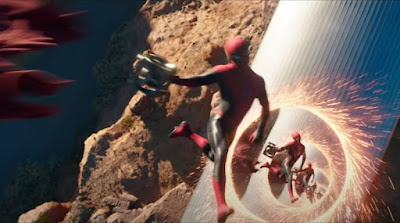
Here’s a Spider-Man movie about how much fun earlier Spider-Man movies were. Sure, it’s also about second chances (for Spider-Men) and learning from your (Spider-Man) mistakes and finding the people who truly love you for who you really are (Spider-Man). But I guess that makes it all the more a movie that begins and ends with nothing but Spider-Man and references to Spider-Man and cheap hits of nostalgia for Spider-Men we’ve loved and lost before. By the finale of Spider-Man: No Way Home, which brings together a cavalcade of cameos for web-swinging acrobatic action and pretends it built (or re-built) characters along the way, it made me, as someone who, I’ll admit, would call Spider-Man my favorite superhero, want the impossible: less Spider-Man.
This oddly flat and clunky project, the latest in the ongoing Marvel Cinematic Universe, opens up a live-action Spider-Verse to tromp around in. Peter Parker (Tom Holland) asks Dr. Strange (Benedict Cumberbatch) to help the world forget he’s the friendly neighborhood superhero. The spells goes wrong and results in characters from previous Spidey pictures stumbling in disoriented and wondering what to do with themselves. There’s Doc Ock (Alfred Molina) and Green Goblin (Willem Dafoe) and Sandman (Thomas Haden Church) from the Tobey Maguire movies and Electro (Jamie Foxx) and Lizard (Rhys Ifans) from the Andrew Garfield ones. The movie’s best idea is also what saps it of energy: these guys are way too confused to be much of a real threat. Instead, Strange and Spidey argue over how best to solve the problem. The wizard doctor wants to zip-zap them back from whence they came where they’ll meet their doom, while good ol’ Peter thinks he can save them. They’re scientists, after all, victims of one misfiring experiment or another. (This movie thinks their villainous natures can be subsumed under the audience’s affection for the characters and performers.) Practically, however, it’s a movie going around in circles, hoping to keep an audience’s interest by trotting out these cameos and lingering long enough for applause breaks before giving each returning face pretty much nothing to do.
And, for how befuddled they should be, and are at first, about getting ripped out of their universe and into another, these villains quickly get pretty casual and blasé about the situation. In typical MCU fashion, there are long scenes of actors standing around trading quips, smirking and giggling at the outsized sci-fi suspense whipping up around them. There’s nothing so heavy—not even the death of a major character—that can pause the deflating jokes for too long. And these have to be the cheapest and emptiest cracks, as Peter’s pals picked to help present possible solutions to this whole mess—MJ (Zendaya) and Ned (Jacob Batalon)—find themselves scoffing in disbelief at names and powers from these inter-dimensional interlopers. It want to both play off how much people love the earlier Spider-Man iterations and set itself up as the best one. (That they start calling Holland “Spidey 1” gets a little funny in that regard when he’s literally sharing the screen with people whose movies worked way better than this one.) No Way Home wobbles between these two modes: reverent celebration of what came before, and goofy puncturing of any possible seriousness. The entire multiverse is threatening to collapse on itself, and it feels about as monumental as channel surfing. That leaves vast swaths of the movie to clunk along in scenes that aren’t shaped so much as plugged into place, and moments of real high drama played off so abruptly and drearily—there are deaths and magical amnesia that’d hit harder with better track laid for it—that one forgets these are supposed to be real characters to care about and not just action figures clattering around.
Worst has to be the movie’s total lack of interesting style. Much has been made of the MCU’s bland house style, closer to network procedurals than cinema spectacle during downtimes between animated action. The style can be pushed here and there—one could parse the fine gradations between a Johnson, Gunn, or Waititi and a Russo bro—but often settles into a bland TV-style over-the-shoulder conversational tone mixed with quick-cut action in sets that trend to muddy grey. (That this year has found the theatrical and TV sides of the universe ever more immeshed makes this homogenized smallness ever more apparent.) This one’s pretty ugly most of the time: photographed with rarely more than three or four actors in frame together, and dialogue often in alternating tight medium or close up shots. Maybe it’s the fact the whole thing was shot last fall taking COVID precautions, but the look ends up cramped—few extras, smallish sets, and tons of flat blocking that has performers so separated from each other that they might’ve been green-screened in separately. When it comes to Big Names swanning in trying to steal scenes in this airless environment, it feels all the worse.
This ill-fitting sense of where to put people in the frame and how to track their behavior extends to the larger sense that nothing much matters herein. When any character can be whatever the plot needs and come flying in on magic sparkle dust from any other movie of which they want to remind you, it doesn’t much matter what happens to them. There’s something hollow at the core, and no amount of emoting can fill it. There’s a silly scene where characters from three different universes seriously compare iterations of advice from dead mentor figures, all tearing up and nodding sagely and talking about how meaningful the franchise’s triplicate pop psychology is. It goes for heavy meaning, but instead piles up comic cliche until it triple-underlines the silliness because the story’s only connection to anything real or human in its movements are to what it means for Spider-Man. And the collision between different visions of the character ends up highlighting how directors Sam Raimi and Marc Webb, for whatever missteps one might concede, were making real movies with their earlier versions, and Jon Watts, on his third go around, is stuck making a product. When characters from the earlier pictures arrive it’s from a different world entirely—one where these superhero movies weren’t only about themselves and pitched for a blandest possible homogeneous outcome. They interact awkwardly with the MCU world because they carry with them messy tendrils of style and substance that can’t entirely get polished away by the shallowness they’re asked to play.
This oddly flat and clunky project, the latest in the ongoing Marvel Cinematic Universe, opens up a live-action Spider-Verse to tromp around in. Peter Parker (Tom Holland) asks Dr. Strange (Benedict Cumberbatch) to help the world forget he’s the friendly neighborhood superhero. The spells goes wrong and results in characters from previous Spidey pictures stumbling in disoriented and wondering what to do with themselves. There’s Doc Ock (Alfred Molina) and Green Goblin (Willem Dafoe) and Sandman (Thomas Haden Church) from the Tobey Maguire movies and Electro (Jamie Foxx) and Lizard (Rhys Ifans) from the Andrew Garfield ones. The movie’s best idea is also what saps it of energy: these guys are way too confused to be much of a real threat. Instead, Strange and Spidey argue over how best to solve the problem. The wizard doctor wants to zip-zap them back from whence they came where they’ll meet their doom, while good ol’ Peter thinks he can save them. They’re scientists, after all, victims of one misfiring experiment or another. (This movie thinks their villainous natures can be subsumed under the audience’s affection for the characters and performers.) Practically, however, it’s a movie going around in circles, hoping to keep an audience’s interest by trotting out these cameos and lingering long enough for applause breaks before giving each returning face pretty much nothing to do.
And, for how befuddled they should be, and are at first, about getting ripped out of their universe and into another, these villains quickly get pretty casual and blasé about the situation. In typical MCU fashion, there are long scenes of actors standing around trading quips, smirking and giggling at the outsized sci-fi suspense whipping up around them. There’s nothing so heavy—not even the death of a major character—that can pause the deflating jokes for too long. And these have to be the cheapest and emptiest cracks, as Peter’s pals picked to help present possible solutions to this whole mess—MJ (Zendaya) and Ned (Jacob Batalon)—find themselves scoffing in disbelief at names and powers from these inter-dimensional interlopers. It want to both play off how much people love the earlier Spider-Man iterations and set itself up as the best one. (That they start calling Holland “Spidey 1” gets a little funny in that regard when he’s literally sharing the screen with people whose movies worked way better than this one.) No Way Home wobbles between these two modes: reverent celebration of what came before, and goofy puncturing of any possible seriousness. The entire multiverse is threatening to collapse on itself, and it feels about as monumental as channel surfing. That leaves vast swaths of the movie to clunk along in scenes that aren’t shaped so much as plugged into place, and moments of real high drama played off so abruptly and drearily—there are deaths and magical amnesia that’d hit harder with better track laid for it—that one forgets these are supposed to be real characters to care about and not just action figures clattering around.
Worst has to be the movie’s total lack of interesting style. Much has been made of the MCU’s bland house style, closer to network procedurals than cinema spectacle during downtimes between animated action. The style can be pushed here and there—one could parse the fine gradations between a Johnson, Gunn, or Waititi and a Russo bro—but often settles into a bland TV-style over-the-shoulder conversational tone mixed with quick-cut action in sets that trend to muddy grey. (That this year has found the theatrical and TV sides of the universe ever more immeshed makes this homogenized smallness ever more apparent.) This one’s pretty ugly most of the time: photographed with rarely more than three or four actors in frame together, and dialogue often in alternating tight medium or close up shots. Maybe it’s the fact the whole thing was shot last fall taking COVID precautions, but the look ends up cramped—few extras, smallish sets, and tons of flat blocking that has performers so separated from each other that they might’ve been green-screened in separately. When it comes to Big Names swanning in trying to steal scenes in this airless environment, it feels all the worse.
This ill-fitting sense of where to put people in the frame and how to track their behavior extends to the larger sense that nothing much matters herein. When any character can be whatever the plot needs and come flying in on magic sparkle dust from any other movie of which they want to remind you, it doesn’t much matter what happens to them. There’s something hollow at the core, and no amount of emoting can fill it. There’s a silly scene where characters from three different universes seriously compare iterations of advice from dead mentor figures, all tearing up and nodding sagely and talking about how meaningful the franchise’s triplicate pop psychology is. It goes for heavy meaning, but instead piles up comic cliche until it triple-underlines the silliness because the story’s only connection to anything real or human in its movements are to what it means for Spider-Man. And the collision between different visions of the character ends up highlighting how directors Sam Raimi and Marc Webb, for whatever missteps one might concede, were making real movies with their earlier versions, and Jon Watts, on his third go around, is stuck making a product. When characters from the earlier pictures arrive it’s from a different world entirely—one where these superhero movies weren’t only about themselves and pitched for a blandest possible homogeneous outcome. They interact awkwardly with the MCU world because they carry with them messy tendrils of style and substance that can’t entirely get polished away by the shallowness they’re asked to play.
Monday, December 6, 2021
End of His Rope: THE POWER OF THE DOG
The Power of the Dog is a darker Western than you might think at first. It’s a psychological rope-a-dope, playing a devious slow-burn game with audience identification and the balance of power between its characters. No surprise, then, it’s the return of writer-director Jane Campion, an expert in pin-point precise emotional turns and unexpected shifts of influence in knotty interpersonal dynamics. In it you might find the dark romance and tough familial strife animating her classic 1993 feature The Piano, the fraught tremulous feelings of potential love from her swooning Keats’ picture Bright Star, the entanglement of desire and danger from her neo-noir In the Cut. But it’s also a bracing original all its own. Here she finds a gruff rancher (Benedict Cumberbatch) trotting into town with his brother (Jesse Plemons). They linger in the restaurant of a widow (Kirsten Dunst) and her awkward teen son (Kodi Smit-McPhee). With a bully’s eye, the rancher targets the boy for withering insult—the older man’s twisted smirk of superiority turned on appearance and hobbies, as well as insinuations about sexuality. Sad, then, that the four characters are drawn closer together as the boy’s mother and the rancher’s brother begin a tentative romance that brings the people together to spend a lot of time on a tract of land that’s somehow both expansive and constrained. It’s a sprawling western landscape austere in its beauty and foreboding, on which hiding away in the wild edges is possible, but somehow they keep stumbling into each other’s business anyway.
Campion, as is her wont, avoids the easy categorization of quickly understandable types and clean lines of conflict for something more intriguingly complex. Adapting a novel by Thomas Savage, the film becomes a long, slow process of being drawn into the ways in which the characters behave toward one another. I found myself leaning in, wondering just what makes these characters tick, and what it’ll mean as they unfold their complexities in conflict or conjunction with others’. There’s an inscrutable quality to the performers Campion uses well. She takes Cumberbatch’s penchant for performances that stand a little above and apart from material and makes it part of a character’s ill-fitting persona—a man overdoing it in an attempt to project the curt masculinity he wishes to inhabit. With his brusk gesticulations, uneasy gait, and his aggressively simmering verbal jabs, he’s playing an abusive part. He’s done it for so long, he hardly knows another way to be. He’s lost in himself. Smit-McPhee, on the other hand, cuts an even more peculiar figure, separating him from the others. He’s incredibly tall and almost impossibly thin, with darting eyes and half-clumsy, half-elegant movements. He’s posed and photographed at once tangible and ethereal, a curious young man who’s somehow all sharp edges and soft features. He doesn’t quite fit a type, either. Then there’s his mother, with Dunst imbuing in her the fragile trembles of vulnerability and hidden (though increasingly exposed) undercurrents of alcoholism, and her new beau, a man whom Plemons plays as a steadying influence who may or may not be the support anyone needs.
Campion stirs the suspense so patiently and perceptively, drawn along by striking natural beauty and a tense stringy Jonny Greenwood score, that it’s not until deep into the run time that I found myself aware of how gripped I was by these characters’ interactions. Here’s a movie about all sorts of sublimated undercurrents, in which a lingering gaze or a furtive gesture or an isolated private moment exposes far more than expected. It’s about how fragile confidence can be, especially as it so easily gets subverted and eroded by jealousies or passive-aggressive tussling for control or social currency. Fittingly, the movie finds the Western perched on the edge of modernity, with early model cars rattling around the dusty roads leading to the small town creaking past a slightly outdated mode of life that’s receding. Nothing lasts forever. As the shifting currents of relationships reveal new modes of life for the tightly wound people in the quartet of performances that push and pull toward an inevitable confrontation of one sort or another, the capacity for learning something new about someone remains. One extraordinary scene late in the picture finds, through a cloud of smoke casually exhaled, a vulnerable innocent suddenly, before our eyes, seductive and sinister, while a brooding brute appears suddenly vulnerable. The artifice of their posturing has burned off, if only fleetingly, leaving the rawness of the unformed and unspoken.
Friday, April 27, 2018
All Superheroes Go To Heaven: AVENGERS: INFINITY WAR
Of all the Marvel Cinematic Universe films so far, the
latest, Avengers: Infinity War, is
certainly the very loudest. I suppose it has a right to be. Billed as the
Series Finale when anyone with a working brain knows it’s merely the biggest
Season Finale yet, it’s the culmination of ten years of these things. Ever
since Samuel L. Jackson’s Nick Fury stepped out in the post-credits scene of
2008’s relatively compact, swift, and charming Iron Man, promising to introduce that hero to a few others, it’s
been an endless string of formulaic origins and meetups. At least the formula –
90 minutes of exposition, banter, and fun with character actors, followed by a
30-minute CGI shooting gallery – remains sturdy enough, and the performances
roped in charismatic enough – that it rarely feels too much. They vary in
quality. I prefer the looser hangouts where the action has a zing of screwball
B-movie appeal (Iron Man 2, Avengers 2,
Thor 2, Spider-Man Homecoming) or earnestness (Captain America 1, Black Panther) to the ponderous self-important
ones (Captain Americas 2 and 3) with
the ones in between tolerable, too. But generally they are completely
disposable diversions. I enjoy them, and then they evaporate, leaving only
vague impressions and the sense they should bring back Sam Rockwell someday. Infinity War is what all 18 films have
built towards, the culmination of many Infinity Gem MacGuffins and Thanos
references, as the purple titan himself (voiced with a growl by Josh Brolin,
whose likeness stares back at us from soulful computerized eyes) comes crashing
down to Earth looking for ultimate power, and two dozen heroes assemble to beat
him back.
This results in apocalyptic sequences as the characters are
genuinely frightened for once in the franchise. Their quips pale in comparison
to a man wielding an enormous gold gauntlet slowly studded with the glowing
powers needed to wipe out half of existence in the snap of his fingers. When a
ginormous whirring oval spaceship hovers over New York City, there are ominous
stakes as Doctor Strange (Benedict Cumberbatch), Hulk (Mark Ruffalo), and Iron
Man (Robert Downey Jr) mix worry into their determination. They all want to
defeat Thanos – once they’re caught up on his plan, that is – but aren’t sure
how to go about doing it. He’s already one of the galaxy’s most powerful
beings, with an evil plot nigh incomprehensible in its universe-wide genocidal
scope. What are a bunch of plucky knockabout do-gooders going to do in the face
of that? Still, this is a Marvel movie, and the jokes fly fast and frequent,
and, as directed by the Russo brothers and scripted by series’ regular writers Christopher
Markus and Stephen McFeely, ably balances the tones. It also shuffles a
massive cast in interesting ways, letting characters hitherto separated by time
and space collide in fun exchanges and tenuous team-ups in bright, clear, IMAX cinematography.
Of course, it doesn’t hurt that it leans on its best
features – letting Spider-Man (Tom Holland) earnestly tag along behind Stark
and Strange, and ceding all of the film’s galactic plotting to the winning
combination of the Guardians of the Galaxy (Chris Pratt, Zoe Saldana, Dave
Bautista, et al) and Thor (Chris Hemsworth). (They are the funniest and, funnily
enough, the most emotionally engaged, too.) It’s something of a screenwriting
and editing marvel (oh, pun not intended, believe me, but now I’m sticking with
it anyway) to keep something like 30 major speaking roles – all major players
in their respective realms – and a couple different tonal modes balanced to
such a successful extent. Part of it is the streamlined plot, subplots carried
over mostly shunted to the side due to the enormity of the main dilemma,
allowing the characters to focus on one goal. Part of it is giving different
pieces of the goal to different smaller team-ups: a cosmic crew, an Earthbound
squad (led by Captain America (Chris Evans), Black Widow (Scarlett Johansson),
and a stay with T’Challa (Chadwick Boseman) in Wakanda), and one travelling
between. It’s perfectly engineered to bounce between these groupings of heroes,
giving each and every one a crowd-pleasing entrance and perfectly timed laugh
line or action pose throughout.
These performers have a certain iconoclasm to their
positioning in the roles by now, and it’s great fun watching them spar and quip
and fight side by side. The action is largely satisfying, too. Not quite as deadening
as usual, it has heft and design, some cleverness, and some big, booming
consequences (that will inevitably be almost or entirely reversed next summer,
but are still satisfying shock in the moment). Best of all are the
applause-break splash panel moments – my favorite goes to a thrilling
late-breaking electric return in the battle royale finale. It may be a big,
dumb, violent cartoon, but improbably Marvel Cinematic Universe productions
have accumulated affection and accrued pleasures that outweigh any individual
film’s successes and flaws. It’s a high-budget, high-spirit corporate product.
It’s blockbuster serialized filmmaking, a massive sporadic television
production on the big screen. The only gamble is that we’ll want to see our
favorite charming superhero buddies pummeled and bloodied and beaten down to
their lowest point yet, and still clamor to see them bounce back again, and
again, and again. As long as the movies are this passably satisfying, agreeably
diverting, and leave the audience just curious enough to see what happens next,
they will. Infinity War, indeed.
Friday, November 3, 2017
Norsing Around: THOR: RAGNAROK
There’s not a lick of suspense to be found in Thor: Ragnarok, as weightless and
mild-mannered as a superhero space epic can be. It’s partially because of its
dedication to being a breezy lark. But it’s mostly due to its position as yet
another widget dropping into the Marvel Cinematic Universe machine, every
interlocking franchise entry continuing the pattern of containing endless
forward momentum with little actual progress. The whole endeavor, diverting
though it may be, is always moving to the next one, and the next and the next,
with no time to shape its characters’ or settings’ development into anything
more than whatever is convenient to serve up the latest flavors of fun
lightshow action and design. That is how you end up with a movie that places
beloved Norse God Avenger Thor in direct confrontation with the end of his home
kingdom Asgard, an apocalyptic vision of Ragnarok coming true, and yet it feels
like nothing is at stake. A people, a realm, a dazzling digital vista, might
burn up into nothingness and there’s no danger. It’s too busy staging striking
electric-day-glo Jack Kirby-styled CG adventure and lovingly holding on
eccentric character actors in scene-stealing supporting roles. There’s plenty
of fun to be had, but it adds up to the usual fleeting charms tied together
with a climactic conflagration cliffhanger.
Like all the best of the MCU movies, the filmmakers behind Ragnarok make sure the production design
is aesthetically pleasing in color and scale and the typical quipping script is
handled with the peppy fizz of comic timing. The story features Thor knocking
about space in lengthy sequences that team him up with a variety of lovable
rouges and charming weirdos. It’s a nesting doll of buddy movies, director Taika
Waititi taking the same loose, sweet, half-mumbled, aw-shucks delivery of his What We Do in the Shadows and tying it
to the bombastic fish-out-of-water silly contrasts that are the Thor movies' stock in trade. It hardly
matters that the plot’s engine is the God of Thunder’s long-lost older sister
(Cate Blanchett) kicking him out of the family home, causing him to wander the
cosmos in exile collecting a team that can take her down. What it really is up
to is providing an excuse for colorful, half-funny/half-exciting set-pieces.
That’s entertaining enough. He pals around with his slick trickster brother
Loki (Tom Hiddleston); he gets his feathers ruffled by Doctor Strange (Benedict
Cumberbatch); he gets captured by an alcoholic swaggering-cool bounty hunter
(Tessa Thompson, who should have her own spinoff); he is forced into gladiatorial
combat by a trash-planet’s loopy ruler (Jeff Goldblum, delightful with every
word); he befriends a soft-spoken rock monster (Waititi); he is knocked about by Hulk
(Mark Ruffalo). It’s all fun and games, Thor so elastically invincible he can
slam through walls and bounce back swinging, yet so mellowed by his many heroic
deeds in the past that he now rides a chill pleasant vibe. He's in on the joke.
There’s a knockabout slapstick tone to the action that
integrates the massive IMAX-sized spectacle and the little filigrees of
personality allowed to the players involved. Waititi is given the space to
build a massive painterly slow-mo vision of warriors atop winged horses diving
toward a storm of arrows, and also let Thompson’s Valkyrie sparkle with a
twinkle in her eye and a soft sway in her step. It has an enormous battle on a
rainbow bridge for the fate of Asgard, and the soft splat of a body hitting the
ground with a pratfall plunk. It has a concussive battle between a God and a
monster – friends turned foe for the amusement of a rascally side-villain – and
enough room to let Goldblum bring down the house with an arc of his eyebrow or
a self-amused stammering surprise delivery of a wry line. (He confronts a
captive with a seeming reprieve with a line bearing a stinging tail: the good news he’ll be
spared…“from life.”) It’s all of a pleasant diverting piece, from the gleaming
fake vistas – though why, in a movie with convincing mythological kingdoms and
neon-landfill planets, a field in Norway is the phoniest setting is beyond me –
to the likably bantering leads and every slick glowing digital swooping
adventure sequence in between. There may be precious little there there, but at
least the frivolity is enough for an entertaining couple of hours of shiny pictures, charming people, and a synthy noodling Mark Mothersbaugh score. Though it's fleeting and disposable, it's a successfully playful and tossed-off version of ingratiating Marvel
bombast.
Subscribe to:
Posts (Atom)