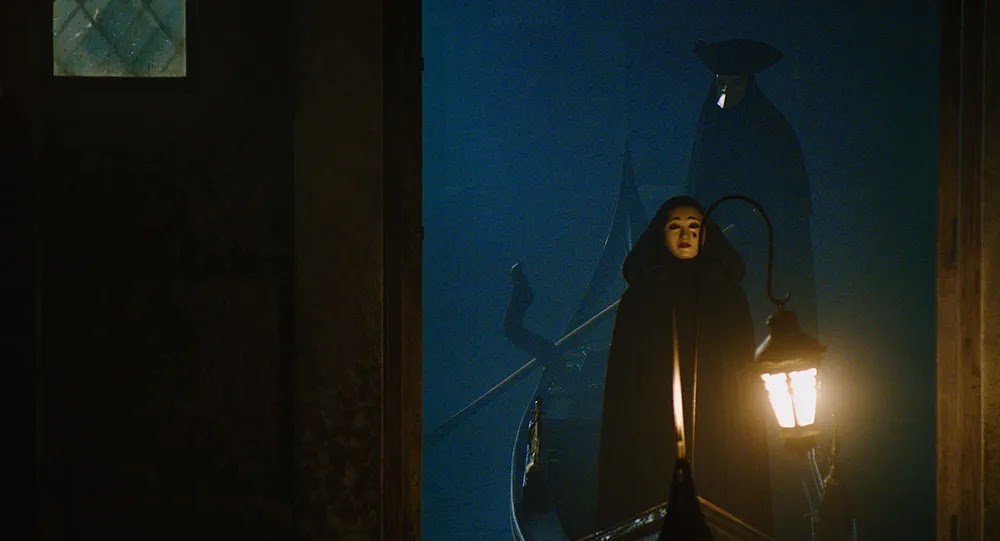
It’s fitting that such a theatrical ham of an actor as Kenneth Branagh, so good at making full course meals out of others’ words, would be drawn, as director, to inhabit others’ works. His directorial career is full of echoes and inhabitations both literary (Shakespeare, Shelley) and filmic (Hitchcock, Lean). This doesn’t always lead to a good movie, but he’s a man of ostentatious Good Taste in a jolly old English way as befits a graduate (and current president) of London’s Royal Academy of Dramatic Art. His latest work as filmmaker, A Haunting in Venice, is his third turn with an Agatha Christie novel, returning as director and star in the role of famous detective Hercule Poirot. It is the best of these three—after Murder on the Orient Express’s airless exercises and over-gilded energy, and Death on the Nile’s expansive melodrama and bitter undercurrent. Compared to those, it has the smallest ensemble (Tina Fey, Michelle Yeoh, Kelly Reilly, and a two-man Belfast reunion). But such spareness successfully builds on this series’ best assets: a sense of world-weary cynicism held back by a relentless cold detective logic that makes even the darkest edges and dreary deaths solvable with a sharp mind and steady investigation.
This one’s literally dripping in atmosphere. The setting is a damp Venetian palazzo on a dark and stormy night, the wind battering the windows, waves crashing into the walls, lights flickering, faucets dripping, interiors clammy and steps slippery. He films it like Welles might, in intense canted closeups reminiscent of Mr. Arkadin and snaky shadows like Touch of Evil. (To keep what Leonard Maltin might call the “Wellesian tomfoolery” going, a cut to a shrieking bird has to be a nod to Kane, and an early shot of a dramatic iron-gated gondola garage and a masked and robed figure is reminiscent of the only extant scene of Welles’ abandoned attempt at Merchant of Venice.) These surface pleasures are fun and potentially shallow, but Branagh finds plenty of percolating character beats and sneaky suspense to keep interest boiling with pop depths somberly intimated. In this locked-room mystery, Branagh is cranking up the spookiness and the sadness in equal measure, letting a blurry, bleary, midnight mood creep around corners and lurk in shadows.
As always in these stories, the murderer is in plain sight, and the cast of recognizable names stumble about in fear and suspicion, driven backwards into their frazzled psyches and paranoia as they try to survive the night. Christie’s sense of social status and class concerns takes a backseat to the tightening tensions and grief-stricken group. They were gathered for a seance: a mother who lost her daughter, a father damaged by war, a young son grappling with his father’s illness. (The seance itself is a fine, formulaic balance between sinister silence and sudden smashes.) Now they’re waiting out the storm while Poirot and his mustache must ask them enough questions to figure out the ghost of a clue. They’re as haunted by death and mystery as the film is by its influences—and its somehow a pleasing combination. For all the plot’s twists and turns, biggest surprise for me, though, was discovering that I’ve grown quite fond of Branagh’s broad take on Poirot with his puffed-up eccentricities and earnest melancholy. Beneath the starched facial hair and chewy accent there’s a real character there.
Showing posts with label Tina Fey. Show all posts
Sunday, September 17, 2023
Friday, December 25, 2020
Out of Body: SOUL
Pixar’s Soul is an unusually perceptive family movie about finding meaning in life. It dares to say life’s purpose is not to cultivate a great talent or have the perfect family or find true love. A good life is simpler than that. How rare it is to find any Hollywood movie resisting the determinism of easy goals and cheap sentiment? This is a movie boldly pushing off into existential waters, directly confronting matters of life and death, and finding a satisfyingly artful and, well, soulful approach to those mysteries. What a neat trick. It starts with a New York City middle-school music teacher (Jamie Foxx) who dreams of being a jazz pianist. Although it’s clear he has the ability to communicate to his students some of the wonder he feels when getting lost in great music, vibing with talent when he’s in the zone, he has bigger dreams. Years of nights and weekends gigging in small clubs, or getting rejected by the bookers and bands thereof, is finally about to pay off when a jazz legend (Angela Bassett) invites him to join her quartet. Too bad, then, that on his way home from their meeting, he dies. Unlike Coco, the cavalcade of color and music and family togetherness that was Pixar’s prior sojourn into the afterlife, this film sends its lead to a cold and sterile place, an enormous glowing white light in total blackness, and a moving sidewalk going up, up, up. Where on Earth the score was full and jazzy with arrangements by Jon Batiste, here it's Trent Reznor and Atticus Ross with swirling New Age synths and spare melodies. Body-less, souls are glowing pale blue blobs led around by geometric modern art profiles. It’s a clear contrast to the bustling, realistically rendered world he’s reluctantly leaving behind. Our lead most desperately wants to escape. You can’t blame him. He falls off the path—through a dazzling variety of squiggly visuals—and lands where souls are trained to be sent down into babies. They must find their spark, a ticket out of this theoretical space and into the world below. This, he thinks, is his ride back to his body.
The stage is set for a typical Pixar plot: hurrying and scurrying around and through barriers and setbacks on the way to a clear goal, while playing loop-de-loops around the logic of a fantasy world. Our lead even gets paired up with a mismatched reluctant buddy, in the adorably aggravating figure of a soul that doesn’t want to be born (Tina Fey). (She’s the source of most of the comedy here, a kind of gentle rat-a-tat patter of silly quips and sparing cutaway gags.) Even so, the most pleasant surprise is to find that the film’s progression isn’t mere formula. Or at least, not completely. Writer-director Pete Docter (Inside Out, Monsters, Inc.) and his co-writer-director, playwright Kemp Powers, instead find through the conceit a means by which to explore the small things that make life worth living. The film tumbles back to earth with a supernatural premise of trying to rekindle a spark in a lost soul. There, resisting a grand thesis, or deadening satire (the afterlife’s bureaucracy has none of the rigorous rules of prior Pixar realms), the movie situates itself lovingly in small interpersonal moments. A teacher guiding a promising pupil. A barbershop bustling with friendship and connection. A mother who just wants the best for her son. A musician who hopes to live up to his potential to connect with a crowd. Because the animation is so warmly textured and fluidly developed, and the writing has such a keen ear for the music of the moments, there’s a remarkable sense of life bustling and bursting. It’s smooth, but takes the usual bops and bumps of this kind of parable; it draws favorable comparison to It’s a Wonderful Life for its otherworldly assist. And yet it doesn’t end with everyone improved supernaturally. It finds quiet contentment in warm memories and simple steps toward a brighter future. Here’s a family film with flights of fancy and eye-popping visual invention that finds its greatest astonishments in the ordinary details of real life.
Thursday, March 3, 2016
Foreign Correspondent: WHISKEY TANGO FOXTROT
If you believe Whiskey
Tango Foxtrot it’s a miracle we’ve had any coherent reporting out of the
war in Afghanistan. It’s a movie singularly focused on a group of correspondents
living in a chaotic Kabul from 2003 to 2006. They drink, flirt, party, hook up,
jockey for airtime and sources, and then occasionally ride out into danger with
American troops. What work they accomplish seems to happen in quick bursts,
often almost accidentally, between bouts of fear, discomfort, violence, and
gallows humor. It’s a mess. The movie follows suit as a lumpy, misshapen thing,
a real quagmire that blunders in with good intentions then bides its time
getting more complicated until, suddenly, it withdraws. It is more concerned
with a perspective of fish-out-of-water befuddlement than contextualizing its
sights and events. It hopes you already know a little about the conflict, and
are interested in seeing it from an off-center angle.
Taking the real story of reporter Kim Barker as its
inspiration, the movie stars Tina Fey as a woman stuck writing up boring
stories in a dull office who jumps at the chance to head off to Afghanistan and
get her boots on the ground. She thinks it’ll be a fun change of pace, but the
longer she stays the more she finds herself addicted to the frenzied and
unpredictable lifestyle. She finds it’s much better than her life back home,
with a sad desk job and a boring boyfriend (Josh Charles). She’s the fish out
of water who discovers she’s wanted to run this sort of terrain all her life
and didn’t even know it. There’s an Oprah-ready quality to the cliché self-actualization
here, but this story of a middle-aged woman who gets her groove back by
succumbing to her inner adrenaline junkie is no Eat Pray Love. It’s sharper, and edgier, just as likely to draw
blood as to shout raunchy sarcasm, or stare contemplatively and
uncomprehendingly at some aspect of Afghan life, which remains closed off to
characters who are theoretically there to make sense of it for the rest of us.
Screenwriter Robert Carlock (a longtime Fey collaborator,
from SNL to 30 Rock and Unbreakable Kimmy
Schmidt) conceives the piece with a seesawing tone, wobbling between
serious-minded comedy and irreverent drama. It’s never more than mildly
amusing, and the dread never quite lands either. But they try. There are scenes
of tragic drone strikes played for straight-faced horror, a daring night raid
undercut by a Harry Nilsson needle drop, and sudden outbursts of ordnance
interrupting all sorts of activities. Fey heads out with troops led by a gruff,
dryly funny general (Billy Bob Thornton), snarks with a coarse Scottish
photographer (Martin Freeman), and makes warm tentative friendship with her
interpreter (Christopher Abbott) and cameraman (Nicholas Braun). This is
certainly a masculine environment, into which comes an easy rapport with a
radiant blonde correspondent (Margot Robbie) who takes her under her wing.
Together they make a fine statement about women in the war zone workplace:
underestimated, undervalued, and constantly fending off unwelcome advances.
Less a narrative, more a collection of scenes that slowly
arrive at a thematically tidy endpoint, directors Glenn Ficarra and John Requa
(in a mode closer to their dark true crime comedy I Love You, Phillip Morris than their slick and smooth heist
picture Focus) keep up the chaos.
It’s a good way of keeping us disoriented, and then, minutes from the end, a
shock to realize its become normalized in a cut back to a tranquil homeland.
(That’s a pale echo of a far superior similar moment in The Hurt Locker.) They don’t go for long takes or coherent spatial
geography. In fact, there’s little interest here in sketching out the geography
or geopolitical facts at all. Put that with the loose structure and you get a
movie that’s interested in reporters and war, but fuzzy with the specifics. And
it’s this fuzziness, matched with the wobbly tone and wheel-spinning story,
that ultimately sinks the film despite Fey having what is perhaps her most
fitting non-TV role to date.
Whiskey Tango Foxtrot
treats its setting with casual disregard for understanding, coding its
production design as Other, often scary. Every foreign element is shot to be as
exotic, miserable, or mystifying as possible. It can’t decide whether Fey’s
headscarf is a source of amusement, cultural appropriation, or social
commentary. (Worse still is a sequence in which she goes undercover in full
local garb, shown in billowing supermodel slow-mo while westerners smirk.) It
casts several white actors to play major Afghani roles, and uses cross-cultural
misunderstandings as cutesy punchlines, like when an elderly, maybe senile,
villager sees an African American soldier and says, “the Russians are black
now!” Maybe you could pull this off as metatextual commentary about the
confusion Fey feels, but when you’re making a movie about a journalist, an aura
of informal insensitivity in portraying this country is disappointing. It’s a
movie that’s too fascinating in its setup to be this thin, hesitant, and
unfocused in implementation.
Monday, December 21, 2015
Doing It For Themselves: SISTERS
Two adult siblings learn their parents have sold the family
house when they’re told to show up and pack up all the junk left in their
childhood bedrooms. Sad to let the last vestiges of youth go, the pair
orchestrates one last party, a raucous blowout to remember the good old days.
If this plot – thinly developed and overfamiliar – was the engine for a movie
called Brothers and starred any two
generic bros it would be insufferable, one more man-child comedy indulging carousing
until reluctant maturity arrives. But it’s called Sisters (no relation to the DePalma of the same name), and stars
Tina Fey and Amy Poehler, a great pairing for a fine gender swap of the usual potty-mouth
party movie. The result is an injection of fresh perspective into a tired
formula, a mix of sex talk and sentimentality that’s energized by its leads.
Only Fey and Poehler’s second film together in leading roles
(after 2008’s pleasant Baby Mama),
they’re a fine comedy duo. With a fizzy improvisatory approach to line
readings, turning every punchline and extended bit into agreeably off-the-cuff
coziness, they have sharp timing and a believable sisterly dynamic. Fey is the
older sister, louder and irresponsible, freshly fired from a salon job, kicked
out of the apartment where she’d been staying. Her careless approach to life
has led to her teen daughter (Madison Davenport) pushing her away. Poehler is
the little sister, an overeager perfectionist who has thrown herself into
micromanaged routines as a way of avoiding stewing over a divorce, and worrying
about their elderly parents (Dianne Wiest and James Brolin). Each sees a bit of
what they wish they could be in the other – Fey wants a smidge more structure;
Poehler wants to loosen up – but they cant say so. Instead, realistic levels of
sibling rivalry manifest as admiration and antagonism going both ways.
Reunited in their hometown, under the same roof, they hatch
their partying plan, to recapture good times they feel have slipped away. They
have to go backwards to go forwards. The script by Saturday Night Live and 30
Rock writer Paula Pell sees the women’s immaturity without condoning it,
allowing for a loose and agreeable non-judgmental atmosphere, especially as the
house fills up with their former high school classmates, the ones who never
left town and just settled down. They see right away these folks (Maya Rudolph,
John Leguizamo, Bobby Moynihan, Rachel Dratch, Samantha Bee, and more) have
gotten older, and are dealing with adult problems and aging concerns. It
doesn’t take long spending time at the house party for the guests to loosen way
up (the booze helps, no doubt), the gathering getting progressively rowdier and
more destructive as the night goes on.
Pitch Perfect director
Jason Moore throws a decent bash, keeping the festivities hopping with pounding
music and funny running gags. Fey tries not to drink and be the responsible one
for once, while Poehler downs the intoxicants and flirts half-successfully with
a sweet handyman (Ike Barinholtz). A desperately unfunny dope gets increasingly
deranged. A muscle-bound drug-dealer (John Cena) stands still in the middle of
the revelers, silently blinking. A sad woman zones out in front of a wall of
clocks, contemplating her mortality. A mom gets drunk, an overgrown mean girl
tries to sabotage, and a pedicurist (Greta Lee) takes advantage of an
overflowing washing machine to start a slippery bubble fight. These scenes are
shot for warm laughs and agreeable chuckles in simple bright sitcom staging,
and feel like they could be flipped around without much damage to the overall
arc.
It’s just one eventful collection of banter and silly
sights, driven forward only by the gradually more destroyed house. But the
result is a fine hangout with earnest good vibes. Fey and Poehler are fantastic
ringleaders, both egging on and reigning in the absurdity as it goes along. They’re
committed to looking pathetic, and as the party drags on it’s clear they’re
going to hit rock bottom. (The movie ends up taking this idea very literally.)
It ends with a pat moral conveniently tying up plot threads, but the trip there
is a loose amusing time, turning standard R-rated comedy fare into a breezy
sister act.
Monday, September 22, 2014
Family Tries: THIS IS WHERE I LEAVE YOU
A family gathers in the shadow of their patriarch’s death,
four grown children living under one upstate New York roof for one week at the
behest of their mourning mother. “You can cry. You can laugh. There’s no right
way to grieve,” the mom (played by Jane Fonda, carrying more dignity than the
plot allows) says early in This is Where
I Leave You, a movie that wants you to do a little laughing and a little
crying. It’s a fairly contained and awfully schmaltzy comedy-tinged drama,
completely predictable in the beats that it hits. Uptight jerks learn to loosen
up. Irresponsible cads mature a bit. Generational gaps are bridged, but
slightly. The grown kids have a prickly, but deep down loving, reunion that
involves old grievances, new secrets, and a reason to rethink their lives’
trajectories. The film’s heart is in the right place.
The ensemble is filled with welcome faces, each an
interesting presence in their own right. There’s Jason Bateman as the middle
son, a man who loses his job and his wife on the same afternoon and arrives for
the funeral convinced he won’t share his bad news. Of course that doesn’t
happen. It’s a secret-spilling free-for-all. His sister (Tina Fey) is in a
marriage in the process of chilling, so much so that her husband only lingers
around two or three scenes, a total non-issue the rest of the time. She has an
adorable kid or two, so that’s nice, except for the scene involving potty
training gone wrong. That’s gross. Also back to sit shiva is their older
brother (Corey Stoll). His wife (Kathryn Hahn) wants to get pregnant, a goal
that drives her a little crazy in a condescending way. There’s also a younger
brother (Adam Driver) and his cougar girlfriend (Connie Britton). Talk about a
full house.
The ensemble is strong, if unevenly deployed in thin
subplots. Bateman and Fey have good rapport, with similar clenched braininess
that feels warmly familial. Stoll gets lost in the shuffle, but is a steady,
mildly neurotic, rock, and Driver seems incapable of an uninteresting line
reading. Mother Fonda gets lost in the sea of subplots for most of the film,
drifting through as only a punchline for her oversharing and her boob job. She
deserves better. They all do, really. Jonathan Tropper’s screenplay (based on
his own novel) gives each family member their own little undercooked plots,
complete with their own, largely separate, set of supporting characters (Rose
Byrne, Ben Schwartz, Timothy Olyphant, Dax Shepard). None of them are all that
interesting on their own, but collectively, it adds up to a passable amalgam of
middle-aged concerns and family tensions.
Director Shawn Levy is an effective manipulator, able to
execute material efficiently and professionally. I liked his robo-boxing movie Real Steel, and found small charms in
his Cheaper by the Dozen remake, one-crazy-night
comedy Date Night, and unfairly
maligned flop The Internship. Those
aren’t great movies, but at least they hit some good notes. With This is Where I Leave You, though, despite
all the soft lighting, on-the-nose pop song choices, and sunny greeting-card
encouragements, the movie never quiet achieves emotional lift it seeks.
I couldn’t help but wonder what a Robert Altman type would’ve
done with this material, and not just because the family’s last name is Altman.
With such a large, talented ensemble in a small location, a balanced approach
with overlapping dialogue and thematic concerns might’ve worked better. Though
certainly non-Altman family reunion films like August: Osage County and Dan
in Real Life manage to hit similar notes with greater aplomb that Levy and
Tropper’s work here. It’s bland and comfortable, but never really comes alive
in any way. Still, for a superficial, sentimental, predictable little
middle-of-the-road thing, it could be worse.
Friday, March 21, 2014
Together Again, Again: MUPPETS MOST WANTED
Muppets Most Wanted
finds Jim Henson’s loveable felt-and-fur goofballs up to their usual
good-natured meta trickiness and bountiful warm-hearted silliness. Writer-director
James Bobin, co-writer Nicholas Stoller, and songwriter Bret McKenzie, who
revived the franchise in 2011 with the surprisingly nostalgic and emotional –
but no less gut-bustingly funny – The
Muppets, are upfront about what their new picture is. It’s a sequel with
the Muppets fresh off the success of their last movie setting off on a European
tour where they cross paths with a jewel heist in progress. If that sounds
partly like a riff on 1981’s The Great
Muppet Caper, the original Muppet sequel, it is and the movie owns up to
it, winking right from the start. The opening musical number is “We’re Doing a
Sequel,” a song full of funny barbs at the business of Hollywood and a clear
tip of the hat to Caper’s curtain
raiser “Hey, a Movie!” It’s a movie that loves movies, but loves the Muppets
even more. And that’s irresistible.
In their opening number, which starts right after the
closing number in the last movie, the gang sings about being a “viable
franchise” and preparing what’s technically their “seventh sequel,” warning
that means it’s “not quite as good.” The Muppets are perpetual optimistic
underdogs, lovable misfits who scramble around with manic showbiz energy, eager
to tell you that the show must go on. Their personalities are so agreeably
constant, chaos and order held in perfect, immutable manic amusement. It’s fun
to see them, as performed here by Steve Whitmire, Eric Jacobson, Dave Goelz,
Bill Barretta, David Rudman, Matt Vogel, and Peter Linz, bounce off of each
other in the old ways. Fearless leader Kermit the Frog, exasperated, is always wrangling
Miss Piggy, Fozzie Bear, Gonzo, Animal, and all the others, competing egos and
eccentricities that constantly threaten to derail their variety shows.
As usual, story exists mainly to provide a rigid genre form for
the Muppets to push against, moving through charmingly near-slapdash sequences of jokes and songs. Most
Wanted’s plot involves the world’s greatest criminal mastermind, a
Kermit-lookalike frog named Constantine. He plots to swap places with the
showbiz icon and use the cover of the Muppet tour to burgle museums at every
stop. Most of the movie finds the fake Kermit faking his way through
interactions with the characters we know and love, while the real Kermit plots
to escape a goofy Siberian gulag. Tina Fey plays the warden, snarling, but
softhearted underneath. Fellow prisoners include Ray Liotta and Jemaine Clement
with thick Russian accents and Danny Trejo playing himself. (His description of
his “triple threat” attributes is priceless.) At least the guards and the
prisoners can agree on something, when they sing a song about how their prison
is the best state-funded hotel in all of Russia. Kermit just wants out of
there.
The Muppets gang moves along unaware of the switch for a
while, though some grow suspicious about the changes in their old pal Kermit.
He talks with a gargling vaguely foreign accent now, but their new tour manager
Dominic Badguy (Ricky Gervais, playing up his shiftiness) assures them their
friend just has a cold. They continue with their plan to stage Muppet Shows in a collection of European
cities, every place an occasion for good culturally specific jokes. In Berlin,
the theater marquee reads “Die Muppets.” Seeing this, Statler and Waldorf wryly
wonder if the reviews are in already or if that’s the suggestion box.
Meanwhile, a French INTERPOL agent (Ty Burrell, with a chewy Clouseau accent)
and Sam the Eagle bumblingly investigate the robberies that seem to be
following the Muppets around.
The impostor storyline allows the franchise a level on which
to comment upon its own evolution. Once more Bobin, Stoller, and McKenzie prove
their love for the Muppets. Their version of these characters is not an exact
recreation. How could it be? The Muppets haven’t been exactly the same since
Jim Henson died, and later when Frank Oz stepped away. No matter how good,
Bobin and his crew are impersonators. But Most
Wanted, like The Muppets before
it, is filled with such affection for the characters and the smart silliness of
Henson’s original vision, we’re better off with these films than none at all,
or, worse yet, soulless profit-driven corporate property perpetuation. It’s a
movie that knows what made the Muppets most lovable and sets out recreating it as
best it can, with love and care. The filmmakers are true to the Muppet spirit
without suffocating their own comic sensibilities in an effort to recreate the
work of the irreplaceable original Muppet artists. The film’s story is resolved
because Muppets are true to themselves and to each other. I’m glad to see their
new stewards are as well.
Muppets Most Wanted is
very good entertainment, loaded up with smart references and broad craziness.
It’s a satisfyingly warm and inviting brand of inspired high/low comedy, a barrage
of puns, vaudeville sketches, dry asides, sloppy slapstick, and cornball dad
humor, with wall-to-wall witty musical numbers, lovable homage, and tickling
satire. There’s also a fleet of random and inspired cameos, a good half of
which kids today won’t get and most are sure to baffle kids of the future. In
other words, it’s a Muppet movie. I had a smile on my face the whole way
through. I wouldn’t have it any other way.
Sunday, March 24, 2013
Extracurricular Applications: ADMISSION
Admission is an agreeable
diversion. It’s a mellow college comedy set not amongst the students, but among
the employees. Specifically, as the title may have revealed for you, it’s set
in the admissions department. Our protagonist is Portia, who has been reading Princeton’s
college applications and their attendant essays for sixteen years now. Played
by Tina Fey, reason enough to like her immediately, she’s a hard-worker firmly
settled into her comfortable and predictable life. She’s in a long-term
relationship with a tenured English professor (Michael Sheen, in another one of
his uncannily convincing embodiments of insufferable academics), a man who
clearly takes her for granted. He’s dismissive and only vaguely affectionate
towards her. It’s one of those movie relationships that’s obviously doomed from
the get go. The story that follows involves Portia’s slow realization that the
life she’s living is not the one that will make her happy.
Enter Paul Rudd, playing the principal of an experimental
high school who invites her to visit their campus and give her usual spiel
about applying for Princeton. He’s taken a special interest in a gifted student
with a rocky transcript (Nat Wolff) and wants to make sure she notices and
gives this underdog a chance. It goes against all the rules, but in the movie’s
totally soft and unemphatic way, it forms a minor critique of the college
admissions process as one that is, in some cases, designed to weed out the more
unconventionally promising candidates. But that’s on the film’s thematic back burner,
since what it’s really interested in is showing us that the admissions Portia
most needs to make are to herself. It’s a low-key movie of self-discovery,
personal growth, and slow evolution of relationship statuses. Admirably serious
about its setting in academia, an unconventional setting and approach for
Hollywood films of any kind, it’s a film that’s nonetheless so low-key that I
was almost afraid that movie itself was going to fall asleep right before my
very eyes.
That it doesn’t is a testament to the charms of the cast
which, Fey and Rudd aside, features lovely small-scale character work from
national treasures like Lily Tomlin (as Fey’s proudly liberal mother) and
Wallace Shawn (as the head of the admissions department). Director Paul Weitz
(working in a mode much closer to his About
a Boy than his American Pie or,
God forbid, Little Fockers) and
screenwriter Karen Croner (adapting the novel by Jean Hanff Korelitz) keep
things moving along cleanly and clearly with a gentle tug of narrative to push
the emotions along in easy and relaxed ways. It’s sometimes funny, but in an
off-hand way rather than through any conventional zingers. It’s sometimes
romantic, but in such a wispy way that it almost registers after-the-fact. It’s
sometimes pointed in explicit summoning of sociopolitical concerns and cultural
studies, but only in the softest possible ways. I found myself smiling and
soothed, if not exactly captivated and entertained.
A tidy embrace of open-endedness and a polite salute to
mildly bad decisions snowballing into big life changes for the better, Admission ends up in a sweet, tender
place as an appealingly minor work. Never once does the movie insist upon its
own worth. Nor does it reach for anything more than its deliberate slightness.
It’s merely a pleasant time with pleasant characters played pleasantly. It’s
the kind of entertainment I’d imagine would play just as well, if not better,
when viewed on cable TV while curled up on the couch some lazy wintry weekend
when a combination of coziness and the common cold demand a
just-complicated-enough piece of comfort.
Sunday, November 7, 2010
Super Bad: MEGAMIND
These days, as long as an animated production has a large supply of studio money flowing in, the movie will at the very least look amazing. That’s the case with Megamind, the latest disappointment from Dreamworks Animation, which is nonetheless blest with bright primary colors and detailed designs. Director Todd McGrath, who previously co-directed the two lame Madagascars, and screenwriters Alan J. Schoolcraft and Brent Simons bring little of interest to the story, which is little more than warmed-over scraps from better animation studios’ far superior efforts. It’s takes the superhero comedy of Pixar’s The Incredibles and the inept supervillain plot of Illumination Entertainment’s Despicable Me and then drains them of wit, speed, and likability.
In fact, it’s hard not to think of the creatively underachieving Dreamworks Animation as Megamind begins with two alien infants fleeing a cataclysmic event, essentially flying through a parody of Superman’s first act on their way to Earth. One is a handsome little tyke for whom it’s all smooth sailing, landing gently under a wealthy couple’s Christmas tree. The other is a blue boy with a bulbous head who has a rocket that clatters through an asteroid field and lands in a prison. They grow up to be superpowered nemeses with the charmed life of hero Metroman (Brad Pitt) being a source of envy for the clumsily diabolical Megamind (Will Ferrell) who constantly wonders how that guy sails effortlessly to acclaim while he has to stew in the shadows. It’s easy to think that the creative team at Dreamworks would have reason to sympathize with Megamind, since their films are so critically underwhelming while their closest rival Pixar puts out films that are consistently acclaimed.
I would have been only too happy to praise Dreamworks latest film. In fact, earlier this year their How to Train Your Dragon was a film that was pleasantly surprising, great fun and the best film they’ve ever produced. (Though maybe the credit should mostly go to Chris Sanders and Dean DeBlois, who definitely left their auteuerist mark on the project.) Megamind, on the other hand, is basically indefensible. It’s sluggish and grating with flat, uninspired vocal performances that sometimes inspire stiff animation. It’s also a film with thin characterization and a deeply uninteresting plot that does little to encourage an atmosphere of fun. It plays like a creation from people who know all the notes to hit when creating a family film but they can’t for the life of them actually figure out how to play the song.
Despite its visually precise and often lovely to regard locations and textures - I especially liked a moment when thousands of flying robots form a face in the sky - this is a nearly unfathomably uninvolving movie. It plays out in fits and starts of clichés and halfhearted jokes. The main battle-of-good-and-evil plot gets off to a fairly promising start with a sequence that finds Megamind, along with his talking fish (David Cross), finally besting Metroman and reacting like a dog that has for once actually caught the car he was chasing. He has no idea what to do next. The filmmakers are right there with him.
Early promise is squandered on a squirmy love-triangle between a disguised Megamind and a sloppy cameraman (Jonah Hill) battling for the affections of a local news reporter (Tina Fey). This plotline then becomes needlessly convoluted with a wholly unconvincing attempt to jump-start the superpowered conflicts. The characters are simply not defined enough to feel convincing. The stakes aren’t imbued with any real sense of danger. Even when the big climax comes and characters are literally swinging buildings around, I found it of some small visual interest but entirely empty of emotion.
Saturday, April 10, 2010
DATE NIGHT: It's a Date!

Date Night is what we tell ourselves Hollywood used to create more consistently. It’s a high concept blockbuster with big stars and a big budget. It’s an action-comedy that’s genuinely exciting and more than a little funny. It moves at a fast pace with a light touch. It’s a perfectly enjoyable night at the movies, even though, as it was winding down, I found myself mildly disappointed that it wasn’t just a little bit better.
After all, the movie stars two of the funniest people working today. Steve Carell and Tina Fey play a married couple whose weekly date night takes a screwball turn when a case of mistaken identity turns their night into a wacky and dangerous race through New York City in order to stay alive and clear up the misunderstandings. Their madcap adventure contains plenty of capably staged action and plenty of laughs. They come into contact with a host of funny characters who are played by a host of funny, talented performers. There’s a hunky security expert (Mark Wahlberg), a mob boss (Ray Liotta), a policewoman (Taraji P. Henson), two shady tough-guys (Common and Jimmi Simpson), and a couple of goofy lowlifes (James Franco and Mila Kunis) who are the real couple that should be at the center of the mess. Needless to say, Carell and Fey are far removed from their suburban-family existence and their circle of friends (which include the always welcome Kristen Wiig and Mark Ruffalo).
Carell and Fey have enjoyable presences on funny sitcoms (The Office and 30 Rock, respectively) and here create an easy rapport. They seem like a real married couple. They have complications and frustrations, sure, but they seem to truly love each other. And when the action movie kicks in, they don’t discover hidden depths in each other, or suddenly become butt-kicking action superstars. Their relationship is a little touching and sweet as their characters remain consistent throughout: likable and relatable. With lesser leads, the movie would be nowhere near as good, even with the excellent supporting cast that has been assembled.
Certainly, the story would not be as memorable if it weren’t for the people acting it out. The plot keeps a lot of thriller and screwball elements in the air, and there’s a feeling that it doesn’t ever develop the ideas more than the plot requires. But what a plot! I’m sure there are plot holes. It’s not complicated, or even particularly distinguished, but it’s certainly enjoyable and involving as it sends the characters racing through ridiculous scenarios and it managed to keep me smiling and chuckling for almost the entire run time. Sure, it retroactively bothers me that the underlying theme about marriage is never fully explored and that the great supporting cast is seriously underused. But the movie was fun enough at the time.
The director is Shawn Levy who ruinously remade The Pink Panther and wasted a perfectly good premise in not one but two Night at the Museum movies. Here, he finally makes a movie that works all the way through. It’s a film that’s energetic without seeming manic while funny without seeming to stretch for laughs. The timing is excellent, the leads are well-deployed, and it doesn’t overstay its welcome. In fact, it all seems to resolve too easily and quickly. If anything, I wanted the movie to go on a little longer. There needs to be just one more turn of the screw, one more unexpected complication. The plot resolves a bit too quickly and easily. Then again, I should be careful what I wish for. This is just an easy, uncomplicated, and enjoyable experience. It's a fun, slick entertainment that’s, at the risk of sounding too willing to be quoted, just right for date night.
Subscribe to:
Posts (Atom)