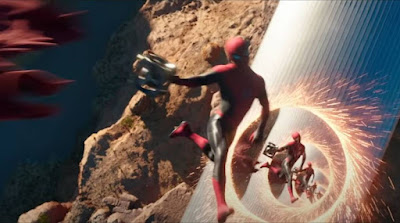
Here’s a Spider-Man movie about how much fun earlier Spider-Man movies were. Sure, it’s also about second chances (for Spider-Men) and learning from your (Spider-Man) mistakes and finding the people who truly love you for who you really are (Spider-Man). But I guess that makes it all the more a movie that begins and ends with nothing but Spider-Man and references to Spider-Man and cheap hits of nostalgia for Spider-Men we’ve loved and lost before. By the finale of Spider-Man: No Way Home, which brings together a cavalcade of cameos for web-swinging acrobatic action and pretends it built (or re-built) characters along the way, it made me, as someone who, I’ll admit, would call Spider-Man my favorite superhero, want the impossible: less Spider-Man.
This oddly flat and clunky project, the latest in the ongoing Marvel Cinematic Universe, opens up a live-action Spider-Verse to tromp around in. Peter Parker (Tom Holland) asks Dr. Strange (Benedict Cumberbatch) to help the world forget he’s the friendly neighborhood superhero. The spells goes wrong and results in characters from previous Spidey pictures stumbling in disoriented and wondering what to do with themselves. There’s Doc Ock (Alfred Molina) and Green Goblin (Willem Dafoe) and Sandman (Thomas Haden Church) from the Tobey Maguire movies and Electro (Jamie Foxx) and Lizard (Rhys Ifans) from the Andrew Garfield ones. The movie’s best idea is also what saps it of energy: these guys are way too confused to be much of a real threat. Instead, Strange and Spidey argue over how best to solve the problem. The wizard doctor wants to zip-zap them back from whence they came where they’ll meet their doom, while good ol’ Peter thinks he can save them. They’re scientists, after all, victims of one misfiring experiment or another. (This movie thinks their villainous natures can be subsumed under the audience’s affection for the characters and performers.) Practically, however, it’s a movie going around in circles, hoping to keep an audience’s interest by trotting out these cameos and lingering long enough for applause breaks before giving each returning face pretty much nothing to do.
And, for how befuddled they should be, and are at first, about getting ripped out of their universe and into another, these villains quickly get pretty casual and blasé about the situation. In typical MCU fashion, there are long scenes of actors standing around trading quips, smirking and giggling at the outsized sci-fi suspense whipping up around them. There’s nothing so heavy—not even the death of a major character—that can pause the deflating jokes for too long. And these have to be the cheapest and emptiest cracks, as Peter’s pals picked to help present possible solutions to this whole mess—MJ (Zendaya) and Ned (Jacob Batalon)—find themselves scoffing in disbelief at names and powers from these inter-dimensional interlopers. It want to both play off how much people love the earlier Spider-Man iterations and set itself up as the best one. (That they start calling Holland “Spidey 1” gets a little funny in that regard when he’s literally sharing the screen with people whose movies worked way better than this one.) No Way Home wobbles between these two modes: reverent celebration of what came before, and goofy puncturing of any possible seriousness. The entire multiverse is threatening to collapse on itself, and it feels about as monumental as channel surfing. That leaves vast swaths of the movie to clunk along in scenes that aren’t shaped so much as plugged into place, and moments of real high drama played off so abruptly and drearily—there are deaths and magical amnesia that’d hit harder with better track laid for it—that one forgets these are supposed to be real characters to care about and not just action figures clattering around.
Worst has to be the movie’s total lack of interesting style. Much has been made of the MCU’s bland house style, closer to network procedurals than cinema spectacle during downtimes between animated action. The style can be pushed here and there—one could parse the fine gradations between a Johnson, Gunn, or Waititi and a Russo bro—but often settles into a bland TV-style over-the-shoulder conversational tone mixed with quick-cut action in sets that trend to muddy grey. (That this year has found the theatrical and TV sides of the universe ever more immeshed makes this homogenized smallness ever more apparent.) This one’s pretty ugly most of the time: photographed with rarely more than three or four actors in frame together, and dialogue often in alternating tight medium or close up shots. Maybe it’s the fact the whole thing was shot last fall taking COVID precautions, but the look ends up cramped—few extras, smallish sets, and tons of flat blocking that has performers so separated from each other that they might’ve been green-screened in separately. When it comes to Big Names swanning in trying to steal scenes in this airless environment, it feels all the worse.
This ill-fitting sense of where to put people in the frame and how to track their behavior extends to the larger sense that nothing much matters herein. When any character can be whatever the plot needs and come flying in on magic sparkle dust from any other movie of which they want to remind you, it doesn’t much matter what happens to them. There’s something hollow at the core, and no amount of emoting can fill it. There’s a silly scene where characters from three different universes seriously compare iterations of advice from dead mentor figures, all tearing up and nodding sagely and talking about how meaningful the franchise’s triplicate pop psychology is. It goes for heavy meaning, but instead piles up comic cliche until it triple-underlines the silliness because the story’s only connection to anything real or human in its movements are to what it means for Spider-Man. And the collision between different visions of the character ends up highlighting how directors Sam Raimi and Marc Webb, for whatever missteps one might concede, were making real movies with their earlier versions, and Jon Watts, on his third go around, is stuck making a product. When characters from the earlier pictures arrive it’s from a different world entirely—one where these superhero movies weren’t only about themselves and pitched for a blandest possible homogeneous outcome. They interact awkwardly with the MCU world because they carry with them messy tendrils of style and substance that can’t entirely get polished away by the shallowness they’re asked to play.
Showing posts with label Jon Watts. Show all posts
Sunday, December 19, 2021
Thursday, July 6, 2017
Swing Shift: SPIDER-MAN: HOMECOMING
The latest product from the Marvel Studios factory is Spider-Man: Homecoming, a co-production
with Columbia Pictures, that company making less an admission of failure and
more a signal of strong showbiz jealousies. The Sony subsidiary hasn’t been
able to make a Spider-Man feature as good as Sam Raimi’s since letting him go,
but surely the powers that be were only interested in loosening the reins on
their rights to the character when they saw the consistent huge grosses and
quality control over at the Marvel Cinematic Universe. They didn’t want to do
right by the character so much as do right by their producers and stockholders.
Still, the result is precisely what you’d hope and expect from bringing in the
people who brought us the whole Avengers product
line. It’s brightly lit and full of good-humored banter, features a great cast
of familiar faces playing colorful characters, and stops every so often for a
dazzlement of colorful CG. Though the formula’s getting tired, this new entry
manages a high degree of charm and fast-paced entertainment (and even a few
genuine surprises). In addition to the predictable polish and routine beats of
a Marvel plot machine, this widget has a sweetness and an energy that makes it
slightly better than average. It’s good fun.
Picking up during the events of last year’s Captain America: Civil War, where this
new interpretation of Spidey was first introduced recruited by Iron Man to be a
potential second-string Avenger, Homecoming
finds Peter Parker (Tom Holland) initially excited to be one of the gang.
(This movie’s biggest uphill climb is having to bounce its continuity out of
what was easily the MCU’s worst movie, a dull grey 147-minute slog.) Alas, his dreams will not be coming true any time
soon. Tony Stark (Robert Downey Jr.) gifts him a souped-up supersuit and tells
him to stick to being a friendly neighborhood Spider-Man. The boy’s just
fifteen, after all. There’ll be plenty of time to be a real hero when he’s
older. This leaves the kid antsy and eager to prove himself, and allows the
movie to stretch out with what’s always best about Spidey’s appeal: his
average, every day, everyman problems. He has homework, an extracurricular
academic challenge team, a cheerfully nerdy best friend (Jacob Batalon), an
unrequited crush (Laura Harrier), a bully (Tony Revolori), a sweet prickly
teammate (Zendaya), and a kind aunt (Marisa Tomei). He has a lot on his plate,
plus the whole sneaking out every evening to patrol the streets, swinging from
buildings to stop bike thieves and ATM bandits.
Writer-director Jon Watts (of the small, tense, kids-in-over-their-heads
thriller Cop Car) and his five
co-writers understand the inherent charm of Spider-Man. They make him a
relatable stressed-out teenager, just trying to fit in and do well at school
while testing his powers. (They’re great, after all, and so, too, are his
responsibilities.) With a bounce in its step, the movie makes like its hero and
juggles the demands placed upon it quite skillfully. It weaves itself into the
fabric of the MCU with better deftness than some of its inferiors, rooting its
villain (The Vulture, played by Batman and Birdman himself, Michael Keaton)
motivation in the aftermath of The
Avengers. One of the more memorable villains in this mega-franchise, his
backstory has him with a contract to clean up the damage from the alien battle,
a lucrative deal that gets pulled when SHIELD classifies the high-tech debris.
Now he’s flying in a makeshift jet-propelled wingspan, making his money on the
black market, smuggling gadgets stolen from the various film’s climactic
calamities (Winter Soldier’s D.C.
craters, Ultron’s rattled fictional
city, and so on). He and Peter – little guys hoping to make big marks – both have
struggles proving themselves in this new outsized ecosphere of heroes and
villains, which gives their clash a little charge. Keaton’s world-weariness
plays nicely against Holland’s adorably boyish happy-to-be-here excitement,
making for a compelling conflict.
Because the bad guy’s a local low-level troublemaker, he
first shows up on Peter’s radar. Since the boy has trouble convincing Stark’s
assistant (Jon Favreau) to take his calls, he feels obligated to put a stop to the
mystery man’s bad deeds as he continually crosses paths with the evil plot. All
this and the big dance, too. There’s the usual roster of fun character actors
popping up to give the zippy plot some added wit and texture (Donald Glover, Bokeem Woodbine,
Hannibal Buress, Angourie Rice, Martin Starr, and Michael Mando among the
pleasant surprises popping up in tiny roles). They keep things pleasant and
crackling with an agreeable comic charge between big splashy two-page spreads
of action – leaping between buildings and off monuments, tussling with henchmen
and saving civilians – that make for the usual superhero shenanigans. These are
all suitably loud and explosive, but also swing with Spidey’s nimble
acrobatics. Watts has managed to make a movie sparkling with enough fun and invention
that its small piece pumps some life back to the larger franchise puzzle. It
simply feels good to spend two hours with a character whose biggest conflict is
wanting to contribute more positive impact in the world than he can manage.
It’s easy to root for him.
Sunday, August 23, 2015
Ride Along: COP CAR
A sharp calling card, writer-director Jon Watts’s Cop Car is an indie genre piece that’s
short, simple, and builds to surprisingly intense suspense. It’s a darkly
logical thriller set on the dusty outskirts of a small town out west, where we
find two boys wandering away from home and into a whole lot of trouble. Watts,
with co-writer Christopher D. Ford, makes a fine amalgamation of John Dahl’s
neo-noir thrillers (like Red Rock West,
The Last Seduction, and Joy Ride)
and loping Grimm fairy tale logic. Two kids head off the beaten path where they
find something they shouldn’t, an emblem of grown-up power that’ll cause them
more trouble than it’s worth. They don’t know any better. They’re just kids,
giddy with make-believe and magical thinking, fascinated by things they only
know about from TV. When they find a cop car abandoned in the woods, of course
they’re ready to explore. When they see keys in the ignition, and can’t see a
cop in sight, they transgress, punishment inevitably following.
So we have two little pigs – “We’ll just tell ‘em we’re
cops!” one boy says, ready to take their pretend up a notch to impersonation,
unaware of how unlikely it is any adult would ever think 10-year-olds are
police – attracting the attention of one very bad wolf. Danger and punishment
takes the wolfish form of a crooked cop desperate to get his car back. You see,
he left his car to take care of some shady business in the woods. When he
emerges to find the theft, he’s livid, panicked, snapping into action. He
simply must get the vehicle back before his colleagues realize what he’s been
up to. The gleaming guns he holsters certainly don’t make the boys’ fates look
safe. The cop is played by Kevin Bacon, in a performance of finely dried ham,
all lean determination and eccentric intensity, like an inarticulate Coen brothers’ specter
sprung from a madhouse.
The kids are equally unreal, or rather movie real. The young
actors (James Freedson-Jackson and Hays Wellford) are an awkwardly perfect
blend of childlike imagination and self-aware artifice, boys being boys being
boys, as realistically frustrating as that sounds. They’re playfully vulgar,
trading swear words back and forth in the opening scene like the language is a
totem of adulthood to which they’re staking a claim. When they drive off in the
cop car, they’re adding an element of palpable danger to their harmless
run-away-from-home plans. It turns a stereotypical benign act of pre-teen
rebellion into something very real, even before Bacon’s sweaty and grim visage
enters the pursuit. I watched with a pit in my stomach as the kids explored the
guns in the vehicle, or accidentally swerved across the centerline much to the
concern of an approaching car. But the man chasing them seems just as deadly.
This can’t end well.
By the time character actor Shea Whigham shows up as a
desperate bloodied figure caught in the middle of the missing car conflict, the
movie turns from a wandering boy’s adventure – like a filthier live action
Disney – into a thin and taught thriller. It’s a chunk of beef jerky of a
picture, dry and tough, unsatisfying compared to a richer meal, but containing
a peculiar and not entirely unwelcome brisk salty snap. To belabor a metaphor
that’s already straining, I’ll add that Watts and his cinematographers
(Netflix’s Daredevil’s Matthew J.
Lloyd and the “Turn Down for What” video’s Larkin Seiple) dress up humble aims
in a slick package. A lovely visual sense of space culminates in a
spectacularly photographed use of light in its final sequence, the lights of
town appearing as a sudden beacon in the dark of night, as the final
ramifications of climactic violence settles. This film is simple and
straightforward, compelling and compact.
Subscribe to:
Posts (Atom)


