Showing posts with label Zendaya. Show all posts

Friday, July 31, 2026

Web Sight: SPIDER-MAN: BRAND NEW DAY

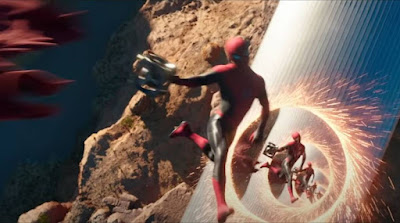
Spider-Man: Brand New Day is the most straightforwardly entertaining Marvel movie in quite some time. It has no multiversal shenanigans or television tie-ins. It’s just a story about colorful characters colliding in the concrete canyons of New York City. Turns out Spidey’s at his best when he’s swinging between skyscrapers. That’s not to say the movie is without its Cinematic Universe trappings. It gets cluttered up with cameos and references and gives over most of its plotting in the back half to what is effectively a backdoor pilot for future comic book storylines with another character entirely. And yet it works pretty well, dovetailing with Peter Parker (Tom Holland) struggling with identity, while fueling some clever action sequences. We get lots of vignettes of crime-fighting, an attempt to stop a hijacked tank rumbling through the streets, a couple psychic chase scenes, and even some hopping among ninjas. Best is one that zips up, down, around, out, and through the top levels of a towering building while Hulk (Mark Ruffalo) and Punisher (Jon Bernthal) alternately help and hurt our main hero. It does a good job juggling variables, and heights. Finally we get one of these MCU Spider-Man movies getting the full vertiginous effect out of his hometown. Even the establishing shots of magic hour skylines or twinkling nighttime windows have some much-needed specificity that the increasingly hermetic green screens and volume video walls lacked in previous entries. (It doesn’t always feel like New York, but it generally feels like a real city streets. Progress!) Is it setting the bar too low to say this one always looks and plays out like a real movie?

It helps that the focus is on Spider-Man himself, even in the midst of all the walk-ons, foreshadowing, references, and loose threads. He’s center stage here; other heroes are clear supporting players in his story. He’s put through an emotional trial, grieving a death from the previous film, as well as recovering from the aftermath of the spell that caused everyone to forget Peter Parker. The citizens still love Spidey, but he’s never been more alone. He’s in constant action, and losing his sense of self. The balance between those ideas is held well in Holland’s body language. He’s a believably more mature and stressed superhero than his high school days. And it’s held in the tone and style, which director Destin Daniel Cretton is well-equipped to pull off from his experience with both outsized acrobatics (Shang-Chi) and small character studies (Short Term 12). He gets good milage out of the chemistry with Zendaya’s MJ, strained by her not knowing their history but sparkling all the same. And he digs into a mysterious quasi-villain played by Sadie Sink, who gets some terrific scenes, even if they often wink and nod in the direction other movies might take. (If they stick to their burgeoning metaphors in later entries, they might be onto something.) The movie is doing a lot, and suffers a bit for it, but it’s intending more of a sampler platter to go along with its core Spidey splash panels. It also manages to not devolve into CG nonsense for its climax, finding instead character-driven motivations and payoffs to root its effects. It’s all pretty entertaining. I’d almost forgotten what it was like to enjoy one of these. 

Sunday, April 12, 2026

Romancing Atone: YOU, ME & TUSCANY and THE DRAMA

If I started listing everything that annoyed me about Kat Coiro’s You, Me & Tuscany it’d start sounding like my reaction was more negative than it was. It’s a big, bright, broad romantic comedy and grooves along pleasantly. It has a cute leading lady (Halle Bailey) playing an aspiring chef who cashes out her meager savings to visit Tuscany. Once there she crashes in a vacant villa and is promptly mistaken for the owner’s fiancé. She decides to go with it because the big stereotypical Italian family are so welcoming and lovely—and travel into each scene en masse like the family in the Big Fat Greek Wedding movies. (No wonder Nia Vardalos cameos in the first scene). As she learns to love life under the Tuscan sun, our heroine’s quickly attracted to a handsome vineyard owner (Regé-Jean Page) who feels a connection with her but doesn’t pursue it, thinking she’s engaged and all. Quite a conundrum. But it’ll work itself out more or less how you’d expect. There’s something to be said for the comforting rhythms of formula storytelling. It almost carries the movie over low-res establishing shots, clunky ADR exposition, flat chemistry from the leads, and a supporting friend character who exists almost exclusively to repeat plot points over FaceTime. Funnily enough for a movie about a wannabe chef, it just adds to a feeling that the whole thing is just a little undercooked, under-spiced, and on too low a boil. It’s the kind of middling dish that gets the job done, but doesn’t truly satisfy. But how often do we get rom-coms that rise to even that level these days, especially in a theater? 

Kristoffer Borgli’s The Drama is also technically a romantic comedy, insofar as it is about romance and has a consistently percolating sense of humor bubbling over into hugely funny moments. But to call it a rom-com would lead potential viewers astray. For all its surface gloss and handsome New York apartments, this is a spiky, prickly movie about a relationship on the brink of marriage and the precipice of disaster. It’s the week of the wedding and the happy couple are given a trust exercise. Name the worst thing you’ve ever done. Big mistake. Robert Pattinson’s flustered Brit — he’s giving 90’s Hugh Grant — becomes slightly, slowly, then all at once undone by the admission of his fiancé (Zendaya). I shan’t spoil her answer, but it’s worth mentioning the movie’s tricky tone and prankish social satire comes out of the sheer liability of the leads and the jolt of electric discourse that their confessions inspire. The movie smirks as it watches others with comparable, or worse, behaviors get sanctimonious, and as it finds characters asking if you can ever really know another person. Here’s a movie about the baggage everyone carries, and how difficult it can be to open it up for someone, even the closest someones, knowing that you’re risking judgment. And, if you’re getting married, you know their baggage will be weighing you down, too. It allows scenes of usual pre-marriage jitters to compound the stress through squirming social situations and escalating psychological sweatiness. The movie’s a sly conversation starter like that, tossing up awkward behaviors and philosophical posturing and watching as the characters flail to get back to a livable normal. Let he who is without sin cast the first stone. 

Wednesday, May 1, 2024

Playing Doubles: CHALLENGERS

In Challengers, director Luca Guadagnino puts his usual obsessive attention to sensual detail to use in a hard-charging sports picture twisted around a juicy relationship drama. Its first shots find sweat dripping in slow-motion off the faces of its main competitors—one-time friends who are now rivals in a tournament. One (Mike Faist) is a wealthy tennis pro; the other is a struggling wild card (Josh O’Connor). When they were teenagers, they both had a crush on the same rising tennis star (Zendaya). Their paths merged and diverged over a decade. One dated her. The other married her. An elaborately structured screenplay volleys between timelines, stretching what a lesser effort might make the climactic match across all two-hours of the film while sketching in the details of their criss-crossed, intertwined romantic lives. Guadagnino makes of this his usual tale of romantic obsessions and lustful appetites marveling at what the human body can do. His camera drinks in the physical beauty of his stars, while his style swoops and zooms and cuts with an ecstatic aesthetic. It has the precision scrambling chronology, snappy dialogue, and the techno-momentum of a pulsating Trent Reznor and Atticus Ross score, which lends the film some of the surface cool of The Social Network. It also has talented young actors effortlessly embodying suggestive body language in a screenplay of crackling dialogue that bops and zips with repartee that might as well be tennis balls.

Guadagnino’s investment in sexual tension has the film sizzling and throbbing on a different wavelength. His films are always attuned to an intimacy of touch and the suspense of lingering looks—one doesn’t make the yearning romance of Call Me By Your Name or the tingling pool-side thriller of A Bigger Splash without a keen sense of physical and emotional textures. In Challengers, that’s all compounded the sheer physical exertion of a sports movie sends pulsing energy through its teasing, tense love triangle that wraps itself into knots of jealousies and frustrations that are professional, romantic, and athletic all at once. Each sizzling interaction plays like a dramatic volley across the net, complications arising with the regular sensation of a serve and a score. Zendaya plays a steely ref between the competitors, complicated by her own thwarted career aims sublimated into her husband’s. For their part, the guys are complicated, fascinating figures, too—by turns preening and pathetic and always carrying a capacity for physical prowess. Here’s a movie about three fascinating people driven by their appetites—for each other, for winning, and for whatever success feels like. They end up manipulating themselves as much as others. The way the characters shift and share and shame across the run time, refracted through the competition animating the sequences, are finely-tuned drama. When Guadagnino goes hard on the style—taking his camera on a tennis-ball-view or slowing down to watch every rippling muscle twitch or secret speechless message—it takes the sensational drama all the farther. It’s entirely an invigorating, enlivening experience. Where most modern melodramas trend toward the plodding, here’s one that dances.

Sunday, December 19, 2021

Tangled: SPIDER-MAN: NO WAY HOME

Here’s a Spider-Man movie about how much fun earlier Spider-Man movies were. Sure, it’s also about second chances (for Spider-Men) and learning from your (Spider-Man) mistakes and finding the people who truly love you for who you really are (Spider-Man). But I guess that makes it all the more a movie that begins and ends with nothing but Spider-Man and references to Spider-Man and cheap hits of nostalgia for Spider-Men we’ve loved and lost before. By the finale of Spider-Man: No Way Home, which brings together a cavalcade of cameos for web-swinging acrobatic action and pretends it built (or re-built) characters along the way, it made me, as someone who, I’ll admit, would call Spider-Man my favorite superhero, want the impossible: less Spider-Man.

This oddly flat and clunky project, the latest in the ongoing Marvel Cinematic Universe, opens up a live-action Spider-Verse to tromp around in. Peter Parker (Tom Holland) asks Dr. Strange (Benedict Cumberbatch) to help the world forget he’s the friendly neighborhood superhero. The spells goes wrong and results in characters from previous Spidey pictures stumbling in disoriented and wondering what to do with themselves. There’s Doc Ock (Alfred Molina) and Green Goblin (Willem Dafoe) and Sandman (Thomas Haden Church) from the Tobey Maguire movies and Electro (Jamie Foxx) and Lizard (Rhys Ifans) from the Andrew Garfield ones. The movie’s best idea is also what saps it of energy: these guys are way too confused to be much of a real threat. Instead, Strange and Spidey argue over how best to solve the problem. The wizard doctor wants to zip-zap them back from whence they came where they’ll meet their doom, while good ol’ Peter thinks he can save them. They’re scientists, after all, victims of one misfiring experiment or another. (This movie thinks their villainous natures can be subsumed under the audience’s affection for the characters and performers.) Practically, however, it’s a movie going around in circles, hoping to keep an audience’s interest by trotting out these cameos and lingering long enough for applause breaks before giving each returning face pretty much nothing to do.

And, for how befuddled they should be, and are at first, about getting ripped out of their universe and into another, these villains quickly get pretty casual and blasé about the situation. In typical MCU fashion, there are long scenes of actors standing around trading quips, smirking and giggling at the outsized sci-fi suspense whipping up around them. There’s nothing so heavy—not even the death of a major character—that can pause the deflating jokes for too long. And these have to be the cheapest and emptiest cracks, as Peter’s pals picked to help present possible solutions to this whole mess—MJ (Zendaya) and Ned (Jacob Batalon)—find themselves scoffing in disbelief at names and powers from these inter-dimensional interlopers. It want to both play off how much people love the earlier Spider-Man iterations and set itself up as the best one. (That they start calling Holland “Spidey 1” gets a little funny in that regard when he’s literally sharing the screen with people whose movies worked way better than this one.) No Way Home wobbles between these two modes: reverent celebration of what came before, and goofy puncturing of any possible seriousness. The entire multiverse is threatening to collapse on itself, and it feels about as monumental as channel surfing. That leaves vast swaths of the movie to clunk along in scenes that aren’t shaped so much as plugged into place, and moments of real high drama played off so abruptly and drearily—there are deaths and magical amnesia that’d hit harder with better track laid for it—that one forgets these are supposed to be real characters to care about and not just action figures clattering around.

Worst has to be the movie’s total lack of interesting style. Much has been made of the MCU’s bland house style, closer to network procedurals than cinema spectacle during downtimes between animated action. The style can be pushed here and there—one could parse the fine gradations between a Johnson, Gunn, or Waititi and a Russo bro—but often settles into a bland TV-style over-the-shoulder conversational tone mixed with quick-cut action in sets that trend to muddy grey. (That this year has found the theatrical and TV sides of the universe ever more immeshed makes this homogenized smallness ever more apparent.) This one’s pretty ugly most of the time: photographed with rarely more than three or four actors in frame together, and dialogue often in alternating tight medium or close up shots. Maybe it’s the fact the whole thing was shot last fall taking COVID precautions, but the look ends up cramped—few extras, smallish sets, and tons of flat blocking that has performers so separated from each other that they might’ve been green-screened in separately. When it comes to Big Names swanning in trying to steal scenes in this airless environment, it feels all the worse.

This ill-fitting sense of where to put people in the frame and how to track their behavior extends to the larger sense that nothing much matters herein. When any character can be whatever the plot needs and come flying in on magic sparkle dust from any other movie of which they want to remind you, it doesn’t much matter what happens to them. There’s something hollow at the core, and no amount of emoting can fill it. There’s a silly scene where characters from three different universes seriously compare iterations of advice from dead mentor figures, all tearing up and nodding sagely and talking about how meaningful the franchise’s triplicate pop psychology is. It goes for heavy meaning, but instead piles up comic cliche until it triple-underlines the silliness because the story’s only connection to anything real or human in its movements are to what it means for Spider-Man. And the collision between different visions of the character ends up highlighting how directors Sam Raimi and Marc Webb, for whatever missteps one might concede, were making real movies with their earlier versions, and Jon Watts, on his third go around, is stuck making a product. When characters from the earlier pictures arrive it’s from a different world entirely—one where these superhero movies weren’t only about themselves and pitched for a blandest possible homogeneous outcome. They interact awkwardly with the MCU world because they carry with them messy tendrils of style and substance that can’t entirely get polished away by the shallowness they’re asked to play.

Saturday, October 23, 2021

Spice World: DUNE

An audience first coming to Frank Herbert’s Dune through its latest adaptation will recognize its component parts from sci-fi and fantasy that have followed its original 1965 publication. It has Avatar’s interplanetary extractive industry colonists, Game of Thrones’ feuding feudal families, and Star Wars’ galactic empire, potential rebels, and mysterious psychic sects. Though threads from its tapestry are shared in its genre compatriots, its sense of ponderous impenetrability, a DeMille-by-way-of-Asmiov majestic Old Testament density, is an impressive edifice all its own. Denis Villeneuve is the third filmmaker to attempt a screen translation of this major work in the sci-fi canon. After David Lynch wrestled it down to one film to mixed results in 1984, and a team of television makers did a more faithful miniseries for Sci-Fi Channel in 2000 (with cheap digital effects that were slightly impressive at the time, but now have more in common with Windows 98 screensavers), this 150-minute effort tells the first half of the book. We meet the Atredies, a ruling family (parents Rebecca Ferguson and Oscar Isaac, and son Timothée Chalamet) who have, at the Emperor’s command, taken over the production of spice—a drug that doubles as spaceship fuel—from the evil Harkonnens. That family got rich off the mines on the desert planet of Arrakis, but fought the indigenous Fremen at every turn. The Atredies hope to win wealth with peace instead. Nice idea, but the sturm und drang of galactic unrest churns conspiracies in which nasty, greedy, scrabbling people in dark rooms and ominous shadows scheme to take them down.

Villeneuve sets the stage well. His pivot from the heavy thrillers that brought him to Hollywood (Prisoners, Sicario) to ponderous science fiction (Arrival, Blade Runner 2049) has been a productive one. His eye for cold majesty and ear for terse genre dialogue is the keen balance of cinematic poetry and prose that makes for some fine stunning vistas of imagination. Here we get something like and yet unlike other space operas. There’s a love of grand takes offs and landings, watching the gears turn on enormous dragonfly-winged helicopters and monolithic ships, and the sliding doors on the side of New Age ziggurats rising out of the desert like something in a nouveau-ancient-Egyptian-revival. He knows how to accumulate detail and give it the undertow of inevitable tragedy. He creates a world of awe-filled spectacle, balanced between dread and drama while playing off its sense of having returned from an alien future world with the kind of attentive visual splendor you’d find in a Biblical epic or Shakespearean tragedy. One might think of L.P. Hartley’s famous line claiming “The past is a foreign country: they do things differently there.” So, too, the future. Here we are dropped into a tangle of ongoing political machinations, colonial strife, religious prophecies and rituals, and cut-throat capitalist ceremony, and watch as various factions—draped in flowing robes and bedazzled headpieces, skin-tight battle suits and protective gear—intone gravely about all they fear is to come. We learn the various groups’ traditions and values, their rituals and hopes, and then watch them all collide and blow apart.

The result is a grand introduction that may or may not go anywhere. It leaves the sense of feeling incomplete. As it trudges along so seriously and full of grave pronouncements, Chalamet contemplates the heavy crown of his future, while the others strut and pose and fret in cavernous sets. It gets a bit monotonous from time to time. I found myself spending the last thirty minutes or so wondering on what cliffhanger it would end more than I was wrapped up in the narrative. Maybe the whole thing would play better after a second feature, cut together as one five-hour sprawl. Because it has the soul of a Ten Commandments (maybe the best comparison point, if you bled it of its overtly colorful camp qualities) straining to escape and go on and on and on. Instead it finds every thread and arc halted abruptly with a cut to black while somehow still stretching to fill its space. (The last line: “this is only the beginning.”) So it’s half a movie. But it’s an intriguing one, full of striking design and heavy soundscapes. It’s a feast of bit parts for a huge eclectic ensemble of familiar actors crowding around the margins—Josh Brolin, Javier Bardem, Charlotte Rampling, Stephen McKinley Henderson, Jason Momoa, Zendaya—who are prepared to chew around expositional jargon with perfect gravity. It has images that tower with the most literally awesome of any Hollywood epic, and sound that rumbles and quakes with import. Clearly everyone involved cared. It’s an experience, compelling with every wide shot and sonic flourish. But it’s hard to feel too excited when it hits an inciting incident and then peters out.

Saturday, February 6, 2021

Washingtons State: THE LITTLE THINGS
and MALCOLM & MARIE

No Denzel Washington movie is all bad because, no matter what, at least it has Denzel Washington in it. His latest, The Little Things, tests the thesis a little. It is a slow, dreary murder mystery that’s yet another movie of cops with flashlights tromping around scenes in which corpses of young women are splayed out surrounded by inscrutable clues and a stringy-haired creeper lurks in the margins as the obvious suspect—or is he? The thing is a procession of cliches — interrogation scenes, press conferences, stakeouts, cat-and-mouse games, solemn autopsies, and crime scene photography, and all the while detectives frown and sigh and triangulate — propped up by workmanlike filmmaking craft from John Lee Hancock (The Blind Side) with nary a surprise. Even the twists arrive with a dull thunk as the plot gears turn. 

 But then there’s a bit of an acting class going on in the center, in which Washington single-handedly puts the entire movie on his sturdy shoulders and almost makes the thing work. He seems to be doing very little—sitting still, talking slowly, moving deliberately. He quietly murmurs his lines. He’s interior to the point of flat. And yet he’s such a confident, capable Movie Star, that even tamping down his megawatt charisma, he holds every frame every moment he’s on screen. We’re told he’s a detective who dropped out the LAPD after a particularly troublesome case. Now his replacement, a buttoned-up serious investigator (Rami Malek), is looking into unsolved murders that point back to that case. It’s a nagging open wound for the both of them. The movie takes its simple stock premise and noodles around a character study at the margins, though we never learn overmuch about these men, and the ultimate question boils unsatisfyingly down to: does a tough case make a tunnel-visioned weirdo out of these guys, or are tunnel-visioned weirdos drawn to tough cases? Either way they pick at the faintest loose ends, pretty quickly zeroing in on a grade-A creeper of an appliance repairman (Jared Leto) who sure seems guilty. He’s so perfectly off in all the right ways; but so, too, is the case against him. What a conundrum. The shame, then, is that the whole lousy project goes pretty much nowhere and takes its sweet time getting there. What remains fascinating is how much Washington can do with so little, and how actors like Malek and Leto work so hard throughout and still have no chance of catching up.

Perhaps John David Washington has an unfair advantage in the department of younger stars hoping to follow in the great man’s footsteps and capture some of that natural charisma. He is, after all, the legend’s son. There’s something totally captivating about his screen presence, and malleable as he can be both full of wily bravado (like in BlacKkKlansman) or suave and coiled (like in Tenet). He’s so close to great. But there’s also a sense he’s not fully done cooking; he has the confident physicality of an athlete, and the soulful stares of a thespian, but he’s yet to have the exact right part to unlock his appeal. Seeing him in Malcom & Marie proves that maybe big meaty theatrical dialogue might get him there yet. The film teams him with Zendaya in a two-hander shot in grainy black and white for an authentic small-scale indie feel. It’s set over the course of a night as a young couple of Hollywood up-and-comers start off bickering and soon end up in a full-blown romantic argument that rumbles and rattles in long tangles of overwritten prose. 

 That the performers are two of the most promising new movie stars to come along in some time carries the movie — small, self-conscious, puffed up — much further than it deserves. Zendaya is a stormy, smoky inscrutable stunner in a gorgeous dress or less as she casually unravels her critiques and complaints about her swaggering, self-important director boyfriend. The film’s first twenty minutes or so are crackling with unspoken resentments and relational misjudgments expertly teased in these tense and sensual performances, the relationship’s flaws tensely embodied in unspoken shifts of weight and design. Alas, unlike the intensity and escalation of a John Cassavetes or Who’s Afraid of Virginia Woolf? argument, which are clear inspirations, this film’s bickering and bantering gets awfully tiresome and repetitive, failing to illuminate by minute 80 or 100 more than we’ve groked in the first flush of interest back in reel one. Writer-director Sam Levinson, who pulled off a much better two-hander in the great recent Zendaya-starring Special Episode of his otherwise overripe HBO show Euphoria, here finds moments of tight squirming intimacy, but ultimately can’t keep the novelty from wearing off fast. It becomes a case study of two fantastic performers easily outpacing their material. That it almost works anyway is to their credit.

Thursday, July 6, 2017

Swing Shift: SPIDER-MAN: HOMECOMING


The latest product from the Marvel Studios factory is Spider-Man: Homecoming, a co-production with Columbia Pictures, that company making less an admission of failure and more a signal of strong showbiz jealousies. The Sony subsidiary hasn’t been able to make a Spider-Man feature as good as Sam Raimi’s since letting him go, but surely the powers that be were only interested in loosening the reins on their rights to the character when they saw the consistent huge grosses and quality control over at the Marvel Cinematic Universe. They didn’t want to do right by the character so much as do right by their producers and stockholders. Still, the result is precisely what you’d hope and expect from bringing in the people who brought us the whole Avengers product line. It’s brightly lit and full of good-humored banter, features a great cast of familiar faces playing colorful characters, and stops every so often for a dazzlement of colorful CG. Though the formula’s getting tired, this new entry manages a high degree of charm and fast-paced entertainment (and even a few genuine surprises). In addition to the predictable polish and routine beats of a Marvel plot machine, this widget has a sweetness and an energy that makes it slightly better than average. It’s good fun.

Picking up during the events of last year’s Captain America: Civil War, where this new interpretation of Spidey was first introduced recruited by Iron Man to be a potential second-string Avenger, Homecoming finds Peter Parker (Tom Holland) initially excited to be one of the gang. (This movie’s biggest uphill climb is having to bounce its continuity out of what was easily the MCU’s worst movie, a dull grey 147-minute slog.)  Alas, his dreams will not be coming true any time soon. Tony Stark (Robert Downey Jr.) gifts him a souped-up supersuit and tells him to stick to being a friendly neighborhood Spider-Man. The boy’s just fifteen, after all. There’ll be plenty of time to be a real hero when he’s older. This leaves the kid antsy and eager to prove himself, and allows the movie to stretch out with what’s always best about Spidey’s appeal: his average, every day, everyman problems. He has homework, an extracurricular academic challenge team, a cheerfully nerdy best friend (Jacob Batalon), an unrequited crush (Laura Harrier), a bully (Tony Revolori), a sweet prickly teammate (Zendaya), and a kind aunt (Marisa Tomei). He has a lot on his plate, plus the whole sneaking out every evening to patrol the streets, swinging from buildings to stop bike thieves and ATM bandits. 

Writer-director Jon Watts (of the small, tense, kids-in-over-their-heads thriller Cop Car) and his five co-writers understand the inherent charm of Spider-Man. They make him a relatable stressed-out teenager, just trying to fit in and do well at school while testing his powers. (They’re great, after all, and so, too, are his responsibilities.) With a bounce in its step, the movie makes like its hero and juggles the demands placed upon it quite skillfully. It weaves itself into the fabric of the MCU with better deftness than some of its inferiors, rooting its villain (The Vulture, played by Batman and Birdman himself, Michael Keaton) motivation in the aftermath of The Avengers. One of the more memorable villains in this mega-franchise, his backstory has him with a contract to clean up the damage from the alien battle, a lucrative deal that gets pulled when SHIELD classifies the high-tech debris. Now he’s flying in a makeshift jet-propelled wingspan, making his money on the black market, smuggling gadgets stolen from the various film’s climactic calamities (Winter Soldier’s D.C. craters, Ultron’s rattled fictional city, and so on). He and Peter – little guys hoping to make big marks – both have struggles proving themselves in this new outsized ecosphere of heroes and villains, which gives their clash a little charge. Keaton’s world-weariness plays nicely against Holland’s adorably boyish happy-to-be-here excitement, making for a compelling conflict.

Because the bad guy’s a local low-level troublemaker, he first shows up on Peter’s radar. Since the boy has trouble convincing Stark’s assistant (Jon Favreau) to take his calls, he feels obligated to put a stop to the mystery man’s bad deeds as he continually crosses paths with the evil plot. All this and the big dance, too. There’s the usual roster of fun character actors popping up to give the zippy plot some added wit and texture (Donald Glover, Bokeem Woodbine, Hannibal Buress, Angourie Rice, Martin Starr, and Michael Mando among the pleasant surprises popping up in tiny roles). They keep things pleasant and crackling with an agreeable comic charge between big splashy two-page spreads of action – leaping between buildings and off monuments, tussling with henchmen and saving civilians – that make for the usual superhero shenanigans. These are all suitably loud and explosive, but also swing with Spidey’s nimble acrobatics. Watts has managed to make a movie sparkling with enough fun and invention that its small piece pumps some life back to the larger franchise puzzle. It simply feels good to spend two hours with a character whose biggest conflict is wanting to contribute more positive impact in the world than he can manage. It’s easy to root for him.

Monday, April 25, 2016

Get in Formation: LEMONADE


Beyoncé’s Lemonade is a masterpiece. The hour-long film, which she directed along with six co-directors including Kahlil Joseph (m.A.A.d.) and Mark Romanek (Never Let Me Go), had a surprise debut on HBO this past Saturday, an electrifying and overwhelming event revealing a collision of pop art and high art, music video and experimental cinema. It’s a deeply personal and political film, dense with flowing allusion and lively imagery, smooth dancing and tough subjects, magical realism and serious contemplation, intimate poetry and provocative juxtapositions. Rich and sparkling eclecticism, it draws inspiration appreciatively from a strong tradition of black women artists – Nina Simone, Julie Dash, Kasi Lemmons, Toni Morrison, Claudia Rankine, and more – to create the feeling of its auteur – one of the most famous pop stars of this century – expressing an evolution, a culmination, and a synthesis. She is possible because of those who came before, building on all that got her here.

She began as pop perfection in group Destiny’s Child and in an excellent solo career. With this film she’s delivered her richest and most emotionally and politically engaged work. She continues playing with and sharpening her craft while opening up and revealing innermost thoughts, fears, and hopes. For a celebrity whose privacy is so closely guarded and whose image is so rigorously managed, it feels like nothing less than a revelation. Filmed in a variety of styles, stocks, and aspect ratios, cutting between them with evocative metaphor and a beautifully intuitive coherent structure, it is continual astonishment. Told in poetry, by Somali-British writer Warsan Shire, and song, going track by track through Beyoncé’s terrifically diverse new album of the same name, we follow a woman who discovers her husband is cheating on her.

First she looks dazed in a field while wearing a black hoodie, next giving us a melancholy look from on a stage, then in a bathtub. Then she’s despondent, jumping off a building (echoes of Beyond the Lights?), the concrete turning into an ocean in which she tries to starve herself. Then she gets angry – strutting out of an austere building ahead of a flood, smashing a baseball bat into windows and, later, driving a monster truck over parked cars, the reggae-beat lyrics wondering, “What’s worse, looking jealous or crazy?” She descends into her anger, as the film gathers bewitching horror movie portent, empty parking garages and eerie black-and-white covens coming before fire and long dark red hallways. Each section of the film is marked by chapter headings, guiding us from “Intuition,” “Denial,” and “Anger,” to this lowest point: “Emptiness.”

But she doesn’t stop there. She gets better, grows stronger, reconnecting with her past and with others like her who have struggled with problems of their own. She moves to “Forgiveness,” “Resurrection,” “Hope,” and a transcendent “Redemption,” as forceful dance music, gloomy blues, and jangly country with moody, mysterious imagery transforms into tender melancholy ballads accompanied by more pastoral sights, lakes and fields, sun-dappled solidarity and romance. (This is where her husband, Jay Z, is revealed slowly, in soft light, cuddling. Is this amnesty or are they playing parts?) She finds the power to forgive within herself, as an act of radical self-confident empowerment, and within her cultural context and in her womanhood, finding strength in numbers, a comfort in knowing that it is not her fate to suffer alone or in silence.

We see women throughout, arranged separately in striking tableau – in nature or in empty urban spaces, cheering her on or standing silent – but then increasingly together, until Beyoncé leads them towards a better tomorrow, striding across water, breaking bread together. We often return to the image of black women in angelic white clothing standing at Southern plantations or on beaches at sunset. (Daughters of the Dust is a clear reference point here.) Early on we hear the voice of Malcolm X saying, “The most disrespected person in America is the black woman. The most unprotected person in America is the black woman. The most neglected person in America is the black woman.” Later we’re shown mothers of recent victims of police brutality – Trayvon Martin, Michael Brown, Eric Garner, Oscar Grant – staring into the camera as they hold framed photographs of their sons. The personal is political, and Beyoncé is here presenting a personal, professional, and political metamorphosis, moving from profound anger at deep betrayal to a serene hope for the future.

Because Lemonade moves so poetically and intuitively through the stages of emotional healing and political engagement, its rapturous fusion enacts the very reckoning at its core. In the film, Beyoncé inhabits the persona of a woman who has been wronged, who is hurt, and who sees her pain on a historical continuum. There’s profound intersection between images playing off her stardom and off the history of black Americans, like when she stretches out on the Superdome’s field – location of her 2013 Superbowl Halftime Show, and the infamous “shelter of last resort” during Hurricane Katrina. The film turns on an acknowledgement of history and matriarchal lineage, summoning allusion for help upending racist and sexist ideology, allowing love to conquer all. She begins the film deeply wounded, but in exorcising her inner torment, weighing a legacy of ancestral pain, she can emerge whole, able to imagine a utopian vision. She surrounds herself with a community of black women, some celebrity (like Serena Williams, Quvenzhané Wallis, and Zendaya), others not. They stand strong together, support one another, and build a peaceable sisterhood.

Can we build a better future off a legacy of pain? When she intones, “Nothing real can be threatened,” having moved from righteous anger to transcendent forgiveness, launching into a soaring ballad of true love’s transformative absolution, turning the lemons of grief into striking lemonade, it feels like the truth. In the final moments she drops the artifice and cuts in home videos – of her wedding, her pregnancy, and candid dancing with daughter Blue Ivy. It’s a peek behind the curtain, and a stirring expression of selfhood, a perfect conclusion to this interior journey vibrantly and densely expressed. What a wondrous and exciting film, as deeply moving as it is deeply felt, alive with pop’s expressive possibilities and cinema’s irresistible power. It has a beat to dance to, a sensitive emotional narrative to feel, a potent poetic collage of sound and image to get lost in, and an overpowering catharsis as it all comes together.