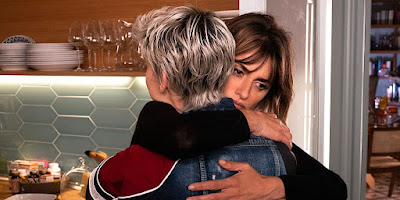
One of the great pleasures of seeing a new film from a director who has done good, distinctive work over many decades is the comforting feeling of knowing we’re in familiar, reliable territory. Ah, one can think, here’s that recognizable style and those usual preoccupations, done up in their confident aesthetics and in their pleasurably recognizable rhythms. So here’s Pedro Almodóvar’s Parallel Mothers. The latest film from the great Spanish filmmaker is another of his intricate narrative designs that plays out so easily one can still be surprised by its emotional impact despite recognizing its moves. It stars Penélope Cruz—whose expressive features graced a half-dozen of his films—and has other frequent collaborators in supporting roles. It’s set in plush Madrid apartments painted with deep reds and blues and greens, decorated with artful textures, vintage photographs, vinyl records, and jamón on the counter. It flows with the usual sumptuous string score from Alberto Iglesias. It concerns itself with: birth and death, mistaken identity, miscommunications, mothers, daughters, sex, family secrets, fallible men, and things long buried or repressed resurfacing. It is, in other words, an Almodóvar film. For all the familiarity of the surface appeal, it also has the beguiling narrative propulsion, pulled along by powerfully underplayed melodrama, with which his most effective films work best. Watching it, one wonders what will happen next, and how the characters will react, not in an edge-of-the-seat way so much as the deep well of feeling and humanity that comes from closely observed curiosity and earnest empathy.
Here, in delicately doubled parallel narratives that draw closer, separates and draw close again, Cruz plays a single middle-aged photographer whose affair with an anthropologist is the cause of an unexpected pregnancy. She decides, given her age and prospects, to have the child. He doesn’t want to be involved, which is fine by her. She ends up, nine months later, sharing the maternity ward with a teenager (Milena Smit) whose pregnancy is similarly shrouded in the unexpected and the unspoken. They agree to keep in touch. As Almodóvar follows these new mothers, the story develops with complications both normal—women recovering from birth, navigating new living arrangements, rebalancing a career (or adolescent desires to strike out) with their familial obligations—and dramatic. The plot ultimately hinges on a couple paternity tests, dark secrets, some held too long, and others not long enough, and, finally, one big devastating turn. There’s high drama here, or at least potentially. (Almodóvar even provides a running subplot of Cruz’s search for a mass grave in her small home village, where her grandmother long claimed her grandfather was buried during the Spanish Civil War. Talk about drama!) And yet the actors present these turns with such ease and naturalism, speaking in soothing soft tones and melodic warmth even as they might be evading or obscuring their true feelings. The movie sets its enormous emotions on a soft simmer, letting the full weight of its heaviest moments push down unexpectedly in the design.
Similarly, Guillermo del Toro’s Nightmare Alley is a work recognizably his own, with a design that is its own reward. It might even be doubly familiar (or triply) to anyone who’s seen the 1947 Tyrone Power-starring adaptation of William Lindsay Gresham’s novel. It’s a noirish carnival con man picture, relishing the seedy inner workings of the freak show atmosphere. Del Toro usually works his affinity for misfits, monsters, and castoffs. See it expressed in the likes of Mimic, Hellboy, Pan’s Labyrinth and his Oscar-winning The Shape of Water—a real monster mash of a filmography, always asking, who’s the real freak here? In this new film, that kinship finds, in some ways, its most human expression amid the dusty tents and flickering flames of its disreputable environment. Here’s a film that looks unflinchingly at a geek in the old fashioned sense of the term, a desperate man biting the head off a live chicken for a paying audience, clenching his teeth to slowly separate vein from muscle until the neck snaps. The film wonders what kind of a life takes someone to that moment. To answer, Del Toro, with co-writer Kim Morgan, finds a winding road through eccentric characters and blustering schemes. It’s a big cast—Rooney Mara, Toni Collette, Willem Dafoe, Ron Perlman, and Dave Strathairn, among others—of carny types, each given loving attention to the art of their grift and graft. It unfolds the ecosystem of the traveling show so patiently and in such detail I was reminded of Ricky Jay’s histories of magicians. The people in this movie are living on the margins, but there’s some kind of mad skill to what they do wrapped in the soft deception of audience appeal. They, like the film, and like a key image in the film, are a loaded pistol in a purse.
At the center is a charismatically recessive movie star performance from Bradley Cooper, one of those magnetic work of gestures and implication that’s compelling, and then only grows in power when he doesn’t speak. He simply exists, first as a lost man stumbling into this world, and then as a figure of increasing power within his person as he turns on the charm and shines up to move in fancier circles. That gets Cate Blanchett and, later, Richard Jenkins involved as high society becomes the scene of a newer, edgier, more personal con. No more swindling quarters out of gullible folk; it’s time to put on more elaborate faux-psychic charades for the high-rollers. The trick of the movie is how easily it moves between these early-20th-century spaces—the rural outskirts and the electric urban interiors, Dust Bowl chic and Art Deco glamor—with a consistency of tone and style. Here are damaged people damaging people, but their wounded souls are attracted and repulsed by the endeavor, and each other. The movie follows suit. It takes grand delight in the low pleasures of its population, and sinks ever deeper into the melancholic romance and eerie despair, both of which are all part of the game, too. It’s not dissimilar from an Edward Hopper painting in its look and feel some of the time—figures of loneliness in the vastness of (retro) modern life. If the movie sometime feels long, it’s because Del Toro can’t pull himself out of these scenes in these visual spaces with these complicated stock of characters; they’re too well-inhabited and handsomely dressed in sets expertly designed. I didn’t mind spending that time. These days, when movies can often feel so impersonal and bland, to groove on a distinct style and mood can be a tonic.
Thursday, February 10, 2022
Sunday, February 6, 2022
Falling Skies: MOONFALL and DON'T LOOK UP
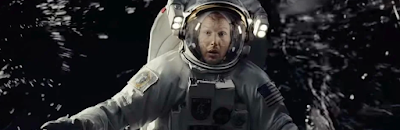
Moonfall is so perfectly awful I was almost charmed. In this high-gloss chintzy approximation of an A-level blockbuster 90s disaster picture, the moon has been knocked out of its orbit. Every time it circles the Earth, it gets closer. That thing’s bound to crash. It’s such total lunacy—and gets weirder by the reel—presented with casual pomposity stretching beyond its budget. It has a choppy opening hour that over-complicates every subplot and races through exposition as if it half-heartedly realizes we won’t care about its convolutions. As the ensemble is brought on stage and the moon looms larger, the vast cast is sketched in with shorthand and cliche. There’s disgraced astronaut Patrick Wilson and glamorous NASA chief Halle Berry and annoying pudgy British wannabe scientist John Bradley, each with a part of the solution as to how to get the moon restored to its proper place before it touches down. Also in the mix are the usual ex-wives, step-fathers, elderly mothers, conspiracy theorists, foreign exchange students, troubled adult sons, adorable moppets, and a general with a key to the nukes and a reluctant trigger finger. All the while, passable effects whip up CG floods as tides go wild, flooding cities of panicking refugees and looters before, during, and after the gravitational disruption kicks off earthquakes.
Where once these sort of big-screen natural disasters lingered on their big effects moments, now they can just wallpaper indiscriminately until it leaves little impact. It’s the kind of movie that relocates the top of the Chrysler building and barely blinks an eye. (The best moments are the most novel, in a crackpot derivative way: a space shuttle outracing an enormous gravity wave, or exploring the secret inner chambers of the moon.) But there’s an odd underplaying throughout, like when a son looks at his father, on the brink of potential apocalypse, at the moment a last-ditch plan has fallen through and shrugs: “I’m sorry that didn’t work out.” The second hour is a little zippier, and moderately wilder, as the apocalyptic stakes cut between a daring mission into the center of the moon, and a family trying to get what appears to be a mile or two down the road back on Earth. The imbalance is a little funny. Par for the course is when the general stares down a guy who wants to bomb the moon and says: “You can’t do that! My ex-wife’s up there!!”
So it’s good for a few laughs, and it might remind you passingly of better sequences in other movies like it. But that the production is helmed by Roland Emmerich, a king of the industrial-strength big budget ensemble disaster flick, having Independence Day, The Day After Tomorrow, and 2012 on his resume, gives it the distinct feeling of a director making his own knockoff. It hasn’t the balance between the spectacle and melodrama that the better versions of the disaster ensemble can pull off. Heck, even his own former co-writer Dean Devlin did a better spin on the all-star global calamity space-junk explode-o-rama with the under-appreciated gargantuan cheese wheel that was Geostorm a few years back. One of that movie’s stars, Gerard Butler, even did it well in a more serious register with the oddly affecting meteor-on-the-way thriller Greenland from Christmas before last. (It went VOD, like the bulk of that season’s offerings, so who knows how many actually saw it?) Just goes to show you we are in a little boom for talking our destruction to death. Gee, what could cause that? We can't expect every attempt to work well.
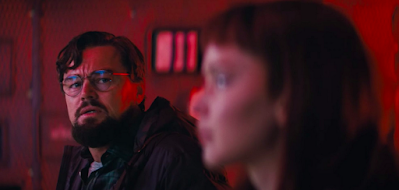
At least all of the above are better than Don’t Look Up. That movie imagines a world-ending calamity is on the way, and getting people to care about or even accept the reality of the situation, let alone examine possible solutions, is nigh impossible. Sounds familiar. Adam McKay wrote the movie as a climate change parable, but the intervening pandemic and its response surely fed into it as well. Here we open on two scientists at Michigan State University (Leonardo DiCaprio and Jennifer Lawrence) identifying a planet-killing meteor that’ll hit Earth in a matter of months. They try to alert the government, but the president (Meryl Streep) is too image-obsessed and election-focused to care and demands the information hidden. (The movie’s funniest joke is her son (Jonah Hill) insisting on double checking the info with experts from a better college. Ha.) So the scientists try to leak it to the media, but most outlets don’t care, and the best they can do is getting laughed off a morning show whose hosts (Cate Blanchett and Tyler Perry) can’t bring themselves to understand what their incongruously serious guests are trying to say. There’s clear anger in this telling, a well-intentioned ranting about humanity hurtling toward its doom and too ignorant and selfish to face it and fix it.
But as the movie spirals and complicates for over two hours, it stays on that grinding pitch of justified anger. It starts to seem less sharply targeted and more tiresomely mismanaged. The characters, no matter how well-acted by an all-star cast, are broad caricatures, and McKay’s rush to condemn doesn’t leave time to actually understand their motives. This is a bloated political cartoon stumbling backwards toward preordained conclusions. Compare it to, say, Dr. Strangelove, and you’ll see how Kubrick’s classic dark comedy of nuclear annihilation is a witheringly hilarious look at nightmarish Cold War logic precisely because it understands how fallible and specific personality types could stumble toward accidental apocalypse. Here, though McKay has understandable outrage at the prevailing forces of prevaricating pundits and the corrupt short-term individualism eroding all sense of common good, he’s made a movie that’s the equivalent of a “raising awareness” campaign. Yeah, I know, and I agree, somewhat, I think. But now what?
This sociopolitical comedy is still somehow McKay’s best of that sort, though this, Vice, and The Big Short are all considerable steps down from his Anchorman, Talladega Nights, and Step-Brothers heyday. He no longer makes exuberantly goofy comedies with serious subtext. Now he’s making self-serious political comedies where his Big Ideas are all on the surface where they won’t stop needling, jabbing, scalding, and condescending at the expense of entertainment and, just as deadly, a point that can get past the surface of the matters on display. Attacking shallowness with shallowness without even the deceptive nuance that, say, Verhoeven might bring, is awfully wearisome. He’s clearly an intelligent and passionate thinker—but when his works about Wall Street corruption or Dick Cheney flatten out the issue as they scream to the choir that it’s all our fault, too, well, if you’re going to think so little of your audience, at least you could actually be better than them. These movies are both contemptuous and scatter-brained. He really thinks he’s telling you something new and vital instead of repackaging common complaints. It looks at massive systemic issues and futilely wags its finger at the viewer. We’re all implicated, yes, but now what do I have to do about it?
As Don’t Look Up widens its lens, with some vigorous absurdities that sparkle here and there, it bogs itself down and clutters itself up with characters and plot lines all pushing in the same direction at the same grim pitch: our society is incapable of saving itself. Everyone’s pathetic and cringingly one-dimensional. There are red-meat military men (Ron Perlman) and weary astronomers (Rob Morgan) and social media celebrities (Ariana Grande and Scott Mescudi) and right-wing propagandists (Michael Chiklis) and progressive journalists (Himesh Patel) and a tech billionaire cutting a real Musky Zuckerbergian Bezoar (Mark Rylance), among others. No one can meet the moment. Of course there’s even a right-wing messaging movement to just avoid the issue entirely. “Don’t Look Up” becomes their rallying cry. (Years of “if climate’s changing, why do we have winter?” and “if masks and vaccines work, why is there still COVID?” make even that sadly believable.) To watch a government and society flailing in the face of overwhelming disaster is painfully familiar. That the movie is willing to condemn a shallow media, lying right-wing authoritarians, and neoliberal corporate shills is not nothing. But the cast is stranded in a movie with ugly blocking and clanking rhythms, scenes that feel hacked together and indifferently covered, unable to build up character or perspective beyond the movie’s insistence that all of these horrible, fallible people are worthy of our scorn.
Though there’s plenty of blame to go around, the movie ends up somehow too much and not enough. Yes, this is a close match to the lunacies we’ve seen lately, and it carries that out to its logical calamitous conclusion on an apocalyptic scale. But it’s not exactly a thrill to see a movie as mean and absurd and judgmental as those it’s trying to condemn. Its final image of cynical comeuppance—spoilers: a nude body double standing in for a beloved actress getting chomped by a CG creature—is the ultimate grotesquerie. By then, the whole final stretch of the film leading up to it, a wild mix of surprise unearned sentiment and nihilistic cynicism and cheap nasty gags, has already made it clear the movie has nothing meaningful to explore or suggest. What a bracingly stupid movie: whipping up a frenzy of ugliness to serve as a funhouse mirror of our current problems and expecting us to thank it for its meager insight. Hey, at least it has a couple laughs, too.
Sunday, January 30, 2022
The Voracious Filmgoer's Top Ten Films of 2021
3. Drive My Car
5. Memoria
6. The Father
Honorable Mentions:
All Light, Everywhere; Bad Luck Banging; Being the Ricardos; Billie Eilish: The World’s a Little Blurry; CODA; Come from Away; The Disciple; Encanto; Everybody’s Talking About Jamie; F9; A Glitch in the Matrix; The Green Knight; Inside; In the Heights; The Last Duel; Last Night in Soho; Listening to Kenny G; Luca; Mass; The Mitchells vs. The Machines; No Sudden Move; No Time to Die; Operation Varsity Blues; Petite Maman; The Power of the Dog; Procession; Shiva Baby; Stillwater; Summer of 85; tick, tick…BOOM!; The Tragedy of Macbeth; The Underground Railroad; The Velvet Underground; The White Lotus; Wrath of Man; Zack Snyder’s Justice League
Other 2021 Bests
Other 2021 Bests
Cinematography (Digital):
Drive My Car
The Green Knight
Inside
Judas and the Black Messiah
The Tragedy of Macbeth
Cinematography (Film):
Dune
The French Dispatch
Licorice Pizza
No Time to Die
West Side Story
Sound:
Drive My Car
Dune
Memoria
West Side Story
Wrath of Man
Stunts:
Black Widow
The Matrix Resurrections
No Time to Die
Shang-Chi and the Legend of the Ten Rings
Wrath of Man
Costumes:
Coming 2 America
Cruella
Dune
The Green Knight
West Side Story
Hair and Makeup:
Dune
The French Dispatch
The Green Knight
Last Night in Soho
West Side Story
Set/Art Direction:
Dune
The French Dispatch
The Green Knight
No Time to Die
West Side Story
Editing:
Bergman Island
Drive My Car
The French Dispatch
West Side Story
The Velvet Underground
Screenplay (Adapted):
Drive My Car
The Father
Judas and the Black Messiah
The Power of the Dog
West Side Story
Screenplay (Original):
Bergman Island
The French Dispatch
Licorice Pizza
Quo Vadis, Aida?
Wheel of Fortune and Fantasy
Non-English Language Film:
The Disciple
Drive My Car
Quo Vadis, Aida?
Summer of 85
Wheel of Fortune and Fantasy
Documentary:
Billie Eilish: The World's a Little Blurry
A Glitch in the Matrix
Operation Varsity Blues
Procession
The Velvet Underground
Animated Feature:
Encanto
Flee
Luca
The Mitchells vs. The Machines
Vivo
Effects:
Army of the Dead
Dune
The French Dispatch
The Green Knight
No Time to Die
Score:
Encanto
The Green Knight
Luca
The Power of the Dog
Wrath of Man
Song:
"Edgar's Prayer" - Barb & Star Go to Vista Del Mar
"No Time to Die" - No Time to Die
"One of a Kind" - Vivo
"So May We Start" - Annette
"We Don't Talk About Bruno" - Encanto
Supporting Actor:
Colman Domingo - Zola
Mike Faist - West Side Story
Daniel Kaluuya - Judas and the Black Messiah
Troy Kotsur - CODA
Kodi Smit-McPhee - The Power of the Dog
Supporting Actress:
Ariana DeBose - West Side Story
Ann Dowd - Mass
Kathryn Hunter - The Tragedy of Macbeth
Olga Merediz - In the Heights
Mia Wasikowska - Bergman Island
Actor:
Andrew Garfield - tick, tick...BOOM!
Anthony Hopkins - The Father
Dev Patel - The Green Knight
Lakeith Stanfield - Judas and the Black Messiah
Denzel Washington - The Tragedy of Macbeth
Actress:
Jasna Duričić - Quo Vadis, Aida?
Taylour Paige - Zola
Tilda Swinton - Memoria
Mary Twala - This Is Not a Burial, It's a Resurrection
Rachel Zegler - West Side Story
Director:
Ryusuke Hamaguchi - Drive My Car
Mia Hansen-Løve - Bergman Island
Steven Spielberg - West Side Story
Apichatpong Weerasethakul - Memoria
Jasmila Zbanic - Quo Vadis, Aida?
Saturday, January 29, 2022
Road to Somewhere: LICORICE PIZZA
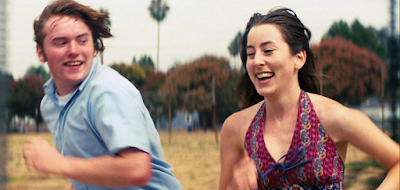
The main characters in Paul Thomas Anderson’s Licorice Pizza are a couple of young people constantly on the move. They seem to operate with the unspoken assumption: why walk when you can run? They’re running heedlessly into their futures on an abundance of youthful energy and naive restlessness. One, Gary Valentine (Cooper Hoffman), is a sweaty teenage boy with a crush. The other, Alana Kane (Alana Haim), is a twenty-something woman on whom he’s crushing. The fact that they are played by relatively fresh newcomers—he’s Philip Seymour’s son; she’s in the band Haim with her sisters, who play her sisters here, too—gives the movie a genuine sense of fumblingly appealing youthful discovery and charisma. The two of them fall into a funny friendship, finding themselves simpatico in the ways his precociousness (he’s a child actor using his money to start dubious entrepreneurial ventures) and her failure to launch (she still lives at home with her parents) meet. There’s a charge of attraction on his part, but she holds him at a distance from that. They simply enjoy their time together as friends, roaming around California’s San Fernando Valley in the early 1970s. He’s a wheeler-dealer, 15 going on 50, falling into one attempted money-making scheme after the next. She’s not sure what she wants to do with her life, so happily falls into his orbit.
Anderson unfolds their converging and diverging stories through a loose collection of shaggy anecdotal episodes. It’s a movie about that awkward time between when high school seems hopelessly juvenile, but the adult world is still held at a remove of skepticism. As is so often the case with young people, they test their sense of self in every moment, adjusting based on circumstances, comparing to people around them, blustering and bluffing to get by, or receding in the face of a more dominant adult presence. Here is a string of events—by turns funny, yearning, oddball, and suspenseful—that brings these young people’s sense of self more and more into focus for themselves. It’s a process still in motion as they run to the final credits. Through them we meet agents, actors, casting directors, teachers, teenagers, producers, politicians, chaperones, hosts, assistants, parents, siblings, salesmen, restaurateurs, photographers and more.
This assemblage of interesting faces and eccentric personality types is warmly carried out by a wide-ranging ensemble of character actors and marquee names (including Bradley Cooper, Tom Waits, Sean Penn, Christine Ebersole, John Michael Higgins, and Mary Elizabeth Ellis). We see each new situation with these various complicated and problematic adult figures through the eyes of our leads. Anderson situates them in a world of flawed or otherwise half-formed aspirations as they scramble toward maturity in the shadows of showbiz. Despite centering the couple, there’s an egalitarianism to the various sequences, a sense that every character on screen is a full, rich, interesting figure in and of themselves. Even people appearing for one or two scenes carry the sense that we could follow them off into an equally enjoyable film all their own. This gives the movie a full sense of lives in motion—pushing forward through emotions and encounters that our leads are working through to get to…somewhere. They’re figuring it out as they go along.
This loose, shaggy one-thing-after-another Anderson gives the proceedings matches his project—from Boogie Nights and There Will Be Blood through The Master and Inherent Vice—of treating intimate character pieces with the sweep and detail of a historical epic. The twinned comings-of-age here also fits in with Anderson’s other awkward, inscrutable relationship semi-comedies, like Punch-Drunk Love and Phantom Thread, although that’s also a common thread through his films. I suppose that might make Licorice Pizza a quintessential Anderson effort. It has a long-lens close-up approach, a dazzling specificity of character foregrounded amid casually perfect period recreations that fill the frames around the central focus. Here the 70s swagger of vintage tech and indoor smoking, of burgeoning pop culture happenings and gasoline shortages, is just a fact of life for the characters who try to find their way into who they’ll become. There’s an aimless free-spiritedness to the hustle—and a squinting toward possibility that never quite arrives.
Anderson gives the movie that touch of Altman—long noted as one of his favorite inspirations—with whipping up an ensemble of controlled chaos. Sequences in schools and restaurants, parties, shops, and offices spill rough natural jumbled life out of relaxed wide frames that are casually composed. And yet their filmic beauty effortlessly guides an audiences’ eye with a steady hand and a generosity of spirit. There’s a sun-dappled grainy romanticism of the past, carried aloft on a steady stream of vintage records, and a cool-eyed present-tense perspective knowing these characters are as-yet unformed. The characters may not know where life will take them, but there’s fun to be had in watching them drift through it. In one of the film’s most exhilarating sequences, a delivery truck runs out of gas mid-trip, so the leads white-knuckle their way downhill, gritting teeth as they plunge through intersections and take tight turns. It is a movie, after all, about the exhilaration of coasting.
Anderson unfolds their converging and diverging stories through a loose collection of shaggy anecdotal episodes. It’s a movie about that awkward time between when high school seems hopelessly juvenile, but the adult world is still held at a remove of skepticism. As is so often the case with young people, they test their sense of self in every moment, adjusting based on circumstances, comparing to people around them, blustering and bluffing to get by, or receding in the face of a more dominant adult presence. Here is a string of events—by turns funny, yearning, oddball, and suspenseful—that brings these young people’s sense of self more and more into focus for themselves. It’s a process still in motion as they run to the final credits. Through them we meet agents, actors, casting directors, teachers, teenagers, producers, politicians, chaperones, hosts, assistants, parents, siblings, salesmen, restaurateurs, photographers and more.
This assemblage of interesting faces and eccentric personality types is warmly carried out by a wide-ranging ensemble of character actors and marquee names (including Bradley Cooper, Tom Waits, Sean Penn, Christine Ebersole, John Michael Higgins, and Mary Elizabeth Ellis). We see each new situation with these various complicated and problematic adult figures through the eyes of our leads. Anderson situates them in a world of flawed or otherwise half-formed aspirations as they scramble toward maturity in the shadows of showbiz. Despite centering the couple, there’s an egalitarianism to the various sequences, a sense that every character on screen is a full, rich, interesting figure in and of themselves. Even people appearing for one or two scenes carry the sense that we could follow them off into an equally enjoyable film all their own. This gives the movie a full sense of lives in motion—pushing forward through emotions and encounters that our leads are working through to get to…somewhere. They’re figuring it out as they go along.
This loose, shaggy one-thing-after-another Anderson gives the proceedings matches his project—from Boogie Nights and There Will Be Blood through The Master and Inherent Vice—of treating intimate character pieces with the sweep and detail of a historical epic. The twinned comings-of-age here also fits in with Anderson’s other awkward, inscrutable relationship semi-comedies, like Punch-Drunk Love and Phantom Thread, although that’s also a common thread through his films. I suppose that might make Licorice Pizza a quintessential Anderson effort. It has a long-lens close-up approach, a dazzling specificity of character foregrounded amid casually perfect period recreations that fill the frames around the central focus. Here the 70s swagger of vintage tech and indoor smoking, of burgeoning pop culture happenings and gasoline shortages, is just a fact of life for the characters who try to find their way into who they’ll become. There’s an aimless free-spiritedness to the hustle—and a squinting toward possibility that never quite arrives.
Anderson gives the movie that touch of Altman—long noted as one of his favorite inspirations—with whipping up an ensemble of controlled chaos. Sequences in schools and restaurants, parties, shops, and offices spill rough natural jumbled life out of relaxed wide frames that are casually composed. And yet their filmic beauty effortlessly guides an audiences’ eye with a steady hand and a generosity of spirit. There’s a sun-dappled grainy romanticism of the past, carried aloft on a steady stream of vintage records, and a cool-eyed present-tense perspective knowing these characters are as-yet unformed. The characters may not know where life will take them, but there’s fun to be had in watching them drift through it. In one of the film’s most exhilarating sequences, a delivery truck runs out of gas mid-trip, so the leads white-knuckle their way downhill, gritting teeth as they plunge through intersections and take tight turns. It is a movie, after all, about the exhilaration of coasting.
Saturday, January 15, 2022
Scream and SCREAM Again
The mad genius of Wes Craven’s Scream movies was making them sharp commentary on the very genre of which they were exceedingly effective versions, and which he helped create. The innovation of Kevin Williamson’s screenplay was, after a couple decades of slasher pictures, making its characters young people who’d seen slasher pictures before. This thorough understanding of the types and tropes of the subgenre made for a thick layer of 90’s irony in their dialogue. Here were young people targeted in a small-town knifing spree from a masked killer, and they nonetheless thought a command of these stories’ cliches would keep them safe—typified in a scene where the horror nut pontificates about rules for survival, including never leaving alone saying “I’ll be right back.” This made the plot’s twists and turns all the more satisfying and surprising—cutting into the conventions by zigging where others zagged, or maybe doubling back around to predictable to catch you all the more off-balance. The first is one of the best of its kind, and a total deconstruction of it at the same time. As the series progressed, it became all the more meta, too, with good sequels including discussions of sequels, as the events of the first film inspired an in-universe horror franchise: Stab. By the 2011 release of the underrated Scream 4, it even became a generational commentary, a belated sequel to a cult property in which younger characters were fans of the movies based on the events of the first movies. That Craven continued making these warmly photographed and sleekly paced thrill machines capable of pulling off bloody kills and teasing genre play in the same movies, sometimes in the same scene, made them excellent entertainments.
So of course the fifth in the series, the confusingly titled Scream, is pretty aware it’s been another 11 years since the last and therefore must, in the current vogue, be all things to all people—a fresh cast of new people doing the same things, and a returning cast looking sideways at the proceedings until reluctantly drawn into the same old same old. It’s also the first in the series (save a forgotten three-season MTV show from a few years ago that goes unreferenced here) without either Craven, who passed away in 2015, or Williamson, who serves only as producer here. Maybe that accounts for the movie’s sense of grinding mechanics. It has been directed, by Ready or Not’s Matt Bettinelli-Olpin and Tyler Gillett, and written, by James Vanderbilt and Guy Busick, in what I could only think of as a karaoke version of the original’s moves. It has a small portion of Craven’s playful use of obstructed negative space, and a bit of the bite of Williamson’s writing. But it’s also clear the originals were the work of auteurs, while this new one is merely the product of talented technicians. They know the notes, but not the music. There’s a cute teen star (Jenna Ortega) on the wrong end of a menacing phone call in the opening scene. There’s a quickly sketched youth group full of victims and suspects (Melissa Barrera, Jack Quaid, Dylan Minnette, and others). There’s a reluctant call to action for the series’ previous survivors (David Arquette, Courteney Cox, Neve Campbell). And there’s an unknown ghostface killer skulking about in a gory whodunnit. The movie plunks down the sequences and surprises exactly where you’d expect them. It’s inelegant, but sometimes effective and always self-aware—like the bloodbath finale inaugurated by the killer waving a gun shouting, “Welcome to the third act, bitch!”
The project mistakes calling out obstacles and missteps for absolution when stumbling over them. There are long sequences in which characters lay out the new rules of a re-quel, along the way name-checking Terminator, Ghostbusters, Star Wars, and Halloween as recent examples of the quasi-remake sequel. There’s joking about the title, too, forgoing a number for a faux-remake naming convention in vogue, a fake grab for a glimmer of originality in the face of so much derivative. One character quips she prefers The Babadook and Hereditary to the Stabs, a fine wink at the art house horror cycle we’re in. Another complains the Stabs went off the rails with the fifth one. (Ha.) Still another references a toxic fanbase that won’t let long-running franchises try new things. That’s pretty sharp commentary on the online right-wing reactionaries who’ve latched onto long-running franchise fanbases to recruit young people into their shallow ax-grinding, anti-“woke” sloganeering. And the movie as a whole does a good job updating the talking points of its self-aware joshing for the current cultural landscape. I appreciated the effort. But the joy of the originals was not just that it could call out current horror tropes, but could upend them in unexpected puncturings. And they had characters you could care about even in the slasher structure—the deaths felt sad even as they fulfilled the genre’s obligation. This one’s everything you’d expect all the way down, and too routine to flesh out its feelings like that. Even the surprises are inevitable. There’s some low genre pleasure as far as that goes, and the young cast is gamely throwing itself into largely under-written parts. At best, it's watchable echoes of pleasures past. But, as is so often the case with these formulaic legacy sequels, there’s something depressing about the legacy characters, and us, stuck in this loop.
So of course the fifth in the series, the confusingly titled Scream, is pretty aware it’s been another 11 years since the last and therefore must, in the current vogue, be all things to all people—a fresh cast of new people doing the same things, and a returning cast looking sideways at the proceedings until reluctantly drawn into the same old same old. It’s also the first in the series (save a forgotten three-season MTV show from a few years ago that goes unreferenced here) without either Craven, who passed away in 2015, or Williamson, who serves only as producer here. Maybe that accounts for the movie’s sense of grinding mechanics. It has been directed, by Ready or Not’s Matt Bettinelli-Olpin and Tyler Gillett, and written, by James Vanderbilt and Guy Busick, in what I could only think of as a karaoke version of the original’s moves. It has a small portion of Craven’s playful use of obstructed negative space, and a bit of the bite of Williamson’s writing. But it’s also clear the originals were the work of auteurs, while this new one is merely the product of talented technicians. They know the notes, but not the music. There’s a cute teen star (Jenna Ortega) on the wrong end of a menacing phone call in the opening scene. There’s a quickly sketched youth group full of victims and suspects (Melissa Barrera, Jack Quaid, Dylan Minnette, and others). There’s a reluctant call to action for the series’ previous survivors (David Arquette, Courteney Cox, Neve Campbell). And there’s an unknown ghostface killer skulking about in a gory whodunnit. The movie plunks down the sequences and surprises exactly where you’d expect them. It’s inelegant, but sometimes effective and always self-aware—like the bloodbath finale inaugurated by the killer waving a gun shouting, “Welcome to the third act, bitch!”
The project mistakes calling out obstacles and missteps for absolution when stumbling over them. There are long sequences in which characters lay out the new rules of a re-quel, along the way name-checking Terminator, Ghostbusters, Star Wars, and Halloween as recent examples of the quasi-remake sequel. There’s joking about the title, too, forgoing a number for a faux-remake naming convention in vogue, a fake grab for a glimmer of originality in the face of so much derivative. One character quips she prefers The Babadook and Hereditary to the Stabs, a fine wink at the art house horror cycle we’re in. Another complains the Stabs went off the rails with the fifth one. (Ha.) Still another references a toxic fanbase that won’t let long-running franchises try new things. That’s pretty sharp commentary on the online right-wing reactionaries who’ve latched onto long-running franchise fanbases to recruit young people into their shallow ax-grinding, anti-“woke” sloganeering. And the movie as a whole does a good job updating the talking points of its self-aware joshing for the current cultural landscape. I appreciated the effort. But the joy of the originals was not just that it could call out current horror tropes, but could upend them in unexpected puncturings. And they had characters you could care about even in the slasher structure—the deaths felt sad even as they fulfilled the genre’s obligation. This one’s everything you’d expect all the way down, and too routine to flesh out its feelings like that. Even the surprises are inevitable. There’s some low genre pleasure as far as that goes, and the young cast is gamely throwing itself into largely under-written parts. At best, it's watchable echoes of pleasures past. But, as is so often the case with these formulaic legacy sequels, there’s something depressing about the legacy characters, and us, stuck in this loop.
Sunday, January 9, 2022
What's Done Cannot Be Undone:
THE TRAGEDY OF MACBETH
Tragedy, in the most classic sense, is about consequences. It’s forged in the moment where characters are confronted, inescapably, with the cold, hard facts of their downfall and realize that they brought it on themselves. It is thus that Shakespeare’s Macbeth is perhaps his most tragic tale. Not the saddest, and not the most dramatic, necessarily, but perhaps the most tragic for it sits almost entirely in that moment of realization. Macbeth is quickly brought to commit treasonous murder—from inscrutable witches on the one hand prophesying his kingship, and from a scheming wife’s goading on the other—and the rest of the play watches as the weight of such a deed sends him to his doom. This deep engagement in what happens and what inevitably results from those happenings is something writer-director Joel Coen, adapting the play for his first film without his brother Ethan, understands. (Quite a brotherly compliment to replace Ethan with the Bard; they do share a love of language.) The Coens have made a career out of films, often some mixture of bleakly suspenseful and darkly funny, about characters confronted with the distance between what they think they can get, and what life’s circumstances have in store for them. I often think of an exchange from their 2009 effort A Serious Man, still perhaps the finest film in a body of work made up almost entirely out of excellent films. In this moment, a harried professor confronts a befuddling student, telling him: “Actions have consequences.” To which the young man replies: “Yes, sir. Often.” The professor’s immediate frustrated response: “No! Always! Actions always have consequences.” There’s no running from that.
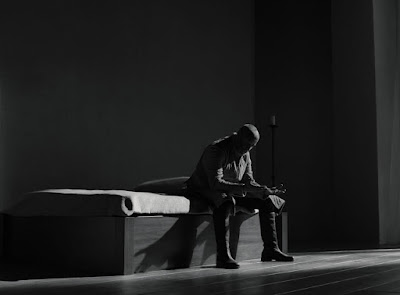
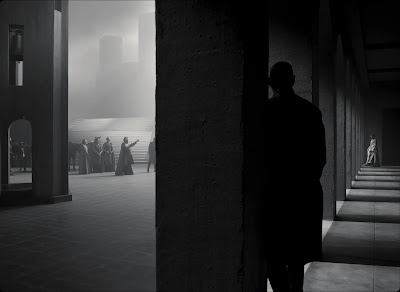
So here’s The Tragedy of Macbeth, a stark and unsparing black and white feature shot in sharp digital closeups, filmed on spare stages cloaked in artifice and darkness, backgrounds that are bleary and sets cavernously empty. A boxy aspect ratio forms a proscenium around the performers, trapping the characters even as their proximity to the camera often causes a startling immediacy. You can see every pore in their face, every wrinkle, each subtle darting of the eye or twitching of the lip. The film is at once intimately engaged in its actors’ decisions and held back at a theatrical remove—a cold and distant picture that’s nonetheless inscrutably, uncomfortably near. Coen’s vision of this story, made vivid by cinematographer Bruno Delbonnel and production designer Stefan Dechant, is one that’s part the high-contrast lighting of a film noir—a look that turns Lady Macbeth into a regal femme fatale—and the woozy constructed angles in crooked stairways and enormous windows of German expressionism—down to its extension of anxieties about dreams and realities. Coen at every turn emphasizes the moral confusion inside the characters by highlighting the foggy displacement around them. The opening shot looks like it is staring up into milky sky, a bird circling, until the fog starts thinning and we see it’s a vast expanse of pale dirt and puddle where crouches our otherworldly portents ready to unfold a grim tale in which its characters are cogs. In this warped world of oppressive contrast and artifice, the potential majesty of the throne is all implication—down to the landscapes terminating in blankness the color of a scrim, through which the castle can be only just barely glimpsed, a flicker in the distance like Kane’s Xanadu. You just know that’ll be unsatisfying for anyone who wants to rule there.
And that’s how Denzel Washington approaches the lead role, as a man who, perhaps unconsciously, already senses that achieving a royal status won’t solve the deep dissatisfactions in his soul. Washington takes his considerable charisma—he easily commands attention like few of his or any generation—and twists it inward in hesitation and guilt. His head hangs heavy even before the crown, like his mind really is plagued with scorpions, leading him to question his choices before, after, and as he makes them. He becomes a reluctant conduit for his own malevolence, and as such is almost going through the motions as a spectator. His soliloquies are hushed, tortured. His later outbursts of madness have none of the live-wire aggrandizement you might expect. Although he holds considerable power in the lives of the other characters, he always carries himself like a pawn. It’s an embodiment of what Emma Smith, professor of Shakespeare studies at Oxford, identifies as a central question of the text: “Is [Macbeth] in control of his own actions…or is he merely working out a part that has been written—by witches’ prophecies, by historical chronicle, by Shakespeare himself?” Washington’s approach wrings pathos from this uncertainty as he frets his hour upon the stage, worried that his life, in the end, will signify nothing. Coen’s film never once roots for his victory; it sees too well how this insecurity leads to his brutality. And Macbeth’s uncomfortable wracked nerves and slippery senses in this telling makes the characters plotting his downfall seem like an act of planning to put him out of his misery.
The movie constantly feels the crushing weight of inevitability. Other characters exist either in direct dialogue with Macbeth, or lurk outside of his notice, each playing their preordained part in the tale. There’s his wife (Francis McDormand), a brittle shiv of ambition whose inability to handle hiding their dark deeds marks the couple’s conjoined unraveling. There are assorted men of more and less power in the kingdom (Corey Hawkins, Brendan Gleeson, Harry Melling, Ralph Ineson, and more) who go under the knife or jostle for power in ways violent, righteous, and self-involved. (Stephen Root’s careless drunken babbling is a fine counterpoint there.) And then there’s the innocent, victimized Lady Macduff (Moses Ingram) sees her home and family burned to the ground by the cruelty of men’s ambitions. All are brought into the nightmare logic of the filming and of the tragedy, positioned as fellow travelers in what fate has in store. Everything is trapped in that aim, as just another facet of the design. Loud on the soundtrack are the steady drips of falling water, or blood—thuds and knocks in a regular rhythm like Poe’s tell-tale heart, or the clock that one should ask not for whom it tolls. We hear fluttering birds and heavy footfalls against cavernous castle walls, every action a reaction. The three witches, all deviously inhabited in the contorted body and raspy voice of the same performer (Kathryn Hunter), remain scarily ambiguous, clearly otherworldly and possessed of dark powers through shifting specters. Are they predicting the future or controlling it? Everything they say comes to pass. Yet dark forces unleashed by greed, guilt, and despair have their own cruel, predictable logic. And tomorrow and tomorrow and tomorrow creeps in from day to day to the last syllable of recorded time. Tragically, one can find too late the consequences of actions are all one’s left in the end. They can signify everything.
So here’s The Tragedy of Macbeth, a stark and unsparing black and white feature shot in sharp digital closeups, filmed on spare stages cloaked in artifice and darkness, backgrounds that are bleary and sets cavernously empty. A boxy aspect ratio forms a proscenium around the performers, trapping the characters even as their proximity to the camera often causes a startling immediacy. You can see every pore in their face, every wrinkle, each subtle darting of the eye or twitching of the lip. The film is at once intimately engaged in its actors’ decisions and held back at a theatrical remove—a cold and distant picture that’s nonetheless inscrutably, uncomfortably near. Coen’s vision of this story, made vivid by cinematographer Bruno Delbonnel and production designer Stefan Dechant, is one that’s part the high-contrast lighting of a film noir—a look that turns Lady Macbeth into a regal femme fatale—and the woozy constructed angles in crooked stairways and enormous windows of German expressionism—down to its extension of anxieties about dreams and realities. Coen at every turn emphasizes the moral confusion inside the characters by highlighting the foggy displacement around them. The opening shot looks like it is staring up into milky sky, a bird circling, until the fog starts thinning and we see it’s a vast expanse of pale dirt and puddle where crouches our otherworldly portents ready to unfold a grim tale in which its characters are cogs. In this warped world of oppressive contrast and artifice, the potential majesty of the throne is all implication—down to the landscapes terminating in blankness the color of a scrim, through which the castle can be only just barely glimpsed, a flicker in the distance like Kane’s Xanadu. You just know that’ll be unsatisfying for anyone who wants to rule there.
And that’s how Denzel Washington approaches the lead role, as a man who, perhaps unconsciously, already senses that achieving a royal status won’t solve the deep dissatisfactions in his soul. Washington takes his considerable charisma—he easily commands attention like few of his or any generation—and twists it inward in hesitation and guilt. His head hangs heavy even before the crown, like his mind really is plagued with scorpions, leading him to question his choices before, after, and as he makes them. He becomes a reluctant conduit for his own malevolence, and as such is almost going through the motions as a spectator. His soliloquies are hushed, tortured. His later outbursts of madness have none of the live-wire aggrandizement you might expect. Although he holds considerable power in the lives of the other characters, he always carries himself like a pawn. It’s an embodiment of what Emma Smith, professor of Shakespeare studies at Oxford, identifies as a central question of the text: “Is [Macbeth] in control of his own actions…or is he merely working out a part that has been written—by witches’ prophecies, by historical chronicle, by Shakespeare himself?” Washington’s approach wrings pathos from this uncertainty as he frets his hour upon the stage, worried that his life, in the end, will signify nothing. Coen’s film never once roots for his victory; it sees too well how this insecurity leads to his brutality. And Macbeth’s uncomfortable wracked nerves and slippery senses in this telling makes the characters plotting his downfall seem like an act of planning to put him out of his misery.
The movie constantly feels the crushing weight of inevitability. Other characters exist either in direct dialogue with Macbeth, or lurk outside of his notice, each playing their preordained part in the tale. There’s his wife (Francis McDormand), a brittle shiv of ambition whose inability to handle hiding their dark deeds marks the couple’s conjoined unraveling. There are assorted men of more and less power in the kingdom (Corey Hawkins, Brendan Gleeson, Harry Melling, Ralph Ineson, and more) who go under the knife or jostle for power in ways violent, righteous, and self-involved. (Stephen Root’s careless drunken babbling is a fine counterpoint there.) And then there’s the innocent, victimized Lady Macduff (Moses Ingram) sees her home and family burned to the ground by the cruelty of men’s ambitions. All are brought into the nightmare logic of the filming and of the tragedy, positioned as fellow travelers in what fate has in store. Everything is trapped in that aim, as just another facet of the design. Loud on the soundtrack are the steady drips of falling water, or blood—thuds and knocks in a regular rhythm like Poe’s tell-tale heart, or the clock that one should ask not for whom it tolls. We hear fluttering birds and heavy footfalls against cavernous castle walls, every action a reaction. The three witches, all deviously inhabited in the contorted body and raspy voice of the same performer (Kathryn Hunter), remain scarily ambiguous, clearly otherworldly and possessed of dark powers through shifting specters. Are they predicting the future or controlling it? Everything they say comes to pass. Yet dark forces unleashed by greed, guilt, and despair have their own cruel, predictable logic. And tomorrow and tomorrow and tomorrow creeps in from day to day to the last syllable of recorded time. Tragically, one can find too late the consequences of actions are all one’s left in the end. They can signify everything.
Subscribe to:
Posts (Atom)