In a recent Facebook post, writer-director Paul Schrader asserted that horror movies resist seriousness and are difficult to use for serious ideas, writing that “for the most part their raison d’ĂȘtre is horror itself.” This he says despite, or maybe because, of his own interesting flawed Cat People remake and Exorcist prequel. Regardless. It’s certainly true that the horror genre is one that easily tips over into empty gestures and routine imagery. Even some of the best somehow milk suspense afresh from the same small bag of tricks. Lights flicker. Frames swell with negative space. The score stings with a tremor of strings or a bleat of brass. Figures suddenly appear. Fog lingers. Grass cracks. Leather gloves stretch and crinkle. Blades shine and snicker-slice through air and flesh alike. Hey, I can like these tools of suspense as much as the next incorrigible horror frequenter. The masters of the form make these same basic moves manipulate responses for something pavlovian, if not pathological, in their ruthless effects. The masterpieces might lean on these, too, but on their way to burrow beneath the skin by turning the unease into an all-consuming nightmare of discomfort and lingering psychological doubt and distress. All that potential to find so many of the buzziest horror films lately are all empty gestures? Or at least they have wide gulfs between good ideas and unsatisfying execution.
Take the surprise sleeper hit of the spring: Late Night with the Devil. It sets itself up as found footage: a doomed episode of a 1970’s talk show wherein a possessed guest wreaked demonic havoc on live television. That’s an incredible premise, and with character actor David Dastmalchian in the lead role playing a kind of flop sweat Dick Cavett, has some unctuous charms. The way the intimations of real horror build along with the chummy surreality of a bleary-eyed half-imagined midnight talk show, segment by segment, has a nice sick logic to it as well. Where the movie loses me, and keeps it from fully activating its potential, is its craftsmanship. Writer-directors Cameron and Colin Cairnes fumble all the little details—from the too-digital faux-video look, to the vaguely modern phoniness of some performances, to the too-smooth gore effects—and break their own conceit with implausible and unnecessary behind-the-scenes photography and some nightmare-perspective shots in the back stretch cut into what could’ve stayed trapped in the diegetic. The longer it went on like that, the more frustrated I was that such a promising idea was whittled away one distracting choice after the next. It’s like they didn’t have the confidence to fully commit to their own idea.
If you want to give some credit for commitment to the bit, though, look no further than In a Violent Nature. It isn’t much of a movie, but as an excuse to sit in the dark and think about slasher movies, it’s not so bad. It’s basically a knockoff Friday the 13th from Jason’s perspective, or more accurately from a third-person camera following closely behind him. The trance-like pacing includes a lot of tromping around in the woods, the distant sounds of shallow young adults carousing and camping drawing nearer as a hulking brute slowly, steady stomps toward them. The eventual kills are so grotesquely over-the-top, even by the genre’s standards, that one watches them with a sick fascination. It’s not so much about the death on display as clocking where, exactly, the wound makeup and eviscerated dummies are digitally stitched into the shots of real actors, and trying not to vomit through one’s appreciation for all that macabre hard work making it look excessive and real when someone is literally pretzeled inside out and pushed down a ravine. Writer-director Chris Nash makes a patiently punishing movie that makes the audience wait and wait, listening to nothing but the crunch of leaves and twigs underfoot as the killer’s back ambles onward to excessive violence. The plot, such as it is, is bone-deep derivative, and any glimmers of genre critique are quickly squelched out by the flat-faced slasher logic taken too seriously. For however much it had me contemplating why people, myself included, even enjoy this hack-and-stab form, it had my mind wandering to all manner of other films of its kind—both better and worse—rather than focus on the increasingly dull one in front of me.
I had a similar sense of diminishing returns with the summer’s bigger art house horror efforts: Ti West’s MaXXXine and Oz Perkins’ Longlegs. Both from reliable modern auteurs of the genre, they nonetheless fall flat in the way strong starts peter out into predictability. They’re not without their surface charms of style, but they never truly satisfy like their inspirations. West’s film is the third in a trilogy he began with his fun 70s throwback X, in which an indie porn crew is killed off on a remote Texas farm, and then continued with Pearl, a flashback to the beginning of the century where a desperate farm girl hoped for stardom and decided to murder instead. MaXXXine is in a neon-and-synths 80s L.A. and finds the imaginary actress of the title role (Mia Goth) trying to transition from porn to horror. Too bad people she knows are being killed off by a giallo-styled leather-gloved perv. It makes for a rather simplistic movie with a mystery that’s limply deployed and violence sparingly splattered. It also introduces nothing new or nuanced about its character or the doomed death-drive to stardom we haven’t already picked up. By the time we get to the weirdly routine conclusion—in which a detective played by Michelle Monaghan gets one of the funniest exits in recent memory—I was wondering what all the empty pastiche was even supposed to be saying at this point. At least Longlegs has some truly terrifying moments punctuating a thick layer of dread. It’s a dimly-lit, coolly framed serial killer procedural that slowly sinks into a satanic spell. Maika Monroe does a good Jodie Foster, and Nicolas Cage brings a typically talented and engaging push-pull between outlandishness and underplayed creepiness. His grotesquely made-up face, shrill vocalizing and halting rhythms puncture the chilly restraint of the filmmaking, warping the texture of the tone and bending the whole movie toward his evil gesticulations. That makes for a great uneasiness at play in every scene, especially when photographed in precision anamorphic tracking shots tied to a figure in the frame. But it’s all so cramped and small, and ultimately way more pedestrian, even in its nightmarish magical realism, that I spent the last third in a shrug. But compared to some of these other horror movies this year, no wonder this one hit the box office with a bit of a jolt.
Showing posts with label Nicolas Cage. Show all posts
Thursday, August 1, 2024
Friday, April 28, 2023
Dead Alive: RENFIELD and EVIL DEAD RISE
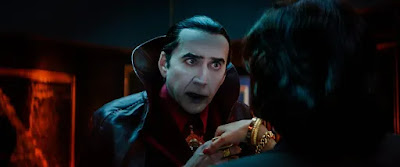
Quite fitting that the horror genre is our most proficient at resurrecting dead franchises. Sometimes it’s a lively jolt. Other times, though, are just as gross and unnatural as the metaphor implies. Take Renfield, a noxious reworking of the Dracula mythos. It’s got exactly one good idea: casting Nicolas Cage as the famous vampire. Explicitly nodding toward the original Universal Monster performance by Bela Lugosi, the movie allows Cage to gnash into his lines with a grinning menace and a blasĂ© affectation. You get the sense that Cage and Dracula alike have been involved in outsized phantasmagorias for so long now that they can do it in their sleep. Unfortunately, the movie never matches Cage’s potential, and ends up dulling his ability to go gleefully over-the-top by sticking him on the sidelines of a manic, hollow, formulaic antihero story. His familiar undead assistant Renfield takes center stage. He’s played by Nicholas Hoult in another of his failure-to-launch leading man roles. Renfield is now little more than a meek serial killer serving up victims for his master, until one day, through unconvincing love-at-first-sight with a cop (Awkwafina) and some vague self-help talk, he decides to kill the old vampire instead. There’s also a whole mess of flimsy story about a preposterous New Orleans mob family and their hair-trigger son (Ben Schwartz) mucking around town that mainly exists to populate the picture with more undifferentiated victims. It’s such a boring slop of a picture, that it can’t even muster the energy to give its setting any real local color among its other unimaginative faults.
The result is waves of gunfire, and goons dismembered in geysers of blood by the lead character as he aw-shucks assures us that he’s doing it for the right reasons. The result is a grindingly predictable movie with smirking attitude toward mayhem and murder that nonetheless asks us to imagine its characters are good and right. Seeing Renfield stand atop a pile of dismembered corpses and claim the moral high ground sure is something. The movie’s incessant jumpiness and inability to take anything seriously runs amok. Its discordant hollowness makes every half-hearted joke clang, every ugly shot composition or smear of muddy color and harsh light harder to watch, and ever self-satisfied cynicism wrapped in sentiment grosser by the second. To see a villain kicked so hard in the stomach that the contents blast out above and below simultaneously is an accurate reflection of all this movie has to offer. A moment like that makes me wonder what the intended reaction is. A laugh? A retch? An admiration that it’s willing to be so sophomorically scatological? In practice it’s a nonstarter, so over-the-top in a deadening film that’s never not at that fevered lack of imagination nothing lands with any impact. What a waste.
Better is Evil Dead Rise, which revivifies the eponymous cult classic series in a new setting. Instead of the cabin in the woods, we get a condemned high-rise apartment on its last few weeks before the remaining few residents have to move out. It’s a dank, creaky place full of ghost stories and dodgy electric work. And that’s before the demons swoop in from the other side. Their victims are even more sympathetic than the youths up for the slaughter in the previous outings. Here it’s a single mom with her teenaged older kids and one sweet moppet, and a pregnant aunt, too. If you think that’ll save them all from possession, zombification, and gruesome deaths, you’d be right for only two of them. Director Lee Cronin does his best to swoosh the camera around and linger on gnarly injuries here and there. A key recurring image is a glowering, brow-forward look that the mutilated corpses get when staring down their prey. It stretches tension as the baddies salivate with the promise of viscera exploding every which way. They’re eager to get to the gore, and Cronin knows how to hold back the pace and keep his few splashy effects to their most effective uses for maximum surprise.
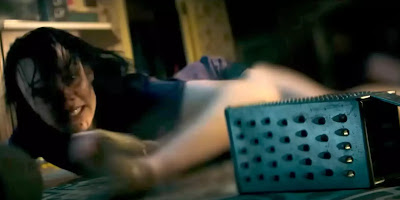
It doesn’t have the hysterical gonzo goofball gore of Raimi’s original trilogy or the squirmingly sustained excessive bodily specificity of Fede Alvarez’s remake. It also doesn’t push as hard, settling into long stretches of suspense and fleeting splatters and queasy insert shots. But it chooses its moments wisely, and shares with its predecessors a giddy fatalism, cut loose from the expected safety. Its respect for human life comes from its willingness to see the desperation on its characters’ faces as the curse comes crashing down with bloody inevitability. Then the fun is, once more, squirming with them. When Cronin swings with a wild idea—a boy choking to death on an eyeball—it lands with the shock and awe that’s the franchise’s calling card. But truly only in an Evil Dead movie can it be a little disappointing when a whirring tattoo gun misses its sensitive mark. (At least the cheese grater hits its mark—ouch.) Still, if the least one of this series is reasonably compelling, slightly underwhelming tension and bloody release, that’s not so bad.
The result is waves of gunfire, and goons dismembered in geysers of blood by the lead character as he aw-shucks assures us that he’s doing it for the right reasons. The result is a grindingly predictable movie with smirking attitude toward mayhem and murder that nonetheless asks us to imagine its characters are good and right. Seeing Renfield stand atop a pile of dismembered corpses and claim the moral high ground sure is something. The movie’s incessant jumpiness and inability to take anything seriously runs amok. Its discordant hollowness makes every half-hearted joke clang, every ugly shot composition or smear of muddy color and harsh light harder to watch, and ever self-satisfied cynicism wrapped in sentiment grosser by the second. To see a villain kicked so hard in the stomach that the contents blast out above and below simultaneously is an accurate reflection of all this movie has to offer. A moment like that makes me wonder what the intended reaction is. A laugh? A retch? An admiration that it’s willing to be so sophomorically scatological? In practice it’s a nonstarter, so over-the-top in a deadening film that’s never not at that fevered lack of imagination nothing lands with any impact. What a waste.
Better is Evil Dead Rise, which revivifies the eponymous cult classic series in a new setting. Instead of the cabin in the woods, we get a condemned high-rise apartment on its last few weeks before the remaining few residents have to move out. It’s a dank, creaky place full of ghost stories and dodgy electric work. And that’s before the demons swoop in from the other side. Their victims are even more sympathetic than the youths up for the slaughter in the previous outings. Here it’s a single mom with her teenaged older kids and one sweet moppet, and a pregnant aunt, too. If you think that’ll save them all from possession, zombification, and gruesome deaths, you’d be right for only two of them. Director Lee Cronin does his best to swoosh the camera around and linger on gnarly injuries here and there. A key recurring image is a glowering, brow-forward look that the mutilated corpses get when staring down their prey. It stretches tension as the baddies salivate with the promise of viscera exploding every which way. They’re eager to get to the gore, and Cronin knows how to hold back the pace and keep his few splashy effects to their most effective uses for maximum surprise.
It doesn’t have the hysterical gonzo goofball gore of Raimi’s original trilogy or the squirmingly sustained excessive bodily specificity of Fede Alvarez’s remake. It also doesn’t push as hard, settling into long stretches of suspense and fleeting splatters and queasy insert shots. But it chooses its moments wisely, and shares with its predecessors a giddy fatalism, cut loose from the expected safety. Its respect for human life comes from its willingness to see the desperation on its characters’ faces as the curse comes crashing down with bloody inevitability. Then the fun is, once more, squirming with them. When Cronin swings with a wild idea—a boy choking to death on an eyeball—it lands with the shock and awe that’s the franchise’s calling card. But truly only in an Evil Dead movie can it be a little disappointing when a whirring tattoo gun misses its sensitive mark. (At least the cheese grater hits its mark—ouch.) Still, if the least one of this series is reasonably compelling, slightly underwhelming tension and bloody release, that’s not so bad.
Labels:
Awkwafina,
Nicholas Hoult,
Nicolas Cage
No comments:
Tuesday, May 3, 2022
Stargazing: THE LOST CITY
and THE UNBEARABLE WEIGHT OF MASSIVE TALENT
Hey, it’s another sign of life for an endangered genre at the multiplex: an original romantic comedy. It’s an old-fashioned treasure hunt adventure, too. Three in one! The Lost City is a rare breed indeed, an original—in that it rips off its inspirations instead of remaking or rebooting or existing in the same cinematic universe as them—star-driven picture that coasts entirely on the charm of its leads. It stars Sandra Bullock, a beloved actress who made it big with romantic comedies returning to the genre after more than a decade away, as a beloved author who made it big with romance novels returning to publish after many years away. Neat trick, that. Unfortunately the comparison isn’t mined for much, as the movie’s instead interested in tromping through some familiar motions. The author’s popular series is best known for a cover model (Channing Tatum). When their joint book tour is quickly interrupted by a villainous billionaire (Daniel Radcliffe) kidnapping her thinking she can help him find buried treasure on a remote tropical island, the handsome lunk hopes to rescue her and prove he’s more than a pretty face.
Thus, we get Bullock and Tatum—also a welcome sight, having just returned to our screens with Dog a few weeks ago—traipsing through the jungle together. It’s Romancing the Stone with a blander coat of paint. The writer thinks highly of her cleverness, and the model is always a step behind but trying so admirably to think things through. He’s just slow on the uptake, and she’s slow to realize she’s falling for him. That old thing. Though the stars shine brightly, proving all over again why they were so appealing in the first place, the project’s way too blandly directed and formulaically scripted to ever really get off the ground. Car chases and shootouts hit their marks, and the banter is slathered on with a first-draft brush—then augmented with tons of off-screen ADR, the last refuge of filmmakers who’ve discovered far too late their scenes need more lines that almost sound like jokes. That’s all pretty pro-forma stuff, but the pretty island scenery and predictable melting of affections through a scampering adventure really do work at some basic level, if only for the charming Movie Stars enjoying the chance to do that increasingly rare thing.
A potentially far richer Movie Star text of a high-concept comedy is The Unbearable Weight of Massive Talent. Too bad it stays shallow. It stars Nicolas Cage as Nicolas Cage. He plays an actor who once won an Academy Award and starred in action blockbusters, but now a couple decades later fears he’s making nothing much of note. Does the actual Cage think that of his lesser direct-to-video efforts of late? (He still gets the occasional wild pitch lead in a hallucinogenic horror movie like Mandy or a taciturn indie drama like Pig.) The film makes some effort to be about the idea of Cage more than the true man himself. His wife (Sharon Horgan) and daughter (Lily Sheen) in the picture are nothing like his real-life family. And his professional frustrations seem to be responding more to a tabloid image than anything real. (He’s fittingly haunted by a waxy de-aged ghost of his younger self.) But of course, if any actor would play a loose self-portrait balancing image maintenance with gentle self-critique it would be Cage. After all, he’s the one who describes his own process leading to wild and unpredictable performances in everything from Moonstruck to Face/Off as “experimenting with what I would like to call Western Kabuki or more Baroque or operatic style of film performance. Break free from the naturalism…” As for if he goes over the top, he once said: “You tell me where the top is and I’ll tell you whether or not I’m over it.”
The movie has a fun hook anyway, even if it eventually loses the fun. Cage is hired to attend the birthday party of a Spanish oligarch (Pedro Pascal). Once there he discovers he’s fast friends with the guy. Too bad, then, that the CIA recruits the actor to spy on his host. The movie’s then bifurcated between pleasant and appealing buddy comedy—Cage humbly cedes most of the charm to Pascal’s giddy enthusiasms, while he provides the thawing reaction shots and sweet-natured stumbling—and a painfully generic action picture. The bad guys are stock types, the chases and explosions are flat, and the mystery is a stop-and-start nothing. Whole subplots are dropped or elided at times, too, with some comic relief suddenly turning up dead and others disappearing for large swaths of run time. This is almost certainly a movie hacked apart at some point in its development. It leans way too hard on its meta winks without going all the way into speculative loop-de-loops a la Being John Malkovich’s head-spinning. Why quote the great Con Air theme song in the opening scene if not bringing it back in a rousing encore by the end? And why make a movie in love with Cage movies without engaging in what makes them great? Or what makes any movie great, for that matter? Early on it has a character disparage being “forced” to watch silent classic Cabinet of Dr. Caligari as it gave them “anxiety” to dislike it, and it’s later a sign of character growth when another learns to love Paddington 2 without much reasoning. This results in an oddly small movie, so in love with its star’s willingness to play himself that it forgets to do anything with that willingness. It needed someone behind the camera who’d be as willing to go hurtling over the top with him.
Thus, we get Bullock and Tatum—also a welcome sight, having just returned to our screens with Dog a few weeks ago—traipsing through the jungle together. It’s Romancing the Stone with a blander coat of paint. The writer thinks highly of her cleverness, and the model is always a step behind but trying so admirably to think things through. He’s just slow on the uptake, and she’s slow to realize she’s falling for him. That old thing. Though the stars shine brightly, proving all over again why they were so appealing in the first place, the project’s way too blandly directed and formulaically scripted to ever really get off the ground. Car chases and shootouts hit their marks, and the banter is slathered on with a first-draft brush—then augmented with tons of off-screen ADR, the last refuge of filmmakers who’ve discovered far too late their scenes need more lines that almost sound like jokes. That’s all pretty pro-forma stuff, but the pretty island scenery and predictable melting of affections through a scampering adventure really do work at some basic level, if only for the charming Movie Stars enjoying the chance to do that increasingly rare thing.
A potentially far richer Movie Star text of a high-concept comedy is The Unbearable Weight of Massive Talent. Too bad it stays shallow. It stars Nicolas Cage as Nicolas Cage. He plays an actor who once won an Academy Award and starred in action blockbusters, but now a couple decades later fears he’s making nothing much of note. Does the actual Cage think that of his lesser direct-to-video efforts of late? (He still gets the occasional wild pitch lead in a hallucinogenic horror movie like Mandy or a taciturn indie drama like Pig.) The film makes some effort to be about the idea of Cage more than the true man himself. His wife (Sharon Horgan) and daughter (Lily Sheen) in the picture are nothing like his real-life family. And his professional frustrations seem to be responding more to a tabloid image than anything real. (He’s fittingly haunted by a waxy de-aged ghost of his younger self.) But of course, if any actor would play a loose self-portrait balancing image maintenance with gentle self-critique it would be Cage. After all, he’s the one who describes his own process leading to wild and unpredictable performances in everything from Moonstruck to Face/Off as “experimenting with what I would like to call Western Kabuki or more Baroque or operatic style of film performance. Break free from the naturalism…” As for if he goes over the top, he once said: “You tell me where the top is and I’ll tell you whether or not I’m over it.”
The movie has a fun hook anyway, even if it eventually loses the fun. Cage is hired to attend the birthday party of a Spanish oligarch (Pedro Pascal). Once there he discovers he’s fast friends with the guy. Too bad, then, that the CIA recruits the actor to spy on his host. The movie’s then bifurcated between pleasant and appealing buddy comedy—Cage humbly cedes most of the charm to Pascal’s giddy enthusiasms, while he provides the thawing reaction shots and sweet-natured stumbling—and a painfully generic action picture. The bad guys are stock types, the chases and explosions are flat, and the mystery is a stop-and-start nothing. Whole subplots are dropped or elided at times, too, with some comic relief suddenly turning up dead and others disappearing for large swaths of run time. This is almost certainly a movie hacked apart at some point in its development. It leans way too hard on its meta winks without going all the way into speculative loop-de-loops a la Being John Malkovich’s head-spinning. Why quote the great Con Air theme song in the opening scene if not bringing it back in a rousing encore by the end? And why make a movie in love with Cage movies without engaging in what makes them great? Or what makes any movie great, for that matter? Early on it has a character disparage being “forced” to watch silent classic Cabinet of Dr. Caligari as it gave them “anxiety” to dislike it, and it’s later a sign of character growth when another learns to love Paddington 2 without much reasoning. This results in an oddly small movie, so in love with its star’s willingness to play himself that it forgets to do anything with that willingness. It needed someone behind the camera who’d be as willing to go hurtling over the top with him.
Tuesday, January 23, 2018
Parents Just Don't Understand: MOM AND DAD
It doesn’t come together with the sick jangled joy of
writer-director Brian Taylor’s best films (grubby, manically entertaining action
efforts Crank and Gamer, which he made as half of
Neveldine/Taylor), but his first solo effort, sloppy, nervy horror film Mom and Dad, packs a perverse punch. It’s a novel take on the zombie subgenre,
exploding suburbia not with a metaphor for materialism or racism, but a gross
inversion of the helicopter parent. Now the folks aren’t invested all-consumingly
in their children’s every move, but are activated through mysterious signals in
snowy TV channels to want to kill them. This leads to several bracing, darkly
comic set-pieces, starting with a twisted pick-up at the local high school, middle-aged
suburbanites rioting at the bus line to attack their kids. They climb fences,
and chase the fleeing teens across the football field, bewildered police launching
tear gas to no effect as backpacks are flung and apple-cheeked youngsters are tackled
by suddenly-malevolent paternal bulk. Worst (but also best, in its way) is a
sequence set in a maternity ward. The screaming, crying, gasping,
blood-curdling, darkly funny stretch, shot in quick cuts of queasy shaking shots and scored to Roxette’s “It Must Have Been Love,” is the only horror movie scene in
ages to have me looking away from the screen, wiggling my knees, and whispering
“no, no, no” under my breath for the duration.
Rather than indulge in the concept’s epic potential, Taylor keeps
the focus narrow on one particular family. A teen bad girl (Anne Winters) and
her innocent younger brother (Zackary Arthur) find their usual days of ducking
their parents’ mid-life crises upended by the sudden murderous intent. Granted,
Dad (Nicolas Cage) had already sledgehammered a pool table while singing “The Hokey
Poky” three weeks prior, so they weren’t exactly a picture of normalcy to begin
with. (An early scene of Cage playfully tickling his kid is shot with wiggly intensity
despite the benign intent.) Still, when Mom (Selma Blair) joins in on the
homicidal gleefulness, it’s hard not to feel the kids’ panic while they’re
huddling together, at a loss for what to do in the face of this insanity. The
performances are all perfectly committed, but none more so than Cage and Blair
who sink in with convincingly unhinged violent persistence. Taylor’s manic pace
and uneven whirlwind tone never quite hooks into the dread of the concept – outside
the hospital scenes – and ramps up the intensity so quickly that it’s not until
the climax kicks the whole thing into a next-level dark comic scramble that it
really becomes something extra special. At 83 minutes, it somehow still feels
too long. Perhaps a film tighter and more clever could’ve done more, but what’s
here is cheap, grimy, bloody, occasionally funny, often upsetting, and always
wonderfully demented. It’s just the right amount of interestingly bad and almost good to make a fine minor
cult classic someday.
Friday, September 16, 2016
Secrets and Lies: SNOWDEN
Edward Snowden makes perfect sense as an Oliver Stone
protagonist. Like JFK’s dogged
district attorney Jim Garrison or Born on
the Fourth of July’s veteran turned war protestor Ron Kovic, Snowden is a
man whose pursuit of what he sees as unambiguous and truthful duty to country
causes him to endure outer skepticism and scorn, and inner destabilizing life
changes. Like Savages, The Doors, Platoon, and two Wall Streets, it’s about a young person drawn into a career with exciting
upsides, but with downsides readily apparent as well. Like Nixon and W. and World Trade Center and Alexander it’s about a man driven by and
ultimately fated to be crushed under the weight of history and expectation. But
unlike those previous movies, Snowden finds
Stone at his most restrained. He views the proceedings from a remove, not
digging into the psychology as deeply, or using filmmaking flash as
ostentatiously. It’s a movie that sees the spreading web of surveillance with a
mournful paranoia. Look at what our government can do and has done, it says,
lauding its hero while wondering if what he did will actually matter in the
long run.
To best make the case for their protagonist as a
misunderstood hero, Stone and co-writer Kieran Fitzgerald (The Homesman) begin by showing us Snowden (Joseph Gordon-Levitt) at
the point of his earliest civic duty. In 2004 he’s discharged from boot camp
after a painful leg injury, after which his drive to serve his country leads
him to transfer to the C.I.A. He’s a smart, unassumingly confident computer
nerd who defends George W. Bush, gently teases his liberal girlfriend (Shailene
Woodley) about her beliefs, and admits to a fondness for Ayn Rand. (It’s not
hard to read this material as Stone inviting conservatives into the story with
a “See? He’s one of you?”) The movie then follows Snowden’s gradual
disillusionment with the intelligence community as he moves from one contract
job to the next, finding increasingly shadier tactics used in gathering and
deploying data scooped up from a global dragnet. Each new revelation gives him
waves of anxiety that seem to pass, but slowly and steadily accrues in the back
of his mind until he has to act.
The movie becomes a portrait of a man whose work anxiety
grows so potent his only recourse is to exorcise it by releasing it into the
world. There’s something of the terror I remember feeling then to this telling
now. (If his revelations about the wide-ranging surveillance tactics at the
fingertips of our country (and others) didn’t have you slap a piece of tape
over your webcam, I don’t know what would.) Because we know what Snowden did –
and what we don’t know remains Top Secret and therefore a ripe target for
Stone’s mythologizing speculation – there’s little surprise to the film. It’s
even structured as flashbacks around scenes of documentarian Laura Poitras
(Melissa Leo) filming Snowden’s secret whistleblower interview with The Guardian’s Glenn Greenwald (Zachary
Quinto) and Ewen MacAskill (Tom Wilkinson), footage which would become the
Academy Award-winning film Citizenfour.
This creates a strangely sedate sense of dutiful reenactment, making the
characters mere pawns in historical inevitability. Gone is the volatile
conspiratorial frenzy of Stone’s heated political films or the schlocky gusto
of his genre fare. Here there’s an almost serene sense of data flowing, history
written in bits and clicks, coded to produce this outcome.
This calm befits what is Stone’s fastest turnaround for
contemplation on a flashpoint in modern American history, beating WTC (another of his eerie calm films) by
two years. Anthony Dod Mantle (frequent Danny Boyle collaborator) makes images
of clean simplicity, cut with occasional smeary doubling or reflections through
layers of screens and glass. Snowden is trapped in a digital world made
tangible, with information glowing and streaming, collected and collated. His
personal dramas – simple fights with his girlfriend, a late-breaking health
issue – are halfhearted, well-acted but beside the point. The most vivid crisis
points are when his work life intrudes with unwelcome force on his home life.
He can’t take his medication to prevent seizures because it slows his response
time. A woozy snap zoom interrupts a heated love scene as he catches the
unblinking cam eye of an open laptop, the extreme close up of the tiny black
circle showing their nakedness reflected in it. There are standard thriller
elements of people avoiding surveillance, befitting a news story that’s already
informed dozens of action movies from Jason
Bourne to Captain America 2 and Furious 7. Its tension remains at a
constant low-boil, mystery dulled by unavoidable outcomes.
It all adds up to a movie that’s vital and turgid, obvious
but with flickers of surprise and life. The known facts of the story are bulked
up with lesser-known or fictionalized incidents, inconvenient truths and
convenient fictions pumped through with enjoyable personalities. Around even
corner is a likable recognizable face bringing fine energy opposite their scene
partners. Part of the fun is wondering who’ll show up next: Rhys Ifans, Nicolas
Cage, Timothy Olyphant, Scott Eastwood, Keith Stanfield, Logan Marshall-Green,
Ben Schnetzer. Each is used by Stone to keep interest and curiosity flowing,
never quite sure whether each new co-worker is a sympathetic ear or a reason to
raise Snowden’s disillusionment. They create a pattern to the movie’s pulsing compelling/dull,
scary/stale info-dumps (the best of which is an abstract swirling animation of
social media chatter and secret metadata flowing into a black hole that slowly
forms an eye, the sort of image so hypnotizing it doesn’t matter how blatant
the symbolism), playing key roles in the process and personifications of
various view points.
In the end it’s another Stone movie of weary patriotism. It’s
about the burden of being a good American, about loving the country so much it’s
worth wishing it were better. Clinging stubbornly to ideals is difficult,
especially when calling into question the ratio of security to liberty from
within the government can make you a target for, at best, criticism and stress,
and at worst jail or exile. Stone makes Snowden a figure unambiguously good, leaking information as a last-ditch
effort to improve what he sees as a slippery slope to tyranny. After the deed
is done he literally has Snowden walk out of the dark data center into gleaming
white sunlight. And yet the unsettled aftermath – stuck in Russia,
communicating in warnings from a robotic screen – creates uncertainty, ending
on a slightly more ambiguous note. He receives applause and attention, yes, but
isolation and confusion, too. He thought it was important we hear what was
happening. Now we know. Now what?
Friday, August 16, 2013
Kick Back: KICK-ASS 2
I get – or is that hope? –Kick-Ass 2, the thematically ugly follow-up to a film that was
none-too-pretty to start with, is intended to skewer power-trip fantasies of
the superhero kind. An oft-repeated bit of phrasing in the narration and
dialogue wonders what would happen if a person in the real world decided to
suit up and dish out vigilante justice. Almost as often, a character will
growl, “this isn’t a comic book!” But this cornerstone of the premise was
thrown out well before the first film ended with Kick-Ass, a dweeby high school
student, riding a jet-pack to fire rounds from a bazooka into a penthouse
apartment where a mobster was beating up Hit Girl, a little girl trained by her
ex-cop father to take the law into her own hands. So, you see, Kick-Ass, for all its professed interest
in more grounded superheroics finds itself squarely in shoot-‘em-up,
blow-‘em-up territory with outlandish characters with wild backstories doing
exaggerated battle with each other. Its one bit of (almost) novelty is the nonstop
vulgar language and copious gory effects of combat. But, even more so the
second time around, that has the effect of making the whole thing revel in the
very implications it ostensibly brings up in order to critique the very genre
of which it’s ultimately a total embrace. It’s purposelessly toxic.
This movie finds Kick-Ass (Aaron Taylor-Johnson) and Hit
Girl (Chloe Grace Moretz) students by day and superheroes by night. It makes a
certain amount of sense that the aftermath of the first film finds the
mobster’s son (Christopher Mintz-Plasse) looking to avenge his father’s death
by cooking up a new persona as a self-declared “world’s first supervillain.” It
makes less sense that the events of the first film have inspired a bunch of
copycat heroes who roam the streets looking to do good. They end up forming a
team with Kick-Ass and call themselves “Justice Forever.” I like the detail
that one of their outings as do-gooders is volunteering at a soup kitchen. The
group is lead by an ex-mob enforcer turned born-again Christian (Jim Carrey) and
includes a motley collection of teenagers (Clark Duke, Robert Emms), young professionals (Donald Faison, Lindy Booth), and a
middle-aged couple (Steven Mackintosh and Monica Dolan). Eventually, the supervillain gathers up an army of his own
and the whole thing starts to look suspiciously like ugly gang warfare in silly
costumes.
But it’s been ugly well before then. What’s worse? That the
film is offensive or that it feels like it has to try so hard to get there? This
is a film that’s mean-spirited and tonally off, expecting us to laugh and
cringe and cry at violence presented at more or less the same speed and style
all the way through. It’s full of quick and dirty stereotypes and unfeeling exaggeration
of conventional superhero tropes. The filmmakers seem to have missed the point
that’s not only implicit in their material, but is actually swirling around
unformed on screen as well. (To their credit, the source comic book by Mark
Millar missed the point, too.) Real life superheroes are just vigilantes in
costumes. Just because they think they’re the good guys, doesn’t make their
actions any less scary as individuals and destabilizing as a group. When
Justice Forever breaks up a poker game below what we’re told is a brothel of
captive illegal immigrants and cuts through a bunch of people, we’re only told
they are “bad.” It’s presented in the film as a lark, but isn’t it terrifying?
Wouldn’t an anonymous tip to the police be better for everyone involved?
Matthew Vaughn’s Kick-Ass was far
from flawless, but at least it seemed aware of the scary and dangerous edge to
the premise.
Violence and vigilantism are not the only ugly aspects of Kick-Ass 2. That it has characters
explicitly call out racism and homophobia doesn’t make the film any less so for
such attitudes running rampant throughout. Especially distasteful is the
villain’s gang filled exclusively with lazy racial stereotypes. Twice he’s told
he’s being racist and he waves off criticism. But then the movie goes ahead and
has, say, a tough Russian henchwoman dressed up like Ivan Drago, as if the
villain’s racist hiring practices would be embraced by his hires. Besides,
every other “bad” person besides Christopher Mintz-Plasse is a broad stereotype,
from the Asians in the aforementioned brothel poker game to the Latino thugs
Kick-Ass fights near the beginning of the film to the black MMA fighter that
jumps at the chance to work for the bad guy. Maybe one or two of these would be
fine, but collectively it paints a picture of “non-white” or “foreign” equaling
“bad.” Those few self-conscious lines do nothing but point out that someone
involved thought the movie should say something to cushion the blow.
Misogyny doesn’t even get called out in this way. The movie
is too busy doing a good job hating every non-Hit Girl woman on screen young
and old alike. If they’re not actively hateful, they’re mocked and dismissed or
turned into an objectified pawn in the plot. Even Hit Girl’s tragic backstory
is plowed under for cheap thrills and lazy motivation. Instead of thinking
through the aftermath a childhood like hers would lead to, she’s dumped into a Mean Girls scenario between martial arts
battles. I felt disappointed for Lyndsy Fonseca, who, after playing a central
role the first time around, here is written off in a jealous overreacting
misunderstanding never to be seen again. But I felt only pity for young Claudia
Lee in her first film role. She plays a vicious queen bee of a high school
girl. Aside from her one-note slimy sniping and insinuating bullying of Hit
Girl, she’s dressed in ultra-tight clothing, gives a risquĂ© dance at
cheerleader tryouts, then plays a scene in which she’s embarrassed in the
cafeteria when she projectile vomits and has explosive diarrhea at the same
time. We’re supposed to be happy watching this comeuppance, but I just felt sad
for everyone involved.
The actors aren’t to blame for any of this. They do their
best with bad writing. A waste of a good character can’t stop Moretz from
seeming like the star on the rise that she is. She’s a captivating screen
presence and sells some risible moments I wouldn’t have thought sellable. She’d
be more than capable of selling a female superhero movie, a sadly nonexistent
variant of the genre as far as Hollywood is concerned. Carrey’s fiercely
entertaining, but in an awfully small role. Mintz-Plasse goes for it, as
misguided as his character is. Taylor-Johnson plays the hero well; maybe we
could get him in a better franchise, stat. The supporting cast is filled with
fine work in roles either underwritten or set dressing, and certainly nothing
as unexpected and weirdly weighty as Nicolas Cage in the first movie. Technically,
he does appear here in a photograph on a wall, proving that he may be the only
actor who can get a big laugh out of me in a film he didn’t act in. (I was the
only one in the theater to laugh, though, so take it with a grain of salt. It
was a reversal of the crowd’s reactions the rest of the film.)
The ultimate failing of Kick-Ass
2 is the complete fumbling of tone that comes with writer-director Jeff
Wadlow’s approach, especially when it comes to violence. The first film had
Matthew Vaughn, who, though far from perfect on this matter, seemed to understand
how to shape it for the screen in ways that sometimes seemed aware of impact
and timing. Wadlow simply splatters the screen, fundamentally misunderstanding
the power of the images he plays with, unable to make violence matter or jokes
land. He underestimates how uncomfortable the film as a whole begins to feel.
It’s a film that’s callous and for all its talk of justice and surface-level
grappling with talk of responsibility and questioning the net societal gain of superheroes,
jocularly fascist and carelessly corrosive.
The movie is punishing and upsetting, all the more so for
treating its content so lightly. When one “bad” character kills a string of
policemen in creatively gory ways while two side characters crack jokes about
her killing prowess, that’s not entertaining. It’s deeply uncomfortable. When a
threat of rape is used as a tool of intimidation, even in a scene that tries to
make the villain the butt of the joke, that’s not simply an illustration of
evil; it’s awful and tonally mismanaged. No amount of straining for cheaply
offensive surface detail, juvenile jokes and cussing can paper over the movie’s
wholly bankrupt thematic and moral center.
Tuesday, March 26, 2013
Modern Stone Age Family: THE CROODS
The Croods is a
basic plot told with zip, color, generous slapstick, and absolutely dazzling
visuals that represent the height of modern 3D CG cartooning. Following an
isolated family of cavepeople, the movie finds as its center, as so many family
films do, a character who yearns for more than the simple existence she knows.
In this case, the family’s father (Nicolas Cage) preaches fear, keeping the
group huddled in a cave when they aren’t on a mad dash hunting and gathering
for the day. The daughter (Emma Stone) is the one who wants more while her
mother (Catherine Keener), brother (Clark Duke), baby sister (Randy Thom), and
grandmother (Cloris Leachman) are comfortable in their routine. One night, the
daughter sneaks out to go exploring. She meets a young man (Ryan Reynolds) who
has strange new talents – like making fire – and appears way more homo sapien
than the latter day Neanderthals she’s stuck with. He’s running one step ahead
of the collapsing landscape caused by the shifting tectonic plates, but the dad
refuses to listen to the interloper. Soon enough, though, the cave collapses
and they need to find a new home, too.
The exceedingly simple plot finds the family (plus the new
guy) walking through lush digital jungles, vast detailed plains, and swooping
vistas, trying to get to a safe new place to call home to the tune of a suitably
larger-than-life Alan Silvestri score. Their world is populated by creatures
that have more in common with the animals of James Cameron’s Pandora than our
own prehistory, but that only enhances the pleasures of the design. These
aren’t modern-day behaviors placed upon a cavepeople template a la The Flinstones. Nor are they entirely
without cartoonish charms. This is a nicely imagined fantasy prehistoric
landscape of wild sights and goofy critters and the people we follow are likably
designed as well, unconventionally shaped, squat and scrunched, perched halfway
between the photorealism of wax tableaus you’d see in a natural history museum
and the rounded cartoonish flesh-colored globs of the designs more typical of a
Dreamworks Animation picture. They interact with their environment in
fast-paced setpieces of danger and comedy, usually both at once. They tumble
over waterfalls, gasp through deserts, traverse grand canyons, and make wild
leaps across chasms. Along the way, they encounter ravenous piranha-birds,
tenacious, stalkerish giant saber-toothed cats, goofy little crocodile dogs,
packs of punching monkeys, and at least one clingy primate they call “Belt.”
It’s all so colorful and appealing, with the characters featuring
fine voice acting (Cage and Stone are particularly good, able to modulate their
distinctive voices in actorly ways) and appealingly broad characteristics. It’s
nothing out of the ordinary – the grandma’s crotchety and snappy, the brother’s
a rounded goofball – but the family has a fine dynamic that feels genuinely
loving and antagonistic only in the stuck-on-a-road-trip way that develops in
even the best of families during cross-country travel. That there will be
valuable lessons learned about being yourself, trusting others and trying new
things is, of course, inevitable. But, as written and directed by Kirk De Micco
and Chris Sanders, it features some of the same warmth and charm in an earnest
family-centered narrative that Sanders used in his great films Lilo & Stitch and How to Train Your Dragon. He’s one of
the great unsung animation directors working these days and, though The Croods can’t quite match those
earlier efforts in overall quality, he puts in a respectable effort in making
this an enjoyable entertainment. The key is the speed, humor and beauty of it
all. It may be thin and expected in many ways, but it’s gorgeous to behold –
visual consultant Roger Deakins surely had something to do with the tactile
sense of light playing across the vivid designs – sprinkled with good-natured
laughs, and never lets up on the narrative gas pedal.
Friday, February 17, 2012
Flame Out: GHOST RIDER: SPIRIT OF VENGEANCE
I have to hand it to Ghost
Rider: Spirit of Vengeance. It’s bad in an often nutso way that’s a
frantic, scrambled, mush instead of the steady mediocrity that was the original
2007 adaptation of this Marvel comic book character. But just because it feels
uncompromised and sometimes defiantly uncommercial doesn’t, in the long run,
make the film any less bad. Maybe we should just call it quits on this whole
turning Ghost Rider into a movie thing. It’s clearly not working out for
anyone.
Nicolas Cage returns as Johnny Blaze, the stunt motorcycle driver
who made a deal with the Devil and is now forever cursed to roam the world
occasionally turning into a burning skeleton and sucking up evil souls. This
time around he’s joined by Idris Elba, who pops up now and then to speak in a
French accent and pretend he’s in a movie that’s actually making him look cool.
He puts the plot in motion by telling Blaze to go rescue a boy (Fergus Riordan)
and his mother (Violante Placido) from the Devil’s Earthbound proxy (CiarĂĄn
Hinds) and his minion (Johnny Whitworth).
The Devil’s been making lots of deals, I guess, since the
poor woman made some kind of arrangement with him hoping he’d never come to
collect. Apparently his evilness causes his mortal form to wear out and he’s
hoping to use the boy as a fresh incarnation for his Earthly evil. So that’s
what Ghost Rider is up against and it all should be rather straightforward.
What could be more exciting – or exploitative – than saving a child from the
clutches of demonic possession? Instead, the whole thing feels half-hearted.
Where’s the sense of urgency? It’s a movie that invokes good versus evil, God
versus Devil, end-of-the-world stakes and then is content to putter around
Eastern Europe staging some small-scale moments of dubious effects work.
The story by David S. Goyer has been cobbled together into a
screenplay with Scott M. Gimple and Seth Hoffman. It’s a thin, shaky, thing,
but at least it was a good choice to hand it over to directors Mark Neveldine
and Brian Taylor. They’ve gained something of a cult following by making
energetic trash that makes action cinema into the avant garde. Their films like
Crank and Gamer push up against the boundaries of conventional style, shaking
and careening along action sequences filmed with a great deal of grit and mess
and edited into spastic, borderline-nonsensical inventiveness. There’s an
improvisatorial madness to their method that leads them to push up against the
boundaries of good taste as well. (That’s the main reason why their Crank 2 often rubs me the wrong way).
But you’d think Ghost
Rider is a would-be franchise that could benefit from a little extra
madness, especially with Cage in the lead role. He’s an actor who has been
making lots of bad choices of roles for a least a decade now. You can say what
you want about his acting, but there’s no denying that he’s a man who commits to his performances. As Johnny
Blaze he exudes a struggle against his literal inner demon that writes a
smoldering pain across the features of his face. But when he turns into a
flaming skeleton everything that makes Cage so erratically appealing, his
warped wit and unconventional line readings that put Jeff Goldblum to shame,
disappear, only to be replaced by a stiff CGI void.
Neveldine and Taylor don’t bring enough craziness with which
to surround Cage. They do some of their unpredictable stylistic thing but their
fractured, high-speed, frenzy wreaks havoc with their 3D compositions. Some of
it is quite striking. They bring one or two nice visual ideas to the
proceedings. One scene uses a split-screen that gains eye-scrambling effect
with the added third dimension. An early shot of Elba shooting a gun while
falling off the side of a cliff is some kind of slo-mo action poetry. But the
bulk of the picture is a hazy, shaky, cheap-looking nightmare of a visual
scheme. It’s monotonously dark and muddied; together with the movie’s
surprisingly violent content, that makes this one of the grimmest, hardest
PG-13s I’ve ever seen. Maybe it skated past the ratings board because it all
seems too inconsequential and incomprehensible.
It should just be a simple chase picture. It is a simple chase picture. But
characters never seem to put much effort into actually chasing each other. Good
guys, bad guys, and all guys in between know just where to show up and let
special effects happen all around them. There’s no momentum here. Characters
pause to explain backstory that was apparently too expensive to film so instead
it’s filled in with drawings that augment the exposition. These characters
explain complicated rules about powers and set up ticking clocks of plot
mechanics, but there’s no real sense of how the powers actually work or when
these ticking clocks are actually going to hit some kind of deadline. All
that’s left is a dull movie. I kept waiting for it to spark to life, but from
start to finish it can’t catch fire like it should.
Thursday, November 3, 2011
Lights On, Nobody Home: TRESPASS
Trespass is what
is known as a bad movie, plain and simple. It’s phony to its core. The movie
comes from director Joel Schumacher who has made some good movies and some bad
ones over the course of his career. This is definitely a bad one. It’s a home
invasion thriller that’s only the slightest mood shift away from being a
flat-out comedy. It’s a film of stupid criminals and lousy hostages that keeps
inventing new reasons to keep the characters in the same place well past any
kind of logic, internal or otherwise.
The movie starts when the rich man (Nicolas Cage) comes home
to his wife (Nicole Kidman) and daughter (Liana Liberato). We know he’s rich
because we hear the sound of Cage rapidly negotiating the price of a diamond
accompanying the opening aerial shot that tracks his convertible down a long
winding road leading to their beachfront steel-and-glass mansion that’s tucked
away in the forest. Once there, he continues to negotiate while he tries to
help his wife make sure their willful teenage daughter doesn’t get to the local
bad girl’s house for a party.
The girl huffs upstairs and the husband and wife prepare for
their evening, which is soon interrupted by a home invasion. A group of thieves
barges in and waves around their guns while barking for security codes. It
turns out they know about the diamonds and would really like them. There’s the
conflict. It’s a good thing that the daughter snuck out of the house and sped
away in a friends car just a scene or two earlier.
What follows is filled with yelling, whining, cajoling,
pleading, and frustrated barking from all of the characters all of the time.
It’s monotonous. As the head of the gang, Ben Mendelsohn stalks about while his
gang members wander around looking mean, constantly waving around guns that
make clickety-clack noises at the slightest touch. These crooks are so obvious
that you can size them up in a second, like the henchman played by Cam Gigandet
who will pretty clearly end up being the criminal with second thoughts since he
gets so shifty eyed in his every reaction shot. Collectively the gang seems to
be pretty dumb. They keep changing their demands and producing different
threatening objects. It’s like they want
to hang around this house for some time.
Have they even thought this plan through? Sure, they have
electrical tape around their fingertips, but their masks are so porous I was
identifying the actors underneath them almost immediately. And all Cage has to
do is start poking holes in their scheme and the characters get to sit around
and threaten each other all night. At one point the daughter sneaks back into
the house and walks straight into the danger. Why? If she were smart enough to
call for help the movie would be over.
Karl Gajdusek’s script does everything it can to keep the
movie rolling forward beyond all plausibility. The homeowners are able to take
their captors off task with such skill that I found myself hoping for some
ultimate ludicrous twist that never materializes despite the ever-growing pile
of ludicrous twists and diversions. This is the kind of movie in which the
intelligence of any given character at any given time is dependent solely on
what the plot requires at that point. These aren’t characters. These are barely
caricatures. It’s all one big phony construct. This is barely a film. It’s a
feature-length stalling tactic that keeps the characters, and the audience,
locked up in this house well past any reason they should be.
Subscribe to:
Posts (Atom)