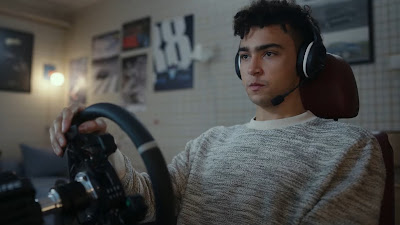
We’re so used to stories of man versus machine that there’s something peculiar about landing in a story that’s man merging with machine. That’s the uncanny element that made Neill Blomkamp’s sci-fi debut District 9 such a sensation, and his followups Elysium and Chappie so divisive and confounding. To see a human swallowed up by something alien or robotic, and to emerge the other side something altogether transformed, treated as ambivalent, and maybe even net positive, is a head-scratcher. Thus I find Blomkamp’s filmmaking alternately compelling and off-putting, especially as he takes such potentially cold ideas—all the more so when they’re juiced with viscera-splattering action sequences—and slathers on sentiment and quasi-pointed uplift within their mechanical hearts. There’s really nothing else quite like it, for better or worse.
Somehow, though, in stepping away from sci-fi, one can find his personality still fits in a based-on-a-true-sports-story like Gran Turismo. Car racing is already a story of man melding with machine to do something greater than either could alone. This one adds the wrinkle of the eponymous video game. The narrative is loosely formed around real events in which the makers of the game convince Nissan and Playstation to bankroll an experiment by which the world’s best Gran Turismo players would get the chance to compete as real race car drivers. The movie casts its lead as a cute fresh-faced gamer and aspiring racer (Archie Madekwe) with a blue-collar dad (Oscar Nominee Djimon Hounsou) and mom (Spice Girl Geri Halliwell) who have their doubts as he leaps at this chance to live his dream. As we follow a pretty standard rise-fall-rise underdog story—would you believe the rich career drivers aren’t keen to share the track with an untested joystick jockey?—the young man is trained by an expert (David Harbour), boosted by a corporate climber (Orlando Bloom), and dogged by self-doubt.
The racing scenes are well-shaped and photographed for quick-paced car stunts. But the real charge in its heart comes from the way it allows the lead’s video game knowledge of tracks and tires to come in handy in real life. That’s the Blomkamp touch, letting the simulated dynamics of the game—down to the digital flourishes that visualize his memory of routes and alerts—turn into a thrill and an asset, as a real winner emerges from a melding with the machines. Even the real doubts, typified by a moving scene in which Hounsou and Halliwell watch a wreck on live TV and register the shock and uncertainty with only their eyes, fade in the midst of the momentum of the formulaically effective plotting. It’s selling a fantasy of man melding with machine that any number of gamers will find flattering, and makes for a sturdy car picture, a la such diverse pictures as Grand Prix and Ford v Ferrari and Talladega Nights, redone in a fresh coat of paint.
Showing posts with label Orlando Bloom. Show all posts
Tuesday, August 29, 2023
Friday, May 26, 2017
Abandon Ship: PIRATES OF THE CARIBBEAN:
DEAD MEN TELL NO TALES
The fifth in a series that once represented welcome
freshness in the blockbuster formula, Pirates
of the Caribbean: Dead Men Tell No Tales is only enjoyable insofar as it
can occasionally remind you of how much more fun you had at the other ones. Gore
Verbinski managed to revitalize the old pirate swashbuckler with 2003’s Curse of the Black Pearl, a perfectly
structured adventure movie let loose with an endlessly charming cast and its
director’s elaborate visual imagination – cursed seafarers turning into
skeletons by moonlight, and funny visual gags involving sinking ships,
subverting expectations, and Buster Keaton-ish choreography. Then there was, of
course, the loopy, unpredictable mannerisms of the ditzy, tipsy, rascally
scoundrel Jack Sparrow, played by Johnny Depp in the most wholly successfully
enjoyable performance of his career, bringing in great eccentric surprise from
the margins of every scene. The rest of the trilogy allowed Verbinski to go
wilder with his terrific eye for spectacle, then a fourth – a coda for which
the director and some of the main cast didn’t return – managed to eke out its
charms by not spoiling the affection built up by its predecessors. This time
around, though, what once felt like a new approach to an old subgenre is now
waterlogged and predictable itself.
Once again, we’re introduced to a band of ghost pirates
intoning about curses and revenge. This time it’s a Spanish crew led by Javier
Bardem (speaking incomprehensibly through a mouthful of black bile) who are
undead, trapped on their zombie ship in a cave. They crave freedom to sail the
seas and slay the pirate who left them for dead. Wouldn’t you know it? That
pirate was Jack Sparrow. Depp slurs in, playing the once-fun character as the
drunkest and loopiest he’s ever been. His timing is off, the mannerisms are
twitchier, and the charm is mostly gone. Now he’s not flirty and sly; he’s
leering and grotesque. Still, there are times when he stirs from his stupor
long enough to pull off a fun bit of action, like a fantastic slice of dark
comedy involving an intricately choreographed guillotine gone wrong. To assist
in filling out an adventure plot around this decaying caricature is a new
fresh-faced hero, a young chap we’re told is the child of the trilogy’s stars,
Will Turner and Elizabeth Swann. (That Brenton Thwaites is a pretty man who
looks like the exact midpoint between Orlando Bloom and Keira Knightley helps
sell the parentage.) There’s also a young lady scientist accused of being a
witch (Kaya Scodelario). They meet crossing paths in pursuit of Poseidon’s
Trident, an ancient device that controls all sea curses or whatever. It’s
always something.
The new filmmakers at the helm are Norwegian directors
Joachim RΓΈnning
and Espen Sandberg, whose Kon Tiki is
just the sort of straight-down-the-middle foreign film that gets you a
Hollywood job. With a blandly competent anonymous style, they steer the
franchise through choppy waters – a screenplay that’s pulling apart at the
seams, old performances rapidly diminishing their appeal, and a tangle of
convoluted new mythos that labors under its nonsensical approach to continuity.
The aesthetics merely recycle what’s worked before – crumbling undead, soggy
ships, sharp period costume – mixing in a few new sights – ghost sharks, a
jewel-encrusted island. The action alternates between big and memorably stupid
(a sort of restaging and one-upping of Fast
Five’s bank vault finale, but on
horseback) and big and boring (gloopy CG waterfalls and incoherent swordplay). As
for navigating the series’ tonal balance or managing tricky performances, that’s
where the movie falls flat the most. It flows out as a procession of incidents
involving vacant figures, played with an exaggerated insistence on forced
frivolity. There’s simply no consistent emotional tug or easily comprehensible
motivation pulling it along when the movie must remind us of the stakes in
increasingly desperate explanations.
It’s bad enough Jeff Nathanson’s screenplay is constantly
repeating itself, introducing every bout of exposition at least three times and
throwing the characters into each scrape – jail cells, double crosses, hidden
islands, and so on – at least twice. But for the new leads to remain only
vaguely attractive blanks filled in with the scantest motivation and the old characters to appear reduced
to barely more than moving Colorforms of their former selves? That’s where the
movie’s total lack of tension, chemistry, and energy really starts to drag. There’s
little about the movie that follows naturally out of what came before it in its
predecessors’ continuity, making this at this point a series dragged out only
for the sake of profit and not for invention of even a meager sort. Even the
nods to old MacGuffins are convoluted and forced. There are fleeting moments of
fun spectacle, that familiar stirring score, and a few choice cameos. But that
it has its passably diverting moments only makes the soggy slog around it more
tediously disappointing.
Friday, December 19, 2014
The End: THE HOBBIT: THE BATTLE OF THE FIVE ARMIES
The Hobbit: The Battle
of the Five Armies is easily the weakest of its trilogy, and by far the
worst of Peter Jackson’s Middle Earth movies. It’s all climax, an endless
battle that does nothing that couldn’t have been accomplished with an extra
fifteen or twenty minutes in the last one. And yet, this is likely the last
time we’ll get to visit Tolkien’s fantasy world through Jackson’s eyes. For
those of us who’ve liked that feeling, it’s bittersweet to see it go. That it’s
not as rousing and wistful as the first finale, eleven years ago with The Lord of the Rings: The Return of the
King, is almost beside the point. It’s one more chance to go there and back
again, to see these landscapes and creatures, marvel at the prodigious
attention to detail, and hear the strains of Howard Shore’s melodies, a feat of
film scoring nearing John Williams’ Star
Wars work for its web of themes. In other words, it’s worth seeing for
those who’ve already made it this far.
So maybe it’s helpful to think of Battle of the Five Armies less as a self-contained movie, more as a
way for Jackson to create this place on the big screen for the last time. It’s
a bestiary: Hobbits, elves, dwarves, orcs, horses, elk, giants, wizards, goblins,
evil spirits, war bats, giant eagles, bears, a dragon, and more. It’s a map: CGI
armies marched around a game board battlefield. It’s an armory: swords,
shields, helmets, hammers, clubs, battering rams, bow and arrow. It’s a drawn
out conclusion from a creator who doesn’t want to let this story go, who wants
to linger in Middle Earth for just five more minutes, then five more, then
more. Good thing, then, that Jackson’s skilled with whipping up blockbuster
spectacle, splashing his vivid visuals across the wide screen in ceaseless
fantastical imagery so big it betrays how small the thinking is of so many of
our tentpole directors. Sure, he’s a filmmaker who errs on the side of too much
of a good thing – endless stalemates, overdone comic relief – but so be it.
This last Hobbit picture
picks up right where the last left off, with the dragon Smaug (Benedict
Cumberbatch) emerging from his mountain lair, flying angrily toward the nearest
village and leaving his vast stockpiles of gold unattended. In the mountain are
the dwarves (led by Richard Armitage), who have a historical claim to the site,
and Bilbo Baggins (Martin Freeman), the Hobbit who helped them get there.
Eventually, the riches are the target of attack by an army of men (led by Luke
Evans) and an army of elves (Lee Pace, Orlando Bloom, and Evangeline Lilly among
them) who want their fair share. The army of orcs right behind them just wants
to kill a bunch of people for some reason. I know that’s only three armies, four
when you count the dwarves reinforcements, but I must confess I’m not exactly
sure how the title’s math works out here.
For the first half of the movie, those computer-animated
armies line up behind character actors as everyone argues about who gets the
gold and how the fighting’s going to start. Then, the fighting starts, and the
armies collide repeatedly in anonymous garbles of digital noise across rocks
and fields, up and down the sides of cliffs, and across an icy lagoon. We dip
into personal conflicts between recognizable orcs and our big heroes, follow
the king of the dwarves and his battle with curse-induced greed, and check in
with Gandalf (Ian McKellen) who has important Lord of the Rings foreshadowing to take care of before joining the
main battle. Some moments of combat are nicely done – the bit with ice is
clever, as is a neat trick involving an elk – but it grows awfully repetitive.
You can almost hear the small material as it’s stretched thin to fill time.
The film loses the emotional thread, and its central
narrative momentum along with it, as it gets tangled up in the clanging swords,
stabbing and bludgeoning. But when the camera comes to rest on Bilbo Baggins, with Freeman's performance as good as always, the film finds its center. He’s taken aback by the developments, is ready to help his
friends even when they disagree with his strategy, and bravely stands in the
thick of it even when danger is great. When it’s all over, he is happy to have
had this experience and even happier to go home. And so Five Armies brings him there, eventually. It wraps up dangling plot
threads, resolves its cliffhangers, and joins up with the beginning of Fellowship of the Ring quite nicely.
Along the way we have to slog through some colossally uninvolving battle
business, but Jackson brings it home, to the Shire and the Hobbits, the coziest
corner of Middle Earth, safe and sound. He asks your indulgence, tries your
patience, but eventually delivers some small rewards.
Friday, December 13, 2013
Into the Fire: THE HOBBIT: THE DESOLATION OF SMAUG
Peter Jackson returns yet again to J.R.R. Tolkien’s
fantastical Middle Earth with The Hobbit:
The Desolation of Smaug, the second of three films devoted to the
comparatively slim novel that precedes The
Lord of the Rings trilogy. Some find that reason enough to dislike the film,
but why get hung up on what it isn’t and miss the chance to luxuriate in what
it is? To dismiss the expansion of Tolkien’s smaller story is to miss the rich
detail Jackson and co-writers Fran Walsh, Philippa Boyens, and Guillermo del
Toro find. This is filmmaking as worldbuilding, a creation of a space that’s
fun to visit with new characters and sights around every corner. When we wander
into the home of a giant man who is also sometimes a bear, there is a sense of
discovery and history. It feels somehow right that such a person would exist in
this world, and as he sadly admits to being the last of his species, there’s a
real sense of loss. We could follow him out into his own film and probably find
something interesting. We won’t, but the sense of a fully realized world is
impressive and goes a long way to selling the movie’s colorful adventure
plotting.
When last we saw our Hobbit friend Bilbo Baggins (Martin
Freeman), he was with the once and future dwarf king Thorin Oakenshield
(Richard Armitage) and his band of dwarves on a journey to enter the Lonely
Mountain and reclaim their home and their gold from Smaug, a powerful dragon. They’re
continuing their quest here, getting into one scrape after another, each only a
danger for as long as the plot requires (and sometimes longer) until the next
danger pops up. Here there be giant spiders, packs of angry orcs, aloof
wood-elves, and, of course, one large fire-breathing dragon. He stretches
across the entire screen that only captures his full wingspan in wide shots. (The
beast is voiced by Benedict Cumberbatch, words rumbling out with booming
augmented bass.) Expert spectacle, the film is filled with elaborate action
sequences overflowing with visual gags. In one early scene, an elf shoots two
orcs with one arrow. Later, a barrel pops up out of roaring rapids and rolls
over baddies on the shore, Rube Goldberg serendipity aiding our heroes.
Also helping (and sometimes threatening) our heroes are two elves
– one, Orlando Bloom, a familiar face from The
Lord of the Rings, the other, Evangeline Lilly, added to give the film a
gentle wispy subplot about a dwarf who has a crush on her and maybe, just
maybe, vice versa. Together they happen to form a reason to have a few more
action sequences. One, a tight, claustrophobic nighttime fight in a tiny house,
is a nice break from the sweeping New Zealand vistas and cavernous caves.
Speaking of subplots, there’s much to do about a dilapidated lake town where
the dwarves find help from a human (Luke Evans) who, it’s quickly apparent, has
made a habit of defying the orders of the town’s grumpy, selfish ruler (Stephen
Fry). Between the elves and the lake town, the quickly sketched politics and history
of this fantasy world is a pleasure. Each new location we step into feels fully
formed before we got there, and has the surety that it will continue long after
we leave.
There’s always something. Compared to The Lord of the Rings end-of-Middle-Earth stakes, this Hobbit, much like the last Hobbit, is lighter fare, bouncier and zippier. But the mythic resonance of
these displaced dwarves and archetypical character types – the strong one, the
silly one, and smitten one, the brave one – give the whole picture a fine kick.
Freeman’s Bilbo is especially sympathetic, in over his head, but trying so very
hard to stay brave and get braver. Our heroes are so very likable, we want to
see them succeed. And the sights Jackson shows us are so wonderful and varied, it’s
clear Middle Earth is a place worth fighting for. At one point Bilbo sits atop
a tree, hundreds of butterflies taking wing around him as he looks across a
sun-dappled skyline, a shimmering lake in the distance and, further on, a misty
mountain. I’d go there and back again any day.
Rarely diverting its attention from the
one-thing-after-another journey of the dwarves, Jackson occasionally drifts
away with the wizard Gandalf (Ian McKellen). I’m not sure what sidetrack he’s
wandering down, but that he at one point appears to be fighting a big black
cloud tells you everything you need to know about just how seriously to take
this. That is to say, enough to feel it, but not so much you can't smile at sillier touches, sometimes both at once. It’s a grand sweeping adventure built out of mythic components, a sense
of its own history, and ripe B-movie fantasy. I had to smile when the king of
the wood elves (Lee Pace) shows up wearing a crown made out of branches. It
just makes sense. Best approached by responding to the surface pulpy fantasy
and letting the big emotion underneath grow and bubble, The Desolation of Smaug is all about creating a world, giving space
to get lost in it, and allowing plenty of time to do so.
This is epic, light-hearted fantasy as bustling adventure. Jackson’s
a sharp enough visual filmmaker to give us movie pleasures of the highest
order. A big highlight is that dragon Scrooge McDuck-ing it up in a pile of
gold, slowly revealed in his enormity through coy editing. But even simple
visual moments, like a shot that finds a worried little girl in the foreground,
unaware of the orcs prowling the rooftops behind her, silhouetted in the
background, is a great punch of imagery, simple and true. This may be a film
that paints in broad strokes, but the surface details are colored in
beautifully. It actually delivers the blockbuster exhilaration, the immense
pleasures of expansive spectacle, so many films promise, but so few deliver.
Jackson, like Steven Spielberg and George Lucas, Guillermo del Toro and James Cameron,
knows how to build gigantic special effects and cohesive
worlds into something that carries real weight and lots of fun.
Tuesday, December 18, 2012
Quick Looks: ARBITRAGE, THE GOOD DOCTOR, and SLEEPWALK WITH ME
In Arbitrage, Richard Gere plays a
hugely wealthy banker in some serious trouble. He’s become embroiled in a
complicated financial deal that’s threatening to sink his company if the funds
don’t get moved around quickly enough to cover his assets. And that’s not even
the worst of it. He sneaks away from his wife (Susan Sarandon) to drive upstate
with his mistress (Laetitia Casta) and ends up flipping the car. When he comes
to, he sees that his mistress is dead in the passenger seat so he flees the
scene of the accident. (The pointed intent couldn’t be clearer: the rich flee
catastrophe on instinct.) So he’s dealing with financial trouble and legal
trouble, skulking around large boardrooms, spacious offices, and fancy
apartments, trying to avoid the consequences of his actions.
Writer-director Nicholas Jarecki has created a phony fantasy
of a character study that feels altogether too calculated a guesstimate of how
the one-percent lives. (Not that I have any experience with that income
bracket, but it can’t be as simple as it’s made to seem here.) To put such
material in a standard thriller (the kind with dramatic turns that make it play
like an episode of Law & Order from
the suspect’s point-of-view) only cheapens what was sparsely drawn to begin
with. It should be juicier and with more of a bite; it’s all strangely
toothless. That said, Gere gives a persuasive performance of a man crumbling
under the burden of keeping up appearances. I also appreciated the work of Nate
Parker, as a working-class man Gere debates scapegoating, and Tim Roth, as the
investigator who is frustrated that the legal system seems rigged in favor the
rich. Would that these performances were in a movie that would be able to
better show them off.
Director Lance Daly’s The
Good Doctor is a squirmy thriller about a lonely young doctor (Orlando
Bloom) who falls in love (no, obsession) with a pretty patient (Riley Keough).
He decides to tweak her medication in order to keep her in the hospital under
his care. The script by John Enborn follows this situation to its predictable
conclusion and the talented supporting cast (including Taraji P. Henson,
Michael PeΓ±a, and J.K. Simmons) fills out the plot convincingly enough. It’s a
shame, then, that the whole experience is just a sad, slow circle down the
drain, completely without tension and devoid of emotional interest. This is a thinly
imagined thriller that manages nothing more than a queasy feeling once or twice.
It’s most unfulfilling in its flat visual style and ploddingly obvious script. As
someone who sort of enjoyed Daly’s similarly slight first feature, the kids-in-puppy-love
romance Kisses, I’m especially
disappointed to see that this is where he’s gone next. He’s a director of potential
and maybe someday he’ll live up to it.
Stand-up comedian Mike Birbiglia has told the same – very
funny – story in several mediums now. If you’re anything like me, you may have
managed to hear several times over (in his stand-up, on This American Life, in his memoir) about his intense sleepwalking
problem that caused him to, say, dream about a jackal intruding in his bedroom,
which would result in him fast asleep shouting at a hamper, fully convinced he
was confronting a wild animal. This is obviously a problem, but his career
seemed to be taking off and his relationship with his girlfriend was growing
complicated and one thing leads to another and he’s in a deep sleep while
jumping out a second-story hotel window.
This story’s latest telling takes movie form in Sleepwalk
with Me and it’s perfectly fine, though I did wonder if it would have
worked better on me if the novelty was still there. Birbiglia, here the writer,
director and star, has a loose, casual style that pumps up dream sequences with
off-hand discombobulation that is undercut with silly shifts to reality. To
fill out the rest of the semi-autobiographical movie, it follows Birbiglia’s
relationship with his girlfriend (played by Lauren Ambrose) as well as his
growing stand-up career that takes him from hotel to hotel, crummy gig to
crummy gig. Altogether it plays like Woody Allen lite, warm and sweetly small. This
is a minor, but often charming movie, mostly because Birbiglia is so likable.
But the thing of it is, you’d have just as good a time listening to the
original monologue, so I have a hard time recommending this movie outright.
Sunday, October 23, 2011
Fun for All or All for Fun? THE THREE MUSKETEERS
Alexandre Dumas’s classic novel The Three Musketeers has been adapted for the movies many times.
After all, the familiar story is a rich source of swordplay and intrigue.
Musketeers Athos, Porthos, and Aramis, with the help of young would-be
musketeer d’Artagnan, try to protect the French monarchy from the dastardly
coup being planned by the evil Cardinal Richelieu. It’s a great story, though
it’s rarely made into good movies. I think it’s safe to say, though, that the
story has never before been told in the way director Paul W.S. Anderson and
screenwriters Alex Litvak and Andrew Davies have in this newest adaptation. They’ve
turned it into a poor-man’s Pirates of
the Caribbean, a swashbuckling 3D superhero movie with a thick layer of steampunk nonsense and genre tomfoolery
ladled on top. (It’s greatest accomplishment is sure to be the exceptionally
confused book reports that kids in the audience may be writing in the future.)
Did I mention I kind of enjoyed it?
This is a film that starts off with a note of such high
ridiculousness that it’s pleasing to find that it never climbs down. It all
starts in Venice, where the Three Musketeers are introduced with splashy
comic-book style freeze frames that spell out their names in thick ink, as if
the screen has briefly turned to parchment. Athos (Matthew Macfadyen) bubbles
up from underwater and attacks some guards with a multi-pronged crossbow. A
cloaked Aramis (Luke Evans) dives off a bridge to smash into a gondola. A
chained Porthos (Ray Stevenson) rips the shackles off the wall and beats back
his captors. Meeting up, it’s clear that they are in the middle of heist. They,
along with the sultry Milady (Milla Jovovich), are stealing secret plans to a
warship hidden deep within Da Vinci’s vault that is accessible through a
retractable staircase, the base of which is covered in Resident Evil by way of Indiana
Jones booby traps. It’s this kind of wild invention and freewheeling genre
stealing that will characterize the movie to come. We haven’t even really
started yet. This is mere prologue.
The heist goes wrong care of an unexpected double cross, so
the Musketeers are wallowing in their less than heroic status, nearly destitute
on the streets of Paris, when sweet-faced, smooth-faced d’Artagnan (nicely earnest Logan
Lerman) rides into town hoping to become a Musketeer like his father once was.
Through some tortured scenes of sometimes-painful dialogue, the three become four
as they begin to realize the extent to which France needs their help. The movie
is top-heavy with thudding scenes of scheming and needling that move the
characters with some degree of narrative bobbling into position for the
forthcoming action sequences. Cardinal Richelieu (Christoph Waltz, always
welcome) and Milady plan to break apart the French monarchy by creating
distrust between the adolescent king (Freddie Fox) and his equally young bride
(Juno Temple). Waltz, looking for all the world like a teacher disappointed in
his students, regards the childish royalty with barely concealed disgust. He’s
not much happier with the British envoy he’s planning to use as an unknowing patsy
for his plan to work. That would be the Duke of Buckingham, played hammily and
wonderfully against type by Orlando Bloom.
So the stage is set for some exciting action, and it arrives
more or less on schedule. Anderson, shooting in 3D, creates some great crazy
visuals that play with depth and space. As the film slips farther and farther
away from Dumas, it arrives at an uneven, but terrific, sense of boyish
adventure with an anything goes genre freedom. A woman in full period costume
rappels down the side of Versailles and then wriggles in slow motion through a
corridor filled with invisible trip-wires. Sailing ships with dirigible-like
enhancements float across the sky. Flamethrowers and rapid-fire cannons shoot
flames and bombs. And still, amidst this pile-up of unexpected imagery that
plays like a head-on collision between Terry Gilliam and Hayao Miyazaki, we get
simple, fun swordplay and gunfire that thrills as well. Like that other
disreputable scholckmeister Michael Bay, 3D has sharpened and clarified Paul
W.S. Anderson’s style. It was hard to glimpse in ridiculously terrible movies like
Mortal Kombat and Alien vs. Predator, but with Three Musketeers there is a likable
self-conscious feeling of playfulness. When Richelieu is confronted with an
accusation, he responds, “Am I supposed to laugh maniacally and divulge my
plans?” When a flying ship comes crashing down onto a steeple, the architectural flourish appears to slice
up out of the screen. Moments like these feel irreverent, gimmicky and
completely natural.
Does the whole movie work on this level? No. So much of the
film is straining to reach a sense of light fun that remains just out of reach.
Dialogue is clunky and strange. Scenes seem to pass with little consequence
before suddenly becoming only stifling importance. By the end, it’s clear that
the plot is burdened by its own possible future. Characters and events are left
dangling just enough for a sequel, which has the unfortunate effect of leaving
all the best villains on the sidelines during the climax, while the heroes do
battle with some lesser evils. And it’s all so very strange, a movie at once
completely derivative and utterly idiosyncratic. It’s both an exasperating and an
enjoyable big budget oddity. It’s a movie that will play best to an open-minded
audience prepared with patience, indulgence, and low expectations.
Subscribe to:
Posts (Atom)